In depth
Prince's Palace of Monaco
A Genoese fortress of 1215 with a palace built over it to hide it — and six hundred square metres of frescoes nobody knew were there until 2015. State Apartments open late March to mid-October; the guard changes at 11:55, free.
Story · Visit · Route · Links
Choose your depth
Essentials or more detail?
See visiting essentials, or read more about the history and places nearby.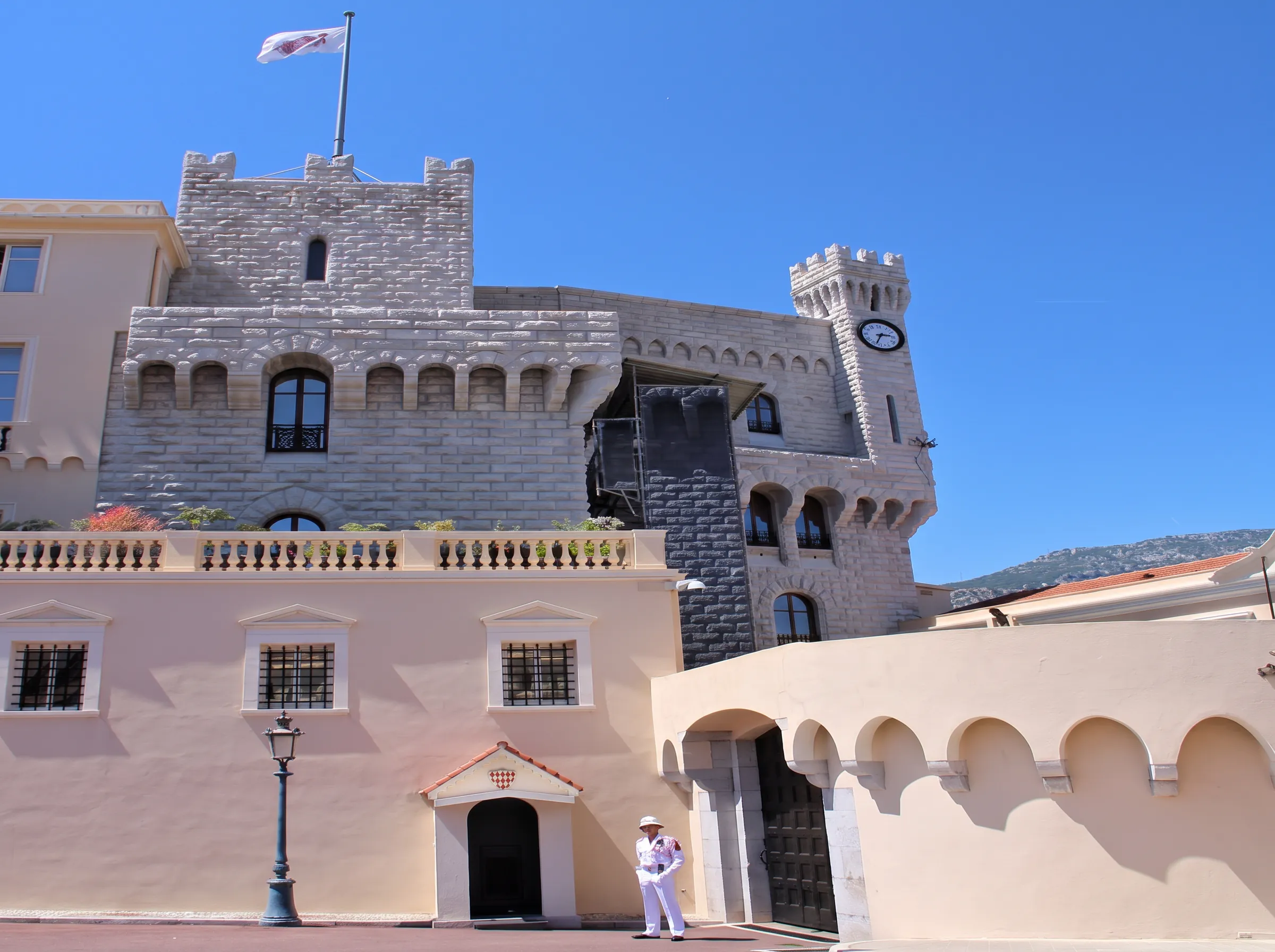
01 The experience
What to expect.
Why it matters
Because the state is still in it. The Palace is not a preserved seat of a vanished dynasty. Prince Albert II lives here, the Carabiniers mount a real guard, and the balcony over the square is where the principality's public moments happen. A visitor is being let into part of a functioning residence for a few hours a day for half the year.
Because the fortress is legible if you know where to look. The site is triangular because a 1215 rampart made it so. The grand entrance faces the square because Honoré II wanted arriving visitors to see a palace. The Serravalle Tower is missing from the skyline because he had it built over.
Because of what the restorers found. Sixteenth-century Genoese fresco cycles are not common, and cycles nobody knew existed until 2015 are rarer still. The Palace has been slowly giving them back for a decade.
What visitors should notice
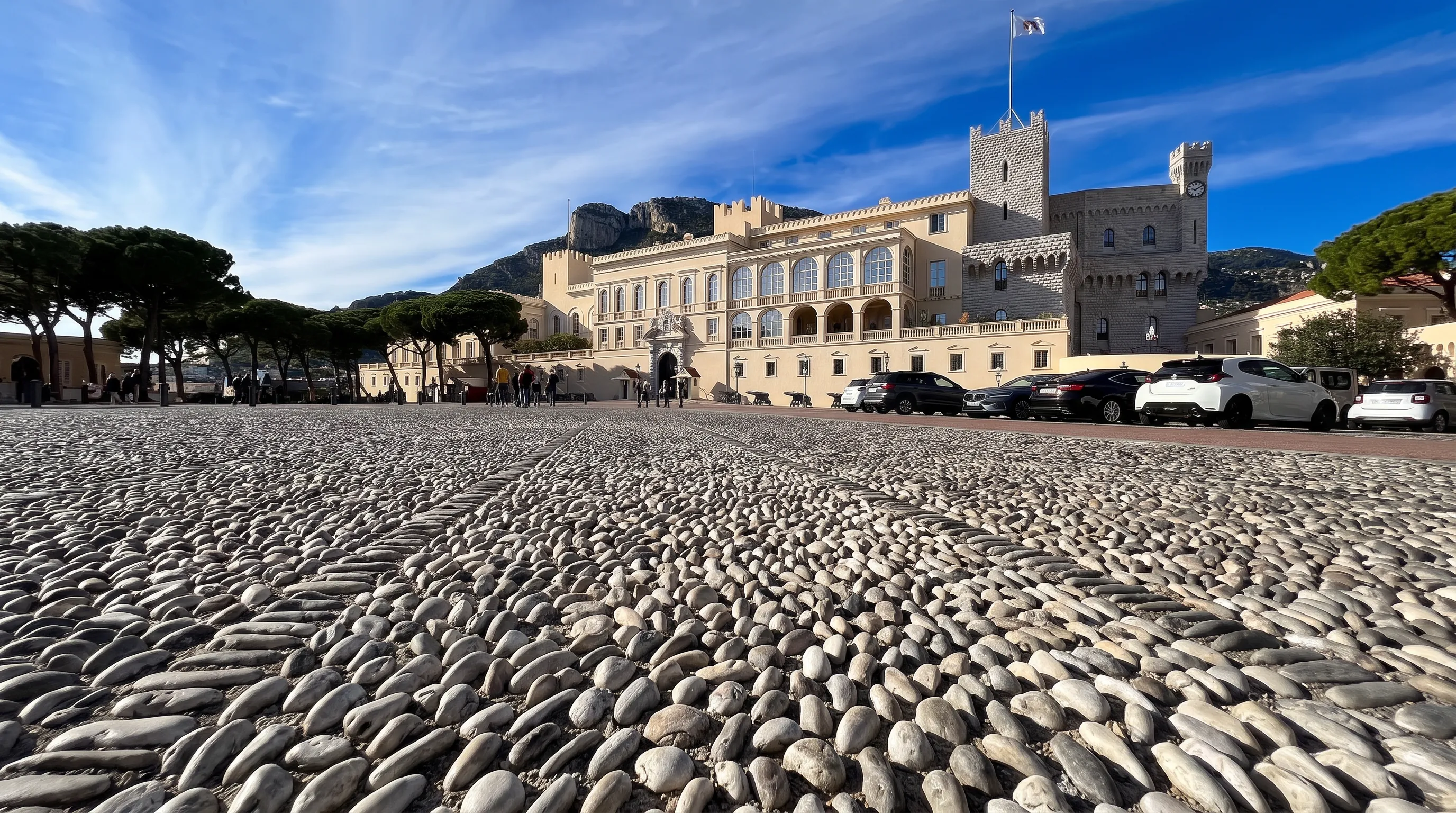
The Cour d'Honneur underfoot — around three million white and coloured pebbles laid in geometric patterns. This is risseu, the Ligurian pebble-mosaic technique, at a scale almost nowhere else attempts.
Then look up at the loggia: two double-decked galleries of twelve arches each, built for Honoré I by Dominique Gallo, with the recovered frescoes overhead.
Then the double-revolution staircase in Carrara marble — two flights curving apart and meeting again — which the Palace says was inspired by a staircase at Fontainebleau.
And carry one fact through the State Apartments: in 1793 this building was looted, renamed Fort d'Hercule, and turned into a military hospital with the throne room used as a kitchen. Almost nothing you see survived that in place.
Who will enjoy it
Anyone interested in how a fortress becomes a residence, which is unusually visible here. Visitors who like Renaissance decorative painting, for the Hercules cycle. People who want the Grimaldi story in the place it happened rather than in a display case. And anyone who finds the idea of a working sovereign residence more interesting than a preserved one.
The free part — the Place du Palais, the cannons, the parapet over the harbour and the 11:55 changing of the guard — suits everyone, costs nothing, and is what most visitors actually come for.
Who may find it difficult
Wheelchair users cannot visit the State Apartments. Stairs only, stated by the Palace. This is a hard stop, not a difficult-but-possible.
Anyone visiting between mid-October and late March will find it shut. Anyone visiting on Grand Prix weekend will find it shut. Anyone visiting on a handful of scattered 2026 dates — 25 September from 15:00, 1–4 October, 7 October — will find it shut.
Visitors expecting a large palace circuit should adjust: this is about an hour, in one wing, with no café, no gardens and no grounds. The Oceanographic Museum four minutes away offers twice the visit for less than twice the price.
And there is no photography guidance published, which for a paid interior visit is an irritating gap — assume restrictions and ask.
Visitor verdict
Worth an hour if the season is open and stairs are not a problem, and the frescoes are the reason. If either condition fails, the square outside is free, the guard change at 11:55 costs nothing, and the cathedral two minutes away holds the Grimaldis who used to live here. Plenty of people have an excellent morning on the Rock without going in.
The story
History & character.
June 1215: a Genoese fortress
The Palace begins as a piece of military engineering. In June 1215 the Genoese consul Fulco de Castello began a fortress on the western apex of the Rock: a rampart of thirty-seven sections and four buttressed towers, enclosing a roughly triangular site. A second fortress was built at the entrance to the port.
Neither survives as such. But the first one still determines the shape of everything here — the Palace occupies a triangle because a thirteenth-century rampart drew one.
8 January 1297: François Grimaldi takes it
On the evening of 8 January 1297, François Grimaldi — Malizia, the Cunning — presented himself at the gate dressed as a monk, killed the guard, and took the fortress for his family. The Grimaldi arms carry two sword-bearing monks as supporters, which is the dynasty's own commemoration of the trick.
What this establishes, and what it does not. The Palace and the Monaco government both give the date and the disguise, and the episode is attested in chronicle rather than in a charter. It is the founding story of the principality.
It is not the beginning of unbroken possession. François held the fortress only a few years before Genoese pressure forced the Grimaldis out, and the family's hold over the following century was intermittent. The dynasty dates itself from 1297 and is entitled to; "held since 1297" describes a lineage rather than a tenancy.
1341–1500s: still a fortress
Charles I, considered the first lord of Monaco, strengthened the fortifications from 1341 — expanding the ramparts and building a breakwater.
Lambert, in the fifteenth century, built further defences around the Rock, installed a garrison of four hundred men, and put up a two-storey building with balcony rooms. That is the first hint of somewhere to live rather than somewhere to hold out.
1522–1581: Honoré I turns it into a palace
Honoré I is where the fortress becomes architecture.
His architect Dominique Gallo built the portico into the courtyard: two double-decked galleries of twelve arches each, with marble balustrades — the Galerie d'Hercule. The Genoese painter Luca Cambiaso worked on the decoration.
Practical works went in alongside the display: a reinforced tower, and a cistern holding fifteen thousand cubic metres of water. A palace on a rock still had to be able to survive a siege.
Honoré II and thirty years of Jacques Catone
Honoré II — recognised as the first Prince of Monaco in 1633 — commissioned the work that produced the building visitors photograph today. His architect Jacques Catone spent thirty years on it.
Catone added the wing facing the square, extended the State Apartments, added the chapel of Saint Jean Baptiste, and created the grand entrance. And he concealed the Serravalle Tower, building the residence over and around the fortress so that what faced the square read as a palace.
That concealment is the single most useful thing to know about the exterior. The fortress is not gone. It is behind the façade.
The Cour d'Honneur was paved with around three million white and coloured pebbles in geometric patterns — risseu, the Ligurian technique — and the double-revolution staircase in Carrara marble was built as the set piece of the arrival: two flights curving apart and rejoining, which the Palace says was inspired by a staircase at Fontainebleau.
1793: Fort d'Hercule
The French Revolution did more damage than any siege.
The Palace was occupied and looted by citizens of Monaco, Roquebrune and Menton. The principality was downgraded to a cantonal seat and the building was renamed Fort d'Hercule. The State Apartments became an Italian military hospital. The throne room was used as a kitchen. The rest became a poorhouse.
Carry that through the visit. The rooms shown today are not a continuously furnished residence; they are a set of spaces emptied inside a single generation and reassembled afterwards.
1814 onwards: recovery and demolition
Monaco returned to the Grimaldis in May 1814, under French protection.
The nineteenth century then removed as much as it restored: the east wing on the Fontvieille side and the Pavillon des Bains were demolished. A later wing on that site housed the Napoleon Museum and the Palace Archives.
Rainier III
Prince Rainier III, who reigned from 1949 to 2005, is credited with restoring the greater part of the Palace to its present condition. He also created the Museum of Napoleonic Souvenirs in the newly built wing, around a collection largely assembled by his predecessor Louis II — including Napoleon's hat worn at Marengo and a fragment of his coronation mantle.
That museum closed in 2014 and its collections were dispersed at auction. It is not part of a visit and has not been for over a decade, though it still appears in a great deal of published material, including on the Palace's own institutional pages.
2013–2015: the frescoes
The most significant recent event here was an accident.
Restorers began routine repair work in 2013. In 2015, examining the lunettes and the vaulted ceiling of a loggia in the courtyard, they found painted decoration beneath later surfaces.
What emerged over the following years was a sixteenth-century cycle of the labours of Hercules, together with his birth and death — around 600 square metres of scenes, allegorical figures and ornament in the Galerie d'Hercule. Attribution rests on style and on the lime-based plaster identified by multispectral analysis, both pointing to Genoese painters of the sixteenth century.
Honoré I also employed the Genoese painter Luca Cambiaso in the courtyard during the same century.
The frescoes are now part of the State Apartments visit and are the strongest reason to buy a ticket.
Look closer
Highlights and hidden details.
The objects, spaces and small observations that turn a visit into a memorable one.1. The Galerie d'Hercule frescoes
The best reason to buy a ticket, and until 2015 nobody knew they existed.
What they are. A sixteenth-century cycle showing the labours of Hercules, together with his birth and death — around 600 square metres of scenes, allegorical figures and ornament across the lunettes and vaulted ceiling of a courtyard loggia.
How they were found. Restorers began routine repair work in 2013. In 2015 they found painted decoration beneath later surfaces. The recovery has been running ever since.
Who painted them. Attribution rests on style and on the lime-based plaster identified by multispectral analysis, both pointing to Genoese painters of the sixteenth century. Honoré I had employed the Genoese painter Luca Cambiaso on this same courtyard in the same century, which sits comfortably with that — though this guide has not found the two connected by a named source and does not assert it.
What to look for. The labours themselves, room by room: the lion, the hydra, the bull. The paint is genuinely old — patchy where plaster has gone, uneven where recent conservation has cleaned some panels brighter than their neighbours.
Time required. Twenty minutes, and it is the part of the visit worth slowing for.
2. The Cour d'Honneur
What it is. The courtyard you enter through, paved with around three million white and coloured pebbles laid in geometric patterns.
Why it matters. This is risseu, the Ligurian pebble-mosaic technique, executed at a scale rare anywhere. It is also the thing almost every visitor walks straight across while looking up at the staircase.
How to see it. Look down first, deliberately, before you look at anything else — the geometry only reads when you stop moving. Then look up: the frescoes are directly above you.
Time required. Five minutes, and it costs you nothing but attention.
3. The double-revolution staircase
What it is. A staircase of Carrara marble in two flights that curve away from each other and meet again at the top. The Palace states it was inspired by a staircase at Fontainebleau.
Why it is here. It is the set piece of the arrival sequence Honoré II's architect Jacques Catone built: through the grand entrance, into the courtyard, and up. Everything about the approach was designed to be walked in that order, and you still walk it in that order.
Time required. Five minutes.
4. The State Apartments
What they are. The rooms the Palace shows: among them the Throne Room, the Blue Room, the Mazarin Room and the Louis XIII bedroom, on an audio-guided route in eleven languages.
The fact to carry through them. In 1793 this building was looted, renamed Fort d'Hercule, and turned into a military hospital — the throne room used as a kitchen, the rest as a poorhouse. Almost nothing here survived that in place. What you are looking at is a reassembly, largely credited to Rainier III.
A caution. Rooms can be withdrawn from the circuit at short notice. This is a working residence and the Palace guarantees no fixed route.
Time required. Thirty minutes.
5. The changing of the guard — free, outside
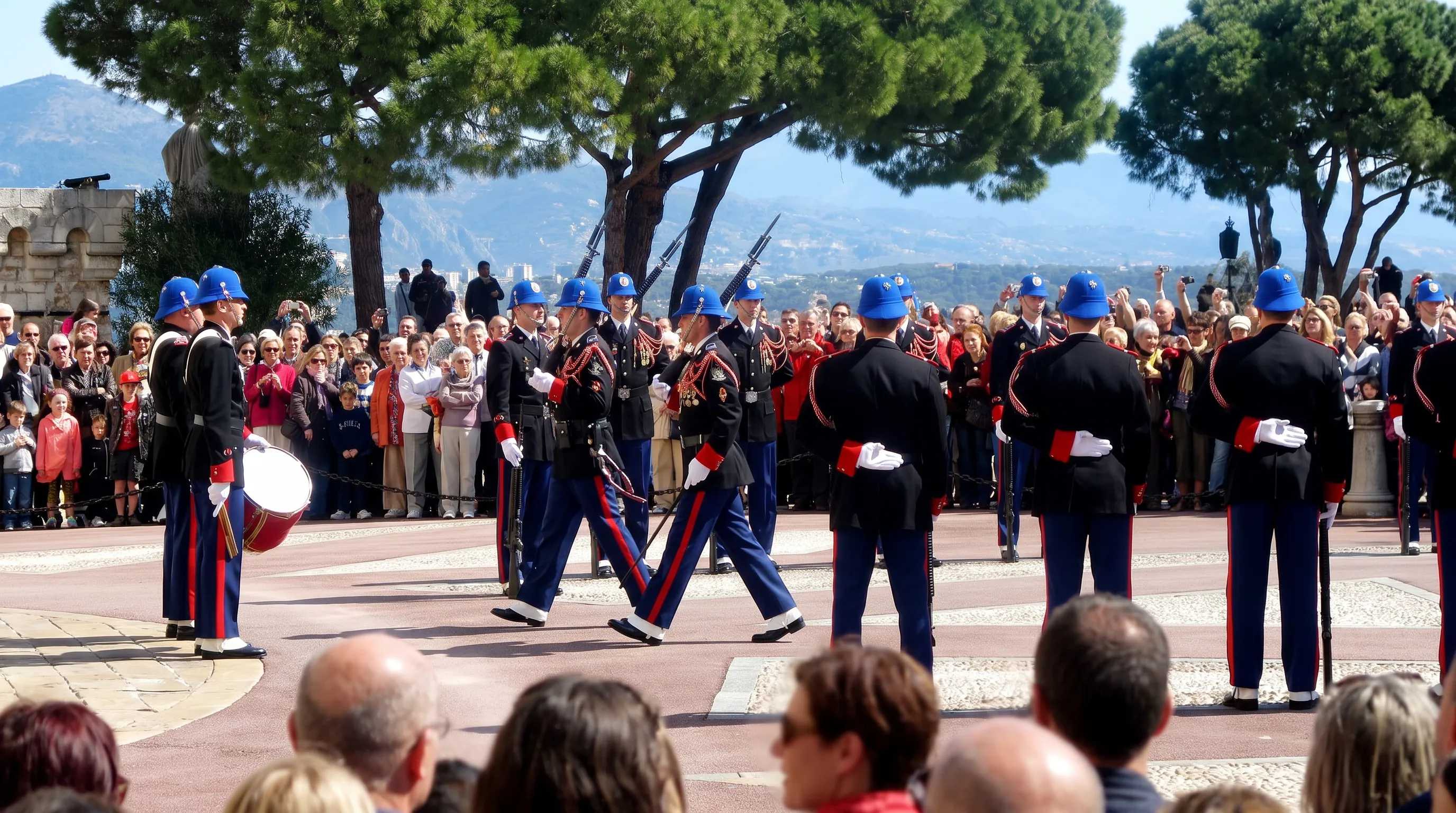
What it is. At 11:55 daily, the Compagnie des Carabiniers du Prince changes the guard in front of the palace entrance. The company was created on 8 December 1817 and each watch runs twenty-four hours.
Why it belongs in the highlights. It is the only daily state ceremony in Monaco, it costs nothing, and a large proportion of visitors to the Rock come for this and nothing else. If the season is closed or the stairs rule out the interior, this is still available.
How to see it. Be in the square by 11:40 and take a position at the railings on the palace side. It is short. Stay outside the marked areas — this is an armed guard on a working residence, not a costumed display.
Time required. Twenty minutes including waiting.
6. The façade, and what it is hiding
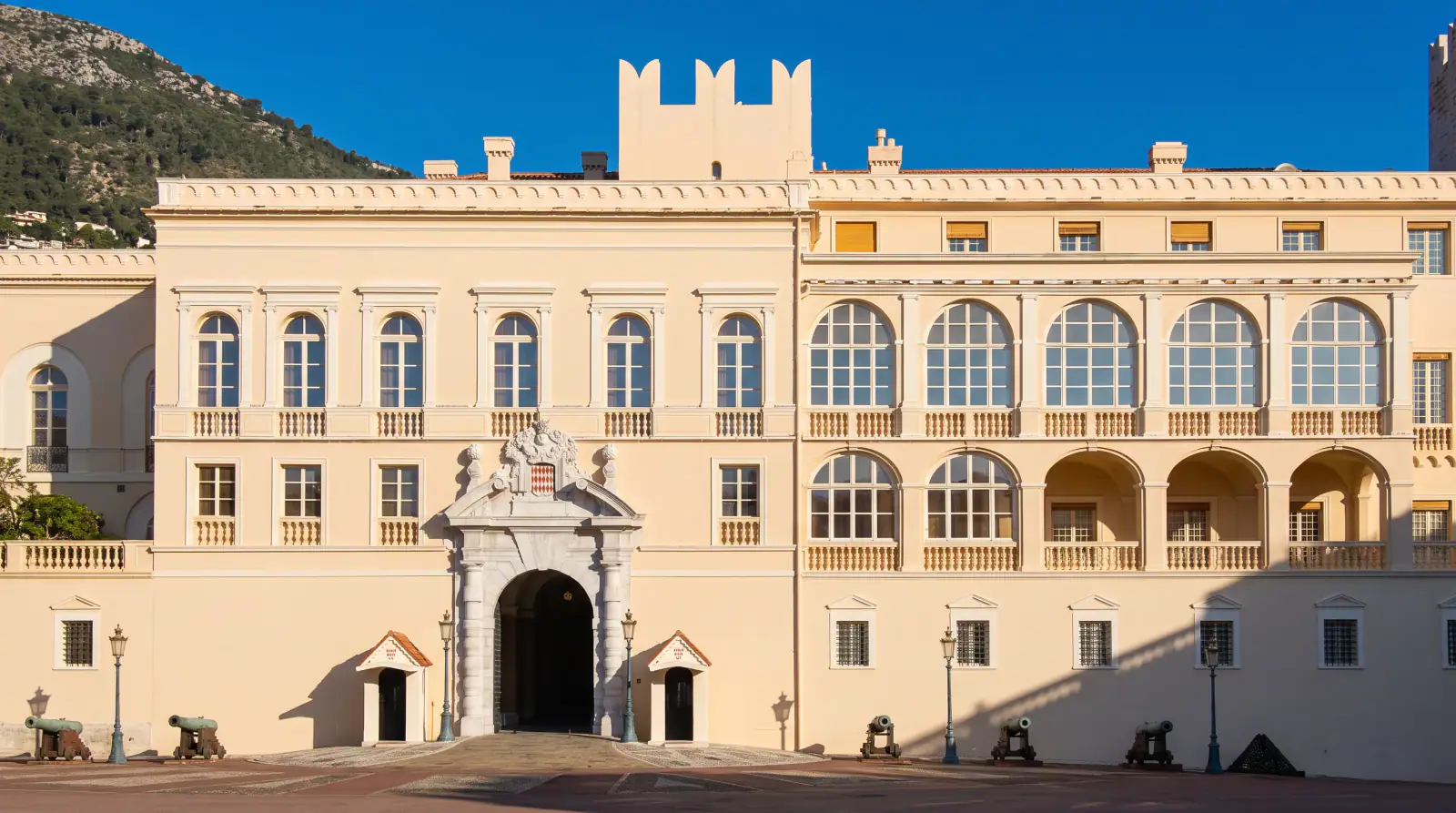
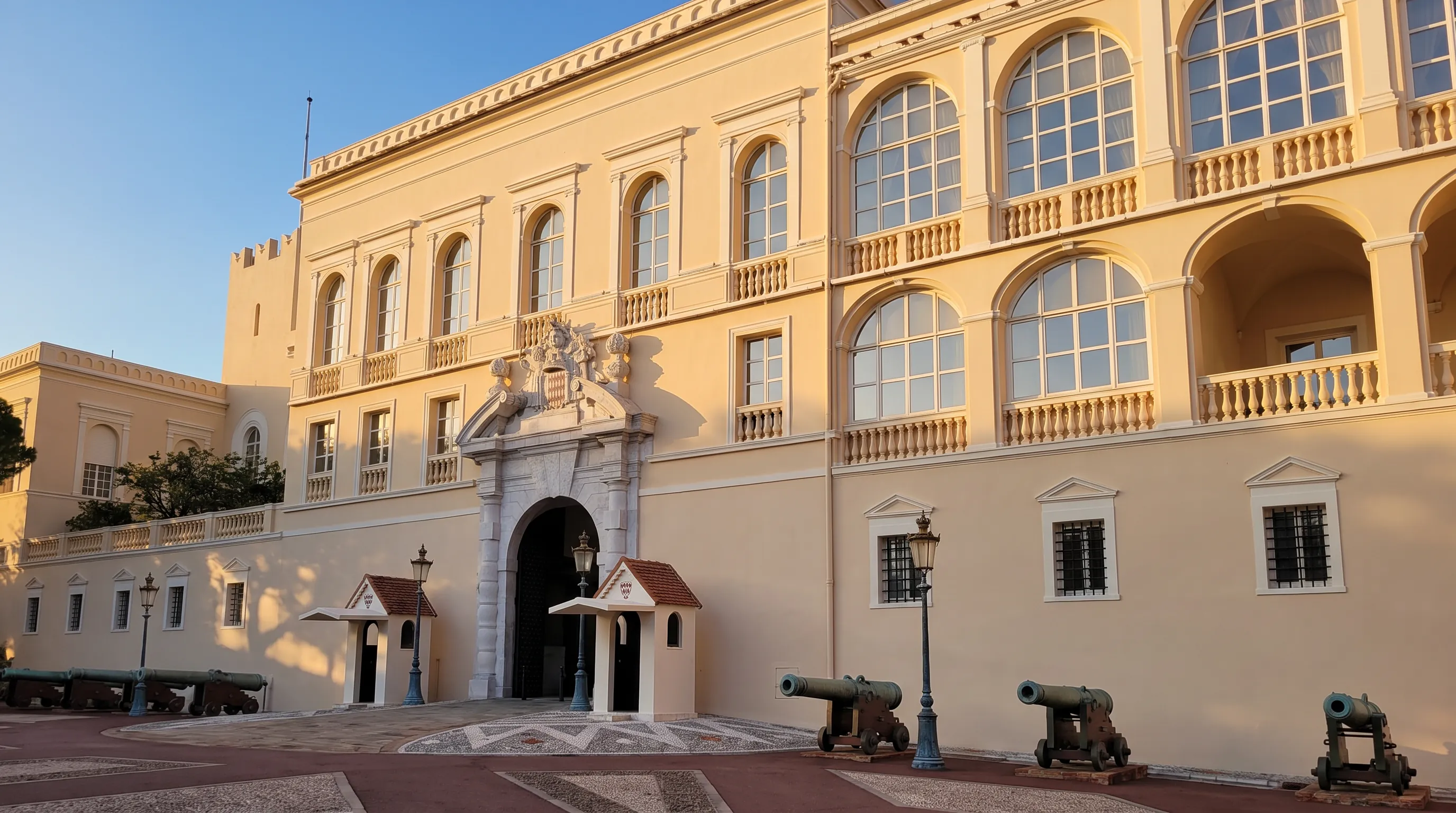
What you see. Pale ochre and cream walls, a long arcaded loggia of round arches on the upper floor, crenellated parapets, and the ornate main entrance at the centre.
What it is hiding. A fortress. Fulco de Castello began a rampart of thirty-seven sections and four buttressed towers here in June 1215, and Honoré II's architect spent thirty years building a residence over it — including concealing the Serravalle Tower entirely.
So the elevation is a deliberate act of disguise, and knowing that changes how it looks. The crenellations are decorative; the real defences are behind them.
Time required. Ten minutes, free, from the square.
7. The cannons and the square
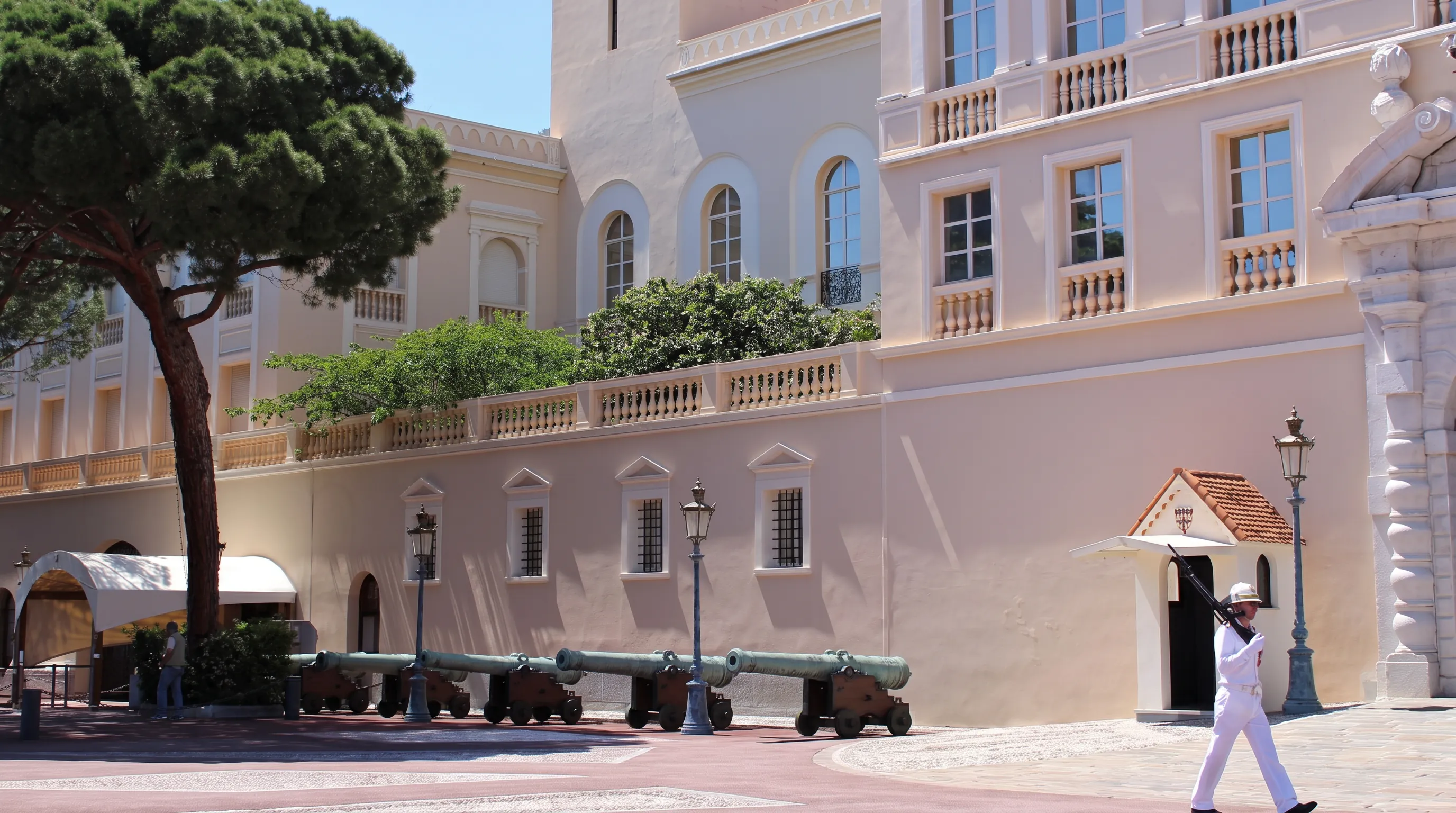
What it is. The Place du Palais: a great open forecourt with the palace on one side and a parapet over Port Hercule on the other, with rows of historic bronze cannons and pyramids of cannonballs standing on the open ground.
Why it matters. It is the ceremonial front door of a country, and it is entirely free. The parapet gives the classic view over the harbour — best before about 10:30, when the sun is behind you.
Time required. Fifteen minutes.
8. The Grimaldi arms — two monks with swords
What it is. The coat of arms, supported by two monks carrying swords, which you will see over doorways, on uniforms and on manhole covers all over the Rock.
Why it matters here. They commemorate 8 January 1297, when François Grimaldi entered this fortress dressed as a Franciscan, killed the guard and took it.
A dynasty that has held its position for seven centuries chose, as its permanent heraldic statement, a picture of the trick that started it. You are standing where it happened.
Time required. A moment, once you know to look.
Details worth slowing down for.
There is a tower missing from the skyline
Honoré II's architect Jacques Catone spent thirty years turning the fortress into a palace, and one of the things he did was conceal the Serravalle Tower — building the residence over and around it so that the elevation facing the square read as a home rather than a stronghold.
It is still in there. The façade you photograph is a deliberate act of disguise, and the crenellations along the top of it are decoration on a building whose real defences are behind them.
The site is triangular because a rampart made it so
Fulco de Castello's fortress of June 1215 was a rampart of thirty-seven sections and four buttressed towers enclosing a roughly triangular area on the apex of the Rock.
Eight centuries and several architects later, the Palace still occupies that triangle. The reason the courtyard is the shape it is, is a decision taken by a Genoese consul before anyone in the Grimaldi family had seen the place.
Three million pebbles, and everyone looks up
The Cour d'Honneur is paved with around three million white and coloured pebbles in geometric patterns — risseu, the Ligurian pebble-mosaic technique, at a scale rarely attempted.
Watch what happens when a group enters. Every single person looks up at the staircase and the loggia, and every single person walks across the floor without seeing it.
The staircase is a quotation
The double-revolution staircase in Carrara marble — two flights curving apart and rejoining — was, the Palace says, inspired by a staircase at Fontainebleau.
A seventeenth-century prince of a very small state built a French royal gesture into the middle of a Genoese fortress. The whole arrival sequence is an argument about status, made in stone.
The frescoes were an accident
Restorers began routine repairs in 2013. In 2015, working on the lunettes and the vault of a courtyard loggia, they found painting under later surfaces.
Around 600 square metres of the labours of Hercules — plus his birth and death — had been sitting above a courtyard that thousands of people crossed every week, and nobody knew.
Look for the unevenness when you are up there. Some panels are cleaned bright, some are still dim, and there are areas where the plaster has simply gone. It is a recovery in progress, not a finished restoration.
The building was once called Fort d'Hercule
In 1793 the Palace was occupied and looted by citizens of Monaco, Roquebrune and Menton. The principality was downgraded to a cantonal seat and the building was renamed Fort d'Hercule.
The State Apartments became an Italian military hospital. The throne room was used as a kitchen. The rest was a poorhouse.
Carry that through the visit: these rooms were stripped inside a single generation and put back together afterwards. What you are being shown is a reassembly.
The cistern held fifteen thousand cubic metres
Honoré I, the prince who turned the fortress into a palace between 1522 and 1581, also enlarged the cistern to hold fifteen thousand cubic metres of water.
A palace on a rock with no fresh water still had to be able to survive a siege. The Renaissance courtyard and the siege tank were the same building programme.
Lambert's garrison was four hundred men
In the fifteenth century Lambert built defences around the Rock and installed a garrison of four hundred.
Set that against today: the ward of Monaco-Ville has about 975 residents. At its most militarised, a substantial fraction of everyone on this headland was there to hold it.
The museum that isn't there any more
A great deal of published material — including the Palace's own institutional pages — still refers to the Museum of Napoleonic Souvenirs, created by Rainier III in a later wing around a collection largely assembled by Louis II. It held Napoleon's hat worn at Marengo and a fragment of his coronation mantle.
It closed in 2014 and the collections were dispersed at auction.
If you have read that the Palace has a Napoleon museum, you have read something that stopped being true over a decade ago.
The monks on the arms are the trick, commemorated
The Grimaldi coat of arms is supported by two monks carrying swords, and they are not generic ecclesiastical figures. They record 8 January 1297, when François Grimaldi came to this gate dressed as a Franciscan, killed the guard, and took the fortress.
Seven centuries of legitimacy, and the heraldry is a picture of the deception that started it. You will see it on doorways, uniforms and manhole covers all over the Rock — and you are standing at the gate in question.
The square empties in ten minutes
The Place du Palais holds several hundred people at 11:55 for the changing of the guard, and is close to empty by 12:05.
If you want the façade photograph without a crowd, you have two windows: before 10:00, and about ten minutes after the ceremony ends — when almost everybody walks off toward the lanes at once and the square briefly belongs to whoever stayed.
The visit ends where the family lives
The Palace shows its State Apartments and nothing else, for roughly half the year, and states it may close to the public without notice.
That is not a limitation of the tour. It is the point: this is a working residence with a head of state in it, and the door you do not go through is the reason the building still exists as something other than a monument.
04 / Before you go
Plan your visit
Prices & admission
€13 adult, €11 student, €8 child 6–17, free under 6. Two combined tickets exist and they are sold by different institutions: Palace + the Prince's Car Collection at €25 adult (€20 student, €15 child 6–17), from the Palace's own platform; and Oceanographic Museum + Palace at €31 adult (€22 student, €19 child 6–17, €14 child 4–5), sold by the museum. Both require both visits on the same day and run only during the Palace's season, 30 March to 15 October in 2026. There is NO Palace + Jardin Exotique combined ticket, despite the claim being widely repeated — the garden's twin ticket pairs it with the Oceanographic Museum, and the garden was closed from 2020 until March 2026. Note that the Palace's institutional site still lists an older €10/€5 tariff — expect the ticket office to charge the higher figures.
Opening hours
State Apartments only, open 30 March to 15 October 2026. March–June and September–October 10:00–18:00, last admission 17:15; July–August 10:00–19:00, last admission 18:15. The ticket office closes an hour before last admission. Closed for the Formula 1 Grand Prix weekend, and in 2026 also on 25 September from 15:00, 1–4 October and 7 October. As a sovereign residence it may close without notice. The changing of the guard is daily at 11:55 in the square outside, free, all year.
Plan your experience
No booking required. The State Apartments open 30 March to 15 October 2026 only — closed the rest of the year, closed for the Formula 1 Grand Prix weekend, and in 2026 also closed on 25 September from 15:00, 1–4 October and 7 October. As a sovereign residence the Palace states it may close to the public without notice, and rooms can be withdrawn from the circuit at short notice. Check before travelling.
Accessibility
The Palace states that the State Apartments are NOT accessible to wheelchair users and that access is by stairs only. There is no lift and no alternative route. This is a hard stop, and it is the most common wasted journey on the Rock.
Checked on 4 August 2026. This is the most volatile page in the Monaco set: the season is published shortly before it opens, the closure list changes annually, and the Palace states it may close to the public without notice because it is a sovereign residence. Check the day before you go.
Read this first
The State Apartments are not wheelchair accessible. Access is by stairs only. There is no lift and no alternative route. The Palace states this plainly, and it is the single most common wasted journey on the Rock.
Only the State Apartments open. Not the private apartments, not gardens, not grounds. The visit is one wing, about an hour.
Season and hours — 2026
Open 30 March to 15 October 2026. Closed the rest of the year.
| Months | Hours | Last admission |
|---|---|---|
| March–June, September–October | 10:00–18:00 | 17:15 |
| July–August | 10:00–19:00 | 18:15 |
The ticket office closes an hour before last admission.
Additional 2026 closures: 25 September from 15:00; 1–4 October; 7 October. Plus the Formula 1 Grand Prix weekend, when the Oceanographic Museum and the Prince's Car Collection close too.
Admission
| Ticket | Price |
|---|---|
| Adult | €13 |
| Student | €11 |
| Child 6–17 | €8 |
| Child under 6 | Free |
| Groups and agencies | On request |
Combined tickets
Two exist, and they are sold by different institutions — which is why you will not find both in one place.
| Combined ticket | Adult | Student | Child 6–17 | Sold by |
|---|---|---|---|---|
| Palace + Prince's Car Collection | €25 | €20 | €15 | The Palace's own platform |
| Oceanographic Museum + Palace | €31 | €22 | €19 (4–5: €14) | The museum, not the Palace |
Both require the two visits on the same day, and both are limited to the Palace's open season — 30 March to 15 October in 2026. The Palace ticket is non-exchangeable and non-refundable.
Buy from the official platforms only. The Palace states that tickets bought through third-party resellers — it names TripAdvisor, Viator and several others — will not admit you.
There is no Palace + Jardin Exotique combined ticket, despite it being widely repeated. The Jardin Exotique's own tariff order provides a billet couplé with the Oceanographic Museum, not with the Palace, and the Palace's platform does not sell one. The garden was also closed from 2020 until 30 March 2026, so anything describing such a ticket predates its reopening.
Price conflict, recorded. The Palace's institutional site, palais.mc, still publishes €10 adult and €5 child and student. The dedicated visit site, visitepalaisdemonaco.com, publishes the figures above for the 2026 season. This guide uses the visit site because it is the ticketing channel and carries this year's dates and closure list. Expect the ticket office to charge the higher figures; check if it matters.
How long to allow
About an hour for the State Apartments. There is no café, no shop worth planning around, no gardens and no grounds, so an hour is genuinely the whole visit.
Add twenty minutes if you are also there for the guard change.
What you get
An audio-guided route through the State Apartments, in eleven languages, with a downloadable smartphone app as an alternative.
The rooms shown have included the Throne Room, the Blue Room, the Mazarin Room and the Louis XIII bedroom, reached through the Cour d'Honneur and up the double-revolution staircase. Rooms can be withdrawn from the circuit at short notice — this is a residence, and the Palace does not guarantee a fixed route.
The Galerie d'Hercule frescoes, uncovered from 2015, are part of the visit and are the reason to go in.
The changing of the guard — free
Daily at 11:55 in the Place du Palais, in front of the palace entrance. It costs nothing and needs no ticket.
The Compagnie des Carabiniers du Prince, created on 8 December 1817, mounts a twenty-four-hour watch that begins with the ceremony. It is short and precise.
Be in the square by 11:40. From 11:45 you are behind a ring of people. Take a position at the railings on the palace side rather than at the back. The square empties within ten minutes of the end, so if you are visiting the State Apartments too, go in afterwards rather than before.
Best time to visit
Time of day. Early. The square is close to empty before 10:00 and the façade is lit from the front in the morning. The Rock takes coach and cruise groups from mid-morning, and the square peaks at the guard change.
Season. April to June and September are the best combination of open season and manageable heat. July and August bring the longest hours and the largest crowds, and the square is unshaded and hard going at midday.
Mid-October to late March the Palace is shut, which removes it entirely — plan the Rock around the cathedral and the Oceanographic Museum in winter.
Getting there
The Palace is at the western apex of the Rock, on the Place du Palais.
On foot: ten minutes up the Rampe Major from Place d'Armes — the historic approach, a continuous climb with little shade. Or four minutes on the level from the cathedral, five from the Oceanographic Museum.
Step-free onto the Rock: the lift and escalator from the Parking des Pêcheurs. Note that this gets you to the quarter, not into the Palace, which remains stairs-only.
By bus: lines 1 and 2 to Place de la Visitation, then about five minutes on the level.
By car: do not plan to. Monaco-Ville is a restricted traffic zone limited to vehicles registered in Monaco or the Alpes-Maritimes unless the Mairie grants an exemption. Park at the Parking des Pêcheurs.
Facilities
Effectively none within the visit. No café, no restaurant, no cloakroom worth the name, no gardens.
Toilets, food and seating are all outside: the lanes of Monaco-Ville for cafés, the Oceanographic Museum for facilities within a ticket, and the Jardins Saint-Martin four minutes away for free benches and shade.
Families
A children's booklet is provided for ages 6–11, which is a genuine asset and better than most palace tours manage. Under-6s are free.
Be aware that the visit is stairs-based, so a pushchair is not workable inside — see the family chapter.
Assistance animals and pets
Service animals are accepted. Pets are admitted only if carried in small bags.
Photography
Not published. The Palace states no photography policy for the State Apartments, which for a paid interior visit is an unhelpful gap. Palaces showing state rooms commonly restrict or prohibit interior photography, and this guide assumes restrictions until told otherwise. Ask at the ticket office, or email visites@palais.mc in advance.
What needs rechecking
| Fact | Cadence | Why |
|---|---|---|
| Season dates and hours | Annually, February–March | Published shortly before the season opens |
| Prices | Annually | And to resolve the two-channel conflict |
| Ad-hoc closures | Monthly in season | A sovereign residence; announced late |
| Grand Prix closure | Annually, once the race date is set | Moves every year |
| Rooms on the circuit | Annually | Rooms can be withdrawn without notice |
| Photography policy | Once, with the Palace | Currently unpublished |
Visit your way
Access and family planning.
The decision, up front
The State Apartments are not accessible to wheelchair users. Access is by stairs only. The Palace states this itself. There is no lift, no alternative route and no partial circuit.
This is a hard stop, not a difficult-but-possible. If a wheelchair user is in your party, the interior of the Palace is not available to them, and no amount of planning changes that.
What is available, and is genuinely worth the journey: the Place du Palais, the cannons, the parapet over Port Hercule, the façade, and the changing of the guard at 11:55 — all outdoors, all free, all on the level once you are up on the Rock. For many visitors that is the better half of the Palace anyway.
Getting up to the Rock
The quarter is reachable step-free even though the building is not.
Step-free: the lift and escalator from the Parking des Pêcheurs, which has over 500 spaces. This gets you into Monaco-Ville; from there the Place du Palais is about five minutes on the level along the lanes.
Not step-free: the Rampe Major from Place d'Armes, ten minutes of continuous climb with little shade and no seating.
By bus: lines 1 and 2 terminate at Place de la Visitation, about five minutes away. The buses are low-floor; confirm boarding arrangements at this stop if you need wheelchair access.
By car: Monaco-Ville is a restricted traffic zone — vehicles registered in Monaco or the Alpes-Maritimes only, unless the Mairie grants an exemption. Blue-badge equivalence for foreign vehicles has not been verified. If you need to be set down close by, contact the Mairie de Monaco in advance.
The Place du Palais
Broadly level, open, and hard-surfaced. The lanes approaching it run along the contour rather than climbing, so the approach from anywhere on the Rock is effectively flat.
Surfaces vary: the square carries areas of pebble mosaic paving, which is uneven underfoot and can be difficult for wheelchairs, walking frames and anyone unsteady. The smoother paved strips alongside are the easier route across.
There is no seating. This is a persistent problem on the Rock generally, and the nearest free benches are in the Jardins Saint-Martin, about four minutes away.
The changing of the guard, with mobility needs
At 11:55 the square fills with several hundred people who arrive over the preceding twenty minutes and leave within ten of the end.
For a wheelchair user or anyone who cannot stand for long, the practical advice is to be in position by 11:35 at the railings, and to accept that leaving before the crowd disperses will be slow. There is no reserved or priority viewing area that this guide is aware of.
Inside — what "stairs only" means in practice
For visitors who can manage stairs but not easily:
The route runs from the Place du Palais into the Cour d'Honneur, then up the double-revolution staircase to the State Apartments. The visit is about an hour, largely standing and walking, on hard floors, with limited seating.
This guide has not verified the number of steps, the presence of handrails, or whether seating is available within the apartments. If stamina rather than wheelchair access is the question, email visites@palais.mc before travelling.
Visual impairment
Two genuine positives here, and they are unusual.
A Braille booklet is provided for visually impaired visitors. Very few palace tours offer this, and the Palace does.
The audio guide runs in eleven languages, with a downloadable smartphone app as an alternative.
Service animals are accepted.
The visit involves stairs. Ask the Palace about lighting, tactile materials or touch tours if these would help you enjoy the apartments.
Hearing impairment
Ask about hearing loops and hearing-aid compatibility before relying on the handset audio guide. Much of the interpretation is delivered through the audio commentary.
Worth asking on visites@palais.mc.
Sensory load
The interior is calm — a slow audio-guided route through furnished rooms, rarely loud. The square at 11:55 is the opposite: dense, noisy and difficult to leave quickly.
For a visitor who needs to avoid crowding, the Palace exterior before 10:00 is quiet and open, and the interior in the first hour of opening is the quietest it gets.
Toilets and facilities
There is no café or restaurant on the visit route. An accessible toilet is not confirmed; ask about facilities before travelling.
Plan around the Oceanographic Museum, five minutes east, which has facilities within its ticket and is the accessible attraction on the Rock.
Pets
Admitted only if carried in small bags. Service animals are separate and are accepted.
Race week
The Palace closes for the Formula 1 Grand Prix weekend, as do the Oceanographic Museum and the Prince's Car Collection. In the 2025 edition several streets on and approaching the Rock were passable on foot only with a race ticket.
For a visitor with mobility needs that is the worst weekend of the year to attempt Monaco-Ville. Those are 2025 facts; each year's arrangements are set afresh about five weeks before the race.
The short answer
The free part is excellent for children. The paid part is not, unless they are eight or over. Do the square and the guard change with any age, and buy tickets only if the interior genuinely appeals.
The two constraints that decide everything
Stairs only. The State Apartments are reached by stairs, with no lift and no alternative route. A pushchair cannot go in. If you have one and no second adult to wait outside with it, the interior is off the table.
About an hour, no facilities. No café, no toilets worth planning around, no gardens, no grounds. Nowhere to break the visit and nowhere to run about.
Age by age
Under 5. Do the square, not the interior. The cannons and cannonballs are the best free play-adjacent thing on the Rock, the guard change is short, and the parapet over the harbour has boats to look at. Under-6s are free if you do go in, but there is nothing for them there.
5–8. The guard change lands hard at this age — a real soldier, a real uniform, a short precise routine. Inside is borderline: an audio-guided route through furnished rooms with nothing to touch. If you go, use the children's booklet.
8–12. The best age for the whole thing, because of one story. Repairmen started fixing the building in 2013, and in 2015 they found paintings hidden above a courtyard that nobody knew were there — six hundred square metres of Hercules fighting a lion, a hydra and a bull. Told on the way in, that turns the visit into a hunt.
Teenagers. Honest assessment: forty-five minutes of state rooms is a hard sell unless there is an interest in history or architecture. The 1297 story helps — a man in a monk's habit killed the guard and took the castle, and the family still puts two sword-carrying monks on its coat of arms.
The children's booklet
The Palace provides a booklet for ages 6–11. It is a genuine asset and better than most palace tours manage — collect it at the start rather than discovering it afterwards.
The stories to tell on the way in
Pick one. Three work well.
The monk at the gate. On a January evening in 1297 a man dressed as a monk asked to be let in. He had a sword under the habit. He killed the guard, opened the gate, and his family has been here ever since — and put two sword-carrying monks on their coat of arms to remember it. Look for them; they are everywhere on the Rock.
The hidden paintings. In 2013 builders came to fix the palace. In 2015 they scraped back a wall and found six hundred square metres of paintings that had been covered up for centuries. Hercules and the lion, the hydra, the bull. Count how many labours you can find.
The palace that became a hospital. In 1793 people broke in and took everything. They renamed it Fort d'Hercule, turned the state rooms into a military hospital, and used the throne room as a kitchen. Almost everything you can see was put back afterwards.
Where children get bored
The State Apartments, if they are under eight. It is an audio-guided walk through furnished rooms with no interactive element, no handling and limited seating.
Where to go afterwards
This matters more here than at most attractions, because the Palace provides nothing itself:
- The Jardins Saint-Martin, four minutes away — free, benches, shade, sea view, and space to run.
- The Oceanographic Museum, five minutes away — the actual family attraction on the Rock, and where the day should probably be built.
A workable family morning
| Time | |
|---|---|
| 09:00 | Place du Palais, empty — cannons, parapet, harbour |
| 09:30 | The lanes, or the cathedral |
| 11:40 | Back to the square for the guard change |
| 12:05 | Palace interior, if children are 8+ and the season is open |
| 13:00 | Lunch in the lanes |
| 14:00 | Oceanographic Museum |
Assistance animals and pets
Service animals are accepted. Pets only if carried in small bags.
Self-guided walk
Explore beyond the venue.
A practical, step-by-step route connecting this experience with more of Monaco Grand Prix.Stop 1 — Arrive early, before the square fills
From 09:00. Allow 15.
Come up the Rampe Major from Place d'Armes — ten minutes, the historic approach — or by the Parking des Pêcheurs lift if you would rather not climb.
You come out onto the great forecourt of a country. Before 10:00 it is close to empty, and this is the only reliable window for a photograph of the façade without a crowd. The sun is on the front of the building until mid-morning.
Stop 2 — The façade, and what it is hiding
15 minutes. Allow 10.
Stand back and read it: pale ochre and cream, a long arcaded loggia of round arches on the upper floor, crenellated parapets, the ornate central entrance.
Now the useful part. Under all of that is a fortress. Fulco de Castello, a Genoese consul, began a rampart of thirty-seven sections and four buttressed towers here in June 1215. Honoré II's architect Jacques Catone then spent thirty years building a residence over it — and concealed the Serravalle Tower entirely.
The crenellations are decoration. The real defences are behind them. What you are photographing is a deliberate disguise.
Stop 3 — The cannons and the parapet
25 minutes. Allow 15.
Cross to the open ground and the rows of bronze cannons with their pyramids of cannonballs, then to the parapet on the harbour side.
Port Hercule below, the Condamine behind it, Monte-Carlo rising beyond. Between about 08:00 and 10:30 the sun is behind you and the harbour is lit; by afternoon you are shooting into it. This is the classic Monaco view and it costs nothing.
Stop 4 — Find the monks
40 minutes. Allow 5.
Look for the Grimaldi arms — over doorways, on uniforms, on the manhole covers. They are supported by two monks carrying swords.
They are not generic. On 8 January 1297 François Grimaldi came to this gate dressed as a Franciscan, killed the guard and took the fortress. Seven centuries later the family's permanent heraldic statement is a picture of the trick.
You are standing at the gate.
Stop 5 — The changing of the guard
11:35. Allow 25.
The one fixed appointment of the day, and free.
At 11:55 the Compagnie des Carabiniers du Prince — created on 8 December 1817 — changes the guard in front of the palace entrance. Each watch runs twenty-four hours.
Be in the square by 11:35 and take a position at the railings on the palace side. From 11:45 you are behind a ring of people. A longer lens beats a wider one: the drill and the uniforms carry the picture.
Stay outside the marked areas. This is an armed guard on a working residence.
The ceremony is short, and by about 12:05 the square is close to empty again — which is your second clean window for the façade photograph, and the moment to go in.
Stop 6 — Into the Cour d'Honneur, and look down
12:10. Allow 10.
Through the grand entrance Catone built, into the courtyard.
Look down before you look at anything else. The Cour d'Honneur is paved with around three million white and coloured pebbles in geometric patterns — risseu, the Ligurian pebble-mosaic technique, at a scale almost nowhere else attempts. Every group that walks in looks up at the staircase, and every group crosses the floor without seeing it.
Then look up: two double-decked galleries of twelve arches each, built for Honoré I by the architect Dominique Gallo in the sixteenth century.
Stop 7 — The Galerie d'Hercule frescoes
12:20. Allow 20.
Above you, the reason to have bought a ticket.
In 2013 restorers began routine repairs. In 2015, working on the lunettes and the vaulted ceiling of this loggia, they found painting under later surfaces. What has emerged since is a sixteenth-century cycle of the labours of Hercules with his birth and death — around 600 square metres — attributed to Genoese painters on the evidence of style and of the lime-based plaster identified by multispectral analysis.
Find the labours one by one: the lion, the hydra, the bull.
And look at the condition rather than past it. Some panels are cleaned bright, some are still dim, and in places the plaster has simply gone. This is a recovery in progress, not a finished restoration — and nobody knew any of it was there eleven years ago.
Stop 8 — The double-revolution staircase
12:40. Allow 5.
Carrara marble, two flights curving away from each other and meeting again at the top. The Palace says it was inspired by a staircase at Fontainebleau.
A prince of a very small state built a French royal gesture into the middle of a Genoese fortress. The whole arrival sequence — entrance, courtyard, staircase — is an argument about status, made in stone, and you have just walked it in the order it was designed to be walked.
Stop 9 — The State Apartments
12:45. Allow 30.
The audio guide runs in eleven languages; there is a smartphone app as an alternative, and a children's booklet for ages 6–11.
The rooms have included the Throne Room, the Blue Room, the Mazarin Room and the Louis XIII bedroom — though rooms can be withdrawn from the circuit at short notice, because this is a residence rather than a museum.
Carry one fact through all of them. In 1793 this building was occupied and looted by citizens of Monaco, Roquebrune and Menton, renamed Fort d'Hercule, and turned into an Italian military hospital. The throne room was used as a kitchen; the rest became a poorhouse. Almost nothing here survived that in place. What you are being shown is a reassembly, largely credited to Prince Rainier III.
Stop 10 — Out, and four minutes east
13:15. Allow 30.
Leave the square eastward into the lanes. The Palace has no café, no shop and no seating, so this is where the day resumes.
Four minutes brings you to the cathedral — free, open until 18:00 — where twenty-four Grimaldis are buried in the ambulatory, Rainier III among them. He restored the building you have just walked through. Albert I is there too, and four minutes further east is the Oceanographic Museum he built.
Then drop into the Jardins Saint-Martin below the cathedral for a free bench, shade and the best view in Monaco. After an hour of state rooms with nowhere to sit, it is the right end.
Make a record
Photograph it thoughtfully.
The interior policy is not published — assume restrictions
The Palace publishes no photography policy for the State Apartments. For a paid interior visit that is an unhelpful gap, and this guide will not fill it with a guess.
Palaces that show state rooms commonly restrict or prohibit interior photography, and the working assumption here is that restrictions apply until you are told otherwise. Ask at the ticket office, or email visites@palais.mc in advance if it matters to your visit.
Everything below about the interior is conditional on being permitted.
The exterior, which is free and unrestricted
The square is public ground and the façade is the most photographed elevation in Monaco. It is also easy to get wrong.
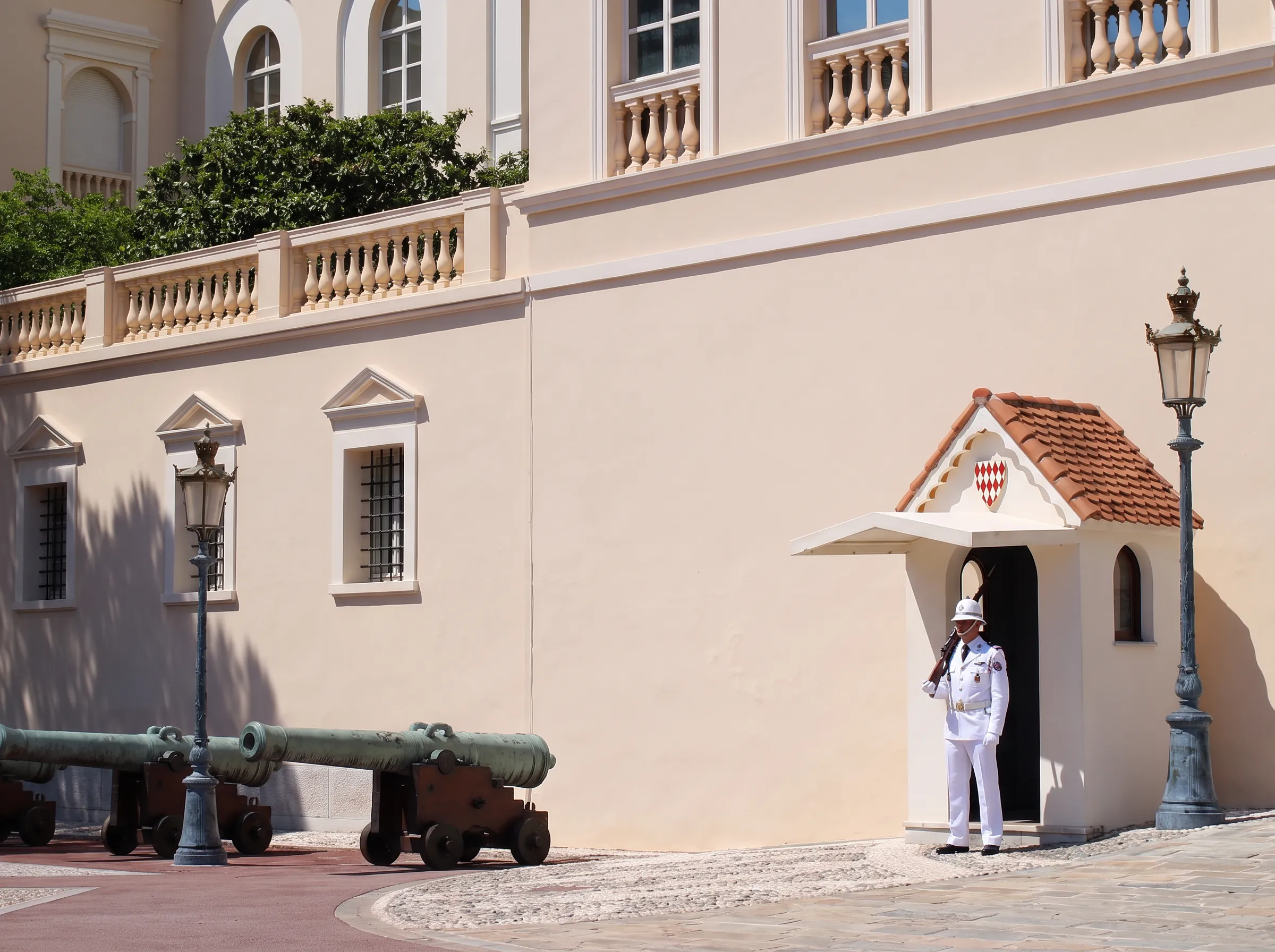
The shot. The Palace straight on across the Place du Palais: pale ochre and cream walls, the arcaded loggia of round arches on the upper floor, crenellated parapets, the ornate central entrance, and the row of bronze cannons with pyramids of cannonballs on the open ground in front.
When. Morning. The façade faces roughly east across the square and is lit from the front until mid-morning; by afternoon it is flat and by evening it is in its own shadow.
The hard part is people. The square is empty before about 10:00 and unusable from 11:15. There is one other window almost nobody uses: about ten minutes after the guard change, when several hundred people walk off toward the lanes at once and the square briefly clears.
Include the cannons. They give scale and foreground, and without them the façade reads as a flat elevation.
The parapet over Port Hercule
On the opposite side of the square from the Palace, and the classic Monaco view: yachts, the Condamine, the tiers of Monte-Carlo rising behind.
When. Between about 08:00 and 10:30, when the sun is behind you and the harbour is lit. By afternoon you are shooting into it.
The changing of the guard
11:55 daily. Easy to shoot badly.
Position beats timing. The crowd forms a ring and you are behind it from about 11:45. Arrive by 11:35, take a place at the railings on the palace side, and accept that you are committed to one angle throughout.
Lens. Longer rather than wider. The detail — the uniforms, the drill, the handover — carries the picture. A wide shot is mostly other people's phones.
Seasonal detail: the Carabiniers wear white in summer and dark uniforms in winter, giving the ceremony a different look through the year.
Conduct. Do not obstruct, do not cross marked lines. This is an armed guard on a working residence, not a costumed display.
Inside — if permitted
The Cour d'Honneur paving. Around three million white and coloured pebbles in geometric patterns. Shoot it low and close, filling the frame with the pattern and letting the palace walls sit behind — a wide shot from standing height turns three million pebbles into grey texture.
The double-revolution staircase. Carrara marble, two flights curving apart and rejoining. From below, centred, is the shot the architecture was designed for.
The Galerie d'Hercule frescoes. The best subject in the building. Low light, high vault, awkward angles. Do not attempt the whole cycle — shoot individual lunettes and let the density do the work. The unevenness is worth capturing rather than avoiding: some panels are cleaned bright, some are still dim, and areas of plaster are simply gone. That is what a recovery in progress looks like.
No flash, whether or not photography is permitted generally. These are sixteenth-century pigments under active conservation.
Light through the day
| Hour | Where |
|---|---|
| Before 10:00 | The façade and the empty square — the only reliable clean shot |
| 08:00–10:30 | The parapet, harbour lit |
| 11:35–12:00 | The guard change, from the railings |
| ~12:05 | The square clearing — the second clean façade window |
| Afternoon | Interior only; the façade is flat |
Drones
Choose ground-level photography. Arrange the necessary written authorisation with the Monaco authorities before any professional drone work.
Of everywhere in Monaco, this is the least sensible place to find out by experiment.
Commercial photography and filming
Not confirmed: the permit regime for commercial shoots, filming, tripods or lighting, either inside or on the square.
Note that the Place du Palais is government ground rather than public highway in the ordinary sense. Assume anything beyond a handheld camera requires prior permission, and approach the Palace directly.
Etiquette
The Carabiniers are on duty. Photograph the ceremony and the uniforms, not individuals at close range, and stop if asked.
Remember what the building is. People live here.
Around here
Make more of the area.
Good to know
Questions, answered.
01Can you visit the Prince's Palace?
Partly. The State Apartments open to visitors from 30 March to 15 October 2026. The private apartments do not open, and there are no gardens or grounds to visit. It is a working sovereign residence, and the Palace states it may close to the public without notice.
02How much does it cost?
€13 for an adult, €11 for a student, €8 for a child aged 6 to 17, and free for under-6s. Two combined tickets exist, sold by different institutions: Palace + the Prince's Car Collection at €25 adult, from the Palace's own platform; and Oceanographic Museum + Palace at €31 adult, sold by the museum. Both require both visits on the same day and run only during the Palace's season, 30 March to 15 October in 2026. There is no Palace + Jardin Exotique combined ticket, despite the claim being widely repeated.
03What are the opening hours?
10:00–18:00 from March to June and September to October, with last admission at 17:15; and 10:00–19:00 in July and August, with last admission at 18:15. The ticket office closes an hour before last admission.
04When is it closed?
Mid-October to late March entirely. Plus the Formula 1 Grand Prix weekend, and in 2026: 25 September from 15:00, 1–4 October, and 7 October. It may also close without notice.
05Is the Prince's Palace wheelchair accessible?
No. The Palace states that the State Apartments are not accessible to wheelchair users and that access is by stairs only. There is no lift and no alternative route. The square outside, the cannons, the parapet and the changing of the guard are all free, outdoors and level.
06How long does the visit take?
About an hour. There is no café, no shop worth planning around, no gardens and no grounds, so an hour is the whole of it.
07Does the Prince live there?
Yes. It is the official residence of the Sovereign Prince, which is why only the State Apartments open and only for part of the year.
08What time is the changing of the guard?
Daily at 11:55, in the Place du Palais in front of the palace entrance. It is free and needs no ticket. Be there by 11:40.
09How long does the changing of the guard last?
A matter of minutes. The Compagnie des Carabiniers du Prince, created on 8 December 1817, mounts a twenty-four-hour watch that begins with the ceremony. The square empties within ten minutes of the end.
10What are the frescoes everyone mentions?
A sixteenth-century cycle of the labours of Hercules, with his birth and death, in the Galerie d'Hercule — around 600 square metres. Restorers began routine repairs in 2013 and found them under later surfaces in 2015. Nobody knew they were there. They are attributed to Genoese painters on the evidence of style and the lime-based plaster identified by multispectral analysis.
11What is the courtyard paved with?
Around three million white and coloured pebbles laid in geometric patterns — risseu, the Ligurian pebble-mosaic technique. Almost every visitor walks across it looking up at the staircase.
12How old is the Palace?
The fortress was begun in June 1215 by the Genoese consul Fulco de Castello. What you see from the square is seventeenth-century work by Honoré II's architect Jacques Catone, built to cover it.
13Is the original fortress still there?
Yes, behind the façade. Catone spent thirty years building the residence over it and concealed the Serravalle Tower entirely. The crenellations on the elevation are decorative; the real defences are behind them.
14Have the Grimaldis really ruled since 1297?
They date their rule from 1297, when François Grimaldi took the fortress disguised as a monk on 8 January. That is a lineage claim rather than a tenancy claim — he held it only a few years before Genoese pressure forced the family out, and their hold over the following century was intermittent.
15Why are there monks on the coat of arms?
They commemorate the 1297 seizure. François Grimaldi came to the gate dressed as a Franciscan with a sword under the habit, killed the guard and took the fortress. The arms are supported by two sword-carrying monks, and you will see them all over the Rock.
16Is there a Napoleon museum at the Palace?
Not any more. The Museum of Napoleonic Souvenirs, created by Rainier III around a collection largely assembled by Louis II, closed in 2014 and its collections were dispersed at auction. A great deal of published material still says otherwise.
17Which rooms will I see?
The circuit has included the Throne Room, the Blue Room, the Mazarin Room and the Louis XIII bedroom, reached through the Cour d'Honneur and up the double-revolution staircase. Rooms can be withdrawn at short notice — the Palace guarantees no fixed route.
18Is there an audio guide?
Yes, in eleven languages, with a downloadable smartphone app as an alternative. A children's booklet is provided for ages 6–11, and a Braille booklet for visually impaired visitors.
19Can I take photographs inside?
The Palace publishes no photography policy for the State Apartments. Assume restrictions apply and ask at the ticket office, or email visites@palais.mc in advance. Photography of the exterior and the square is unrestricted.
20Can I bring a pushchair?
Not inside. The visit is stairs-only. The square outside is fine.
21Are dogs allowed?
Service animals are accepted. Pets only if carried in small bags.
22Is it worth it?
If the season is open and stairs are not a problem, yes for an hour — and the frescoes are the reason. If either fails, the square, the cannons, the parapet and the guard change are free, and the cathedral four minutes away holds the Grimaldis who used to live here.
23What if it is closed when I visit?
The free half still works: the Place du Palais, the façade, the cannons, the parapet over Port Hercule and the 11:55 changing of the guard. Then the cathedral, the Jardins Saint-Martin and the Oceanographic Museum, none of which shut in winter.
24How do I get there?
Ten minutes up the Rampe Major from Place d'Armes, or by lift and escalator from the Parking des Pêcheurs and five minutes on the level. Buses 1 and 2 terminate at Place de la Visitation, five minutes away.
25Can I drive to the Palace?
No. Monaco-Ville is a restricted traffic zone limited to vehicles registered in Monaco or the Alpes-Maritimes unless the Mairie grants an exemption. Park at the Parking des Pêcheurs.
26What else should I do nearby?
The cathedral, four minutes east and free, where twenty-four Grimaldis are buried. The Jardins Saint-Martin below it for free benches and the best view in Monaco. And the Oceanographic Museum, five minutes east, which is the visit to build a day around.
Before you visit
Useful links.
Venue and visitor information
Method
Two official channels exist for this building and they disagree, so they were used for different things.
palais.mc, the Palace's institutional site, is the authority for the building's history — the fortification phases, the architects, the 1793 episode, the fabric. visitepalaisdemonaco.com, the dedicated visit and ticketing site, is the authority for anything a visitor acts on: the season, the hours, the prices, the closures and the access statement.
That split is not a stylistic preference. The institutional site currently carries a superseded tariff, a superseded season and a museum that closed in 2014, all documented in the conflict ledger below.
Where a fact could not be traced to an adequate source, this guide says it is unverified rather than asserting it.
Sources
| ID | Source | Used for | Retrieved |
|---|---|---|---|
| S01 | Prince's Palace — the institution | Fulco de Castello and the June 1215 fortress; the rampart of thirty-seven sections and four buttressed towers and the second fortress at the port; the 8 January 1297 seizure; Charles I from 1341; Lambert's fifteenth-century defences and 400-man garrison; Honoré I, Dominique Gallo, the twelve-arch double-decked galleries, Luca Cambiaso, the reinforced tower and the 15,000 m³ cistern; Honoré II, Jacques Catone, the thirty years of work, the concealment of the Serravalle Tower, the Saint Jean Baptiste chapel and the grand entrance; the three million pebbles of the Cour d'Honneur; the Carrara marble double-revolution staircase and its Fontainebleau inspiration; the 1793 looting, the renaming as Fort d'Hercule, the military hospital, the throne room as a kitchen and the poorhouse; the May 1814 restoration; the demolition of the east wing and the Pavillon des Bains; Rainier III's restoration | 2026-08-04 |
| S02 | Prince's Palace — the State Apartments | The rooms shown, the statement that the State Apartments are not accessible to wheelchair users and that access is by stairs only, and the €10/€5 tariff recorded in the conflict ledger | 2026-08-04 |
| S03 | Visite du Palais Princier de Monaco | The 2026 season of 30 March to 15 October; hours and last admission for both seasonal bands; the 2026 closure list of 25 September from 15:00, 1–4 October and 7 October, plus the Grand Prix weekend; the ticket prices; the audio guide in eleven languages and the smartphone app; the children's booklet for ages 6–11; the Braille booklet; service animals accepted and pets only in small bags | 2026-08-04 |
| S04 | Napoleon.org — Musée napoléonien et des Archives du Palais Princier and associated museum listings | That the Museum of Napoleonic Souvenirs closed in 2014 and its collections were dispersed at auction; its creation by Rainier III around a collection largely assembled by Louis II; Napoleon's Marengo hat and the coronation-mantle fragment | 2026-08-04 |
| S05 | Monaco Tribune — Palace restoration uncovers 500-year-old frescoes | The 2013 start of restoration; the 2015 discovery in the lunettes and loggia vault; the labours of Hercules with his birth and death; approximately 600 m²; the sixteenth-century Genoese attribution on style and on lime-based plaster identified by multispectral analysis | 2026-08-04 |
| S06 | Artnet News — Renaissance frescoes uncovered at the Prince's Palace | Corroboration of the discovery, the attribution method and the scale of the recovered surface | 2026-08-04 |
| S07 | Compagnie des Carabiniers du Prince — guarding the Palace and VisitMonaco — changing of the guard | The 11:55 daily ceremony, the twenty-four-hour watch, the creation of the company on 8 December 1817, and the seasonal uniforms | 2026-08-04 |
| S08 | Monaco Service Public — access sticker for Monaco-Ville | The vehicle-access regime for the quarter | 2026-08-04 |
| S09 | Above Guide's own Monaco off-track dataset, checked against the venue on 1 August 2026 | Verified venue coordinates, seasonal hours and the Grand Prix closure, cross-checked against S03 | 2026-08-04 |
Conflict ledger
The unusual thing about this bundle is that all three principal conflicts are between an institution and itself.
The tariff
- palais.mc (S02): €10 adult, €5 child and student.
- visitepalaisdemonaco.com (S03): €13 adult, €11 student, €8 child 6–17, free under 6, for the 2026 season.
Used: the visit site, as the ticketing channel carrying this year's dates and closure list. The institutional page appears not to have been updated.
Consequence: no price data is emitted in structured data until this is resolved.
The season
- palais.mc (S01): "The Palace opens June to October."
- visitepalaisdemonaco.com (S03): 30 March to 15 October 2026.
Used: the visit site. Note this is not a small discrepancy — it is nearly three months of the season, and a visitor relying on the institutional page would skip an open Palace in April or May.
The Napoleon Museum
- palais.mc (S01): states that the Napoleon Museum and the Palace Archives now occupy the site of the demolished east wing.
- napoleon.org and museum listings (S04): the museum closed in 2014 and its collections were dispersed at auction.
Used: the closure. This is the clearest of the three, and it also resolves a question left open in the Le Rocher bundle, where the museum's status could not be confirmed and it was omitted rather than guessed at.
The 1297 seizure, and what it establishes
The Palace (S01) and the Monaco government give 8 January 1297 and the monk's disguise; S01 adds that François Grimaldi killed the guard. The episode is attested in chronicle rather than in a charter, and the Grimaldi arms — two sword-bearing monks — are the family's own commemoration rather than independent evidence.
The conflict is not the date. It is what follows from it. Promotional material uses "held since 1297" in a way that implies unbroken possession; general reference indicates the Grimaldis were forced out within a few years and held Monaco intermittently for the following century.
Used: the dynasty dates itself from 1297, stated as a lineage claim rather than a tenancy claim.
Outstanding: no academic source on medieval Liguria has been consulted for any bundle in this set. It remains the highest-value research task across the whole Monaco collection.
The frescoes and Luca Cambiaso
Honoré I employed the Genoese painter Luca Cambiaso on this courtyard in the sixteenth century (S01). The frescoes discovered from 2015 are attributed to sixteenth-century Genoese painters (S05, S06).
Not asserted. The two facts sit together suggestively and no source consulted connects them by name. A source that did would be a genuinely good addition.
Facts deliberately not asserted
| Fact | Where this guide says so |
|---|---|
| The photography policy for the State Apartments | Photography, Plan your visit, and the FAQ |
| Number of steps and presence of handrails on the visit route | Accessibility |
| Seating within the State Apartments | Accessibility |
| Accessible toilets | Accessibility |
| Hearing loops, or hearing-aid compatibility of the audio handsets | Accessibility |
| Lighting levels and tactile provision | Accessibility |
| Priority viewing for the changing of the guard | Accessibility |
| The Carabiniers' uniform changeover dates and weather cancellation | Photography |
| Commercial photography and filming permits | Photography |
| The drone regime over Monaco-Ville | Photography |
| Bus boarding at the Place de la Visitation terminus | Accessibility |
| Blue-badge equivalence for foreign vehicles | Accessibility |
| Any link between Cambiaso and the 2015 frescoes | Conflict ledger, above |
The photography gap is worth naming twice: this is a paid interior visit with no published photography policy, which is unusual and mildly unhelpful. This guide assumes restrictions and tells the reader to ask.
A note on what was not used
No AI-generated encyclopaedia was cited. Ticket resellers and attraction aggregators were avoided: they widely repeat the superseded "June to October" season, several still list the Napoleon Museum as an attraction, and almost none carries the accessibility statement — which is the single most decision-changing fact about this building.
Opening hours, prices, programmes and access arrangements can change. Confirm critical details with the venue.
Continue exploring / Monaco
More things to do
in Monaco
Explore Monaco activities, sights and places to eat. Compare the time to allow, costs and booking details, then save your favourites to your itinerary.
 01Monaco Grand Prix experienceCasino de Monte-CarloExplore experience →
 02Monaco Grand Prix experienceCathedral of Notre-Dame-ImmaculéeExplore experience →
 03Monaco Grand Prix experienceFontvieilleExplore experience →
 04Monaco Grand Prix experienceFort AntoineExplore experience →
 05Monaco Grand Prix experienceGrimaldi ForumExplore experience →
 06Monaco Grand Prix experienceJardin Exotique de MonacoExplore experience →
 07Monaco Grand Prix experienceJardin Japonais de MonacoExplore experience →
 08Monaco Grand Prix experienceLa CondamineExplore experience →
 09Monaco Grand Prix experienceLarvottoExplore experience →
 10Monaco Grand Prix experienceLe Rocher / Monaco-VilleExplore experience →
 11Monaco Grand Prix experienceLes Ballets de Monte-CarloExplore experience →
 12Monaco Grand Prix experienceMareterraExplore experience →
 13Monaco Grand Prix experienceMonte-CarloExplore experience →
 14Monaco Grand Prix experienceNouveau Musée National de MonacoExplore experience →
 15Monaco Grand Prix experienceOceanographic Museum of MonacoExplore experience →
 16Monaco Grand Prix experienceOpéra de Monte-CarloExplore experience →
 17Monaco Grand Prix experienceThe Museum of Old MonacoExplore experience →
 18Monaco Grand Prix experienceThe Museum of Stamps and CoinsExplore experience →
 19Monaco Grand Prix experienceThe Prince's Car CollectionExplore experience →
 Plan / Itinerary builderBuild your Monaco Grand Prix dayStart planning →