In depth
Fort Antoine
An eighteenth-century fort at the tip of the Rock — free, open every day from sunrise to sunset, and an open-air theatre with free admission for a month each summer.
Story · Visit · Route · Links
Choose your depth
Essentials or more detail?
See visiting essentials, or read more about the history and places nearby.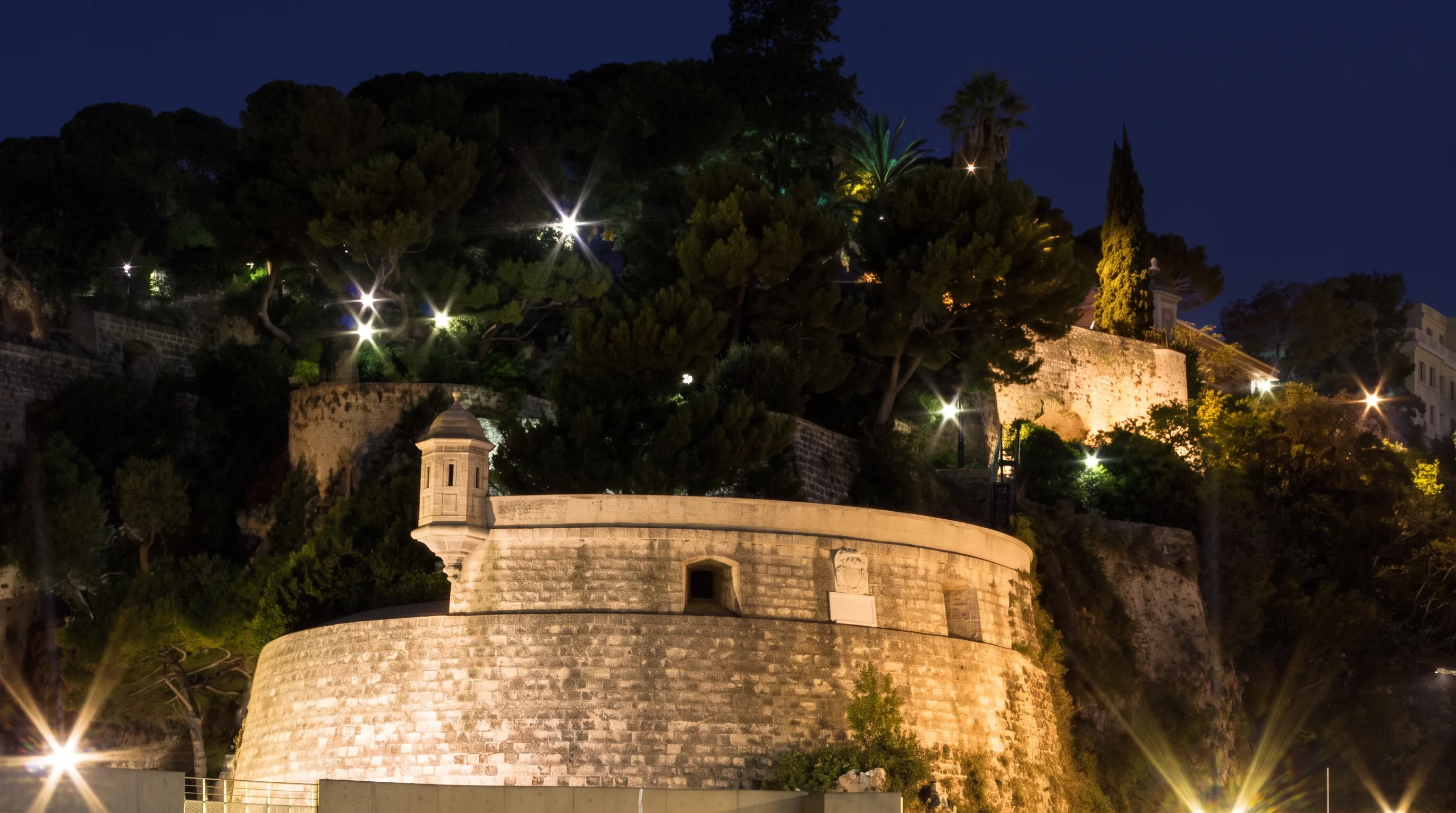
01 The experience
What to expect.
Why it matters
It is a fort with a completely useless military record, and that is the interesting part.
Prince Antoine I built it during the War of the Spanish Succession, expecting invasion. The primary fortifications went up in 1709 and the work ran to 1713 — huge gates, sheared cliffs, underground barracks with a cistern, a drawbridge.
He paid for it by melting down the family silver and selling the family jewels.
The attack never came. The fort sat on the corner of the Rock, fully armed, waiting for a war that went elsewhere, and gradually stopped having a purpose.
Then it was destroyed by its own occupants. Italy occupied Monaco in the Second World War and used Fort Antoine as an air-raid shelter. Germany took control in 1943 and used it as a munitions store. On 3 September 1944, as American forces liberated Monaco, retreating German troops blew it up.
A fortress that survived two centuries without ever being attacked was destroyed by the side that was using it for storage.
Rainier III restored it across 1953–54 — not as a fort, which there was no longer any use for, but as a theatre, opening in 1954.
What survives
The rebuild kept the military architecture rather than prettifying it away:
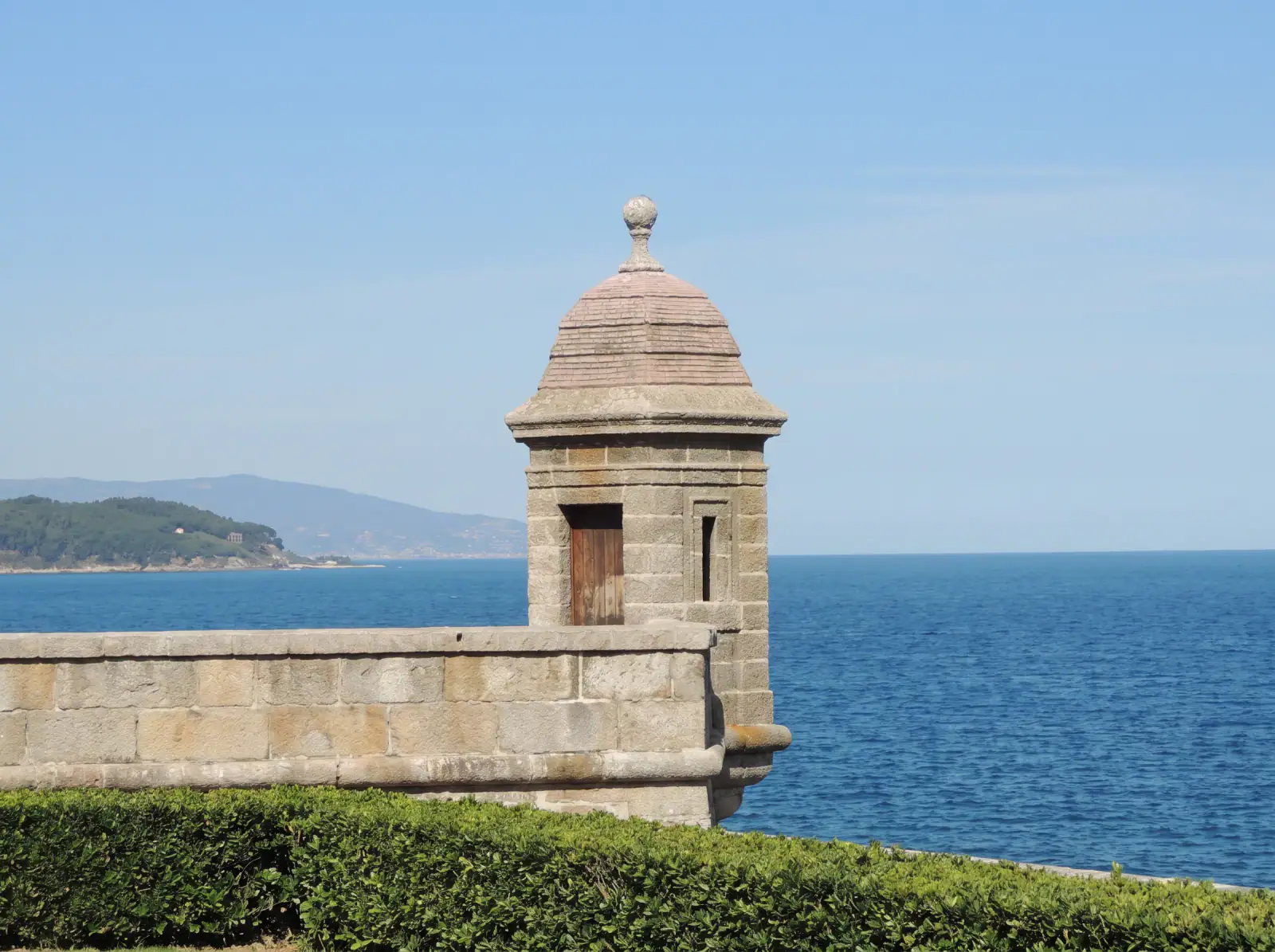
- A bartizan — the small corner turret that watched the approach
- A pyramid of cannonballs, at the centre of the theatre
- The parapet, now planted with pittosporum hedges
- About 350 seats, cut in stone
The cannonballs are the detail people remember. They sit in the middle of an auditorium, stacked as ammunition was stacked, in a place where nobody ever fired anything in anger.
Who it is for
Anyone on the Rock who wants ten minutes away from the crowd — which, in high season, is a genuine need rather than a preference. Anyone interested in fortification, for whom this is the eighteenth-century counterpart to the Genoese fortress at the Palace end. Anyone in Monaco in July who would like to see live theatre for nothing.
It is not a museum, and there is nothing curated to look at. It is a place, a view and a story.
The essentials
Where. Avenue de la Quarantaine, at the far north-eastern tip of Le Rocher. Seven or eight minutes on foot from the Place du Palais.
When. Every day, sunrise to sunset. No published closing days. Closed to casual visitors during scheduled performances.
Cost. Nothing — for the fort, and for the festival.
How long. Twenty minutes to half an hour, unless you have come for a performance.
The festival. Roughly late June to late July. Free, but reserve: booking opens in early June through montecarloticket.com, or in person at the Théâtre Princesse Grace on Avenue d'Ostende, Monday to Friday 10:00–13:00. Extra places are released each Friday evening for the following week's shows — which is the single most useful thing to know if the run looks full.
What this guide does not claim
Accessibility has not been verified, and the structural odds are poor — this is a converted eighteenth-century fort with stone seating, reached along a clifftop avenue. See the accessibility chapter.
The wet-weather policy for performances is not published. It is an open-air theatre; ask when you book.
The story
History & character.
A fort built for a war that went somewhere else
The War of the Spanish Succession was the reason. Europe spent the first years of the eighteenth century fighting over who would inherit the Spanish throne, and Monaco — a fortified rock with a harbour, on a contested coast — had every reason to expect a visit.
Prince Antoine I fortified the north-eastern tip of the Rock in answer. The primary fortifications went up in 1709 and the work continued to about 1713: huge gates, cliffs cut sheer, underground barracks equipped with a cistern, and a drawbridge.
He sold the family jewels to pay for it
This is the detail worth carrying round the site.
Antoine I funded the defences by melting down the family silver and selling the family jewels.
It is a measure of how seriously the threat was taken. A sovereign prince liquidated the household plate to put guns on a headland.
And then nothing happened
The feared attack never came.
The war ended, the fleets went elsewhere, and Fort Antoine settled into a long career as a fortification that had never been fought over. Across the following two centuries it gradually lost its military function altogether.
Two hundred years of readiness, and not a shot fired at it.
The Second World War, and the one thing that did happen
Monaco was occupied.
Italy took control and used Fort Antoine as an air-raid shelter — which is a fair use for thick eighteenth-century masonry, and the closest the fort ever came to protecting anyone from anything.
Germany took control in 1943 and put it to a different use: a munitions store.
Then, on 3 September 1944, as United States forces liberated Monaco, the retreating German troops blew the fort up.
Read that sequence properly. A fortress built against invasion, never attacked in two hundred and thirty years, was finally destroyed — by the occupying army that had been using it as a warehouse, on its way out.
1953: Rainier III rebuilds it as a theatre
There was no longer any purpose in a coastal artillery position on the Rock, and Rainier III did not pretend otherwise.
He had the fort restored across 1953–54 — rebuilt as a structure, but converted in function into an open-air theatre, with about 350 seats cut in stone in the space where the guns had been. It opened as a theatre in 1954.
The military architecture was deliberately kept. The bartizan — the small corner turret that watched the approach — still stands. The parapet survives, now emphasised by pittosporum hedges. And a pyramid of cannonballs sits at the centre of the theatre, stacked as ammunition was stacked.
The result is a place that is honest about both of its lives. It has not been dressed up as a ruin or disguised as an auditorium.
The theatre since
The Théâtre du Fort Antoine now runs a summer festival of theatre and music under the open sky, programmed by the government's cultural service.
Admission is free. In 2026 it ran from 30 June to 28 July, with performances at 21:30.
That is the fort's fourth act, and by a distance its most useful: a defensive work that never defended anything, and never had a paying audience either, giving away free theatre on summer nights.
(A third date circulates — one reference dates the start of open-air theatre use to 1970. See the source register. The 1953–54 reconstruction and 1954 opening are the better-attested sequence.)
Look closer
Highlights and hidden details.
The objects, spaces and small observations that turn a visit into a memorable one.The pyramid of cannonballs
In the middle of a theatre.
Iron shot, stacked in a pyramid exactly as ammunition was stacked beside a gun, sitting at the centre of an auditorium where about 350 people watch plays on summer evenings.
It is the single object that tells you what this place is. The 1953 rebuild could have cleared it away and did not — and the result is a stack of ammunition that was never fired, in a fort that was never attacked, in a theatre that gives its seats away.
The bartizan
The small corner turret projecting from the wall, watching the approach.
A bartizan is a lookout for a soldier who needs to see along a wall without leaning out over it and being shot. This one was built to watch for a fleet that never arrived.
It is the most purely military thing left standing, and it survived both the 1944 demolition and the conversion.
The parapet, and what it is now
The parapet survives, and the rebuild emphasised it with pittosporum hedges.
Worth registering as a piece of design thinking: the line a gunner stood behind is now the line a hedge is planted along. Nobody hid the parapet or turned it into something else.
The position
Walk to the edge and look at where you are standing.
This is the north-eastern tip of the Rock — the corner that watches the approach from Italy and the open sea. Antoine I did not put the fort here for the view. He put it here because this is where you would see them coming.
The Rock is 62 metres high and this is its exposed shoulder. The cliffs were cut sheer as part of the works.
The stone seats
About 350, cut into the fort in 1953.
Sit on them. They are hard, they are outdoors, and they are the clearest illustration of what Rainier III actually did here — not a restoration, not a museum, but a change of use for a building whose original purpose had expired.
The quiet
Not an object, but the best thing about the place.
You are seven or eight minutes past the Place du Palais and the crowd does not come. The Rock in season carries an extraordinary density of visitors and essentially all of it stops at the Palace square, the cathedral and the Oceanographic Museum.
The last few hundred metres of Avenue de la Quarantaine are where Monaco-Ville goes quiet.
What you cannot see
Worth knowing so you do not hunt for it.
The original works included underground barracks with a cistern. Whether any of that is accessible to visitors is not published, and this guide does not claim it is. What you can see is the surface: the parapet, the bartizan, the cannonballs and the seating.
The thing to hold on to
Two hundred and thirty years without a shot fired at it, and then destroyed by its own garrison.
Built 1709–1713 against an invasion that never came. Used by the Italian occupation as an air-raid shelter, then by the Germans from 1943 as a munitions store. Blown up on 3 September 1944 by the retreating German troops as the Americans liberated Monaco.
Rebuilt in 1953 as somewhere to watch a play, for nothing.
Details worth slowing down for.
Antoine I sold the family jewels to build it
Not a figure of speech.
To pay for the fortifications, Prince Antoine I melted down the family silver and sold the family jewels.
A sovereign prince liquidating the household plate to put guns on a headland is a fair measure of how certain he was that the war was coming for Monaco.
It never came
The attack Fort Antoine was built for never happened.
The War of the Spanish Succession ended, the fleets went elsewhere, and the fort settled into two centuries of readiness with nothing to be ready for. Over time it lost its military function entirely.
Everything you are standing on was insurance against an event that did not occur.
It was destroyed by the people using it
The one genuinely violent thing in the fort's history was done by its own occupants.
Italy occupied Monaco and used Fort Antoine as an air-raid shelter. Germany took control in 1943 and used it as a munitions store. On 3 September 1944, as American forces liberated Monaco, the retreating Germans blew it up.
Two hundred and thirty years unattacked, then demolished by the side that had been keeping its ammunition there.
The cannonballs are in the middle of the auditorium
A pyramid of iron shot, stacked the way ammunition was stacked beside a gun — sitting in the centre of a theatre.
The 1953 rebuild could have removed it. It did not, and neither did it move it to the edge as an ornament. It is where the ammunition was, in a space where people now sit and watch plays.
A hedge marks where the gunners stood
The parapet survives, and the reconstruction planted pittosporum hedges along it.
The line a soldier crouched behind is now a line of shrubs. It is a quietly good piece of design — the geometry of the fort is preserved and the function is simply allowed to lapse.
There are barracks underneath
The original works included underground barracks, equipped with a cistern, along with huge gates, a drawbridge, and cliffs cut sheer.
Whether any of it can be visited is not published. But it is under your feet.
Free theatre, in Monaco
The Théâtre du Fort Antoine stages theatre and music through about a month each summer — and admission is free.
In 2026 it ran 30 June to 28 July, performances at 21:30.
In a principality where the opera does not publish prices and the casino asks for a passport, the government gives away seats at an open-air theatre on a cliff.
And there is a trick to getting in
Free does not mean available — the run fills.
Additional places are released every Friday evening for the following week's performances.
That single fact is the difference between "sold out" and "going", and it appears nowhere outside the festival's own practical page.
It is open every day of the year, and nobody says so
Sunrise to sunset, free, no closing days, except when a performance is on.
Compare the rest of the Rock: the Palace has a season and shuts for the Grand Prix, the Oceanographic Museum shuts for Christmas and the Grand Prix, the cathedral closes during services.
Fort Antoine just stays open.
Seven minutes is all that separates it from the crowd
The Rock in season is dense with visitors, and essentially all of them stop at the Palace square, the cathedral and the Oceanographic Museum.
Fort Antoine is seven to eight minutes further along Avenue de la Quarantaine.
That short walk is the whole difference between the busiest ground in Monaco and the quietest corner of the same headland.
04 / Before you go
Plan your visit
Prices & admission
Free. The fort costs nothing to enter, and the summer theatre festival is free as well.
Opening hours
Open every day from sunrise to sunset, with no published closing days — the only exception being that it closes to casual visitors during scheduled performances. No clock times are published. The summer festival runs for about a month from late June, with performances at 21:30.
Plan your experience
Nothing to book for the fort itself — it is free and open daily, sunrise to sunset, with no published closing days. It closes to casual visitors only during scheduled performances. FOR THE SUMMER FESTIVAL: admission is free but reservation is recommended, through montecarloticket.com or in person at the Théâtre Princesse Grace, Avenue d'Ostende, Monday to Friday 10:00–13:00. In 2026 booking opened on 10 June for a season running 30 June to 28 July, with performances at 21:30. THE USEFUL TIP: additional places are released every Friday evening for the following week's shows, so a run that looks fully booked is worth checking again on Friday night. Dates move every year — several general guides wrongly say 'July and August'.
Accessibility
Nothing is published, and unlike most gaps in this guide the structural odds here are genuinely poor. That is said plainly rather than hedged optimistically.
The short version
Free. Open every day, sunrise to sunset. No ticket, no gate, no hours to check.
There is nothing to plan. Walk to the north-eastern tip of the Rock and go in.
The only restriction is that it closes to casual visitors during scheduled performances, which happen on summer evenings.
Opening
| Hours | Daily, sunrise to sunset |
| Closing days | None published |
| Cost | Free |
| Booking | None |
| Exception | Closed to casual visitors during scheduled performances |
That is unusually simple for Monaco, where the Palace has a season, the opera has a season, the casino has an age limit and a dress code, and three of the princely sites close for the Grand Prix.
Getting there
Avenue de la Quarantaine, at the far north-eastern tip of Le Rocher.
On foot from the Place du Palais: seven to eight minutes, along Avenue de la Quarantaine. It is the walk almost nobody makes — the crowd stops at the Palace square, the cathedral and the Oceanographic Museum.
From the harbour: you are climbing the Rock. Use the Parking des Pêcheurs lift rather than the Rampe Major if you would rather not.
Note the terrain. You are on a clifftop at the end of a headland. Getting to the Rock at all means ascending 62 metres, and the walk out to the fort is along an exposed avenue.
How long to allow
Twenty minutes to half an hour.
There is nothing curated and no interpretation to work through. It is a place, a piece of architecture, a view and a story. Half an hour is generous unless you sit down, which is rather the point of going.
The best reason to come
Quiet.
Monaco-Ville in season is one of the more concentrated tourist experiences in Europe, and Fort Antoine is seven minutes past the end of it. If you have done the Palace square and the cathedral and want to stop being in a crowd, this is the answer on the Rock.
The summer festival
For about a month each summer the fort becomes the Théâtre du Fort Antoine, staging theatre and music in the open air.
| 2026 season | 30 June – 28 July |
| Start time | 21:30 |
| Admission | Free |
| Booking | Opened 10 June in 2026 |
| Online | montecarloticket.com |
| In person | Théâtre Princesse Grace, Avenue d'Ostende — Monday to Friday, 10:00–13:00 |
| Contact | fortantoine@gouv.mc |
Reserve. Admission is free but places are not unlimited, and a free ticket in Monaco is a rare enough thing that the run fills.
The tip that matters: additional places are released every Friday evening for the following week's performances. If a show looks fully booked, check again on Friday night rather than giving up.
The dates move. In 2026 the season ran late June to late July — not, as several general guides state, "July and August". Check the current programme rather than assuming.
Coming for a performance
It starts at 21:30 and it is outdoors, on stone, on a clifftop.
Practical consequences, none of which anyone publishes but all of which follow from the setting:
- It will be cooler than the day was. A clifftop at the end of a headland after dark in July is not the same temperature as the Place du Palais at noon.
- The seats are stone. Three hundred and fifty of them, cut into the fort.
- You are walking back along Avenue de la Quarantaine at around 23:00, and then down off the Rock. Work out the return before you go.
The wet-weather policy is not published. It is an open-air theatre; ask when you book.
When to come
For the fort itself: early morning or late afternoon. It faces north-east from the tip of the Rock, so the light is best early, and the crowd on the Rock is thinnest then too.
For the festival: late June to late July, in the evening.
Any time of year works for the fort. There is no season and nothing closes.
Combining it
You are at the end of the Rock, so everything is behind you:
- The Prince's Palace and the Place du Palais — seven or eight minutes back
- The cathedral — where the princes are buried, including Rainier III, who rebuilt this fort
- The Oceanographic Museum — the other end of the headland
- The Jardins Saint-Martin — free, and the other quiet corner of the Rock
Each has its own guide.
The obvious pairing is the Jardins Saint-Martin. They are the Rock's two free, unticketed, uncrowded places, at opposite ends of the same headland.
What is not confirmed
- Accessibility — see the accessibility chapter; nothing is published and the odds are structurally poor
- Exact opening and closing times. "Sunrise to sunset" is what is published; no clock times are given
- The wet-weather policy for performances
- Whether the underground barracks or cistern are accessible to visitors
- Toilets, seating or shade outside performance times
- Whether the site closes during the Grand Prix, when the Rock's approaches have been ticket-only on foot in some years
Facts with a shelf life
| Fact | Recheck | Why |
|---|---|---|
| Festival dates | Annually, each May | Moved to 30 June–28 July in 2026 |
| Booking opening date | Annually, each May | Opened 10 June in 2026 |
| Performance start time | Annually | 21:30 in 2026 |
| Booking channels | Annually | montecarloticket.com and the Théâtre Princesse Grace |
| Grand Prix access | Annually, each March | The Rock's approaches are restricted in race week |
Visit your way
Access and family planning.
The headline
Nothing is published, and unlike most gaps in this project, the structural odds here are genuinely poor.
It is important to say that plainly rather than lead with optimism. This is a converted eighteenth-century artillery fort at the exposed tip of a clifftop, reached along an avenue at the far end of a rock you must first climb 62 metres to reach, with seating cut in stone.
Some of those facts are certain. What is not certain is how any of them translate into an actual visit, because no accessibility information exists for this site at all.
What is certain, and unhelpful
You are on Le Rocher. Getting to Monaco-Ville means ascending 62 metres from the harbour. That is true of the Palace, the cathedral and the Oceanographic Museum too, and it is the first barrier.
The fort is at the far end. Seven to eight minutes on foot from the Place du Palais, along Avenue de la Quarantaine — an exposed clifftop route.
The seating is stone. About 350 places cut into the fort, not fitted seating.
The cliffs were cut sheer as part of the original works, and the site is a fortification with a parapet rather than a landscaped viewpoint.
What genuinely helps
The Parking des Pêcheurs lift. Monaco runs a public lift and escalator network precisely because the principality is vertical, and the Parking des Pêcheurs lift is the established way up to the Rock without the Rampe Major. It does not solve the walk out to the fort, but it removes the climb.
It is free. No ticket, no booking, no turnstile — so nothing is lost by attempting it and turning back, which is not true of a €22.50 museum.
It is open all day, every day. No timed entry, no queue, no pressure to arrive at a particular moment.
Avenue de la Quarantaine is a made road, not a stepped lane — the Rock's medieval streets are elsewhere.
What has not been verified
Named rather than inferred:
- Whether there is step-free access into the fort itself
- Whether there are steps, ramps or gradients on Avenue de la Quarantaine approaching it
- The surface of the approach and of the fort interior
- Whether any of the 350 stone places is reachable without steps, and whether any wheelchair space exists for performances
- Edge protection, railings and barriers at the parapet and the cliff
- Accessible toilets, or any toilets
- Seating with backs or arms anywhere on the site
- Shade and shelter
- Whether the underground barracks or cistern are accessible, or accessible at all
- Handrails
- Accessible parking and blue-badge arrangements on the Rock
- Assistance-dog policy
- Any provision at all for the summer festival — reserved places, companion tickets, or an accessible route to a seat
- Lighting on the walk back after a 21:30 performance ending around 23:00
The festival deserves a specific warning
A performance means arriving in daylight and leaving in the dark, walking back along a clifftop avenue at roughly 23:00, and then descending from the Rock.
No lighting, transport or assistance information is published for that return. If mobility, vision or fatigue is a factor, that walk is the part to ask about — not the seat.
How to ask
There is one route, and it is the festival's own address:
fortantoine@gouv.mc
Reservations for the festival also run through montecarloticket.com and in person at the Théâtre Princesse Grace, Avenue d'Ostende, Monday to Friday 10:00–13:00 — and an in-person booking is the better channel if you need to discuss access.
The question worth asking
If anyone can settle one thing with the festival office, make it: is there a step-free route into the fort, and is any seating position reserved or reachable for a wheelchair user during performances?
As it stands the honest position is that Fort Antoine is a free, open, welcoming place that has published nothing whatever about who can actually get into it.
The short answer
A free fort with a pyramid of cannonballs in it, and nobody else there.
That is a genuinely good offer for a child on the Rock, and it costs nothing. It is also short — twenty minutes to half an hour — which is the right length after the Palace square and the cathedral have used up the patience.
The real argument is the crowd. Monaco-Ville in season is dense, hot and slow-moving with a pushchair or a tired seven-year-old. Fort Antoine is seven minutes past the end of it, and the last stretch of Avenue de la Quarantaine is where the Rock finally goes quiet.
What works for children
The cannonballs. A pyramid of iron shot, stacked in the middle of what is now a theatre. It needs no explanation and it is the thing they will remember.
The bartizan. A small turret built for a soldier to watch the sea from without being shot. Children take to lookouts.
The story, which is unusually good:
A prince sold his family's jewels to build a fort because he was sure an army was coming. It never came. Two hundred years later a different army used it to store their bullets — and then blew it up on their way out. Then another prince rebuilt it as a theatre.
The stone seats. About 350 of them, cut into the fort. Children climb on things, and here there is nothing to damage and nobody to disturb.
The edge, and the view. You are at the tip of a 62-metre rock looking out to sea.
The free theatre
For about a month each summer the fort stages theatre and music in the open air, and admission is free. In 2026 it ran 30 June to 28 July.
Be realistic about the timing. Performances start at 21:30, outdoors, on stone seats, at the end of a headland — and you will be walking back along the clifftop at around 23:00 and then down off the Rock.
That is a late night for most children, and the programme is adult theatre and music rather than family programming. For an older child who likes theatre and can manage the hour, it is a remarkable free evening. For a young one, it is not.
Reserve if you go, and remember that extra places are released each Friday evening for the following week.
The honest cautions
It is a clifftop. You are at the exposed north-eastern tip of the Rock, and the cliffs below were cut sheer as part of the original works. There is a parapet, but this is a fortification rather than a playground, and no information on edge protection or railings is published. Treat it as you would any cliff-edge site.
Getting there is a climb. Not the fort itself — the Rock. Reaching Monaco-Ville means 62 metres up, and the fort is at the far end of it. Use the Parking des Pêcheurs lift rather than the Rampe Major with children.
There is no shade guaranteed and no facilities documented. See below.
What is not confirmed
Stated plainly, because a family plan should not rest on guesswork:
- Toilets anywhere on the site
- Shade, seating or shelter outside performance times
- Edge protection, railings or barriers
- Pushchair access — this is a converted eighteenth-century fort reached along a clifftop avenue
- Whether the underground barracks or cistern are accessible
- Any family or children's programming in the festival
- A minimum age for performances
- The wet-weather policy for performances
The toilets and the edge protection are the two most likely to matter.
Pairing it
The Jardins Saint-Martin are the other free, unticketed, uncrowded place on the Rock — at the opposite end of the same headland, with benches, shade and a sea view. Between them they are the two places up here that cost nothing and are not full of people.
The Oceanographic Museum is the Rock's headline family destination and has its own guide. It is also €22.50 an adult, so the contrast with a free fort is worth using: do the museum properly, then come out here to let everyone decompress.
Self-guided walk
Explore beyond the venue.
A practical, step-by-step route connecting this experience with more of Monaco Grand Prix.1. Avenue de la Quarantaine
Seven to eight minutes from the Place du Palais.
Walk out along the north-eastern side of the headland.
Notice what happens around halfway: the crowd stops. The Rock in season carries an extraordinary density of visitors and essentially all of it is behind you by the time the avenue straightens out.
The name is worth a thought. A quarantaine is a quarantine — this exposed corner, away from the town, is where you put things you did not want near people.
2. Arriving — look at the position before the building
Two minutes.
Stop at the entrance and look outwards before you look at the fort.
You are on the north-eastern tip of the Rock, 62 metres up, watching the approach from the open sea and the coast running east. This is where you would see them coming.
Antoine I did not choose this corner for the view. He chose it because it is the corner that matters, and the cliffs below were cut sheer as part of the works.
3. The bartizan
Three minutes.
The small corner turret projecting from the wall.
A bartizan lets a soldier watch along a wall without leaning out over it. Put your eye where his was and follow the line it covers.
It survived the 1944 demolition and the 1953 conversion, and it is the most purely military thing still standing here.
4. The parapet, and the hedges
Three minutes.
Follow the parapet round. The 1953 rebuild emphasised its line with pittosporum hedges — so the geometry of an artillery position is now drawn in shrubs.
Nothing has been hidden or restyled. The shape of the fort is intact and only the purpose has lapsed.
5. The cannonballs
Five minutes, and this is the one.
In the centre of the theatre: a pyramid of iron shot, stacked exactly as ammunition was stacked beside a gun.
Stand back far enough to get the stone seating in the same view, because the whole point is the juxtaposition.
Three facts, in order:
- Nothing was ever fired from here. The attack Antoine I built against never came.
- Antoine I paid for this fort by melting the family silver and selling the family jewels.
- The one violent thing that happened here was done by its own occupants. Italy used it as an air-raid shelter; Germany took over in 1943 and used it as a munitions store; and on 3 September 1944, as American forces liberated Monaco, the retreating German troops blew it up.
Two hundred and thirty years unattacked, then demolished by the side keeping its ammunition in it.
6. Sit down
As long as you like.
About 350 places, cut in stone in 1953 when Rainier III rebuilt the fort — not as a fortification, which had no remaining purpose, but as a theatre.
This is the best free seat in Monaco, and the reason to have walked out here. Behind you is one of the most crowded quarters in Europe. In front of you is the sea.
If it is late June or July, come back at 21:30 — the Théâtre du Fort Antoine stages theatre and music here, outdoors, and admission is free. Reserve through montecarloticket.com, and note that extra places are released every Friday evening for the following week.
7. Walking back
Ten minutes to the gardens, or fifteen down off the Rock.
The Jardins Saint-Martin are about ten minutes back on the seaward side — free, ungated, with benches and shade. They and this fort are the Rock's only two free, uncrowded places, at opposite ends of the same headland.
The cathedral is eight minutes back, and both men in this story are buried there: Antoine I, who built the fort, and Rainier III, who rebuilt it as somewhere to watch a play.
Then take the Parking des Pêcheurs lift down rather than the Rampe Major.
Make a record
Photograph it thoughtfully.
The short version
Free, outdoors, open all day, and empty. For photography that combination is close to ideal, and it is the opposite of everywhere else on the Rock.
No ticket, no gate, no time limit, no queue and — for most of the day — nobody in your frame.
The light
The fort sits at the north-eastern tip of the Rock, which decides everything.
Early morning is the best light here by a distance: low sun coming in off the sea onto the seaward walls, and an empty site.
Late afternoon puts the north-eastern face into its own shadow. Good for the parapet and the interior; poor for the walls.
Midday is the worst — flat, hard, and bleaching on pale stone.
Blue hour is worth considering in summer, because it coincides with people arriving for a 21:30 performance.
The four things to shoot
The pyramid of cannonballs. Get low and shoot it with the stone seating behind it. The picture is the juxtaposition — ammunition in an auditorium — and a tight crop on the shot alone throws that away.
The bartizan. Shoot it against the sea rather than against the wall, so the reason for its existence is legible. It is a lookout; frame what it was looking at.
The parapet line. The pittosporum hedges follow the defensive geometry. From the right angle you get the shape of an artillery position drawn in shrubs, which is a better picture than it sounds.
The stone seating. Three hundred and fifty places cut into a fort. Shoot along the rows rather than across them, empty, in raking light.
The wider frame
You are on the corner of the Rock that watches the approach. Turn round and shoot what Antoine I was worried about — the open sea and the coast running east.
That frame explains the building better than any detail of it, and it is free and permanently available.
During performances
Do not photograph the performance.
It is free theatre, but free does not mean unlicensed: the work on stage is authored and the performers are professionals. No photography policy is published for the festival, which is a reason to ask rather than to assume.
Photographing the fort before the performance, as the audience settles and the light goes, is a different matter and is where the good pictures are anyway.
Privacy
Ordinary courtesy. It is a small, quiet place — if there are three people at the parapet, they will notice a camera. Wait for them to move; they will.
What is not confirmed
- Any published photography policy for the site or the festival
- Tripod policy — likely irrelevant on open public ground, but not confirmed
- Commercial and press permits, and who issues them
- The drone regime. This is a clifftop at the tip of the Rock, a few hundred metres from the Prince's Palace, in a sovereign state. Do not assume, and do not test it.
Around here
Make more of the area.
Good to know
Questions, answered.
01Is it free?
Yes. The fort is free to enter, and the summer theatre festival is free as well.
02What are the opening hours?
Every day, sunrise to sunset. No closing days are published. The only exception is that it closes to casual visitors during scheduled performances.
03Where is it?
Avenue de la Quarantaine, at the far north-eastern tip of Le Rocher. About seven to eight minutes on foot from the Place du Palais.
04Do I need a ticket or a booking?
Not for the fort. For the summer festival, admission is free but reservation is recommended — through montecarloticket.com, or in person at the Théâtre Princesse Grace on Avenue d'Ostende, Monday to Friday 10:00–13:00.
05When is the theatre festival?
Roughly late June to late July — in 2026 it ran 30 June to 28 July, with performances at 21:30.
Note that several general guides say "July and August". The 2026 season ended in July. Check the current programme.
06The festival looks fully booked — is that it?
No. Additional places are released every Friday evening for the following week's performances. If a show shows as full, check again on Friday night.
07How long does a visit take?
Twenty minutes to half an hour, unless you have come for a performance. There is nothing curated and no interpretation trail — it is a place, a view and a story.
08Who built it, and when?
Prince Antoine I, during the War of the Spanish Succession. The primary fortifications went up in 1709 and the work ran to about 1713. He paid for it by melting down the family silver and selling the family jewels.
09Was there ever a battle here?
No. The attack it was built for never came. Fort Antoine spent two centuries fully fortified and was never attacked.
10What happened to it in the war?
Italy occupied Monaco and used the fort as an air-raid shelter. Germany took control in 1943 and used it as a munitions store. On 3 September 1944, as American forces liberated Monaco, retreating German troops blew it up.
A fort that was never attacked in two hundred and thirty years was destroyed by the army using it as a warehouse.
11When did it become a theatre?
Prince Rainier III had it restored across 1953–54 and converted into an open-air theatre with about 350 stone seats, opening in 1954. One reference dates the start of open-air theatre use to 1970, which does not reconcile with the rest.
12Is it a castle?
No, and it is not medieval. It is an eighteenth-century artillery fort. The medieval fortification on the Rock is the Prince's Palace, at the opposite, western end of the headland — built on the Genoese stronghold.
13What is there to see?
A pyramid of cannonballs at the centre of the theatre, a bartizan (corner lookout turret), the parapet with its pittosporum hedges, about 350 stone seats, and the position itself — the corner of the Rock that watches the sea approach.
14Is it good for children?
A free fort with cannonballs in it and nobody else there is a decent offer, and it is short. But it is a clifftop fortification, not a playground, and no information on edge protection or railings is published. The evening festival starts at 21:30 and is adult programming, so it is not a family event.
15Is it accessible?
Nothing whatever is published, and the structural odds are poor: an eighteenth-century fort with stone seating, at the end of a clifftop avenue, on a rock you must climb 62 metres to reach. The Parking des Pêcheurs lift removes the climb to the Rock. Contact fortantoine@gouv.mc before relying on a visit.
16Are there toilets?
Not documented. No facilities information is published for the site.
17Can I take photographs?
Outside, freely — it is open public ground and one of the best-lit, least crowded spots on the Rock, especially early. Do not photograph performances; no policy is published, so ask.
18Is it open during the Grand Prix?
Not confirmed. The Rock's approach streets have been ticket-only on foot in some race years, which affects getting there rather than the site itself. Check before relying on it.
Before you visit
Useful links.
Venue and visitor information
Method
The festival's own practical page and the government's cultural service carried the current facts — dates, start time, free admission, booking channels, and the Friday-evening release of additional places, which is the most useful practical detail in the bundle and appears nowhere else.
The history came from general and regional reference, cross-checked. The fort's story is well documented and not contested in outline, though two dates vary — see the conflict ledger.
Access outside performances was the question this bundle existed to answer, since three sibling bundles described the site as "free to look at" without stating hours. It is resolved: open daily, sunrise to sunset, free, no closing days, except during performances.
Three things were deliberately not attempted. Accessibility, which does not exist in published form for this site. The wet-weather policy for an open-air theatre. And any clock conversion of "sunrise to sunset", which no source provides.
Sources
| ID | Source | Used for | Retrieved |
|---|---|---|---|
| S01 | Théâtre du Fort Antoine — Infos pratiques | The 2026 season, 30 June – 28 July; "ENTRÉE GRATUITE"; that reservation is recommended and opened on 10 June 2026; the booking channels — montecarloticket.com and in person at the Théâtre Princesse Grace, Avenue d'Ostende, Monday to Friday 10:00–13:00; that additional places are released each Friday evening for the following week's shows; and the contact address fortantoine@gouv.mc | 2026-08-05 |
| S02 | Portail du Gouvernement — The Fort Antoine Festival opens its 2026 season and culture.mc | The 21:30 start time; the address on Avenue de la Quarantaine; that the festival is programmed by the Direction des Affaires Culturelles; and the 2026 programme — opening with Dissonances Jeanne d'Arc, a Pagnol adaptation voiced by Vincent Fernandel, musical readings with Vincent Dedienne, Camille Chamoux and Léopoldine HH, Stephan Eicher & Osomo, and a closing concert by Quatuor A Bocca Chiusa | 2026-08-05 |
| S03 | Wikipedia — Fort Antoine Theatre | That the fort was constructed by Prince Antoine I during the War of the Spanish Succession, with underground barracks equipped with a cistern; that Germany took control of Monaco in 1943 and used the fort as a munitions store; that on 3 September 1944 the fort was blown up by retreating German troops as the United States liberated Monaco; that Prince Rainier III oversaw the reconstruction in 1953; and the surviving features — a bartizan, a pyramid of cannonballs at the centre of the theatre, and the parapet emphasised by pittosporum hedges. Also the 1970 date for open-air theatre use, recorded in the conflict ledger | 2026-08-05 |
| S04 | Regional and Monégasque historical coverage, including Atlas Obscura and HelloMonaco on Prince Antoine I | That the primary fortifications were built in 1709 with work — huge gates, sheared cliffs, underground barracks and a drawbridge — continuing to 1713/1714; that Antoine I melted down the family silver and sold the family jewels to pay for the defences; that the feared attack never came and the fort gradually lost its military function; that Italy occupied Monaco and used Fort Antoine as an air-raid shelter before the Germans; and that the rebuilt theatre seats up to 350 on stone seats | 2026-08-05 |
| S05 | French-language visitor references, including Génération Voyage and regional listings | THE ACCESS ANSWER: the fort is open to visitors all year with no particular closing days; access is free outside performances; and the site is open daily from sunrise to sunset except during scheduled shows. Also the address as Avenue de la Quarantaine, 98000 Monaco | 2026-08-05 |
| S06 | Above Guide's own src/data/raceTravel/monacoOffTrack.js and the Monaco bundle set | The verified venue coordinates 43.733081, 7.427943 (node/7788214971), adopted unchanged; the existing entry's null hours and season, recorded as a fix; the 62-metre ascent to the Rock and the Parking des Pêcheurs lift; and the walking relationships to the Palace, the cathedral and the Jardins Saint-Martin | 2026-08-05 |
Conflict ledger
When was the fort built? 1709, 1713 or 1714?
Three dates appear and they are largely compatible:
- S04: the primary fortifications in 1709, with the works — gates, sheared cliffs, underground barracks, drawbridge — running to about 1713, and one formulation giving 1714 for their completion.
- S03: "constructed as a fortress by Prince Antoine I in 1714".
Used: 1709–1713, which is also the range the le-rocher-monaco-ville bundle already carries, with the 1714 variant recorded in the operational data.
Why it barely matters and is logged anyway: no reader decision turns on it, but a future editor who meets "1714" should know it has been considered rather than missed.
When did it become a theatre? 1953, 1954 or 1970?
Three dates again, and these are not so easily reconciled:
- S03 and S04: Prince Rainier III rebuilt it in 1953. Well attested.
- S03 also states the venue "served as an open air theatre" beginning in 1970.
- The `le-rocher-monaco-ville` bundle currently says 1954.
Two of the three reconcile; one does not. Above Guide's own le-rocher-monaco-ville research records a 1953–54 restoration with the theatre opening in 1954 — which is consistent with the 1953 reconstruction date rather than contradicting it. The work spanned both years; the theatre opened at the end of it.
1970 does not reconcile with either, and no source explains it.
Used: "restored across 1953–54, opened as a theatre in 1954." The 1970 date is recorded as an unexplained variant.
A note against over-correction. This bundle's first draft asserted 1953 flatly and recorded an action to "correct" the sibling bundle's 1954 — which would have replaced a correct date with an incomplete one. The two were describing different events. Check what a date refers to before calling it wrong.
The festival window: "July–August" or late June to late July?
Several general guides — including two Above Guide bundles — describe a "July–August" programme.
S01 and S02 are unambiguous: the 2026 season ran 30 June to 28 July.
Used: late June to late July, with an explicit warning that the dates move annually and must be rechecked each May. The siblings should be corrected.
Was there a battle here?
No source suggests one, and several state the opposite: the feared attack never came and the fort progressively lost its military function (S04).
Used: stated positively as the site's defining fact. It is unusual to record an absence this prominently, but here the absence is the history — a fortification with a two-hundred- and-thirty-year record of never being attacked, destroyed at last by its own occupants.
Facts deliberately not asserted
| Fact | Where this guide says so |
|---|---|
| Clock opening times | Overview, Plan your visit, operational data, SEO |
| Any accessibility provision | Accessibility, FAQ, family guide |
| Step-free access into the fort, or any accessible seating | Accessibility |
| Edge protection, railings or barriers | Accessibility, family guide, FAQ |
| Toilets, shade or shelter | Plan your visit, family guide, FAQ |
| Whether the underground barracks or cistern can be visited | Highlights, Plan your visit |
| The wet-weather policy for performances | Overview, Plan your visit, family guide |
| Any minimum age for performances | Family guide |
| Any photography policy for site or festival | Photography, FAQ |
| The drone regime | Photography |
| Whether the site closes during the Grand Prix | Plan your visit, FAQ |
| When organised theatrical use actually began | History, operational data |
The accessibility gap deserves a specific note, and a different one from the rest of this project. Elsewhere — Mareterra, the Museum of Stamps and Coins — the structure favoured access and only documentation was missing, so the bundles led with the favourable facts. Here the structure genuinely works against it, and the accessibility file says so in its first line rather than opening optimistically. That is a deliberate departure and it is the honest one.
A correction to this project's own data
src/data/raceTravel/monacoOffTrack.js entry fort-antoine carries opening: null, season: null, hoursCheckedOn: null, hoursSource: null and hoursUrl: null.
Access is now verified — free, daily, sunrise to sunset, no closing days, closed to casual visitors during performances — and the summer festival window can be recorded as a season. Its link points at the tourist office; theatrefortantoine.com is the site's own.
The coordinates are correct and should not be touched.
Logged in 13-operational-data.json under editorial_review.repo_data_fix.
A note on what was not used
No AI-generated encyclopaedia was cited.
Aggregator "ticket price" pages were avoided. Several list Fort Antoine with ticket prices and timings, which is straightforwardly wrong — the site is free and publishes no clock hours — and they are the likely origin of the impression that it is a ticketed attraction.
Opening hours, prices, programmes and access arrangements can change. Confirm critical details with the venue.
Continue exploring / Monaco
More things to do
in Monaco
Explore Monaco activities, sights and places to eat. Compare the time to allow, costs and booking details, then save your favourites to your itinerary.
 01Monaco Grand Prix experienceCasino de Monte-CarloExplore experience →
 02Monaco Grand Prix experienceCathedral of Notre-Dame-ImmaculéeExplore experience →
 03Monaco Grand Prix experienceFontvieilleExplore experience →
 04Monaco Grand Prix experienceGrimaldi ForumExplore experience →
 05Monaco Grand Prix experienceJardin Exotique de MonacoExplore experience →
 06Monaco Grand Prix experienceJardin Japonais de MonacoExplore experience →
 07Monaco Grand Prix experienceLa CondamineExplore experience →
 08Monaco Grand Prix experienceLarvottoExplore experience →
 09Monaco Grand Prix experienceLe Rocher / Monaco-VilleExplore experience →
 10Monaco Grand Prix experienceLes Ballets de Monte-CarloExplore experience →
 11Monaco Grand Prix experienceMareterraExplore experience →
 12Monaco Grand Prix experienceMonte-CarloExplore experience →
 13Monaco Grand Prix experienceNouveau Musée National de MonacoExplore experience →
 14Monaco Grand Prix experienceOceanographic Museum of MonacoExplore experience →
 15Monaco Grand Prix experienceOpéra de Monte-CarloExplore experience →
 16Monaco Grand Prix experiencePrince's Palace of MonacoExplore experience →
 17Monaco Grand Prix experienceThe Museum of Old MonacoExplore experience →
 18Monaco Grand Prix experienceThe Museum of Stamps and CoinsExplore experience →
 19Monaco Grand Prix experienceThe Prince's Car CollectionExplore experience →
 Plan / Itinerary builderBuild your Monaco Grand Prix dayStart planning →