In depth
Jardin Japonais de Monaco
Monaco's free Japanese garden — 7,000 m² by a prize-winning Japanese designer, blessed by a Shinto priest in 1992, built on a slab over the bus station, and newly extended with a pagoda.
Story · Visit · Route · Links
Choose your depth
Essentials or more detail?
See visiting essentials, or read more about the history and places nearby.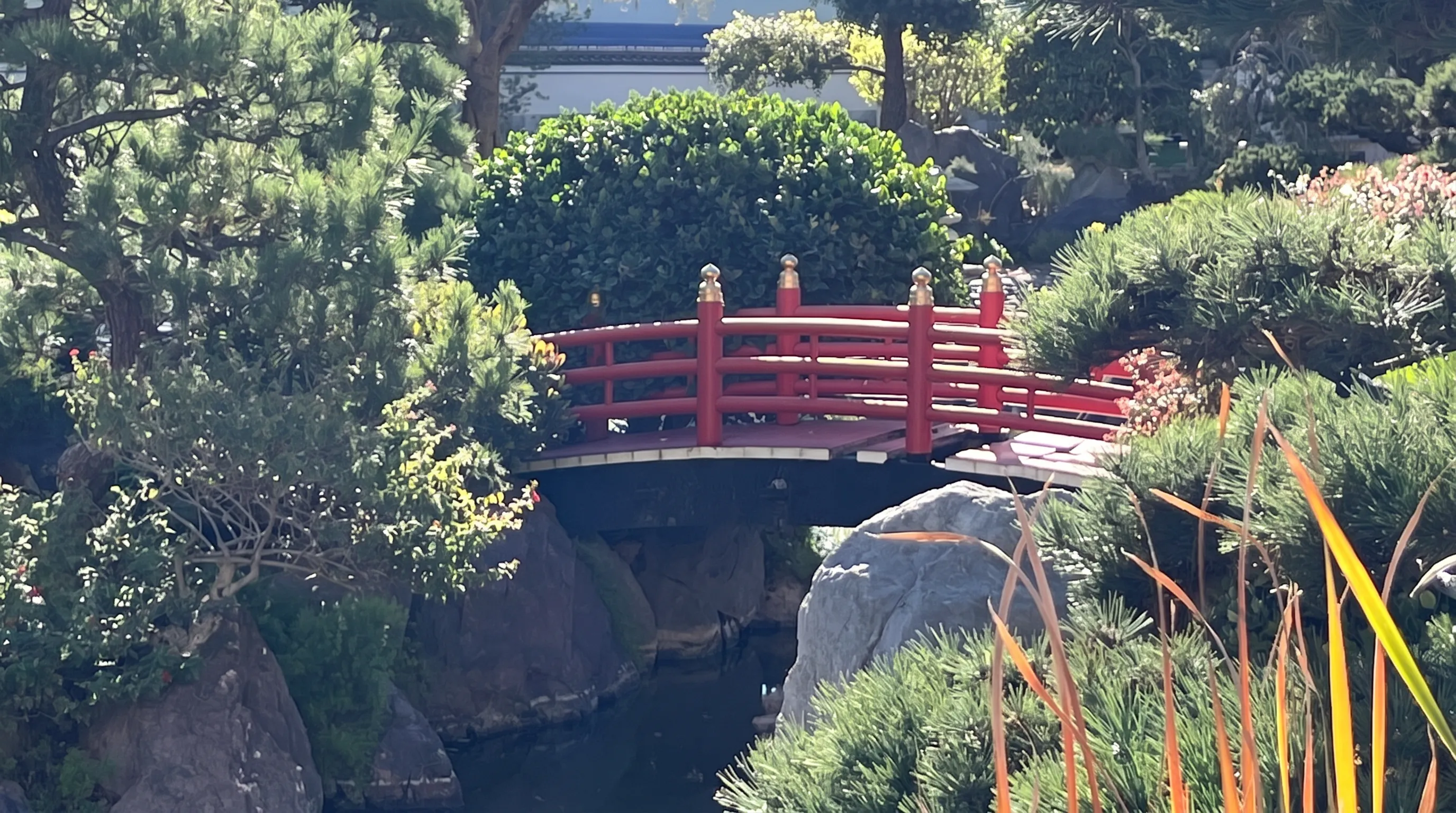
01 The experience
What to expect.
Why it matters
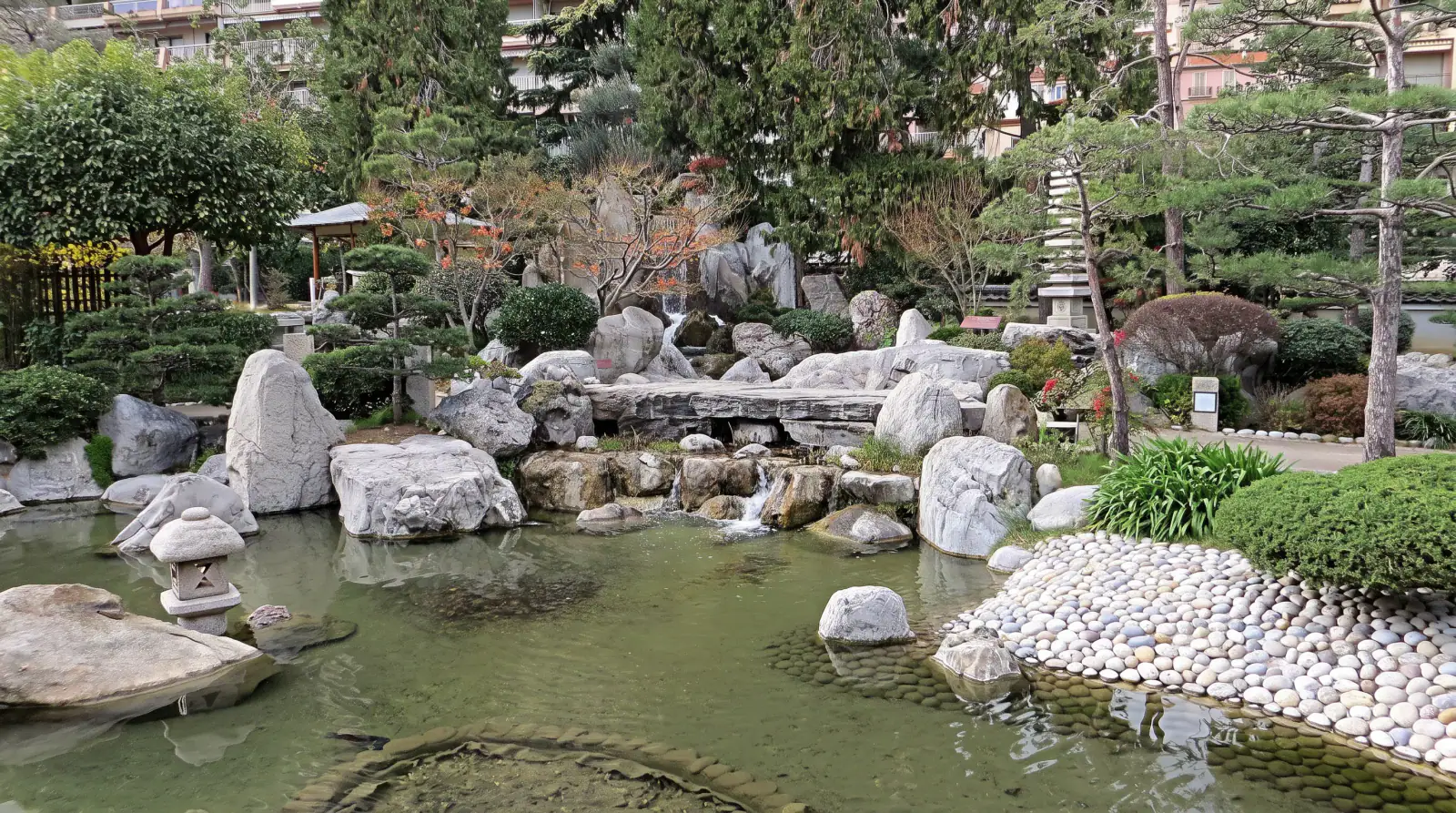
It is a serious garden, not a theme. The rocks are the tell: the stone around the pond and waterfall was brought from Corsica — porphyry and cipolin — and granite from the Auvergne. Nobody ships stone that far for a water feature.
*The tea house is called the Jardin de Grace***, for Princess Grace, who had died twelve years before it opened.
It is the best free half-hour in Monaco. Most visitors give it five minutes on the way to the beach and never notice they are in a designed landscape with rules about where you may stand.
And it is built on a roof. Seven thousand square metres of Zen garden, including 1,100 square metres of water, laid on a concrete slab over the bus station. That is the most Monégasque fact available: when the country needs somewhere contemplative and has no land, it puts it on top of the transport infrastructure.
What visitors should notice
The compression. A Japanese garden stages a whole landscape at small scale — the hill is a mountain, the stream is a river, the pebble beach is a shore. Once you read it that way the site stops being small.
The water. 1,100 square metres of it in a 7,000 square metre garden: ponds, a waterfall, and the stream between them.
The new pagoda, if you have been before. It is the visible part of the Mareterra works on this side of the fence.
Where you are standing. The Grimaldi Forum is on one side and the sea on the other, with Mareterra now beyond it — and a bus station underneath.
Who will enjoy it
- Anyone wanting half an hour of quiet in the middle of Monaco, for nothing.
- Gardeners, and anyone who knows what a Japanese garden is doing.
- Visitors already at Larvotto for the free beach — it is a few minutes away.
- Anyone in Monaco during the Grand Prix: it stays open.
- Photographers, early, before the light goes hard.
Who may find it difficult
- No picnics and no dogs. Both are prohibited, and this is a contemplative garden rather than a park to spread out in.
- It is small. Half an hour, not an afternoon.
- Children who need to run will be asked not to. The free beach next door is the better answer for that.
- The published hours disagree with each other — see Plan your visit.
- Its neighbours are a congress centre and a building programme, so the setting is urban rather than secluded.
Visitor verdict
Half an hour, free, every day of the year including race week. Go early, read it as a landscape rather than a lawn, find the tea house named for Princess Grace and the new pagoda — then walk to the beach, which is free too.
The story
History & character.
A prince's request
The garden exists because Prince Rainier III asked for one. That is the whole origin: not a diplomatic gift, not a twinning, not a corporate commission — a sovereign who wanted a Japanese garden in a country with no room for it.
The designer
The commission went to Yasuo Beppu, a Japanese landscape architect who had won the Grand Prix at the Osaka Flower Show in 1990.
That matters, because it settles what kind of garden this is. Beppu built to strict traditional principles rather than producing a Japanese-flavoured municipal planting: the composition stages a complete natural landscape in miniature — mountain, hill, waterfall, stream, bridge and beach — which is what a Japanese garden is for.
Consecrated before it was finished
In 1992, a Shinto high priest from the Dazaifu shrine in Fukuoka blessed the site.
The blessing came two years before the garden opened, and before construction was complete. It is the detail that separates this from a landscaping project: the ground was consecrated first, and the garden built on consecrated ground.
Built, slowly, on a roof
Preparation alone took more than seventeen months. The garden was created in 1994.
It stands on a concrete slab over the bus station. Seven thousand square metres, of which 1,100 square metres are water — ponds, a waterfall and a stream — carried on a structural deck above municipal transport.
The materials were not local. The rocks and stone blocks around the pond and waterfall came from Corsica — porphyry and cipolin — and granite from the Auvergne. Stone was chosen and shipped for its character, which is how a Japanese garden is built and not how a park is.
The tea house
The tea house is named the Jardin de Grace, in homage to Princess Grace, who had died in 1982 — twelve years before the garden opened.
Mareterra, and what it changed
Mareterra — the six-hectare land extension inaugurated on 4 December 2024 — was built on reclaimed ground immediately seaward of the garden.
The Monégasque government's own account of the works is that the Japanese Garden has been extended and now has a brand new pagoda.
That is worth stating plainly, because Mareterra is otherwise told as pure addition: ground that did not exist before. This is the one place the project reached something already standing, and on the government's account it left it larger.
Look closer
Highlights and hidden details.
The objects, spaces and small observations that turn a visit into a memorable one.1. The composition itself
The garden is one object, and it is the highlight.
Yasuo Beppu staged a complete natural landscape in seven thousand square metres: a mountain, a hill, a waterfall, a stream, a bridge and a beach. Nothing is decorative and nothing is arbitrary — each element stands for a feature of a landscape much larger than the site.
Read it that way and the garden stops being small. Most visitors walk through looking for individual things to photograph and never notice they are inside a single designed idea.
Time required. Half an hour, walking slowly.
2. The water
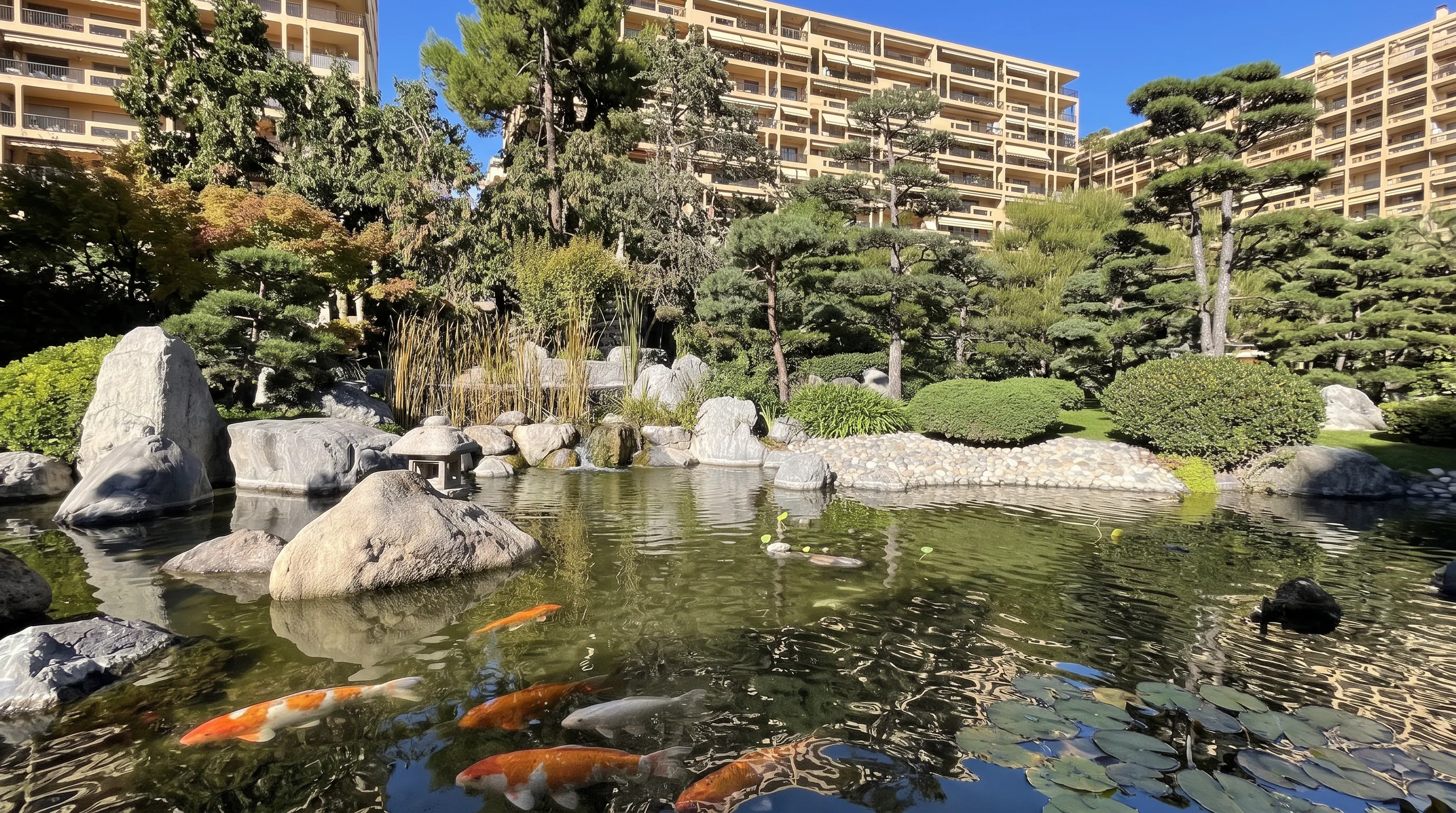
1,100 square metres of it — ponds, a waterfall and the stream that joins them — in a garden of 7,000.
Almost a sixth of the site is water, on a structural slab, in a country that has to import its ground.
3. The stone, and where it came from
The rocks and blocks set around the pond and waterfall were brought from Corsica — porphyry and cipolin — and granite from the Auvergne.
This is the detail that proves the garden is serious. Nobody ships stone across the Mediterranean and down from central France for municipal landscaping. In a Japanese garden the rocks are the structure, chosen individually for character and set as the first move; here they were sourced accordingly.
4. The red bridge
The one piece of strong colour in the whole garden, and the thing most visitors photograph without quite knowing why it works.
A vermilion-red arched wooden bridge with a balustrade of slender posts, curving over a narrow channel of dark water between boulders, framed on both sides by cloud-pruned pines.
Why it is red. Everything else here is green, grey and water. A Japanese garden uses a single saturated accent sparingly and places it where the path will turn you towards it — this is that accent, and it is the reason the garden reads as composed rather than merely planted.
Time required. Two minutes, and it is worth waiting for a gap in the traffic across it.
5. The pebble shore
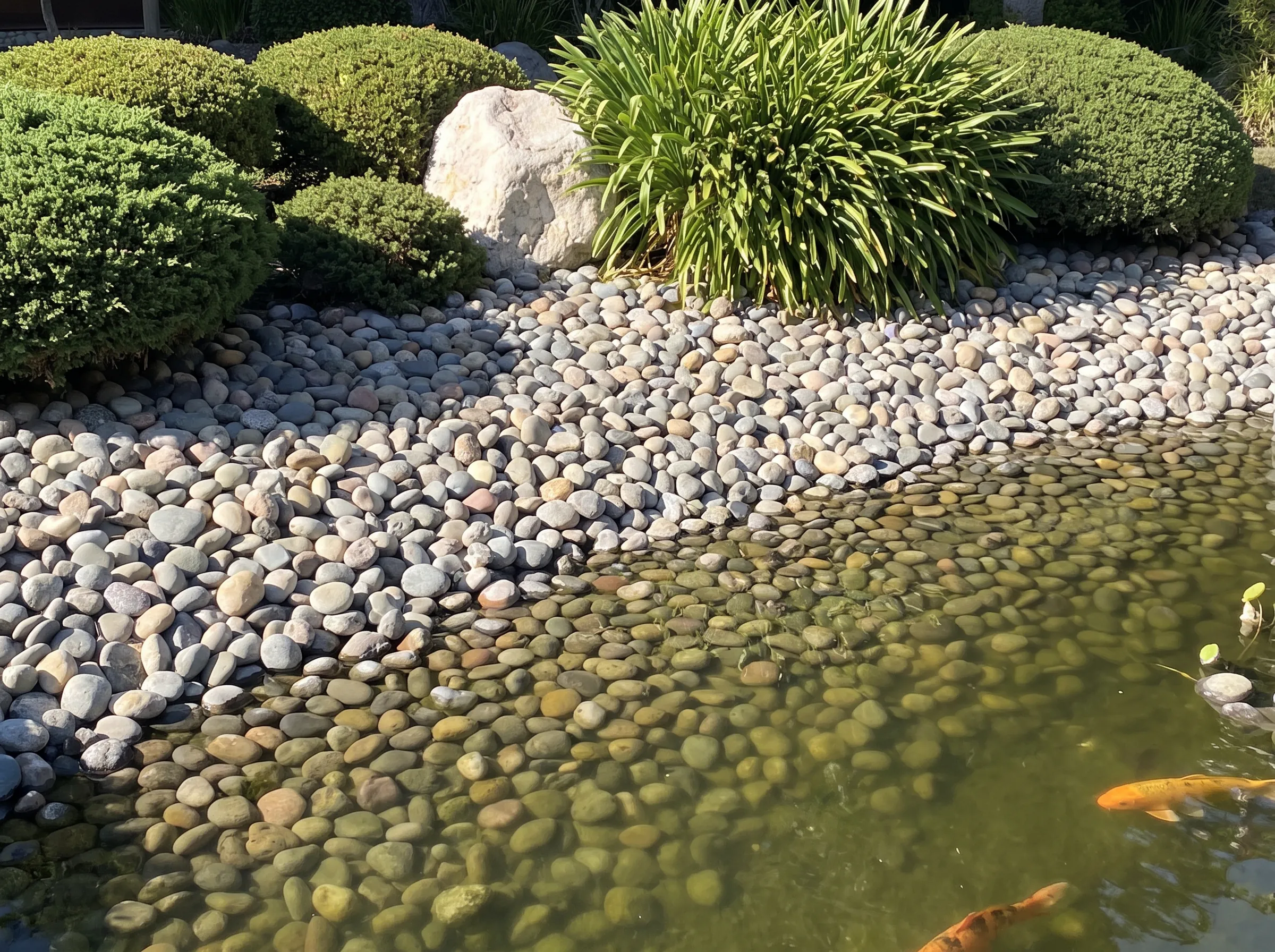
A packed slope of smooth rounded pebbles in grey, cream and ochre running down into the pond and continuing under the water.
It is the "beach" of the miniature landscape — the coast, at the scale the rest of the garden is built to. It is also the clearest single illustration of what a Japanese garden is doing, and almost nobody stops at it.
6. The tea house — *Jardin de Grace*
Named for Princess Grace, who died in 1982, twelve years before the garden opened.
A small, quiet dedication in a country that also named an avenue, a rose garden, a hospital and a theatre for her — and this is the least-known of them.
7. The new pagoda
New since Mareterra. The Monégasque government's account of the works is that the garden was extended and now has a brand new pagoda.
Why it earns a place. Mareterra is told everywhere as pure addition: six hectares that did not exist. The pagoda is the visible proof that the project also reached inland and changed something already here.
If you visited before 2024, this is what is different.
8. The fact underneath everything
You are standing on a roof.
The whole garden — seven thousand square metres, 1,100 of them water, plus imported Corsican stone — sits on a concrete slab over the bus station.
Monaco needed somewhere contemplative and had no land, so it put one on top of the transport infrastructure. Nothing else in the principality states the country's problem and its answer so economically.
9. It is open when everything else is shut
Free, daily, all year — and it does not close for the Grand Prix.
During race week the Jardin Exotique shuts, the Nouveau Musée National shuts, the Condamine market is displaced and half the country is behind fencing. This stays open, and costs nothing.
10. The setting, which is the argument
Grimaldi Forum on one side, the sea on the other, Mareterra beyond it, and a bus station below.
A Zen garden is supposed to shut the world out. This one is surrounded by a congress centre, a land-reclamation project and municipal transport, and still manages it.
Details worth slowing down for.
It was consecrated before it existed
A Shinto high priest from the Dazaifu shrine in Fukuoka blessed the site in 1992 — two years before the garden opened, and before construction had finished.
The ground was made sacred first, and the garden built on it afterwards. That is the correct order for the tradition, and it is the reason this is not simply a themed planting.
Seven thousand square metres on a bus station roof
The entire garden stands on a concrete slab over the bus station. Ponds, waterfall, mature planting, imported rock — all carried on a structural deck above municipal transport.
The rocks came further than most visitors
Corsica for the porphyry and cipolin around the pond and waterfall. The Auvergne for the granite.
In a Japanese garden the stones are set first and everything else is composed around them. Sourcing them from two distant regions is the single clearest evidence that this was built properly rather than dressed up.
The tea house is a memorial
It is called the Jardin de Grace. Princess Grace died in 1982; the garden opened in 1994. The dedication is twelve years after her death and is not signposted with any prominence.
Almost a sixth of it is water
1,100 square metres of the 7,000. On a roof, in a country that reclaims land from the sea because it has none.
The designer had just won at Osaka
Yasuo Beppu took the Grand Prix at the Osaka Flower Show in 1990 and was commissioned for Monaco shortly after. The principality did not hire a local practice to do a Japanese style — it hired the man who had just won the biggest prize in the field.
Seventeen months of preparation
Before the garden opened, more than seventeen months went into preparing it. For a site of seven thousand square metres that is an unusually long lead, and it reflects how much of a Japanese garden is decided before anything is planted.
Mareterra made it bigger, not smaller
Some accounts say the reclamation reduced the garden. The Monégasque government's own account of the finished works says it was extended, and now has a brand new pagoda.
Both may have been true in sequence — ground given up during construction, more returned on completion. The government's is the later account and the one this guide follows.
It stays open for the Grand Prix
The Jardin Exotique closes for the race. So does the Nouveau Musée National. The Condamine market was displaced for the Fan Zone. This garden does not close — free, daily, all year.
The rules are enforced, and they tell you what it is
No picnics. No dogs. Not a park with restrictions, but a contemplative garden that happens to have no gate on it. The absence of a ticket has led a great many visitors to treat it as a shortcut to the beach.
04 / Before you go
Plan your visit
Prices & admission
Free
Opening hours
Free, daily, all year, opening at 09:00 — and it does not close for the Grand Prix, which almost nothing else in Monaco can say. The closing time is genuinely disputed: sources variously give 09:00–19:00 April–October with 09:00–18:00 November–March, a flat 09:00–18:00, and 09:00 to sunset. Treat it as closing around dusk and do not count on a long summer evening. Picnics and dogs are prohibited. Verified 6 August 2026.
Plan your experience
No ticket, no desk, no booking — it is free and open. Note that picnics and dogs are both prohibited.
Participation requirements
No restrictions and no charge at any age. Note that it is a contemplative garden rather than a park — picnics and dogs are prohibited, and there is nothing to climb.
The short answer
Free. Every day. All year. It does not close for the Grand Prix.
Half an hour is the right length. It is on avenue Princesse Grace, between the Grimaldi Forum and the sea, at the Larvotto end of the principality.
What it costs
Nothing. There is no ticket, no desk and no booking.
That is worth stating against the rest of the country: the Oceanographic Museum is €22.50, the Jardin Exotique €12, the Nouveau Musée National €6. This is the free one, and it is not a lesser thing than any of them.
Opening hours
The garden opens at 09:00 daily and is free to enter. Closing times vary; check with the Mairie de Monaco before planning a late-afternoon or evening visit.
The rules, which are real
This is a contemplative garden, not a park, and it is policed as one:
- No picnics. Prohibited.
- No dogs. Prohibited.
- Stay on the paths. The composition is the point and the planting is not bedding.
If you want to eat outdoors or bring a dog, Fontvieille's parks are free, flat and permit both — twenty minutes west.
What you are looking at
A stylised compression of a natural Japanese landscape: mountain, hill, waterfall, stream, wooden bridges, a pebble beach, stone lanterns and statues.
7,000 square metres, of which 1,100 are water.
The tea house is called the Jardin de Grace, for Princess Grace.
The pagoda is new — added when Mareterra was built alongside, on the government's account of the works.
Getting there
Avenue Princesse Grace, at Larvotto. Between the Grimaldi Forum and the sea, on the edge of Larvotto and Mareterra.
On foot it is a flat walk along the seafront promenade from Larvotto beach, or from Mareterra's promenade.
By bus, the Larvotto stops serve it — and the bus station is literally underneath the garden.
Do not drive to it specifically. Parking at this end is expensive and the walk from the beach is two minutes.
When to go
Early morning. It opens at 09:00, the light is still soft, and it is empty — which for a garden designed around stillness is not a small thing.
Avoid the middle of a summer afternoon, when the light is hard and the beach crowd passes through.
During the Grand Prix it is one of the few open, free, quiet places left, and it does not shut.
How long to allow
- Half an hour to walk it properly.
- Five minutes if you only cross it, which is what most people do and why most people miss it.
- A whole morning if you pair it with the free beach and the promenade.
Visit your way
Access and family planning.
The good part
It is free, it is at sea level, and getting to it involves no climb — which in Monaco is rare enough to be the headline. Almost every other attraction in the principality is up a cliff, up a hill, or up 300 steps.
The garden sits on avenue Princesse Grace between the Grimaldi Forum and the sea, on flat seafront ground reached along the promenade from Larvotto beach or from Mareterra. The bus station is directly beneath it, so public transport arrives at the door.
The caution
A Japanese garden is a composition of levels. Mountain, hill, waterfall, stream and beach are staged as changes in height, joined by wooden bridges and paths that step. The site is flat to arrive at and is not flat inside.
What is not published is how much of the circuit is step-free: whether the principal path can be completed without steps, whether the bridges have alternatives, or what the surfaces are.
Ask about the entrance and routes through the garden before visiting if step-free access is essential.
The rules that affect access
- No dogs. The prohibition is general and no exception for assistance dogs is published either way. If you travel with an assistance dog, establish this before you arrive — a blanket "no dogs" notice at the entrance to a free, unstaffed garden is exactly the situation in which a lawful exception is hard to assert on the spot.
- No picnics, which matters if managing blood sugar or medication with food is part of your day. Fontvieille's parks permit both.
Facilities
There are none in the garden — no toilets, no café, no seating beyond the garden's own benches.
The Grimaldi Forum is adjacent and the Larvotto beachfront has toilets and cafés a few minutes away. Both are the practical base.
Who it suits
- Anyone who cannot manage Monaco's hills. This is one of the few destinations that does not begin with an ascent.
- Visitors who need somewhere quiet. It is contemplative by design, has no amplified sound, and is uncrowded outside summer afternoons.
- Anyone needing a free, open, calm hour during the Grand Prix, when it stays open and much else does not.
Facts we do not have
- Whether any complete route through the garden is step-free.
- Whether the bridges have level alternatives.
- Path surfaces.
- Accessible toilet provision nearby.
- The assistance dog position — the most consequential of these.
- Seating quantity and distribution.
All are unpublished rather than confirmed absent. The garden is run by the Mairie de Monaco, a municipal office with a public contact — the same body that runs the Stade Nautique and the Condamine market, and the same one this set has repeatedly noted is answerable by a single call.
Be honest about what this is
It is free, and it is a contemplative garden with rules. Those two facts pull in opposite directions for a family, and it is better to know before you arrive than to be corrected at the waterfall.
No picnics. No dogs. Both prohibited. Children are welcome; children running loose are not really what the garden is for.
Half an hour is the visit. It is not somewhere to spend a morning with young children.
What works
Treat it as a puzzle rather than a park. The garden is a whole landscape shrunk down — a mountain, a hill, a waterfall, a stream, a beach. Ask a child to find all six. It takes about twenty minutes and it turns a walk-through into something they are actually looking at.
The water. Ponds, a waterfall and a stream, over a sixth of the site.
The bridges. Wooden, and the obvious thing to stand on.
The pagoda, which is new, and the stone lanterns.
And the fact underneath it all: they are standing on the roof of a bus station. Seven thousand square metres of garden on top of where the buses go. For the right child that is the best thing in Monaco.
Ages
- Under 5: fine for fifteen minutes, but there is nothing to climb and nowhere to run. The free beach next door is the real destination.
- 5–10: the six-features hunt works well; so do the bridges and the water.
- 11–15: a genuine interest in design or Japan makes it land; otherwise it is a pleasant fifteen minutes.
- Any age: it is free, so there is no cost to trying it.
The pairing that makes the day
The free public beach at Larvotto is a few minutes away, and Mareterra's promenade is on the other side.
Garden first, beach after. Half an hour of quiet is achievable before swimming; it is not achievable after.
Practical
- Free, daily, opens 09:00. Closing time is disputed between sources — treat it as dusk and do not arrive late expecting a long summer evening.
- No toilets or café in the garden. The Grimaldi Forum is adjacent and Larvotto's beachfront has both.
- Flat. Unlike almost everything else in Monaco, no climb — see the accessibility chapter for the caveats.
- Open during the Grand Prix, when much of the principality is fenced off and most attractions close. For a family stuck in Monaco during race week, this is a genuinely useful free hour.
If it doesn't suit
Fontvieille has four hectares of flat free park where picnics and dogs are fine, twenty minutes west. Larvotto beach is free and immediate. Both are better places to let children be loud.
Self-guided walk
Explore beyond the venue.
A practical, step-by-step route connecting this experience with more of Monaco Grand Prix.1. Before you go in
Stand on avenue Princesse Grace and look at where you are.
The Grimaldi Forum on one side. The sea on the other, with Mareterra beyond it — six hectares that did not exist in 2013. Towers behind you.
And a bus station underneath your feet. The entire garden is built on a concrete slab over it.
That is the frame for everything else. A Japanese garden is supposed to shut the world out; this one is doing it in the most built-up country on earth, on a roof.
2. Read the six features
Do not look for individual pretty things. A Japanese garden stages a whole landscape in miniature, and this one, by Yasuo Beppu, has the full set:
mountain · hill · waterfall · stream · bridge · beach
Find all six as you walk. It takes twenty minutes and it converts the visit from a stroll into something you are actually reading.
The hill is a mountain. The pebble shore is a coast. The scale is the whole point.
3. The rocks — stop at the pond and the waterfall
The stones are the structure, set first, with everything composed around them. That is how the tradition works.
These came a long way. Porphyry and cipolin from Corsica; granite from the Auvergne.
Nobody ships stone across the Mediterranean and down from central France to decorate a municipal water feature. This is the evidence that the garden is real, and it is sitting in plain sight where everyone photographs the waterfall without looking at what it is made of.
4. The water
1,100 square metres of the garden's 7,000 is water — ponds, the waterfall, the stream between them.
Almost a sixth of the site, carried on a structural deck, in a country that reclaims land from the sea because it hasn't any.
Stand still at the pond. It is the quietest place in Monaco that costs nothing.
5. The tea house — *Jardin de Grace*
Named for Princess Grace, who died in 1982, twelve years before the garden opened in 1994.
It is not signposted with any prominence, and most visitors pass it without knowing whose name is on it.
6. The pagoda
New. Added when Mareterra was built on the reclaimed ground seaward of here — the government's account of the works is that the garden was extended and now has a brand new pagoda.
If you came here before 2024, this is what has changed. And it matters beyond the object: Mareterra is told everywhere as pure addition, six hectares from nothing. This is the one place the project reached something already standing.
7. One thing to know as you leave
The ground was blessed before the garden was finished.
In 1992, a Shinto high priest from the Dazaifu shrine in Fukuoka consecrated the site — two years before it opened, and before construction was complete.
That is the correct order for the tradition, and it is the difference between this and a themed planting. You have been walking on consecrated ground on top of a bus station.
8. Out to the beach
Larvotto's free public sand is two minutes east, along the promenade rebuilt by Renzo Piano's office and reopened in July 2021.
Mareterra's promenade is the other direction, with *Calder's Quatre lances*** on Place Princesse Gabriella.
Both are free. So was this.
Timing
Half an hour for the garden. A whole morning with the beach and Mareterra.
09:00, when it opens. Soft light, still water, empty paths — and a garden designed around stillness actually still.
It does not close for the Grand Prix, which makes this one of the very few free, open, quiet places in Monaco during race week.
No picnics and no dogs, both prohibited. Fontvieille's parks allow both.
Make a record
Photograph it thoughtfully.
The discipline the garden asks for
A Japanese garden is composed from specific standing points. The paths are laid so that the view opens in a designed sequence — a bridge reveals the waterfall, a turn reveals the pond.
Photograph from where the path puts you, not from where you would like to stand. It is both the courteous approach in a contemplative garden and, more practically, the one that produces the picture the designer built.
Morning, and only morning
It opens at 09:00 and that is the hour to be there. Soft light, still water, and the garden empty before the beach crowd starts crossing it.
By the middle of a summer afternoon the light is hard, the water has lost its reflections, and there are people walking through every frame.
The subjects
The water. 1,100 square metres of it. Still pond surfaces double the composition — shoot low and let the reflection do half the work — and the waterfall wants a slower shutter than you can hand-hold comfortably.
The bridges. Wooden, arched, and the strongest single object in the garden. Shoot along them rather than at them.
The stone. Corsican porphyry and cipolin, Auvergne granite, set as structure rather than ornament. Side light in the early morning brings out the surface; flat midday light makes them grey lumps.
The lanterns and the new pagoda — the pagoda is the newest thing here and almost nobody has photographed it yet.
The tea house, the Jardin de Grace.
The frame that tells the truth
Include the context deliberately, at least once. The Grimaldi Forum on one side, the towers behind, the sea and Mareterra beyond.
A tight crop makes this look like a garden in Kyoto. A wider frame shows what it actually is — a Zen garden wedged between a congress centre, a land-reclamation project and the Mediterranean, on the roof of a bus station. That is the more honest and the more interesting picture, and nobody takes it.
Technical
- A polariser earns its place here more than anywhere else in Monaco: it controls reflections on the ponds and saturates the planting.
- Tripods: think before you set one up. The paths are narrow, the garden is contemplative, and there is no published policy either way — if it is busy, don't.
- Longer lenses compress the planting and hide the towers; wide lenses show the setting. Decide which story you are telling.
Courtesy
Stay on the paths. The planting is composition, not bedding, and the garden is free and unstaffed — which makes visitor behaviour the only thing protecting it.
It is a small, quiet space. A photographer working slowly is conspicuous in a way they would not be in a public park.
Drones
No. Prohibited in Monaco, and this sits between a congress centre, a residential quarter and the sea.
Around here
Make more of the area.
Good to know
Questions, answered.
01Is the Japanese Garden free?
Yes — completely free, every day, all year. No ticket, no desk, no booking.
Against €22.50 at the Oceanographic Museum, €12 at the Jardin Exotique and €6 at the Nouveau Musée National, it is the free one — and not a lesser thing than any of them.
02What are the opening hours?
It opens at 09:00, daily, all year. The closing time is genuinely unsettled: current sources variously give 09:00–19:00 April–October and 09:00–18:00 November–March, a flat 09:00–18:00, and 09:00 to sunset.
Treat it as opening at 09:00 and closing around dusk, and do not count on a long summer evening. The garden is run by the Mairie de Monaco, which is the source to check if it matters.
03Does it close for the Grand Prix?
No. It stays open — which almost nothing else in Monaco does. The Jardin Exotique closes for the race, the Nouveau Musée National closes, and the Condamine market was displaced for the Fan Zone.
For anyone in Monaco during race week, this is a free, open, quiet hour.
04Can I picnic there? Can I bring a dog?
No to both. Picnics are prohibited and dogs are prohibited. It is a contemplative garden rather than a park.
Fontvieille's parks — four hectares, free, flat, twenty minutes west — permit both.
On assistance dogs: no exception is published either way. If you travel with one, establish it before arriving rather than at an unstaffed entrance.
05How big is it, and how long do I need?
7,000 square metres, of which 1,100 are water. Half an hour walks it properly; most visitors give it five minutes and miss that it is a designed landscape.
06Who designed it, and when was it built?
Yasuo Beppu, a Japanese landscape architect who had won the Grand Prix at the Osaka Flower Show in 1990, at the request of Prince Rainier III. The garden was created in 1994 after more than seventeen months of preparation.
07Was it really blessed by a Shinto priest?
Yes — in 1992, by a high priest from the Dazaifu shrine in Fukuoka, two years before the garden opened and before construction had finished.
The ground was consecrated first and the garden built on it, which is the correct order for the tradition and the reason this is not a themed planting.
08Is it a real Japanese garden or a decorative imitation?
A real one. It was designed to strict traditional principles by a prize-winning Japanese landscape architect, the site was ritually consecrated, and the composition stages a complete landscape in miniature — mountain, hill, waterfall, stream, bridge and beach.
The rocks settle the argument: porphyry and cipolin from Corsica, granite from the Auvergne. In a Japanese garden the stones are the structure, set first; nobody imports them that far for decoration.
09Is it true it is built on a bus station?
Yes. The whole garden — all 7,000 square metres, including 1,100 of water and the imported stone — stands on a concrete slab over the bus station.
10Did Mareterra make the garden smaller?
The Monégasque government's account of the finished works is the opposite: the garden was extended, and now has a brand new pagoda.
Some accounts do say the reclamation reduced it. Both may have been true in sequence — ground given up during construction, more returned on completion — and the government's is the later and authoritative account.
11What is the tea house called?
The Jardin de Grace, in homage to Princess Grace, who died in 1982 — twelve years before the garden opened.
12Where is it and how do I get there?
Avenue Princesse Grace, at Larvotto, between the Grimaldi Forum and the sea, on the edge of Larvotto and Mareterra.
Flat walking from Larvotto beach or Mareterra's promenade, and the bus station is directly beneath it. Do not drive to it specifically.
13Is it wheelchair accessible?
Getting there is flat, which in Monaco is unusual and genuinely valuable — no climb, and buses arrive underneath.
Inside is a composition of levels: the mountain, hill, waterfall and stream are staged as changes in height, joined by wooden bridges. How much of the circuit is step-free is not published, and this guide will not guess. There are no toilets in the garden; the Grimaldi Forum and Larvotto beachfront are the nearest.
14Is it worth visiting?
For nothing, half an hour, in the middle of Monaco — yes. It is the best free half-hour in the principality, and the only garden here that is about stillness rather than spectacle.
Pair it with the free beach two minutes away and you have a morning that costs the price of lunch.
Before you visit
Useful links.
Venue and visitor information
Method
Operating status was checked first, as for every bundle since the Chapelle de la Visitation. Here it came back clean — open, free, daily, all year — which is itself worth recording after a run of bundles where it did not.
The research then went after the things a quarter-page summary had not had room for, and found three: the Shinto consecration, the imported stone, and the new pagoda.
One fact resisted settling. The closing time. Three incompatible patterns circulate and the operator's own page was unreachable, so the bundle publishes what is agreed and refuses to invent the rest.
Sources used
| ID | Source | Used for | Retrieved |
|---|---|---|---|
| S01 | Gouvernement Princier / MonServicePublic — *Immersive walk through Mareterra's public spaces* | THE EXTENSION AND THE PAGODA, from the Monégasque government: "the Japanese Garden has been extended and now has a brand new pagoda." Also Mareterra's public realm — 800 trees, 35,000 plants, 9,400 m² of green space, a five-pool fountain network cascading to Larvotto, a rainwater watering basin and a retention basin | 2026-08-06 |
| S02 | Current garden coverage, including visitmonaco.com — The Japanese Garden and japonjardin.fr | THE FOUNDING: created 1994 at the request of Prince Rainier III, to strict Zen principles, by the landscape architect Yasuo Beppu, winner of the Grand Prix at the Osaka Flower Show in 1990. The site blessed in 1992 by a Shinto high priest from the Dazaifu shrine in Fukuoka, before construction was complete. 7,000 m² with 1,100 m² of water. Its position between the Grimaldi Forum and the sea, on the edge of Larvotto and Mareterra | 2026-08-06 |
| S03 | Garden and regional listings, including parcsetjardins.fr and sortir06 | THE COMPOSITION AND THE MATERIALS: that the garden is a stylised copy of Japanese nature — mountain, hill, waterfall, bridge, beach and stream; that the *tea house is named Jardin de Grace* in homage to Princess Grace; and that the rocks and stone blocks around the pond and waterfall come from Corsica (porphyry and cipolin) and the Auvergne (granite). Also ponds, waterfalls, wooden bridges, lanterns and statues, and the prohibitions on picnicking and dogs** | 2026-08-06 |
| S04 | Above Guide's own larvotto bundle | The verified coordinates (43.742274, 7.431074, OSM way/157719658); that the garden is built on a concrete slab over the bus station; that preparation took more than seventeen months; that it does not close for the Grand Prix; and the seasonal hours pattern recorded in the conflict ledger. Also the Grimaldi Forum's inauguration on 20 July 2000 and its 6,000 m² extension in January 2025, and the Larvotto promenade rebuilt by Renzo Piano Building Workshop with Michel Desvigne, reopened July 2021 | 2026-08-06 |
| S05 | Above Guide's own mareterra bundle | Mareterra's inauguration on 4 December 2024, its six hectares, and the full documented provenance of *Alexander Calder's Quatre lances*** on Place Princesse Gabriella | 2026-08-06 |
| S06 | Mairie de Monaco | ATTEMPTED AND UNAVAILABLE. The Mairie operates the garden and is the authority for its hours and rules. Its page returned HTTP 500 during this research, which is why the closing time is left unresolved rather than settled | 2026-08-06 |
Where sources disagree
The closing time — NOT RESOLVED, and said so
Three patterns, all current:
| Pattern | Where |
|---|---|
| 09:00–19:00 April–October; 09:00–18:00 November–March | S04, the seasonal version this project already carried |
| 09:00–18:00 daily | S02 and current 2026 listings |
| 09:00 to sunset | S03 and other listings |
All three agree: opens 09:00, daily, all year, free. The disagreement is only the close.
Used: the 09:00 opening and daily/year-round pattern as fact; the closing time as disputed, with readers told to treat it as dusk and not to count on a long summer evening.
13-operational-data.json and 12-seo.md both forbid emitting a closing time in structured data. Publishing one of three would be guessing, and an hours property is exactly where a guess does damage.
S06 would settle it and was unreachable.
Did Mareterra shrink the garden or enlarge it? — RESOLVED, WITH THE CONFLICT KEPT
Secondary coverage states that, with Mareterra built on reclaimed land in front of it, the garden's surface was partially reduced.
S01, the Monégasque government's own account of the completed public-space works, states the opposite: the garden has been extended and now has a brand new pagoda.
Used: extended, with a pagoda. S01 is the operator of the works, is later, and describes the finished state rather than the construction period.
Both may have been true in sequence — ground given up while the reclamation was under way, more returned on completion — and the bundle says so rather than flatly contradicting the other account. It is recorded in the history, the highlights, the hidden details and the FAQ.
Why it matters beyond this page. Mareterra is described everywhere as pure addition, six hectares from nothing. This garden is the one thing already standing that the project reached. That correction now appears in the mareterra and larvotto bundles as well.
Facts deliberately not asserted
| Fact | Where this guide says so |
|---|---|
| A closing time | Plan your visit, FAQ, operational data, SEO |
| Whether assistance dogs are exempt from the no-dogs rule | Accessibility, FAQ, operational data |
| Whether any complete route through the garden is step-free | Accessibility, FAQ |
| Whether the bridges have level alternatives | Accessibility |
| Path surfaces | Accessibility |
| Accessible toilet provision nearby | Accessibility |
| A tripod or photography policy | Photography |
The assistance-dog question is the one that matters. A blanket "no dogs" at a free, effectively unstaffed garden is precisely the situation where a lawful exception is hard to assert on the spot, and no source states the position either way. The accessibility chapter tells affected readers to establish it before travelling rather than at the entrance.
All of these are answerable by the Mairie, the same municipal office behind the Stade Nautique and the Condamine market — a body this set has now noted three times is reachable by one call.
A note on this bundle's status
This entity was promoted out of the `larvotto` bundle, which previously owned it and carried a full highlight. Larvotto's coverage has been reduced to a pointer in the same pass.
The material above is why: a quarter page could carry the size, the date, the designer and the price, but not the consecration, the stone, the seventeen months, the tea house dedication, the three-way hours conflict and the pagoda.
Opening hours, prices, programmes and access arrangements can change. Confirm critical details with the venue.
Continue exploring / Monaco
More things to do
in Monaco
Explore Monaco activities, sights and places to eat. Compare the time to allow, costs and booking details, then save your favourites to your itinerary.
 01Monaco Grand Prix experienceCasino de Monte-CarloExplore experience →
 02Monaco Grand Prix experienceCathedral of Notre-Dame-ImmaculéeExplore experience →
 03Monaco Grand Prix experienceFontvieilleExplore experience →
 04Monaco Grand Prix experienceFort AntoineExplore experience →
 05Monaco Grand Prix experienceGrimaldi ForumExplore experience →
 06Monaco Grand Prix experienceJardin Exotique de MonacoExplore experience →
 07Monaco Grand Prix experienceLa CondamineExplore experience →
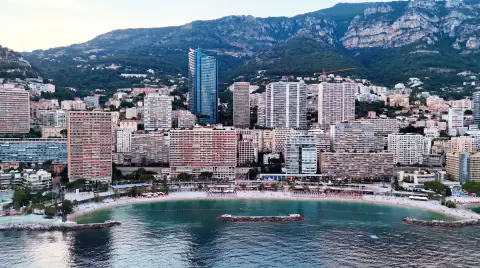 08Monaco Grand Prix experienceLarvottoExplore experience →
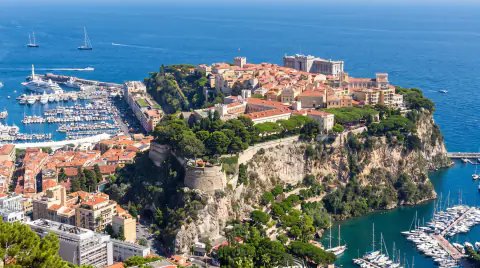 09Monaco Grand Prix experienceLe Rocher / Monaco-VilleExplore experience →
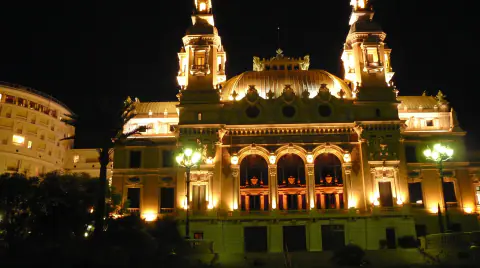 10Monaco Grand Prix experienceLes Ballets de Monte-CarloExplore experience →
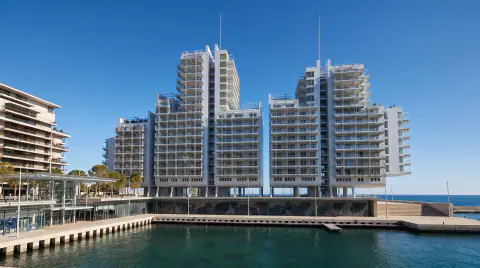 11Monaco Grand Prix experienceMareterraExplore experience →
 12Monaco Grand Prix experienceMonte-CarloExplore experience →
 13Monaco Grand Prix experienceNouveau Musée National de MonacoExplore experience →
 14Monaco Grand Prix experienceOceanographic Museum of MonacoExplore experience →
 15Monaco Grand Prix experienceOpéra de Monte-CarloExplore experience →
 16Monaco Grand Prix experiencePrince's Palace of MonacoExplore experience →
 17Monaco Grand Prix experienceThe Museum of Old MonacoExplore experience →
 18Monaco Grand Prix experienceThe Museum of Stamps and CoinsExplore experience →
 19Monaco Grand Prix experienceThe Prince's Car CollectionExplore experience →
 Plan / Itinerary builderBuild your Monaco Grand Prix dayStart planning →