In depth
Oceanographic Museum of Monaco
Prince Albert I's museum of the sea, built into an 85-metre cliff and opened in 1910: one of the world's oldest aquariums, a working turtle hospital, and the instruments from twenty-eight scientific campaigns.
Story · Visit · Route · Links
Choose your depth
Essentials or more detail?
See visiting essentials, or read more about the history and places nearby.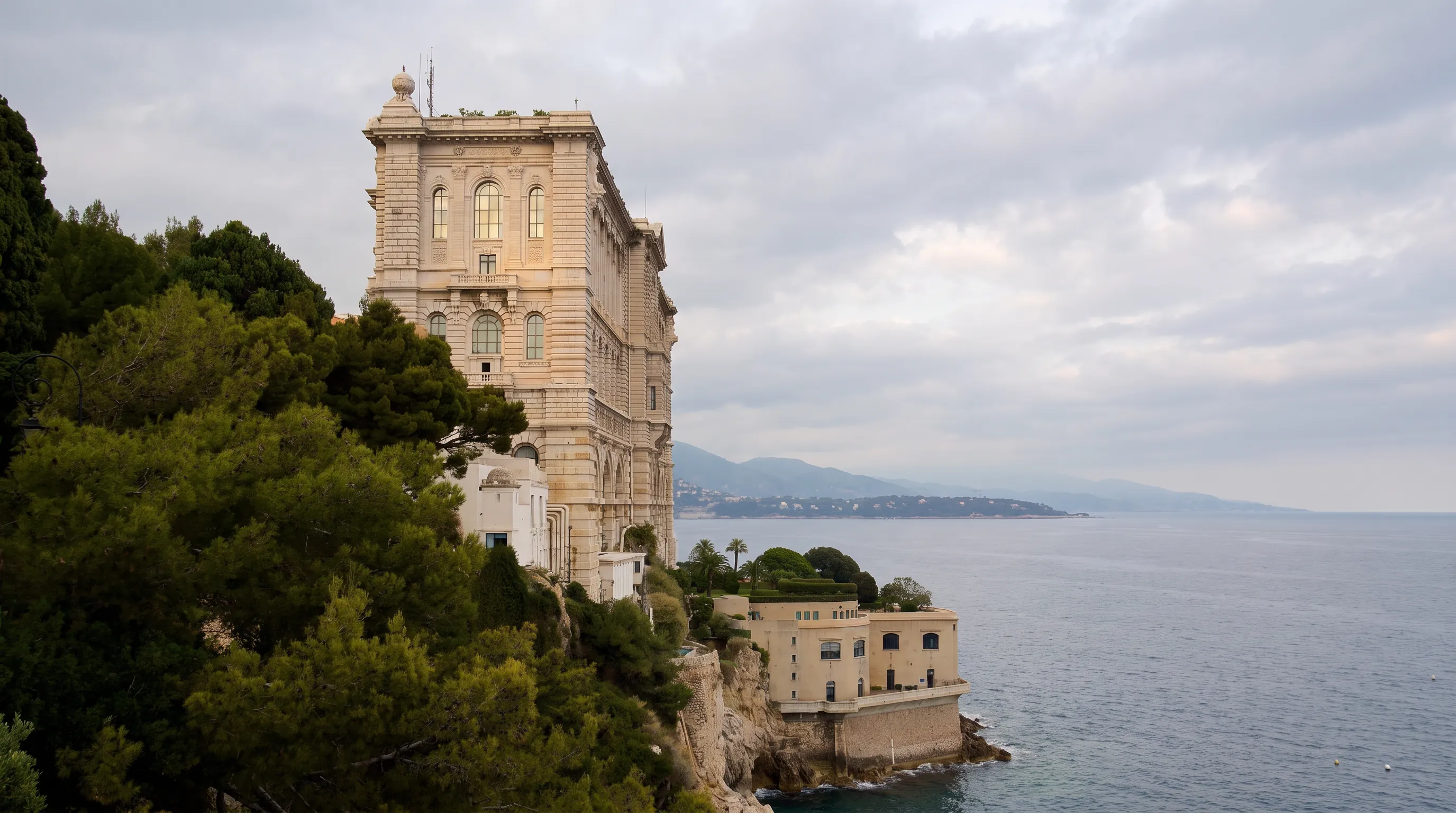
01 The experience
What to expect.
Why it matters
Three reasons, in ascending order of interest.
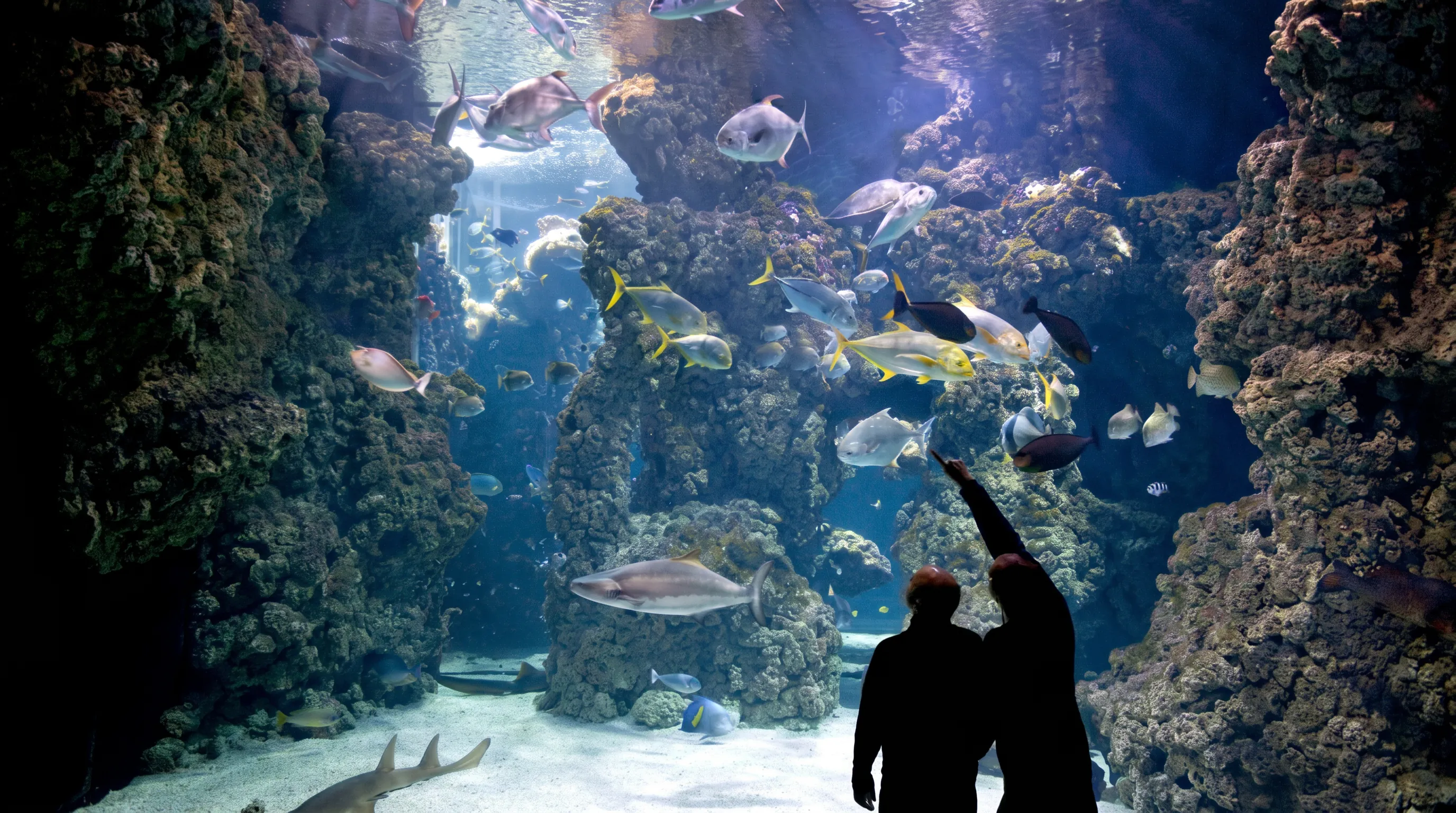
It is a serious aquarium. One of the oldest in the world, holding roughly 6,000 fish among some 350 species, with a Mediterranean section, a tropical reef, a fluorescent coral display, and a nursery that breeds seahorses, clownfish and the endangered Banggai cardinalfish as part of an international programme. One Mediterranean resident is over sixty years old.
It is a working conservation centre. The Sea Turtle Odyssey, opened in 2019, is 550 m² of open-air facility with a 160 m³ rehabilitation basin where the Centre Monégasque de Soins des Espèces Marines treats injured and stranded turtles before returning them to the sea. Visitors are looking at live casework, not a display.
It is a museum of the history of ocean science, and that is the part almost nobody sees. The upper floor holds Albert I's instruments, the Whale Room, and Oceanomania — an 18-metre by 10-metre wall of skeletons, fossils, models, diving suits and precious books assembled in 2011 by the American artist Mark Dion as the largest cabinet of curiosities in the marine world.
What visitors should notice
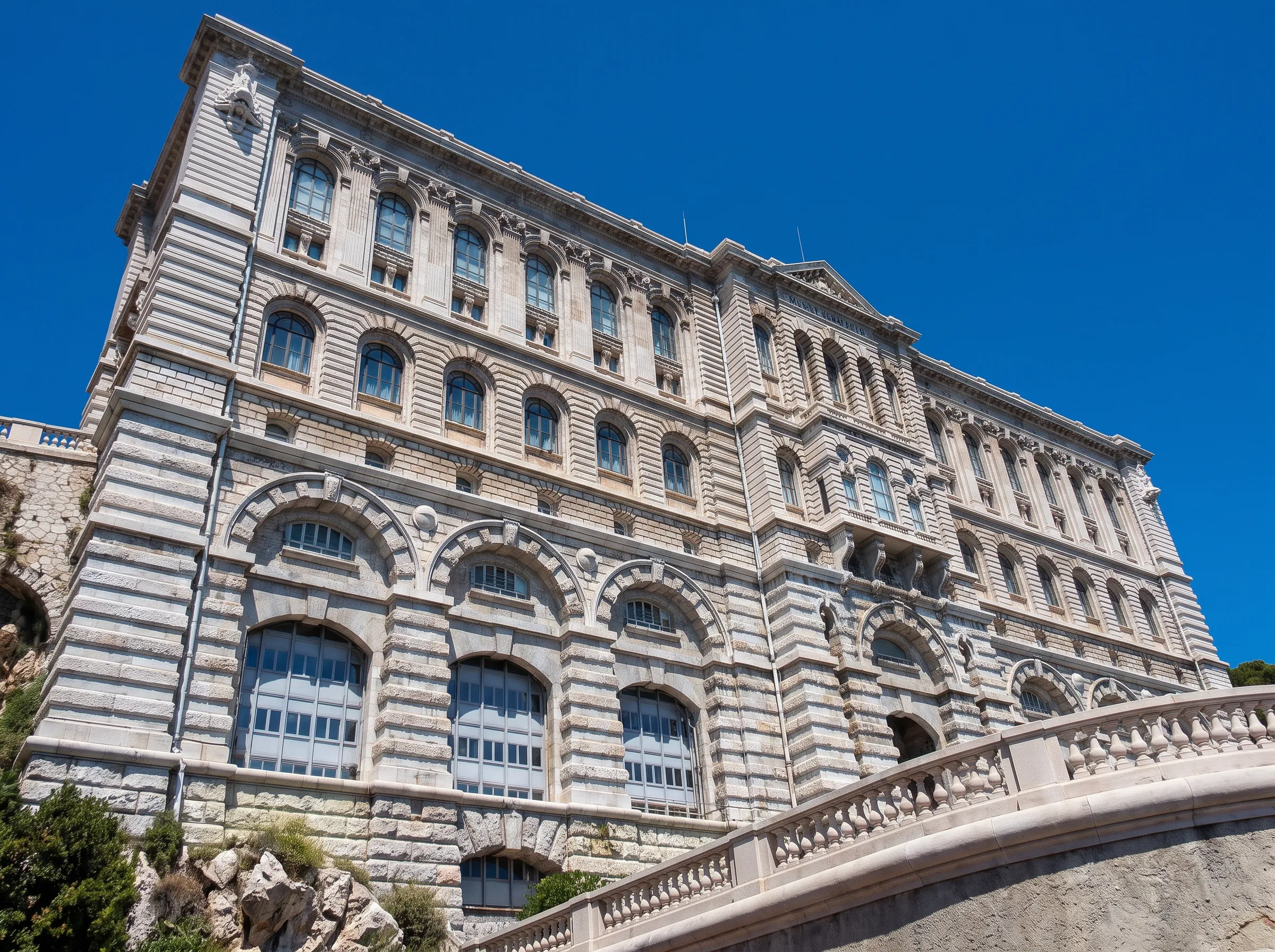
Read the façade before you go in. The names carved into it are oceanographic research vessels, chosen by Albert I — a building signing the credits of its own discipline.
Inside, notice the direction of travel the museum wants you to take and consider reversing it if you have children: the aquarium is below, the history is above, and a tired seven-year-old will not make it back up.
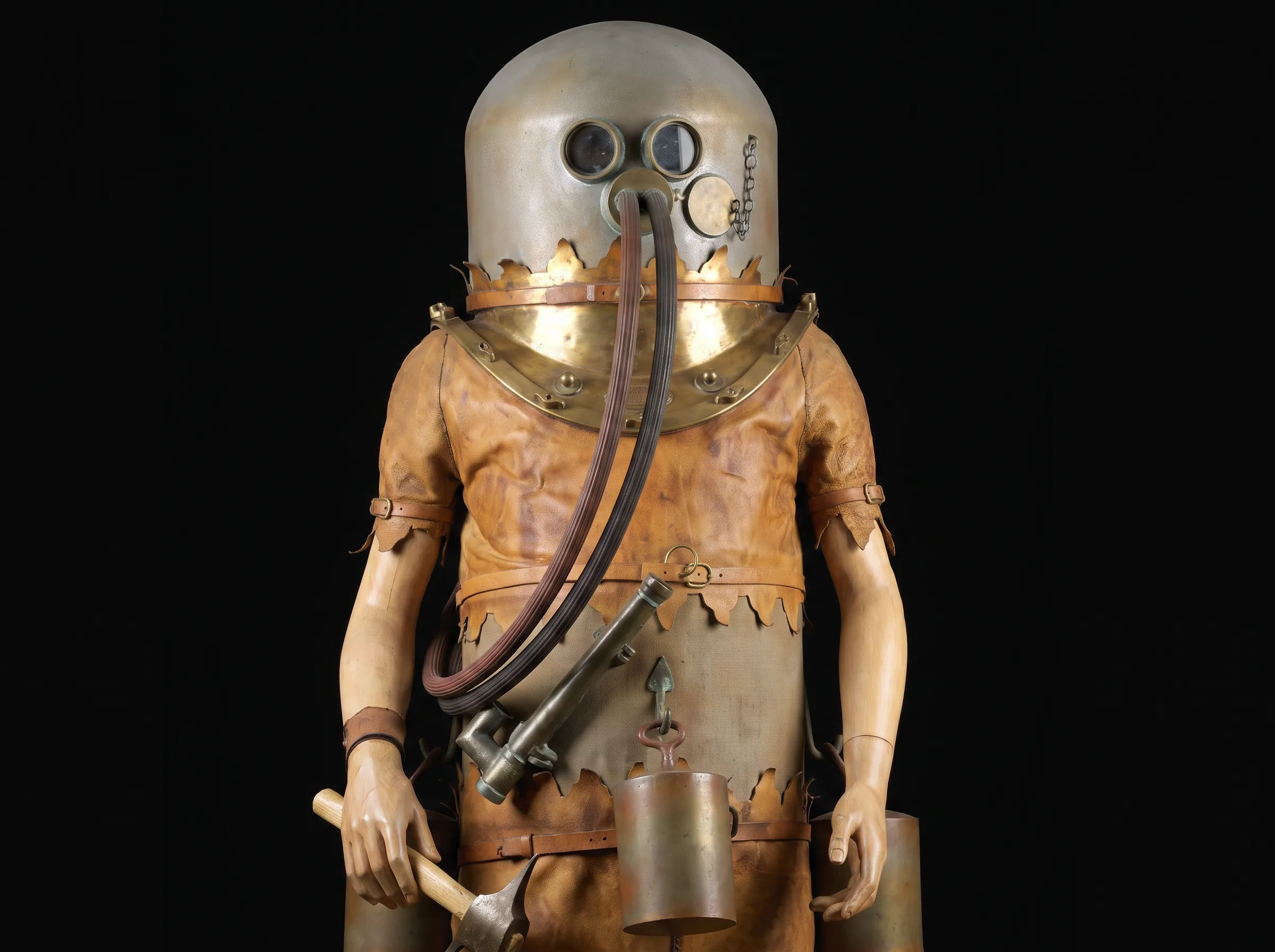
In Oceanomania, find the Klingert diving suit of 1797, which let a man breathe at around twelve metres, and the naturalised polar bear from the west coast of Greenland. In the Mediterranean tanks, look for the octopus and the brown grouper rather than sweeping past to the sharks.
Who will enjoy it
Families, unreservedly — this is the strongest children's attraction in Monaco. Anyone interested in the history of science, who will find more here than the signage advertises. Divers and sailors. Photographers, for the terrace and the building. And anyone who wants two hours indoors when the Rock is too hot or too wet to walk.
Who may find it difficult
It is busy. Around 650,000 people come each year, concentrated into the middle of the day in season, and the aquarium levels are dim, echoing and crowded at those hours.
It is expensive by museum standards: €22.50 for an adult, €14 for a child aged four to seventeen, so a family of four is a real outlay. The annual pass at €46 adult and €29 child is worth a moment's arithmetic if you are in the region again.
The building is on a cliff and is entered from the top, which means the visit descends and then climbs. Lifts and adapted pathways exist throughout and wheelchairs can be borrowed, so this is manageable — but it is not a flat museum.
And it closes for the Formula 1 Grand Prix weekend, along with Christmas Day. That is the opposite of what a visitor planning a race-week day expects.
Visitor verdict
The best two hours in Monaco and the one attraction that would still be worth the journey if the principality had nothing else. Go early, go down to the aquarium first while it is quiet, come up through the collections rather than skipping them, and finish on the terrace. Give it the two hours the museum asks for.
The story
History & character.
A prince who went to sea
The museum exists because Albert I of Monaco was a working oceanographer who happened to be a head of state, rather than a head of state who took an interest in the sea.
He led twenty-eight scientific campaigns, from Cape Verde to the Arctic, developing equipment as he went because the equipment he needed did not yet exist. The instruments displayed in the upper galleries are not replicas or representative examples: they are the prototypes his crews used, which is why the collection is described as the richest of its kind anywhere.
He founded the Institut océanographique in 1889 to hold and publish what the campaigns produced. The institute was conceived with two homes — one in Paris for teaching, one in Monaco for the collections and the public — and the Monaco half is this building.
1899–1910: building into a cliff
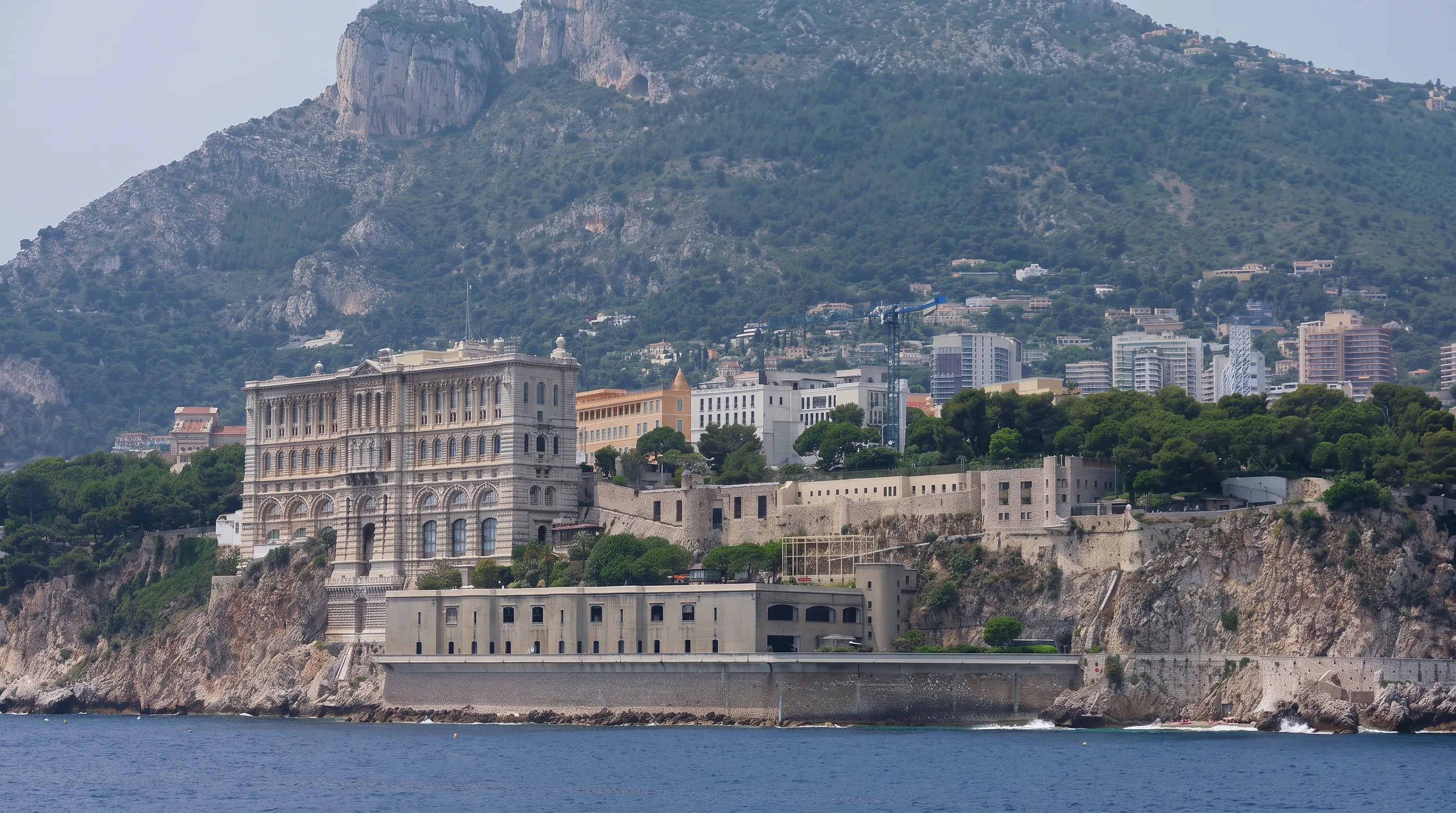
The first stone was laid on 25 April 1899, on the seaward flank of the Rock, where there was no level ground at all. That was the point. Albert I wanted the museum to face the sea it was about, and the only way to do it was to build up the cliff from close to the waterline.
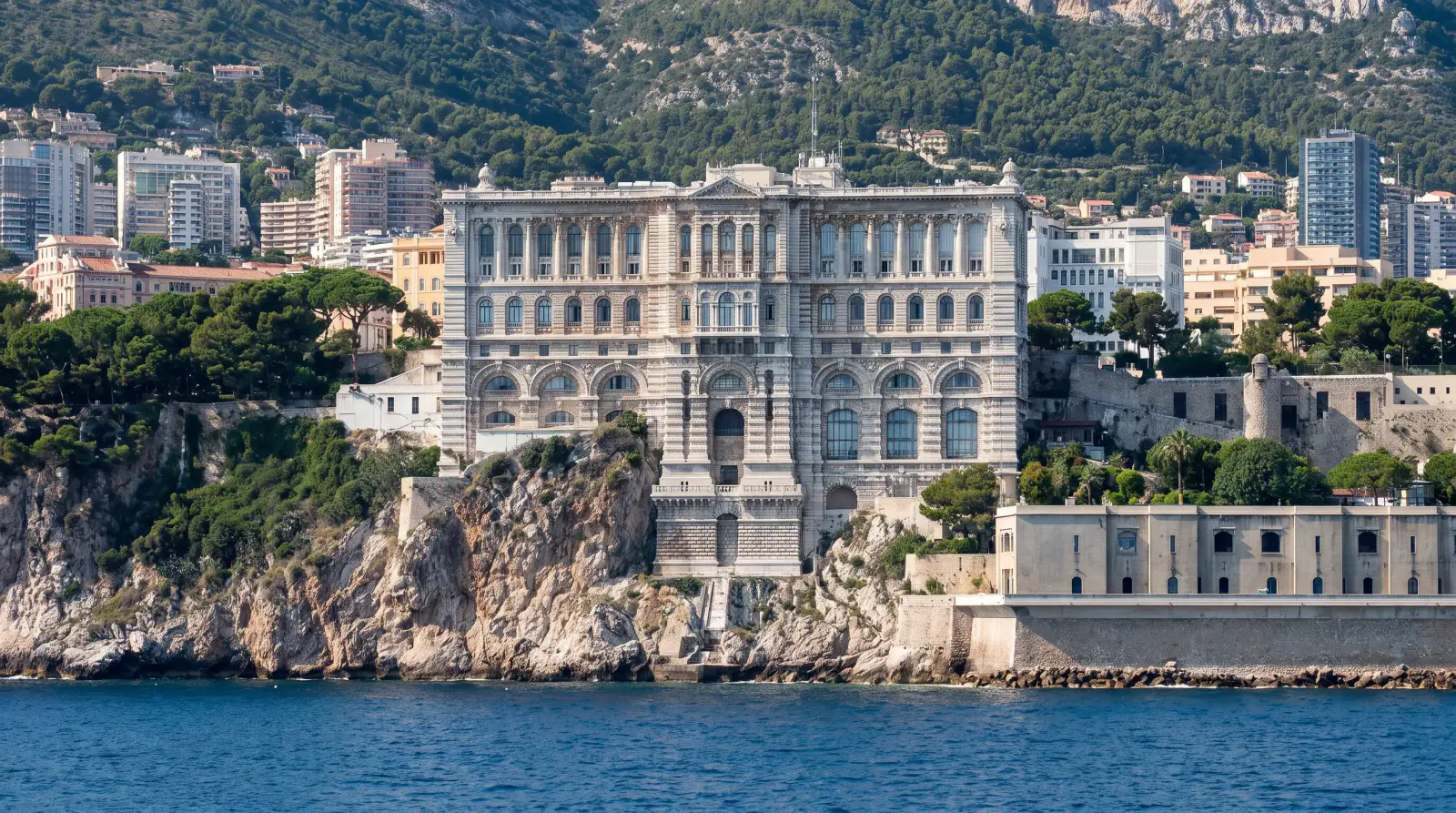
Paul Delefortrie, a French architect, designed a neo-Baroque palace-museum 100 metres long that rises 85 metres from the water. The masonry is white stone from La Turbie — the same quarry above Monaco that had supplied the cathedral being built at the same moment — with limestone from Brescia. Construction took about eleven years.
The sculpture came first. The two allegorical groups on the main façade, Le Secours and Le Progrès venant au secours de l'Humanité, by Gustave Dussart, were inaugurated on 25 February 1903, seven years before the museum opened.
Carved into the façade are the names of oceanographic research vessels, chosen by Albert I himself. It is worth pausing on what that means: at the moment the discipline was being assembled, the prince who was assembling it put the working fleet's names on the front of the building rather than his own.
The official inauguration was on 29 March 1910.
1900–1945: Jules Richard and the long first chapter
Jules Richard directed the institution from 1900 — a decade before the doors opened — until 1945. Forty-five years, spanning the museum's construction, its opening, Albert I's death in 1922 and two world wars.
That continuity is the reason the historical collections survive intact. A museum whose founder dies twelve years after it opens can easily drift; this one had someone who had been there from before the beginning.
Jules Rouch followed, from 1945 to 1957.
1957–1988: Cousteau
Jacques-Yves Cousteau directed the museum for thirty-one years. He arrived in 1957, already famous, and stayed until 1988.
This is the period that made the institution internationally known rather than scientifically respected, and the two are different things. Cousteau's tenure overlapped with the era in which the public first saw the sea on film, and the museum was the shore establishment behind a great deal of that. The Calypso, the ship he commanded, is represented in the museum's displays.
It is also the period that shaped how most visitors still arrive: expecting Cousteau's aquarium, and needing to be told about Albert I's instruments.
1989–2009: five directors in twenty years
François Doumenge (1989–2001), Michèle Dufrenne (2001–2004), Jean Jaubert (2004–2007) and the explorer Jean-Louis Étienne (2007–2008) followed in comparatively quick succession, before Robert Calcagno became Director General in 2009 and has led the institution since.
Visitor numbers over the same stretch tell their own story: about 970,000 in 1991, 725,061 in 1996, and roughly 650,000 today. The museum has become less of a mass attraction and more of a considered one — which, given what is upstairs, is not obviously a loss.
2010 onwards: the centenary and the reinvention
Prince Albert II marked the museum's centenary in 2010 with an extensive renovation programme, and the decade that followed changed what the building does.
Oceanomania, 2011. The American artist Mark Dion was commissioned to build a cabinet of curiosities for the marine world on the first floor. The result is a wall 18 metres wide and 10 metres high holding skeletons, fossils, models, diving suits, chimeras and precious books — among them a naturalised polar bear from the west coast of Greenland and a diving suit built by Karl Heinrich Klingert in 1797, which allowed a man to breathe at around twelve metres. It is a nineteenth-century museum idea executed as a twenty-first-century artwork, inside a building that belongs to both.
Monaco and the Ocean. A 27-metre installation shaped as a ship, telling a century of Monégasque ocean policy through three princes: Albert I and his campaigns, Rainier III and his work with Cousteau on the Mediterranean, and Albert II's contemporary commitments. It carries optical theatres, touch screens and collaborative games for up to twenty people at once.
The Sea Turtle Odyssey, 2019. A 550 m² open-air facility reached from the aquarium, where the Centre Monégasque de Soins des Espèces Marines treats injured, stranded and endangered sea turtles. Animals in treatment pass through a 160 m³ open-air rehabilitation basin to test their fitness before release. It is the clearest statement the museum has made about what it now thinks it is for.
Méditerranée 2050, from 29 March 2025. An immersive exhibition across more than 1,000 m² and four spaces, including an interactive route through ocean exploration from 1885 to the present and a large-scale projection imagining a Mediterranean marine protected area in 2050. It had passed 800,000 visitors by mid-2026.
Look closer
Highlights and hidden details.
The objects, spaces and small observations that turn a visit into a memorable one.1. The seaward façade
Before you go in, get to a point where you can see the building from below — the coastal path, a boat, or the parapet on the way up from the Parking des Pêcheurs.
What it is. Paul Delefortrie's neo-Baroque front, 100 metres long, rising 85 metres from the water up a sheer cliff in white La Turbie stone and Brescia limestone. From the sea it reads as a ship stopped against the rock, which was the intention.
What to look for. The two allegorical sculptural groups by Gustave Dussart, Le Secours and Le Progrès venant au secours de l'Humanité, unveiled on 25 February 1903 — seven years before the museum opened. And the names carved across the front: oceanographic research vessels, chosen by Albert I. A building signing the credits of its own discipline.
Time required. Ten minutes, and it is free.
2. The shark lagoon
The set piece of the aquarium and the thing most visitors come for.
What it is. A six-metre-deep tank behind glass thirty centimetres thick, held at that thickness to take the water pressure while staying clear enough to see through. Several shark species, viewed from beside and below rather than from above.
How to see it properly. Go early. Between about 10:30 and 15:00 in season you will be looking at it over shoulders. Stand to one side rather than head-on: the reflections are worst square to the glass, and the sharks pass closest at the corners.
Time required. Fifteen minutes, longer if you let a full circuit go past.
3. The Mediterranean tanks
Easy to walk through on the way to the sharks, and the more interesting half of the aquarium if you slow down.
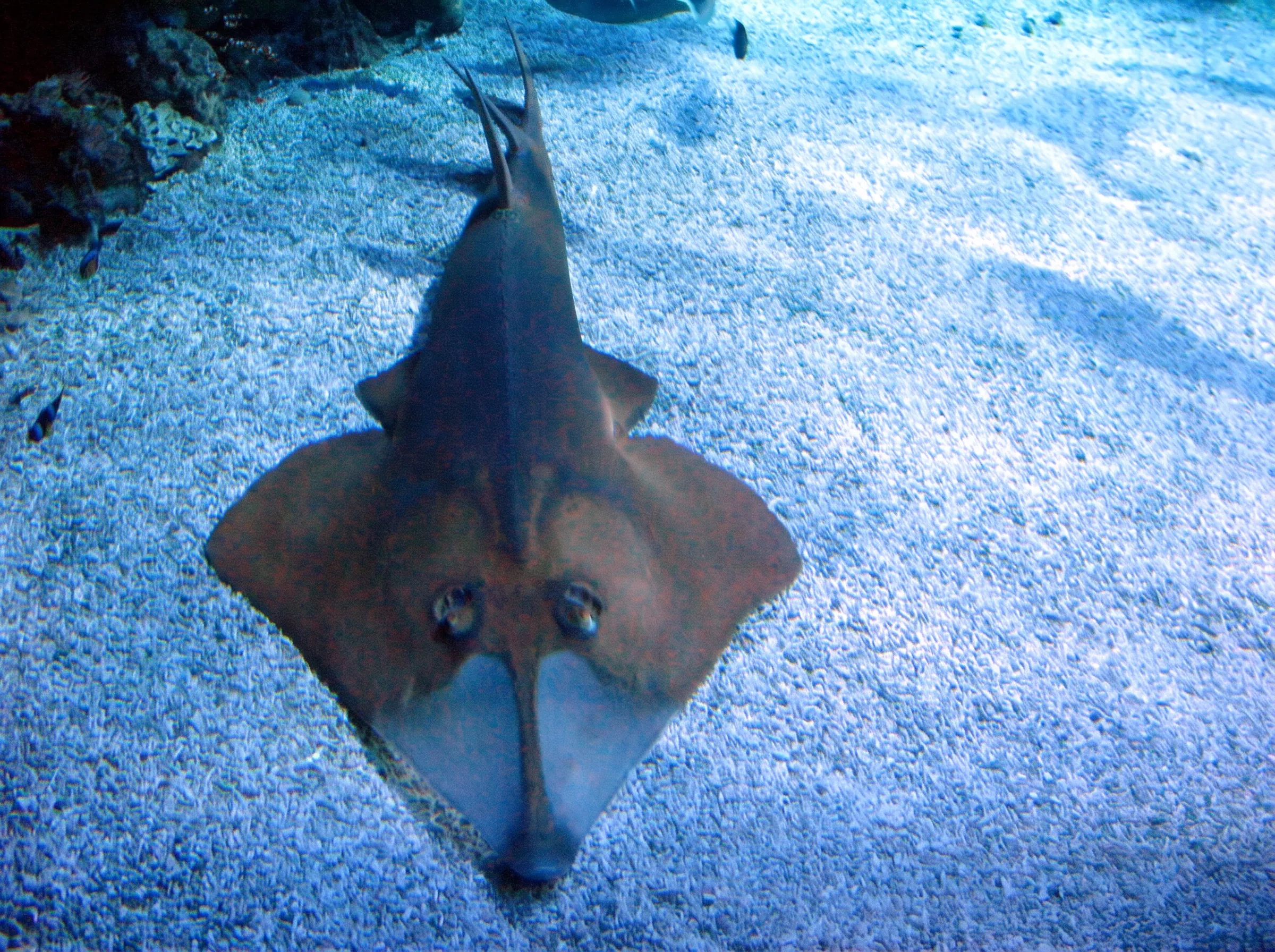
What to look for. Species that change sex during their lives. The octopus, which the museum fairly calls the king of illusionists. Protected species including the brown grouper and the sea cicada. And one resident that is over sixty years old — older than most people reading its label.
The point of this section is that it is local. Everything in it lives in the water you can see from the terrace upstairs.
Time required. Twenty minutes.
4. The tropical seas and the fluorescent corals
What it is. A coral reef section showing species living in close interdependence for shelter and feeding, and a separate display of fluorescent corals whose pigments make them glow under the right light.
Why it matters here. The museum's nursery breeds for conservation rather than display — young seahorses, juvenile clownfish and royal grammas, and the Banggai cardinalfish, an endangered Indonesian endemic bred here as part of an international programme. Some of what you are looking at was born on site.
Time required. Twenty minutes.
5. The Sea Turtle Odyssey
What it is. A 550 m² facility, partly open air, reached from the aquarium, where the Centre Monégasque de Soins des Espèces Marines cares for injured, stranded and endangered sea turtles. Animals in treatment swim in a 160 m³ open-air basin that tests whether they are fit to go back to sea.
Why it matters. These are patients, not exhibits. The turtles are here because something happened to them, and the ones that recover leave. It opened in 2019 and it is the clearest statement the museum has made about what it now thinks it is for.
Time required. Twenty-five minutes. Longer with children, who tend to stay.
6. Oceanomania
The best thing in the building and the one most visitors never reach, because it is upstairs and they have already spent their attention below.
What it is. A wall eighteen metres wide and ten metres high on the first floor, holding skeletons, fossils, models, diving suits, chimeras and precious books. It is the largest cabinet of curiosities in the marine world, and it was built in 2011 by the American artist Mark Dion — a contemporary artwork in the form of a nineteenth-century museum, inside a building that belongs to both.
Two things to find. The naturalised polar bear from the west coast of Greenland. And the diving suit built by Karl Heinrich Klingert in 1797, which allowed a man to breathe at around twelve metres — an object from the very beginning of the idea that people might go down and come back.
Time required. Twenty-five minutes, and it repays more.
7. Albert I's instruments and the Whale Room
What it is. The historical collections: more than 60,000 objects in total, of which the instruments are the significant part. The museum holds the richest collection of oceanographic instruments in the world, containing the prototypes used across Albert I's twenty-eight campaigns.
Alongside them, the Whale Room and its sperm whale skeleton, plus the ethnographic material — a Marseille longliner, a Madagascar pirogue, fishing gear from a period when fishing was a way of eating rather than a way of trading.
Why it matters. These are not representative examples of period equipment. They are the actual devices, many of them made because nothing suitable existed, from the campaigns that helped establish the discipline.
Time required. Twenty-five minutes.
8. Monaco and the Ocean
What it is. A 27-metre installation built in the shape of a ship, telling a century of Monégasque ocean policy through three princes — Albert I and his campaigns, Rainier III and his work with Cousteau on the Mediterranean, and Albert II's present-day commitments.
Why it works. It is the most heavily interactive space in the museum — optical theatres, touch screens, and collaborative games that up to twenty people can play at once. It is also where the museum makes its argument rather than just showing its collection.
Time required. Twenty minutes, and it is the best room in the building for teenagers.
9. The roof terrace
What it is. The roof of the museum, 85 metres above the Mediterranean, with the restaurant La Terrasse on it.
Why finish here. It is one of the two best outlooks in Monaco — the other being the Jardins Saint-Martin a few minutes away — and after two hours in dim aquarium light, coming out onto it is the correct end to the visit. Late afternoon is best. In July and August, when the museum is open until 20:00, it is exceptional.
Time required. Fifteen minutes, or a meal. Reserve on +377 93 15 36 16.
Details worth slowing down for.
The sculptures are older than the museum
The two allegorical groups on the main façade — Le Secours and Le Progrès venant au secours de l'Humanité, by Gustave Dussart — were inaugurated on 25 February 1903. The museum opened on 29 March 1910.
For seven years there was a finished sculptural programme on the front of an unfinished building. Construction took about eleven years in total, and the art was ready before the walls were.
The building signs the credits, not the cheque
The names carved into the seaward façade are oceanographic research vessels, chosen by Albert I during construction.
Consider what a reigning prince building a museum in 1900 would normally put on the front of it. He put the working fleet of a discipline that barely existed yet — the ships whose crews had done the measuring.
Two heights, both correct
The Rock of Monaco is a 62-metre monolith. This building rises 85 metres.
Both figures are right, because they measure from different places. The 85 metres runs from the waterline up a sheer cliff on the seaward side, where the museum's foundations begin far below the level of the town it stands in. The museum is not perched on the Rock; it is built into the side of it, and most of what you see from a boat is beneath your feet when you are standing at the entrance.
The same quarry as the cathedral
The masonry is white stone from La Turbie, the hill village above Monaco. So is the Cathedral of Notre-Dame-Immaculée, four minutes' walk away, whose foundation stone was laid in 1875 and which was still being built while this went up.
The two buildings look nothing alike — one Romanesque-Byzantine revival, one neo-Baroque — but stand between them on Avenue Saint-Martin on a bright morning and the stone reads as a single material. Monaco-Ville's nineteenth-century face came out of one hillside.
One director covered forty-five years
Jules Richard ran the institution from 1900 to 1945 — a decade before the doors opened, and on through Albert I's death in 1922 and two world wars.
That is why the historical collections are intact. A museum whose founder dies twelve years after opening can drift badly; this one had someone who had been in post since before the beginning.
The instruments are the originals
It is easy to walk past the upper galleries assuming they hold period equipment of the kind Albert I's campaigns would have used.
They hold the equipment Albert I's campaigns did use — the prototypes themselves, many built because nothing suitable existed to buy. It is described as the richest collection of oceanographic instruments in the world, and it is upstairs, past the point where most visitors have stopped looking.
A fish older than the museum's last renovation
One resident of the Mediterranean tanks is over sixty years old. It arrived while Cousteau was director.
Some of the fish were born here
The nursery breeds seahorses, juvenile clownfish and royal grammas, and the Banggai cardinalfish — an endangered species endemic to a small part of Indonesia, bred here as part of an international programme.
So the tropical tanks are not simply stocked. Part of what you are looking at is the output of a breeding operation for a species in trouble in the wild.
The turtles are patients
The Sea Turtle Odyssey is not a turtle enclosure. It is the public face of the Centre Monégasque de Soins des Espèces Marines, and the animals in it are injured, stranded or endangered turtles under treatment.
The 160 m³ open-air basin is a fitness test: an animal has to prove it can swim well enough to be released. The turtles you see are the ones that have not yet either recovered or failed to.
Thirty centimetres of glass
The shark lagoon's panes are 30 cm thick — thick enough to hold back six metres of water, and specified to stay optically clear at that thickness, which is the harder half of the problem.
An artist built the best room
Oceanomania looks like the museum's own historic display and is nothing of the kind. It is a 2011 commission by the American artist Mark Dion — eighteen metres by ten, a contemporary artwork in the deliberate form of a nineteenth-century cabinet of curiosities.
Inside it, two objects worth finding: a naturalised polar bear from the west coast of Greenland, and a diving suit built by Karl Heinrich Klingert in 1797 that let a man breathe at around twelve metres. That suit predates the museum by more than a century and sits inside an artwork made a century after the museum opened.
The visitor numbers went down on purpose
About 970,000 people came in 1991. Around 725,000 in 1996. Roughly 650,000 now.
A third fewer visitors across thirty-five years, at an institution that has spent that time adding a rescue centre, an artist commission and an immersive exhibition. Read against what the museum has built, that is a change of ambition rather than a decline.
The quiet hour
The aquarium is dim, echoing and crowded from about 10:30 to 15:00 in season. In July and August the museum stays open until 20:00.
The last ninety minutes of a summer day are the best time to be in this building and almost nobody uses them. The groups have gone, the tanks are quiet, and the terrace is in the best light it gets.
04 / Before you go
Plan your visit
Prices & admission
Adult €22.50; student and child 4–17 €14; under 4 free; visitors with a disability €11. Annual passes €46 adult and €29 child. Four combined tickets are sold, all requiring both visits on the same day: with the Prince's Car Collection at €33 adult (€24 student, €21 child 6–17, €14 child 4–5), the Prince's Palace at €31 (€22, €19, €14), the Jardin Exotique at €33 (€20 child 6–17, €30 senior) and the Bus Grand Tour at €35. The Palace pairing runs only 30 March to 15 October, and the Jardin Exotique pairing is sold ONLY at the museum's ticket desks, not online, so it cannot be booked in advance.
Opening hours
Open daily except 25 December and the Formula 1 Grand Prix weekend. 10:00–18:00 from January to March and October to December; 10:00–19:00 from April to June and in September; 09:30–20:00 in July and August. Last entry is 30 minutes before closing.
Plan your experience
Booking is not required for individual visitors; buying online mainly saves queueing in peak season. The rooftop restaurant La Terrasse should be reserved on +377 93 15 36 16. Note that the museum closes on 25 December and for the Formula 1 Grand Prix weekend.
Accessibility
The most accessible attraction on the Rock. The museum states it has lifts, adapted pathways, wheelchairs available to borrow and priority checkout for visitors with disabilities. Admission is reduced to €11.
Checked on 4 August 2026. Hours, prices and exhibitions here change with the season and the programme; the Grand Prix closure moves with the race date each year. Recheck before travelling.
Opening hours
Open daily except 25 December and the Formula 1 Grand Prix weekend.
| Months | Hours |
|---|---|
| January–March, October–December | 10:00–18:00 |
| April–June, September | 10:00–19:00 |
| July–August | 09:30–20:00 |
Last entry is 30 minutes before closing. The Grand Prix closure catches people out every year: the museum, the Prince's Palace and the Prince's Car Collection all shut for the race weekend, which is the opposite of what most visitors planning a race-week day assume.
Admission
| Ticket | Price |
|---|---|
| Adult (18+) | €22.50 |
| Student, with valid ID | €14.00 |
| Child 4–17 | €14.00 |
| Under 4 | Free |
| Visitor with a disability | €11.00 |
| Annual pass, adult | €46 (renewal €42) |
| Annual pass, child | €29 (renewal €27) |
Combined tickets
The museum sells more of these than anywhere else in Monaco, and they are a genuine saving if you are doing two things in a day.
| Combined ticket | Adult | Student | Child 6–17 | Child 4–5 |
|---|---|---|---|---|
| + Prince's Car Collection | €33 | €24 | €21 | €14 |
| + Prince's Palace | €31 | €22 | €19 | €14 |
| + Jardin Exotique | €33 | — | €20 | — |
| + Bus Grand Tour | €35 | — | — | — |
All require both visits on the same day.
The Palace pairing runs only in the Palace's season — 30 March to 15 October in 2026 — because the Palace is shut the rest of the year.
The Jardin Exotique pairing is counter-only. It has been available since April 2026 and is sold only at the museum's ticket desks, not online — which is why it does not appear on the museum's own booking site. The garden's senior rate on that ticket is €30. Buy it in person or not at all. Two adults and two children come to €73 at standard prices, so if you are in the region more than once in a year the annual passes repay themselves on the second visit.
Booking is not required. Buying online mainly saves queueing in peak season.
How long to allow
The museum states about two hours, and that is an honest figure rather than a conservative one. Allow three with children, or with any real interest in the historical collections.
Forty minutes is the commonest mistake. It buys the aquarium and nothing else.
The order to do it in
The building is entered at the top and the aquarium is at the bottom, which creates a decision most visitors make by accident.
With children, go down first. The aquarium, the shark lagoon and the Sea Turtle Odyssey are the reason they came. Do those while they are fresh, then come up through the collections, then finish on the roof terrace.
Without children, consider going up first. The upper floor — Albert I's instruments, the Whale Room, Oceanomania, Monaco and the Ocean — is quietest early and is the part people skip when they are tired. The aquarium holds attention at any energy level.
Either way, the terrace is the natural end.
Best time to visit
Time of day. Be there at opening. The Rock takes coach and cruise groups from mid-morning, and the aquarium levels are dim, echoing and genuinely crowded from about 10:30 to 15:00 in season. The first hour is a different museum.
In July and August the 09:30 opening is a real advantage — it is also the coolest part of the day for the walk up.
Season. April to June and September are the best balance of long hours and manageable crowds. July and August have the longest hours, closing at 20:00, and an evening visit in high summer is a genuinely good idea: the light on the terrace is at its best and the groups have gone.
Winter is quiet, and the museum is entirely indoors apart from the terrace and the turtle facility, which makes it the strongest wet-weather option in Monaco.
What is on
Méditerranée 2050, running since 29 March 2025, is an immersive exhibition across four spaces and more than 1,000 m², including an interactive route through ocean exploration from 1885 to the present and a large projection imagining a Mediterranean marine protected area in 2050. It had passed 800,000 visitors by mid-2026.
Méditerranée, un joyau fragile, photographs by the Nice underwater photographer Greg Lecoeur, ran 4 July to 31 August 2026 in partnership with SNCF Gares & Connexions.
Temporary programming changes; check the museum's site for what is running when you travel.
Getting there
On foot. The museum is on Avenue Saint-Martin in Monaco-Ville, about five minutes from the Place du Palais along the level lanes of the old town.
Step-free. The lift and escalator from the Parking des Pêcheurs come up directly below the museum. This is the recommended arrival for anyone who would rather not climb.
By car. Do not plan to drive up to Monaco-Ville — it is a restricted traffic zone. Park at the Parking des Pêcheurs, which has over 500 spaces directly below the museum, and take the lift.
By bus. Lines 1 and 2 terminate at Place de la Visitation, about five minutes away. Line 100 runs along the coast from Nice and Menton.
By train. Monaco-Monte-Carlo station, then bus or a walk around the harbour and up.
Facilities
La Terrasse, the rooftop restaurant, sits 85 metres above the sea and is the one meal on the Rock worth planning rather than stumbling into. Reservations on +377 93 15 36 16.
The shop is weighted towards books, toys, organic cotton soft toys and clothing, and is the better of the shops on the Rock — the alternative being the souvenir lanes outside.
Toilets are inside, for ticket-holders. Use them before you leave; the Rock has limited public provision.
The Oceano Monaco app carries audio guides and video and is free to download. Bring headphones.
With children
Very well served — see the family chapter. In short: the aquarium and the turtle centre carry any age from about three upwards, the touch pool is the set piece for small children, and the Oceano Club runs activities. Pushchairs are manageable inside thanks to the lifts, though getting up to Monaco-Ville is the harder part.
Accessibility in brief
Lifts, adapted pathways, wheelchairs available to borrow and priority checkout. Admission €11. This is the most accessible attraction on the Rock, and the full picture is in the accessibility chapter.
Photography
Permitted. No flash in the aquarium — it is harmful to the animals and useless through glass anyway. The terrace and the seaward façade are the strongest subjects. Commercial shoots and tripods should be cleared in advance.
What needs rechecking
| Fact | Cadence | Why |
|---|---|---|
| Hours and prices | Quarterly | Seasonal bands and annual price setting |
| Grand Prix closure dates | Annually, once the race date is set | Moves every year |
| Temporary exhibitions | Quarterly | Programme-led |
| Species and specimen counts | Annually | Live collection, and the published figures already conflict |
| Sea Turtle Odyssey access | Annually | Partly outdoors; a working clinical facility |
| Combined ticket partners and prices | Annually | Depends on the partner sites' own seasons |
Visit your way
Access and family planning.
Written for someone deciding whether a visit is feasible. Where something has not been verified against the museum, it says so rather than reassuring you.
The decision in one paragraph
This is the accessible attraction on the Rock, and by some distance. The museum states that it has lifts, adapted pathways, wheelchairs available to borrow and priority checkout for visitors with disabilities, and admission is reduced to €11. Getting up to Monaco-Ville step-free is also solved, by the lift and escalator from the Parking des Pêcheurs, which comes up directly below the museum. If the Prince's Palace has ruled out a visit to the Rock — it is stairs-only and states it is not wheelchair accessible — this museum is the reason to come anyway.
Getting there
Step-free, and the recommended route. The Parking des Pêcheurs sits directly below the museum, has over 500 spaces, and connects up into Monaco-Ville by lift with an escalator on the same route. It delivers you at the museum end of the quarter rather than the Palace end.
Not step-free. The Rampe Major from Place d'Armes is a ten-minute continuous climb with little shade and no seating. It is a ramp rather than a stair for most of its length, so some visitors with limited stamina manage it, but it is a real ascent.
By bus: lines 1 and 2 terminate at Place de la Visitation, about five minutes away on a level route. The buses are low-floor; confirm boarding arrangements with CAM if you need wheelchair access.
By car. Monaco-Ville is a restricted traffic zone — access is limited to vehicles registered in Monaco or the Alpes-Maritimes unless the Mairie grants an exemption. Blue-badge equivalence for foreign vehicles has not been verified. If you need to be set down at the door, contact the museum in advance on resa@oceano.org rather than assuming.
Inside the museum
The building is entered at the top and runs down through the aquarium levels and up again to the roof terrace, across 6,000 m² of exhibition space. It is not a flat museum, and the lifts are what make it work.
Stated by the museum: lifts, adapted pathways, wheelchairs available to borrow, and priority checkout for visitors with disabilities.
Practical consequence. The circuit is long. Even with full step-free access, this is a two-hour visit across several levels, so plan rest stops. The roof terrace and the Sea Turtle Odyssey are the two obvious ones, both with air and daylight.
Admission
€11 for a visitor with a disability, against €22.50 standard.
Email resa@oceano.org before booking to confirm companion or carer admission.
The Sea Turtle Odyssey
This partly open-air area covers 550 m² and is reached from the aquarium. Ask about surfaces, gradients and viewing heights if the Sea Turtle Odyssey is a priority for your visit.
Sensory environment
The aquarium levels are the difficult part. Dim, echoing, and busy from roughly 10:30 to 15:00 in season, with narrow aisles at the popular tanks. For a visitor who finds crowding or low light hard, the museum has two genuinely quiet windows: the first hour after opening, and — in July and August, when it stays open until 20:00 — the last ninety minutes of the day.
Calmer spaces within the ticket: the Sea Turtle Odyssey, partly outdoors; the upper historical galleries, which are consistently the quietest rooms in the building; and the roof terrace.
Monaco and the Ocean is the loudest and most stimulating space — optical theatres, screens and group games. Easily skipped.
Visual impairment
The Oceano Monaco app carries audio guides and video, and is free. Bring headphones.
Ask about braille, large-print labels, tactile materials or touch tours before visiting. The touch pool offers a sensory experience as part of a family activity.
The aquarium's low light and reflective glass are a genuine difficulty. A sighted companion is advisable.
Hearing impairment
Ask about hearing loops and captioning for Monaco and the Ocean and Méditerranée 2050. Both experiences make substantial use of sound.
The aquarium, the collections and the terrace lose very little without audio.
Assistance animals
Accepted.
Seating and rest
Better than most of Monaco-Ville, which is not a high bar — the Rock outside has almost no free seating. Inside, plan around the terrace and the restaurant. The specification and distribution of seating through the galleries has not been verified.
Toilets
Inside, for ticket-holders. The specification of accessible toilets has not been verified and is not claimed. Given the museum's other provision it would be surprising if there were none, but surprise is not evidence.
Race week
The museum closes for the Formula 1 Grand Prix weekend, as do the Prince's Palace and the Prince's Car Collection. In the 2025 edition several streets on and approaching the Rock were passable on foot only with a race ticket.
For a visitor with mobility needs that is the worst weekend of the year to attempt Monaco-Ville: the accessible attraction is shut and the step-free route may sit inside a controlled perimeter. Those are 2025 facts and each year's arrangements are set afresh, roughly five weeks before the race.
The short answer
The strongest children's attraction in Monaco, and the only one that will hold a family for a full half-day. Go down to the aquarium first, come up through the collections, finish on the terrace. Allow three hours rather than two.
Age by age
Under 3. Works better than most museums at this age. The tanks are at eye level from a pushchair, there is nothing to read, and there is constant movement. Under-4s are free. The lifts mean a pushchair is manageable inside — the harder part is getting up to Monaco-Ville in the first place, for which the Parking des Pêcheurs lift is the answer.
3–7. The best age here. The shark lagoon, the touch pool, the turtles and the fluorescent corals are all immediate. The upper floor is scenery on the way to the terrace and that is fine — do not fight it.
8–12. The age at which the whole museum starts working. Oceanomania lands properly at this age: a wall of skeletons, fossils and a 1797 diving suit is a better story than any label. The turtle centre being a real hospital, with real patients, is the thing they will tell people about afterwards.
Teenagers. Monaco and the Ocean is the room for them — 27 metres of ship with touch screens, optical theatres and collaborative games up to twenty people can play at once. The Méditerranée 2050 projection also holds this age. This is the one attraction in Monaco a teenager is unlikely to resent.
The route that works
The building is entered at the top and the aquarium is at the bottom, and the order matters more with children than without.
| Go down first | Aquarium, shark lagoon, touch pool, tropical tanks |
| Then out | Sea Turtle Odyssey — partly open air, a good break from tank light |
| Then up | Whale Room, Oceanomania, Monaco and the Ocean |
| Finish | Roof terrace |
Doing it the other way round means a tired child at the point where the sharks are, which wastes the best part of the ticket.
The touch pool
The set piece for small children and the thing to plan around rather than stumble into. Activities run there through the day.
The Oceano Club
The museum runs activities for children under the Oceano Club programme, along with school and family sessions. Contents and times change with the season and the school calendar — check the museum's own site or email resa@oceano.org before building a day around a specific session.
The turtles, and how to talk about them
Worth a sentence of preparation on the way in. The turtles are there because they were injured or stranded, they are being treated, and the ones that get better are released back into the sea. Children take that well and it changes the visit from looking at animals to understanding why the place exists.
The 160 m³ basin is where a turtle proves it can swim well enough to go home.
Cost
| Adult | €22.50 |
| Child 4–17 | €14 |
| Under 4 | Free |
| Family of four (2+2) | €73 |
That is a real outlay. If you are in the region more than once in a year, the annual passes — €46 adult, €29 child — pay for themselves on the second visit. Combined tickets are also sold, and for a family they are the better buy: €33 adult with the Prince's Car Collection (child 6–17 €21, child 4–5 €14), €31 with the Prince's Palace (€19 and €14), and €33 with the Jardin Exotique (child 6–17 €20). Both visits must be on the same day.
Two things to plan around. The Palace pairing only runs 30 March to 15 October, and the Jardin Exotique pairing is sold only at the ticket desk, not online — so you cannot secure it in advance.
Pushchairs, carriers and lifts
Lifts and adapted pathways run throughout the museum, so a pushchair works inside. Getting up to Monaco-Ville is the constraint: use the lift and escalator from the Parking des Pêcheurs rather than the ten-minute climb up the Rampe Major, in both directions.
A carrier is easier in the aquarium itself, where the aisles narrow at the popular tanks in the middle of the day.
Food
La Terrasse, on the roof, 85 metres above the sea. Reserve on +377 93 15 36 16 if you want lunch to be part of the plan rather than a search afterwards — it solves the meal, the view and the sitting-down problem at once.
Otherwise the lanes of Monaco-Ville are two minutes away, at Monaco prices, and the free benches in the Jardins Saint-Martin are four minutes away for anything carried.
Toilets
Inside, for ticket-holders. Use them before you leave — public provision on the Rock is limited.
Noise, crowds and sensory load
The aquarium levels are dim, echoing and busy from about 10:30 to 15:00 in season. For a child who finds that hard, the fixes are real and easy: arrive at opening, or come in the last ninety minutes of a July or August evening when the museum is open until 20:00 and the groups have gone.
The Sea Turtle Odyssey is partly outdoors and much calmer. The terrace is open air. Both work as decompression stops without leaving the ticket.
The other half of the day
The best family day in Monaco is this museum in the morning and Larvotto in the afternoon — the sea explained, then the sea itself. It also solves the museum's one structural problem for families, which is that three hours indoors is the ceiling for most children and the Rock has nowhere for them to run afterwards.
Larvotto is at the far eastern end of the principality, so treat it as a bus or taxi rather than a walk with tired children. The beach, the promenade and the Japanese Garden are all free, and Larvotto has its own guide. One caveat to check before you build the day around it: swimming is prohibited for roughly three weeks every spring, usually in April, while the beach is re-profiled.
Self-guided walk
Explore beyond the venue.
A practical, step-by-step route connecting this experience with more of Monaco Grand Prix.Stop 1 — Outside, before you buy a ticket
0 minutes. Allow 10.
Walk past the entrance and along Avenue Saint-Martin far enough to see the building from the side, or come up from the Parking des Pêcheurs so it rises above you.
Look at what it is doing. Paul Delefortrie built 100 metres of neo-Baroque museum into a cliff, rising 85 metres from the water, over about eleven years from 1899. It is not standing on the Rock; it is built into the side of it, and the foundations start far below the level of the lane you are on.
Find two things on the main façade. The allegorical sculptural groups — Le Secours and Le Progrès venant au secours de l'Humanité, by Gustave Dussart, inaugurated in February 1903, seven years before the museum opened. And the carved names: oceanographic research vessels, chosen by Albert I. A prince building a museum in 1900 put the working fleet's names on the front rather than his own.
Stop 2 — Down to the Mediterranean tanks
10 minutes. Allow 20.
Go straight down. Do not stop on the way; you are coming back through here.
Start in the Mediterranean section rather than heading for the sharks, because it is the half people skip and it is about the water you can see from the roof. Look for the species that change sex during their lives, the octopus, and the protected species — the brown grouper and the sea cicada.
One resident here is over sixty years old. It arrived while Cousteau was running the place.
Stop 3 — The shark lagoon
30 minutes. Allow 15.
Six metres deep, behind glass 30 centimetres thick — thick enough to hold the pressure and specified to stay optically clear at that thickness, which is the harder problem.
Stand at a corner rather than square on. The reflections are worst head-on and the sharks pass closest at the edges. Let one full circuit go by before you decide you've seen it.
Stop 4 — Tropical seas and the fluorescent corals
45 minutes. Allow 20.
The reef section, where the interest is interdependence — species sheltering and feeding off each other — and then the fluorescent corals, whose pigments glow.
Worth knowing as you look: the museum's nursery breeds seahorses, juvenile clownfish, royal grammas and the Banggai cardinalfish, an endangered Indonesian endemic bred here under an international programme. Some of this was born on site.
Stop 5 — The touch pool
65 minutes. Allow 10, or 25 with children.
The set piece for small children. Activities run here through the day.
Stop 6 — The Sea Turtle Odyssey
75 minutes. Allow 25.
Out of the aquarium into 550 m² of partly open-air facility, opened in 2019.
This is a hospital. The Centre Monégasque de Soins des Espèces Marines treats injured, stranded and endangered sea turtles here, and the 160 m³ open-air basin is where an animal proves it can swim well enough to be released. The turtles in front of you are patients — the ones that recover leave.
It is also the first daylight and fresh air since Stop 2, which is not an accident of the route. Take the break here.
Stop 7 — Up to the Whale Room and the instruments
100 minutes. Allow 25.
Now climb, into the part of the museum most visitors never reach.
The sperm whale skeleton is the object everyone photographs. The instruments beside it are the reason the building exists: the richest collection of oceanographic instruments in the world, holding the prototypes used across Albert I's twenty-eight campaigns — many of them built because nothing suitable existed to buy.
Look also for the ethnographic material: a Marseille longliner, a Madagascar pirogue, fishing gear from when fishing was a way of eating.
Stop 8 — Oceanomania
125 minutes. Allow 25.
The best room in the building.
Eighteen metres wide, ten metres high: skeletons, fossils, models, diving suits, chimeras and precious books, assembled as the largest cabinet of curiosities in the marine world. It looks like the museum's own Victorian display and is nothing of the kind — the American artist Mark Dion built it in 2011, a contemporary artwork in the deliberate form of a nineteenth-century cabinet.
Find the naturalised polar bear from the west coast of Greenland. Then find the diving suit built by Karl Heinrich Klingert in 1797, which let a man breathe at around twelve metres — an object from the beginning of the idea that people might go down and come back, sitting inside an artwork made a century after this museum opened.
Stop 9 — Monaco and the Ocean
150 minutes. Allow 20.
A 27-metre installation shaped as a ship, running a century of Monégasque ocean policy through three princes: Albert I and the campaigns, Rainier III and his work with Cousteau on the Mediterranean, Albert II and the present commitments.
The most interactive space in the museum — optical theatres, touch screens, and collaborative games up to twenty people can play at once. This is where the museum stops showing you its collection and starts making an argument. It is also the best room here for teenagers.
Stop 10 — The roof terrace
170 minutes. Allow 15, or a meal.
Out onto the roof, 85 metres above the Mediterranean, after two and a half hours of tank light. This is the correct end.
Late afternoon is best. In July and August the museum stays open until 20:00, and the last ninety minutes up here are the best the building offers — the groups have gone and the light is at its best. La Terrasse takes reservations on +377 93 15 36 16.
Stop 11 — The gardens, one minute away
185 minutes. Allow 20.
Leave the museum and turn into the Jardins Saint-Martin, whose entrance is a minute from the door. Free, no gate, benches, shade, and the best free view in Monaco — south and west over Fontvieille and the open sea.
Find François Cogné's 1951 bronze of Prince Albert I. He is dressed as a sailor, not as a sovereign, and he is facing out to sea rather than towards the town. Every other Grimaldi monument in Monaco faces the principality.
It is the right last stop: the man who built what you have just walked through, looking at the reason he built it.
Stop 12 — The cathedral, if you have twenty minutes
205 minutes. Allow 20.
Four minutes west along Avenue Saint-Martin. Free, open until 18:00, closed during services, shoulders covered.
Two reasons to finish here. It is built of the same white La Turbie stone as the museum, a generation earlier, so you see one hillside in two architectures. And Albert I is buried in the ambulatory with the other princes.
Make a record
Photograph it thoughtfully.
The three subjects
This building gives you three quite different problems, and they want different hours and different kit.
The exterior is an architecture subject and cannot be photographed from the museum. The aquarium is low-light work through thick glass. The terrace is a landscape at 85 metres. Plan for all three or accept you will do one well.
The seaward façade — the shot the building was designed for
Delefortrie's front rises 85 metres from the water, and it was composed to be seen from the sea. You cannot get that from inside or from the entrance.
Where. From a boat, or from the coastal path below the Rock, or from the approach up from the Parking des Pêcheurs where the building opens up above you.
When. Morning, when the sun is on the seaward face. By late afternoon the front is in its own shadow and the sky behind it blows out.
What to include. Enough cliff to show that the building grows out of the rock rather than sitting on it — that relationship is the whole point and it is what a tight crop loses.
Detail worth a second frame. The two Dussart sculptural groups on the main façade, and the carved names of the research vessels. Both need a longer lens from the entrance approach.
Inside the aquarium
No flash, ever. It is harmful to the animals and it is useless through glass — you photograph your own flash.
Settings. Push the sensitivity, open up, and accept grain. The light is dim and the fish do not hold still.
Reflections. The single biggest problem. Get the lens close to the glass, and shoot at a slight angle rather than square on. A rubber lens hood pressed to the glass solves it almost completely; dark clothing helps.
The shark lagoon. Six metres deep behind 30 cm of glass. Shoot from the corners rather than the centre — the sharks pass closest there and the reflections are weakest. Wait for a full circuit rather than chasing.
The fluorescent corals are the most photogenic thing in the building and the easiest to get wrong. Let the exposure sit dark; the whole subject is the glow.
People. A silhouette against a lit tank is the strongest aquarium composition available and it needs no faces, which solves the consent problem at the same time.
The Sea Turtle Odyssey
Partly open air, so the light is good — but photograph it with some care. These are injured animals under treatment, not a display, and the staff working there are doing clinical work. Photograph the animals and the facility, not the people, and stop if asked.
Oceanomania
Hard and worth it. Eighteen metres by ten, in a room, which means you cannot get far enough back for the whole wall without a very wide lens and heavy distortion.
The better answer is to stop trying. Shoot sections — the polar bear, the 1797 Klingert diving suit, a shelf of skulls — and let the density do the work. A tight frame of one crowded shelf says more about a cabinet of curiosities than a wide shot of the lot.
The roof terrace
85 metres above the sea, with the whole southern horizon.
When. Late afternoon into golden hour. In July and August the museum is open until 20:00, which puts you up there in the best light of the day with the crowds gone — comfortably the best photographic hour this building offers.
What. The open sea to the south, the coast running east, and the parapet and restaurant furniture as foreground. Include something of the building itself so the picture is of a place rather than a view.
Light and crowds through the day
| Hour | Where |
|---|---|
| Opening–10:30 | Aquarium, empty — the only time you can compose freely |
| 10:30–15:00 | Upper galleries and Oceanomania; the aquarium is unworkable |
| 15:00–17:00 | Sea Turtle Odyssey, exterior detail |
| Last 90 minutes (Jul–Aug) | Terrace, golden hour, then the aquarium again as it empties |
Drones
Choose ground-level photography. Arrange the necessary written authorisation with the Monaco authorities before any professional drone work.
The aerial-looking shot everyone wants is available for free from the roof terrace and from the Jardins Saint-Martin four minutes away.
Commercial photography
Not confirmed: the permit regime for commercial shoots, filming, tripods and lighting. Assume that anything beyond a handheld camera needs prior permission and ask on resa@oceano.org.
Etiquette
Standard museum manners, plus two specific to here. The turtle centre is a hospital. And the aquarium is dark and full of children pressed to the glass — do not use a phone torch to light a tank, which is the same mistake as flash with a worse result.
Around here
Make more of the area.
Good to know
Questions, answered.
01What is the Oceanographic Museum of Monaco?
A marine science museum and aquarium on the seaward cliff of Monaco-Ville, founded by Prince Albert I and opened in 1910. It holds one of the world's oldest aquariums, the richest collection of oceanographic instruments anywhere, and a sea turtle rescue centre.
02How much does it cost?
€22.50 for an adult aged 18 and over, €14 for students with ID and children aged 4 to 17, free for under-4s, and €11 for visitors with a disability. Annual passes are €46 adult and €29 child.
03How long does a visit take?
The museum states about two hours, and that is accurate. Allow three with children or with an interest in the historical collections.
04What are the opening hours?
10:00–18:00 from January to March and October to December; 10:00–19:00 from April to June and in September; 09:30–20:00 in July and August. Last entry is 30 minutes before closing.
05When is it closed?
Christmas Day, 25 December, and the Formula 1 Grand Prix weekend. Those are the only two closures.
06Why does it close for the Grand Prix?
The Rock overlooks the circuit and access to the quarter is controlled during the race weekend. The Prince's Palace and the Prince's Car Collection close for it too — which is the opposite of what most visitors planning a race-week day expect.
07Do I need to book?
No. Booking is not required for individual visitors. Buying online mainly saves queueing in peak season. The rooftop restaurant should be reserved.
08Is it worth the money?
It is the most expensive attraction on the Rock and the only one worth a half-day. If you do the two hours the museum asks for, yes. If you plan forty minutes and see only the aquarium, you have paid €22.50 for a third of it.
09Is it just an aquarium?
No, and this is the commonest misconception. The aquarium is on the lower levels. Above it are Albert I's instruments, the Whale Room, the Oceanomania cabinet of curiosities and the Monaco and the Ocean installation — and those are the reason the building exists.
10Who founded it?
Prince Albert I of Monaco, who founded the Institut océanographique in 1889, laid the first stone here on 25 April 1899 and inaugurated the museum on 29 March 1910.
11Did Jacques Cousteau found the museum?
No. He directed it from 1957 to 1988 — thirty-one years — but that was forty-seven years after it opened. Albert I founded it.
12Who runs it now?
Robert Calcagno has been Director General since 2009.
13Who designed the building?
The French architect Paul Delefortrie. It is neo-Baroque, 100 metres long, and rises 85 metres from the sea up a cliff face, in white La Turbie stone and Brescia limestone.
14How is the building 85 metres tall when the Rock is 62 metres?
They measure different things. The 62 metres is the height of the Rock as a monolith. The 85 metres runs from the waterline up the cliff on the seaward side, where the museum's foundations begin well below the level of the town. The building is set into the Rock, not on top of it.
15How deep is the shark tank?
Six metres, behind glass 30 centimetres thick.
16How many fish are there?
Roughly 6,000 fish among about 350 species, plus around 300 families of invertebrates. Be careful with figures found elsewhere — a widely repeated claim of 4,000 species appears to confuse specimens with species.
17What is Oceanomania?
A wall eighteen metres wide and ten metres high on the first floor, holding skeletons, fossils, models, diving suits, chimeras and precious books — the largest cabinet of curiosities in the marine world. It was created in 2011 by the American artist Mark Dion.
18What is the oldest object in the museum?
Among the most striking is a diving suit built by Karl Heinrich Klingert in 1797, which allowed a man to breathe at around twelve metres. It is inside Oceanomania.
19What is the Sea Turtle Odyssey?
A 550 m² facility, partly open air, opened in 2019, where the Centre Monégasque de Soins des Espèces Marines treats injured, stranded and endangered sea turtles. The 160 m³ basin is where an animal proves it is fit to be released.
20Are the turtles kept there permanently?
No. They are patients. The ones that recover are returned to the sea.
21Is there a restaurant?
Yes — La Terrasse, on the roof, 85 metres above the sea. Reserve on +377 93 15 36 16.
22Is the museum wheelchair accessible?
Yes. The museum states it has lifts, adapted pathways, wheelchairs available to borrow and priority checkout for visitors with disabilities, and admission is €11. It is the accessible attraction on the Rock — unlike the Prince's Palace, which is stairs-only.
23How do I get there without climbing?
Take the lift and escalator from the Parking des Pêcheurs, which comes up directly below the museum. That car park has over 500 spaces.
24Can I drive to the museum?
Not up to Monaco-Ville — it is a restricted traffic zone limited to vehicles registered in Monaco or the Alpes-Maritimes unless the Mairie grants an exemption. Park at the Parking des Pêcheurs below and take the lift.
25Which bus goes there?
Lines 1 and 2 terminate at Place de la Visitation, about five minutes away. Line 100 runs along the coast from Nice and Menton.
26Is it good for children?
It is the strongest children's attraction in Monaco. Go down to the aquarium first, do the touch pool and the turtles, then come up through the collections and finish on the terrace.
27What is the best time of day to visit?
Opening time. The aquarium is dim, echoing and crowded from about 10:30 to 15:00 in season. In July and August, when the museum stays open to 20:00, the last ninety minutes are just as good and almost nobody uses them.
28Can I take photographs?
Yes, but no flash in the aquarium — it harms the animals and photographs your own reflection. Commercial shoots and tripods should be cleared in advance.
29Can I fly a drone over the museum?
Assume not. Monaco has a working palace, a heliport and active airspace control. This guide has not obtained a specific published rule, so it states the conservative position: no flying without written authorisation from the Monaco government.
30Is there a combined ticket?
Yes, four of them — Prince's Car Collection €33, Prince's Palace €31, Jardin Exotique €33 and Bus Grand Tour €35, all adult rates, and all requiring both visits on the same day.
Two catches. The Palace pairing runs only during the Palace's season, 30 March to 15 October. And the Jardin Exotique pairing is sold only at the museum's ticket desks, not online — so you cannot book it in advance.
31What is on at the moment?
Méditerranée 2050, an immersive exhibition across four spaces and more than 1,000 m², has run since 29 March 2025 and passed 800,000 visitors by mid-2026. Temporary programming changes — check the museum's site for your travel dates.
Before you visit
Useful links.
Venue and visitor information
Method
The museum's own site is the authority for hours, prices, areas and the living collection, and was used for all of them. French-language reference was used for the building and the institutional history, where it is substantially fuller than the English equivalent — and where, on one point, the English version is wrong in a way that has propagated widely.
Aggregator and ticket-reseller sites were deliberately avoided. They repeat a species figure that does not survive contact with the museum's own numbers, and several publish opening hours that omit the Grand Prix closure entirely.
Where a fact could not be traced to an adequate source, this guide says it is unverified rather than asserting it. Those gaps are listed at the end.
Sources
| ID | Source | Used for | Retrieved |
|---|---|---|---|
| S01 | Musée Océanographique — Practical information | Seasonal hours, last entry, Christmas and Grand Prix closures, all ticket prices and annual passes, the stated two-hour visit, address, transport, parking, accessibility provision, La Terrasse and the shop | 2026-08-04 |
| S02 | Musée Océanographique — Discover the museum | The 60,000-object collection figure, the museum's own area descriptions, the Oceano Monaco app, and its own specimen and coral-species counts | 2026-08-04 |
| S03 | Musée Océanographique — Aquariums | The shark lagoon depth and glass thickness, the Mediterranean and tropical sections, the 60-year-old resident, the fluorescent corals, the breeding programme including the Banggai cardinalfish, and the touch pool | 2026-08-04 |
| S04 | Musée Océanographique — Our collections | The instrument collection and its status as the richest in the world, the campaign prototypes, the ethnographic material including the Marseille longliner and Madagascar pirogue, and the 1884–1915 campaign dating recorded in the conflict ledger | 2026-08-04 |
| S05 | Musée Océanographique — Oceanomania | Mark Dion's authorship, the 2011 inauguration, the 18 × 10 m dimensions, the first-floor location, the Greenland polar bear and the 1797 Klingert diving suit | 2026-08-04 |
| S06 | Musée Océanographique — Monaco and the Ocean | The 27-metre ship installation, the three princes, the 1885–1915 campaign dating, and the interactive elements including the twenty-person games | 2026-08-04 |
| S07 | Wikipédia — Musée océanographique de Monaco | Paul Delefortrie as architect; the 25 April 1899 first stone; the 25 February 1903 sculpture inauguration and Gustave Dussart's authorship; the 29 March 1910 opening; 100 m length, 85 m height, 6,000 m² of exhibition space; La Turbie and Brescia stone; the full list of directors with dates; the sperm whale skeleton; the 2010 centenary programme; and the visitor numbers for 1991, 1996 and today | 2026-08-04 |
| S08 | Wikipedia — Oceanographic Museum of Monaco | The eleven-year construction period, the research-vessel names carved on the façade, Cousteau's 1957–1988 directorship, the Institut océanographique founded 1889, and the disputed species figure recorded in the conflict ledger | 2026-08-04 |
| S09 | Musée Océanographique — The Sea Turtle Odyssey and Monaco press coverage of its opening | The 2019 opening, the 550 m² area, the 160 m³ rehabilitation basin, the Centre Monégasque de Soins des Espèces Marines, and that the facility is partly open air and reached from the aquarium | 2026-08-04 |
| S10 | Monte Carlo Living and Monaco cultural listings for the 2026 season | Méditerranée 2050 running from 29 March 2025 across four spaces and 1,000 m², its 800,000 visitors, and the Greg Lecoeur photographic exhibition 4 July – 31 August 2026 with SNCF Gares & Connexions | 2026-08-04 |
| S11 | Above Guide's own Monaco off-track dataset, checked against the venue on 1 August 2026 | Verified venue coordinates, seasonal hours and the Grand Prix closure, cross-checked against S01 | 2026-08-04 |
Conflict ledger
How many species are in the aquarium?
The most consequential disagreement in this bundle, and the reason no species count should be put into structured data yet.
- French Wikipedia (S07): about 6,000 fish specimens, roughly 350 species, and 300 families of invertebrates.
- English Wikipedia (S08): "4,000 species of fish and more than 200 families of invertebrates."
- The museum itself (S02): "several thousand specimens", 200 invertebrate species, and about 100 coral species.
Used: the French Wikipedia figures, as the only set that is internally coherent and consistent with the museum's own "several thousand specimens".
Assessment: the 4,000 figure is almost certainly a specimen count reported as a species count. Four thousand fish species would be a substantial fraction of all described marine fish and is not plausible for a single aquarium. The error is repeated across dozens of aggregator and ticketing sites, which is why this guide avoided them.
Outstanding: confirm with the museum. Until then the numbers are published as approximate and are excluded from schema.
When did Albert I's campaigns run?
The museum publishes two dates on its own site: 1885–1915 on the Monaco and the Ocean page (S06), and 1884–1915 on the collections page (S04). Both give twenty-eight campaigns.
Used: 1885–1915, as the more frequently stated.
Separately, English Wikipedia (S08) records Albert I's ship's logs as running 1873–1922. That is his seagoing life, not the campaign series, and the two must not be conflated.
Is the building 85 metres tall?
Not a conflict once resolved, but it reads as one. The Rock of Monaco is a 62-metre monolith; this museum is described as 85 metres high.
Both are correct and they measure different things: the 85 metres runs from the waterline up the seaward cliff, where the museum's foundations begin far below the level of the town. The building is set into the Rock rather than standing on it. This guide explains the difference explicitly rather than picking one number, because a reader who notices it will otherwise assume an error.
How much La Turbie stone?
An earlier figure of around 100,000 tons circulates. French Wikipedia (S07) specifies the materials — white La Turbie stone and Brescia limestone — without a tonnage.
Used: the materials, not the tonnage. The tonnage is not carried in this bundle because it could not be traced to the museum or to a primary source.
Cousteau's role
Widely described as the museum's founder or creator. He was its director from 1957 to 1988 (S07, S08), forty-seven years after it opened. Albert I founded it. This guide states that correction explicitly in the history chapter and the FAQ, because it is the single most common error about the institution.
Facts deliberately not asserted
Each is named as unverified in the chapter that would otherwise carry it, rather than quietly omitted or guessed.
| Fact | Where this guide says so |
|---|---|
| Whether a carer or companion is admitted free | Accessibility, and Plan your visit |
| Accessible toilet specification | Accessibility |
| Hearing loops anywhere in the building | Accessibility |
| Braille, large-print or tactile provision | Accessibility |
| Subtitling on the audiovisual exhibits | Accessibility |
| Step-free detail within the Sea Turtle Odyssey | Accessibility |
| Seating distribution through the galleries | Accessibility |
| The Oceano Club activity schedule | Family guide |
| Bus boarding arrangements at Place de la Visitation | Accessibility |
| Blue-badge equivalence for foreign vehicles | Accessibility |
| Commercial photography and filming permits | Photography |
| The drone regime over Monaco-Ville | Photography, and the FAQ |
| Tonnage of stone used in construction | Conflict ledger, above |
A note on what was not used
No AI-generated encyclopaedia was cited at any point. Ticket resellers, attraction aggregators and travel-blog listings were excluded on this subject specifically: they carry the species error described above, and several publish hours that omit the Grand Prix closure, which is the most practically useful fact on the page.
Opening hours, prices, programmes and access arrangements can change. Confirm critical details with the venue.
Continue exploring / Monaco
More things to do
in Monaco
Explore Monaco activities, sights and places to eat. Compare the time to allow, costs and booking details, then save your favourites to your itinerary.
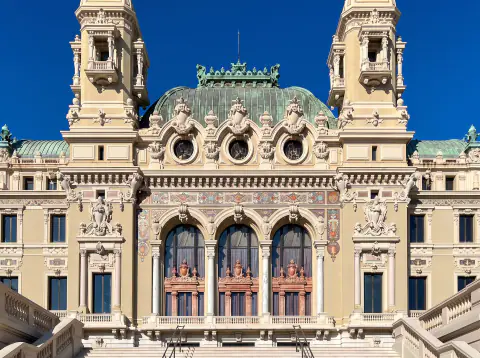 01Monaco Grand Prix experienceCasino de Monte-CarloExplore experience →
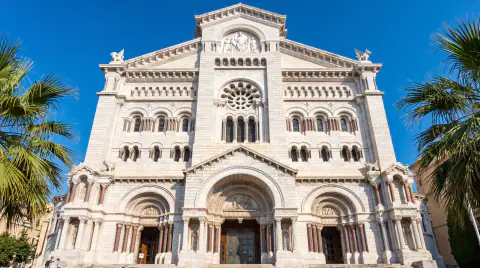 02Monaco Grand Prix experienceCathedral of Notre-Dame-ImmaculéeExplore experience →
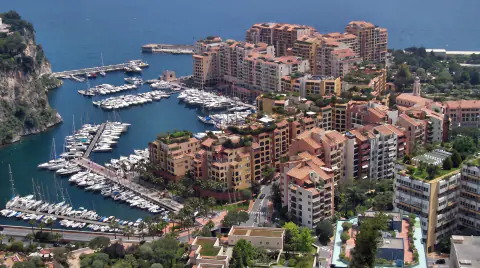 03Monaco Grand Prix experienceFontvieilleExplore experience →
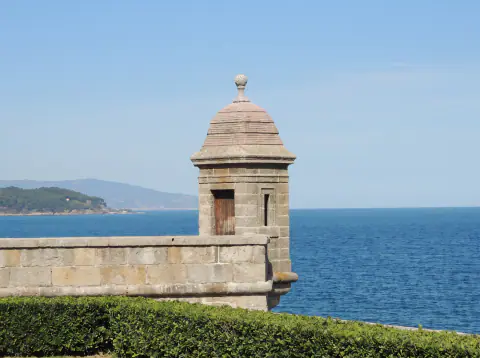 04Monaco Grand Prix experienceFort AntoineExplore experience →
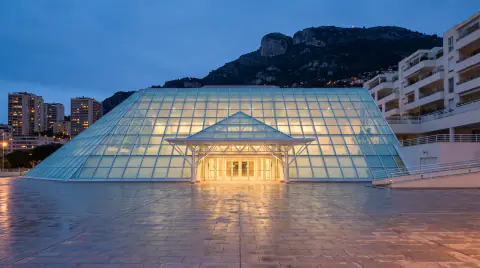 05Monaco Grand Prix experienceGrimaldi ForumExplore experience →
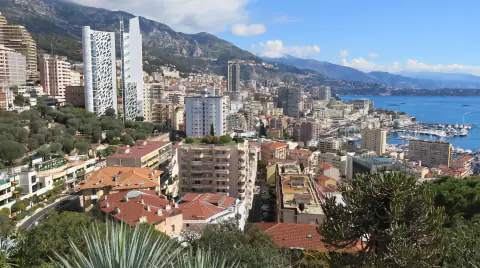 06Monaco Grand Prix experienceJardin Exotique de MonacoExplore experience →
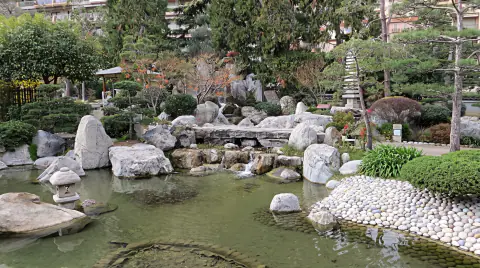 07Monaco Grand Prix experienceJardin Japonais de MonacoExplore experience →
 08Monaco Grand Prix experienceLa CondamineExplore experience →
 09Monaco Grand Prix experienceLarvottoExplore experience →
 10Monaco Grand Prix experienceLe Rocher / Monaco-VilleExplore experience →
 11Monaco Grand Prix experienceLes Ballets de Monte-CarloExplore experience →
 12Monaco Grand Prix experienceMareterraExplore experience →
 13Monaco Grand Prix experienceMonte-CarloExplore experience →
 14Monaco Grand Prix experienceNouveau Musée National de MonacoExplore experience →
 15Monaco Grand Prix experienceOpéra de Monte-CarloExplore experience →
 16Monaco Grand Prix experiencePrince's Palace of MonacoExplore experience →
 17Monaco Grand Prix experienceThe Museum of Old MonacoExplore experience →
 18Monaco Grand Prix experienceThe Museum of Stamps and CoinsExplore experience →
 19Monaco Grand Prix experienceThe Prince's Car CollectionExplore experience →
 Plan / Itinerary builderBuild your Monaco Grand Prix dayStart planning →