In depth
Grimaldi Forum
Monaco's congress and culture centre is three-quarters below sea level, on 35,000 m² taken from the sea — and it has no opening hours of its own, which is the thing to know before you go.
Story · Visit · Route · Links
Choose your depth
Essentials or more detail?
See visiting essentials, or read more about the history and places nearby.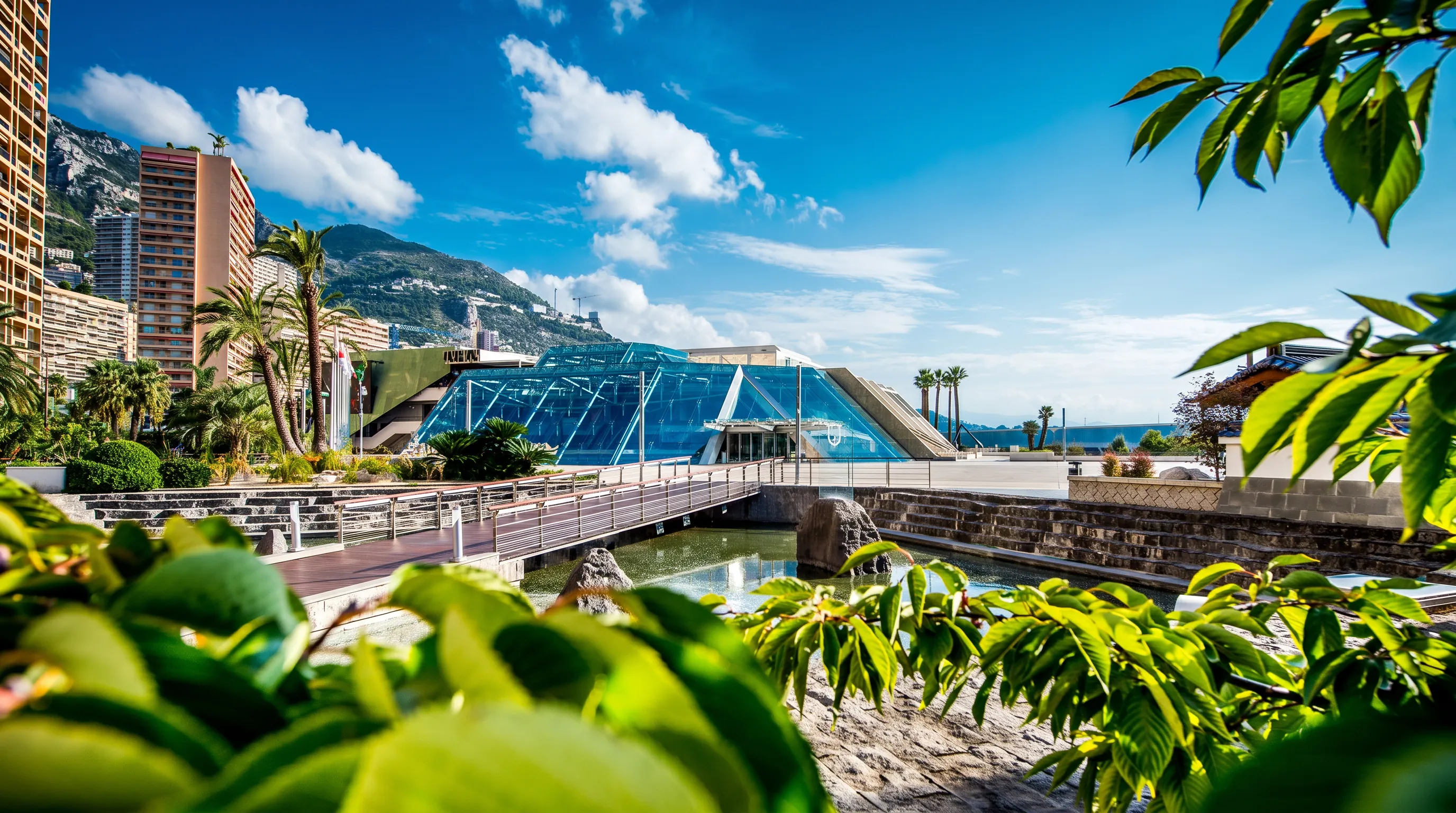
01 The experience
What to expect.
Why it matters
There is no such thing as "the Grimaldi Forum's opening hours". It is a venue, not an attraction — hours belong to whatever is on. That single fact is the most useful thing this page can tell you, and it is why so many visitors arrive to a locked cultural centre.
But when something is on, it is usually the best thing in Monaco. The permanent collections are on the Rock; the Forum is where the loans come.
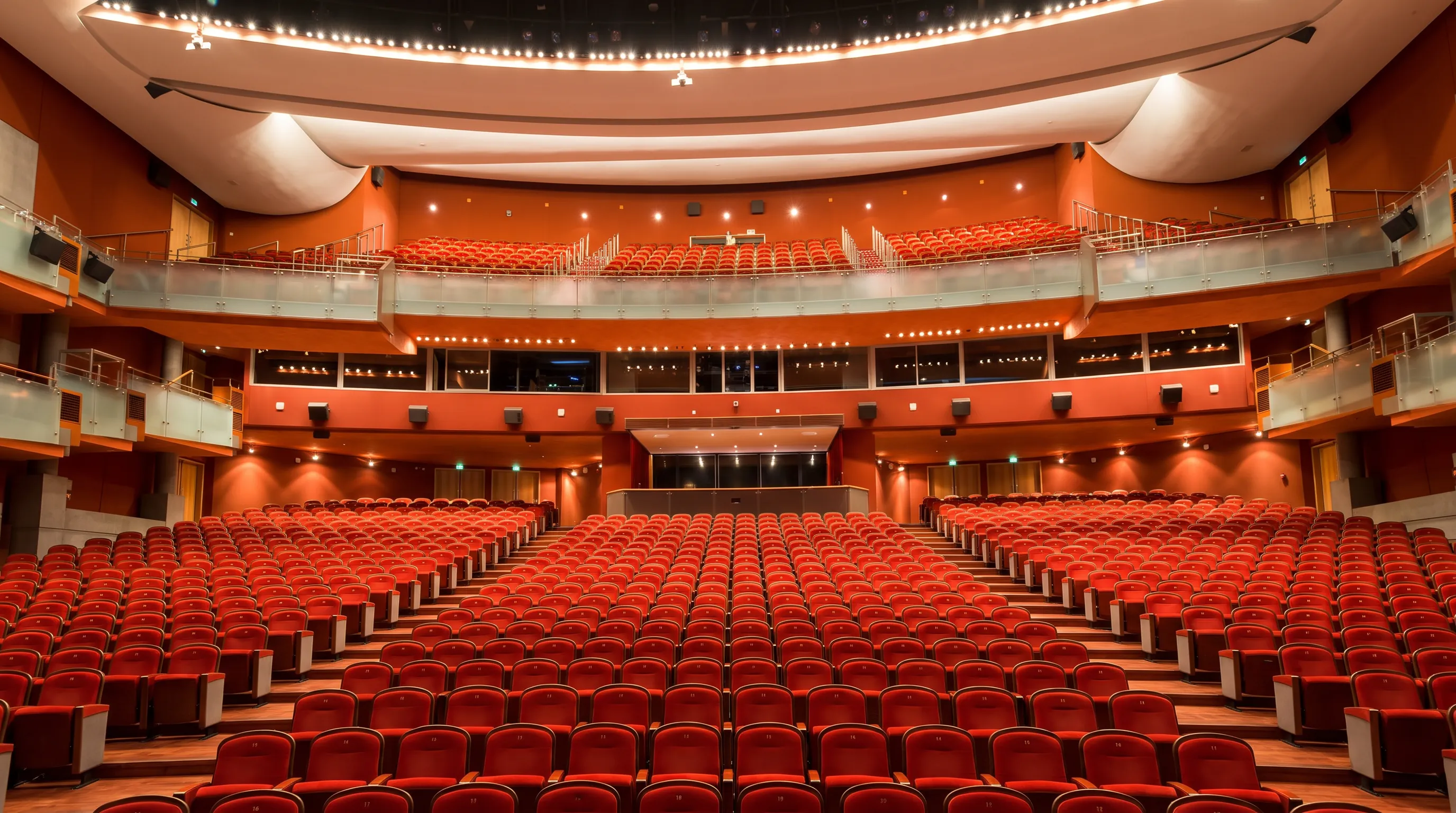
It is also the Opéra de Monte-Carlo's second stage. Productions too large for Garnier's Salle Garnier are staged here, in the Salle des Princes — 1,864 seats against the opera house's few hundred.
And it is an engineering answer to the same question as everything else in Monaco. No land: so build 35,000 square metres, put three-quarters of it under the sea, and when that fills up, extend it out into the water alongside a land-reclamation project.
What visitors should notice
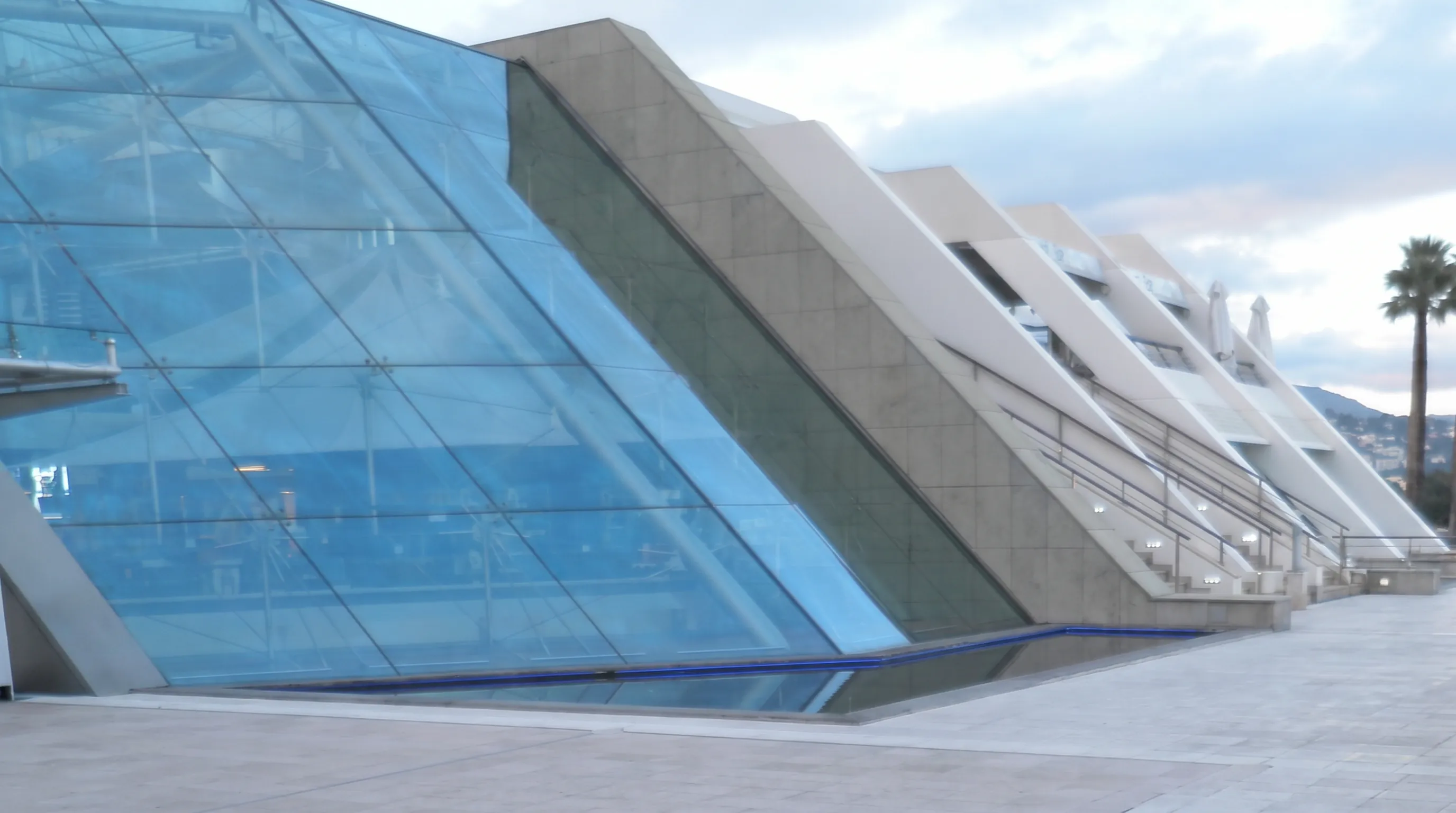
How little of it is above ground. The glass frontage is the top quarter of the building. Everything else is beneath you.
The Ravel terrace. Six hundred square metres facing the Mediterranean, and the part of the building most people never reach because it is inside the paid event.
The sea-side entrance. The 2025 extension has its own independent entrance on the water side, which is how it connects to Mareterra rather than to the avenue.
That it heats and cools itself with the sea. The extension uses seawater as a renewable energy source, and the Forum has held ISO 14001 since 2008 and ISO 20121 since 2023.
Who will enjoy it
- Anyone in Monaco while the summer exhibition is on — it is the strongest cultural offer in the principality, and this year it is cars.
- Opera and concert audiences: the Salle des Princes is where the big productions go.
- Anyone interested in how Monaco builds — this is the same problem as Fontvieille and Mareterra, solved downwards.
- Business visitors, for whom the building exists in the first place.
Who may find it difficult
- It has no permanent display and no standing opening hours. If nothing is on, there is nothing to see. Check the programme before you go.
- It is a congress centre for most of the year, and much of it is closed to anyone without an event ticket.
- The best parts — the Ravel terrace, the halls — are inside the paid event.
- A summer exhibition ticket is not cheap, and the show changes annually, so nothing here can be described once and relied on.
Visitor verdict
Check what is on first — everything else follows from that. If the summer exhibition is running, give it two hours; it is the most substantial thing Monaco stages. If nothing is on, walk past it to the Japanese Garden next door, which is free and open every day.
The story
History & character.
Why it exists
Rainier III wanted Monaco to be a centre of European business tourism. The principality had the casino, the opera house, the Grand Prix and the hotels; what it did not have was anywhere to put a congress of several thousand people.
The Grimaldi Forum is the instrument built to fix that. It is a state facility — Monaco's Government Congress and Culture Centre — not a private venture, and the "and Culture" half of that title is the reason a visitor has any business here at all.
The problem, and the answer
Monaco's constraint is always the same one: there is no land.
The answer here was twofold. Reclaim the ground — the Forum stands on 35,000 square metres of adaptable space taken from the sea. And then build downwards:
Three-quarters of the building is below sea level.
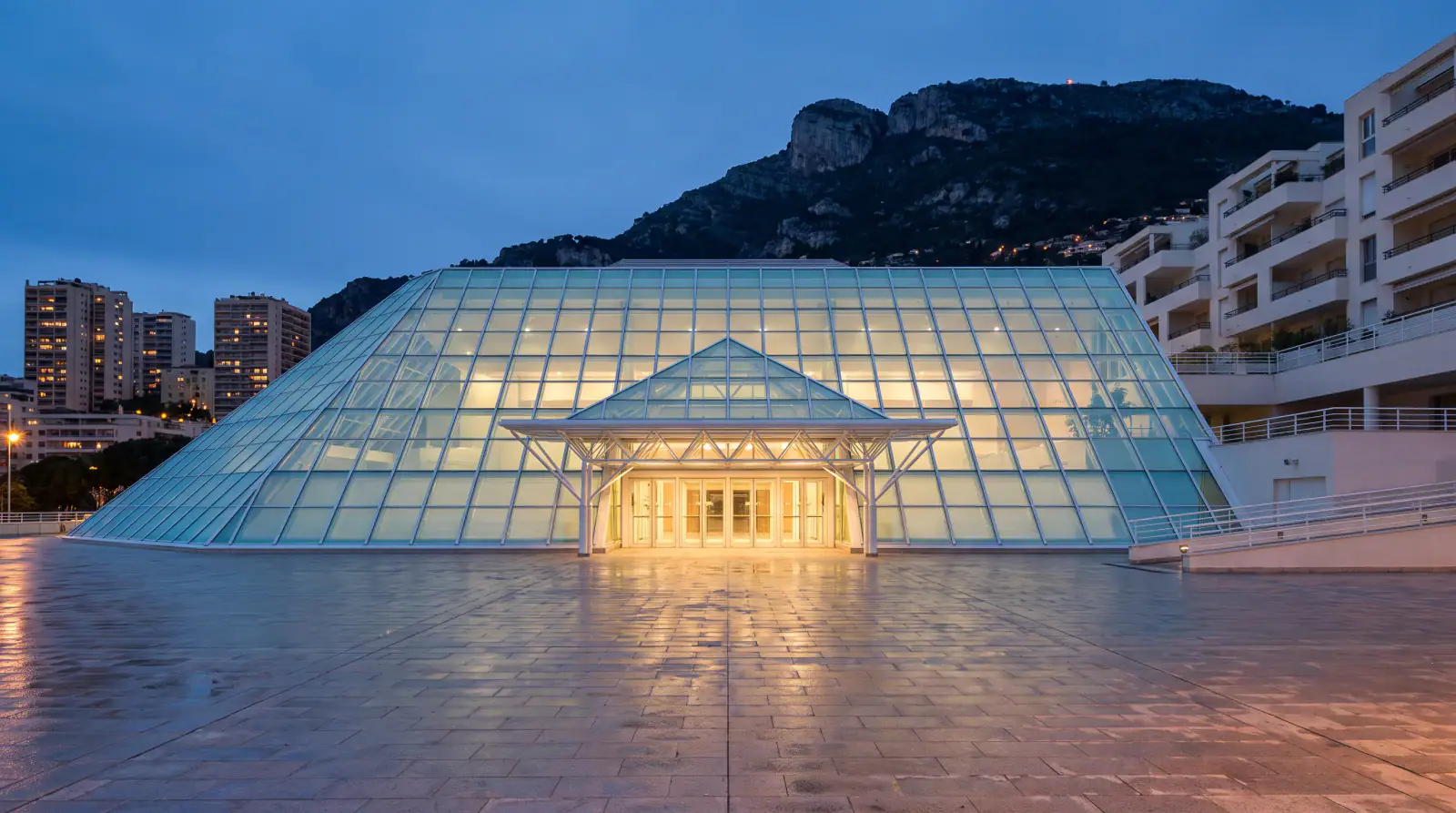
The glass and steel frontage on avenue Princesse Grace, which is what everybody photographs, is the top quarter. The halls, the auditorium and the exhibition floors are underneath, and underneath the waterline.
Opened in 2000
The Forum was inaugurated on 20 July 2000 by Prince Rainier III, accompanied by the then Hereditary Prince Albert.
Since opening it has run roughly 100 events a year and drawn about 300,000 visitors annually — cumulatively some eight million people across more than 2,700 events.
The summer exhibition
The single decision that made the Forum matter to visitors rather than to delegates was to mount one major exhibition every summer, borrowing from world-class museums.
It gave a congress centre a public identity, and it gave Monaco something the Rock cannot provide: large temporary shows. The permanent collections — oceanography, stamps and coins, the prince's cars, the cathedral — do not change. The Forum is where anything new arrives.
The 2025 extension
Inaugurated on 16 January 2025 by Prince Albert II and Princess Charlene.
The architects were Alexandre Giraldi and Patrick Raymond. The extension added 6,000 square metres, of which 2,000 square metres are outdoor space, and it raised the Forum's exhibition capacity by 50 per cent.
It was built out into the sea, and it is integrated into the Mareterra eco-district — the six-hectare land extension immediately alongside. The Forum solved its space problem the same way the country did, at the same time, on the same water.
Two details are worth having:
- It connects by a direct internal link to the Diaghilev exhibition hall, so the new space works as part of the existing building rather than as an annexe.
- It has its own independent external entrance on the sea side — which is how it faces Mareterra rather than the avenue.
Environmental record
The extension was built to BREEAM standards and uses seawater as a renewable energy source.
The Forum itself has held ISO 14001 certification since 2008, recertified in 2023, and gained ISO 20121 — the sustainable-events standard — in 2023.
For a building three-quarters submerged in the Mediterranean, drawing its heating and cooling from the water around it is less a gesture than an obvious move.
Look closer
Highlights and hidden details.
The objects, spaces and small observations that turn a visit into a memorable one.1. Three-quarters of it is underwater
The single fact worth carrying in.
Thirty-five thousand square metres of adaptable space, on ground reclaimed from the sea — and three-quarters of the building sits below sea level.
What you see from avenue Princesse Grace is a glass and steel frontage. That is the top quarter. The halls you walk through, the auditorium, the exhibition floors: those are underneath, and underneath the waterline.
Why it earns first place. Every other Monaco landmark answers the no-land problem by going up, or by going out into the sea. This one went down into it, and then did both.
2. The summer exhibition — this year, fifty cars
Monaco & l'Automobile, de 1893 à nos jours — 1 July to 6 September 2026, in the Hall Ravel, across more than 3,500 square metres.
More than fifty authentic vehicles and 130 years of the principality's relationship with the car: the era before the Grand Prix existed, the Rally, the race itself, the collections.
The summer exhibition is the Forum's public identity. It borrows from world-class museums and it is consistently the most substantial temporary show in Monaco. Nothing else in the principality changes; this does, every year.
Time required. Two hours.
3. The 2025 extension, and where it went
Six thousand square metres, inaugurated on 16 January 2025 by Prince Albert II and Princess Charlene, designed by Alexandre Giraldi and Patrick Raymond. It raised exhibition capacity by 50 per cent.
It was built out into the sea, and integrated into Mareterra.
Two thousand of the six thousand square metres are outdoor space. It links directly to the Diaghilev hall inside, and it has its own independent entrance on the sea side — so it faces the new district rather than the old avenue.
Why it matters. Mareterra is usually told as pure addition: six hectares that did not exist. This is the piece of it that attached to something already standing.
4. The Salle des Princes — 1,864 seats
The Forum's auditorium, and the Opéra de Monte-Carlo's second stage.
The Salle Garnier at the casino is small, ornate and beloved, and it cannot take a large production. When Monaco stages opera at scale, it stages it here.
If you only associate Monaco opera with Garnier's gilt interior, this is the correction: the principality's biggest performances happen in a modern hall under the sea, a mile east.
5. The Ravel terrace
Six hundred square metres facing the Mediterranean, part of the 4,201 square metre Ravel complex.
It is the best space in the building and most visitors never see it, because it sits inside the ticketed event. If your exhibition or concert gives you access to it, take the interval outside.
6. It heats and cools itself with the sea
The extension was built to BREEAM standards and uses seawater as a renewable energy source.
The Forum holds ISO 14001 since 2008 — recertified 2023 — and ISO 20121, the sustainable-events standard, since 2023.
A building three-quarters submerged drawing its energy from the water it sits in is the neatest thing about its engineering, and it is invisible.
7. The scale of what passes through
Roughly 100 events a year and 300,000 visitors. Since 2000: about eight million people across more than 2,700 events.
In a country of under 40,000 residents, on a site that did not exist before it was reclaimed.
8. What it was built for
Rainier III wanted Monaco to be a centre of European business tourism.
The Forum is that policy, in concrete, and it is worth knowing because it explains the building's one real weakness for a visitor: it is a congress centre that also does culture, not a cultural institution that also hosts congresses.
That is why there are no permanent opening hours, and why checking the programme matters more here than anywhere else in Monaco.
Details worth slowing down for.
The frontage is the roof
What you take for the building is the top of it.
Stand on avenue Princesse Grace and you see a wide glass and steel elevation. Three-quarters of the Forum is below sea level, which means the great majority of what you are looking at is above the great majority of what is actually there.
Try this: work out where the sea is relative to where you are standing, then remember that the exhibition hall you are about to walk into is lower than it.
Two entrances, two eras
The Forum has its original entrance on avenue Princesse Grace and — since January 2025 — an independent external entrance on the sea side, serving the extension.
The avenue entrance faces the Monaco of 2000. The sea entrance faces Mareterra, ground that did not exist until December 2024.
The building now opens onto two different decades of the country's coastline, and they are on opposite walls.
The hall names are a set
Ravel. Diaghilev. Salle des Princes.
Maurice Ravel and Serge Diaghilev are both here because both are part of Monte-Carlo's performance history — Diaghilev's Ballets Russes were closely bound to the principality, and Ravel's L'Enfant et les sortilèges had its world première in Monte-Carlo, in 1925.
A congress centre named its trade-fair halls after a composer and an impresario. It is the clearest signal that the "and Culture" in the building's official title was meant seriously.
The 50 per cent that is not 50 per cent
The 2025 extension added 6,000 square metres to a building of 35,000, and is described as increasing capacity by 50 per cent.
Both figures are correct, and they are not in conflict: the 50 per cent applies to exhibition space specifically, not to the building. Much of the Forum is auditorium, congress rooms and back-of-house, none of which the extension enlarged.
It is a good example of a real statistic that reads as an error if you only have half of it.
A third of the new space has no roof
Of the extension's 6,000 square metres, 2,000 are outdoor.
For a building that put three-quarters of itself underwater, the newest third is open to the sky. The Forum has spent twenty-five years going down and has just gone up and out.
It borrows what Monaco cannot keep
The Rock's institutions all hold permanent collections. The Oceanographic Museum, the stamps and coins, the prince's cars — these do not change, and cannot.
The Forum has no collection at all, and that is precisely why it can bring in loans from world-class museums every summer.
The building's apparent weakness is the source of the only thing in Monaco that is different each year.
Ravel's terrace is bigger than most Monaco gardens
Six hundred square metres, facing the Mediterranean.
That is a tenth of the Japanese Garden next door, on the roof of an exhibition hall, behind a ticket barrier — and it has the better view.
The energy source is the thing it is buried in
Seawater heats and cools the extension.
A building submerged to three-quarters of its height, taking its energy from the water doing the submerging. ISO 14001 since 2008, ISO 20121 since 2023, BREEAM on the new build — but the elegant part is not the certificate, it is the arrangement.
04 / Before you go
Plan your visit
Prices & admission
Set per exhibition — there is no standing admission
Opening hours
THE GRIMALDI FORUM HAS NO OPENING HOURS OF ITS OWN. It is a venue, not an attraction: hours, prices and public access all belong to the individual event, and between events much of the building is closed to the public. This is the most common way visitors waste a trip here, and any source quoting 'the Grimaldi Forum's opening times' is describing whatever happened to be on when it was written. Check the programme before you travel. The summer exhibition runs roughly July to early September and is the main public draw. The Forum sits well east of the Grand Prix circuit and is not behind race fencing, but the summer show has not opened by race weekend, so in practice there is often nothing on. Verified 7 August 2026.
Plan your experience
Book through the exhibition or performance, not the venue — there is no general admission. Prices and hours are set per event and change every year.
Participation requirements
No general age restriction — but whether it suits children depends entirely on what is on, and the answer changes every year. A large object-rich exhibition works very well; a fine-art loan show is a hard sell to a nine-year-old. Read what the exhibition actually is before committing.
Before anything else: check what is on
The Grimaldi Forum has no opening hours of its own. It is a venue. Hours, prices and access all belong to the individual event, and between events much of the building is simply shut to the public.
This is the most common way visitors waste a trip here. Look at the programme first, then plan around it.
What is on now
Monaco & l'Automobile, de 1893 à nos jours 1 July – 6 September 2026
- Daily, 10:00–20:00
- Thursdays until 22:00
- Hall Ravel
- Over 3,500 square metres
More than fifty authentic vehicles connected to Monaco, tracing over 130 years of the principality's relationship with the motor car — from 1893 to the present.
This is the current summer exhibition, and it is the reason to come. Give it around two hours. It is the largest thing Monaco stages, and it will not be here after 6 September.
Prices are set per exhibition. Check the Forum's own site before travelling — this page will not quote a figure that changes every year.
Getting there
Avenue Princesse Grace, in the Larvotto district, on the seafront east of Monte-Carlo.
On foot — around fifteen minutes from the Casino square along avenue Princesse Grace, flat the whole way. From the Rock it is a long walk; take a bus.
By bus — routes along avenue Princesse Grace stop directly outside. This is the simplest arrival.
By car — there is public parking beneath the building. Monaco parking is paid, plentiful and well signed, and driving here is far less painful than in most cities.
From the Japanese Garden — it is next door. Literally adjacent, and free. Pair them.
How long to allow
| What | Time |
|---|---|
| The summer exhibition | 2 hours |
| A concert or opera in the Salle des Princes | The performance |
| Looking at the building from outside | 10 minutes |
If nothing is on, allow nothing. Walk to the Japanese Garden instead.
The spaces, so the signage makes sense
| Space | Size or capacity | What happens there |
|---|---|---|
| Salle des Princes | 1,864 seats | Concerts, opera, large performances |
| Hall & Terrasse Ravel | 4,201 m² | The summer exhibition lives here |
| Terrasse Ravel | 600 m² | Sea-facing terrace |
| Hall Diaghilev | 3,501 m² | Exhibitions, trade shows, gala dinners |
| The 2025 extension | 6,000 m² | Linked to Diaghilev; own sea-side entrance |
Signage inside uses these names and nothing else, so a ticket saying "Hall Ravel" is worth being able to place before you arrive.
Best time to visit
During the summer exhibition, which runs roughly July to early September. Outside that window the Forum's public programme thins considerably.
Thursday evening, if the exhibition is running late — the 22:00 closing gives you the show after the day's heat, and Monaco's seafront is at its best then.
Not during the Grand Prix. The Forum is well east of the circuit, so it is not behind fencing, but the whole principality is difficult that week and the summer exhibition has not opened yet.
Practical notes
- Toilets and cloakroom are inside the ticketed area.
- There is a café/restaurant provision tied to events rather than a permanent public café. Do not plan lunch around it.
- Photography rules belong to the exhibition, not the building — a loan show can prohibit it entirely at the lender's insistence. Check at the door.
- The building is modern and fully lift-served. See the accessibility page.
The one thing to notice while inside
You are below the sea. Three-quarters of the Forum sits beneath sea level, and the exhibition halls are among the parts that do. There is no window to prove it, which is exactly why it is worth knowing.
Visit your way
Access and family planning.
The short version
This is the most accessible major venue in Monaco, and it is not close.
The Forum opened in 2000 as a purpose-built modern congress centre, and it was extended in 2025. There is no historic fabric to work around, no stair-only tower, no cobbled approach and no medieval doorway. Everything is lift-served, level and wide.
Compare that with the Rock, where the cathedral, the palace and the old town all involve gradients, steps or cobbles, and the difference is stark.
Approach
Avenue Princesse Grace is flat. The walk from Monte-Carlo along the seafront is level for its whole length — one of very few genuinely flat routes in the principality.
Buses stop directly outside on the avenue.
There is parking beneath the building, which puts a car within the building's own lift system rather than at the top of a hill.
Inside
- Lifts serve the building throughout. Given that three-quarters of the Forum is below sea level, lifts are not a concession here — they are how everyone moves.
- Halls are large, open and level. The Ravel and Diaghilev halls are exhibition floors: wide aisles, no thresholds, no steps between zones.
- Accessible toilets are provided.
- The Salle des Princes has wheelchair positions; book them through the event organiser rather than on arrival, since allocation is per performance.
The caveat that matters
Access provision belongs to the event, not the building.
The structure is accessible. What varies is:
- Ticketing and companion policy — set by whoever is running the exhibition or concert, not by the Forum.
- Exhibition layout — a loan show builds temporary walls, and case heights, aisle widths and seating within the show are the exhibition designer's decisions.
- Seating and audio-description for performances — per production.
Contact the event organiser in advance, not the venue. This is the opposite of the advice that applies to Monaco's museums, and it follows directly from the Forum being a venue rather than an institution.
Sensory notes
- The exhibition halls are quiet, air-conditioned and evenly lit, which makes them among the calmer indoor spaces in Monaco in summer.
- Trade fairs and congresses are the opposite — crowded and loud. If the building is hosting a fair rather than an exhibition, that is a different environment entirely.
- A large loan exhibition can be busy at weekends. Weekday mornings and the Thursday late opening to 22:00 are the quieter windows during this summer's show.
Nearby, if the Forum is closed
The Jardin Japonais is next door and free. Arrival is flat and the entrance is level, but the garden's interior is arranged as levels with steps between them, and the step-free route through it is not published. Treat it as partially accessible.
What is not published
Precise step-free routes, door widths and lift dimensions are not published by the Forum, and this page will not invent them.
If any of those matter, ask the event organiser for the specific figures for the specific show — a temporary exhibition's internal layout is not knowable in advance from any public source.
The honest answer first
Whether this works for children depends entirely on what is on.
The Grimaldi Forum is a venue, not an attraction. There is no permanent display, nothing to touch, no trail and no play area. If nothing is running, there is nothing here for a family at all.
But this year is unusually good.
This summer: fifty cars
Monaco & l'Automobile, de 1893 à nos jours — to 6 September 2026, in the Hall Ravel.
More than fifty real vehicles across more than 3,500 square metres. For most children between roughly five and fifteen this is a straightforwardly excellent couple of hours, and it needs no preparation: they are cars, they are large, and some of them raced here.
Ages 5–12 will do well. Teenagers with any interest in motorsport will do better than at almost anything else in Monaco.
Under 5s — it is a big, open, air-conditioned hall with wide aisles. Buggies are manageable. Attention will run out around the forty-minute mark, which is fine; leave.
Pair it with the Prince's Car Collection
These two are the same subject from opposite directions, and doing both in one day is a genuinely strong Monaco itinerary for a car-minded family.
- The Collection is permanent, in Fontvieille, and it is the family's cars.
- The exhibition is temporary, here, and it is the country's story — 130 years, from 1893.
Do the exhibition first while everyone is fresh, because it is the bigger of the two.
In other years
Assume nothing. Past summer exhibitions have ranged from fine-art loan shows — which are a hard sell to a nine-year-old — to broad, object-rich subjects that work very well.
Read what the exhibition actually is before committing. "A major exhibition at the Grimaldi Forum" tells you nothing about whether your children will enjoy it.
Practicalities
- Fully lift-served and level inside. Buggies are no problem.
- Air-conditioned, which in a Monaco August is not a small point — this is one of the better places to spend the hottest part of the afternoon.
- Toilets and cloakroom are inside the ticketed area.
- Food is tied to the event rather than permanently available. Bring something, or eat before you come.
- Thursday late opening to 22:00 during this summer's exhibition suits families who want to avoid the heat.
The free alternative next door
The Jardin Japonais is immediately adjacent, costs nothing, and is open every day.
If the Forum is between events, or the exhibition is not one for children, walk next door instead. Ponds, koi, a red bridge and a waterfall — and no ticket.
Note that dogs and picnics are prohibited in the garden, so plan lunch elsewhere.
What to tell them
"The building goes down further than it goes up. Most of it is under the sea."
It is true, it is unprovable from inside, and it is the kind of thing children enjoy testing you on.
Self-guided walk
Explore beyond the venue.
A practical, step-by-step route connecting this experience with more of Monaco Grand Prix.1. Avenue Princesse Grace, opposite the frontage — 5 minutes
Start outside, and start by getting the building wrong.
Look at the glass and steel elevation. It is wide, low and unremarkable, and it is the only part of the Forum most people ever see.
Now place the sea. It is behind the building, and it is above three-quarters of it. What you are looking at is the top quarter of 35,000 square metres, and the ground it stands on was taken from the water in the first place.
Hold that for the rest of the walk. Nothing you see later will show it to you.
2. Inside — the exhibition — 2 hours
Check what is on before you build a day around this stop.
This summer: Monaco & l'Automobile, de 1893 à nos jours, in the Hall Ravel — over 3,500 square metres, more than fifty vehicles, and 130 years, starting from 1893. To 6 September 2026, daily 10:00–20:00, Thursdays to 22:00.
Two things to notice while you are in there:
- The hall names. Ravel and Diaghilev — a composer and an impresario, both tied to Monte-Carlo's performance history. A congress centre named its trade-fair floors after them, which tells you what the building thinks it is.
- The floor you are standing on is below the sea. In the Ravel hall you are inside the submerged three-quarters.
If your ticket reaches the Terrasse Ravel, go out on it — 600 square metres facing the Mediterranean, and the best thing in the building.
3. Out through the sea-side entrance, into Mareterra — 20 minutes
This is the stop that makes the route worth walking.
The 2025 extension — 6,000 square metres, 2,000 of them outdoors, inaugurated on 16 January 2025 by Prince Albert II and Princess Charlene — has its own independent entrance on the sea side.
Get round to the seaward side of the building, whether by leaving through that entrance if your event allows it, or simply by walking round the outside from the avenue. Mareterra's public promenade is open ground and reachable either way.
You are now standing on Mareterra, six hectares inaugurated on 4 December 2024, which did not exist before.
The Forum has an entrance on land from 2000 and an entrance on land from 2024, on opposite walls. Twenty-four years of coastline, one building.
The extension is built to BREEAM standards and takes its heating and cooling from seawater — from the same water it was built into.
4. The Jardin Japonais — 20 minutes, free
Next door. Costs nothing. Open every day, including during the Grand Prix.
Commissioned by Rainier III, designed by Yasuo Beppu, created in 1994, and blessed by a Shinto high priest from the Dazaifu shrine in 1992 — two years before it opened.
Seven thousand square metres, of which 1,100 are water. Stone from Corsica; granite from the Auvergne.
And it too is on a slab. The garden sits on a concrete deck over the bus station.
Stand where you can see the Forum from inside the garden. That view — a congress centre, a Japanese garden and reclaimed coastline in one frame — is the whole of modern Monaco in a single look, and it is the last thing on this route for a reason.
The route in one line
Look at the quarter you can see → walk through the three-quarters you can't → step out onto ground that didn't exist → look back at all of it from a garden built on a bus station.
If nothing is on at the Forum
Do stops 1, 3 and 4. Skip the inside. It is still a good forty-five minutes, it is flat, and it costs nothing.
Make a record
Photograph it thoughtfully.
Read this first
Photography rules inside belong to the exhibition, not the building.
A loan show can prohibit photography entirely, and often does, at the lender's insistence. Check at the door every time. Do not assume that because you photographed last year's exhibition you can photograph this one.
Assume no flash and no tripod anywhere inside, in all cases.
The exterior
The building is a hard subject and worth being honest about it. It is a wide, low, glass-and-steel elevation on a flat avenue, with no elevation to shoot from and no framing foreground. Most photographs of it are dull.
What works:
- Late afternoon and dusk, west light raking along the glass frontage rather than hitting it flat. The elevation faces the sea and the avenue; it takes side-light far better than front-light.
- After dark, lit from within. The glass frontage is the whole point of the building's exterior and it only reads at night, when the interior becomes the subject and the structure becomes the frame.
- From the seaward side, since the 2025 extension. This is the newer and better angle, and almost nobody uses it.
What does not work: a straight frontal daytime shot from the pavement opposite. There is no distance to gain, and the building is longer than it is tall.
The angle nobody takes
From the Japanese Garden, looking at the Forum.
It is next door, it is free, it is open every day, and it gives you the Forum's bulk behind planting and water — a far more interesting composition than the avenue offers, and the only one that says anything about where the building sits.
This is also the honest frame: a congress centre, a contemplative garden and a reclaimed coastline, all in one shot.
Inside, when permitted
- The halls are large and evenly lit, which is easy on exposure and flat on interest. Look for a person for scale — a 3,500 square metre hall means nothing in a photograph without one.
- Shoot the Ravel terrace if your ticket reaches it. Six hundred square metres facing the Mediterranean is the best view the building has, and the one fewest people photograph.
- This summer, the cars. Fifty vehicles under exhibition lighting: shoot low and close on detail — badges, grilles, instrument panels — rather than trying to take whole cars in a crowded hall.
What you cannot photograph
The three-quarters below sea level. It is the building's best fact and it is completely invisible. There is no vantage point, inside or out, that shows it.
Say it in the caption instead. This is one of the rare cases where the interesting thing about a subject cannot be photographed at all.
Timing
| When | Why |
|---|---|
| Late afternoon | Side-light on the frontage |
| Dusk / after dark | The glass reads; the interior lights the exterior |
| Thursday evening this summer | Exhibition open to 22:00, and the seafront at its best |
| Midday | Avoid — flat front-light on a flat elevation |
Courtesy
- No flash, ever, and particularly not near loaned objects.
- Congress delegates are at work. If the building is hosting a fair rather than an exhibition, do not photograph people at stands.
- Do not photograph performers in the Salle des Princes. Performance photography is prohibited as a matter of course.
Around here
Make more of the area.
Nouveau Musée National de Monaco
Villa Paloma remains open; Villa Sauber is closed. Check before setting out — the NMNM's two-villa arrangement is currently one villa.
Like the Forum, the NMNM programmes temporary exhibitions rather than a permanent display, so check what is on at both before deciding which to give an afternoon to.
Good to know
Questions, answered.
01What are the Grimaldi Forum's opening hours?
It does not have any.
This is the single most important thing on this page. The Forum is a venue, not an attraction — hours are set per event. A summer exhibition has its own hours, a concert has a curtain time, and between events much of the building is closed to the public.
Check the programme before you travel. Any source quoting "the Grimaldi Forum's opening times" is describing whatever happened to be on when it was written.
02What is on right now?
Monaco & l'Automobile, de 1893 à nos jours — the 2026 summer exhibition.
1 July to 6 September 2026, in the Hall Ravel, daily 10:00–20:00, with Thursdays until 22:00. Over 3,500 square metres and more than fifty authentic vehicles, covering 130 years of Monaco and the motor car.
03How much does it cost?
Prices are set per exhibition and change every year. This page will not quote a figure that would be wrong by next season — check the Forum's own site.
04Can I look round the building if there is no exhibition?
No. There is no permanent display, no public foyer to wander, and no tour of the building. If nothing is on, there is nothing to see.
Walk next door to the Jardin Japonais instead — free, open daily, thirty seconds away.
05Is it really below sea level?
Three-quarters of it.
The Forum occupies 35,000 square metres of adaptable space reclaimed from the sea, and the great majority of the structure sits beneath sea level. The glass frontage on avenue Princesse Grace is the top quarter.
There is no window or viewpoint that demonstrates this. You have to take it on trust, which is part of why it is worth knowing.
06When did it open?
Inaugurated on 20 July 2000 by Prince Rainier III, with the then Hereditary Prince Albert.
It was built as state policy: Rainier III wanted Monaco to be a centre of European business tourism.
07What was the 2025 extension?
6,000 square metres — 2,000 of them outdoor space — inaugurated on 16 January 2025 by Prince Albert II and Princess Charlene. Architects Alexandre Giraldi and Patrick Raymond.
It was built out into the sea and integrated into the Mareterra eco-district, connects directly to the Diaghilev hall inside, and has its own independent entrance on the sea side. It increased exhibition capacity by 50 per cent — not the building's total size by 50 per cent.
08Is it the same thing as the opera house?
No. The Opéra de Monte-Carlo performs in the Salle Garnier, inside the casino building, half a mile west.
But the Forum is the opera's second stage. Productions too large for Garnier go into the Forum's Salle des Princes, which seats 1,864.
09How long should I allow?
Two hours for the summer exhibition. Ten minutes for the outside of the building. Nothing at all if the building is between events.
10How do I get there?
Avenue Princesse Grace, in Larvotto. Buses stop outside; there is parking beneath the building; and the seafront walk from Monte-Carlo takes about fifteen minutes and is flat the whole way.
11Is it accessible?
It is the most accessible major venue in Monaco. Purpose-built in 2000, extended in 2025, lift-served throughout, level halls, flat approach, parking underneath.
The caveat: access provision within an exhibition — aisle widths, case heights, seating — belongs to the event organiser, not the venue. Ask them, not the Forum.
12Is it worth it with children?
This summer, yes — fifty real cars in a large air-conditioned hall works very well for roughly ages five to fifteen.
In other years, it depends entirely on the exhibition. A fine-art loan show is a hard sell to a nine-year-old. Read what the show actually is first.
13Can I take photographs inside?
It depends on the exhibition, not the building. Loan shows frequently prohibit photography at the lender's insistence. Ask at the door, and assume no flash and no tripod in every case.
14Does it close for the Grand Prix?
The Forum is well east of the circuit and is not behind race fencing. But the summer exhibition has not opened by race weekend, so in practice there is often nothing on.
The Japanese Garden next door stays open during the Grand Prix, when much of the principality does not.
Before you visit
Useful links.
Venue and visitor information
Compiled 7 August 2026.
Primary — the venue itself
Grimaldi Forum Monaco, official presentation — grimaldiforum.com/en/presentation
The authority for the structural facts, and the only source consulted that states the most important one.
- Opened 2000 as Monaco's Government Congress and Culture Centre
- 35,000 m² of adaptable space, reclaimed from the sea
- The structure is three-quarters below sea level
- 2025 extension by architects Alexandre Giraldi and Patrick Raymond
- About 100 events a year and 300,000 visitors
- Approximately 8 million visitors across 2,700+ events since 2000
- ISO 14001 first certified 2008, recertified 2023; ISO 20121 certified 2023
- Major summer exhibitions with loans from world-class museums
Grimaldi Forum Monaco — current exhibition page — grimaldiforum.com/fr/agenda-manifestations-monaco/monaco-et-l-automobile-de-1893-a-nos-jours
- *Monaco & l'Automobile, de 1893 à nos jours*
- 1 July – 6 September 2026, Hall Ravel
- Daily 10:00–20:00; Thursdays until 22:00
- Over 3,500 m², more than 50 authentic vehicles, 130+ years
Grimaldi Forum Monaco — spaces — grimaldiforum.com/fr/nos-espaces and grimaldiforum.com/en/events-planner-monaco/spaces/exhibition-catering-areas/espace-diaghilev
- Salle des Princes — 1,864 seats
- Hall & Terrasse Ravel — 4,201 m²; the Ravel terrace is 600 m² with a Mediterranean view
- Hall Diaghilev — 3,501 m²
- Since January 2025, a sea extension increasing exhibition surface by 50%, 6,000 m² of additional space
Grimaldi Forum Monaco — cultural centre — grimaldiforum.com/fr/centre-culturel
Extension — corroborating
Consulted for the 2025 extension: inaugurated 16 January 2025 by Prince Albert II and Princess Charlene; 6,000 m² including 2,000 m² of outdoor space; integrated into the Mareterra eco-district on land reclaimed from the sea; direct link to the Diaghilev exhibition hall plus an independent external entrance on the sea side; built to BREEAM standards and using seawater as a renewable energy source.
Note on the two dates. Mareterra was inaugurated 4 December 2024; the Forum's extension followed on 16 January 2025. Six weeks apart, connected projects, and repeatedly conflated in secondary coverage. The bundle keeps them separate.
Visitor-facing listings
Visit Monaco — Grimaldi Forum summer exhibition — visitmonaco.com/en/events/monaco-s-major-events/grimaldi-forum-monaco-summer-exhibition
The principality's tourism board on the annual summer exhibition as a fixture.
Venue-hire directories — ABC Salles, 1001 Salles, Aleou
Used only to corroborate hall capacities and areas, which trade directories carry accurately because their users book on them. Not used for anything visitor-facing — these are sales listings, and their descriptive copy is promotional.
Carried from other bundles in this set
- `larvotto` — the quarter, the promenade rebuilt by Renzo Piano Building Workshop with Michel Desvigne and reopened July 2021, the spring beach re-profiling. And the Forum coverage this bundle supersedes.
- `jardin-japonais-de-monaco` — the adjoining garden: Rainier III, Yasuo Beppu, 1994, the 1992 Dazaifu blessing, the bus-station slab, and the verified coordinate 43.742274, 7.431074 (OSM
way/157719658). - `mareterra` — six hectares inaugurated 4 December 2024; Calder's Quatre lances.
- `nouveau-musee-national-de-monaco` — Villa Sauber closed, Villa Paloma open, €6, free Sundays and free under 26.
- `princes-car-collection` — the pairing for this summer's exhibition.
Coordinate
Wikipedia — Grimaldi Forum — en.wikipedia.org/wiki/Grimaldi_Forum
43°44′38″N 7°25′54″E — 43.743832, 7.431757. Also corroborates the address (10 avenue Princesse Grace), the 20 July 2000 inauguration by Rainier III with Prince Albert, and the 6,000 m² extension including 2,000 m² of outdoor space inaugurated January 2025.
Cross-checked before use: the adjoining Jardin Japonais is verified at 43.742274, 7.431074 (OSM way/157719658), roughly 180 m away — consistent with two adjoining sites on the same avenue. A figure failing that check would have been discarded rather than published.
What no source established
A ticket price, which is set per exhibition and changes annually.
Any opening hours for the building, because it has none — hours belong to individual events. This is a finding, not a gap.
Photography policy, which belongs to each exhibition and its lenders.
Step-free routes, door widths and lift dimensions. Unpublished, and a temporary exhibition's internal layout is not knowable in advance from any public source.
Method note
The promotion test. This entity was already covered inside the larvotto bundle, and that coverage was accurate. A research pass was run specifically to establish whether the material outgrew the slot before any decision to promote — the same test applied to jardin-japonais-de-monaco. Four substantive additions resulted, listed in 16-editor-notes.md.
Trade directories were kept away from the prose. They were consulted because hall dimensions are their core data and they get them right; their descriptive copy is sales material and none of it reached a rendered file.
Where the Forum's own French and English pages differ, the French page was preferred, per the rule carried through this set.
Opening hours, prices, programmes and access arrangements can change. Confirm critical details with the venue.
Continue exploring / Monaco
More things to do
in Monaco
Explore Monaco activities, sights and places to eat. Compare the time to allow, costs and booking details, then save your favourites to your itinerary.
 01Monaco Grand Prix experienceCasino de Monte-CarloExplore experience →
 02Monaco Grand Prix experienceCathedral of Notre-Dame-ImmaculéeExplore experience →
 03Monaco Grand Prix experienceFontvieilleExplore experience →
 04Monaco Grand Prix experienceFort AntoineExplore experience →
 05Monaco Grand Prix experienceJardin Exotique de MonacoExplore experience →
 06Monaco Grand Prix experienceJardin Japonais de MonacoExplore experience →
 07Monaco Grand Prix experienceLa CondamineExplore experience →
 08Monaco Grand Prix experienceLarvottoExplore experience →
 09Monaco Grand Prix experienceLe Rocher / Monaco-VilleExplore experience →
 10Monaco Grand Prix experienceLes Ballets de Monte-CarloExplore experience →
 11Monaco Grand Prix experienceMareterraExplore experience →
 12Monaco Grand Prix experienceMonte-CarloExplore experience →
 13Monaco Grand Prix experienceNouveau Musée National de MonacoExplore experience →
 14Monaco Grand Prix experienceOceanographic Museum of MonacoExplore experience →
 15Monaco Grand Prix experienceOpéra de Monte-CarloExplore experience →
 16Monaco Grand Prix experiencePrince's Palace of MonacoExplore experience →
 17Monaco Grand Prix experienceThe Museum of Old MonacoExplore experience →
 18Monaco Grand Prix experienceThe Museum of Stamps and CoinsExplore experience →
 19Monaco Grand Prix experienceThe Prince's Car CollectionExplore experience →
 Plan / Itinerary builderBuild your Monaco Grand Prix dayStart planning →