In depth
Cathedral of Notre-Dame-Immaculée
The burial church of the Grimaldis: twenty-four tombs in one curved corridor, from 1505 to Rainier III and Princess Grace — plus a Louis Bréa altarpiece of 1500 and a seven-thousand-pipe organ. Free, open daily.
Story · Visit · Route · Links
Choose your depth
Essentials or more detail?
See visiting essentials, or read more about the history and places nearby.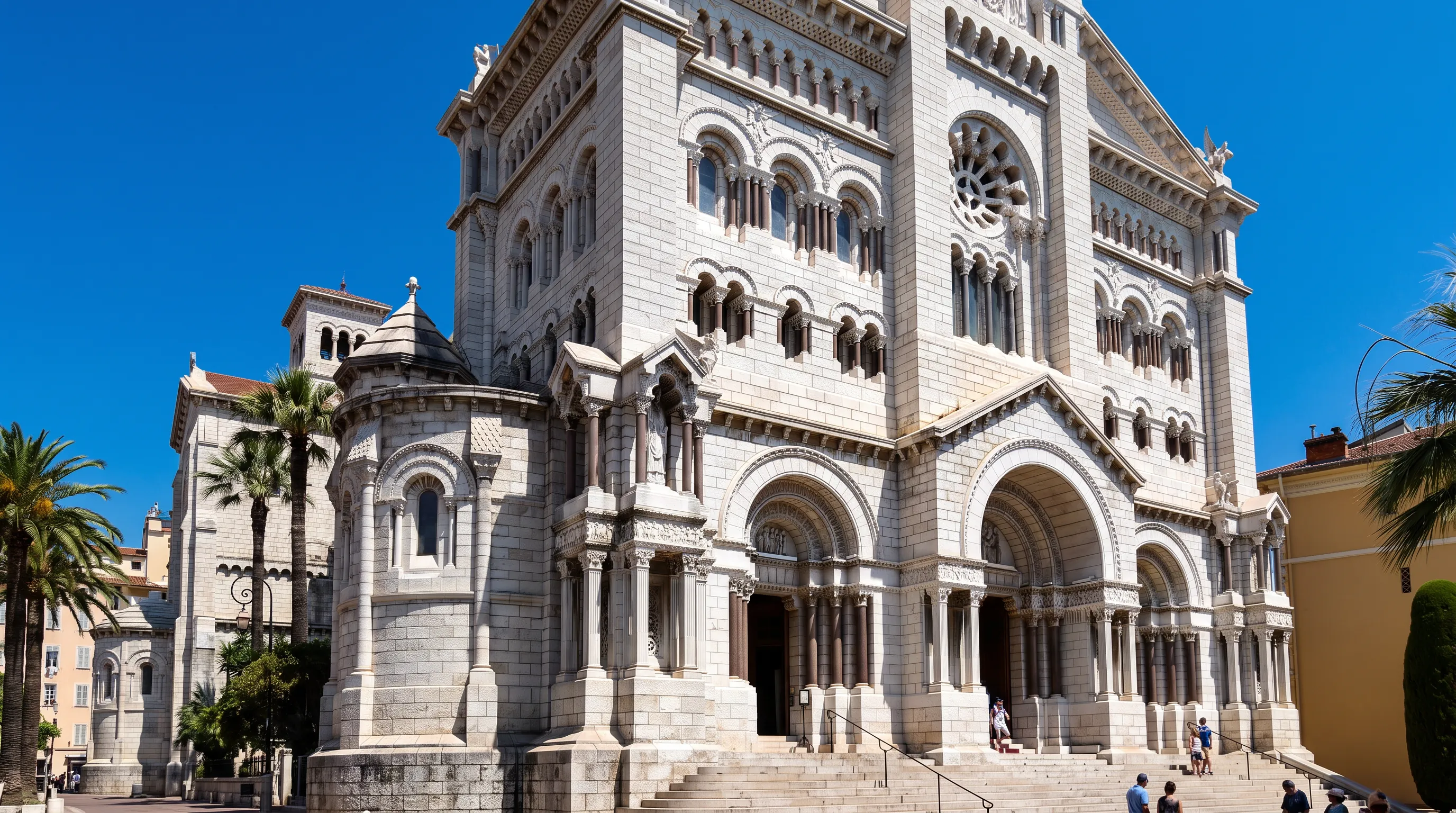
01 The experience
What to expect.
Why it matters
It is where the state is buried. Not a museum of the dynasty but the place the dynasty ends up. The princes and their consorts lie in the ambulatory behind the high altar in a single continuous row, and reading that row is the clearest thing in Monaco: seven centuries of a family, in order, in one curved corridor.
It is where the state's story begins. The relics of Sainte Dévote are here. She was martyred in Corsica in the early fourth century; her body was set adrift and, the tradition says, guided by a dove to the shore below the Rock. She became Monaco's patron under Honoré II in the seventeenth century, and every 27 January her relics are carried in procession and a boat is burned on the harbour.
And it is a building of unusual materials. Lenormand used white La Turbie stone, red and blue porphyry from the Esterel, green stone and granite from the Vosges, granite from Biella and Carrara marble. It is a geological collection as much as an architectural one.
What visitors should notice
The row, not the two graves. Almost everyone stops at Princess Grace, photographs the slab and turns round. Walk the whole ambulatory instead and the house's conventions become visible: the sovereign princes named as princes, their wives named as wives, in Latin, in sequence, for five hundred years.
In the right transept, the Bréa retable — eighteen compartments, painted in August 1500, brought here from a church that no longer exists.
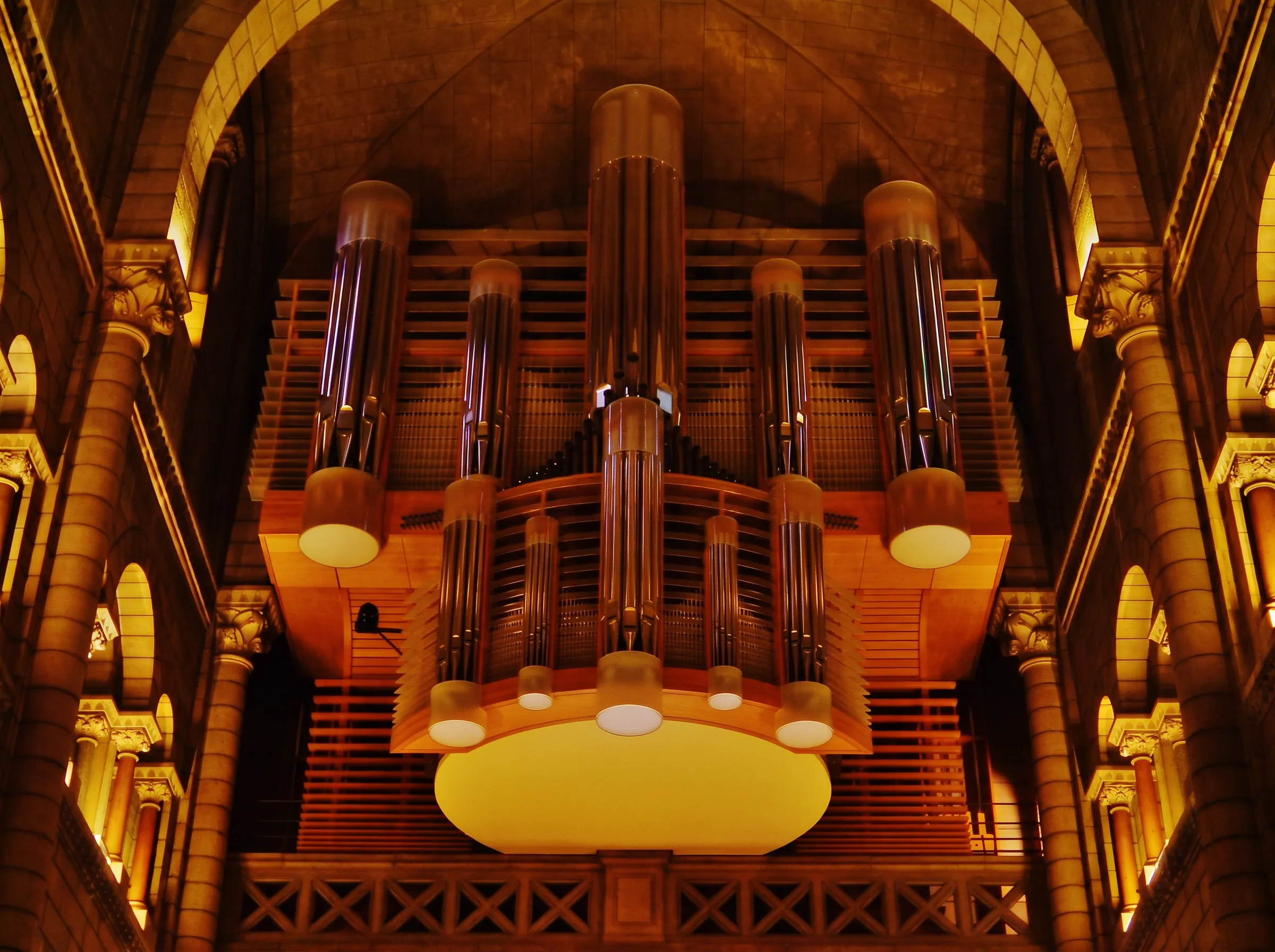
And, if you can, come when the organ is playing. The instrument's façade carries Plexiglas panels lit by LEDs, which change with the sound.
Who will enjoy it
Anyone interested in the Grimaldis, who will get more from twenty minutes here than from an hour in the Palace square. Anyone who likes early Renaissance painting — there are five retables, not one. Church-music enthusiasts, for whom the 10:00 Sunday sung mass from September to June is the reason to plan the day around it. And anyone wanting a free, cool, quiet interior in the middle of a hot walk on the Rock.
Who may find it difficult
There is very little to do. This is a church, not a visitor attraction: no ticket, no route, no interpretation to speak of, and nothing interactive. Visitors who want a museum experience will find twenty minutes is the whole of it.
It closes to sightseeing during services, which are frequent, and the 10:00 Sunday mass from September to June — the best time to hear the building — is precisely when you cannot wander around it.
The dress code is enforced at the door: shoulders covered, no mini-skirts or short shorts, though Bermuda shorts are accepted. It catches beach-dressed visitors arriving from Larvotto every day.
Step-free entry, an accessible toilet and a hearing loop are not confirmed. Telephone before travelling if you need any of these facilities.
Visitor verdict
Free, four minutes from the Oceanographic Museum, and worth thirty minutes rather than the fifteen most people give it. Go for the ambulatory and stay for the Bréa retable. If your visit falls on a Sunday morning between September and June, attend the sung mass instead of touring it — you will hear the choir, the organ and the building doing what they were built to do.
The story
History & character.
Before the cathedral: Saint-Nicolas, 1252–1874
Monaco's first parish church stood on this ground from 1252. It was dedicated to Saint Nicholas, patron of sailors, which tells you what the settlement on the Rock was for.
It served the principality for six centuries and it is the reason the cathedral's older name still circulates. It was demolished in 1874 — not by disaster but by decision, to clear the site for something larger.
Two things survived the demolition and are still here. The retable of Saint Nicholas, painted by Louis Bréa around 1500, now in the right transept. And a bell cast in 1484, which rang in 1641 when Honoré II expelled the Spanish garrison and returned Monaco to its own sovereignty. A bell that announced the principality's independence outlived the church it hung in.
1868: Monaco gets its own diocese
The cathedral exists because of an administrative change. Monaco separated from the diocese of Nice in 1868, and a principality with its own ecclesiastical standing needed a cathedral church. The thirteenth-century parish church was not it.
1875–1903: Lenormand's building
Prince Charles III laid the foundation stone on 6 January 1875. The architect was Charles Lenormand, and his choice of manner was against the current: a Romanesque-Byzantine revival, with round arches, broad wall surfaces and mosaic, at a moment when Gothic revival dominated European church building.
Construction ran for nearly thirty years and was completed on 12 November 1903. The consecration followed on 11 June 1911.
The materials are worth listing, because they are unusually various for a building that reads as uniformly white from outside:
| Element | Stone |
|---|---|
| The fabric | White stone from La Turbie, the hill village above Monaco |
| Decorative work | Red and blue porphyry from the Esterel massif |
| Decorative work | Green stone and granite from the Vosges |
| The choir | Granite from Biella, in Piedmont |
| Altar and episcopal throne | White Carrara marble |
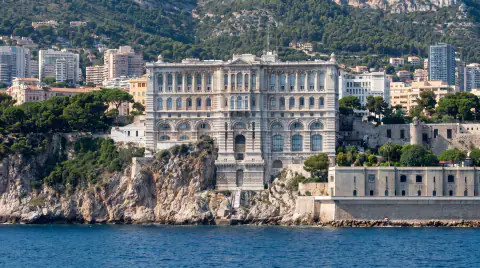
The white La Turbie stone connects it to the Oceanographic Museum, begun in 1899 on the same headland and built from the same quarry. Two buildings that look nothing alike came out of one hillside within a generation.
The cathedral is 72 metres long, 22 wide and 18 high.
The art it gathered
Five retables hang here, and only one is widely known.
The retable of Saint Nicholas, by Louis Bréa of Nice — Ludovico Brea in the Italian form — is dated August 1500. It measures 202 by 260 centimetres and is divided into eighteen compartments. It came from the demolished church and is the oldest important object on the Rock.
A Pietà by Curé Teste, dated 1505.
The retable of Sainte Dévote.
The retable of the White Penitents and a Saint Roch, both attributed to the workshop of François Bréa.
The high altar is inlaid with mosaic and copper; the episcopal throne is white Carrara marble. The stained glass runs a programme rather than a set of scenes: the upper nave carries women of the Old Testament, the lateral naves the lives of Jesus and Mary.
1904 and 1974: the music
The Maîtrise de la Cathédrale de Monaco — the choir school — was founded in 1904, the year after the building was finished. Its masters have included Perruchot and the canons André Aurat and Henri Carol; Pierre Debat has directed it since 1999, as master of chapel to both the palace and the cathedral.
Les Petits Chanteurs de Monaco were founded within the Maîtrise in 1974 and are under the High Patronage of Prince Albert II. Together with the cathedral choir they sing the 10:00 mass on Sundays from September to June.
1956: the wedding
On 19 April 1956, Prince Rainier III married the American actress Grace Kelly in this cathedral, before six hundred guests, with the ceremony broadcast live on Eurovision to an estimated thirty million viewers.
It is the single most-photographed event in the principality's history and the reason a large proportion of the cathedral's visitors are here at all.
1960 and 1976: bells and organs
Three bells were blessed on 8 December 1960.
The grand organ on the tribune was built by Jean-Loup Boisseau in 1976, in collaboration with Pierre Cochereau — then organist of Notre-Dame de Paris — and Canon Henri Carol. A choir organ by Giovanni Tamburini of Crema followed in the same year.
The titular organists since then are a short and distinguished list: Henri Carol from 1976 to 1984, René Saorgin from 1984 to 2005, and Olivier Vernet since 2006.
2011: the organ rebuilt
The Belgian firm Manufacture d'orgues Thomas completed a rebuild of the grand organ in December 2011: four manuals, seventy-nine stops and close to seven thousand pipes, using Vosges fir for the bellows, maple for the console and oak for the façade.
The façade also carries Plexiglas panels lit by LEDs, intended to give the instrument's sound a visible colour. A century-old building was given a twenty-first-century voice with a light show attached, and the combination works better than it sounds on paper.
1982 and 2005: the funerals
Princess Grace died on 14 September 1982 and was buried in the ambulatory. Prince Rainier III died on 6 April 2005 and was buried beside her.
They join twenty-two others. The ambulatory holds twenty-four Grimaldi burials in all, running back to Jean II, who died in 1505 — a continuous row spanning five centuries.
2020 and 2026: the present
Pope Francis appointed Dominique-Marie David Archbishop of Monaco on 21 January 2020.
On 28 March 2026, Pope Leo XIV celebrated Midday Prayer in this cathedral with the Catholic community of Monaco, in the presence of Prince Albert II and Archbishop David. It was his first international journey of 2026 and only the second of his pontificate, and the first papal visit to the principality in the modern era.
In his homily he praised Monaco as a place "where all find welcome and hospitality", and told the congregation that within this church its social variety "should never become the occasion of division into social classes" — a pointed thing to say in the wealthiest square kilometre in Europe.
Look closer
Highlights and hidden details.
The objects, spaces and small observations that turn a visit into a memorable one.1. The ambulatory and the twenty-four tombs
The reason most people come, and almost always seen wrong.
What it is. A curved corridor behind the high altar holding twenty-four Grimaldi burials, running back to Jean II, who died in 1505. Not a crypt: they are at floor level, in the open, in sequence.
How to see it properly. Walk the whole row. The visitors who stop at the two famous slabs miss the thing that makes this remarkable — five centuries of a single family in one continuous line, in order, with the house's conventions applied consistently down the whole length.
Princess Grace's slab is inscribed Gratia Patricia and names her in Latin as the wife of Prince Rainier III. She is not styled a princess in her own right. That is the convention for consorts rather than a slight, and you only see that it is a convention by reading the whole row.
Prince Rainier III lies beside her. He died on 6 April 2005; she died on 14 September 1982. They were married in this building on 19 April 1956.
Where else the two of them turn up, two minutes away. In 1974 Rainier III and Grace opened the Museum of Old Monaco on rue Émile de Loth — the only museum in the principality about Monégasques rather than about the family in this ambulatory. It reopened in March 2026 after a long renovation. Standing at these slabs and then walking up the street to it is the most useful twenty minutes on the Rock, and almost nobody does it.
Time required. Fifteen minutes if you read the row. Three if you do not.
2. The retable of Saint Nicholas
The oldest important object on the Rock, in the right transept, and the one almost everybody walks past.
What it is. An altarpiece painted by Louis Bréa of Nice — Ludovico Brea in Italian — dated August 1500. It measures 202 by 260 centimetres and is divided into eighteen compartments.
Why it is here. It came from the church of Saint-Nicolas, built on this ground in 1252 and demolished in 1874 to clear the site for the cathedral. The building around it was consecrated in 1911; the painting predates it by four centuries.
What to look for. The compartment structure — eighteen scenes, each its own small picture, in the late-medieval Ligurian manner rather than the single unified field a Renaissance altarpiece would use a generation later.
Time required. Ten minutes, and it repays more.
3. The other four retables
The cathedral holds five altarpieces. Most guides mention one.
The Pietà by Curé Teste, dated 1505 — five years after the Bréa.
The retable of Sainte Dévote, for the principality's patron.
The retable of the White Penitents and a Saint Roch, both attributed to the workshop of François Bréa — a different Bréa, and a reminder that this was a family workshop supplying the whole Ligurian coast.
Why it matters. Taken together they make the cathedral the best collection of early-sixteenth-century Ligurian panel painting anyone is likely to see for free, in a country most people visit for something else entirely.
Time required. Fifteen minutes across all four.
4. The apse mosaic
The thing you actually see when you walk in and look east, and the reason the interior does not read as plain.
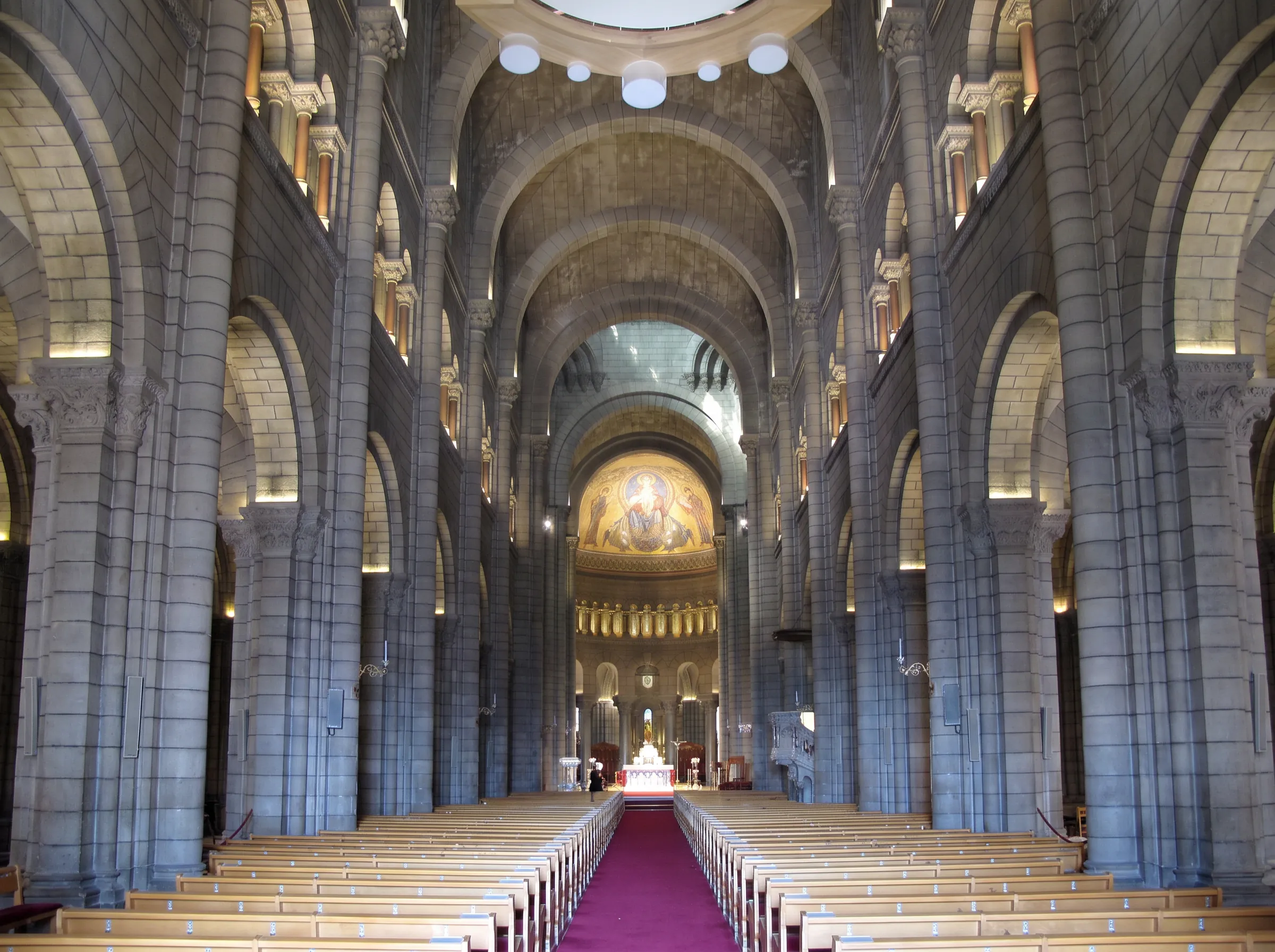
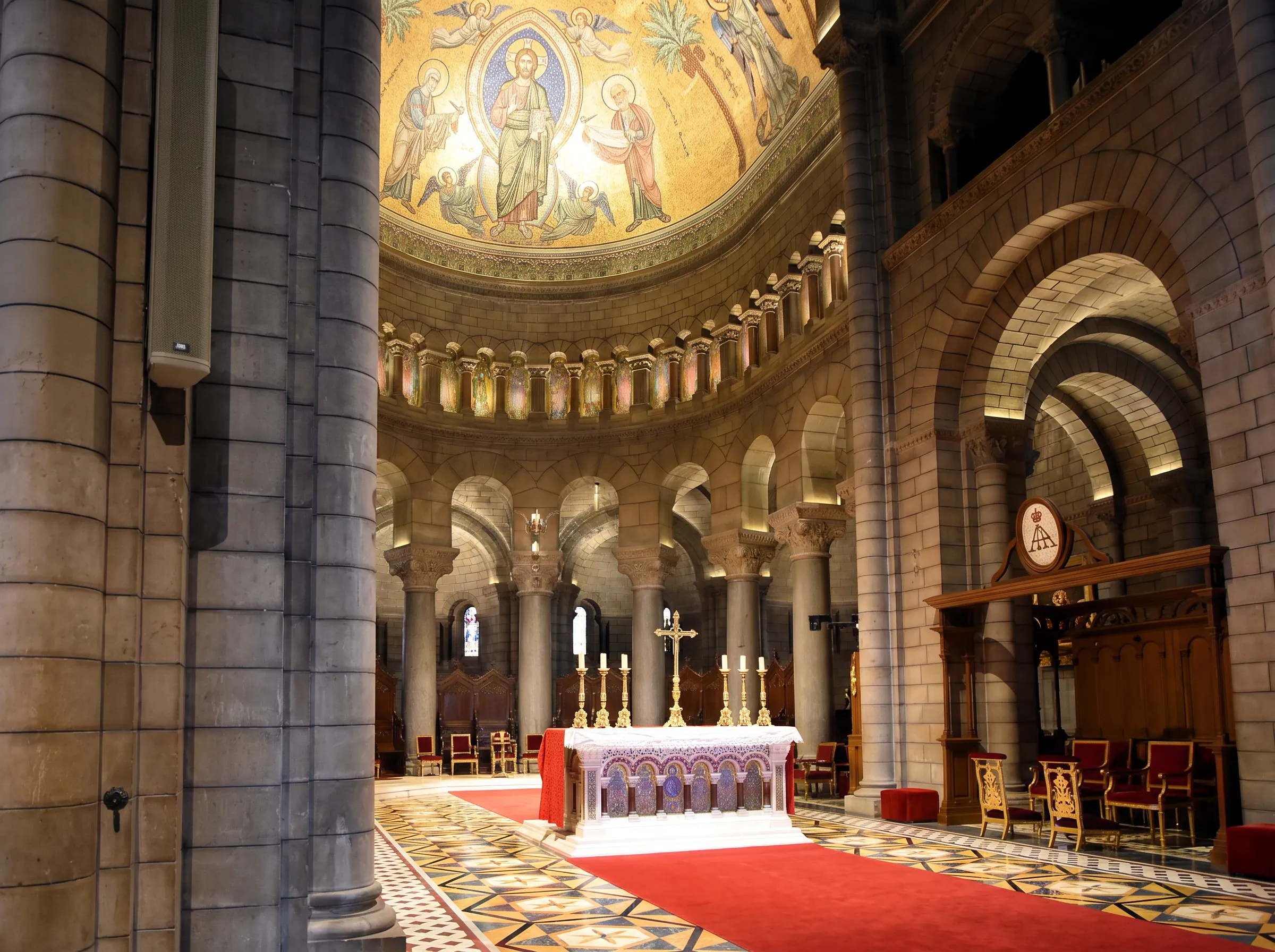
What it is. The semi-dome above the sanctuary — the cul-de-four — is filled with a gold-ground mosaic in the Byzantine manner, a standing haloed figure with attendant figures either side against a field of gold.
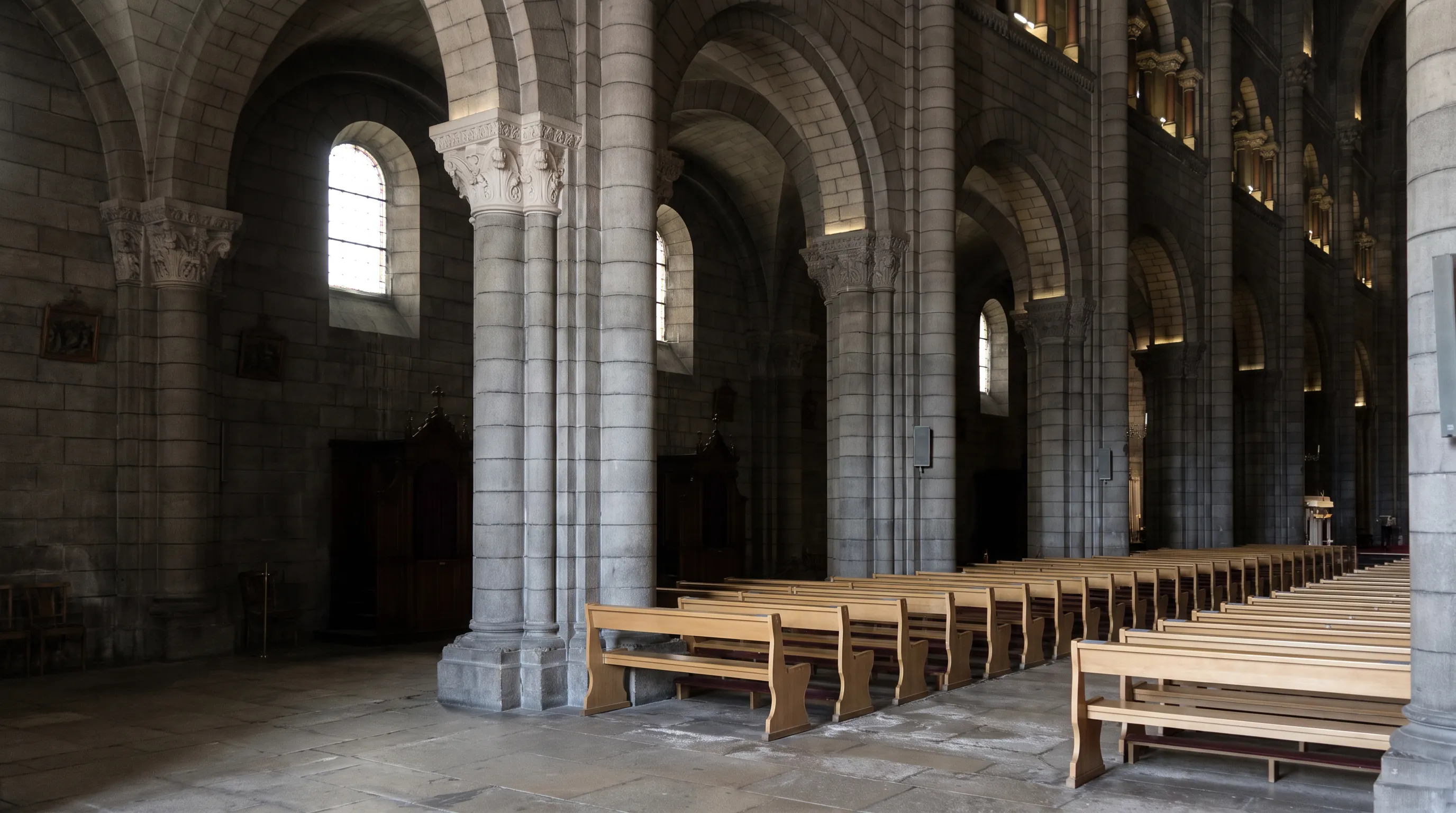
Why it works. The nave is deliberately austere: grey stone piers, plain surfaces, almost no colour for seventy metres. Then the whole east end glows. In a building lit as low as this one, the mosaic is the brightest thing in it from any position in the nave, and it is what pulls you up the aisle.
The same treatment, three times. Mosaic inlay is not confined to the apse. The high altar is white Carrara marble inlaid with mosaic and copper, and the organ case and the episcopal throne carry the same combination — so the building's richest material runs in a line from the west end to the east.
Look for the gilded mosaic; ask cathedral staff if you would like to learn more about its artist and subject.
Time required. Five minutes, from the crossing, where you can see it whole.
5. The relics of Sainte Dévote
What it is. The chapel holding the relics of Monaco's patron saint.
The tradition. Dévote was a young Christian martyred in Corsica in the early fourth century, during Diocletian's persecution. Her body was placed on a boat, and the tradition holds that a dove guided it to the Vallon des Gaumates below the Rock, arriving around 27 January. She became patron of the principality under Honoré II in the seventeenth century, and is also principal patron of Corsica.
Why it matters here. 27 January is Monaco's national day. Each year on the 26th and 27th the relics are carried in procession, and a boat is burned on the harbour in the presence of the sovereign and the princely family — a tradition established in the 1870s.
So the reliquary in this chapel is not a museum object. It is the centre of the principality's own annual observance.
Time required. Five minutes, and worth knowing before you look.
6. The organ
What it is. A grand organ on the tribune with four manuals, seventy-nine stops and close to seven thousand pipes.
Its history. Built by Jean-Loup Boisseau in 1976, in collaboration with Pierre Cochereau — then organist of Notre-Dame de Paris — and Canon Henri Carol. Rebuilt by the Belgian firm Manufacture d'orgues Thomas, completed in December 2011, using Vosges fir for the bellows, maple for the console and oak for the façade.
The detail worth looking for. The façade carries Plexiglas panels lit by LEDs, intended to give the sound a visible colour. A separate choir organ by Giovanni Tamburini of Crema stands below, also from 1976.
When to hear it. The 10:00 sung mass on Sundays from September to June.
Time required. Two minutes to look. An hour to hear.
7. The music, and the choir school
What it is. The Maîtrise de la Cathédrale de Monaco, founded in 1904 — the year after the building was completed — and Les Petits Chanteurs de Monaco, founded within it in 1974 and under the High Patronage of Prince Albert II.
Why it matters. The cathedral is a working musical institution rather than a venue that occasionally has music in it. Pierre Debat has directed since 1999 as master of chapel to both the palace and the cathedral, and the titular organists run in a short line from Henri Carol through René Saorgin to Olivier Vernet.
When. Sundays at 10:00, September to June.
Time required. An hour, and it is the best hour available in this building.
8. The stone
What it is. A building that reads as uniformly white from outside and is anything but.
White stone from La Turbie for the fabric. Red and blue porphyry from the Esterel massif. Green stone and granite from the Vosges. Granite from Biella in Piedmont for the choir. White Carrara marble for the high altar and the episcopal throne, the altar itself inlaid with mosaic and copper.
The connection worth making. The white La Turbie stone is the same quarry that supplied the Oceanographic Museum, begun in 1899 four minutes' walk away. Two buildings that look nothing alike came out of one hillside within a generation.
Time required. Five minutes, once you know to look down and around rather than up.
9. The 1484 bell
What it is. A bell cast in 1484 for the church of Saint-Nicolas, which stood here from 1252 until it was demolished in 1874.
Why it matters. In 1641 it rang for the expulsion of the Spanish garrison by Honoré II — the moment Monaco recovered its own sovereignty. The church it hung in is gone; the bell that announced the principality's independence is still on site.
Three further bells were blessed on 8 December 1960.
Time required. A moment, and mostly a thing to know rather than to see.
Details worth slowing down for.
The grave that does not say "princess"
Princess Grace's slab reads Gratia Patricia and names her in Latin as the wife of Prince Rainier III. It does not style her a princess in her own right.
That is the House of Grimaldi's convention for consorts, not a slight — and you can only tell it is a convention by reading the rest of the row. Twenty-four burials run back to Jean II, who died in 1505: sovereign princes named as princes, their wives named as wives, for five centuries.
Almost every visitor photographs one slab and turns round, which is exactly the reading that makes it look like a judgement on her.
The oldest thing on the Rock is in the newest building
The cathedral was consecrated in 1911. The retable of Saint Nicholas in its right transept was painted in August 1500.
It was carried across from the church that stood on this ground from 1252 until it was demolished in 1874. Nothing else on public view in Monaco-Ville is as old, and it is in the room people cross fastest.
There are five retables, not one
Everyone mentions the Bréa. Alongside it are a Pietà by Curé Teste dated 1505, a retable of Sainte Dévote, a retable of the White Penitents and a Saint Roch — the last two from the workshop of François Bréa.
A different Bréa. It was a family workshop supplying the Ligurian coast, and this cathedral quietly holds five of its era's panels in a country nobody visits for early Renaissance painting.
The bell outlived its church
A bell cast in 1484 hangs here, from the demolished church of Saint-Nicolas.
In 1641 it rang for the expulsion of the Spanish garrison by Honoré II — the moment Monaco recovered its sovereignty. The building it was made for is gone. The object that announced the principality's independence is still on the Rock.
The white cathedral is five kinds of stone
From outside it reads as one material. It is not.
White stone from La Turbie for the fabric. Red and blue porphyry from the Esterel massif. Green stone and granite from the Vosges. Granite from Biella, in Piedmont, for the choir. Carrara marble for the high altar and the episcopal throne, with the altar inlaid in mosaic and copper.
Lenormand assembled a geological collection and rendered it as a white building.
The same quarry as the museum
The white La Turbie stone came from the hill village directly above Monaco. So did the Oceanographic Museum's, begun in 1899 and four minutes' walk east along Avenue Saint-Martin.
Stand between them on a bright morning. Two buildings that share nothing stylistically — Romanesque-Byzantine revival and neo-Baroque — read as one material. Monaco-Ville's nineteenth-century face came out of a single hillside.
The windows have a curriculum
Not a set of scenes but a programme, and it divides by level.
The upper nave carries women of the Old Testament. The lateral naves carry the lives of Jesus and Mary.
Once you know the division you can read the building by looking up and then across, which is not how most people look at stained glass.
The organ has a light show
The 2011 rebuild by the Belgian firm Thomas put Plexiglas panels into the organ façade, lit by LEDs, intended to give the instrument's sound a visible colour.
A church consecrated in 1911, an instrument from 1976, a rebuild from 2011, and a lighting rig interpreting the music in real time. Nothing about the sound of this building is as old as the building.
The choir school is older than most of the fittings
The Maîtrise de la Cathédrale was founded in 1904 — the year after construction finished and seven years before consecration. The music was organised before the building was blessed.
Les Petits Chanteurs de Monaco were founded within it in 1974 and are under the High Patronage of Prince Albert II.
A dove, a boat, and a national day
The relics in the Sainte Dévote chapel are the centre of Monaco's national observance, which is a stranger fact than it first appears.
The tradition: Dévote was martyred in Corsica in the early fourth century under Diocletian; her body was set on a boat; a dove guided it to the Vallon des Gaumates below the Rock, arriving around 27 January. She became the principality's patron under Honoré II in the seventeenth century.
Every year on 26 and 27 January the relics are carried in procession and a boat is burned on the harbour by the princely family — a tradition established in the 1870s. 27 January is Monaco's national day.
The reliquary is not a museum object. It is the reason the country has the date it has.
A pope came, four months ago
On 28 March 2026 Pope Leo XIV celebrated Midday Prayer in this cathedral with Prince Albert II and Archbishop Dominique-Marie David present. It was the first papal visit to the principality in the modern era, and only the second international journey of his pontificate.
What he said in the homily is the part worth carrying: within this church, Monaco's social variety "should never become the occasion of division into social classes." Said in the wealthiest square kilometre in Europe, in the burial church of its ruling family.
The quietest hour on the Rock
The cathedral opens at 08:15. The Rock does not fill until mid-morning.
Between opening and about half past nine you can have the ambulatory to yourself, in a free building, four minutes from the busiest square in the country. There is no other interior in Monaco-Ville where that is true.
04 / Before you go
Plan your visit
Prices & admission
Free. No ticket, no booking and no timed entry.
Opening hours
Open daily 08:15–18:00, free. The cathedral closes to visitors during religious services, which are frequent — including the 10:00 sung mass on Sundays from September to June, sung by Les Petits Chanteurs de Monaco and the cathedral choir. It also closes to casual visiting on 26 and 27 January for the feast of Sainte Dévote. It does not close for the Grand Prix weekend.
Plan your experience
No booking. The cathedral closes to visitors during religious services, which are frequent — the highest-risk slot is the 10:00 sung mass on Sundays from September to June. It also closes to casual visiting on 26 and 27 January for the feast of Sainte Dévote, Monaco's national day. Unlike the Prince's Palace and the Oceanographic Museum, it does not close for the Grand Prix weekend.
Accessibility
The cathedral publishes no accessibility information at all. What is known is favourable: it stands at town level rather than up steps from the street, the step-free route onto the Rock arrives close by, and the interior is a single large volume with a wide ambulatory, so circulation inside should be good and the tombs are at floor level.
Dress code
Enforced at the door: shoulders must be covered, and mini-skirts and short shorts are not permitted. Bermuda shorts are accepted.
Checked on 4 August 2026. A working cathedral rather than a visitor attraction: the hours are stable, but access depends on the service schedule, which changes with the liturgical year.
Hours and admission
Open daily 08:15–18:00. Entry is free.
The cathedral closes to visitors during services. That is not a token restriction — services are frequent, and on Sunday mornings from September to June the building is in use at exactly the hour most visitors arrive.
There is no ticket, no booking and no timed entry.
Contact: +377 99 99 14 00 · cathedrale@diocese.mc Address: 8 rue Émile de Loth, 98000 Monaco-Ville
Dress code — enforced at the door
- Shoulders must be covered
- Mini-skirts and short shorts are not permitted
- Bermuda shorts are accepted
This catches people every day, particularly visitors arriving from Larvotto beach or walking up from the harbour in summer. Carry something with sleeves if you are combining the Rock with a beach day.
How long to allow
| Plan | Time |
|---|---|
| The tombs only | 10 minutes |
| Tombs, Bréa retable and a walk round | 30 minutes |
| Attending the sung mass | About an hour |
Thirty minutes is the honest figure for a proper visit. Most people give it fifteen and see two graves.
The best time to come
For quiet: first thing. The cathedral opens at 08:15, well before the Rock fills with coach and cruise groups from mid-morning. Between 08:15 and about 09:30 you may have the ambulatory to yourself.
For the music: the 10:00 mass on Sundays from September to June, sung by Les Petits Chanteurs de Monaco and the cathedral choir. This is the building at its best and the organ at full stretch.
Note the trade-off, because it is absolute: during that mass you are attending, not sightseeing. You cannot walk the ambulatory, photograph the tombs or inspect the retables. Choose one.
For the principality's own occasion: 26 and 27 January, the feast of Sainte Dévote, Monaco's patron and its national day. The relics are carried in procession and a boat is burned on the harbour in the presence of the princely family. Expect the cathedral to be closed to casual visiting across those days.
Getting there
The cathedral is on Avenue Saint-Martin in Monaco-Ville, at the level of the old town.
Step-free: the lift and escalator from the Parking des Pêcheurs come up close by. This is the recommended arrival for anyone who would rather not climb.
On foot: about four minutes from the Place du Palais through the lanes, or four minutes from the Oceanographic Museum along Avenue Saint-Martin. Ten minutes up the Rampe Major from Place d'Armes.
By bus: lines 1 and 2 terminate at Place de la Visitation, five minutes away.
By car: do not plan to. Monaco-Ville is a restricted traffic zone limited to vehicles registered in Monaco or the Alpes-Maritimes unless the Mairie grants an exemption. Park at the Parking des Pêcheurs and take the lift.
What to see, in order
- The right transept — the retable of Saint Nicholas by Louis Bréa, August 1500, eighteen compartments. The oldest important object on the Rock and the one most visitors walk past on the way to the tombs.
- The ambulatory, behind the high altar — twenty-four Grimaldi burials. Walk the whole row rather than stopping at the two famous slabs.
- The high altar and episcopal throne — mosaic and copper inlay; white Carrara marble.
- The other retables — the Sainte Dévote retable, the Pietà by Curé Teste of 1505, and the White Penitents and Saint Roch panels from François Bréa's workshop.
- The stained glass — women of the Old Testament in the upper nave; the lives of Jesus and Mary in the lateral naves.
- The organ — four manuals, seventy-nine stops, close to seven thousand pipes.
Facilities
There are none to speak of. This is a church: no shop, no café, no visitor centre, and no interpretation beyond limited signage.
Toilets, food and seating are all outside — the Oceanographic Museum four minutes east for facilities within a ticket, the lanes of Monaco-Ville for cafés, and the Jardins Saint-Martin immediately below for free benches and shade.
Photography
Permitted, with the obvious restraint. No flash. Do not photograph services or individual worshippers. At the tombs: no posing, no standing on the slabs.
The dress code applies to photographers as much as anyone.
Accessibility in brief
The cathedral sits at town level, which is the main thing in its favour, and the interior is a single large volume with a wide ambulatory — so once inside, circulation is good and the tombs are reachable on the level.
Step-free entry, an accessible toilet and a hearing loop are not confirmed. Telephone +377 99 99 14 00 before travelling to discuss your access requirements.
With children
Twenty minutes, comfortably. The tombs interest children more than adults expect — a real grave of a real film star is a concept that lands — and the scale of the building does some work on its own. There is nothing to do, so do not plan longer.
Rainy days and heat
One of the few free indoor spaces on the Rock, and cool in summer. In a downpour it is the obvious shelter between the Palace and the museum; in August it is the only place in Monaco-Ville you can sit down out of the sun without buying something.
What needs rechecking
| Fact | Cadence | Why |
|---|---|---|
| Service times | Six-monthly | The sung-mass season runs September to June |
| Opening hours | Annually | Stable, but published in only one place |
| Sainte Dévote arrangements | Annually, each January | The national feast closes the cathedral to visiting |
| Accessibility provision | Once, with the diocese | Currently unverified |
| Papal visit legacy | Once | Any permanent commemoration of the 2026 visit |
Visit your way
Access and family planning.
Written for someone deciding whether a visit is feasible. This is the least well-documented building on the Rock for access, and this chapter says so rather than filling the gaps with reassurance.
The honest position, up front
The cathedral publishes no accessibility information. Not a limited amount — none. What follows separates what can be established from what cannot, and the second list is longer than the first.
What is known is favourable: the building sits at town level rather than up steps from the street, the step-free route onto the Rock arrives close by, and the interior is a single large volume with a wide ambulatory, so circulation inside is good and the tombs are reachable on the level.
What is not known includes the thing you most need to know, which is whether there is a step at the door.
If step-free entry is decisive, telephone +377 99 99 14 00 or email cathedrale@diocese.mc before travelling. A wrong assumption here costs a journey up a 62-metre rock.
Getting there
Step-free and recommended. The lift and escalator from the Parking des Pêcheurs come up into Monaco-Ville close to the cathedral. The car park has over 500 spaces and sits directly below the Oceanographic Museum, four minutes east.
Not step-free. The Rampe Major from Place d'Armes is a ten-minute continuous climb with little shade and no seating.
By bus. Lines 1 and 2 terminate at Place de la Visitation, about five minutes away on the level. Boarding arrangements for wheelchair users at that terminus have not been verified and are not claimed.
By car. Monaco-Ville is a restricted traffic zone — vehicles registered in Monaco or the Alpes-Maritimes only, unless the Mairie grants an exemption. Blue-badge equivalence for foreign vehicles has not been verified. If you need to be set down at the door, contact the Mairie de Monaco in advance.
Approaching the building
The cathedral stands on Avenue Saint-Martin at the level of the surrounding town, which is the single most helpful fact about it. The lanes of Monaco-Ville run along the contour rather than climbing, so the approach from any direction on the Rock is effectively flat.
Surfaces on the approach are stone setts and worn paving, and the lanes are shared with vehicles.
The neighbouring Jardins Saint-Martin have reduced-mobility access points near the cathedral. Check the cathedral’s entrance separately: a level approach does not ensure step-free entry.
Inside
A single large volume, 72 metres long and 22 wide, with a wide ambulatory running behind the high altar. Once inside, this is among the easier interiors in Monaco to move around: no changes of level are known, the aisles are broad, and the tombs — the main object of most visits — are set in the ambulatory floor at ground level.
Seating is pews, which are fixed. There is no separate rest area.
The building is never crowded in the way the Oceanographic Museum is, though it fills between mid-morning and mid-afternoon in season and during services.
Sensory environment
Among the calmest interiors on the Rock. Cool, echoing, and quiet outside service times — the acoustic is live, so sound carries further than expected, but the overall level is low.
For a visitor who needs a low-stimulation environment, the cathedral between 08:15 and about 09:30 is the quietest indoor space in Monaco-Ville.
During the 10:00 Sunday sung mass from September to June, the organ and choir make this a loud building. That is the attraction for most people and the reason to avoid it for others.
Visual impairment
The lighting is low by daylight standards and varies sharply between the nave and the ambulatory. The retables are in poor light for anyone with reduced vision.
Ask the cathedral about braille, large-print information, tactile materials or audio support before visiting if you need them.
Hearing impairment
A hearing loop is not confirmed. Ask the cathedral directly if you need one during your visit or a service.
Visiting outside service times loses almost nothing without sound.
Toilets
There are none. The cathedral has no visitor facilities at all — no toilets, no shop, no café.
The nearest are at the Oceanographic Museum four minutes east, for ticket-holders, plus public facilities on the Rock. Plan around this before arriving, particularly with children or if mobility makes a return journey costly.
Assistance animals
Contact the cathedral before visiting with an assistance animal to confirm arrangements.
Service closures
The cathedral closes to visitors during services, which are frequent. For a visitor for whom the journey is difficult, arriving to find the building closed to sightseeing is a real risk — and the highest-risk slot is Sunday morning between September and June.
Telephoning ahead is worth it for this reason alone, quite apart from the access questions.
The feast of Sainte Dévote
On 26 and 27 January the cathedral is at the centre of Monaco's national observance: the relics are carried in procession and a boat is burned on the harbour. Expect the building to be closed to casual visiting and the surrounding quarter to be crowded and partly controlled.
The short answer
Twenty minutes, free, and better with children than most parents expect — but it is a church, not an attraction. Go in with one story to tell and leave before anyone gets restless.
Be honest about the length
There is nothing to do here. No trail, no handling, no interactive anything, no shop. That is not a criticism of the cathedral; it is a working church that happens to be on every visitor's route.
Sold as a twenty-minute stop with a story attached, it works well. Sold as an attraction, it disappoints within five.
Age by age
Under 5. Fine, briefly. The scale of the space does the work — it is cool, tall and echoing, which most small children find interesting for about ten minutes. Pushchairs are manageable inside; getting up to Monaco-Ville is the harder part, for which the Parking des Pêcheurs lift is the answer.
5–9. The best age, and the reason is the tombs. A real grave belonging to a real film star is a concept that lands hard at this age, and it turns an abstract building into a specific place. Expect questions.
10–14. Add the Bréa retable, which works as a puzzle: eighteen separate little pictures in one frame, painted in the year 1500, older than the church around it. Counting the compartments is a genuinely good ten minutes.
Teenagers. Twenty minutes at most, unless there is an interest in music or history. The organ specification helps — seventy-nine stops, seven thousand pipes, and a façade that lights up with the sound.
The story to tell on the way in
Pick one. Two work particularly well.
The boat and the dove. Sainte Dévote was killed in Corsica about seventeen hundred years ago. Her body was put in a boat, and the story says a dove guided it across the sea to the rocks below Monaco. She became the country's patron saint, and every January the principality burns a boat in the harbour to remember it. Her relics are in this building.
The bell that is older than the church. There was a different church here, built in 1252 and knocked down in 1874. One of its bells, made in 1484, is still here — and in 1641 it was rung to tell everyone that Monaco had thrown out a foreign garrison and was its own country again.
Both are short, both are true as traditions or as history, and both give a child a reason to look at something specific.
The dress code applies to children too
Shoulders covered; no short shorts or mini-skirts, though Bermuda shorts are accepted. It is enforced at the door.
This matters more for families than anyone, because families are the group most likely to arrive from a beach or in high-summer clothing. Carry a layer.
Conduct
It is a working church and there may be people praying. The short version for children: quiet voices, no running, and do not stand on the flat stones in the curved corridor behind the altar — those are graves.
Services close the building to visitors, and they are frequent. If you arrive at 10:00 on a Sunday between September and June you have arrived for a sung mass. With children, that is either a wonderful accident or the wrong moment entirely; decide before you go in.
Facilities — there are none
No toilets, no café, no shop, no baby-change. Plan around:
- Toilets and food: the Oceanographic Museum, four minutes east, for ticket-holders. Cafés in the lanes of Monaco-Ville.
- Sitting down and running about: the Jardins Saint-Martin, immediately below the cathedral — free, ungated, benches, shade and a sea view. This is the natural next stop and it solves everything the cathedral does not provide.
Where it fits in a family day
It works best as a ten-to-twenty-minute stop between two bigger things, not as a destination:
| 09:00 | Cathedral, while it is empty and cool |
| 09:30 | Jardins Saint-Martin — sit down, run about, sea view |
| 10:15 | Walk the lanes to the Place du Palais |
| 11:40 | Changing of the guard |
| 13:00 | Oceanographic Museum — the actual day |
Self-guided walk
Explore beyond the venue.
A practical, step-by-step route connecting this experience with more of Monaco Grand Prix.Stop 1 — The west front, from across the street
0 minutes. Allow 5.
Cross Avenue Saint-Martin and look back before entering.
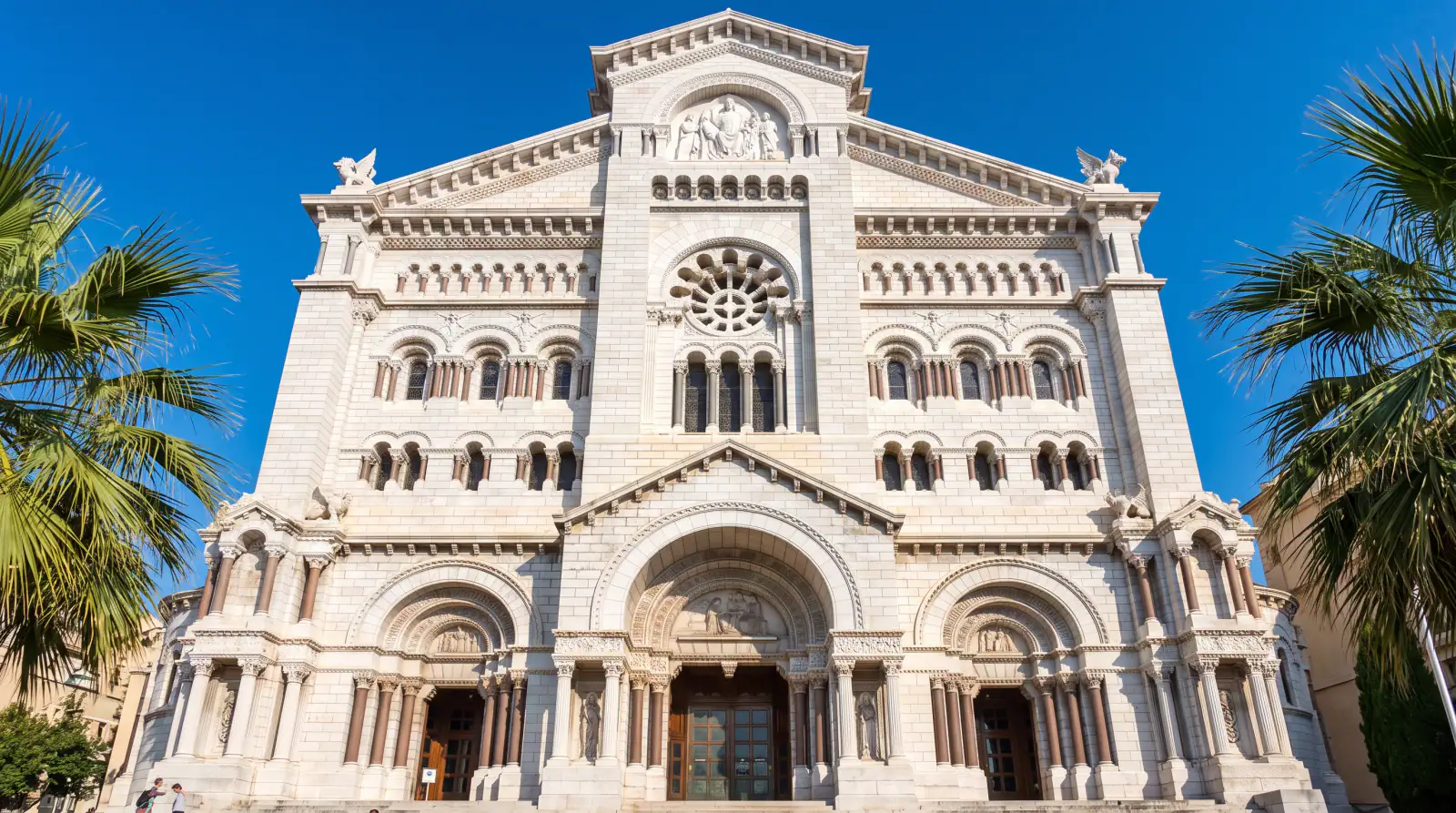
Brilliant white stone from La Turbie, the hill village directly above Monaco. Three round-arched portals, a rose window above them, tiers of small arcaded windows, and a triangular pediment with carved relief and sculpted figures at the corners of the roofline.
Charles Lenormand designed this in a Romanesque-Byzantine manner in 1875, when almost every other church in Europe was being built Gothic. He was going against the current deliberately.
Look at the stone and remember it. You will see it again in twenty minutes.
Stop 2 — Inside the door, and stop
5 minutes. Allow 3.
Do not walk on yet. Stand at the back and take the volume: 72 metres long, 22 wide, 18 high, in a single uninterrupted space.
The cathedral was completed on 12 November 1903 and consecrated on 11 June 1911 — so what you are standing in is younger than the Oceanographic Museum four minutes away, and younger than most people assume by six hundred years.
Stop 3 — The right transept and the Bréa retable
8 minutes. Allow 10.
Go right, not forward. This is the stop everyone skips and it holds the oldest important object on the Rock.
The retable of Saint Nicholas was painted by Louis Bréa of Nice — Ludovico Brea — and is dated August 1500. It is 202 by 260 centimetres and divided into eighteen compartments.
Count them. The compartment structure is the point: eighteen separate small pictures in one frame, in the late-medieval Ligurian manner, a generation before an Italian altarpiece would have become a single unified scene.
It is here because it was carried across from the church of Saint-Nicolas, which stood on this ground from 1252 until it was demolished in 1874. The painting is four hundred years older than the walls around it.
Stop 4 — The other retables
18 minutes. Allow 10.
Four more, and most guides mention none of them.
A Pietà by Curé Teste, dated 1505 — five years after the Bréa. The retable of Sainte Dévote. And the retable of the White Penitents and a Saint Roch, both attributed to the workshop of François Bréa — a different Bréa, from a family workshop that supplied the whole Ligurian coast.
Five early-sixteenth-century panels, free to see, in a country nobody visits for early Renaissance painting.
Stop 5 — The high altar and the episcopal throne
28 minutes. Allow 4.
Walk up the nave — and as you go, look at what is above the sanctuary. The semi-dome, the cul-de-four, is filled with a gold-ground mosaic in the Byzantine manner: a standing haloed figure with attendants against a field of gold. In a nave this austere and this dimly lit, it is the brightest thing in the building from anywhere in the aisle, and it is what has been pulling you east since you came in. Stop at the crossing, where you can see it whole.
The high altar below it is white Carrara marble inlaid with mosaic and copper — and the organ case behind you and the episcopal throne carry the same combination, so the richest material in the building runs in a line from west to east.
Look at the choir floor and the surrounding stonework as you go, because this is where the building stops being white. Lenormand used red and blue porphyry from the Esterel massif, green stone and granite from the Vosges, and granite from Biella in Piedmont for the choir. A building that reads as one material from the street is five once you are inside it.
Stop 6 — The ambulatory: twenty-four Grimaldis
32 minutes. Allow 15.
Behind the high altar, the curved corridor. This is what most people came for and almost nobody reads properly.
Walk the whole row. Twenty-four burials, running back to Jean II, who died in
- Sovereign princes named in Latin as princes; their wives named as wives; five centuries, in order, in one continuous line.
Only when you have read the sequence does the famous slab make sense. Princess Grace is inscribed Gratia Patricia and named as the wife of Prince Rainier III — not styled a princess in her own right. That is the house's convention for consorts, applied identically the whole length of the ambulatory. Read alone, it looks like a judgement on her; read in the row, it is a rule.
Rainier III lies beside her. She died on 14 September 1982; he died on 6 April 2005; they were married in this building on 19 April 1956, before six hundred guests and a live Eurovision broadcast to some thirty million people.
Albert I is here too — the prince who built the Oceanographic Museum four minutes east. Find him.
Do not stand on the slabs.
Stop 7 — The chapel of Sainte Dévote's relics
47 minutes. Allow 5.
The relics of the principality's patron saint.
The tradition: Dévote was a young Christian martyred in Corsica in the early fourth century under Diocletian. Her body was placed on a boat, and a dove is said to have guided it to the Vallon des Gaumates below the Rock, arriving around 27 January. She became Monaco's patron under Honoré II in the seventeenth century, and is principal patron of Corsica too.
Every year on 26 and 27 January the relics are carried down in procession and a boat is burned on the harbour by the princely family — a tradition established in the 1870s. 27 January is Monaco's national day.
This is not a museum object. It is the reason the country's national day falls when it does.
Stop 8 — Look up: the windows and the organ
52 minutes. Allow 5.
The stained glass runs a programme, and it divides by level. The upper nave carries women of the Old Testament; the lateral naves carry the lives of Jesus and Mary. Look up, then across.
Then turn and look back at the tribune. The grand organ has four manuals, seventy-nine stops and close to seven thousand pipes. Jean-Loup Boisseau built it in 1976 with Pierre Cochereau — then organist of Notre-Dame de Paris — and Canon Henri Carol; the Belgian firm Thomas rebuilt it in December 2011 with Vosges fir bellows, a maple console and an oak façade.
Look at the façade itself: it carries Plexiglas panels lit by LEDs, meant to give the sound a visible colour.
If it is Sunday between September and June, the 10:00 mass is sung by Les Petits Chanteurs de Monaco, founded here in 1974, and the cathedral choir, whose school was founded in 1904. Attending is the better visit — but you cannot do this route during it. Choose one.
Stop 9 — Down into the gardens
57 minutes. Allow 20.
Leave and turn immediately downhill into the Jardins Saint-Martin, whose access point is a minute from the door.
The cathedral has no toilets, no café, no shop and no seating but pews. The gardens have free benches, shade, rest areas and the best free view in Monaco, south and west over Fontvieille and the open sea. They were laid out in 1816 to give paid work during a famine — Monaco's oldest public gardens, and a deliberate change of register after half an hour among princely tombs.
Find François Cogné's 1951 bronze of Prince Albert I, dressed as a sailor and facing out to sea rather than towards the town. You stood at his grave twenty minutes ago.
Stop 10 — Four minutes east, if you have two hours
Allow 2 hours.
Walk east along Avenue Saint-Martin to the Oceanographic Museum — the institution Albert I founded in 1889 and opened in 1910.
Look at its stone before you go in. It is white La Turbie, the same quarry as the cathedral you have just left, quarried a generation apart for two buildings that share nothing else at all.
Make a record
Photograph it thoughtfully.
Before anything else
This is a working church with a burial row in it. Photography is permitted with the restraint that implies: no flash, no photographing services or individual worshippers, and at the tombs no posing, no props and no standing on the slabs.
The dress code applies to photographers exactly as it does to everyone — shoulders covered, no mini-skirts or short shorts, Bermuda shorts accepted. It is enforced at the door and a camera does not exempt you.
The west front
The strongest exterior and the easiest shot in the building's whole repertoire.
What. Brilliant white La Turbie stone in a Romanesque-Byzantine revival manner: three round-arched portals, a large rose window above, tiers of small arcaded windows, a triangular pediment with carved relief and sculpted figures at the corners of the roofline.
When. Morning, when the front is lit and the stone is at its whitest. By afternoon it is in shadow and you are shooting into the sky.
How. Straight on, symmetrical — the façade is composed for it. Palm fronds at the frame edges give scale and stop it reading as an architectural elevation. Step back far enough that the pediment is not cut, which on Avenue Saint-Martin means crossing to the far side.
The harder version. From the Jardins Saint-Martin below, looking up, with the building against sky rather than street. Fewer people take it.
Inside: the nave
A long, tall, plain volume — 72 metres by 22, and 18 high — which photographs better than it looks because of the light.
Settings. Low light, high contrast between the windows and the walls. Push the sensitivity, brace against a pillar, expose for the stone rather than the glass or the windows will burn out the whole frame.
Composition. Straight down the centre to the high altar is the obvious frame and the right one. Include enough ceiling to give the height.
The ambulatory and the tombs
The most photographed and the most often photographed badly.
Do. Photograph the row — the sequence of slabs curving away behind the altar, which is the thing that actually explains this place. A low angle along the line of stones carries the five centuries better than any single grave.
Do not. Pose beside Princess Grace's slab, stand on it, or use flash. People do all three daily.
The single slab, if you want it, is Gratia Patricia. Shoot it square, from standing, with the inscription legible and nothing else in the frame. Available light only.
The Bréa retable
In the right transept, painted in August 1500, 202 by 260 centimetres in eighteen compartments.
The problem. Low light, glass or varnish, and no ability to move it or light it.
The answer. Do not attempt the whole panel unless you have a tripod and permission. Shoot compartments — one or two scenes filling the frame — which suits the object's own structure and produces a far better image than a dim, skewed record of all eighteen.
Same approach for the Pietà of 1505 and the two François Bréa workshop panels.
The organ
Four manuals, seventy-nine stops, close to seven thousand pipes, on the tribune.
The detail worth having. The 2011 rebuild put Plexiglas panels into the façade, lit by LEDs that respond to the sound. Photographing that means photographing during music — which means during a service, which means you should not be photographing at all.
The honest advice: photograph the case when the building is empty, and listen when it is playing. Do not try to do both.
The stained glass
A programme rather than a set of scenes, and worth shooting as one: women of the Old Testament in the upper nave, the lives of Jesus and Mary in the lateral naves.
Expose for the glass and let the interior go black. Midday gives the strongest colour; a bright overcast gives the most even light across a whole window.
Light through the day
| Hour | Where |
|---|---|
| 08:15–09:30 | Interior, empty — the only time you can compose without people |
| Morning | The west front, lit |
| Midday | Stained glass at full colour |
| Afternoon | Interior only; the façade is in shadow |
| Sunday 10:00, Sep–Jun | Put the camera away and listen |
Services and the feast
The cathedral closes to visitors during services. On 26 and 27 January — the feast of Sainte Dévote and Monaco's national day — the relics are carried in procession and a boat is burned on the harbour. That is a significant photographic occasion and it is a religious and state observance, not a display. Shoot from where the public is directed and nowhere else.
Drones
Choose ground-level photography. Arrange the necessary written authorisation with the Monaco authorities before any professional drone work.
Commercial photography and weddings
Not confirmed: the permit regime for commercial photography, filming, tripods or lighting, and the cathedral's policy on wedding photography.
Assume that anything beyond a handheld camera requires prior permission from the diocese, and ask on cathedrale@diocese.mc.
Around here
Make more of the area.
Good to know
Questions, answered.
01Where is Grace Kelly buried?
In the ambulatory of Monaco Cathedral, the curved corridor behind the high altar, among the tombs of the sovereign princes. Her slab is inscribed Gratia Patricia and names her in Latin as the wife of Prince Rainier III. He is buried beside her.
02Is Prince Rainier III buried there too?
Yes, next to Princess Grace. She died on 14 September 1982; he died on 6 April 2005. They were married in this cathedral on 19 April 1956.
03How much does it cost to visit?
Nothing. Entry is free.
04What are the opening hours?
Open daily from 08:15 to 18:00. The cathedral closes to visitors during religious services, which are frequent.
05How long do I need?
Ten minutes for the tombs alone; thirty for a proper visit including the Bréa retable and the other altarpieces. Most people give it fifteen and see two graves.
06Is there a dress code?
Yes, and it is enforced at the door. Shoulders must be covered, and mini-skirts and short shorts are not permitted. Bermuda shorts are accepted.
07Can I go inside during a service?
You can attend, but not sightsee. The cathedral closes to visitors during services — you cannot walk the ambulatory, photograph the tombs or inspect the retables while one is in progress.
08When is the best time to visit?
08:15, when it opens. Between then and about half past nine the building is close to empty, before the Rock fills with coach and cruise groups.
09When can I hear the choir?
The 10:00 mass on Sundays from September to June, sung by Les Petits Chanteurs de Monaco and the cathedral choir. It is the building at its best — but you are attending, not touring.
10Is it a medieval cathedral?
No. The foundation stone was laid on 6 January 1875, construction finished on 12 November 1903, and it was consecrated on 11 June 1911. The site is medieval: a church stood here from 1252 until it was demolished in 1874.
11Who designed it?
Charles Lenormand, in a Romanesque-Byzantine revival style — deliberately against the Gothic revival that dominated European church building at the time.
12Why is it sometimes called Saint Nicholas Cathedral?
Because the church that stood here from 1252 until 1874 was dedicated to Saint Nicholas. The present building is dedicated to Notre-Dame-Immaculée. Saint Nicholas survives in the Bréa altarpiece carried across from the old church, which is why the older name persists.
13What is the oldest thing inside?
The retable of Saint Nicholas by Louis Bréa, dated August 1500, in the right transept. It is 202 by 260 centimetres with eighteen compartments, and it is the oldest important object anywhere on the Rock.
14How many people are buried there?
Twenty-four, from Jean II Grimaldi, who died in 1505, to Rainier III in 2005 — five centuries of the family in one continuous row.
15Are the tombs in a crypt?
No. They are set into the floor of the ambulatory behind the high altar, at ground level and in the open. Do not stand on them.
16Who is Sainte Dévote?
The patron saint of Monaco, and principal patron of Corsica. The tradition holds that she was martyred in Corsica in the early fourth century, her body set adrift in a boat, and a dove guided it to the shore below the Rock around 27 January. Her relics are kept in the cathedral.
17Why does Monaco burn a boat every January?
It commemorates the arrival of Sainte Dévote's boat. On 26 and 27 January her relics are carried in procession and a boat is burned on the harbour by the princely family — a tradition established in the 1870s. 27 January is Monaco's national day, and the cathedral is closed to casual visiting across those days.
18What is the gold mosaic above the altar?
A gold-ground mosaic filling the cul-de-four, the semi-dome above the sanctuary, in the Byzantine manner — a standing haloed figure with attendants against a field of gold. In a nave this austere and this dimly lit it is the brightest thing in the building, and it is what draws you up the aisle. Who made it and when are not established: one secondary source credits a Venetian mosaicist and calls the subject the Virgin and Child, while the fuller source records only a gilded mosaic and names nobody.
19Tell me about the organ.
Four manuals, seventy-nine stops and close to seven thousand pipes. Jean-Loup Boisseau built it in 1976 with Pierre Cochereau and Canon Henri Carol; the Belgian firm Thomas rebuilt it and finished in December 2011. Its façade carries Plexiglas panels lit by LEDs that respond to the sound.
20Did a pope ever visit?
Yes. Pope Leo XIV celebrated Midday Prayer here on 28 March 2026, with Prince Albert II and Archbishop Dominique-Marie David present — the first papal visit to the principality in the modern era.
21Are there toilets?
No. The cathedral has no visitor facilities at all — no toilets, no café, no shop. The nearest are at the Oceanographic Museum, four minutes east, for ticket-holders.
22Is it wheelchair accessible?
The cathedral is at town level, with a wide ambulatory and tombs at floor level. Step-free entry is not confirmed. Telephone +377 99 99 14 00 before travelling if it is essential.
23How do I get there?
It is on Avenue Saint-Martin in Monaco-Ville, four minutes from the Place du Palais and four from the Oceanographic Museum. The step-free route onto the Rock is the lift and escalator from the Parking des Pêcheurs. Buses 1 and 2 terminate at Place de la Visitation, five minutes away.
24Can I drive there?
Not up to Monaco-Ville — it is a restricted traffic zone limited to vehicles registered in Monaco or the Alpes-Maritimes unless the Mairie grants an exemption. Park at the Parking des Pêcheurs and take the lift.
25Can I take photographs?
Yes, without flash. Do not photograph services or individual worshippers, and at the tombs do not pose, use props or stand on the slabs.
26Does it close for the Grand Prix?
No. The Prince's Palace, the Oceanographic Museum and the Prince's Car Collection all close for the Grand Prix weekend; the cathedral does not. It is one of the few things on the Rock still open that weekend — though access to the quarter itself may be restricted.
27Is it worth visiting?
For thirty minutes, yes — it is free, it holds the oldest object on the Rock and the graves of a dynasty, and it is four minutes from the Oceanographic Museum. It is not worth building a day around, and there is nothing to do in it.
28What else should I see nearby?
The Jardins Saint-Martin, immediately below — free benches, shade and the best free view in Monaco. The Oceanographic Museum, four minutes east and built from the same quarry. The Prince's Palace, five minutes west.
Before you visit
Useful links.
Venue and visitor information
Method
The diocese is the authority for the cathedral's own hours, address and contact details, and was used for all three. The Vatican's own publications were used for the March 2026 papal visit rather than press summaries. Monaco's government and tourist board were used for Sainte Dévote and the national feast.
For the building's fabric, its art and its music, French-language reference is substantially fuller than the English equivalent and was preferred — the same asymmetry that produced two errors in an earlier guide on this site, corrected once the Oceanographic Museum was researched properly.
Where a fact could not be traced to an adequate source, this guide says it is unverified rather than asserting it. The accessibility gaps are extensive and are listed at the end.
Sources
| ID | Source | Used for | Retrieved |
|---|---|---|---|
| S01 | Paroisse Cathédrale — Diocèse de Monaco | Daily opening 08:15–18:00, the address at 8 rue Émile de Loth, telephone and email | 2026-08-04 |
| S02 | VisitMonaco — Notre-Dame-Immaculée Cathedral | Separation from the diocese of Nice in 1868; the foundation stone of 6 January 1875 under Charles III; consecration 11 June 1911; white La Turbie stone; the Carrara marble high altar; the Bréa retable of 1500; the 2011 organ rebuild with four manuals, 79 stops and nearly 7,000 pipes; the Sunday 10:00 sung mass September–June; free access except during services; the dress code | 2026-08-04 |
| S03 | Wikipédia — Cathédrale Notre-Dame-Immaculée de Monaco | Charles Lenormand as architect; completion 12 November 1903; dimensions 72 × 22 × 18 m; the full material list including Esterel porphyry, Vosges stone and granite, and Biella granite; the predecessor church of 1252 demolished 1874; the 1484 bell and the 1641 expulsion of the Spanish; all five retables with dates, dimensions and attributions; the stained-glass programme; the three chapels; the three bells blessed 8 December 1960; the organ builders, rebuilders and materials; the titular organists; the Maîtrise founded 1904 and Les Petits Chanteurs founded 1974; the twenty-four burials; the 1956 wedding with 600 guests and the Eurovision broadcast | 2026-08-04 |
| S04 | Vatican — Apostolic Journey to Monaco, homily at the Cathedral, 28 March 2026 | The date and setting of the papal visit; Midday Prayer with the Catholic community; the presence of Prince Albert II and Archbishop Dominique-Marie David; the homily's remarks on welcome and on social division | 2026-08-04 |
| S05 | Holy See Press Office — Apostolic Journey of Pope Leo XIV in the Principality of Monaco | Confirmation of the journey, its date and its status as the first international journey of 2026 | 2026-08-04 |
| S06 | Gouvernement de Monaco — Les célébrations de la Sainte Dévote and Monaco cultural coverage | The 26–27 January observance; the procession of the relics; the burning of the boat by the princely family; the tradition established in the 1870s; 27 January as the national day | 2026-08-04 |
| S07 | Wikipédia — Dévote (sainte)) | The martyrdom in Corsica under Diocletian; the boat and the dove; the Vallon des Gaumates; patron of Monaco under Honoré II; principal patron of Corsica | 2026-08-04 |
| S08 | Above Guide's own Monaco off-track dataset, checked against the venue | Verified venue coordinates | 2026-08-04 |
| S09 | Provence 7 — Cathédrale Notre-Dame-Immaculée | The gilded mosaic in the cul-de-four; the high altar in Carrara marble inlaid with mosaic and copper, and the same treatment on the organ case and the episcopal throne; and the retable compartment count recorded in the conflict ledger | 2026-08-04 |
| S10 | Wikimedia Commons photographs of the interior, examined directly | The apse mosaic as observed — gold ground, Byzantine manner, a standing haloed figure with attendants — described from the photographs rather than from a text source, and labelled as observation in the highlights chapter | 2026-08-04 |
Conflict ledger
Opening hours
The cathedral's own site (S01) states 08:15–18:00 daily. Secondary tourism listings state 08:30–18:00 in winter and 08:30–19:00 in summer. The tourist board (S02) gives no clock time at all, saying only "free access every day, except during religious services".
Used: 08:15–18:00, from the cathedral itself. Note that no source publishes the service schedule in a form that lets a visitor predict when the building will be closed to sightseeing — which is the practically important gap.
When was the earlier church built?
French-language reference (S03) gives the church of Saint-Nicolas as built in 1252 and demolished in 1874. An English-language tourist-board page implies a construction spanning 1215–1321.
Used: 1252, from the fuller source. The demolition date of 1874 is not in dispute, and neither is the fact that the Bréa retable and the 1484 bell came across from it.
"The first papal visit since 1538"
French-language reference frames the 2026 visit as the first since Paul III in 1538. The Vatican's own materials (S04, S05) and the accompanying press coverage say only that it was the first papal visit to the principality in the modern era.
Used: the modern-era wording. The 1538 claim may well be right, but it is not supported by the primary sources consulted and this guide does not promote it.
Who made the apse mosaic, and what does it show?
The gold-ground mosaic filling the semi-dome above the sanctuary is the most striking thing in the interior, and it is the worst-documented.
- Provence 7 (S09), the fullest source on the interior, records only "le cul-de-four est composé d'une mosaïque dorée" — a gilded mosaic. No artist, no date, no subject.
- A secondary visitor site credits "the Venetian master Faccina" and describes the subject as the Virgin and Child in Byzantine style.
- Photographs (S10) show a gold ground with a standing haloed figure and attendant figures either side.
Used: the description, not the attribution. The mosaic is described as observed and as a gilded Byzantine composition; no artist, date or definite subject is claimed, and the highlights chapter says so explicitly.
Why the caution. The Faccina attribution is plausible — it is a well-known nineteenth-century Venetian mosaicist name — but it appears in one secondary source and is absent from the fuller one. The building's dedication is Notre-Dame-Immaculée, which makes a Virgin composition likely, but "likely" is not a source.
Outstanding: the cathedral or the diocese can presumably settle both. Worth a single email.
Seventeen compartments, or eighteen?
French-language reference (S03) gives the Bréa retable eighteen compartments. Provence 7 (S09) gives seventeen.
Used: eighteen, from the source that also supplies the panel's dimensions and its precise August 1500 dating, and is more detailed throughout.
Note for a future editor: this is countable. Anyone standing in the right transept can settle it in thirty seconds, and it is the kind of small verifiable fact worth fixing on a site visit rather than by more searching.
How many chapels?
Three are documented (S03): the chapel of the relics of Sainte Dévote, the chapel of Saint Roman, and the chapel of the Blessed Sacrament, which serves as the episcopal funerary chapel.
The diocese's own mass listings (S01) also name a Chapelle Notre-Dame de Mercy. This may be a fourth chapel within the cathedral, a subsidiary space, or a separate building in the parish.
Used: three, as documented. The discrepancy is recorded rather than resolved.
The organ: 1976 or 2011?
Both. Jean-Loup Boisseau built the instrument in 1976 with Pierre Cochereau and Canon Henri Carol; the Belgian firm Manufacture d'orgues Thomas completed a rebuild in December 2011 (S02, S03).
Reconciled, both retained. The bundle states the 2011 specification — four manuals, seventy-nine stops, close to seven thousand pipes — and names the 1976 origin. Sources that give only one date are incomplete rather than wrong.
Sainte Dévote: tradition, not record
The martyrdom, the boat and the dove are a devotional tradition held and celebrated by the principality (S06, S07), not an attested sequence of events.
Used: written as a tradition throughout, and labelled as one. This loses nothing: what Monaco actually does every 27 January — the procession, the burning boat, the national day — is a documented fact, and it is the more interesting half.
Facts deliberately not asserted
Each is named as unverified in the chapter that would otherwise carry it.
| Fact | Where this guide says so |
|---|---|
| The threshold at the main door — the critical access unknown | Accessibility |
| Hearing loops | Accessibility |
| Braille, large-print or tactile provision | Accessibility |
| Audio guides or interpretation | Accessibility |
| Assistance-animal policy | Accessibility |
| Seating other than fixed pews | Accessibility |
| Bus boarding at the Place de la Visitation terminus | Accessibility |
| Blue-badge equivalence for foreign vehicles | Accessibility |
| Commercial photography and wedding-photography permits | Photography |
| The drone regime over Monaco-Ville | Photography |
| Opening hours of the Church of Sainte-Dévote | Nearby |
| Whether the 2026 papal visit left a permanent commemoration | Not claimed anywhere |
The accessibility list is unusually long because the cathedral publishes no accessibility information at all. That is stated plainly in the accessibility chapter rather than smoothed over, because a wrong assumption there costs a visitor a journey up a sixty-two-metre rock.
A note on what was not used
No AI-generated encyclopaedia was cited. Ticket resellers and attraction aggregators were avoided: they carry the "medieval cathedral" error, several give the wrong dedication as the primary name, and none carries the detail that makes this building interesting — the five retables, the burial convention, or the choir school.
Opening hours, prices, programmes and access arrangements can change. Confirm critical details with the venue.
Continue exploring / Monaco
More things to do
in Monaco
Explore Monaco activities, sights and places to eat. Compare the time to allow, costs and booking details, then save your favourites to your itinerary.
 01Monaco Grand Prix experienceCasino de Monte-CarloExplore experience →
 02Monaco Grand Prix experienceFontvieilleExplore experience →
 03Monaco Grand Prix experienceFort AntoineExplore experience →
 04Monaco Grand Prix experienceGrimaldi ForumExplore experience →
 05Monaco Grand Prix experienceJardin Exotique de MonacoExplore experience →
 06Monaco Grand Prix experienceJardin Japonais de MonacoExplore experience →
 07Monaco Grand Prix experienceLa CondamineExplore experience →
 08Monaco Grand Prix experienceLarvottoExplore experience →
 09Monaco Grand Prix experienceLe Rocher / Monaco-VilleExplore experience →
 10Monaco Grand Prix experienceLes Ballets de Monte-CarloExplore experience →
 11Monaco Grand Prix experienceMareterraExplore experience →
 12Monaco Grand Prix experienceMonte-CarloExplore experience →
 13Monaco Grand Prix experienceNouveau Musée National de MonacoExplore experience →
 14Monaco Grand Prix experienceOceanographic Museum of MonacoExplore experience →
 15Monaco Grand Prix experienceOpéra de Monte-CarloExplore experience →
 16Monaco Grand Prix experiencePrince's Palace of MonacoExplore experience →
 17Monaco Grand Prix experienceThe Museum of Old MonacoExplore experience →
 18Monaco Grand Prix experienceThe Museum of Stamps and CoinsExplore experience →
 19Monaco Grand Prix experienceThe Prince's Car CollectionExplore experience →
 Plan / Itinerary builderBuild your Monaco Grand Prix dayStart planning →