In depth
Fontvieille
A fifth of Monaco built out of the sea from 1966. Free parks and sculpture, a €5.20 stadium tour — and the zoo and Naval Museum both closed while the quarter is rebuilt.
Story · Visit · Route · Links
Choose your depth
Essentials or more detail?
See visiting essentials, or read more about the history and places nearby.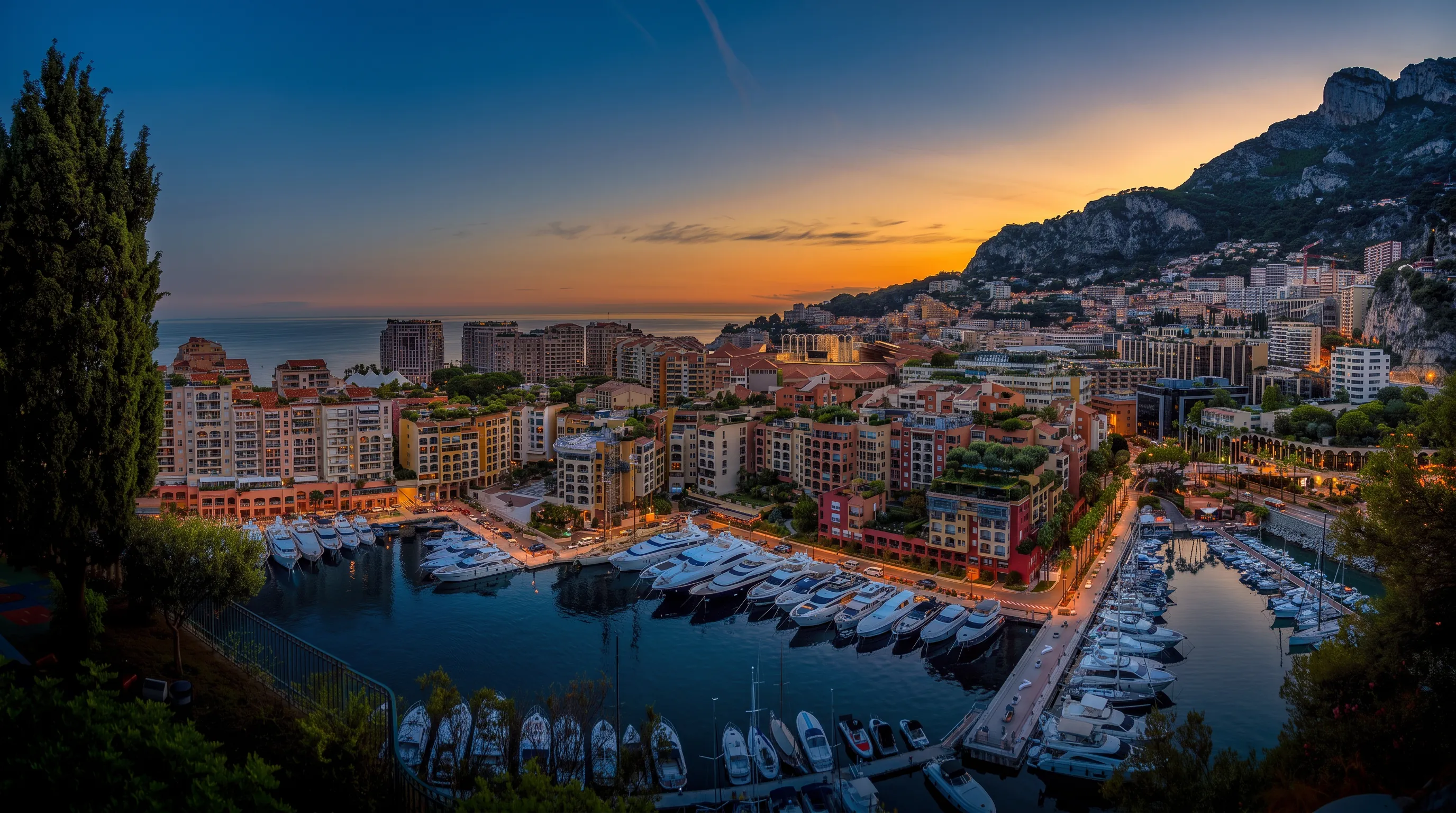
01 The experience
What to expect.
Why it matters
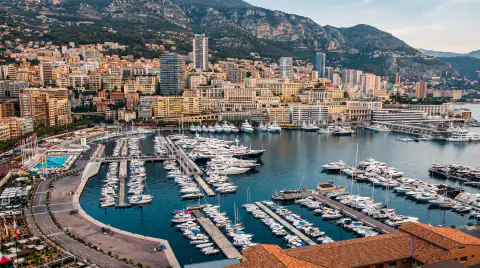
It is the clearest thing Monaco has ever done. Every other quarter grew. This one was decided. You can see the outline of the decision from the Jardins Saint-Martin: a hard geometric edge where the coast stops being coastline and starts being engineering.
It is where the principality keeps what it actually needs. Monte-Carlo has the casino and Larvotto has the beach. Fontvieille has the stadium, the heliport, the port for working boats, the hypermarket, light industry, and housing that ordinary Monégasques can get. The contrast with the postcard is the point, not a disappointment.
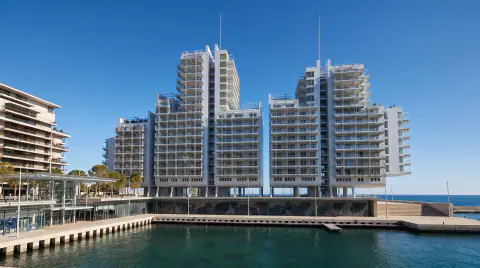
It is the precedent for Mareterra. The six hectares that opened off Larvotto in 2024 are the direct descendant of what happened here from 1966. Fontvieille is the first draft, at five times the size, and seeing them in the same week tells you more about Monaco than any museum.
It is off the Grand Prix circuit. The track runs through La Condamine and Monte-Carlo. Fontvieille does not touch it. During race week, when most of the principality is fenced, ticketed or gridlocked, this is where the parks, the supermarket and the quiet are.
What visitors should notice
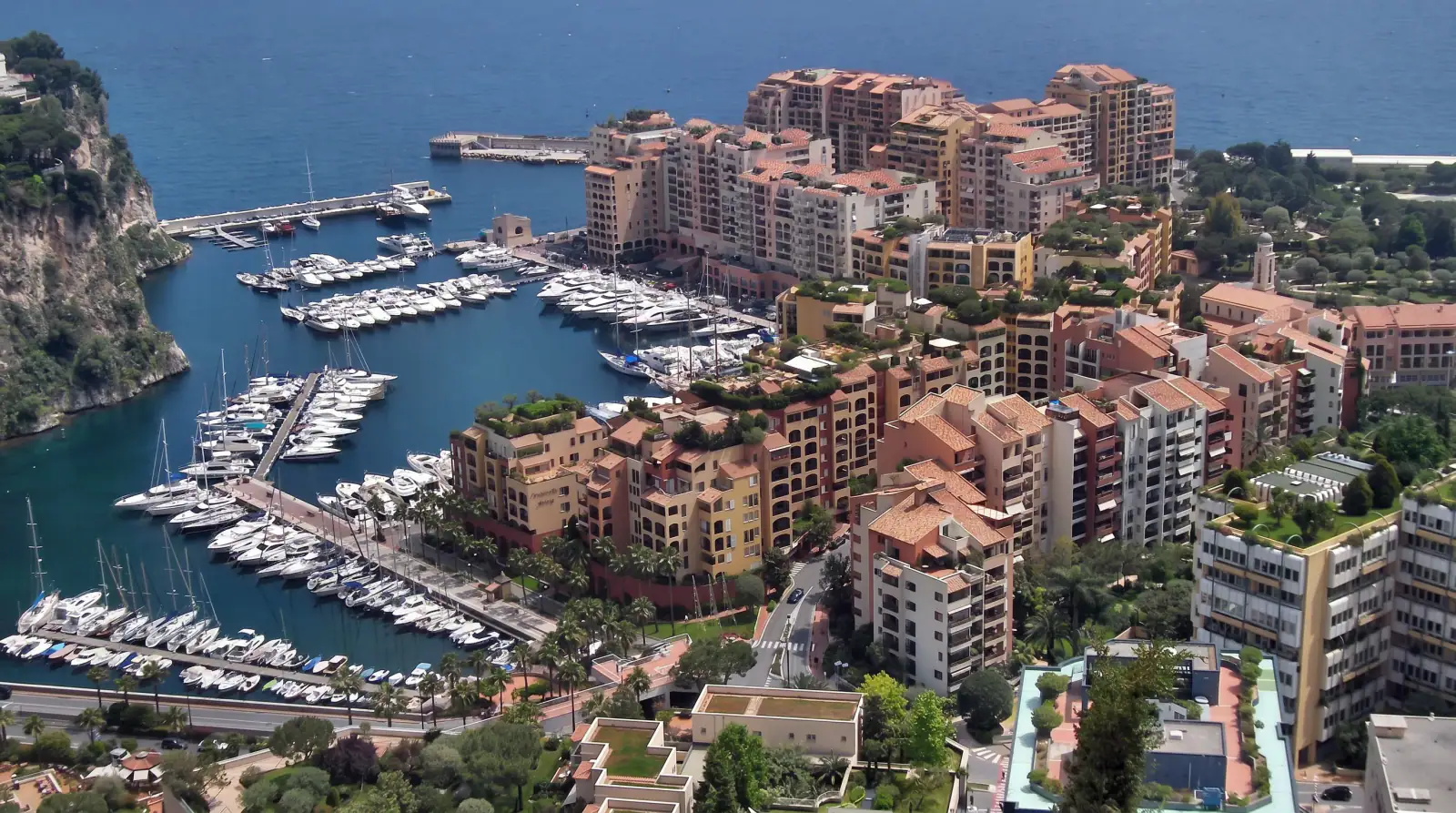
The seawall. A kilometre of it, holding the whole quarter. Walk the outer edge of the port and you are standing on the reason any of this exists.
How green it is. Reclaimed industrial land, and yet Fontvieille Park and the Princess Grace Rose Garden together run to about four hectares of open, free, unticketed ground with sculpture in it. This was designed in, not left over.
The scale change. Come down from Monaco-Ville, where the lanes are three metres wide, into a quarter laid out for delivery lorries and coaches. Two hundred metres and six hundred years apart.
Who is here. On a weekday morning it is residents with shopping, children going to school, and men in overalls. Fontvieille is the least performed part of Monaco.
Who will enjoy it
- Anyone interested in how a country manufactures territory.
- Families — the parks are free, flat, shaded and have space to run.
- Football and basketball supporters: the Stade Louis II runs guided tours.
- Anyone in Monaco during the Grand Prix who needs somewhere that is not the Grand Prix.
- Visitors who want to see where Monégasques live rather than where they are photographed.
Who may find it difficult
- Several attractions are closed. The Jardin Animalier is shut for all of 2026. The Naval Museum has closed and its future on the site is unresolved. Check before building a day around either.
- The architecture is 1980s municipal, and unapologetically so. If you have come to Monaco for belle époque, this is not it.
- The Prince's Car Collection is no longer here. It left in July 2022 for Port Hercule. Maps and listings still send people to Fontvieille.
- It is a walk or a lift ride from everywhere else, and the return leg to Monaco-Ville is a climb.
- Nothing here is a headline sight. The rose garden is lovely and free; the stadium tour is genuinely good and costs €5.20. Neither is the Oceanographic Museum.
Visitor verdict
Half a day, and best combined with the Rock above it. Go for the parks, the stadium tour and the understanding of how Monaco made itself bigger — and check what is open first, because this quarter is mid-renovation and the published information has not kept up.
The story
History & character.
The problem: a country with no room
Monaco is about two square kilometres. By the 1960s it had run out of building land, and the only directions left were up and out. Rainier III chose both, and the reputation he earned for it — le prince bâtisseur, the builder prince — rests more on Fontvieille than on anything else.
Before it, the western edge of the principality ended at the foot of the Rock. What is now the stadium, the marina, the parks and several thousand homes was open sea, with the bottom falling away to around forty metres.
Building land out of water
Work began in 1966. A consortium of French, Italian and Swiss engineering interests — SADIM — had started preparing the ground in 1965.
The method was not glamorous and it is worth knowing, because the quarter's whole character follows from it. Rather than tipping fill into open sea, the engineers built dykes out from the shore to enclose the water, then drained the space behind them. The enclosure is why Fontvieille has hard, straight edges where the rest of the coast curves.
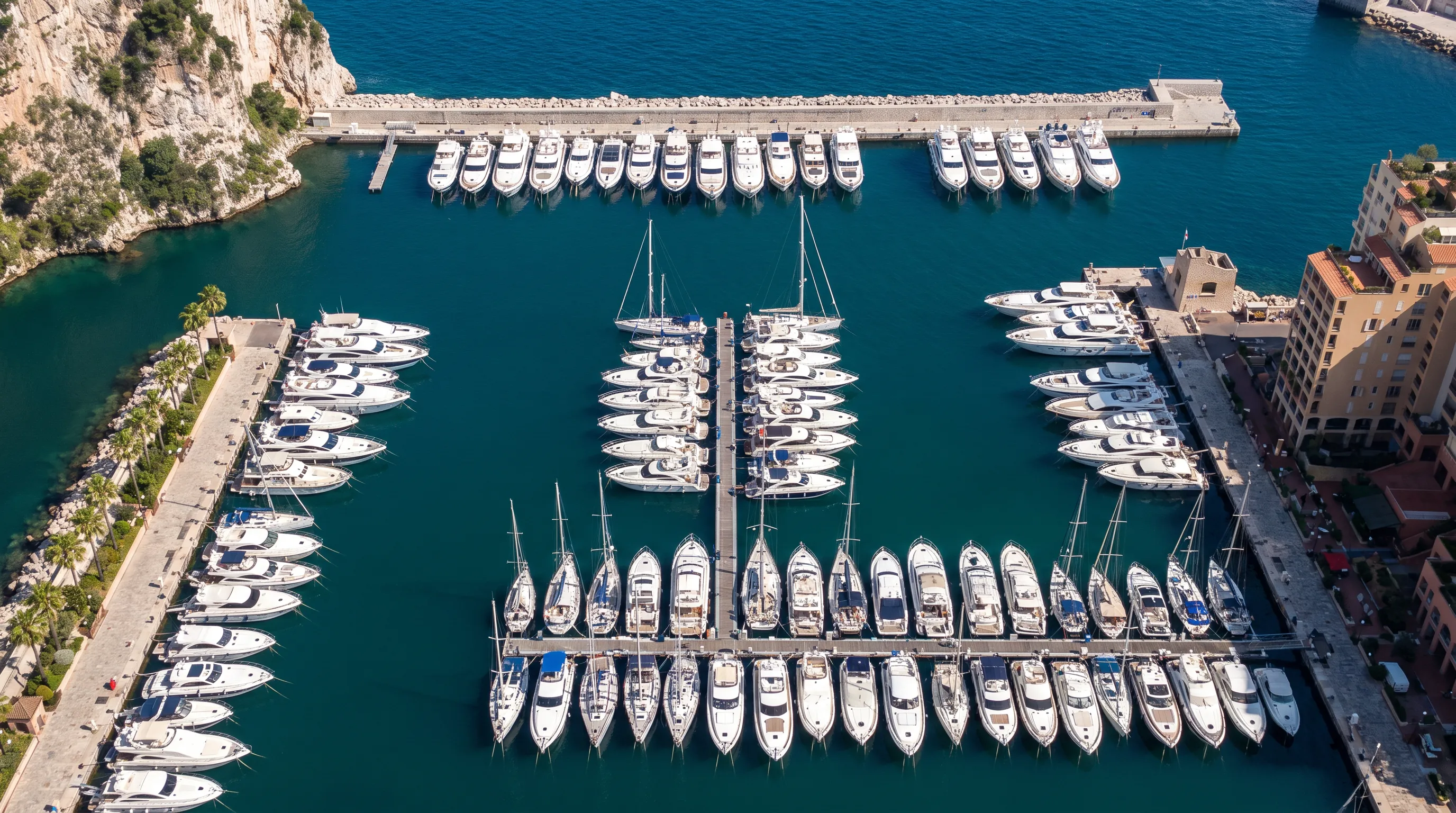
A seawall about a kilometre long protects the result from storm and swell. Behind it the project produced roughly 220,000 m² of usable land and a 55,000 m² marina.
Crown Prince Albert laid the cornerstone in 1981, which tells you the project ran far longer than the reclamation itself. The district was designed across the 1970s to 1990s by the architect Manfredi Nicoletti, under the engineer Gianfranco Gilardini.
How big, exactly — an honest disagreement
Sources do not agree, and the bundle does not pretend they do:
- 22 hectares, for the initial phase of 1966–1973.
- ~33 hectares for the quarter as it stands.
- ~35 hectares added by around 1981.
These are probably measuring different things — the first reclamation, the administrative ward, and the total including later phases — but no source this bundle found states which. Around a fifth of Monaco's surface is the figure that survives all three, and that is the one used.
What was built on it
Not a resort. Fontvieille was filled with the things a country needs and cannot fit anywhere else:
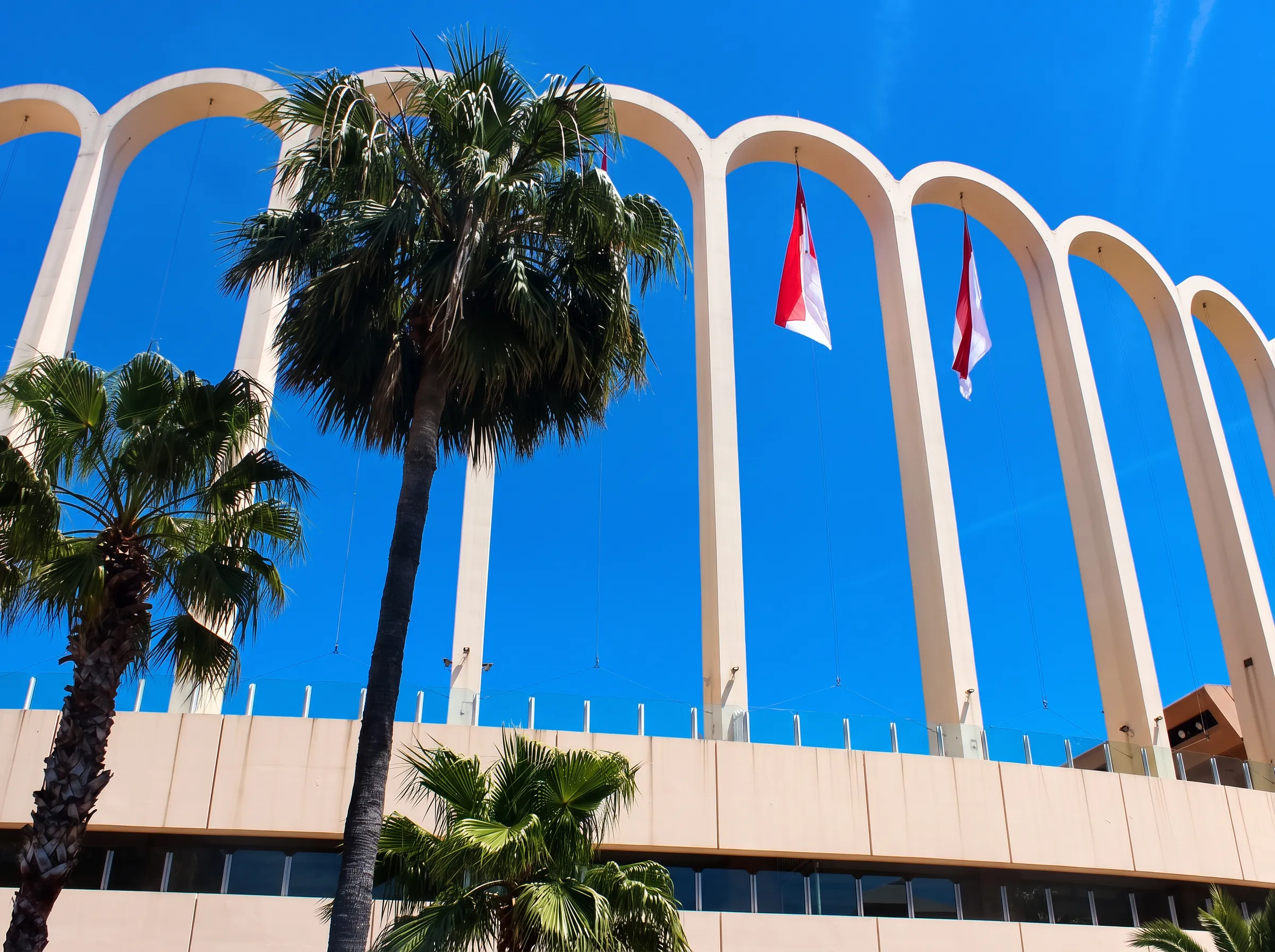
- Stade Louis II, home of AS Monaco, with the Salle Gaston Médecin inside it for the basketball club.
- The heliport, Monaco's only aviation link.
- A working port, as opposed to Port Hercule's yacht display.
- Light industry and company headquarters — Venturi Automobiles and Voxan are based here, and the Formula E operation now racing as Maserati MSG.
- Subsidised housing for Monégasque nationals, which is why the population is residential rather than seasonal.
- Parks — Fontvieille Park and, from 18 June 1984, the Princess Grace Rose Garden, created in memory of the Princess who had died in 1982.
The Terrasses de Fontvieille complex, built 1990–1992, added a shopping centre with a hypermarket, an events hall, underground parking and three museums.
The zoo predates the quarter
The Jardin Animalier was founded on 25 December 1954 — twelve years before reclamation began — when Rainier III brought back around thirty injured animals from a trip to Africa. It sits on the southern flank of the Rock, looking down over what later became Fontvieille.
No animal in it has ever been bought. Every resident was donated, rescued from a circus, abandoned, or seized by customs.
And now it is being rebuilt again
The Terrasses de Fontvieille are slated for restructuring, and the occupants are affected. The Espace Léo Ferré must leave, with a confirmed new home under the collège being built at Îlot Pasteur. The Naval Museum must leave too, and its future is not settled. See Plan your visit, because this is not a distant planning matter — it is the reason doors are shut now.
Look closer
Highlights and hidden details.
The objects, spaces and small observations that turn a visit into a memorable one.1. The Princess Grace Rose Garden
Free, open daily sunrise to sunset.
Created on 18 June 1984 in memory of Princess Grace, who had died two years earlier, and re-dedicated in 2014 after renovation. Around 4,000 rose bushes, over an area of more than 5,000 m².
What to look for. The bronze of Princess Grace by Kees Verkade, standing among the beds rather than on a plinth above them. And the varieties themselves — sources put the count anywhere from 150 to 450, which tells you more about how gardens are catalogued than about the roses.
Best in late spring and early summer, but it is worth walking at any season because it is free, level, shaded and quiet.
Time required. Half an hour.
2. The sculpture trail in Fontvieille Park
Running through the park beside the rose garden, and almost entirely undiscovered by visitors.
The two to find are *Arman's Cavalleria Eroica* and a clenched fist by César** — both major post-war French sculptors, both in an unfenced public park with no ticket and usually nobody looking at them.
Why it matters. Monaco's serious art is mostly behind admission or inside institutions. This is the exception, and it is free.
Time required. Twenty minutes, folded into the rose garden walk.
3. The Stade Louis II tour
€5.20 adult, €2.60 under 12 and over 65. About an hour.
Home of AS Monaco, and unlike most stadium tours this one is cheap and genuinely gets you in: the changing rooms, the players' tunnel, the princely dressing rooms, and the Salle Gaston Médecin, the basketball arena built inside the stadium structure.
The catch. Seasonal — tours resume in April 2026 — no online booking, and nothing on match days. You meet the guide at the stadium.
Time required. One hour.
4. The seawall and the port
Walk the outer edge of the marina. Everything behind you is manufactured, and the kilometre of seawall under your feet is the reason.
Port de Fontvieille is the working counterpart to Port Hercule — smaller boats, fewer superyachts, more actual maritime activity. It is also the best place in the quarter to understand its geometry: hard straight lines meeting a coast that curves everywhere else.
Time required. Twenty minutes.
5. The view back up at the Rock
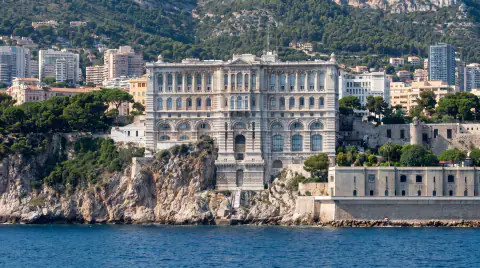
From the park and the port, Monaco-Ville stands directly above you — the cliff, the Oceanographic Museum's façade cut into it, and the ramparts.
This is the best angle on the Rock in the principality, and it is the one almost nobody photographs, because almost nobody comes down here. From above you see Fontvieille as a plan; from below you see the Rock as a fortress.
Time required. Ten minutes, and it is free.
6. The Museum of Stamps and Coins
11 Terrasses de Fontvieille. €3, free under 12.
Small, cheap, unfashionable, and about the state rather than the dynasty — the principality told through what it issued.
→ This museum has its own Above Guide entry.
Note the context. It sits inside the Terrasses complex that is slated for restructuring. Its own position in those plans is not published.
Time required. Forty-five minutes.
7. The Jardin Animalier — closed, and worth knowing about anyway
Closed for all of 2026. Cliff consolidation and a modernisation ordered by Prince Albert II, described as the most ambitious change since it was created. Reopening expected 2027.
It is worth knowing what is behind the fence. Founded on 25 December 1954 by Rainier III, who had brought back about thirty injured animals from a trip to Africa. About 250 animals of some 60 species, on four terraced levels over roughly a hectare on the Rock's southern flank.
The fact that makes it unusual: no animal has ever been purchased. Every resident was donated, rescued from a circus, abandoned, or seized by customs.
Time required in 2026. None. Do not walk up to it.
8. The Terrasses de Fontvieille
Built 1990–1992: a shopping centre of some thirty-six shops with a Carrefour hypermarket, an events hall, two underground parking levels, and museums.
Why it earns a place on this list. Not for charm. It is the most ordinary building in Monaco and it is where the principality actually shops — and it is about to be rebuilt, with proposals including a cinema, doubled retail space, forty-one state-owned homes and around two thousand trees planted across its terraces and roof.
Time required. As long as your shopping takes.
Details worth slowing down for.
The sea here was forty metres deep
Not a shallow bay filled in. The seabed dropped to around forty metres, and the engineers went out into it with dykes rather than tipping fill from the shore — enclosing the water first and draining it afterwards.
Everything straight-edged about Fontvieille follows from that method.
A fifth of the country, and none of it is old
Monaco is about two square kilometres. This quarter is roughly a third of a square kilometre of it, and not one square metre existed before 1966.
The cornerstone was laid fifteen years after work started
Reclamation began in 1966. Crown Prince Albert laid the cornerstone in 1981 — the future Albert II, marking a project his father had begun when he was a child.
The zoo is older than the ground it overlooks
Founded 25 December 1954, twelve years before reclamation began. It sits on the Rock, not on made land, and has looked down on open water, then a building site, then a quarter.
Nothing in the zoo was ever bought
Every animal was donated, rescued from a circus, abandoned, or seized by customs officers. For a principality with a reputation for acquiring things, its zoo is a collection of what other people gave up.
The Car Collection left in 2022 and the maps have not noticed
Nearly thirty years on the Terrasses de Fontvieille, then a move to Port Hercule in July 2022. Guides, maps, listings — and this project's own older dataset — still place it here. If someone tells you the Prince's cars are in Fontvieille, they are working from stale information.
The stadium has a basketball arena inside it
The Salle Gaston Médecin is built into the Stade Louis II structure, home to AS Monaco Basket. A football ground with an indoor arena inside its own footprint is a very Monégasque solution to not having room.
The quarter is off the circuit
The Grand Prix runs through La Condamine and Monte-Carlo. Fontvieille touches none of it. In a principality that shuts down for a fortnight, that is the single most useful piece of local knowledge here.
Free lifts do the climbing for you
Monaco's public lift and escalator network is free and connects Fontvieille to the levels above. Most visitors walk the ramps and arrive exhausted. The lifts are not hidden, but they are unmarked on most tourist maps.
It is being rebuilt while you look at it
The Terrasses complex is slated for restructuring — proposals include a cinema, doubling retail floorspace to around 30,000 m², forty-one state-owned homes, and roughly two thousand trees planted on the terraces and roof. The Espace Léo Ferré has to move, and has a confirmed new home under the collège going up at Îlot Pasteur. The Naval Museum has to move too, and does not yet have one.
Fontvieille was Monaco's answer to running out of room. Sixty years on, it is running out of room.
04 / Before you go
Plan your visit
Prices & admission
Free to walk; parks free; Stade Louis II tour €5.20
Opening hours
The quarter is open at all times and costs nothing to walk. Fontvieille Park and the Princess Grace Rose Garden are free, ungated and open daily from sunrise to sunset. The Stade Louis II guided tour runs seasonally, resuming April 2026, at 10:30, 11:30, 14:30, 15:30 and 16:30, and cannot be booked online. IMPORTANT: the Jardin Animalier is closed for the whole of 2026 and the Naval Museum is closed indefinitely. Verified 6 August 2026.
Plan your experience
Nothing needs booking. The Stade Louis II tour cannot be booked online at all — you meet the guide at the stadium, seasonally from April 2026, and not on match days.
Participation requirements
No restrictions. Children under 12 pay €2.60 on the Stade Louis II tour, and the parks are free to all ages.
Check this first
Fontvieille is mid-renovation, and the published information has not kept up. Three things a guidebook will send you to:
| Status | |
|---|---|
| Jardin Animalier (zoo) | Closed for all of 2026. Cliff consolidation and a modernisation ordered by Prince Albert II. Reopening expected 2027 |
| Naval Museum | Closed. Refurbishment of indefinite length — and it must leave the Terrasses de Fontvieille under the redevelopment. Future site unresolved |
| Prince's Car Collection | Not here. Moved to Port Hercule in July 2022. Listings and maps still say Fontvieille |
What is reliably open: the parks and rose garden, the Museum of Stamps and Coins, the port, the shopping centre, and the Stade Louis II tour in season.
What it costs
Most of the quarter is free.
| Site | Adult | Child | Notes |
|---|---|---|---|
| Fontvieille Park and Princess Grace Rose Garden | Free | Free | Open daily, sunrise to sunset, ungated |
| Stade Louis II guided tour | €5.20 | €2.60 | Under 12s and over 65s at the child rate. Seasonal — see below |
| Museum of Stamps and Coins | €3 | Free under 12 | Has its own Above Guide entry |
| Jardin Animalier | — | — | Closed for 2026 |
| Naval Museum | — | — | Closed |
The Stade Louis II tour
The best-value ticket in Monaco, and most visitors have no idea it exists.
€5.20 adult, €2.60 for under-12s and over-65s. About an hour. It goes behind the scenes: the changing rooms, the players' tunnel out to the pitch, the princely dressing rooms, and the Salle Gaston Médecin, the basketball hall built inside the stadium.
Tour times are generally 10:30, 11:30, 14:30, 15:30 and 16:30.
Two things to know. It runs seasonally — tours resume in April 2026 — and you cannot book online. You turn up and meet the guide. Groups of more than ten should request a quote through the stadium's contact form.
Tours do not run when the stadium is in use, so avoid match days.
Fontvieille Park and the Princess Grace Rose Garden
Free, ungated, open daily from sunrise to sunset. Together about four hectares.
The rose garden was created on 18 June 1984, in memory of Princess Grace, who had died in 1982. It holds around 4,000 rose bushes; the number of varieties is given variously as 150, and as high as 450, depending on the source. It was re-dedicated in 2014 after renovation.
There is a bronze of Princess Grace by Kees Verkade, and a sculpture trail through the park — including *Arman's Cavalleria Eroica* and a clenched fist by César**.
Benches, shade, and level paths. This is the best free hour in the quarter.
Getting there
On foot from Monaco-Ville, down past the Jardin Animalier and the Rampe Major, or from Port Hercule around the foot of the Rock. Allow 15 minutes from the Place du Palais, and remember the return is a climb.
By public lift. Monaco's network of free public lifts and escalators connects Fontvieille to the levels above it and removes most of the ascent. This is the single most useful thing to know about moving around here.
By bus. Lines serve the quarter and the shopping centre.
By car. There is far more parking here than anywhere else in Monaco — two underground levels beneath the Terrasses, plus the Parking des Pêcheurs at the Rock. If you are driving in Monaco at all, Fontvieille is where to leave the car.
During the Grand Prix
Fontvieille is not on the circuit. The track runs through La Condamine and Monte-Carlo; this quarter is outside the fencing.
That makes it the practical refuge during race week: the parks stay open and free, the hypermarket is the only sane place to buy food, and the quarter is walkable when much of Monaco is not. It is also where the helicopters come and go from.
How long to allow
- The rose garden and park: 45 minutes.
- Adding the stadium tour: 2 hours.
- A full half-day with the Museum of Stamps and Coins and the port.
Visit your way
Access and family planning.
The short version, and it is unusually good
Fontvieille is the most accessible quarter in Monaco, for one structural reason: it was designed and built from nothing in the late twentieth century, on flat reclaimed ground, for cars and deliveries. Everywhere else in the principality is a hillside that was adapted afterwards.
The parks are level, paved and ungated, with benches. The shopping centre is modern and has lifts, parking and toilets. The port frontage is flat.
Getting here without climbing
This is the part worth planning, because the barrier is the arrival, not the quarter.
Use Monaco's public lifts and escalators. The network is free, and it connects Fontvieille to the levels above it. Walking down the ramps from Monaco-Ville is easy; walking back up is a 60-metre ascent and the most common way visitors exhaust themselves here.
Parking is the other answer. Fontvieille has more of it than anywhere else in Monaco — two underground levels beneath the Terrasses, with lift access into the shopping centre. If a car is part of your trip, this is the quarter to use it in.
Facilities
Toilets, cafés, lifts and step-free routes are all at the Terrasses de Fontvieille shopping centre. This is the practical base for the quarter.
There are no toilets in the parks themselves.
The rose garden and park
Level, paved and free, open sunrise to sunset with no gate and no ticket. Benches throughout, and shade in the park.
Whether every path in the sculpture trail is fully step-free is not published; the main circuits are flat.
The Stade Louis II tour
The tour includes changing rooms, the players' tunnel and the Salle Gaston Médecin. Whether the route is step-free, and what provision exists for wheelchair users, is not published.
There is no online booking, so there is no booking form on which to state a requirement — you meet the guide. Contact the stadium in advance rather than arriving and hoping.
Closed, and therefore not an access question in 2026
- Jardin Animalier — closed all year. It is four terraced levels on a cliff and was never an easy visit; whether the modernisation improves access is one of the more interesting unpublished questions about the works.
- Naval Museum — closed.
Facts we do not have
- Step-free detail and wheelchair provision on the Stade Louis II tour.
- Accessible toilet locations outside the shopping centre.
- Whether the sculpture trail is step-free throughout.
- Hearing loops anywhere in the quarter.
- Whether the Jardin Animalier's modernisation addresses access.
These are unpublished rather than absent. The quarter's basic geography does most of the work here — but the specifics for the one ticketed attraction are genuinely unknown, and that is the gap worth a telephone call.
Sensory notes
Open, low-rise and quiet by Monaco standards. The two exceptions are match days at the Stade Louis II and the heliport, which is in the quarter and audible across it.
Why this is the best quarter in Monaco for children
It is flat, free and has space to run — three things Monaco is otherwise very bad at. Monaco-Ville is stairs and crowds; Monte-Carlo is dress codes and traffic; Larvotto is a beach and little else. Fontvieille has four hectares of open park with no gate and no ticket.
The one disappointment to head off
The zoo is closed for all of 2026. The Jardin Animalier is the thing most families come to Fontvieille for, and it is shut for cliff consolidation and a full modernisation, expected to reopen in 2027.
Tell children before you set out, not at the fence. Nothing else in the principality substitutes for it — the Oceanographic Museum's aquarium is the nearest thing and it is a twenty-minute climb away on the Rock.
What works
Fontvieille Park and the Princess Grace Rose Garden. Free, level, shaded, ungated, open sunrise to sunset. Benches for adults, room for children.
The sculpture trail is a good game: find the giant clenched fist by César, and Arman's horse — Cavalleria Eroica. Children find modern sculpture much easier than adults do, because nobody has told them it is difficult.
The Stade Louis II tour, at €2.60 for under-12s, is the single best family value in Monaco. An hour, and it goes into the changing rooms and out through the players' tunnel. For a football-minded child this beats anything in Monte-Carlo.
The port. Boats, cranes, working craft rather than superyachts behind ropes — and you can get right up to the water.
The hypermarket. Not a joke. Carrefour at the Terrasses is where you buy a picnic at normal prices, which in Monaco is a genuine service to a family budget.
Ages
- Under 5: the parks, and the port. Flat ground and no traffic.
- 5–10: parks, sculpture trail, the stadium tour if they will manage an hour of walking and talking.
- 11–15: the stadium tour lands properly, and the reclamation story — this was all sea — is the sort of fact that sticks.
- Teenagers: honestly, the shopping centre and the football.
Practical
- Toilets and cafés are at the Terrasses de Fontvieille shopping centre. There is nothing in the parks themselves.
- Pushchairs are fine here and nowhere else in Monaco is as easy.
- Use the free public lifts rather than the ramps. The climb back up to Monaco-Ville with a tired child is the mistake to avoid.
- Shade exists in the park; the port and the open ground do not have much.
During the Grand Prix
This is where to bring children during race week. Fontvieille is off the circuit, so the parks stay open and free while much of Monaco is fenced and ticketed. It is also under the helicopter approach, which small children consider a feature.
A two-hour version
Down by the free lifts → the Princess Grace Rose Garden → the sculpture trail through the park → the port and the seawall → picnic from Carrefour → back up by lift. Nothing costs anything except lunch.
Self-guided walk
Explore beyond the venue.
A practical, step-by-step route connecting this experience with more of Monaco Grand Prix.1. Start at the top, on the Rock
Do not start in Fontvieille. Stand first on the seaward side of Monaco-Ville — the Jardins Saint-Martin, or anywhere along the ramparts looking south-west.
Below you is the whole quarter: stadium, marina, parks, apartment blocks, heliport. Fix the outline in your head. Notice where the coastline stops curving and starts being straight — that line is 1966. Everything inside it was sea.
2. Take the lift down
Monaco's public lifts are free and they exist precisely so that people do not have to walk a 60-metre cliff twice a day. Use them.
Walking down is fine. Walking back up at the end is the mistake.
3. The Princess Grace Rose Garden
You arrive on flat, planted ground within a couple of minutes of leaving a medieval hill town. That jolt is the quarter's whole point and it never happens anywhere else in Monaco.
Created 18 June 1984 for Princess Grace, who had died two years before; re- dedicated in 2014. Around 4,000 rose bushes.
Find the bronze of Grace by Kees Verkade. She is placed among the beds, at your level, not raised on a plinth. That is a deliberate choice and it is worth a moment.
4. The sculpture trail through Fontvieille Park
Walk on into the park. Two things to find:
*Arman's Cavalleria Eroica* and César's clenched fist** — two major post-war French sculptors, unfenced, unticketed, and usually with nobody looking at them.
This is the only serious art in Monaco you can walk up to for nothing.
5. Out to the port and the seawall
Cross to the marina and walk its outer edge.
You are standing on the reason the quarter exists. A seawall about a kilometre long, enclosing a basin where the sea floor drops to around forty metres. The engineers built dykes out into that, then drained what was behind them.
Look at the quay lines: straight, hard, deliberate. Then look anywhere else on this coast, which curves.
Port de Fontvieille is the working harbour — smaller craft, fewer ropes and velvet, more actual maritime business than Port Hercule.
6. Turn round and look up
The best view in the quarter, and almost nobody takes it.
The Rock stands directly above you: the sheer cliff, the ramparts along the top, and the Oceanographic Museum's façade rising straight out of the rock face.
From the top, Fontvieille reads as a plan. From down here, the Rock reads as a fortress. You have now seen both, in the right order.
Best in late afternoon, when the west-facing cliff takes the light.
7. The Stade Louis II
Round to the stadium. If the tour is running — seasonal, resuming April 2026, €5.20, no online booking — take it. An hour, and it goes into the changing rooms, the players' tunnel and the Salle Gaston Médecin, the basketball arena built inside the football ground.
If it is not running, walk the outside anyway and note the arches. A stadium with another arena inside its own footprint is what a country does when it has no land.
8. The Terrasses de Fontvieille
Finish at the shopping centre — genuinely, and not as a joke.
This is where Monaco shops. Built 1990–92, with a hypermarket, about thirty-six shops, an events hall and two levels of parking. It is the most ordinary building in the principality and the most used.
It is also about to be rebuilt: proposals include a cinema, doubled retail floorspace, forty-one state-owned homes, and around two thousand trees on the terraces and roof. The Espace Léo Ferré must leave and has a confirmed new home; the Naval Museum must leave and does not.
Buy lunch here. It is the only place in Monaco where food costs what food costs.
9. Back up by lift
Not the ramp.
Timing
Ninety minutes without the stadium tour, two and a half hours with it.
Do it in the morning for the rose garden and the port, or late afternoon for the cliff. Avoid midday, when flat reclaimed ground under overhead sun is the least rewarding light in Monaco.
Make a record
Photograph it thoughtfully.
The shot nobody takes
The Rock, from below. From Fontvieille's park and port frontage, Monaco-Ville stands directly above you: the sheer cliff, the ramparts along its top, and the Oceanographic Museum's façade rising straight out of the rock face.
Everyone photographs Fontvieille from the Rock. Almost nobody turns round and photographs the Rock from Fontvieille, and it is the better picture — because from up there Fontvieille reads as a plan, and from down here the Rock reads as a fortress.
Best in late afternoon, when the west-facing cliff and the museum façade take the light.
The geometry
Fontvieille's subject is its own artificiality, and the way to photograph that is lines.
- The seawall, along the outer edge of the marina — a hard kilometre-long edge against open sea.
- The port basin, where straight quays meet a coast that curves everywhere else in the principality.
- From above, on the descent from Monaco-Ville, the whole quarter reads as a drawing. This is the frame that explains what the place is.
The rose garden
- Late spring and early summer for the roses themselves.
- The Kees Verkade bronze of Princess Grace works best in soft light, and she is placed among the beds rather than raised above them — shoot from her level, not up at her.
- Morning is quietest, and the beds face into it.
The sculpture trail
*Arman's Cavalleria Eroica* and César's clenched fist** are the two to find. Both are outdoors, unfenced and free to photograph.
Shoot them against sky rather than against the apartment blocks — the backdrop is the weak part of the composition.
Light and timing
- Morning — the park, the rose garden, the port basin.
- Late afternoon — the cliff, the ramparts and the Oceanographic Museum façade above you.
- Midday is the worst here. Reclaimed flat ground, pale modern buildings and overhead sun make a flat, hard picture with no relief.
- Overcast suits the quarter better than most of Monaco, because the subject is form rather than glamour.
What will disappoint you
The architecture is 1980s municipal and it does not photograph romantically. Trying to make Fontvieille look like Monte-Carlo produces a bad picture of a good place. Photograph it as what it is — engineered, functional, green — and it works.
Rules and courtesy
- The heliport is operational. Do not photograph in a way that interferes, and expect restrictions near it.
- Stadium tour photography — check with your guide; conditions differ inside the changing rooms and princely areas.
- This is a residential quarter. Several thousand people live here, many in subsidised housing. Photograph the buildings, not through the windows.
Drones
No. Monaco prohibits it, the heliport is here, and the quarter sits under a helicopter approach path.
Around here
Make more of the area.
Good to know
Questions, answered.
01Is the Monaco zoo open?
No. The Jardin Animalier is closed for the whole of 2026. It is undergoing cliff safety consolidation and a major modernisation ordered by Prince Albert II — described as the most ambitious change since it was created. Reopening is expected in 2027.
Most listings still show it as open. Do not build a family day around it.
02Is the Naval Museum open?
No. It closed for refurbishment for an indefinite period, and under the planned restructuring of the Terrasses de Fontvieille it will have to leave the site altogether. Where it goes, and when, is not settled.
Note that some encyclopaedia entries make no mention of the closure at all.
03Is the Prince's Car Collection in Fontvieille?
Not any more. It spent nearly thirty years on the Terrasses de Fontvieille and moved to Port Hercule in July 2022 — 54 route de la Piscine, in La Condamine. Maps, guides and listings still send people to Fontvieille.
04What is actually open in Fontvieille?
The parks and Princess Grace Rose Garden (free, daily, sunrise to sunset), the Museum of Stamps and Coins (€3), the port, the Terrasses shopping centre, and the Stade Louis II tour in season.
05Can you tour the Stade Louis II?
Yes, and it is the best-value ticket in Monaco. €5.20 adult, €2.60 for under-12s and over-65s, about an hour. It covers the changing rooms, the players' tunnel, the princely dressing rooms and the Salle Gaston Médecin.
Tours are seasonal — resuming in April 2026 — generally at 10:30, 11:30, 14:30, 15:30 and 16:30. You cannot book online; you meet the guide. Nothing runs on match days.
06Is the Princess Grace Rose Garden free?
Yes. Free, ungated, open daily from sunrise to sunset, along with the surrounding Fontvieille Park — about four hectares together.
07When was Fontvieille built?
Reclamation began in 1966 under Rainier III. Crown Prince Albert laid the cornerstone in 1981, and building continued into the 1990s. It was designed by the architect Manfredi Nicoletti under the engineer Gianfranco Gilardini.
08How much land was reclaimed?
Sources disagree: 22 hectares for the first phase of 1966–73, around 33 hectares for the quarter as it stands, and about 35 hectares added by around 1981. They are probably measuring different things. Roughly a fifth of Monaco's surface is the figure that survives all three.
09How was it built?
Not by tipping fill into the sea. Engineers built dykes out into water around forty metres deep to enclose it, then drained the space behind them. A seawall about a kilometre long protects the result, which produced roughly 220,000 m² of land and a 55,000 m² marina.
10Do people live in Fontvieille?
Yes — about 4,420 of them, roughly twelve per cent of Monaco's population, including a great deal of subsidised housing for Monégasque nationals. It is a residential quarter, not a resort.
11Is Fontvieille on the Grand Prix circuit?
No. The circuit runs through La Condamine and Monte-Carlo. Fontvieille sits outside the fencing, which makes it the practical refuge during race week — the parks stay free and open, and the hypermarket is the sane place to buy food.
12Is it worth visiting?
As a quarter, yes — half a day, mostly free. As a single destination, no. Nothing here is the Oceanographic Museum. What it gives you is free green space, the cheapest good ticket in Monaco, and an understanding of how the country manufactured a fifth of itself.
13How do I get there without a climb?
Use Monaco's public lifts and escalators — they are free and connect Fontvieille to the levels above. Walking down from Monaco-Ville is easy; walking back up is a 60-metre ascent and the usual mistake.
14Where should I park in Monaco?
Here. Fontvieille has more parking than anywhere else in the principality, including two underground levels beneath the Terrasses with lift access.
15What is happening to the Terrasses de Fontvieille?
A restructuring is planned. Reported proposals include expanding the hypermarket, adding a cinema, reconfiguring offices and parking, 41 state-owned homes, doubling retail space to around 30,000 m², and planting roughly 2,000 trees across the terraces and roof.
It is not settled. One account has the project awarded to a developer after an international competition; another reports three draft schemes with nothing yet decided by the princely government.
Before you visit
Useful links.
Venue and visitor information
Method
The research began with current operating status, not with history.
That order is deliberate and comes from two earlier bundles in this set: the Chapelle de la Visitation, whose collection had been sold in 2014 while every listing still described it as hanging, and the Museum of Old Monaco, whose hours had changed completely at a reopening nobody had noticed.
Checking status first was the right call again. Three of the things guidebooks send visitors to in this quarter are closed or gone, and that finding became the bundle's spine rather than a footnote.
Sources used
| ID | Source | Used for | Retrieved |
|---|---|---|---|
| S01 | Current coverage of the Jardin Animalier, including visitmonaco.com and regional guides | THE HEADLINE CLOSURE: that the garden is closed for the whole of 2026 for cliff safety consolidation and a major modernisation ordered by Prince Albert II, described as the most ambitious transformation since its creation and aimed at modern animal-welfare standards, with normal visiting expected to resume in 2027. Also its founding on 25 December 1954 by Rainier III with about thirty injured animals brought from Africa; about 250 animals of some 60 species; one hectare on four terraced levels on the Rock's southern flank; and that no animal has ever been purchased — all donated, rescued from circuses, abandoned, or seized by customs | 2026-08-06 |
| S02 | Coverage of the Musée Naval de Monaco, including rivieraloisirs and Monaco-Matin, *Quel avenir pour le musée naval de Fontvieille?* | That the museum is closed for refurbishment for an indefinite period, and that under the announced restructuring of the Terrasses de Fontvieille the facilities there — the Espace Léo Ferré and the Naval Museum in particular — will be required to leave the site. That the Léo Ferré relocation is confirmed, under the collège being built at Îlot Pasteur, while the Naval Museum's future remains uncertain | 2026-08-06 |
| S03 | Wikipedia — Monaco Naval Museum | Founding in 1993 by Professor Claude Pallanca with the assistance of Rainier III, the Monegasque Administration, Bernard Fautrier and Charles Ballerio; more than 250 models, paintings and maritime objects on display from a collection of more than 1,200 scale models. Recorded also for what it omits — see the conflict ledger | 2026-08-06 |
| S04 | Coverage of the Terrasses de Fontvieille restructuring, including Monaco-Matin on the shopping-centre schemes and PSS-Archi | That the complex was built 1990–1992 and contains a shopping centre of about 36 shops with a Carrefour hypermarket, three museums, an events hall and two underground parking levels. The reported programme: expanding the hypermarket, a cinema, reconfigured offices and parking, 41 state-owned homes, doubling retail space to about 30,000 m², curved transparent architecture and about 2,000 trees. Also the two incompatible accounts of the project's status recorded below | 2026-08-06 |
| S05 | Wikipedia — Fontvieille, Monaco | That the quarter is built almost entirely on reclaimed land, work beginning 1966, with Crown Prince Albert laying the cornerstone in 1981; the architect Manfredi Nicoletti under the engineer Gianfranco Gilardini, across the 1970s–1990s; about 33 hectares; about 4,420 residents as of 2023, roughly 12% of Monaco's population; the Stade Louis II, Salle Gaston Médecin, heliport, commercial port, Fontvieille Park and Princess Grace Rose Garden, and the headquarters of Venturi Automobiles and Voxan with the Formula E operation now racing as Maserati MSG | 2026-08-06 |
| S06 | Reclamation engineering coverage, including Monaco Life and related reporting | The method — a French-Italian-Swiss consortium, SADIM, preparing from 1965 and building dykes to contain the sea before draining the interior; a seabed falling to about 40 metres; a seawall about one kilometre long; about 220,000 m² of usable land and a 55,000 m² marina; and the figures of 22 hectares (1966–1973) and about 35 hectares by around 1981 recorded in the conflict ledger | 2026-08-06 |
| S07 | Coverage of the Princess Grace Rose Garden, including monte-carlo.mc and visitmonaco.com | Creation on 18 June 1984 in memory of Princess Grace; about 4,000 rose bushes; an area of more than 5,000 m² within parks totalling about 4 hectares; free, daily from sunrise to sunset; the sculpture trail including *Arman's Cavalleria Eroica* and a clenched fist by César; the bronze of Princess Grace by Kees Verkade; and re-dedication in 2014**. The variety count is recorded as disputed | 2026-08-06 |
| S08 | Stade Louis II visitor information, including stadelouis2.mc and stadium-tour listings | The guided tour at €5.20 adult and €2.60 for under-12s and over-65s, lasting about an hour, covering the changing rooms, players' tunnel, princely dressing rooms and the Salle Gaston Médecin; tour times of 10:30, 11:30, 14:30, 15:30 and 16:30; that tours run seasonally and resume in April 2026; that reservations cannot be made online and visitors meet the guide; and that groups of more than ten request a quote | 2026-08-06 |
| S09 | Above Guide's own bundle set | The July 2022 move of the Prince's Car Collection from the Terrasses de Fontvieille to 54 route de la Piscine, Port Hercule, already established and documented in that bundle; the Museum of Stamps and Coins at 11 Terrasses de Fontvieille; and the walking relationships to the Rock, Port Hercule, Mareterra and Larvotto | 2026-08-06 |
| S10 | OpenStreetMap via Nominatim | The ward centroid for Fontvieille, recorded as a centroid and not as a building address | 2026-08-06 |
Where sources disagree
How much land was reclaimed — UNRESOLVED, and left so
Three figures circulate:
- 22 hectares, for the initial phase of 1966–1973 (S06)
- about 33 hectares, for the quarter as it stands (S05)
- about 35 hectares added by around 1981 (S06)
They are almost certainly measuring different things — the first reclamation, the administrative ward, and the total including later phases — but no source found states which.
Used: "roughly a fifth of Monaco's surface", which is consistent with all three, with the disagreement stated in the history chapter and the FAQ rather than hidden. 13-operational-data.json carries all three figures.
The Terrasses redevelopment — TWO INCOMPATIBLE ACCOUNTS
S04 contains both:
- The project entrusted to the Socri group following an international competition, with a detailed programme.
- "Trois ébauches de projet mais rien de tranché par l'exécutif princier" — three draft schemes, with nothing decided by the princely government.
Used: both, and neither as settled. The bundle reports the programme as proposed and states explicitly that it is not decided. Do not let a future edit present this as imminent — the only firm consequences are the ones already happening: the Léo Ferré move is confirmed and the Naval Museum is closed.
The rose variety count — DISPUTED, and trivially so
S07 gives figures from 150 to 450 varieties for about 4,000 bushes. Used as "reported variously", because the disagreement says more about how gardens are catalogued than about the garden.
Wikipedia's silence on the Naval Museum — RECORDED
S03, the museum's English Wikipedia article, makes no mention of any closure, despite being recently edited. S02, regional coverage and the local press, establishes that it is closed and must leave the site.
Used: S02. This is recorded rather than passed over because it is the cleanest example in the set of a high-authority source being silent rather than wrong — a different failure mode from the stale aggregator listings that misdated the Museum of Old Monaco, and one that is harder to notice.
Which ward the zoo is in — NOT RESOLVED, AND NOT IMPORTANT
Sources assign the Jardin Animalier to Fontvieille and to Monaco-Ville inconsistently. It sits on the Rock's southern flank, above the quarter, and not on reclaimed land.
Used: covered in this bundle, because that is where visitors look for it and where the approach runs, with an explicit statement that it does not stand on made ground and predates the quarter by twelve years.
Facts deliberately not asserted
| Fact | Where this guide says so |
|---|---|
| Step-free detail and wheelchair provision on the Stade Louis II tour | Accessibility, operational data |
| Accessible toilets outside the shopping centre | Accessibility, facilities |
| Whether the whole sculpture trail is step-free | Accessibility |
| Hearing loops anywhere in the quarter | Accessibility |
| Whether the Jardin Animalier's modernisation improves access | Accessibility |
| A single reclaimed-area figure | History, FAQ |
| That the Terrasses redevelopment will proceed as reported | Hidden details, FAQ, operational data |
| The Museum of Stamps and Coins' position in the redevelopment | Highlights, nearby, operational data |
The accessibility gaps are unpublished rather than absent, and the stadium one is compounded by there being no online booking form on which to state a requirement — which makes it the quarter's most answerable gap and its most irritating.
A note on this project's own data
The Prince's Car Collection's move from this quarter in July 2022 is already correctly recorded in its own bundle, which also notes that older records in monacoOffTrack.js still place it in Fontvieille. This bundle does not re-litigate that; it repeats the correction because Fontvieille is where people still look for the cars.
Opening hours, prices, programmes and access arrangements can change. Confirm critical details with the venue.
Continue exploring / Monaco
More things to do
in Monaco
Explore Monaco activities, sights and places to eat. Compare the time to allow, costs and booking details, then save your favourites to your itinerary.
 01Monaco Grand Prix experienceCasino de Monte-CarloExplore experience →
 02Monaco Grand Prix experienceCathedral of Notre-Dame-ImmaculéeExplore experience →
 03Monaco Grand Prix experienceFort AntoineExplore experience →
 04Monaco Grand Prix experienceGrimaldi ForumExplore experience →
 05Monaco Grand Prix experienceJardin Exotique de MonacoExplore experience →
 06Monaco Grand Prix experienceJardin Japonais de MonacoExplore experience →
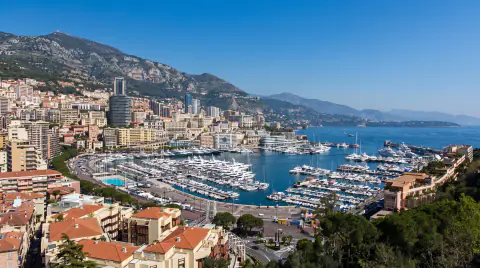 07Monaco Grand Prix experienceLa CondamineExplore experience →
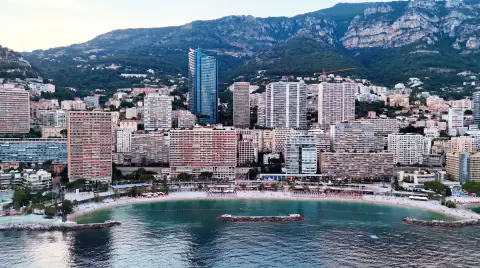 08Monaco Grand Prix experienceLarvottoExplore experience →
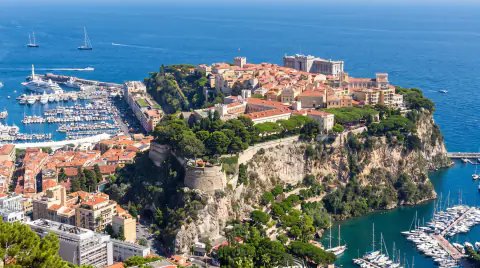 09Monaco Grand Prix experienceLe Rocher / Monaco-VilleExplore experience →
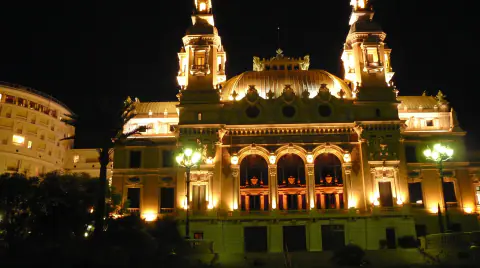 10Monaco Grand Prix experienceLes Ballets de Monte-CarloExplore experience →
 11Monaco Grand Prix experienceMareterraExplore experience →
 12Monaco Grand Prix experienceMonte-CarloExplore experience →
 13Monaco Grand Prix experienceNouveau Musée National de MonacoExplore experience →
 14Monaco Grand Prix experienceOceanographic Museum of MonacoExplore experience →
 15Monaco Grand Prix experienceOpéra de Monte-CarloExplore experience →
 16Monaco Grand Prix experiencePrince's Palace of MonacoExplore experience →
 17Monaco Grand Prix experienceThe Museum of Old MonacoExplore experience →
 18Monaco Grand Prix experienceThe Museum of Stamps and CoinsExplore experience →
 19Monaco Grand Prix experienceThe Prince's Car CollectionExplore experience →
 Plan / Itinerary builderBuild your Monaco Grand Prix dayStart planning →