In depth
The Mitre
A Bridge Street pub advertising three different founding dates, none of which agree — and a carriage arch a century younger than the year carved on it.
Story · Visit · Route · Links
Choose your depth
Essentials or more detail?
See visiting essentials, or read more about the history and places nearby.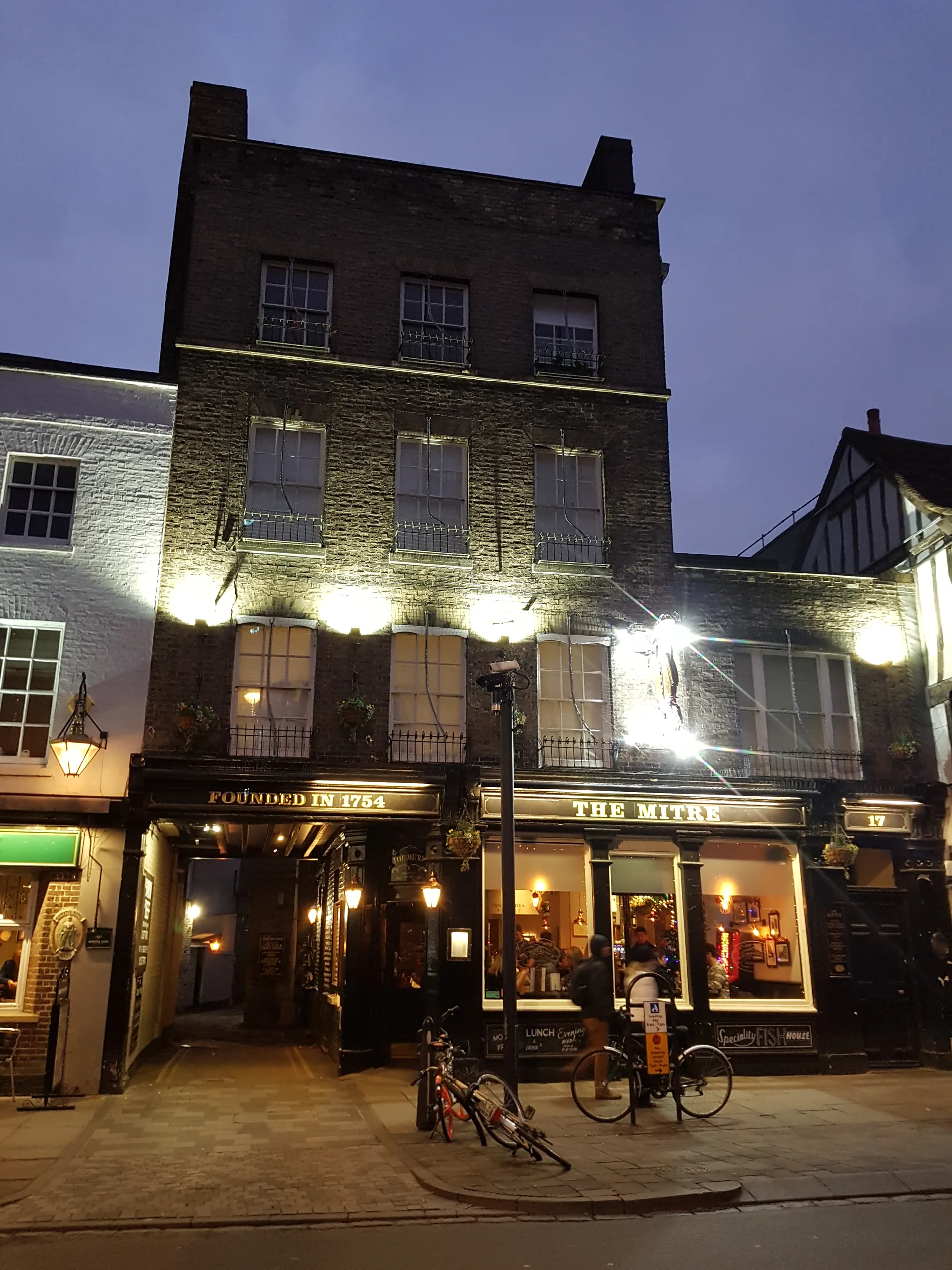
01 The experience
What to expect.
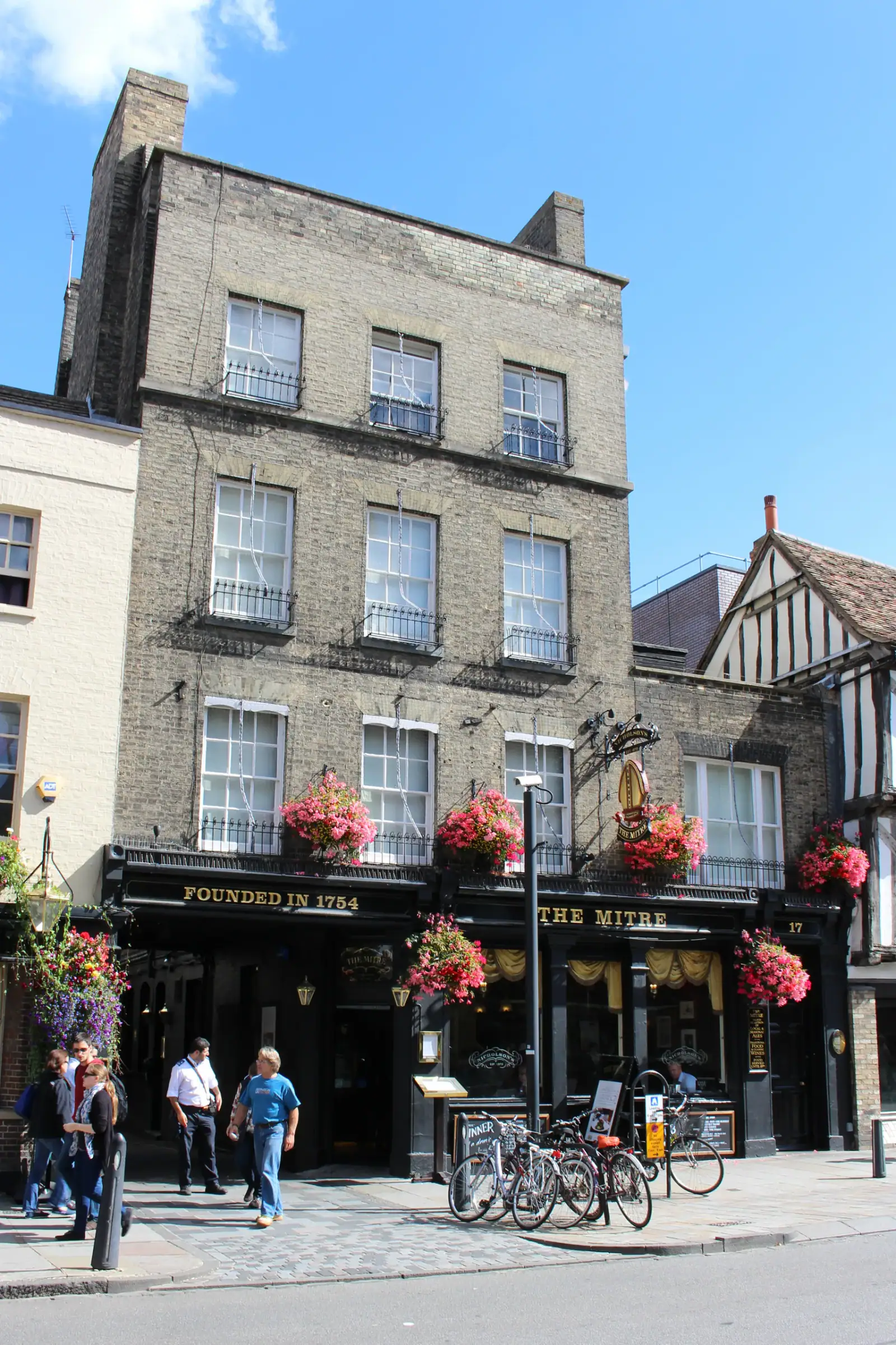
The Mitre is a Grade II listed pub at 17 to 18 Bridge Street, Cambridge, almost facing the gate of St John's College and a few paces from the Round Church. It occupies the site of two mid-18th-century inns — the Blackmoor's Head and the Cock and Magpie — and it has been called the Mitre only since 1881. The name has nothing to do with bishops: there is no Bishop of Cambridge and no Cambridge cathedral, the city lying in the Diocese of Ely. The Mitre took its name from a 19th-century brewery that stood a few yards away in Blackmoor Head Yard.
The pub's own signage does not agree with itself. A plaque outside records that the earliest known licensee on the site was Robert Clarke in 1752. The date carved on the arch says the house was founded in 1754. Two dates, two years apart, on the same building, both put there by the pub. Neither is wrong exactly; they are answers to different questions, and nobody has ever reconciled them in public. That gap is the most interesting thing about the Mitre, and it is a good example of how English pub history actually works.
Why it matters
Bridge Street is the old road out of Cambridge to the north, and before the railway it was a working river street: the Cam ran freight, and the inns along the bank served the barge trade, the carriers and the travellers crossing the Great Bridge. The Mitre's site is a record of what happened to that trade. In the mid-18th century this stretch had two separate inns on one plot. By 1856 the fifteen pubs of St Clement's parish had been reduced to four. By 1874 the Cock and Magpie was the only pub left in the immediate vicinity. The railway, which reached Cambridge in 1845, had taken the river trade the Bridge Street houses lived on, and the pubs went with it.
What survived did so by changing what it was. By 1878 the house was trading as the Mitre Billiard Rooms; in 1881 the publican Elizabeth Mays put the name Mitre over the door, borrowed from the brewery in the yard next door. A pub that started as two coaching-and-river inns ended the century as a billiard hall with a brewery's name on it. That is a more honest story about Victorian Cambridge than most heritage pubs tell.
What visitors should notice
The building you see is not the building the dates refer to. Historic England lists it as early to mid 19th century: grey gault brick, four storeys, three windows wide, sashes with glazing bars and iron grilles to every window, with a two-storey extension to the right and a 19th-century public-house frontage and carriage arch. Read that carefully and the anomaly sharpens — the arch carrying the date 1754 is itself a 19th-century arch. The date is a claim made about the site, not an inscription cut when the house was built.
Look for the plaque by the door, which names the previous pubs and tells the story of Ann Lawrence and her eight daughters. Look at the carriage arch and the narrow alley beside it: that is Blackmoor Head Yard, which ran back from Bridge Street between the Mitre at 17 and the Baron of Beef at 19, and which gave the Mitre Brewery its address. The Mitre still has a side door onto it. Then look out of the large front windows, which face St John's College across the bus and bicycle traffic of Bridge Street — one of the better indoor views of a Cambridge college in the city.
Who will enjoy it
Anyone interested in how places acquire and lose names, and in the ordinary economic history that heritage plaques usually skate over. It rewards real-ale drinkers — there is one regular cask beer, Adnams Southwold Bitter, and up to seven changing ones — and anyone doing Cambridge's historic pubs in sequence, since it is the youngest of the six in Above Guide's collection and the one whose founding date is least settled. It is also a straightforwardly useful pub: central, food all day, a table-service dining area, and a position that makes it the natural stop between the Round Church, St John's and Magdalene Bridge.
Who may find it difficult
The Mitre is not a preserved historic interior. A refurbishment in 2011 removed what remained of its old ale-house character, and the inside is now smart and contemporary. Anyone arriving expecting beams, settles and 18th-century panelling will be disappointed; the history here is in the frontage, the arch, the plaque and the archive, not in the furniture. The dining section is down a flight of steps from the bar, which matters for anyone with mobility needs (see the accessibility file). Bridge Street is a busy bus route, so the front of the pub is noisy and the outdoor drinking is standing space in an alley rather than a garden. And there is no interpretation beyond the plaque — the 1752 and 1754 story is not explained anywhere on site, which is precisely why it is worth arriving knowing it.
Visitor verdict
Worth twenty minutes for the frontage, the arch, the plaque and Blackmoor Head Yard, and worth longer if you want a drink or a meal in a genuinely central spot. Come knowing the two dates and what each one means, because the pub will not tell you: the plaque gives 1752 as the earliest recorded licensee, the arch gives 1754 as the foundation, the listed-building record dates the fabric to the 19th century, and the name only arrived in 1881. Four different answers to "how old is this pub" is not a failure of the sources. It is what the history of an English pub site usually looks like once you stop asking for a single number.
The story
History & character.
The two dates on the building
Start with the anomaly, because everything else about the Mitre's history follows from it.
A plaque fixed outside the pub records that the earliest known record of a licensee on this site is Robert Clarke in 1752. The date carved on the pub's arch says it was founded in 1754. The two are two years apart, and both were put up by the same establishment. Nothing on the building explains the gap.
They are not, strictly, contradictory: they answer different questions. "Earliest recorded licensee" is an archival statement — the first year in which a named person appears in the surviving licensing and directory records for this address. "Founded in 1754" is a statement about the origin of the house as an institution. A pub could easily have a licensee recorded in one year and adopt a different year as its foundation for reasons long since forgotten — a rebuilding, a new licence, a lease, or simply a later proprietor's best guess.
What makes the pairing genuinely odd is that the archive supports neither date as a beginning. The licensee list compiled by the Museum of Cambridge's Capturing Cambridge project, drawing on T E Faber's An Intimate History of St Clement's Parish (2006), shows Robert Clarke — and after him Alice Clarke — holding the Blackamore's Head from 1744, eight years before the plaque's date, with the 1752 entry simply being the year Clarke appears attached to that particular sign. And the same list runs the licensed history of the plot back to 1615/16, when Hugh Humphrey, a baker, was granted a lease of Clement Hostel and an alehouse licence in the same year.
So the plaque's 1752 is not the earliest licensee on the site, and the arch's 1754 is not a foundation in any documented sense. The dates are best read as the pub's own inherited tradition rather than as archival findings — which is exactly how most pub founding dates in England should be read.
The site before the inns
The plot at 17 to 18 Bridge Street was part of Clement Hostel, one of the medieval hostels attached to the parish of St Clement's, whose church stands a short way along Bridge Street. The name of the first inn on the site — the Blackmoor's Head — is said to derive from Robert Blackmoor, spelled Blakamore in the records, a chantry priest at St Clement's. He was granted a tenement and garden in the parish; in 1472 he was the only priest serving what had been intended as a multi-priest chantry, and his will of 1503 describes him as perpetual chaplain of the united chantry. His successors were Thomas Paris and then Robert Massye, who died in 1528.
The derivation is traditional rather than proved. It is repeated by the pub's own operator and by Patrick Comerford's 2026 account of the plaque, and it is at least consistent with the documented existence of a priest of that name holding property in the parish. It is worth noting that "Blackamoor's Head" was also a very common English inn sign in its own right, referring to a dark-skinned head as a heraldic and shop-sign device, so the Cambridge house may have taken a standard sign that was later attached to a convenient local name. Present the chantry-priest story as what it is: local tradition with a plausible person behind it.
The site was licensed long before the Blackmoor's Head is first named. The Capturing Cambridge sequence for the address gives Hugh Humphrey (1615/16), Hugh and later John Jones (1614–26), John Wood (1660–62) and Henry Gunnell (1664–67). The sign "Blackamoor's Head" is first recorded against Oliver Pangbourne, who held the house from 1671 to 1693, in the directory years 1672–74.
Plague, 1665
Henry Gunnell's tenure ended in the plague. On 27 September 1665 his son John died of it, and Gunnell was required to close the inn for forty days. When he and his wife came out of quarantine they gave up the house altogether and moved across to St John's Lane, where Henry died in 1667. The inn at that point was owned by Peter Lightfoot, a fishmonger and alderman. It is a small, exact record of what an epidemic did to a single Cambridge business, and it survives because the parish kept good books.
The 18th century: the Clarkes and the Blackmoor's Head
The 18th-century sequence at the Blackmoor's Head runs: Robert, later Alice, Clarke (1744–57) — the Robert Clarke of the plaque, recorded for the Blackamore's Head in 1752; George Mead (1758–59); a gap in 1760–61 when the house is not listed; Juner Perry (1762–91); Sarah Perry (1792); and Joseph Lawrence from 1793.
Two things are worth pulling out. First, the recurrence of women holding the licence in their own right — Alice Clarke after Robert, Sarah Perry after Juner — which was ordinary in the 18th-century trade and is one of the few sectors where women appear routinely in the commercial record. Second, the house survives the entire century without interruption apart from those two unlisted years, which is what you would expect of a working inn on the main road north out of the town.
Two inns on one plot: the Cock and Magpie
From about 1809 the plot carried two businesses at once. Joseph Lawrence is recorded for the Cock and Magpie from 1809 to 1815, while the Blackmoor Head continues to be listed at the same address — John Day, brewer, in 1810, and then continuously as the Blackmoor Head from 1811 to 1852. Sarah Lawrence held the Cock and Magpie from 1816 to 1831 (listed as the "new Cock and Magpie" until 1824) and it is described as a "liquor shop" from 1829.
In 1825 the property came up for sale as part of the wider Clement Hostel lots. The building was at that point shared between the Blackmoor Head and the liquor shop known as the Cock and Magpie. The whole lot was bought by a Mrs Lawrence and rebuilt by her. That 1825 purchase and rebuilding is the origin of most of what stands today; the modern brick facade appears to have been built in or before 1841.
Ann Lawrence and her eight daughters
The Cock and Magpie's best-known figure is Ann Lawrence, a widow and a successful wine merchant, who ran the house assisted by her eight daughters. She appears in the licensing record for the Cock and Magpie with Edward Rist Lawrence between 1836 and 1845; Juner Perry Lawrence and Edward Rist Lawrence held it before her, from 1832 to 1834. The plaque outside the modern pub names her and her daughters — one of the few Cambridge pub memorials to a woman trader, and a fair reflection of who actually ran the house.
The Lawrences held the site for the best part of a century. Edward Rist Lawrence appears in the 1861 census at number 18 as a wine and spirit merchant, aged 54, born in Cambridge, with William John Gallyon, a gunmaker, next door at number 17. By the 1871 census Edward is a widower of 64, still described as a wine merchant, living at 18 Bridge Street, the Cock and Magpie, with two daughters and a servant.
The railway, and the collapse of the Bridge Street trade
The railway reached Cambridge in 1845, and it took the river trade the Bridge Street inns depended on. The consequences on this stretch were severe and quick. By 1856 the fifteen pubs of the parish had been reduced to just four. The Blackmoor Head is last given a full reference in the 1841 census and appears only in the preamble to the 1851 return; it is not listed at all from 1853 to 1856. By 1874 the Cock and Magpie was the only pub remaining in the immediate vicinity.
That is the pivot of the whole story. The Mitre exists because the Cock and Magpie was the last house standing on a street that had lost its reason for having pubs at all, and it had to find a new trade.
William Headdy, the Mitre Brewery, and the billiard rooms
The licensee in 1874 was William Headdy, who was also proprietor of the nearby Mitre Brewery — a 19th-century brewery which stood in Blackmoor Head Yard, the alley running back from Bridge Street between number 17 and the Baron of Beef at number 19.
By 1878 the house was trading as the Mitre Billiard Rooms. Billiards was the respectable Victorian answer to a collapsing drinks trade: it drew a subscribing clientele, filled the afternoons, and gave a licensed house a second source of income. The name came off the brewery in the yard.
In 1876 the Mitre did not yet exist as such: the site still belonged to Edward Rist Lawrence at his death in that year, the Cock and Magpie was at number 18, and number 17 was a shop. Thomas William Reilly appears in Kelly's directory for 1879.
Elizabeth Mays and the name, 1881
The pub was renamed the Mitre by the publican Elizabeth Mays in 1881. The 1881 census records her at the Mitre, aged 33, described as a licensed victualler's wife, with a four-month-old son, John F Mays, and her widowed mother Julia Mays, an annuitant of 55 born in Guernsey.
That census description — "licensed victualler's wife" — is worth flagging. It means the licence may formally have stood in her husband's name while she ran the house, which was extremely common and is the reason women disappear from pub histories. The tradition that Elizabeth Mays renamed the pub is recorded and repeated; the census gives her a title that would, taken alone, have written her out of it.
So the sequence is: Cock and Magpie until the later 1870s; Mitre Billiard Rooms by 1878; the Mitre from 1881. For the great majority of its documented existence this pub was not called the Mitre.
The 20th century
Later licensees follow in the directories: Arthur Montague Butler (1883), Mrs Elizabeth Cue (1888), the Rich family from Girton and Chesterton through the 1891 and 1901 censuses, Thomas McLachlan (1904), J F Harlow as manager of "the Mitre Hotel" in 1913, Frank E Rice (1916), Thomas Stafford Spurgeon (1933) and William James Stubbings in 1962.
Two events stand out. In 1933 Blackamoor Head Yard was swept by fire; the Cambridge Independent Press of 6 October 1933 reported one of the fiercest fires in Cambridge for years, which partially destroyed the neighbouring Baron of Beef — a pub that had only just been rebuilt after the demolition of seven old cottages.
On the night of 27 July 1942, after an air raid that caused widespread damage in the area, an unexploded bomb was found in the basement party wall and another lay unexploded in the outbuildings of the Mitre. They were later identified as Sprengband C.50s, the first German "firepots". The account is from Michael Bowyer's Air Raid! (1986).
The building
Historic England listed the Mitre at Grade II on 2 November 1972, list entry 1126261, as "The Mitre Public House, 17 and 18, Bridge Street". The description dates it early to mid 19th century: grey gault brick, four storeys and three windows wide, sashes with glazing bars and iron grilles to all windows; a two-storey extension to the right with a single tripartite sash on the upper floor; a 19th-century public-house frontage and carriage arch; a band at first-floor cill level; parapet, roof not visible. The listing carries a group value note with its Bridge Street neighbours.
The significant phrase for anyone weighing the pub's dates is "C19 public house frontage and carriage arch". The arch on which the 1754 date appears is described by the national heritage record as a 19th-century arch. Whatever 1754 refers to, it is not the date the arch was built.
The modern pub
The Mitre is operated by Nicholson's, the heritage-pub brand of Mitchells & Butlers, who are also recorded as freehold owner. A refurbishment in 2011 removed what remained of the pub's older ale-house appearance; the interior is now described by CAMRA's Cambridge branch as smart and contemporary, with an extended down-steps section given over mainly to dining and full table service. A side door still leads onto Blackmoor Head Yard, with the Baron of Beef across the alley. The cask range is one regular beer, Adnams Southwold Bitter, plus up to seven changing beers, often including St Austell's pale ale.
Historical myths and things to be careful with
Christopher Smart's Mitre. The poet Christopher Smart wrote "The Pretty Bar-Keeper of the Mitre" in 1741, and the poem is sometimes attached to this pub. It cannot be. Capturing Cambridge states plainly that the Mitre did not exist at this location until the latter half of the 19th century, and that the whereabouts of Smart's Mitre is unknown. There was a Mitre somewhere in 18th-century Cambridge; it was not this building, which was then the Blackmoor's Head.
The ecclesiastical name. A mitre is a bishop's headgear, and pubs called the Mitre in cathedral cities usually take the name from the diocese. Cambridge has no bishop and no cathedral — it lies in the Diocese of Ely — so the name here is an anomaly, and it comes from the Mitre Brewery in Blackmoor Head Yard. Do not let the name imply an ancient ecclesiastical connection.
"18th-century pub". Defensible for the site, misleading for the building. The inns on the plot date from the mid-18th century and earlier; the standing fabric is early to mid 19th century by Historic England's dating, largely the result of Mrs Lawrence's rebuilding after the 1825 sale.
Look closer
Highlights and hidden details.
The objects, spaces and small observations that turn a visit into a memorable one.1. The arch that says 1754
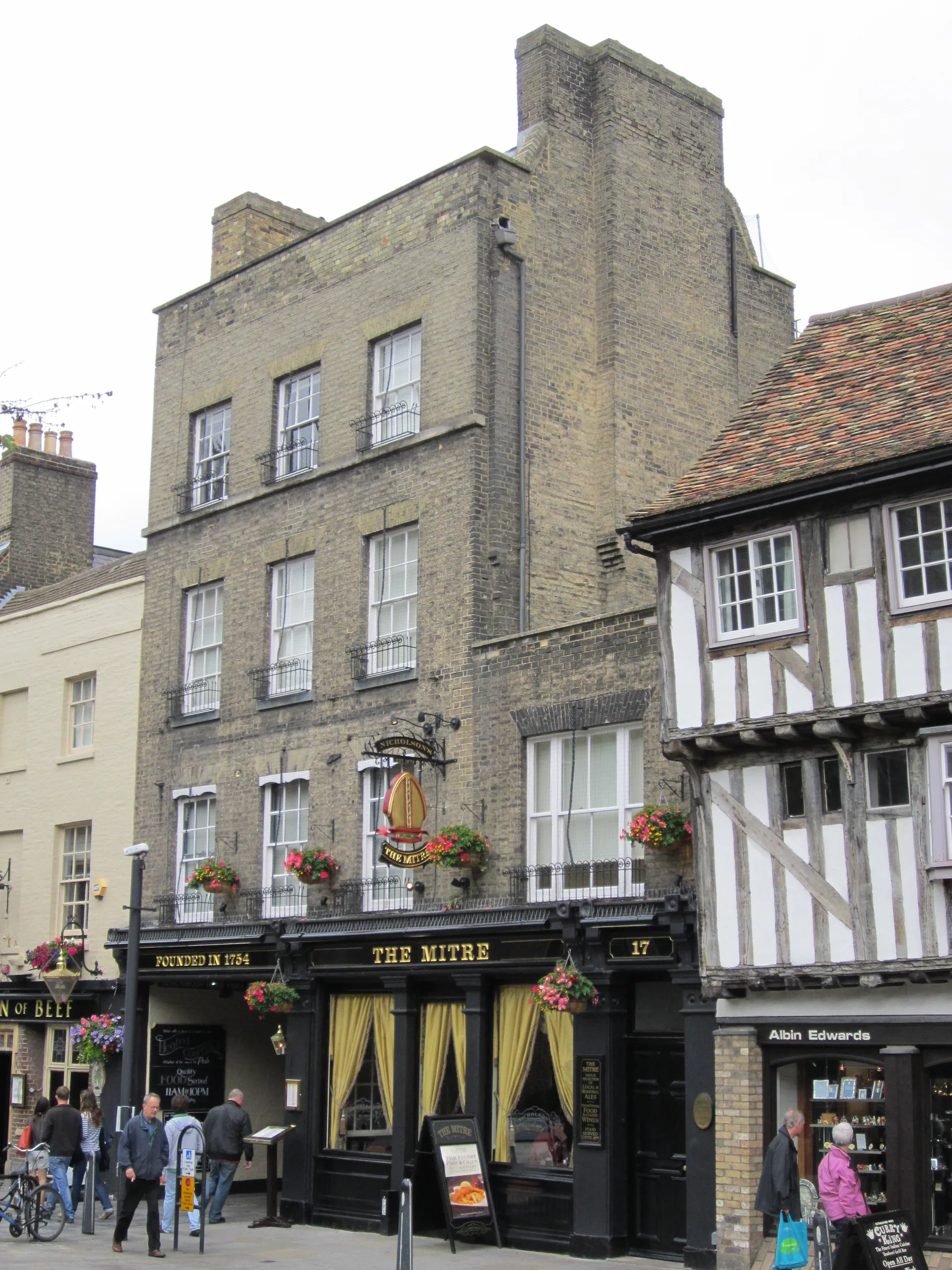
The carriage arch beside the pub carries the date 1754 as the year of foundation. Stand under it and read it, because it is one half of the pub's internal contradiction: the plaque a few feet away gives a different date. It is also, according to Historic England's listing, a 19th-century carriage arch — the national heritage record describes the building as early to mid 19th century with a "C19 public house frontage and carriage arch". So the arch is roughly a century younger than the date it carries. That does not make the date false; it makes it a claim about the site rather than a record of the arch. Very few pubs put their own inconsistency on the wall this plainly. Historical importance: very high — it is the editorial centre of the place. Visitor experience: takes two minutes and changes how you read everything else. Photography: shoot the date and the arch together, straight on. Time required: 5 minutes.
2. The plaque that says 1752
A plaque outside the Mitre records that the earliest known licensee on this site was Robert Clarke in 1752, and names the two former inns — the Blackmoor's Head and the Cock and Magpie — and Ann Lawrence, the widowed wine merchant who ran the Cock and Magpie with her eight daughters. Read the plaque and the arch as a pair. "Earliest recorded licensee" and "founded" are different claims, which is why the two dates can both stand; nobody, however, has reconciled them in public, and the archive in fact pushes the site's licensed history back further still, to a 1615/16 alehouse licence. Three answers, one building. Historical importance: very high. Visitor experience: the only interpretation the pub offers, and it is worth reading in full. Photography: legible plaque shot, slightly angled to avoid glare. Time required: 5 minutes.
3. Blackmoor Head Yard
The narrow alley running back from Bridge Street immediately beside the pub. It takes its name from the Blackmoor's Head, the inn that stood here before the Mitre, and it is where the Mitre Brewery stood in the 19th century — the brewery that gave the pub its name in 1881. The Mitre still has a side door onto it, and across the alley is the Baron of Beef at number 19. The yard was swept by fire in 1933, in a blaze that partially destroyed the Baron of Beef. Walk a few paces in: it is the physical link between the pub's three names. Historical importance: high — this is where the name came from. Visitor experience: an unremarkable alley until you know what it is, which is rather the point. Photography: strong compressed shot looking down the yard from Bridge Street. Time required: 5 minutes.
4. The gault-brick frontage
Grey gault brick, four storeys, three windows wide, sashes with glazing bars and iron grilles to every window, a band at first-floor cill level and a parapet concealing the roof. Historic England dates it to the early or mid 19th century, and it is very largely the result of the 1825 sale, when the whole Clement Hostel lot was bought by a Mrs Lawrence and rebuilt; the modern brick facade appears to have gone up in or before 1841. Gault brick is the pale yellow-grey Cambridgeshire brick that gives so much of 19th-century Cambridge its particular colour, and this is a clean, tall example of it on a street of much older-looking frontages. Historical importance: high — this is the actual listed fabric. Visitor experience: better from the far pavement, where you can see all four storeys. Photography: cross Bridge Street and shoot from the St John's side. Time required: 5 minutes.
5. The front windows and the view of St John's
The large windows at the front of the Mitre look straight out at St John's College across Bridge Street. It is one of the better indoor views of a Cambridge college that you can get without paying to go into one, and it explains why the pub has always traded on this spot: this is the old road north out of the town, over the Great Bridge, and everyone going that way passed the door. Take a window seat if one is free. Historical importance: medium — the view is context rather than heritage. Visitor experience: the single best reason to sit inside. Photography: shoot through the glass in soft light; avoid direct reflections. Time required: as long as a drink.
6. The cask ale range
The Mitre is Nicholson's house in Cambridge, and the cask offer is the reason many locals come: one regular beer, Adnams Southwold Bitter, plus up to seven changing beers, often including St Austell's pale ale, with guests sometimes from small breweries. It holds Cask Marque accreditation. This is a genuine eight-line cask pub in a city where that is not common, and it is a more reliable reason to step inside than the 2011-refurbished interior is. Historical importance: low; contemporary interest high. Visitor experience: ask what is on and what is about to go on. Time required: as long as a pint.
7. The Baron of Beef next door
Across Blackmoor Head Yard at 19 Bridge Street stands the Baron of Beef, the Mitre's immediate neighbour and the pub partially destroyed in the 1933 yard fire, having only just been rebuilt after seven old cottages were demolished. The two houses share the alley and a side door's worth of history. If you are working through Cambridge's pubs, they are twenty seconds apart and make an obvious pair. Historical importance: medium. Visitor experience: a second pub without moving your feet. Time required: 5 minutes to look, longer if you go in.
Details worth slowing down for.
The pub's own two dates disagree, and the arch is the younger of the two
Everyone photographs the arch. Almost nobody reads the plaque as well, which is where the anomaly lives. The plaque says the earliest recorded licensee here was Robert Clarke in 1752; the arch says the house was founded in 1754. Then look at the national heritage record: Historic England describes a "C19 public house frontage and carriage arch" on a building it dates to the early or mid 19th century. The arch bearing the 1754 date is itself a Victorian arch. The date is a tradition carved onto a much later structure — which is how a great many English pub founding dates work, and almost none of them admit it as legibly as this one.
The archive goes back to 1615, not 1752
The plaque's claim — earliest recorded licensee, 1752 — is narrower than it sounds. The licensee sequence for 17–18 Bridge Street compiled by Capturing Cambridge, drawing on T E Faber's parish history, begins with Hugh Humphrey, a baker, who was granted a lease of Clement Hostel and an alehouse licence in 1615/16, and runs through the Joneses, John Wood, Henry Gunnell and Oliver Pangbourne before the Clarkes appear at all. Robert Clarke himself is recorded from 1744, eight years before the plaque's date; 1752 is simply the year he is listed against the sign of the Blackamore's Head. There are, in other words, at least four defensible answers to how old this pub is, and the plaque gives the third-oldest.
The name has nothing to do with bishops
A mitre is a bishop's hat, and in Ely, Lincoln or Canterbury a pub of this name would be advertising its diocese. Cambridge has no bishop and no cathedral — the city lies in the Diocese of Ely — so the sign is an anomaly. The name came off the Mitre Brewery, a 19th-century brewery that stood in Blackmoor Head Yard beside the pub, and it arrived in 1881. It is a commercial name from the beer trade wearing ecclesiastical dress.
Robert Blackmoor was a real priest, and his will survives
The first inn on the site, the Blackmoor's Head, is said to have taken its name from Robert Blackmoor — Blakamore in the records — a chantry priest at nearby St Clement's Church who held a tenement and garden in the parish. In 1472 he was the sole priest serving a chantry that had been founded for several, and his will of 1503 describes him as perpetual chaplain of the united chantry; he was succeeded by Thomas Paris and then Robert Massye. The derivation is traditional rather than proved — "Blackamoor's Head" was a common inn sign across England — but the man existed, in that parish, at the right time.
Christopher Smart's poem is about a different Mitre
In 1741 the poet Christopher Smart wrote "The Pretty Bar-Keeper of the Mitre", and the poem is occasionally attached to this pub. It cannot belong here: the Mitre did not exist at this address until the later 19th century, and in 1741 the house was the Blackmoor's Head. Capturing Cambridge states the point flatly and adds that the whereabouts of Smart's Mitre is unknown. It is a rare case of a local-history project actively refusing a good story.
Forty days shut in the plague year
On 27 September 1665 John, son of the innkeeper Henry Gunnell, died of plague here, and the inn was required to close for forty days. When Gunnell and his wife came out of quarantine they gave the house up altogether and moved across to St John's Lane, where Henry died in 1667. The inn then belonged to Peter Lightfoot, a fishmonger and alderman. Two lines in a parish record, and a whole small catastrophe.
A woman bought the site and rebuilt it
Most of what you are looking at exists because of a woman whose first name the record does not give. When the Clement Hostel lots came up for sale in 1825, the building was shared between the Blackmoor Head and a liquor shop called the Cock and Magpie. The whole lot was bought by a Mrs Lawrence and rebuilt by her; the brick facade appears to date from in or before 1841. The Lawrence family then held the site for around a century, until Edward Rist Lawrence's death in 1876.
Nine women behind one bar
The Cock and Magpie was run by the widowed Ann Lawrence, a successful wine merchant, assisted by her eight daughters — nine women running a Bridge Street inn in the 1830s and 1840s. The plaque outside names her, which makes the Mitre one of the few Cambridge pubs with a memorial to a woman trader. She was not an exception on this site either: Alice Clarke took over from Robert Clarke in the 1750s, Sarah Perry follows Juner Perry in 1792, Sarah Lawrence holds the licence from 1816 to 1831, Elizabeth Mays renames the pub in 1881, Mrs Elizabeth Cue holds it in 1888 and Mrs Ann Rich in 1896.
Elizabeth Mays is recorded as a "licensed victualler's wife"
The publican credited with renaming the pub the Mitre in 1881 appears in that year's census not as a licensee but as a licensed victualler's wife, aged 33, with a four-month-old son and her widowed mother, Julia Mays, an annuitant born in Guernsey. That formula — the licence in the husband's name, the work in the wife's — is the standard mechanism by which women vanish from the pub record. Here the tradition kept her name and the census very nearly took it away.
The pub survived because everything around it did not
The railway reached Cambridge in 1845 and took the river trade the Bridge Street inns lived on. By 1856 the fifteen pubs of the parish were down to four. By 1874 the Cock and Magpie was the only pub left in the immediate vicinity. The Mitre is a survivor by attrition, and the way it survived was to stop being only a pub: by 1878 it was trading as the Mitre Billiard Rooms.
Unexploded German "firepots" in the basement wall
On the night of 27 July 1942, after an air raid that damaged this part of Cambridge badly, an unexploded bomb was found in the basement party wall and another in the Mitre's outbuildings. They were later identified as Sprengband C.50s — the first German "firepots". The account comes from Michael Bowyer's Air Raid! (1986). Nine years earlier, in 1933, Blackmoor Head Yard had been swept by one of the fiercest fires in Cambridge for years.
The side door into the alley
There is a side door from the Mitre onto Blackmoor Head Yard, the alley that runs back between number 17 and the Baron of Beef at number 19. It is easy to miss and it is the most historically loaded door in the building: it opens onto the yard that gave the first inn its name and the brewery that gave the present pub its name.
The interior is younger than the pub's reputation
Be honest about this one. The 2011 refurbishment swept away the last of the Mitre's ale-house appearance, and CAMRA's own description calls the interior smart and contemporary. The down-steps section is now mostly a dining room with table service. The Mitre's age is in the brick, the arch, the alley and the archive — not in the fittings.
Make it work
Plan the visit properly.
Current practical detail, kept separate from the story so it is easy to scan when you need it.Walk in for a drink or book a table for food. Check the pub’s current opening and kitchen hours before setting out.
How to use it
The Mitre is a working pub, not a paid attraction. There is no admission charge, no ticket and no tour. The things worth seeing from outside — the gault-brick frontage, the carriage arch with its 1754 date, the plaque naming the Blackmoor's Head, the Cock and Magpie and Ann Lawrence, and the mouth of Blackmoor Head Yard — cost nothing and take five minutes from the pavement. Inside, you are a customer: walk in for a drink, or book a table if you want the down-steps dining area at a busy time.
Opening hours
Verified 29 July 2026. Recheck monthly.
From the operator's own listing (Nicholson's), read 29 July 2026 — use these:
- Monday to Thursday: 11:00 – 23:00
- Friday and Saturday: 10:00 – 00:00 (midnight)
- Sunday: 11:00 – 23:00
Check the pub’s Nicholson’s listing for current opening and kitchen hours, especially before an early visit.
Kitchen hours are not published on the operator's page. CAMRA's food times (above) are the only figures available and are several years old at survey. If you are travelling specifically to eat, telephone first.
Address and contact
- Address: The Mitre, 17 Bridge Street, Cambridge, CB2 1UF (the listed building covers 17 and 18 Bridge Street)
- Telephone: 01223 358403 (verified 29 July 2026)
- Website: nicholsonspubs.co.uk — The Mitre, Cambridge
- Operator: Nicholson's, the heritage-pub brand of Mitchells & Butlers
- Freehold owner: Mitchells & Butlers, per CAMRA's WhatPub record
- Listed: Grade II, Historic England list entry 1126261
Admission and booking
Free to enter. No booking needed to drink. Tables can be booked through the Nicholson's website, and order-at-table and collection services are offered. Booking is worth it for the down-steps dining section at weekends and in the evening; walk-in is normally fine mid-week and mid-afternoon.
Best time to visit
For the building and the plaque, any daylight hour — they are all outside. For a quiet interior, come on a weekday between about 14:00 and 17:00. Bridge Street is a bus corridor, so the frontage is busiest and noisiest at commuting times and on Saturdays. Term-time evenings and graduation periods (late March, late June and July) fill the central pubs; the Mitre is less pressed than the Eagle but still gets full.
How long to allow
- Frontage, arch, plaque and Blackmoor Head Yard from the pavement: 10 minutes
- The same plus a drink inside and the window view of St John's: 45 minutes
- With a meal: 75–90 minutes
Seasonality
Open year-round. Nothing about the Mitre is seasonal except the crowd: summer and the University's ceremonial weeks are the peaks, January and February the quietest. Because the outdoor drinking is standing space in Blackmoor Head Yard rather than a garden, warm weather pushes people into the alley rather than spreading them out.
Facilities
Verified 29 July 2026 from the operator's page and CAMRA's Cambridge branch record.
- Food: British pub menu, table service in the down-steps dining section, order-at-table, and collection
- Cask ale: one regular beer (Adnams Southwold Bitter) plus up to seven changing beers, often including St Austell's pale ale; guests may come from small breweries. Cask Marque accredited
- Full bar: keg beer, wine, spirits, cocktails
- Sports television
- Newspapers
- Toilets on site
- Function/private-event space
- Card payment; gift cards
- Free Wi-Fi is listed by third-party pub directories but is not stated on the operator's own page — treat as probable, not confirmed
Outdoor drinking space is in Blackmoor Head Yard, the alley beside the pub. Do not plan on a beer garden or on-site parking.
Accessibility (summary)
Entry from Bridge Street is at pavement level, but the main dining area is down a flight of steps from the bar, which is the critical fact for anyone with mobility needs. Accessible-toilet provision has not been verified. See the dedicated accessibility file, and telephone the pub before making a special trip.
Families, dogs, weather
Children are welcome when the family is eating, under the usual licensing rules for under-18s in bars; it is a pub, not a family attraction. Customer accounts describe the Mitre as dog-friendly and third-party directories list it as such, but this is not stated on the operator's own page — confirm on arrival. On a wet day it works well: everything of interest outside can be seen in five minutes from under the carriage arch, and the interior is a comfortable place to wait out rain two minutes from the Round Church.
Getting there
- On foot: Bridge Street runs between Sidney Street (at the Jesus Lane junction) and Magdalene Street (at the Thompson's Lane junction). The Mitre is on the north-east side, roughly opposite St John's College and about a minute north of the Round Church. From the Market Square it is about five minutes.
- From Cambridge railway station: about 25–30 minutes on foot, or a short bus ride to the city centre. Cambridge North station is further out and less useful.
- By bus: Bridge Street is a main city bus corridor and stops are immediately outside.
- By bicycle: Bridge Street has cycle lanes and there is on-street cycle parking nearby; it is also one of the busier and more contested cycle streets in the city, so ride it with care.
- By car: don't. Central Cambridge is effectively closed to visitor parking; use a Park & Ride site.
Crowd levels
Busy but rarely impassable. The Mitre is a well-used central pub rather than a pilgrimage site, so it does not suffer the queue-and-crush that the Eagle does. Peaks are Friday and Saturday evenings, lunchtimes in term, and graduation weeks. Weekday mid-afternoon is reliably calm.
What to recheck, and when
| Item | Cadence | Source |
|---|---|---|
| Opening hours | Monthly | Nicholson's pub page |
| Kitchen hours | Monthly | Telephone — not published online |
| Operator | Annually | Nicholson's / Mitchells & Butlers |
| Cask beer range | Annually | CAMRA Cambridge branch |
| Accessible toilet | Once, then annually | Telephone the pub |
| Historic facts | Annually | Historic England, Capturing Cambridge |
Visit your way
Access and family planning.
Plan your visit around the entrance and seating that work for you. Telephone 01223 358403 to discuss access requirements before travelling.
The single most important fact
The main dining area is down a flight of steps from the bar. CAMRA's Cambridge branch describes "the extended down-steps section" as primarily for dining, with full table service. If you cannot manage steps, you can still use the pub — but plan on the bar-level area, and say so when you arrive or when you book, so that staff can seat you accordingly. Do not book the dining room online and assume it will be level.
Step-free access
The entrance is on Bridge Street. A fully step-free threshold and the doorway width are not confirmed. Telephone the pub to discuss the entrance and bar-level seating before travelling.
Everything of historic interest at the Mitre is outside the building: the gault-brick frontage, the carriage arch carrying the 1754 date, the plaque recording Robert Clarke in 1752, and the mouth of Blackmoor Head Yard. All of it can be seen and read from a level public pavement without entering the pub at all. For a visitor for whom the interior is not feasible, the site still works.
Wheelchairs and mobility
- Bar level: likely workable, subject to the door question above and to how busy the pub is. Central pubs at peak times are tight regardless of layout.
- Dining level: down steps, and therefore not accessible to wheelchair users or to anyone who cannot manage a flight.
- The pavement outside: Bridge Street pavements here are narrow and the street carries heavy bus and cycle traffic. Blackmoor Head Yard is a narrow alley with an uneven surface; treat it as a look-down-it rather than a go-along-it.
Toilets
Standard toilets are available. An accessible toilet and its location are not confirmed; ask whether the facilities you need can be reached from bar level without steps.
Sensory considerations
- Noise, outside: Bridge Street is a primary bus route. The frontage is loud and there is constant cycle and pedestrian movement, which is difficult for anyone who needs space and quiet to stand and read a plaque. Mid-afternoon on a weekday is markedly better than a weekday morning or a Saturday.
- Noise, inside: sports television is a listed facility, so match days and major fixtures will be loud. If you need a quiet room, ask before you sit, or avoid fixture days entirely.
- Lighting: the interior was refurbished in 2011 to a contemporary standard and is not the dim, low-beamed environment of an unmodernised old pub — which is better for low vision than most historic Cambridge pubs. The large front windows give good natural light at bar level during the day.
- Visual impairment: the two key features are both text on the exterior — a carved date on the arch and an engraved plaque. There is no large-print, audio or tactile interpretation. The plaque is at standing reading distance; a sighted companion can help read the inscription.
- Hearing impairment: table service in the dining section removes the need to order at a busy bar, which helps. Background music and sports television will interfere with hearing aids and lip-reading at peak times.
Seating and rest
Plenty of seating at both levels, including window seats at the front. Table service in the dining area means you can be seated for the whole visit. There is no outdoor seating in any meaningful sense — the outdoor space is standing room in Blackmoor Head Yard — so do not plan on sitting outside.
Getting there
Bridge Street is served directly by city buses, with stops immediately outside, which makes the Mitre one of the easier central Cambridge sites to reach without walking far. There is no parking; central Cambridge is effectively closed to visitor cars. Blue-badge provision in the immediate area is limited and is not confirmed — check Cambridge City Council's current parking information before travelling by car.
The practical recommendation
If the interior matters to you, telephone first and ask three specific questions: is the front entrance step-free; is there an accessible toilet and is it on the bar level; and can a table be reserved at bar level rather than in the down-steps dining room. If the answers do not work, the visit is still worth making — the history of the Mitre is entirely legible from the pavement, in about ten minutes, and the Round Church a minute away has its own accessible visitor provision.
Known gaps in this assessment
- Step-free status of the front threshold — unverified.
- Accessible toilet: existence, location and dimensions — unverified.
- Baby-change facilities — unverified.
- Assistance-dog policy — not stated by the operator, though the pub is widely described as dog-friendly.
- Blue-badge parking in the immediate vicinity — unverified.
These are flagged rather than guessed. If a reader closes any of them, update this file and 13-operational-data.json together.
The honest picture
The Mitre is a city-centre pub on a busy bus street, not a family attraction. Children are welcome when the family is eating, within the usual licensing rules for under-18s in bars, and the down-steps dining section with table service is where families end up. There is no children's menu trail, no play space and nothing staged for young visitors. It works as a lunch stop on a Cambridge day, and it works as a two-minute pavement stop for a family that likes a puzzle — but those are two different visits.
The bit that actually works for children
The 1752-versus-1754 problem is a genuinely good five minutes with a child who likes noticing things. Stand them under the arch, let them find the carved date, then walk them ten feet to the plaque and let them find the other one. Ask which is right. The honest answer — that both are, because they are answers to different questions, and that a heritage record dates the arch itself to a hundred years later — is a small, real lesson in how evidence works. It beats most museum labels, it is free, and it takes place entirely on the pavement.
Ages and what they'll get from it
- Under 5s: Nothing here for them beyond a meal. Bridge Street traffic means hands held throughout, and the dining area is down steps, which is awkward with a pushchair. Feed them and move on.
- 5–10s: The two-dates puzzle lands well at this age, and so does Blackmoor Head Yard — a real alley with a real name and a fire in it. The story of nine women running the pub (Ann Lawrence and her eight daughters) tends to stick. Ten minutes outside, then lunch.
- 11–16s: The best age for this stop. The gap between what a place says about itself and what the archive says is exactly the sort of thing that interests teenagers, and it is a usable example for history coursework on sources and reliability. Pair it with the Round Church one minute away for a jump from 1130 to 1754 to 1881 in a single street.
Educational value
Moderate as a place, high as a case study. The Mitre is a compact worked example of source criticism: a plaque, an arch, a national heritage listing and a parish licensee register that give four different answers about one building. For a child studying how historians weigh evidence, that is more useful than a straightforwardly old building would be. It also carries a clear piece of transport and economic history — the railway arrives in 1845, the river trade dies, fifteen parish pubs become four by 1856, one survives by turning itself into billiard rooms.
Practical friction points
- The steps. The main dining area is down a flight of steps from the bar. Pushchairs are awkward; plan to fold and carry, or ask for a table at bar level.
- Traffic and noise. Bridge Street is a bus and cycle corridor. The frontage is loud and there is no safe pavement loitering with small children at peak times — stand under the arch or in the mouth of the yard instead.
- No outdoor space to speak of. There is no garden. Outdoor drinking is standing room in Blackmoor Head Yard, which is not somewhere to put a family.
- It is a bar. Evenings are adult, with sports television on. Come at lunchtime.
- Boredom risk. Real once the food arrives and the puzzle is solved. The Mitre is a fifteen-minute stop with children, not an hour.
Facilities for families
Toilets on site. Table service in the dining section, which helps with children. No accessible-toilet or baby-change provision has been verified — telephone ahead if that matters. Card payment throughout.
The efficient family version
Stop on the pavement opposite and count the four storeys of gault brick. Cross, find the 1754 on the arch, then find the 1752 on the plaque, and let them argue about it. Look twenty paces down Blackmoor Head Yard and explain that a brewery there gave the pub its name in 1881 — and that for most of its life this place was called the Cock and Magpie. Then walk one minute south to the Round Church, which is six hundred years older than any of the dates you have just been reading. Fifteen minutes, three good facts, no sit-down required.
Self-guided walk
Explore beyond the venue.
A practical, step-by-step route connecting this experience with more of Cambridge.Stop 1 — The Mitre, 17–18 Bridge Street (start)
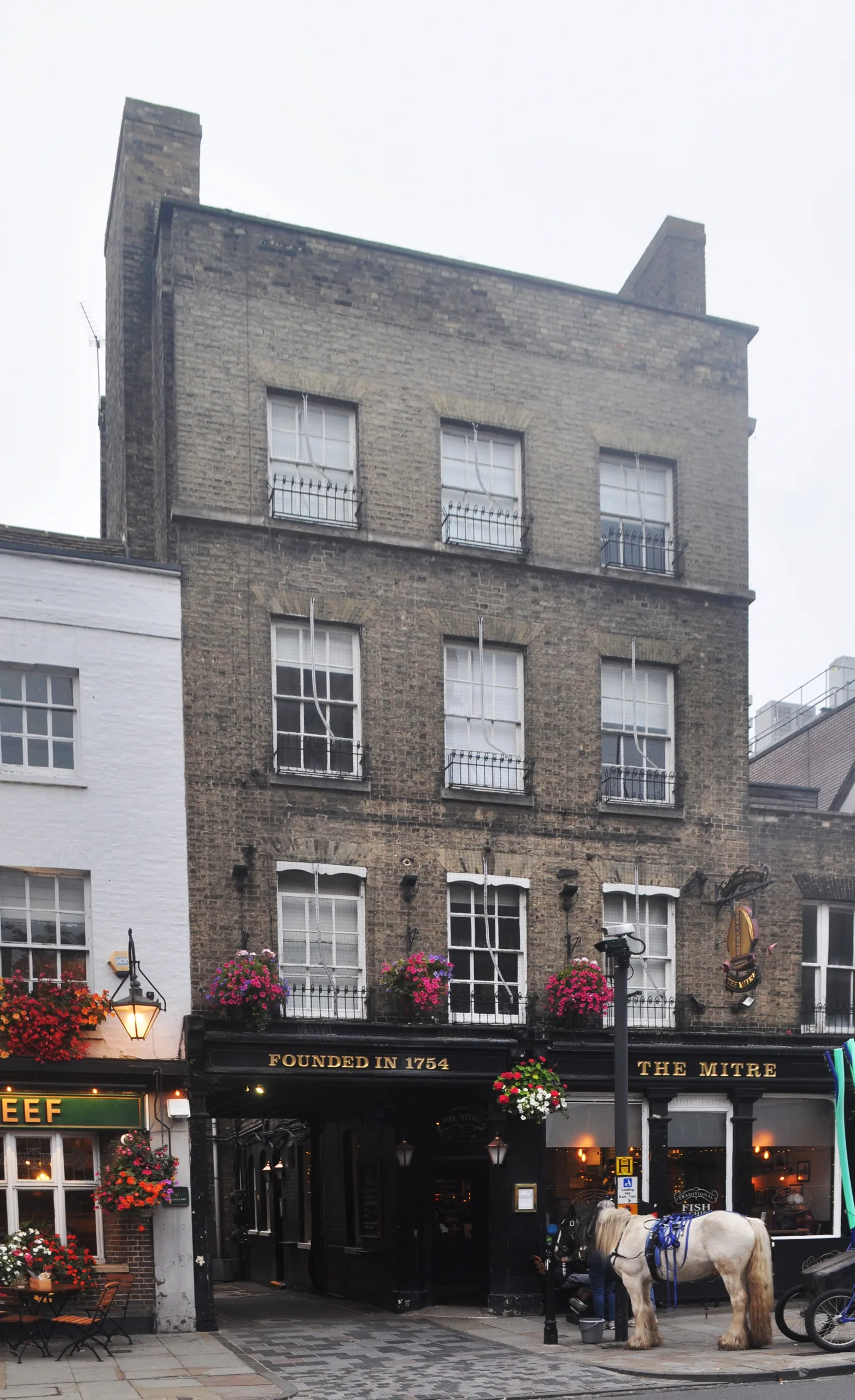
Begin on the pavement outside the pub, on the north-east side of Bridge Street. Do three things in order. First, find the carriage arch and read the date carved on it: 1754, the year the pub gives as its foundation. Second, find the plaque by the door: it records the earliest known licensee here as Robert Clarke in 1752, and names the two inns that stood on this site — the Blackmoor's Head and the Cock and Magpie — and Ann Lawrence, the widowed wine merchant who ran the Cock and Magpie with her eight daughters. Third, cross to the far pavement and look back at the whole frontage: four storeys of grey gault brick, three windows wide, iron grilles to every window. Historic England dates that building, and the arch, to the 19th century — so the arch carrying 1754 is about a hundred years younger than its own date.
Hold those three facts. The rest of the walk explains them. Photo stop: the arch with the date legible; the plaque; the frontage from across the street. 15 minutes.
Stop 2 — Blackmoor Head Yard (30 seconds)
Step to the alley immediately beside the pub. This is Blackmoor Head Yard, named for the inn that stood on the site before the Mitre, and it is where the Mitre Brewery stood in the 19th century — the brewery from which the pub took its name in 1881, when the publican Elizabeth Mays put it over the door. The Mitre still has a side door onto the yard. Across the alley at number 19 is the Baron of Beef, partially destroyed when the yard was swept by fire in 1933. Look down the yard, but do not block it — it is a working service alley. Photo stop: compressed shot down the yard. 5 minutes.
Stop 3 — The Round Church (1 minute)
Walk south-east along Bridge Street to the corner of Round Church Street. The Church of the Holy Sepulchre — the Round Church — is one of only four medieval round churches still in use in England, built in the 1130s in imitation of the church of the Holy Sepulchre in Jerusalem. It runs a visitor centre on the history of Cambridge and the University; check opening times and admission on the day. Stand outside it and hold the comparison: the Mitre disputes with itself over two years in the 1750s, and this building was six hundred years old before either date was reached. Photo stop: the round nave from the street corner. 15–25 minutes with the visitor centre.
Stop 4 — St Clement's Church (2 minutes)
Continue south-east along Bridge Street towards Sidney Street; St Clement's is on your left. This is the parish church of the parish that had fifteen pubs before the railway and four by 1856, and it is where Robert Blackmoor — Blakamore in the records — was a chantry priest, holding a tenement and garden here and described in his will of 1503 as perpetual chaplain of the united chantry. The Blackmoor's Head, the first inn on the Mitre's site, is said to take its name from him. This is as close as the Mitre gets to an origin story, and almost nobody walks the two minutes to see it. 5–10 minutes.
Stop 5 — Portugal Place (3 minutes)
Retrace north-west along Bridge Street and turn off into Portugal Place, a quiet lane of small houses immediately behind the Mitre. The name is sometimes explained by Sephardic Jews settling here in Cromwell's England; the likelier explanation is the Peninsular War — houses built for returning officers, or Portuguese coins turned up when the houses went in during the 19th century. Another confident local story that the evidence does not quite carry, two minutes from a pub with the same problem. Photo stop: the lane looking towards the chimney-pots. 5 minutes.
Stop 6 — Magdalene Bridge and the river (4 minutes)
Return to Bridge Street and walk north-west, past the Mitre, to where the street becomes Magdalene Street at the Thompson's Lane junction. Stand on Magdalene Bridge and look at the Cam. This is the successor to the Great Bridge that gave the street its name and carried the road north out of Cambridge. Everything about the Mitre's site makes sense from here: freight came up the river, the road crossed it, and the inns stood on the bank between the two. When the railway arrived in 1845 the river trade went, and within a decade most of the pubs on this street had gone with it. Photo stop: the punts and the river from the bridge parapet. 10 minutes.
Stop 7 — The Pickerel Inn, 30 Magdalene Street (1 minute)
Cross the bridge and continue a few doors along Magdalene Street. The Pickerel is widely regarded as the oldest continuously licensed house in Cambridge, dating from 1608. Look at it and then think back to the arch you started at. The Pickerel's claim is settled and specific; the Mitre's is asserted twice, in two different years, on its own wall. Both pubs are old; only one of them knows how old. Magdalene College is immediately beyond, with the Pepys Library inside. 10 minutes, longer if you go in.
Stop 8 — Back to the Mitre (4 minutes)
Walk back over Magdalene Bridge and down Bridge Street to where you started. Take a window seat at the front if one is free: the large front windows look straight across at St John's College, and that view is the reason there has been an inn on this plot for four hundred years. Ask what is on the cask lines — one regular (Adnams Southwold Bitter) and up to seven changing beers — and sit with the fact that for most of its documented life this building was not called the Mitre at all. End where you started. 30 minutes with a drink.
Notes
The whole loop is flat, entirely on public streets, and free apart from the Round Church visitor centre and anything you drink. In wet weather, compress it: stops 1, 2, 3 and 8 are all within two minutes of each other and mostly sheltered. If you want to extend it into a full pub sequence, continue past Magdalene up Castle Street to the Castle Inn (1740s), or turn south from the Round Church for the ten-minute walk to the Eagle on Bene't Street.
Timing advice. The Mitre's frontage faces south-west, so it photographs best in the afternoon. Starting this walk at about 15:00 puts good light on the arch at the beginning and gets you back to the pub as the front windows warm up.
Make a record
Photograph it thoughtfully.
The strongest compositions
- The arch and its date. The single defining image of this pub: the carriage arch beside the frontage, with the carved 1754 legible. Shoot it straight on and close enough that the date reads at thumbnail size. This is the picture the whole story hangs on, so it has to be sharp and legible rather than atmospheric.
- The arch and the plaque in one frame. Harder, and more valuable. If you can find an angle from which the 1754 on the arch and the 1752 plaque both appear — even at different scales — you have the entire editorial premise in a single image. A slightly wide lens from the pavement, or a two-shot diptych if one frame will not hold them.
- The full frontage from the St John's side. Cross Bridge Street and shoot back at the pub from the opposite pavement. From there you get all four storeys of grey gault brick, the three-window rhythm, the iron grilles, the cill band and the parapet — the actual listed fabric, which a close-up of the pub sign does not show.
- Blackmoor Head Yard, looking in. A compressed shot down the alley from Bridge Street, with the Mitre's flank on one side and the Baron of Beef on the other. Long lens, so the walls close in. This is the picture that carries the name story.
- The front windows from inside, with St John's beyond. Sit at a window seat and shoot out through the glass at the college opposite. It places the pub on the old road north better than any exterior can.
Light and timing
Bridge Street runs roughly north-west to south-east, and the Mitre stands on the north-east side, which means the frontage faces south-west. It gets its best direct light in the afternoon and early evening, and sits in its own shadow through the morning. Plan accordingly:
- Morning: flat, even, shadowless light on the frontage. Good for legible documentary shots of the plaque and the carved date; poor for modelling the brickwork.
- Mid to late afternoon: raking light across the gault brick, which brings out the window grilles and the arch. The best hour for the building.
- Golden hour and dusk: the frontage warms up and the interior lights come on; with the pub windows lit against a blue sky this is the strongest evening frame.
- Blackmoor Head Yard is a narrow north-east-running alley and is in shade almost all day. Expose for the shaded walls and let Bridge Street blow out slightly behind you, or shoot it on an overcast day when the contrast collapses.
Practical problems and how to beat them
- Buses. Bridge Street is a primary bus corridor and a double-decker will fill your frame every couple of minutes. Set up, wait for the gap, and be ready. Early Sunday morning is the quietest the street ever gets.
- Cyclists. Constant, fast and close. Do not stand in the cycle lane to get a straight-on frontage; use the opposite pavement.
- Pavement width. Narrow on the pub side, which forces a steep upward angle and strong converging verticals on the four-storey frontage. Either correct in post, shoot from across the street, or lean into the convergence deliberately.
- Plaque glare. Engraved plaques on a south-west-facing wall flare badly in afternoon sun. Shoot the plaque in the morning shade, or angle off-axis and use a polariser.
- Interior light. The 2011 refurbishment left a well-lit contemporary room with large front windows — much easier to shoot than a dim historic bar. Expose for the window if you want St John's outside, or for the room if you want the interior.
What not to bother with
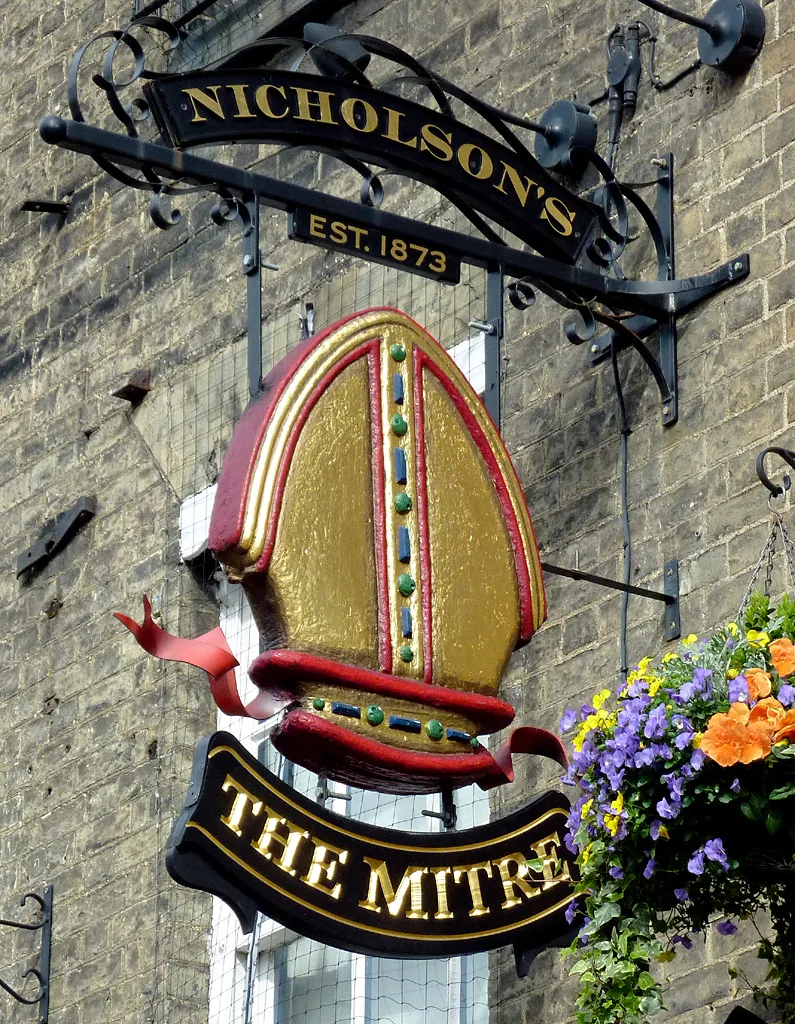
The interior is not the story here, and a general shot of a modern pub room adds nothing that a hundred other pub interiors do not. Spend your frames on the arch, the plaque, the brick and the yard. Similarly, the hanging sign is worth one frame for identification and no more — the Mitre's interest is in its dates, not its signage.
Etiquette and permissions
The Mitre is a working pub and the people in it are there to drink and eat, not to be photographed. Keep other customers and staff out of frame, or ask first; if you want a photograph of a member of staff behind the bar, ask the manager. Do not photograph people at tables. The exterior, the arch, the plaque and the alley are all visible from the public highway and can be photographed freely for personal use.
Commercial photography inside the pub needs the permission of the operator (Nicholson's / Mitchells & Butlers) — arrange it in advance with the pub manager rather than turning up with lights. Tripods are impractical on the Bridge Street pavement, where they obstruct a narrow footway on a busy bus route, and unwelcome inside a working bar; use a monopod or brace against a wall.
Drone flight is not an option here. The Mitre stands in the centre of a dense urban area with uninvolved people and vehicles beneath it at all times, which brings it squarely under the CAA's restrictions on flying over crowds and near people in built-up areas. Central Cambridge airspace is also affected by Cambridge Airport. Do not plan aerial coverage of this site; if an overhead view is needed, use a licensed stock aerial or an illustrated map instead.
Respect for the neighbours
Blackmoor Head Yard is a working service alley between two pubs, with deliveries, staff and cellar access. Photograph it quickly and do not block it. The residential and college frontages opposite are private; shoot the street, not through windows.
Around here
Make more of the area.
Good to know
Questions, answered.
01Where is the Mitre in Cambridge?
At 17 Bridge Street, Cambridge, CB2 1UF, on the north-east side of the street almost opposite St John's College. The listed building covers 17 and 18 Bridge Street. It is about a minute north of the Round Church and four minutes from Magdalene Bridge.
02Was the Mitre founded in 1752 or 1754?
Both dates appear on the building. The plaque records the earliest known licensee, Robert Clarke in 1752; the arch says the house was founded in 1754. Look for both as you approach the entrance.
03So which date is right?
Strictly, neither is a foundation date that the archive supports. The licensee sequence for this address compiled by Capturing Cambridge, from T E Faber's parish history, shows Robert Clarke holding the house from 1744 — eight years before the plaque's date — and runs the site's licensed history back to a 1615/16 alehouse licence granted to Hugh Humphrey. Meanwhile Historic England dates the arch itself to the 19th century. Treat 1752 and 1754 as the pub's inherited tradition, not as archival findings.
04How can the arch be younger than the date carved on it?
Because the date is a claim about the site, not a record of the arch's construction. Historic England's listing describes the building as early to mid 19th century with a "C19 public house frontage and carriage arch". The present arch went up roughly a hundred years after 1754, and the date was carved onto it to assert the age of the house.
05How old is the Mitre really?
Depends what you are counting. The standing building is early to mid 19th century. The name "Mitre" dates from 1881. The two inns on the site — the Blackmoor's Head and the Cock and Magpie — date from the mid-18th century and earlier. And the plot carried a licensed alehouse by 1615/16. Four defensible answers, none of which is 1754.
06Why is it called the Mitre if Cambridge has no bishop?
Exactly the right question. Cambridge has no bishop and no cathedral — the city lies in the Diocese of Ely — so the name is an anomaly for a pub sign that usually advertises a diocese. It came from the Mitre Brewery, a 19th-century brewery in Blackmoor Head Yard beside the pub, and it was adopted in 1881. There is no medieval ecclesiastical connection.
07What was the pub called before it was the Mitre?
The site carried two inns: the Blackmoor's Head and the Cock and Magpie. The Blackmoor's Head faded out in the 1850s; the Cock and Magpie survived, was trading as the Mitre Billiard Rooms by 1878, and was renamed the Mitre by the publican Elizabeth Mays in 1881. For most of its documented history this building was not called the Mitre.
08Who was Robert Blackmoor?
A chantry priest at nearby St Clement's Church, spelled Blakamore in the records, who held a tenement and garden in the parish. In 1472 he was the sole priest serving a chantry founded for several, and his will of 1503 describes him as perpetual chaplain of the united chantry. The Blackmoor's Head inn is said to take its name from him — it is a traditional derivation rather than a proved one, and "Blackamoor's Head" was also a common English inn sign in its own right.
09Who was Ann Lawrence?
The widowed wine merchant who ran the Cock and Magpie, assisted by her eight daughters. She appears in the licensing record for the house with Edward Rist Lawrence between 1836 and 1845, and she is named on the plaque outside the modern pub — one of the few Cambridge pub memorials to a woman trader.
10Who renamed the pub the Mitre?
The publican Elizabeth Mays, in 1881. The 1881 census records her at the Mitre, aged 33, described as a "licensed victualler's wife", with a four-month-old son and her widowed mother. That formula usually means the licence stood in a husband's name while the wife ran the house.
11Why did so many Bridge Street pubs close?
The railway. It reached Cambridge in 1845 and took away most of the river trade the Bridge Street inns depended on. By 1856 the fifteen pubs of the parish had been reduced to four, and by 1874 the Cock and Magpie was the only pub left in the immediate vicinity.
12What were the Mitre Billiard Rooms?
The trading name of the house by 1878. Billiards was the standard Victorian answer to a collapsing drinks trade — it drew a paying, respectable clientele and filled the afternoons. It is how this pub survived the loss of the river trade.
13Who was William Headdy?
The licensee of the Cock and Magpie in 1874, and also the proprietor of the nearby Mitre Brewery. He is the link between the pub and the name it would take seven years later.
14Is the Mitre a listed building?
Yes — Grade II, listed on 2 November 1972, Historic England list entry 1126261, as "The Mitre Public House, 17 and 18, Bridge Street".
15What does the listing say about the building?
Early to mid 19th century; grey gault brick; four storeys, three windows wide; sashes with glazing bars and iron grilles to all windows; a two-storey extension to the right with a single tripartite sash on the upper floor; a 19th-century public house frontage and carriage arch; a band at first-floor cill level; parapet, roof not visible.
16Who runs the Mitre now?
Nicholson's, the heritage-pub brand of Mitchells & Butlers, who are also recorded as freehold owner. Verified 29 July 2026; pub operators change, so confirm if it matters.
17What are the opening hours?
From the operator's own listing, read 29 July 2026: Monday to Thursday 11:00–23:00, Friday and Saturday 10:00–00:00, Sunday 11:00–23:00. CAMRA's WhatPub record disagrees, giving Monday to Wednesday from noon and Thursday to Sunday 10:00–23:00. Confirm before travelling.
18What time does the kitchen serve?
The operator does not publish kitchen hours. CAMRA's record gives food from noon to 22:00 Monday to Wednesday and 10:00 to 22:00 Thursday to Sunday, but that entry was last surveyed in 2017. If you are travelling to eat, telephone 01223 358403 first.
19Is there an entry fee?
No. It is a working pub, free to enter. Everything historically interesting — the arch, the date, the plaque, the frontage and Blackmoor Head Yard — is outside and visible from the public pavement without going in at all.
20What beer does the Mitre serve?
One regular cask beer, Adnams Southwold Bitter, plus up to seven changing beers, often including St Austell's pale ale, with guests sometimes from small breweries. It holds Cask Marque accreditation. Eight cask lines is a strong offer by Cambridge standards.
21Is the interior historic?
No, and this is worth knowing before you go. A refurbishment in 2011 removed the last of the pub's ale-house appearance, and CAMRA describes the interior as smart and contemporary. The Mitre's age is in the brick, the arch, the alley and the archive, not in the fittings.
22Is the Mitre wheelchair accessible?
The main dining area is down a flight of steps from the bar. Ask for bar-level seating and confirm the entrance threshold and accessible toilet before travelling. The historic exterior features can be seen from the public pavement.
23Is there an accessible toilet?
Unverified. There are toilets on site, but no reliable source states whether a dedicated accessible WC exists or which level it is on. Ring and ask rather than assume.
24Is there a beer garden?
No. At least one aggregator directory lists a beer garden and a car park at this address; neither is credible for a terraced building on a central bus street and neither appears in CAMRA's survey or on the operator's page. The outdoor space is standing room in Blackmoor Head Yard, the alley beside the pub.
25Are dogs allowed?
The Mitre is widely described as dog-friendly by customers and third-party directories, but the operator's own page does not state a policy. Confirm on arrival.
26Is it suitable for children?
Children are welcome when the family is eating, under the usual licensing rules for under-18s in bars. It is a pub rather than a family attraction. The two-dates puzzle outside is a genuinely good five minutes with a curious child, and the dining area is down steps, which is awkward with a pushchair.
27Do I need to book?
Not to drink. Booking a table through the Nicholson's website is worth it for the down-steps dining section at weekends and in the evening.
28How long should I spend there?
Ten minutes for the arch, plaque, frontage and yard from the pavement; about forty-five minutes with a drink; an hour and a half with a meal.
29What is Blackmoor Head Yard?
The narrow alley running back from Bridge Street between the Mitre at 17 and the Baron of Beef at 19. It is named after the Blackmoor's Head inn, and the Mitre Brewery stood in it. The pub still has a side door onto it. The yard was swept by fire in 1933, in a blaze that partially destroyed the Baron of Beef.
30Is the Mitre the oldest pub in Cambridge?
No — it is the youngest of the six pubs in Above Guide's "Cambridge's oldest pubs" collection. The Pickerel Inn on Magdalene Street (1608) is generally regarded as the oldest continuously licensed house, and the Green Dragon in Chesterton as the oldest surviving pub building.
31Did Christopher Smart write a poem about this pub?
No. Smart's "The Pretty Bar-Keeper of the Mitre" dates from 1741, when this house was the Blackmoor's Head; the Mitre did not exist at this address until the later 19th century. Capturing Cambridge notes that the whereabouts of Smart's Mitre is unknown.
32Was the Mitre bombed in the war?
On the night of 27 July 1942, after an air raid that badly damaged this part of Cambridge, an unexploded bomb was found in the basement party wall and another in the Mitre's outbuildings. They were later identified as Sprengband C.50s, the first German "firepots". The account is from Michael Bowyer's Air Raid! (1986).
33What else is worth seeing nearby?
The Round Church is a minute away, St John's College is directly opposite, St Clement's Church — where Robert Blackmoor was chantry priest — is two minutes along Bridge Street, and Magdalene Bridge and the Pickerel Inn are four minutes north-west. The Eagle on Bene't Street is about ten minutes south.
Before you visit
Useful links.
Venue and visitor information
Every substantive factual claim in this bundle traces to a source below. Prioritised: Historic England (statutory listing), the Museum of Cambridge's Capturing Cambridge project (drawing on published parish scholarship), the operator's own listing, CAMRA's Cambridge branch survey, and a dated first-hand account of the pub's plaque. All sources read and verified on 29 July 2026. No AI-generated sources have been used.
Primary sources
- Historic England, National Heritage List for England — The Mitre Public House, 17 and 18, Bridge Street, Cambridge. List entry 1126261, Grade II, first listed 2 November 1972, group value. Listing description: "Early/Mid C19. Grey gault brick. 4 storeys, 3 windows, sashes with glazing bars, iron grilles to all windows; 2 storey extension to right with single tripartite sash window on upper floor. C19 public house frontage and carriage arch. Band at front floor cill level. Parapet, roof not visible." Used for: listed status, grade, date of listing, the early/mid 19th-century dating of the fabric, the materials and elevation description, and — critically — the 19th-century dating of the carriage arch that carries the 1754 date. Text available under the Open Government Licence v3.0. https://historicengland.org.uk/listing/the-list/list-entry/1126261
- Capturing Cambridge (Museum of Cambridge) — "17 – 18 Bridge Street, The Mitre / Blackmoor Head / Cock and Magpie". Compiled from directories, censuses and T E Faber, An Intimate History of St Clement's Parish (2006). Used for: the full licensee sequence from 1615/16 (Hugh Humphrey, baker, lease of Clement Hostel and alehouse licence) through Oliver Pangbourne (Blackamoor's Head 1672–74), Robert and Alice Clarke (1744–57, "for Blackamore's Head in 1752"), the Perrys and the Lawrences; the 1665 plague closure of Henry Gunnell's inn and its ownership by Peter Lightfoot; the 1825 sale of the Clement Hostel lots and the purchase and rebuilding by a Mrs Lawrence; the modern brick facade of in or before 1841; the last full reference to the Blackmoor Head in the 1841 census; the 1861, 1871, 1881, 1891 and 1901 census entries; William Headdy in 1874; the note that in 1876 the Mitre "not yet in existence" and the site still belonged to Edward Rist Lawrence at his death; Thomas William Reilly (1879); Elizabeth Mays in the 1881 census as licensed victualler's wife, aged 33; later licensees to 1962; the 1933 Blackamoor Head Yard fire (Cambridge Independent Press, 6 October 1933) and its damage to the Baron of Beef; the unexploded Sprengband C.50 "firepots" of 27 July 1942 (citing Michael Bowyer, Air Raid!, 1986); and the explicit statement that Christopher Smart's 1741 poem "The Pretty Bar-Keeper of the Mitre" cannot refer to this house. Licensed CC BY-NC-SA 4.0. https://capturingcambridge.org/centre/bridge-street/17-bridge-street-the-mitre/
- Capturing Cambridge — "Blackmoor Head Yard". Used for: the yard as an alleyway perpendicular to Bridge Street between the Mitre (17) and the Baron of Beef (19); twelve addresses there in 1913; the 1825 livery behind the yard leased by St John's College to Henry Browning. https://capturingcambridge.org/centre/bridge-street/blackmoor-head-yard/
- Capturing Cambridge — "9 Portugal Place / St Clement's Chantry". Used for: Robert Blakamore as a chantry priest granted a tenement and garden; sole priest for two chantries in 1472; his will of 1503 describing him as perpetual chaplain of the united chantry; his successors Thomas Paris and Robert Massye (d. 1528). Note that this page does not itself link Blakamore to the Blackmoor Head inn — the naming derivation comes from sources 5 and 6. https://capturingcambridge.org/centre/portugal-place/9-portugal-place-st-clements-chantry/
- Nicholson's (Mitchells & Butlers) — The Mitre, Cambridge, official pub listing. Read 29 July 2026. Used for: current operator; address 17 Bridge Street, Cambridge, Cambridgeshire, CB2 1UF; telephone 01223 358403; opening hours (Mon–Thu 11:00–23:00, Fri–Sat 10:00–00:00, Sun 11:00–23:00); booking, order-at-table and collection services; function space; and the operator's own history text — that the pub stands on the site of two former inns, the Blackmoor's Head and the Cock and Magpie, that the first inn took its name from Robert Blackmoor, a medieval chantry priest, and that the coming of the railway took away the river trade to the point where by 1874 the Cock & Magpie was the only remaining pub. https://www.nicholsonspubs.co.uk/restaurants/eastofengland/themitrecambridge
- Patrick Comerford, "The Mitre in Cambridge, the meaning of a name, and restoring a forgotten woman's name at the Eagle", COMERFORD WAY, posted 27 July 2026. A first-hand account, with the author's own photographs of the building and its plaque. Used for: the plaque's record that the earliest record of a licensee at the site was Robert Clarke in 1752, and the date on the arch giving the foundation as 1754 — the central claim of this bundle; the Grade II listing at 17 to 18 Bridge Street; the two former inns and the Blackmoor derivation; Ann Lawrence, widowed wine merchant, assisted by her eight daughters, and the plaque naming her; by 1856 the fifteen pubs of the parish reduced to four, and by 1874 the Cock and Magpie the only pub remaining in the immediate vicinity; William Headdy licensee in 1874 and proprietor of the nearby Mitre Brewery; the Mitre Billiard Rooms by 1878 and the renaming to the Mitre by Elizabeth Mays in 1881; the observation that Cambridge has no bishop and no cathedral, lying in the Diocese of Ely, so the name is an anomaly taken from a brewery; the front windows looking onto St John's College; and the description of Bridge Street running between Magdalene Street and Sidney Street, formerly continuing over the Great Bridge. Status: a personal blog, and treated as such — but it is a dated, first-hand, photographed reading of the pub's own plaque and arch, which is the only available record of what they say. Where its statements can be tested against the archive (source 2) they hold up: Robert Clarke is indeed recorded at the Blackamore's Head in 1752, William Headdy in 1874, Ann and Edward Rist Lawrence in the 1830s–40s, and Elizabeth Mays at the Mitre in the 1881 census. A field visit transcribing the plaque verbatim would upgrade this to a primary reading. http://www.patrickcomerford.com/2026/07/the-mitre-in-cambridge-meaning-of-name.html
- CAMRA — Mitre, Cambridge (national site and WhatPub entry, pub ID CAM/126; and the Cambridge & District branch pub guide). WhatPub record last updated 14 January 2026, last surveyed 16 November 2017. Used for: freehold owner Mitchells & Butlers; the pub known as the Mitre since 1881 and standing on the site of two former inns; the 2011 refurbishment which "swept away" the last of its ale-house look, leaving a smart contemporary interior; the extended down-steps section used primarily for dining with full table service; the side door onto Blackmoor Head Yard with the Baron of Beef across it; the cask offer of one regular beer (Adnams Southwold Bitter) plus seven changing beers, often St Austell's pale ale, with guests from small breweries; Cask Marque accreditation; facilities (lunchtime and evening meals, restaurant, newspapers, sports TV, close to bus routes); telephone 01223 358403; and the alternative opening and food hours recorded in the conflict ledger below. https://camra.org.uk/pubs/mitre-cambridge-131222 · https://whatpub.com/pubs/CAM/126/mitre-cambridge · https://pubs.cambridge-camra.org.uk/viewnode.php?id=1634
Secondary / corroborating sources
- UseYourLocal — Mitre, Cambridge. Used for: corroboration of the operator's history text verbatim, and for a mapped coordinate (52.2087, 0.1182). Also the source of the disputed "beer garden" and "car park" facility flags recorded in the conflict ledger. Treated as an aggregator, not as evidence. https://www.useyourlocal.com/pubs/mitre-cambridge-1029/
- OpenStreetMap / Nominatim — node for The Mitre, 17 Bridge Street, Cambridge, CB2 1UF. Used for: coordinates 52.2088653, 0.1182051, rounded to 52.2089 / 0.1182 in
13-operational-data.json. https://nominatim.openstreetmap.org/
- Pints and Pubs, "Cambridge Pubs – Mitre" (19 January 2017). Used for: corroboration that the Mitre is the only Nicholson's house in Cambridge, that Blackamoor's Yard separates it from the Baron of Beef and is named for a former pub, that the large front windows overlook St John's College, and that a refurbishment then planned included drinking shelves down the side in the yard. A pub blog, used only where it agrees with sources 5 and 7. https://pintsandpubs.wordpress.com/2017/01/19/cambridge-pubs-mitre/
- *T E Faber, An Intimate History of St Clement's Parish, Cambridge (2006). Cited by Capturing Cambridge as the underlying scholarship for the licensee sequence and the parish's pub history. Not consulted directly* for this bundle — flagged in the editor notes as the obvious next source for anyone strengthening the archival side of the 1752/1754 question.
- *Michael Bowyer, Air Raid! (1986).* Cited by Capturing Cambridge for the identification of the 27 July 1942 unexploded devices as Sprengband C.50 "firepots". Not consulted directly.
- Historic England list entry 1331841 (15 and 16 Bridge Street) and the Greater Cambridge Bridge Street conservation area appraisal. Used for: context on the listed Bridge Street frontage and the group value note in the Mitre's own listing.
Conflict ledger
1. THE HEADLINE CONFLICT — 1752 versus 1754. What each source says: The plaque outside the pub records the earliest record of a licensee at the site as Robert Clarke in 1752. The date on the arch gives the foundation as 1754 (source 6, first-hand and photographed). The Capturing Cambridge / Faber licensee list (source 2) records "1744-57 Robert, later Alice, Clarke, for Blackamore's Head in 1752" — corroborating the name and the 1752 attachment to that sign, but placing Clarke's tenure from 1744; and it runs the site's licensed history back further still, to a 1615/16 alehouse licence granted to Hugh Humphrey. Historic England (source 1) dates the building and its carriage arch to the 19th century, meaning the arch bearing "1754" post-dates that year by roughly a hundred years. Resolution: Both dates are presented throughout the bundle, each with what it represents — 1752 as the plaque's earliest-recorded-licensee claim, 1754 as the foundation date carved on the arch — and neither is adopted as "the" founding date. The archival context (Clarke from 1744; the site licensed by 1615/16) and the 19th-century dating of the arch are stated alongside them. The bundle does not attempt to decide which is correct, because the more useful and more defensible finding is that the pub's own two signs disagree and that neither matches the archive. This is recorded in 13-operational-data.json under founding_dates rather than as a single founded value.
2. When did the pub become "the Mitre"? Source 6 gives the Mitre Billiard Rooms by 1878 and the renaming to the Mitre by Elizabeth Mays in 1881. Source 2 records Thomas William Reilly in Kelly's for 1879, notes that in 1876 the Mitre was "not yet in existence", and first shows the name "Mitre" against the 1881 census entry for Elizabeth Mays. Sources 5 and 7 both state simply that the pub has been known as the Mitre since 1881. Resolution: 1881 is used as the date of the name, with 1878 given as the year the house was trading as the Mitre Billiard Rooms. Reilly's 1879 entry is noted in the history file's licensee sequence without contradicting either.
3. Elizabeth Mays's status. Source 6 and the pub's own tradition call her "the publican" who renamed the house. The 1881 census (source 2) describes her as a licensed victualler's wife, aged 33. Resolution: Both are given, and the discrepancy is treated as evidence rather than error — the census formula is the standard mechanism by which women running licensed houses appear as dependants. Stated explicitly in the history and hidden-details files.
4. Opening hours. The operator's own page (source 5, read 29 July 2026) gives Mon–Thu 11:00–23:00, Fri–Sat 10:00–00:00, Sun 11:00–23:00. CAMRA's WhatPub (source 7, record updated January 2026, last surveyed November 2017) gives Mon–Wed 12:00–23:00 and Thu–Sun 10:00–23:00. Resolution: the operator's own listing is used, with a verified_on date of 2026-07-29 and a monthly recheck flag. The CAMRA figures are recorded in the visitor guide and in 13-operational-data.json so the disagreement is visible, and readers are told to confirm before travelling.
5. Kitchen hours. The operator publishes none. CAMRA gives food noon–22:00 Mon–Wed and 10:00–22:00 Thu–Sun, from a 2017 survey. Resolution: recorded as null in the operational JSON with the CAMRA figures in a note, and stated in the visitor guide as unpublished. Not invented.
6. Facilities that do not exist. Source 8 lists a beer garden and a car park at this address. Neither appears on the operator's page or in CAMRA's survey, and neither is credible for a four-storey terraced building on a central Cambridge bus street. Resolution: both are recorded as facilities_disputed and explicitly corrected in the visitor guide and FAQ. The outdoor space is standing room in Blackmoor Head Yard.
7. Free Wi-Fi and dog policy. Third-party directories list both; the operator states neither, and customer accounts describe the pub as dog-friendly. Resolution: recorded as facilities_unverified and described to readers as probable rather than confirmed, with advice to check on arrival.
8. Coordinates. OpenStreetMap gives 52.2088653 / 0.1182051 (source 9); UseYourLocal's map marker gives 52.2087 / 0.1182 (source 8); a commissioning brief for this bundle gave approximately 52.2093 / 0.1183, about 45 m north. Resolution: the OpenStreetMap node is used, rounded to 52.2089 / 0.1182, and the discrepancy is noted in the operational JSON and the editor notes.
9. Christopher Smart's Mitre. Smart's poem "The Pretty Bar-Keeper of the Mitre" (1741) is occasionally attached to this pub. Source 2 states that the Mitre did not exist at this location until the latter half of the 19th century and that the whereabouts of Smart's Mitre is unknown. Resolution: the association is rejected in the history, hidden-details and FAQ files, with the reason given.
10. Robert Blackmoor and the inn name. Sources 5 and 6 both state that the Blackmoor's Head "took its name from" Robert Blackmoor, a medieval chantry priest. Source 4 documents the priest but makes no connection to the inn. "Blackamoor's Head" was also a common English inn sign independent of any local person. Resolution: stated throughout as "is said to have taken its name from", with the documented facts about the priest given separately and the alternative explanation noted in the history file. Never asserted as established.
Opening hours, prices, programmes and access arrangements can change. Confirm critical details with the venue.
Continue exploring / Cambridge
More things to do
in Cambridge
Explore Cambridge activities, sights and places to eat. Compare the time to allow, costs and booking details, then save your favourites to your itinerary.
 01Culture & historyFitzwilliam MuseumExplore experience →
 02Culture & historyKettle's YardExplore experience →
 03Culture & historyKing's CollegeExplore experience →
 04Food & drinkFort St GeorgeExplore experience →
 05Food & drinkThe Blue Ball, GrantchesterExplore experience →
 06Food & drinkThe Cambridge BlueExplore experience →
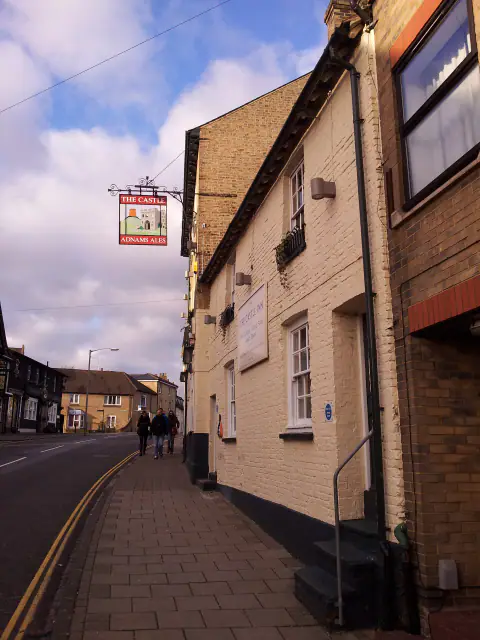 07Food & drinkThe Castle InnExplore experience →
 08Food & drinkThe Devonshire ArmsExplore experience →
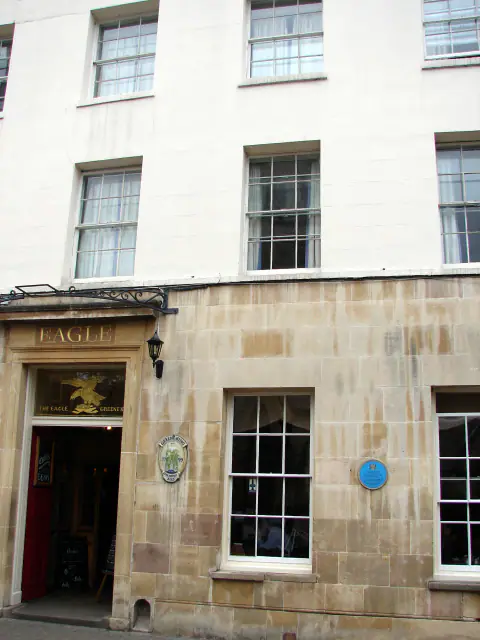 09Food & drinkThe EagleExplore experience →
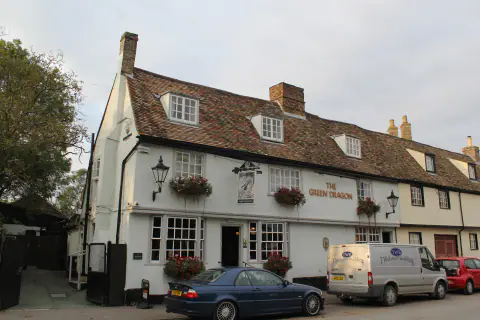 10Food & drinkThe Green DragonExplore experience →
 11Food & drinkThe HaymakersExplore experience →
 12Food & drinkThe Kingston ArmsExplore experience →
 13Food & drinkThe Live & Let LiveExplore experience →
 14Food & drinkThe MaypoleExplore experience →
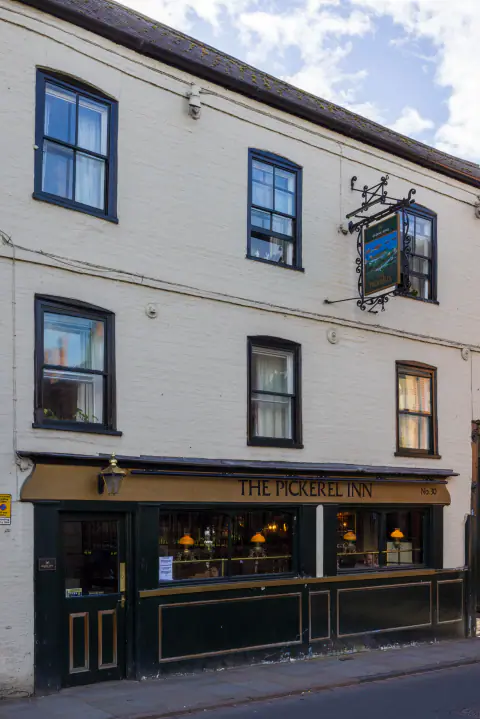 15Food & drinkThe Pickerel InnExplore experience →
 16Food & drinkThe Queen’s Head, NewtonExplore experience →
 17Food & drinkThe Royal StandardExplore experience →
 18Food & drinkThe St RadegundExplore experience →
 19OutdoorsCambridge University Botanic GardenExplore experience →
 20Water activitiesPunting the BacksExplore experience →
 35CollegesAll the collegesEvery Cambridge collegeOpen the college guide →
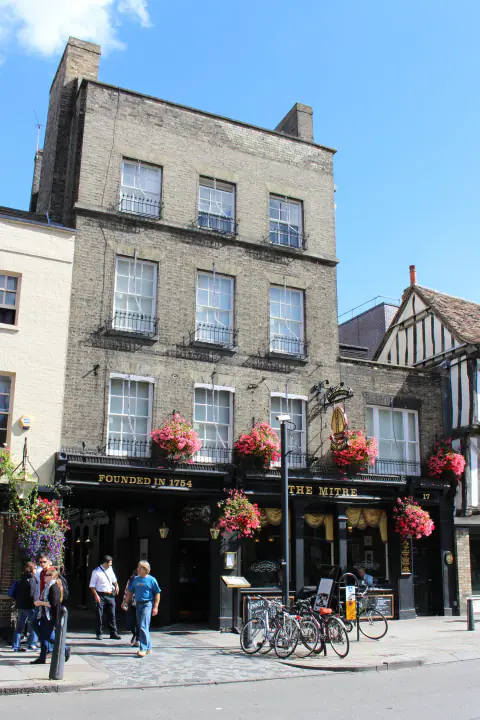 Food & drink / a storyThe six oldest pubsWalk the timeline →Plan / Itinerary builderBuild your Cambridge dayStart planning →