In depth
The Pickerel Inn
Usually called Cambridge’s oldest pub, on the strength of a continuous licence traditionally dated to 1608 — though its Magdalene Street frontage is early 19th century.
Story · Visit · Route · Links
Choose your depth
Essentials or more detail?
See visiting essentials, or read more about the history and places nearby.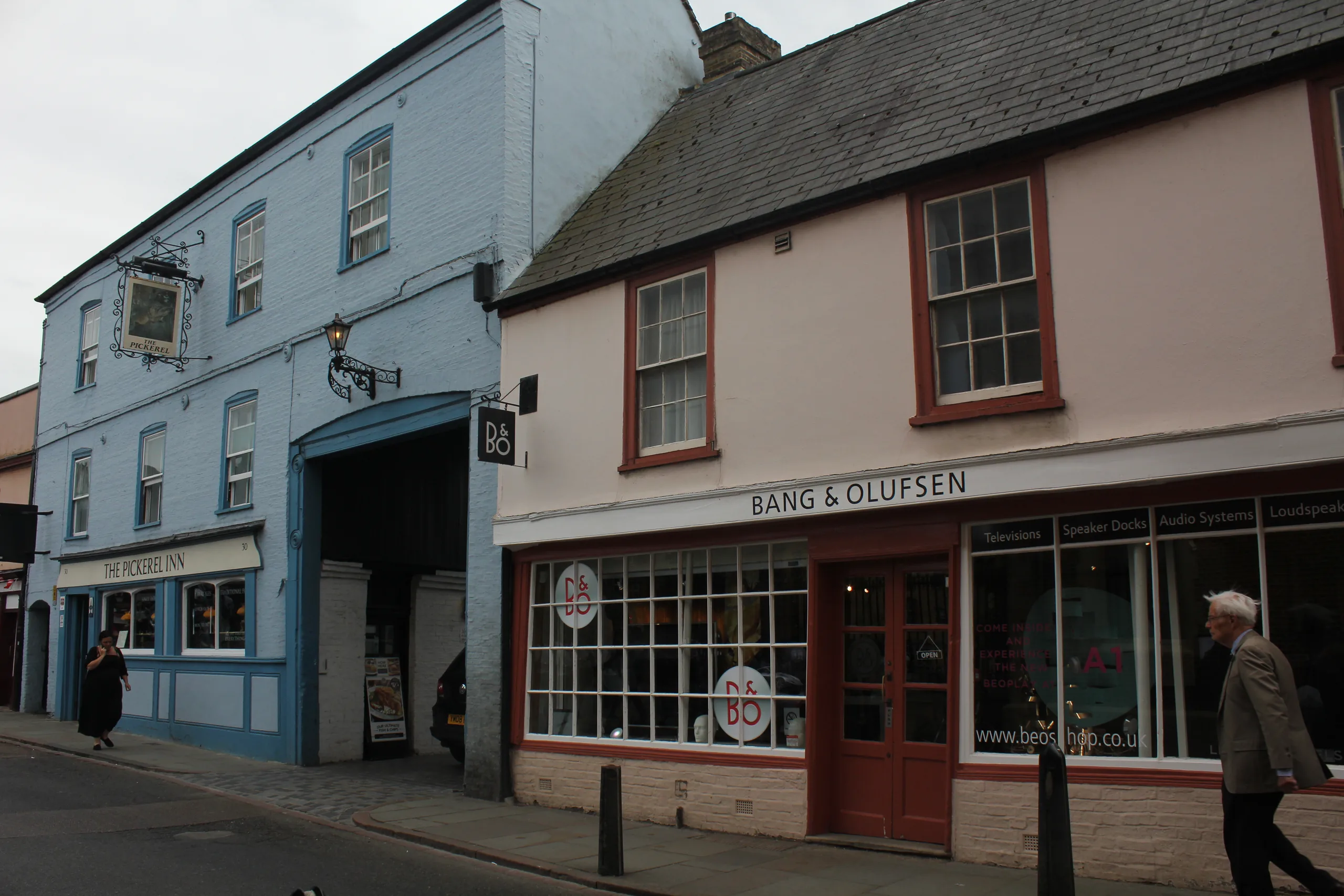
01 The experience
What to expect.
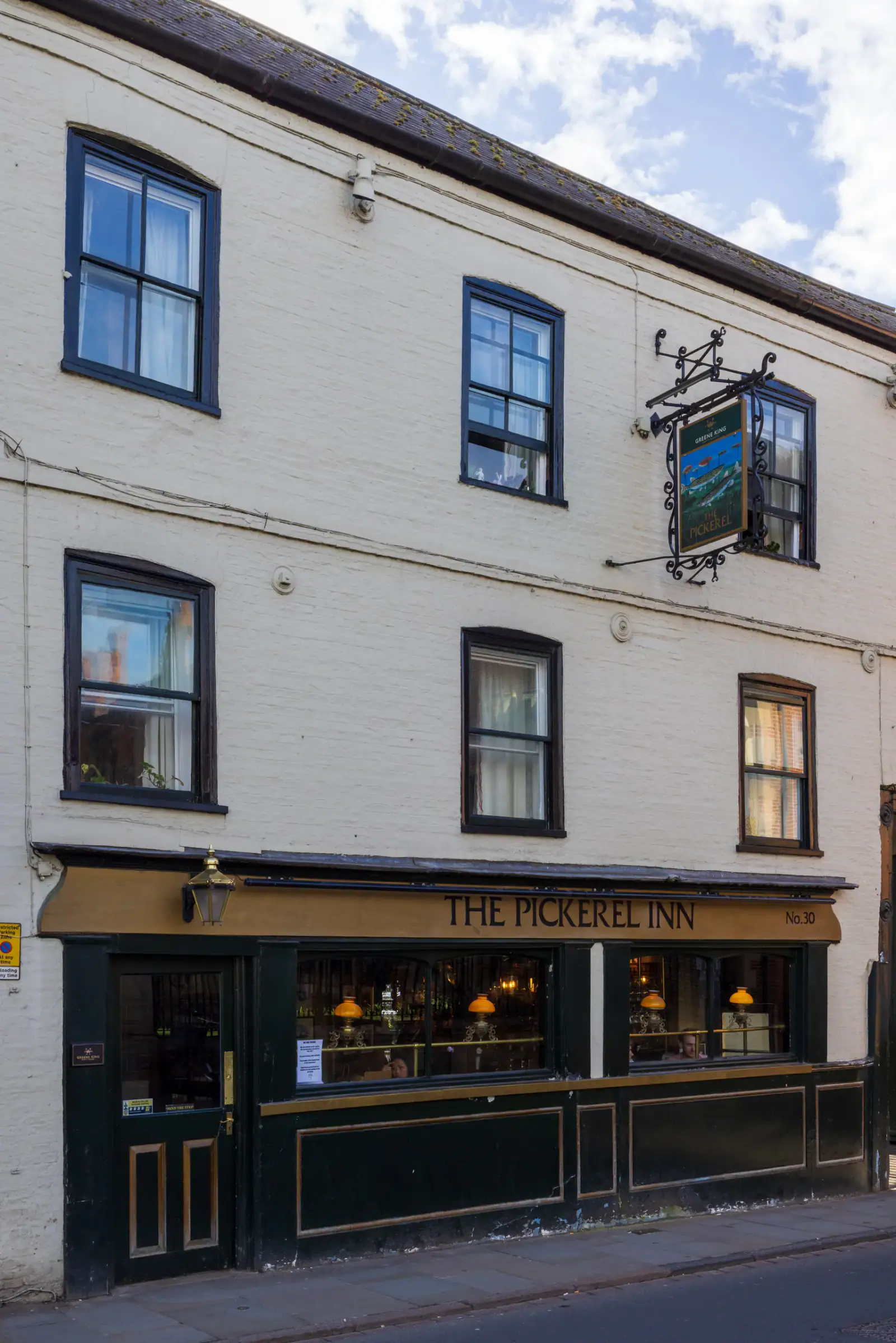
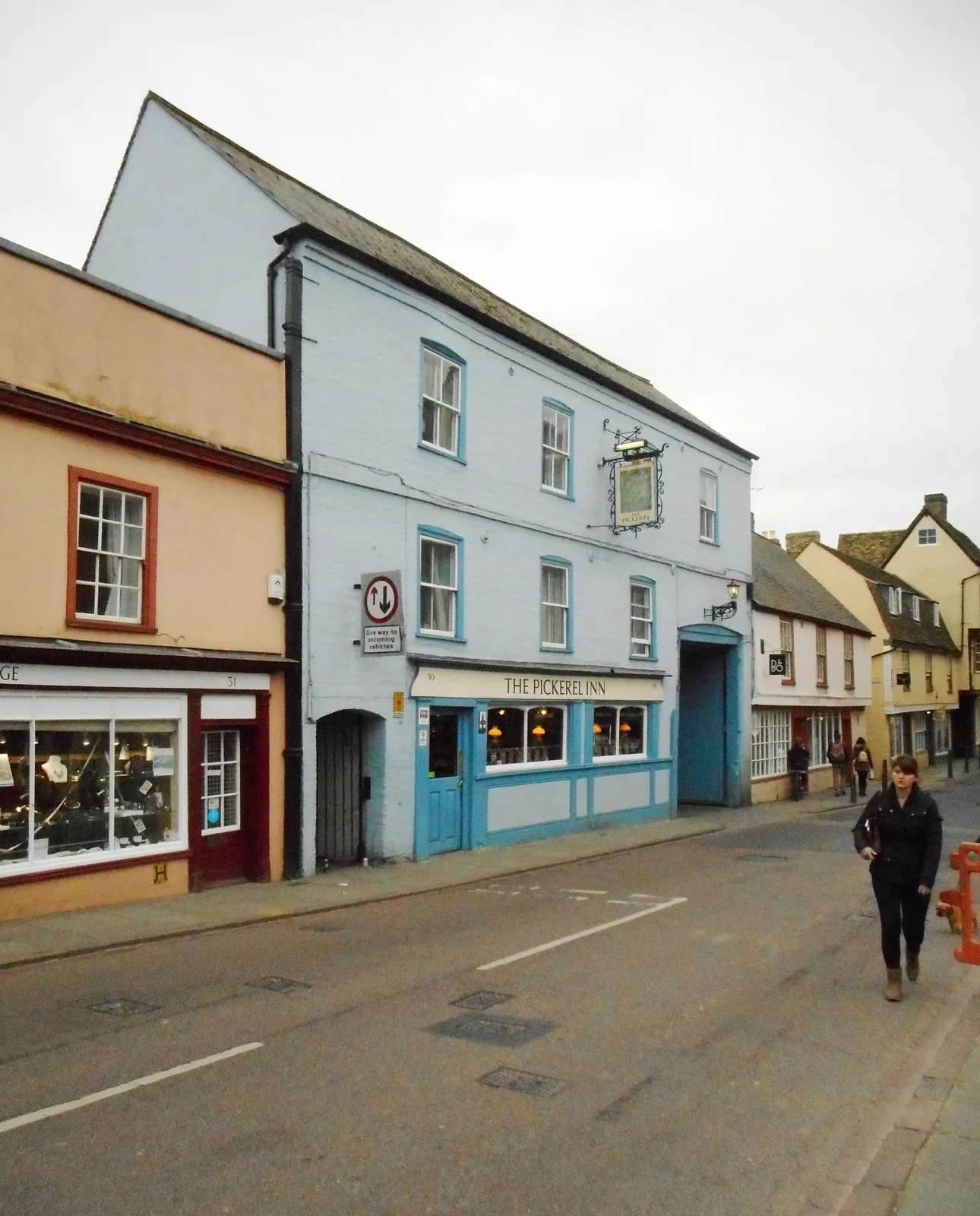
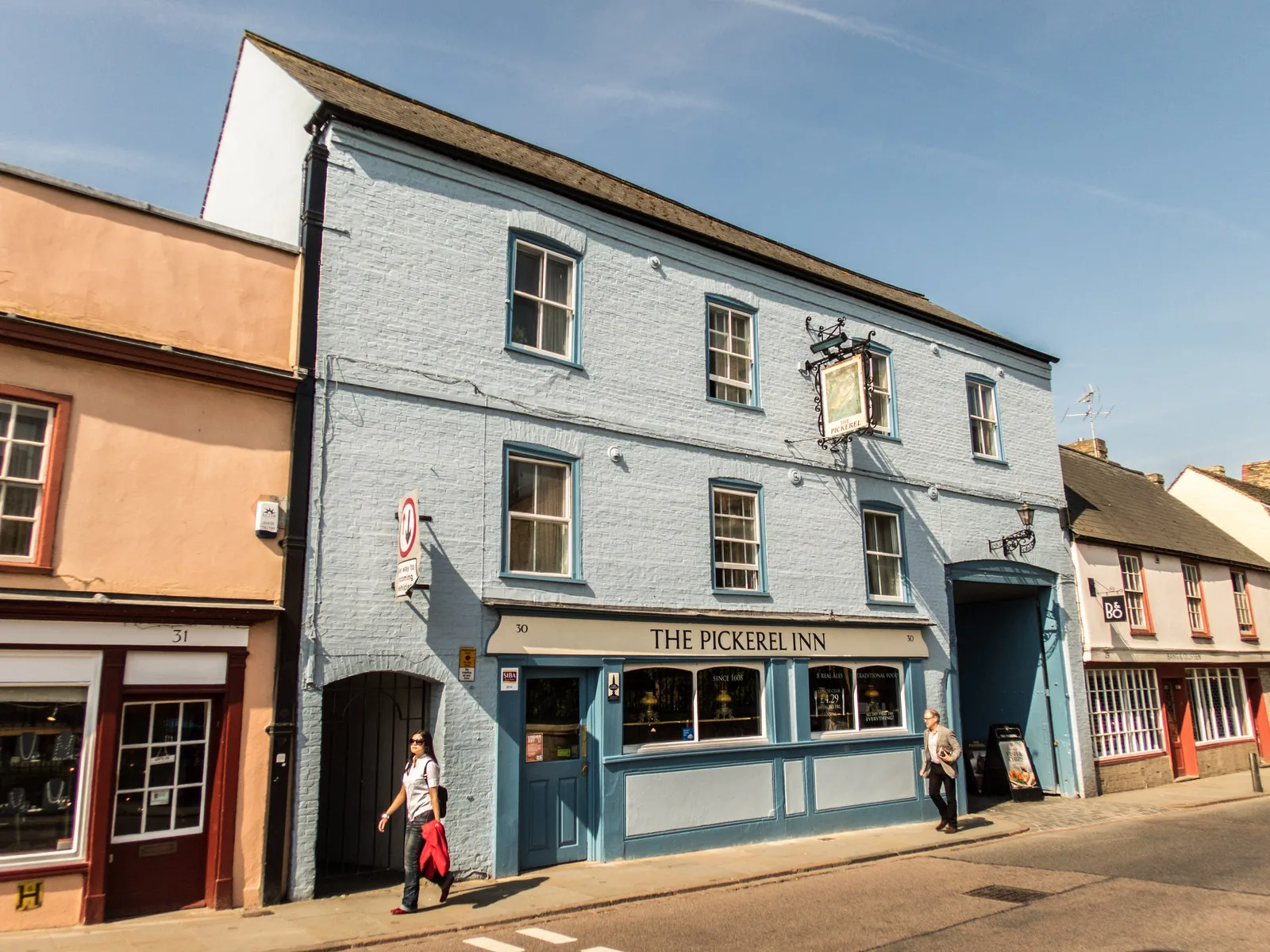
The Pickerel Inn stands at 30 Magdalene Street, on the far side of the Great Bridge from central Cambridge and almost directly opposite the gates of Magdalene College. It is Grade II listed (Historic England list entry 1101465) and operated by Greene King, and it is the pub most often given the title of Cambridge's oldest. That title is worth stating carefully, because it is the single most misreported fact about the place: the Pickerel is generally regarded as the city's oldest continuously licensed house, traditionally dated to 1608, while the oldest surviving pub building is usually reckoned to be the Green Dragon in Chesterton. The Pickerel's own street frontage, confusingly, is the youngest thing about it — an early 19th-century gault-brick front with a carriageway arch, put up two centuries after the licence it is famous for.
Why it matters
Cambridge has a dense stock of old pubs, and it argues about their ranking with some enthusiasm. The Pickerel matters because it is the house around which that argument organises itself: the Eagle on Bene't Street is described as "second-oldest, after the Pickerel", and every list of the city's historic pubs begins here. Behind the claim there is real fabric. Historic England's listing records that the rear wing is "much older" than the front — of the 16th and 17th centuries, timber-framed and plastered, with some 17th-century panelling and many 18th-century interior features. So the pub genuinely does contain Tudor and Stuart building, and it has genuinely been in the drinks trade on this spot for something close to four hundred years. What it does not have is a Tudor shopfront, and it does not claim to.
It matters, too, because of where it sits. Magdalene Street is the approach to the crossing that gave Cambridge its name. The bridge outside the door is the reason there is a town here at all, and the Pickerel is the surviving inn on the road up from it — a reminder that this street was a working thoroughfare of carriers, carts and travellers long before it was a college frontage.
What visitors should notice
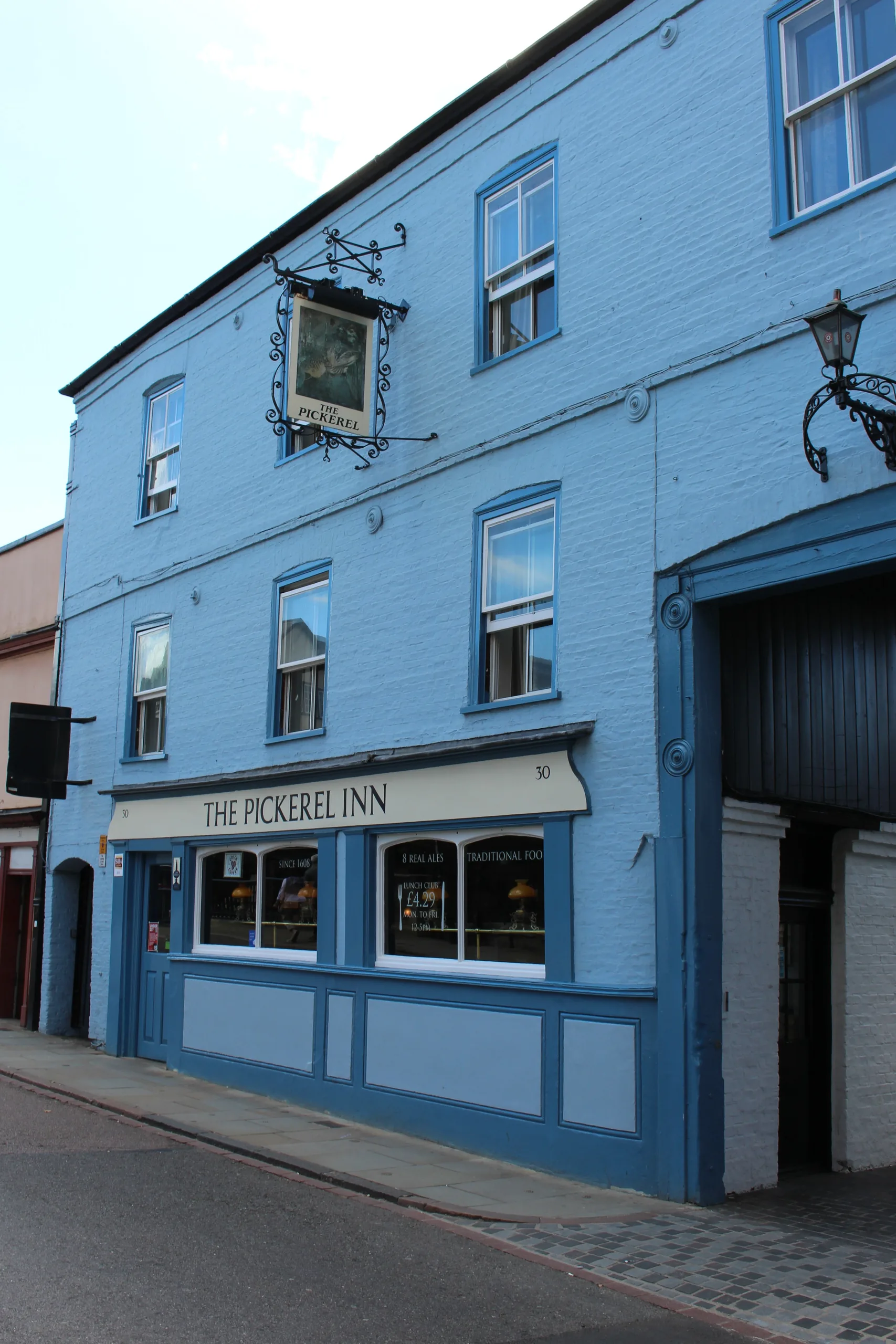
Stand on the pavement first. The three-storey gault-brick front, its segmental window heads and the tall carriageway arch on the right are pure early 19th-century Cambridge; the wrought-iron bracket that projects over the arch was made to carry a central lamp. Then go through — the carriageway is the way into the courtyard, and the courtyard is where the older building shows itself. Inside, the pub is a warren of small linked drinking spaces rather than one room, with heavy roof beams, exposed brickwork and a fireplace. Interiors here have been substantially reworked over the centuries, so treat individual "original" features with mild scepticism and enjoy the shape of the building instead: the way rooms step and turn is the honest evidence of a structure that grew piecemeal over four hundred years. Window seats on the river side look out towards the Great Bridge and the college.
Who will enjoy it
Anyone working through Cambridge's historic pubs in order, anyone interested in how an English inn actually accretes over centuries, and real-ale drinkers — the Pickerel has a strong cask reputation, holds beer festivals, and was named Cambridge & District CAMRA's Most Improved City Pub in 2023. It suits visitors to Magdalene College and the Pepys Library, walkers coming down off Castle Hill, and anyone who wants a pub within a minute of the river without the crush of the Bene't Street and King's Parade circuit.
Who may find it difficult
The reputation runs ahead of the experience. Visitors arriving expecting a preserved Jacobean interior find a working Greene King pub with a modernised bar, televised sport and a menu of pub standards, and are sometimes disappointed. There is no interpretation, no plaque and no guide — the history is entirely in your own head unless you read it first. Access is a genuine constraint: CAMRA's survey records a step down at the front door and a small step from the courtyard entrance, and no accessible WC, which is at odds with the "disabled facilities" tag on the operator's own website; anyone with mobility needs should read the accessibility file and telephone before travelling. The rooms are small and get loud, the position beside a busy road and bridge means street noise, and the colourful stories the pub is best known for — gin palace, opium den, brothel — are local tradition rather than documented history. If you want them to be true, do not look too hard.
Visitor verdict
Worth the five-minute walk over the bridge, and best understood as a licence rather than a monument: the interest is that people have been served drink on this plot since the reign of James I, not that you can see much of 1608 when you get there. Come for a pint, look at the carriageway and the rear range, and read the listing description before you arrive so you know which parts of the building are old and which are not. Twenty minutes for the fabric, an hour if you sit down. As the opening stop on a walk through Cambridge's oldest pubs it is the right place to begin, and it pairs naturally with Magdalene College, the Round Church and the climb to Castle Mound.
The story
History & character.
The site: the road to the bridge
Magdalene Street is the old approach to Cambridge's river crossing, and the reason the town exists. A series of wooden bridges stood on the site from Anglo-Saxon times until James Essex built the first stone bridge in 1754; the present Great Bridge — a single cast-iron span with iron railings terminating in ashlar piers — was built in 1823 to a design by the Norwich architect Arthur Browne, and is itself Grade II listed. The street was spared Victorian redevelopment largely by poverty and isolation, which is why a run of 16th- and 17th-century buildings survives along it, most of them now listed. The Pickerel is part of that run: Historic England's entry notes that Nos 13 to 18 and Nos 20 to 31 Magdalene Street "form a group".
An inn at this point on the street is exactly what one would expect. Traffic for the crossing had to pass the door, and the carriageway arch that still cuts through the frontage led to a yard with stables — the ordinary equipment of a roadside house rather than a college tavern.
The 1608 licence and the "oldest pub" question
The date attached to the Pickerel is 1608. CAMRA's national pub record puts it plainly and cautiously: the Pickerel is "one of several claimants to be the oldest pub in Cambridge, first licensed in 1608." Greene King, the operator, states the same origin year on its own listing for the pub, describing "a decadent past that started in 1608".
What that date does and does not mean is the most important thing on this page. 1608 is a licensing date, not a building date. It supports the claim that drink has been sold on this plot, more or less continuously, for over four hundred years — which is the specific title the Pickerel holds: the oldest continuously licensed site in Cambridge. It does not mean the building dates from 1608, and it does not mean the Pickerel has the oldest surviving pub building in the city.
That second title is generally given to the Green Dragon at Chesterton, a timber-framed 16th-century building already described as an ancient victualling house when it was licensed in 1630. The Fort St George, on Midsummer Common, is another Grade II listed 16th-century timber-framed house. So the honest formulation is:
- Oldest licence, continuously held: the Pickerel (traditionally 1608).
- Oldest surviving pub building: the Green Dragon, Chesterton (16th century).
- Second-oldest licensed house: the Eagle, Bene't Street — an inn by 1566 in the Corpus Christi College lease books, a coaching house from 1667 — which is where the ranking gets genuinely awkward, because 1566 is earlier than 1608.
The reconciliation usually offered is continuity: the Eagle's documented life as an inn is older, but it was divided in about 1850, when the frontage became a hotel and then offices and the pub retreated to the rear range, breaking the claim to an unbroken licensed house on the whole site. The Pickerel's claim is to uninterrupted trade. Whether one finds that convincing is a matter of definition, and no source resolves it decisively. Above Guide's position is to state the distinction rather than to award the trophy: the Pickerel is Cambridge's oldest pub in the sense that is normally meant, and readers deserve to know what that sense is.
The building: two dates in one structure
Historic England's list entry (1101465, Grade II, first listed 23 March 1962) is unusually clear about the split, and is worth quoting in full because almost every popular account of the pub blurs it:
MAGDALENE STREET … No 30 (The Pickerel Inn) … Early C19, 3 storeys; gault brick, slate roof; 4 windows top floor, 3 windows 1st floor, segmental heads without glazing bars; tall carriageway on right with projecting wrought-iron bracket parallel with head for central lamp. The rear wing is much older, being of the C16 and C17, timber-framed and plastered. There is some C17 panelling and many C18 interior features. (RCHM 202).
Three things follow. First, the street front is early 19th century — gault brick, the pale yellow Cambridgeshire brick that dominates the city's Georgian and Regency building, under a slate roof. Second, the rear wing is the old part: 16th- and 17th-century, timber-framed and plastered, with 17th-century panelling surviving inside and a good deal of 18th-century joinery and fitting-out. Third, the carriageway on the right of the front is a designed feature of the 19th-century rebuild, complete with its lamp bracket — the formal entrance to the yard behind.
The Royal Commission on Historical Monuments' survey of the City of Cambridge (the "RCHM 202" reference in the listing, published 1959) recorded the building as 16th-century in origin and L-shaped in plan, with walls of plastered timber framing and of brick, the oldest portion being roughly half of the western range where it adjoins the eastern range. In other words: an old timber house on the plot, extended and then re-fronted in brick to face a street that by the 1800s expected something more respectable.
The 19th century: brewers, innkeepers and undertakers
The Pickerel is well documented from the early 1800s onward through licensing records, directories and the census, collected by the Museum of Cambridge's Capturing Cambridge project.
- October 1812 — Barnett Leach takes the house with his wife Margaret. Barnett dies in 1814; Margaret carries on alone until 1816. Their son, born in 1794, was Richard Hopkins Leach, who became one of the most prolific pub-sign painters in Cambridge and the father of Frederick Richard Leach, the leading Victorian decorative painter in the city. An original Leach sign — for the Man Loaded with Mischief — survives in the Museum of Cambridge's collection. The Pickerel's link to Cambridge's celebrated sign-painting family is therefore a real, documented one, through the licensee's household rather than through a surviving sign at the pub.
- 1830 — John Nutter. 1839 — John Glasscock. 1851 — William Bullen. 1852 — Thomas Favell. 1861 — William Lusher, alongside William Bullen, recorded in the census as a 39-year-old "innkeeper and brewer" born in Norfolk.
- 1869–1878 — W. Bullen listed as a brewer here. This is the documentary footing for the tradition that the Pickerel had its own brewery and malting at the back: brewing on the premises was a normal part of the trade, and the Bullens were doing it.
- 1881 — James Harris, described as a hotel proprietor, aged 43, from Middlesex. The "hotel" phase of the building's reputation is not invention; the census calls it that.
- 1888–1933 — the Silk family: Frederick Silk, then William Silk, then William W. Silk (listed in 1913 as a fly and funeral carriage proprietor), then Benjamin Frederick Silk in 1933. The undertaking connection in the pub's folklore comes from exactly this: the licensee ran funeral carriages out of the yard. Horses, flys and hearses in the courtyard is what the stables were actually for.
- 1922 — Fred Silk is badly burned on both arms when the ignition of an acetylene lamp causes a petrol tank to explode in the harness room; the fire is put out by Thomas Frohock of Magdalene College. A small incident, but it fixes the character of the yard in the motor age: harness room, lamps, petrol.
- 1953 — the building is decorated for the coronation of Elizabeth II.
- 1962 — Karl E. Friman is licensee; in March of that year the building is listed Grade II.
The 20th century: out of bounds
For part of the 1960s the Pickerel appeared on the University's list of establishments out of bounds to undergraduates — the Proctors' ban list. One student was gated for playing trumpet in a jazz group on the premises. It is a useful corrective to the idea of a Cambridge pub as a genteel senior-common-room annexe: the Pickerel was, at that point, a pub the University did not want its students in.
The pub's association with Magdalene College across the road is long-standing and neighbourly, and one modern local account states that the College owns the freehold. This is not confirmed by CAMRA's record, which lists the freeholder as Greene King. The conflict is recorded in the source register and left open.
Ownership today
The Pickerel traded under Taylor Walker, the pub brand within the Spirit Pub Group. Greene King acquired the Spirit Pub Group, and the Pickerel passed with it; it is now a Greene King house, listed on the company's own website and staffed under its brand. Regular drinkers noted the change: the guest-beer range narrowed and Greene King's own brands and menus appeared. The pub retains a strong cask offer — six changing beers, eight in summer, usually including a dark beer, with Cask Marque accreditation, CAMRA LocAle status and quarterly beer festivals — and was named Cambridge & District CAMRA's Most Improved City Pub in 2023. Oakham Ales has brewed house beers for the pub, including one named Esox Lucius after the scientific name of the pike; a pickerel is a young or small pike, which is where the pub's name and sign come from.
The colourful reputation — and what to do with it
The Pickerel is best known, in guidebooks and on the pub's own marketing, for a run of lurid former lives: gin palace, opium den, brothel, hotel, undertaker's, with a brewery and malting house at the back and stables in the courtyard. Greene King's own page refers to "our ghosts, flamboyant past and malting house legacies".
Some of this is documented and some is not, and the distinction is worth making:
- Hotel — supported. The 1881 census calls the licensee a hotel proprietor.
- Undertaker's / funeral carriages — supported. The Silks were fly and funeral carriage proprietors, from 1913 at the latest.
- Brewery and malting — supported in substance. William Bullen is recorded as an innkeeper and brewer here through the 1860s and 1870s.
- Stables — supported. A carriageway to a yard is what the frontage was built around, and the 1922 fire happened in the harness room.
- Gin palace — plausible as a phase, not as an origin. Gin palaces were a documented phenomenon of roughly the 1820s to the 1840s: plate glass, gas light, gilding and a long counter. A house licensed in 1608 cannot have "started life" as one, whatever the operator's copy says — but the Pickerel's early 19th-century re-fronting falls squarely in the gin-palace decades, which is at least a coherent reading of why a Jacobean inn suddenly acquired a smart brick front. Treat as reputation with a supporting circumstance, not as fact.
- Opium den and brothel — unsupported by any source located for this bundle. These are pub tradition, repeated widely and confidently and traceable to no record. Above Guide reports them as claims and does not assert them.
The same applies to the ghosts. The Cambridge Ghost Book (2000) collects the local stories: a former landlady said to have drowned herself in the Cam, whose presence staff report feeling, and two landlords said to have hanged themselves on the premises. A more recent retelling dates the landlady's death to the 1950s. These are folklore, honestly recorded as folklore by the book that collects them, and the "residual opium smoke" occasionally mentioned in write-ups is a piece of atmosphere, not an observation.
Modern significance
The Pickerel earns its place in Cambridge for two reasons that have nothing to do with gin or opium. It is the anchor of the city's oldest-pub sequence, the house every other claim is measured against. And it is a rare survival of the ordinary roadside inn on the ancient bridge approach — a building that has been serving travellers at the river crossing for four centuries and still is, a hundred metres from the spot the town is named after.
Look closer
Highlights and hidden details.
The objects, spaces and small observations that turn a visit into a memorable one.1. The carriageway arch and its lamp bracket
The tall arched carriageway on the right of the frontage is the single most informative feature of the building, and almost everyone walks past it into the bar instead of through it. Historic England's listing singles it out: "tall carriageway on right with projecting wrought-iron bracket parallel with head for central lamp." It was built as the vehicle entrance to the yard — for the carts, flys and funeral carriages the licensees ran from here — and the iron bracket above it once held the lamp that lit the way in. Walk through it rather than round it. It is the difference between seeing a pub and seeing a coaching plot. Historical importance: high. Visitor experience: a thirty-second detail that reframes the whole building. Photography: excellent — shoot the arch from the opposite pavement with the bracket in silhouette. Time required: 5 minutes.
2. The early 19th-century gault-brick frontage
Three storeys, pale yellow gault brick, slate roof, four windows on the top floor and three on the first, with segmental heads and no glazing bars. This is textbook Cambridge Regency building, and the interesting thing about it is that it is the youngest part of the pub — put up two hundred years after the licence the Pickerel is famous for. Stand across the road and read it as a deliberate act: an old timber inn being given a respectable modern face for a street that had come up in the world. The re-fronting falls in the decades when gin palaces were being built across England, which is at least a plausible context for the pub's "gin palace" reputation. Historical importance: high (and routinely misdated). Visitor experience: a pavement pause; needs the context to mean anything. Photography: straight-on from the far pavement, morning light. Time required: 5 minutes.
3. The rear wing — the genuinely old building
The part that justifies the pub's reputation is behind you when you are standing at the bar. Historic England: "The rear wing is much older, being of the C16 and C17, timber-framed and plastered." The Royal Commission's 1959 survey recorded an L-shaped plan of plastered timber framing and brick, the oldest portion being about half of the western range where it meets the eastern. From the courtyard you can read the older massing and roofline against the brick front. Inside, the listing records surviving 17th-century panelling and many 18th-century interior features — worth looking for, though the interior has been substantially reworked and not everything that looks old is. Historical importance: very high — this is the Tudor and Stuart fabric. Visitor experience: rewarding if you know what you are looking at; invisible if you don't. Photography: from the courtyard, looking back at the range. Time required: 10 minutes.
4. The courtyard
Through the arch is the yard that was the working part of the inn: stables, a harness room, a brewery and malting at one time, and the flys and funeral carriages of the Silk family, who held the licence from the 1880s to the 1930s. It was here in 1922 that Fred Silk was burned when an acetylene lamp ignited a petrol tank in the harness room. It is now the beer garden, and in summer it is the best place to sit — but it is also the only spot from which the pub's real chronology is legible. Historical importance: high. Visitor experience: the pleasant part of the visit; sheltered, sunny in the afternoon. Photography: strong, especially the arch framed from inside looking out to Magdalene Street. Time required: 10 minutes, longer with a drink.
5. The beams, brickwork and fireplace
The interior is a run of small linked drinking spaces rather than one room, and the genuinely old features are worth picking out: heavy roof beams, patches of old brickwork, and a fireplace with a real fire in winter. CAMRA's survey is honest that the interior "has been substantially modified over time", so this is not a preserved historic interior — it is an old building that has been repeatedly refitted, which is what almost every four-hundred-year-old pub actually is. Take it on those terms and it is a good one. Historical importance: medium. Visitor experience: best on a winter weekday with the fire lit. Photography: dim; see the photography file. Time required: 10 minutes.
6. The window seats and the view to the Great Bridge
The tables by the windows on the river side look out towards the Great Bridge and across to Magdalene College. This is the view that explains the pub: the bridge outside is the successor to the crossing that gave Cambridge its name, rebuilt in cast iron in 1823 to Arthur Browne's design, and the inn sits on the road up from it. Sit there for ten minutes and the Pickerel stops being a curiosity and becomes an obvious piece of infrastructure. Historical importance: medium — the value is contextual. Visitor experience: the best seats in the pub; get there early. Photography: shoot out through the window rather than of it. Time required: as long as a drink.
7. The cask ale board
Not a historic feature, but the pub's strongest present-day claim and the reason most Cambridge drinkers come. Six changing beers, eight in summer, usually including a dark beer — mild or stout — with Cask Marque accreditation, CAMRA LocAle status for locally brewed beer, and quarterly beer festivals. Oakham Ales has brewed house beers for the pub, one of them named Esox Lucius after the scientific name for the pike. A pickerel is a young pike, so the beer, the sign and the pub name are all the same joke. Historical importance: low; contemporary interest high. Visitor experience: ask staff what is local. Time required: as long as you like.
8. The pub sign
Follow the sign back to the name. A pickerel is a small or young pike, a fish of the Cam and the fen waterways a few metres away. There is also a documented Cambridge sign-painting connection: Barnett and Margaret Leach, who ran the pub from October 1812, were the parents of Richard Hopkins Leach (born 1794), a prolific painter of Cambridge pub signs, and grandparents of Frederick Richard Leach, the city's leading Victorian decorative painter. The surviving Leach sign in public hands — for the Man Loaded with Mischief — is in the Museum of Cambridge, not here, so the connection is through the family rather than through the board hanging outside. Historical importance: medium, and frequently garbled. Visitor experience: a detail for people who like detail. Photography: easy close-up. Time required: 2 minutes.
Details worth slowing down for.
The oldest thing here is behind you
Almost everyone photographs the frontage as "Cambridge's oldest pub". The frontage is the newest part of the building. Historic England is explicit: early 19th century at the front, and "the rear wing is much older, being of the C16 and C17, timber-framed and plastered." So the correct move on arrival is to walk through the carriageway and look back — the Tudor and Stuart building is the low range around the yard, not the brick face on the street. It is a rare case of a listed building whose own listing quietly contradicts the way it is marketed.
The lamp bracket over the arch
Above the carriageway, projecting from the wall parallel with the arch head, is a wrought-iron bracket. It is specified in the statutory listing, which means it was considered part of what makes the building special in 1962. It was there to carry a central lamp over the entrance to the yard — the practical equipment of a roadside inn whose customers arrived after dark, on foot and by cart. The lamp is gone; the ironwork stayed.
The Pickerel had a funeral business
The Silk family held the licence from 1888 into the 1930s, and the directories describe William W. Silk in 1913 as a fly and funeral carriage proprietor. The courtyard that is now the beer garden was a carriage yard with a harness room; in 1922 an acetylene lamp ignited a petrol tank in it and burned Fred Silk's arms, the fire put out by Thomas Frohock of Magdalene College over the road. When guidebooks list "undertaker's" among the pub's past lives, this is what they are referring to — and it is one of the few items on that colourful list with a paper trail.
A brewer lived here
William Bullen appears in the 1861 census as a 39-year-old "innkeeper and brewer", born in Norfolk, and is listed as a brewer at this address from 1869 to 1878. The tradition of a brewery and malting house at the back of the Pickerel is not marketing invention: brewing on the premises was ordinary practice, and the records name the man doing it.
The sign-painter's family kept the pub
Barnett Leach took the house in October 1812 with his wife Margaret; he died in 1814 and she carried on until 1816. Their son, born 1794, was Richard Hopkins Leach, one of the most prolific pub-sign painters Cambridge produced, and his son Frederick Richard Leach became the city's leading Victorian decorative painter, whose work survives in churches and college chapels across Cambridge. A dynasty of Cambridge painters therefore began, in part, behind this bar. Note carefully what this does not mean: there is no evidence that the sign now hanging outside is a Leach, and the surviving Leach sign in public hands is in the Museum of Cambridge.
It was out of bounds to students
For a stretch of the 1960s the Pickerel was on the University's list of establishments undergraduates were forbidden to enter — the Proctors' ban list. One student was gated for playing trumpet in a jazz group here. The pub sits opposite a college gate and was, at the time, precisely the sort of place the University wanted its members out of. It is a better piece of social history than most of the pub's more advertised legends.
"Gin palace" is the wrong end of the story
The pub's own copy says it "started life as a lavish gin palace". It cannot have. Gin palaces are a documented phenomenon of about the 1820s to the 1840s — plate glass, gaslight, gilding, a long counter — and the Pickerel's licence is traditionally dated 1608. What is interesting is that the building's early 19th-century re-fronting sits exactly in the gin-palace decades. If the Pickerel was ever a gin palace, it was during the life of the brick front you are looking at, not at its origin. That is a better story than the one on the website, and it is the only version the evidence supports.
The opium den has no source
Stories of an opium den, a brothel and lingering ghosts are part of the pub’s local folklore rather than its established history.
The ghosts are catalogued
The Cambridge Ghost Book (2000) records the pub's hauntings as local belief: a former landlady said to have drowned herself in the Cam, whose presence staff report feeling, and two landlords said to have hanged themselves on the premises. A later account puts the landlady's death in the 1950s. This is folklore recorded as folklore, which is the honest way to carry it.
The Lewis-and-Tolkien claim belongs in Oxford
You will find posts online asserting that C. S. Lewis and J. R. R. Tolkien drank here. Lewis genuinely was a Fellow of Magdalene College, Cambridge, from 1954, and the college is across the road — so a Lewis connection is at least geographically possible, and one local write-up says the Pickerel quickly became his favourite pub. But "Lewis and Tolkien's pub" is the Eagle and Child in Oxford, where the Inklings met, and the two are being conflated. No reliable source ties Tolkien to Magdalene Street at all.
The pub is named after a fish, and so is the beer
A pickerel is a young or small pike — a fish of the Cam and the fen drains a few metres from the door. Oakham Ales has brewed a house beer for the pub called Esox Lucius, which is the scientific name of the northern pike. Sign, name and beer are all the same fish, and the joke only lands if you know the Latin.
The group listing
The Historic England entry ends with a line most readers skip: "Nos 13 to 18 (consec) and Nos 20 to 31 (consec) form a group." The Pickerel is not listed as a freestanding curiosity but as part of a continuous protected streetscape — the run of 16th- to 19th-century buildings along Magdalene Street that survived Victorian redevelopment largely because this side of the river was poor and out of the way. Look up and down the street, not just at the pub.
Make it work
Plan the visit properly.
Current practical detail, kept separate from the story so it is easy to scan when you need it.This is the most time-sensitive file in the bundle. Hours, food service and the beer range change; the details below were read from the pub's own Greene King listing on 29 July 2026 and should be rechecked monthly.
How to use it
The Pickerel is a working pub, not a paid attraction. There is no admission charge, no ticket, no tour and no interpretation panel. You walk in, and you are free to look at the building — but it is somebody's bar, so buy a drink. All the interest is in the fabric and the position, so the visit is short unless you sit down. Read the history file before you arrive; nothing on site will tell you which parts of the building are old.
Opening hours
Verified 29 July 2026 from the operator's listing. Recheck monthly — pub hours change with season and management.
Bar:
- Monday to Thursday: 11:00 – 00:00 (midnight)
- Friday: 11:00 – 00:30
- Saturday: 11:00 – 01:00
- Sunday: 11:00 – 00:00 (midnight)
Food / serving hours:
- Monday to Saturday: 11:30 – 21:00
- Sunday: 11:30 – 20:30
Conflict note: CAMRA's WhatPub record, surveyed 16 February 2026, gives noticeably shorter hours (noon to 23:00 Monday–Wednesday, noon to midnight Thursday–Friday, noon to 01:00 Saturday, noon to 23:00 Sunday, food to 20:00). We have used the operator's own current listing. If you are travelling specifically for an early opening, telephone first.
Address and contact
- Address: 30 Magdalene Street, Cambridge, CB3 0AF
- Telephone: 01223 355068
- Website: greeneking.co.uk/pubs/cambridgeshire/pickerel-inn
- Operator: Greene King (formerly Taylor Walker, under the Spirit Pub Group)
- Listed: Grade II, Historic England list entry 1101465
Admission and booking
Free to enter. No booking to drink or to look around. Tables for food can be booked through the Greene King website or by telephone, which is worth doing at weekends and in graduation weeks — the pub is small and fills. There are no guided tours of the building.
Best time to visit
For the building, come on a weekday late morning, from opening at 11:00 to about 12:30. The rooms are quiet, the light through the river-side windows is at its best, and you can walk through to the courtyard without threading past drinkers. Mid-afternoon (14:30–16:30) is the second-best window. Avoid Friday and Saturday evenings, warm summer afternoons and the days around graduation (late March, late June, July), when the interior is standing-room and the courtyard is full. Match-day evenings can also be busy, as the pub shows terrestrial sport.
Seasonality
Open year-round. The courtyard garden is the draw from May to September; the interior — small rooms, a real fire — is the draw from October to March, and is arguably when the pub is at its best. Quarterly beer festivals are worth checking for if cask ale is the reason you are coming.
How long to allow
- Ten to twenty minutes to look at the frontage, walk through the carriageway into the courtyard, and take in the interior rooms.
- Forty-five to ninety minutes if you sit down with a drink or eat.
It is a stop on a walk, not a destination in itself. It combines naturally with Magdalene College opposite, the Round Church, Kettle's Yard and Castle Mound.
Facilities
- Food menu (traditional pub cooking: fish and chips, pies, sausage and mash, burgers, Sunday roast), with vegan, vegetarian and non-gluten-containing options
- Strong cask ale offer: six changing beers, eight in summer, usually including a dark beer; Cask Marque accredited, CAMRA LocAle, quarterly beer festivals
- Courtyard beer garden
- Free Wi-Fi
- Real fire
- Terrestrial sports TV
- Dog friendly
- Family friendly
- Delivery available
- Card payment
- Toilets on site — no accessible WC recorded (see below)
Accessibility (summary)
Expect a step down at the front door and a small step at the courtyard entrance. An accessible toilet is not confirmed. Telephone 01223 355068 before travelling if step-free access or an accessible toilet is essential.
Families, dogs, weather
Children are welcome — the pub is tagged family friendly — subject to the usual licensing rules on under-18s in bars, and it works best as a lunchtime rather than an evening stop. Dogs are welcome. The courtyard is open to the weather; the interior, with its small rooms and fire, makes this one of the better rainy-day pubs on this side of the river, and the Round Church and Kettle's Yard are close enough to build a wet-afternoon route around.
Getting there
- On foot: the natural approach is from the city centre over the Great Bridge — from Market Square about 8 minutes, from King's Parade about 12, from the Eagle on Bene't Street about 12–14. The pub is on the south-west side of Magdalene Street, opposite Magdalene College.
- From Cambridge railway station: about 30–35 minutes on foot, or the Citi bus / Universal service into the centre and a short walk. A taxi is 10–15 minutes depending on traffic.
- By bus: several routes run along Bridge Street and Magdalene Street; stops are within a minute or two of the door.
- By bicycle: easy, but Magdalene Street is narrow and busy; use the racks on Quayside or around Magdalene Bridge rather than obstructing the pavement.
- By car: do not. Central Cambridge is effectively closed to visitor parking. Park Street multi-storey is the nearest option, a short walk away, and the Park & Ride sites are the sensible choice from outside the city.
Weather considerations
Magdalene Street is narrow with a tight pavement and constant bus and delivery traffic; on a wet day the frontage is an unpleasant place to linger, and the photograph you want of the carriageway arch is best taken quickly. Inside, the pub is warm and dim and works well in bad weather. The courtyard is exposed.
Crowd levels
Busy but not besieged — it does not carry the tourist load the Eagle does, which is one of its advantages. Peaks are Friday and Saturday evenings, sunny weekend afternoons in the courtyard, and term-time evenings with a Magdalene student crowd. Weekday mornings and mid-afternoons are reliably quiet.
Practical advice
- Look at the frontage from across the street before you go in — the whole point of the building is the contrast between the brick front and the older range behind, and you cannot see it from the doorway.
- Go through the carriageway to the courtyard even if you are not drinking outside. It is the historic entrance and the best view of the rear range.
- Ask what is on cask. The changing beer list is the pub's strongest current claim, and staff will tell you what is local.
- Do not expect a museum. If you want documented, interpreted pub history in Cambridge, the Eagle has a plaque and a story; the Pickerel has a licence and a building, and you have to bring the context yourself.
Visit your way
Access and family planning.
Step-free entry and an accessible toilet are not confirmed. Expect a step down at the front door and a small step from the courtyard. Telephone 01223 355068 before travelling to discuss a suitable entrance, seating and toilet arrangements.
Step-free access
Not confirmed, and probably not available at the front. The recorded step down at the front door is the principal obstacle: a single step at a threshold is manageable for some visitors with assistance and impassable for others.
There is a second entrance from the courtyard, which the same survey records as having a small step. The courtyard is reached through the carriageway arch to the right of the frontage, which is wide and level underfoot — so the courtyard itself is the most likely accessible space in the building, and it is also the most comfortable one for anyone who needs room to turn.
The building is a listed structure with a 16th–17th-century rear range, so internal floor levels change, doorways are narrow, and thresholds are worn. Expect a historic building rather than an adapted one.
Wheelchairs and mobility
Circulation inside is the limiting factor even setting the entrance aside. The pub is a series of small linked rooms with close-set furniture; when it is busy, a wheelchair or a walking frame will struggle to get past standing drinkers, and there is no large open room to retreat to. A weekday late-morning or mid-afternoon visit is a materially different and easier experience from a Friday evening one.
The courtyard is the most practical space: outdoor, level, and with room to manoeuvre. In good weather, planning to sit there rather than inside is the sensible approach.
Toilets
Standard toilets are available, but an accessible toilet is not confirmed. Ask the pub about steps, doorway widths and the location of facilities before visiting.
Sensory considerations
- Noise. Small rooms with hard surfaces, plus terrestrial sports TV, make this a loud pub when it is full — difficult for anyone with hearing aids, anyone lip-reading, and anyone sensitive to noise. Quiet weekday hours are genuinely quiet. There is no separate quiet room.
- Lighting. The interior is dim by design: low ceilings, small windows, and a fire in winter. Good for atmosphere, poor for low vision. The window seats on the river side and the courtyard are the brightest places.
- Visual impairment. There is no interpretation of any kind — no plaque, no panel, no large print, nothing tactile. The building's interest is almost entirely visual (a brick frontage, an arch, a timber range), so a sighted companion's description is what makes the visit work. The carriageway arch is the one feature that can be appreciated by touch and by the change in acoustic as you pass through it.
- Hearing impairment. A hearing loop is not confirmed. Order at the bar at a quiet hour if communication in noise is difficult.
Rest areas and seating
Plenty of seating throughout, including window seats and the courtyard, but it fills fast at peak times and there is nowhere to sit and wait if it does. Booking a table for food is the only reliable way to guarantee a seat. There is no seating outside the door on Magdalene Street, and the pavement is narrow, so there is nowhere comfortable to pause on arrival.
Getting there
Magdalene Street has a narrow pavement, dropped kerbs at the bridge, and steady bus and delivery traffic. The approach over the Great Bridge from the city centre is level. Approaching from Castle Hill means a noticeable slope down. There is no adjacent parking; the nearest Blue Badge provision is in the city centre car parks, and the walk from Park Street is short but on busy narrow pavements.
The practical recommendation
If you have significant mobility needs, telephone the pub first and ask three specific questions: whether there is a step at the front door today, whether the courtyard entrance can be used, and whether there is an accessible toilet. Do not rely on the website tag. If the answers are unfavourable, the Pickerel's exterior — the frontage, the carriageway arch, the group of listed buildings along the street — is genuinely most of the interest and can be seen from the pavement opposite without entering at all.
The honest picture
The Pickerel is a pub, and it is tagged family friendly by its operator, but it is not a family attraction. There is no trail, no play area, no interpretation and nothing staged for children. Families do come — usually to eat, usually at lunchtime, usually as one stop on a walk that also takes in Magdalene Bridge, Kettle's Yard or Castle Mound. It works well on those terms and badly on any others. The rooms are small, the ceilings are low, and after about half past six on a Friday it is an adult room.
Ages and what they'll get from it
- Under 5s. Fine for a meal, and dog-friendly, which some small children enjoy more than the history. Nothing here will hold their attention; the courtyard is the best place to be with a toddler because there is space and daylight. A pushchair inside is awkward at any busy hour.
- 5–10s. One good hook, and it works: the pub is named after a fish, the fish is a young pike, and the river with the pike in it is fifty paces away over the bridge. Walk down to the water first, then come to the pub. The building's own story — a house where drinks have been sold since before anyone's great-great-great-grandparents — is abstract at this age unless you anchor it to something countable.
- 11–16s. The best age for it, if the visit is framed properly. The "which is really the oldest pub" argument is genuinely interesting to a teenager who likes an argument: the Pickerel has the oldest licence, the Green Dragon has the oldest building, and the Eagle has the earliest documented inn but a broken claim. Give them the listing text and ask them to work out which parts of the building are old. Ten minutes, one real puzzle, no lecture.
Educational value
Moderate to good, and better than it looks, because the Pickerel is a clean worked example of two things schools actually teach. First, how to read a building: a statutory listing that says one part is early 19th century and another is 16th–17th century, and a frontage that can be checked against it from the pavement. Second, how claims get made and repeated: "oldest pub in Cambridge" is a genuinely contested statement with a defensible answer, and the gap between the pub's marketing copy and the documentary record is a tidy lesson in evaluating sources. Pair it with Magdalene College opposite and the Round Church five minutes away for a medieval-to-Regency sequence in fifteen minutes' walking.
Facilities for families
- Family friendly per the operator; children welcome subject to the usual licensing rules on under-18s in bars.
- Food served daily from 11:30 (to 21:00, 20:30 on Sunday), with vegan, vegetarian and non-gluten-containing options.
- Courtyard beer garden — the best space with children.
- Toilets on site. No accessible WC recorded, and no baby-changing facilities confirmed; if changing facilities matter, telephone ahead rather than assume.
- Dogs are welcome throughout, which is worth knowing if a child is nervous of them.
Practical friction points
- Space. The interior is a warren of small rooms. With a pushchair, or with more than four people, you will be negotiating furniture. Book a table.
- Noise. Small rooms, hard surfaces and terrestrial sports TV. It gets loud quickly, and there is nowhere quiet to retreat to indoors.
- The road. Magdalene Street is narrow, busy with buses and delivery traffic, and the pavement outside is tight. Hold small hands on the frontage; do not arrange the family photograph from the kerb.
- Boredom risk. High, and fast. There is nothing to look at once the food is gone. Have the next stop ready — the bridge and the river work well and are one minute away.
- It is a bar. The trade is drink. Lunchtime with children, not evening.
The efficient family version
Walk down to Quayside and look at the river and the punts. Cross the Great Bridge on foot. Stop on the pavement opposite the pub and point out the two dates in one building — new brick front, old range behind. Go through the carriageway arch into the courtyard, eat, and leave. Twenty-five minutes plus lunch, one idea explained properly, and Kettle's Yard, the Round Church or the climb up to Castle Mound waiting five minutes away in three different directions.
Self-guided walk
Explore beyond the venue.
A practical, step-by-step route connecting this experience with more of Cambridge.Stop 1 — The Pickerel Inn, 30 Magdalene Street (start)
Begin on the pavement opposite the pub, on the north-east side of Magdalene Street, where you can see all three storeys. Read the front: pale gault brick, slate roof, four windows on top, three below, segmental heads without glazing bars — early 19th century, and the newest part of the building. Find the tall carriageway arch at the right-hand end and the wrought-iron bracket projecting above it, which once carried the entrance lamp.
Now cross and go through the arch, not through the front door. In the courtyard, turn and look back at the rear range: this is the 16th- and 17th-century timber-framed and plastered wing that Historic England calls "much older" than the front. Have a drink now or save it for the end. Photo stop: the arch with its lamp bracket, from the opposite pavement. 15 minutes.
Stop 2 — The Great Bridge and Quayside (1 minute)
Leave the pub and turn left (south-east) down Magdalene Street to the bridge. This is the crossing that gave the town its name; wooden bridges stood here from Anglo-Saxon times until James Essex's stone bridge of 1754, and the present cast-iron span with its iron railings and ashlar piers was built in 1823 to Arthur Browne's design. Stand mid-span and look upstream. Then take the steps down to Quayside on the far bank for the punt station and the riverside terrace. Everything about the Pickerel's position is explained from here. Photo stop: the pub sign and street framed from the bridge. 10 minutes.
Stop 3 — The Round Church, Bridge Street (3 minutes)
Continue over the bridge; Magdalene Street becomes Bridge Street. On the right, at the corner of Round Church Street, is the Church of the Holy Sepulchre, built about 1130 in imitation of the rotunda in Jerusalem and one of only four medieval round churches still in use in England. It was a wayside chapel on the old Roman road, built for travellers rather than a parish — the same traffic the inn behind you served five hundred years later. Grade I listed since 1950; there is usually a small admission charge to go inside. Photo stop: the rotunda from the street corner. 15 minutes with the interior.
Stop 4 — St John's Street and St John's College (4 minutes)
Carry on down Bridge Street as it becomes St John's Street. On the right is the Tudor gatehouse of St John's College, with the arms of Lady Margaret Beaufort above the arch. You need not go in for the walk to work — the gate, the street front and the sense of scale are the point, and this is where the collegiate city begins in earnest, three minutes from a roadside inn. Photo stop: the gatehouse. 10 minutes, longer if you enter.
Stop 5 — Back over the bridge to Castle Street (8 minutes)
Retrace your steps north-west along St John's Street and Bridge Street, over the Great Bridge, past the Pickerel, and keep going. Magdalene Street becomes Castle Street and begins to rise. On the right, a few doors up, is Kettle's Yard — Jim Ede's house left as he arranged it, with a free modern gallery attached; on the left, a little further, the Museum of Cambridge in the timber-framed former White Horse Inn, which holds the surviving pub sign by Richard Hopkins Leach, whose parents kept the Pickerel from 1812. Either is a worthwhile diversion; both are free or low-cost. Photo stop: the White Horse Inn frontage. 10 minutes passing through, 45+ if you go into Kettle's Yard.
Stop 6 — Castle Mound (6 minutes, uphill)
Continue up Castle Street to the entrance beside Shire Hall and climb the motte of Cambridge Castle, raised on William I's orders in 1068. It is a short steep path to a flat grass top, and the view is the best free one in the city: the college roofs, King's Chapel pinnacles, the towers of the centre, and flat fen country beyond. From up here you can see exactly how small the old town was and how much of it clustered at the bridge. Photo stop: the panorama south over the centre. 20 minutes including the climb.
Stop 7 — Down Castle Street and back to the Pickerel (6 minutes)
Walk back down the hill. The descent is the best approach to the pub there is: you come down Castle Street with the river ahead of you and arrive at the Pickerel from above, which is the direction most of its historic traffic came from. If you saved your drink, this is the moment — through the carriageway arch into the courtyard, or a window seat looking out at the bridge. End where you started. 10 minutes plus a drink.
Optional extension — the oldest-pub argument, settled on foot
If you want to finish the argument rather than read about it, add two stops. The Eagle on Bene't Street is 12–14 minutes south through the centre: an inn by 1566, a coaching house from 1667, usually ranked second-oldest. The Green Dragon on Water Street in Chesterton is about 25 minutes north-east along the river: a 16th-century timber-framed building, an ancient victualling house by 1630, and the holder of the oldest surviving pub building. Doing all three in a day is the only way to understand why Cambridge cannot agree on which pub is oldest. Adds 1.5–2 hours plus drinking time.
Notes
The loop is flat except for Castle Street and the mound. Nothing on it costs money except the Round Church, Kettle's Yard donations, and food and drink. In wet weather, cut Stop 6 — the mound is slippery and the view is the whole point — and spend the time in Kettle's Yard or the Museum of Cambridge instead. In summer, reverse the order and do the climb first, so the pub is the reward rather than the warm-up.
Make a record
Photograph it thoughtfully.
The strongest compositions
- The frontage from the opposite pavement. The essential shot, and it has to be taken from across Magdalene Street because the pavement outside the pub is too narrow to get the three storeys in. Frame the full gault-brick front — four windows above, three below, segmental heads — with the carriageway arch at the right-hand edge and the hanging sign clear of the roofline. This is the picture that makes the "early 19th century" reading obvious.
- The carriageway arch with its lamp bracket. The single best detail on the building. Shoot it three-quarter from the street so the wrought-iron bracket reads in silhouette against the sky or the brick, and keep the dark tunnel of the arch in frame — the contrast between the lit street and the shadowed entrance is the composition.
- Through the arch, looking out. From inside the courtyard, frame Magdalene Street and the Magdalene College frontage opposite through the carriageway. A natural vignette, and the one shot that puts the pub in its street.
- The rear range from the courtyard. The C16–C17 timber-framed and plastered wing, photographed from the yard, with the brick front's roofline visible above or behind it. This is the "two dates in one building" image and the most editorially useful frame in the set — but it is also the hardest, because the courtyard is tight and cluttered with furniture.
- The pub with the Great Bridge. From the bridge itself or its approach, a wider frame placing the pub on the street that leads down to the river crossing. Cast-iron railings of 1823 in the foreground, pub sign beyond.
Light and timing
Magdalene Street runs roughly north-west to south-east, and the Pickerel is on the south-west side, which means the frontage faces north-east and takes direct sun in the morning. Come between about 08:00 and 11:00 for a lit front; by mid-afternoon it is in its own shadow and the brick goes flat and grey.
The courtyard is the reverse — best in the afternoon, when sun clears the roof line. Interiors are dim at every hour; the window seats on the river side are the brightest interior position and the only place you will get usable natural light on a face or a glass.
Golden hour on the frontage is limited by the buildings opposite, but the last half-hour of light on a summer evening puts warm light on the upper storeys while the street below is in shade, which is a good separation. Winter is better than summer for the frontage overall: bare branches, low sun and fewer parked delivery vans.
The practical problems, and how to work around them
- Traffic. Magdalene Street is narrow and constantly used by buses and delivery vehicles. A clean frontage shot needs patience and a quick shutter between vehicles. Very early morning is the reliable answer.
- The pavement. Too narrow to back up on. Cross the road; do not step into the carriageway of a live bus route to compose.
- Signage clutter. Modern A-boards, menus and brewery livery sit in front of a listed frontage. Frame above them, or shoot from an angle that hides them behind the arch.
- Interior light levels. Low ceilings, small windows, dark timber. Brace against a wall or a table for a slow hand-held exposure rather than pushing ISO until the image is noise. A phone's night mode, held very still, usually beats a "correct" exposure. Avoid direct on-camera flash — it flattens the beams and annoys drinkers.
Etiquette and permissions
The Pickerel is a working pub full of people who came for a drink, not to be photographed. Photograph the building and the details, not the strangers at the next table; if a person is recognisable and central to your frame, ask first. Bar staff should be asked before being photographed at work, and asked again before anything is published. Do not photograph into the toilets corridor or the private areas beyond the courtyard.
There are no restrictions on personal photography of the exterior from the public highway — the frontage is a listed building on a public street and can be photographed freely. Commercial photography inside, or any shoot involving lighting, crew or a tripod, needs the permission of the pub management and, in practice, of Greene King's press office; arrange it in advance rather than arriving with equipment. Tripods are impractical and unwelcome in a small busy bar at any time.
Drone
Do not. Central Cambridge sits within controlled airspace served by Cambridge Airport, the street is a dense residential and collegiate area, and Magdalene College's grounds are private property directly opposite. Any aerial work needs CAA-compliant permissions, an operational authorisation appropriate to a congested area, and the agreement of the landowners overflown. Choose ground-level photography here. An elevated view, if one is wanted, is better obtained legitimately from Castle Mound, seven minutes' walk away, which looks back over the rooftops of this side of the river.
Shot discipline for the bundle
The two images that must exist are: (1) the full frontage, straight on, legible as early 19th-century brick, and (2) the carriageway arch with the lamp bracket. Every other frame is optional. The hero should be the frontage; the arch is the chapter image that carries the history section. See the shot list for the full brief.
Around here
Make more of the area.
Good to know
Questions, answered.
01Is the Pickerel really the oldest pub in Cambridge?
It is generally regarded as the city's oldest continuously licensed pub, with a licence traditionally dated to 1608. That is not the same as having the oldest building: the Green Dragon in Chesterton, a timber-framed 16th-century house already described as an ancient victualling house when licensed in 1630, is usually credited with the oldest surviving pub building in Cambridge. CAMRA's own record hedges, calling the Pickerel "one of several claimants". So: oldest licence, yes; oldest building, no.
02Where is the Pickerel Inn?
At 30 Magdalene Street, Cambridge, CB3 0AF — on the south-west side of the street, directly opposite Magdalene College, about forty metres north-west of the Great Bridge over the Cam.
03Does the building date from 1608?
No, and this is the most common error about the pub. Historic England's listing records the street front as early 19th century — three storeys of gault brick under a slate roof, with a tall carriageway arch — while the rear wing is much older, of the 16th and 17th centuries, timber-framed and plastered. 1608 is the licensing date, not a building date.
04So which part of the pub is actually old?
The rear wing, behind the frontage and around the courtyard. The listing also records some 17th-century panelling and many 18th-century interior features surviving inside. The Royal Commission's 1959 survey described an L-shaped plan of plastered timber framing and brick, with the oldest portion roughly half of the western range where it adjoins the eastern range.
05Is the Pickerel a listed building?
Yes — Grade II, Historic England list entry 1101465, first listed on 23 March
- The entry also notes that Nos 13–18 and Nos 20–31 Magdalene Street form a group, so the pub is protected as part of a continuous historic streetscape.
06Why is it called the Pickerel?
A pickerel is a young or small pike — a fish of the Cam and the fen waterways a few metres from the door. Oakham Ales has brewed a house beer for the pub called Esox Lucius, which is the scientific name of the northern pike, so the name, the sign and the beer are all the same fish.
07What are the opening hours?
Verified on 29 July 2026 from the operator's own listing: bar Monday to Thursday 11:00–00:00, Friday 11:00–00:30, Saturday 11:00–01:00, Sunday 11:00–00:00. Food is served Monday to Saturday 11:30–21:00 and Sunday 11:30–20:30. Pub hours change; confirm before travelling. CAMRA's February 2026 survey records shorter hours, so there is some disagreement between sources.
08Who owns and runs the Pickerel?
It is operated by Greene King, following the company’s acquisition of the Spirit Pub Group. The pub previously traded under Taylor Walker.
09Was the Pickerel really a gin palace, opium den and brothel?
Those are its reputation, repeated widely and by the pub's own marketing, not documented history. Some past uses are supported by record — the 1881 census calls the licensee a hotel proprietor, the Silk family ran funeral carriages from the yard, and William Bullen was recorded as an innkeeper and brewer here in the 1860s and 1870s. The opium den and brothel are unsourced. The gin palace is chronologically impossible as an origin, because gin palaces were a phenomenon of roughly the 1820s to 1840s — though the pub's early 19th-century re-fronting does fall in exactly those decades.
10Is the Pickerel haunted?
Local tradition says so. The Cambridge Ghost Book (2000) records the stories: a former landlady said to have drowned herself in the Cam, whose presence staff report feeling, and two landlords said to have hanged themselves on the premises. A later retelling puts the landlady's death in the 1950s. These are folklore, honestly recorded as folklore.
11Did C. S. Lewis or J. R. R. Tolkien drink here?
Lewis was a Fellow of Magdalene College, Cambridge, from 1954, so he lived across the road, and one local write-up says the Pickerel became his favourite pub — but we found no reliable source for that. The claim that Lewis and Tolkien drank together here is almost certainly a confusion with the Eagle and Child in Oxford, where the Inklings met. Nothing connects Tolkien to Magdalene Street.
12How does the Pickerel compare with the Eagle?
The Eagle on Bene't Street has the earlier documented record — a licensed inn by 1566 in the Corpus Christi College lease books — but was divided in about 1850, when its frontage became a hotel and then offices and the pub retreated to the rear range. The Pickerel's claim rests on unbroken trade on one site. The Eagle is therefore usually called second-oldest, and the ranking is a matter of definition rather than a settled fact.
13Is there an admission charge or a tour?
No. It is a working pub. There is no charge, no ticket and no guided tour, and no interpretation on site — no plaque, no panel, nothing to read. Bring the history with you.
14How long should I spend there?
Ten to twenty minutes for the frontage, the carriageway arch and the courtyard; forty-five to ninety minutes if you sit down with a drink or eat.
15When is the best time to visit?
Weekday late morning, from opening at 11:00 to about 12:30, when the rooms are quiet and the light through the river-side windows is best. Mid-afternoon is the second-best window. Avoid Friday and Saturday evenings, sunny summer afternoons and graduation weeks.
16Do I need to book?
Not to drink or to look around. For food at weekends, in graduation weeks or with a group, book a table through the Greene King website or by telephone — the pub is small and the rooms fill.
17Is the Pickerel wheelchair accessible?
This is genuinely unclear and worth a phone call. The operator's website carries a "disabled facilities" tag, but CAMRA's survey records a step down at the front door, a small step from the courtyard entrance, and no accessible WC. We could not resolve the conflict remotely. If step-free access or an accessible toilet is essential, telephone 01223 355068 before travelling.
18Is there an accessible toilet?
An accessible toilet is not confirmed. Telephone the pub before travelling if you need one.
19Does the Pickerel serve food?
Yes — traditional pub cooking: fish and chips, pies, sausage and mash, burgers and a Sunday roast, with vegan, vegetarian and non-gluten-containing options. Serving hours are shorter than bar hours.
20Is it a good pub for real ale?
Yes, and this is its strongest present-day claim. Six changing cask beers, eight in summer, usually including a dark beer; Cask Marque accredited; CAMRA LocAle status for locally brewed beer; quarterly beer festivals. It was named Cambridge & District CAMRA's Most Improved City Pub in 2023.
21Are dogs allowed?
Yes — the pub is listed as dog friendly.
22Is it suitable for children?
Children are welcome, subject to the usual licensing rules on under-18s in bars, and the pub is tagged family friendly. It works as a lunchtime stop rather than an evening one; the rooms are small and there is nothing on site for children to do.
23Is there outdoor seating?
Yes — a courtyard beer garden reached through the carriageway arch. It is the best space in the building for groups, pushchairs and wheeled access, and the sunniest part of the pub in the afternoon.
24What should I look at if I only have five minutes?
Two things. Stand on the opposite pavement and read the early 19th-century brick frontage; then walk through the carriageway arch — noting the wrought-iron lamp bracket above it — into the courtyard and look back at the older timber-framed range. That is the whole building explained.
25How do I get there from Cambridge railway station?
About 30–35 minutes on foot, or a bus into the city centre and a short walk. A taxi takes 10–15 minutes depending on traffic. Do not drive into the centre; use a Park & Ride site if you are coming by car.
26Can I park nearby?
Not on the street. Park Street multi-storey is the nearest car park, a short walk away, but central Cambridge is effectively closed to visitor parking and Park & Ride is the sensible option.
27What is the bridge outside?
The Great Bridge, the successor to the crossing that gave Cambridge its name. Wooden bridges stood here from Anglo-Saxon times until James Essex built the first stone bridge in 1754; the present cast-iron single span with iron railings and ashlar piers dates from 1823 and was designed by the Norwich architect Arthur Browne. It is itself Grade II listed.
28What else is worth seeing nearby?
Magdalene College and the Pepys Library are directly opposite; the Round Church (about 1130, one of four medieval round churches still in use in England) is four minutes away on Bridge Street; Kettle's Yard and the Museum of Cambridge are five minutes up Castle Street; Castle Mound, with the best free view in the city, is about seven. St John's College and the city centre are a few minutes over the bridge.
29Is the Pickerel worth visiting if I am not drinking?
Partly. The exterior — the gault-brick frontage, the carriageway arch and its lamp bracket, and the listed group of buildings running along Magdalene Street — is genuinely most of the interest and can be seen from the pavement without going in. The courtyard and the older rear range are the reasons to step inside, and stepping into a pub without buying anything is a courtesy question rather than a rule.
30Which pubs are in Above Guide's Cambridge oldest-pubs collection?
Six: the Green Dragon (16th century, Chesterton — the oldest surviving pub building), the Fort St George (16th century, Midsummer Common), the Pickerel Inn (licensed 1608 — the oldest continuously licensed site), the Eagle (an inn by 1566, a coaching house from 1667 — usually called second-oldest), the Castle Inn (1740s, Castle Street) and the Mitre (a licensee recorded from 1752, Bridge Street).
Before you visit
Useful links.
Venue and visitor information
Every substantive factual claim in this bundle traces to a source below. Prioritised: Historic England, the Royal Commission on Historical Monuments (via the listing and the Museum of Cambridge), the Museum of Cambridge's Capturing Cambridge local-history project, CAMRA's national pub record, and the operator's own listing. Verified 29 July 2026.
Primary sources
- Historic England, National Heritage List for England — The Pickerel Inn, 30 Magdalene Street, Cambridge. List entry 1101465, Grade II, date first listed 23 March 1962; National Grid Reference TL 44690 58963. Official list entry text used verbatim in
02-history.md. Used for: listed status and grade; the early C19 date and description of the frontage (3 storeys, gault brick, slate roof, 4 windows top floor, 3 first floor, segmental heads without glazing bars); the tall carriageway and its projecting wrought-iron bracket for a central lamp; the C16 and C17 timber-framed and plastered rear wing; surviving C17 panelling and C18 interior features; the RCHM 202 reference; and the group listing of Nos 13–18 and Nos 20–31 Magdalene Street. https://historicengland.org.uk/listing/the-list/list-entry/1101465
- Greene King — The Pickerel Inn, Cambridge (official operator listing). Read 29 July 2026. Used for: current bar hours (Mon–Thu 11:00–00:00, Fri 11:00–00:30, Sat 11:00–01:00, Sun 11:00–00:00) and serving hours (Mon–Sat 11:30–21:00, Sun 11:30–20:30); address 30 Magdalene Street, CB3 0AF; telephone +44 1223 355 068; map coordinates 52.209959, 0.116211; facilities list (Disabled Facilities, Dog Friendly, Family Friendly, Beer Garden, WiFi, Delivery, Historic Pub); food offer including vegan, vegetarian and non-gluten-containing options; and the operator's own framing of the pub's history — "a decadent past that started in 1608 and includes being a former gin palace. Our ghosts, flamboyant past and malting house legacies…". https://www.greeneking.co.uk/pubs/cambridgeshire/pickerel-inn and https://www.greeneking.co.uk/pubs/cambridgeshire/pickerel-inn/find-us
- CAMRA / WhatPub — Pickerel, Cambridge (pub ID CAM/137). Last surveyed 16 February 2026. Used for: the cautious framing "one of several claimants to be the oldest pub in Cambridge, first licensed in 1608"; coordinates 52.20990, 0.11624; email 7227@greeneking.co.uk; the description of the interior as having "genuinely old features including roof beams, old brickwork, fireplace" and being "substantially modified over time"; the courtyard garden; the cask offer (six changing beers, eight in summer, usually including a dark beer; Milton, Oakham and Belhaven among suppliers; Weston's Old Rosie); Cask Marque, LocAle and quarterly beer festivals; Cambridge & District CAMRA Most Improved City Pub 2023; operator Taylor Walker (Greene King) and freehold owner Greene King; and the accessibility record — step down at the front door, small step from the courtyard entrance, no accessible WC. https://camra.org.uk/pubs/pickerel-cambridge-131234 (formerly https://whatpub.com/pubs/CAM/137/pickerel-cambridge)
- *Museum of Cambridge — Capturing Cambridge: 30 Magdalene Street, Pickerel Inn & Pickerel Yard. Used for: the 1959 Royal Commission (RCHM) survey description — 16th-century origin, L-shaped plan, walls of plastered timber framing and of brick, the oldest portion being about half of the western range where it adjoins the eastern; the licensee sequence — Barnett and Margaret Leach from October 1812 (Barnett d. 1814, Margaret to 1816), John Nutter 1830, John Glasscock 1839, William Bullen 1851, Thomas Favell 1852, William Lusher and William Bullen 1861, W. Bullen as brewer 1869–1878, James Harris (hotel proprietor) 1881, Frederick and William Silk 1888–1896, William W. Silk (fly and funeral carriage proprietor) 1913, Benjamin Frederick Silk 1933, Karl E. Friman 1962; the 1861 census record of William Bullen as innkeeper and brewer, aged 39, born Norfolk; the 1922 harness-room fire in which Fred Silk was burned and which Thomas Frohock of Magdalene College extinguished; the 1953 coronation decorations; the 1960s appearance on the University's list of establishments banned to students, and the student gated for playing trumpet in a jazz group; and the ghost stories as recorded in the Cambridge Ghost Book* (2000). https://capturingcambridge.org/museum-of-cambridge/museum-exhibit-stories/30-magdalene-street-pickerel-inn/
- *Museum of Cambridge — Capturing Cambridge: The Man Loaded with Mischief. Used for: Richard Hopkins Leach*, born 1794, prolific Cambridge sign painter, son of Barnett and Margaret Leach of the Pickerel; the surviving Leach sign held in the museum's collection; and the line of descent to Frederick Richard Leach. https://capturingcambridge.org/museum-of-cambridge/museum-exhibit-stories/the-man-loaded-with-mischief/
Secondary / corroborating sources
- Greene King — "What are the oldest pubs in Cambridge?" (company blog, 20 August 2024). Used to record the operator's public position: "Tracing its roots all the way back to 1608, the Pickerel Inn is the oldest pub in Cambridge", and the assertion that "the pub started life as a lavish gin palace, before becoming an inn when the spirit fell out of fashion". Cited as the source of a claim the bundle disputes, not as evidence for it. https://www.greeneking.co.uk/behind-the-bar/oldest-pubs-cambridge
- Pints and Pubs — "Cambridge Pubs – Pickerel" (27 February 2017). Used for: the description of the pub as "one of the oldest extant, continuously licensed pubs in Cambridge"; the reputation list — gin palace, opium den and brothel, ancient beams, a former brewery, malting house and stables; the reference to ghosts and "residual opium smoke"; the connection to a celebrated Cambridge pub sign painter; the Oakham house beers including Esox Lucius and Biting Bitter; and the ownership chain — the pub "got swallowed up by Greene King when they bought the Spirit Group, which included Taylor Walker who owned the pub". Treated as an informed local blog, used for reputation and ownership narrative rather than for documented fact. https://pintsandpubs.wordpress.com/2017/02/27/cambridge-pubs-pickerel/
- Cambridge Edition — "The Pickerel Inn". Used for: the past-uses list — "a gin palace, a brothel, a hotel, an undertakers… a brewery out the back and stables in the courtyard"; the statement that Magdalene College owns the property; the ghost story of a landlady who drowned in the river in the 1950s; the food offer; and the C. S. Lewis claim. Local press; used for reputation and logged in the conflict ledger where it disagrees with CAMRA. https://cambsedition.co.uk/food-drink/the-pickerel-inn-cambridge/
- Wikipedia — "Magdalene Street". Used for: the Great Bridge — a single cast-iron span with iron railing decoration terminating in ashlar piers, built 1823 to a design by the Norwich architect Arthur Browne, Grade II listed since 1969; the sequence of wooden bridges from Anglo-Saxon times to James Essex's stone bridge of 1754; and the survival of 16th-century and later buildings along the street because the area escaped Victorian redevelopment. https://en.wikipedia.org/wiki/Magdalene_Street
- Magdalene College, Cambridge — college history, with Wikipedia corroboration. Used for: the licence of 1428 to Abbot Lytlington of Crowland to found a hostel for Benedictine student-monks; the renaming to Buckingham College under Stafford patronage after 1472; the refoundation as the College of St Mary Magdalene by Thomas, Lord Audley in 1542; and the Pepys Library, holding Samuel Pepys's books and manuscript diary. https://www.magd.cam.ac.uk/about/history-magdalene-college https://en.wikipedia.org/wiki/Magdalene_College,_Cambridge
- Wikipedia — "Church of the Holy Sepulchre, Cambridge" and Christian Heritage. Used for: the Round Church, built about 1130 in imitation of the rotunda of the Holy Sepulchre in Jerusalem; one of four medieval round churches still in use in England (with Temple Church London, Little Maplestead and Northampton); Grade I listed since 1950; and its origin as a wayside chapel on the old Roman route rather than a parish church. https://en.wikipedia.org/wiki/Church_of_the_Holy_Sepulchre,_Cambridge
- CAMRA — Green Dragon, Cambridge, and Capturing Cambridge: 5–11 Water Street, Chesterton. Used for: the Green Dragon as a timber-framed 16th-century building, described as an ancient victualling house when licensed in 1630 — the basis for the claim that it holds the oldest surviving pub building in Cambridge. https://camra.org.uk/pubs/green-dragon-cambridge-131498 https://capturingcambridge.org/chesterton-2/water-street/5-11-water-street-chesterton-green-dragon/
- Above Guide research bundle — `research/the-eagle/`, itself sourced to Historic England (list entry 1126250) and Corpus Christi College. Used for: the Eagle as a licensed inn by 1566 (Corpus lease to Andrew Pylkynton), a coaching house from 1667, divided about 1850 when the frontage became a hotel and then offices — the facts on which the continuity argument in
02-history.mdrests.
Conflict ledger
- The headline conflict: which pub is the oldest in Cambridge? Greene King's own blog states flatly that the Pickerel, "tracing its roots all the way back to 1608, … is the oldest pub in Cambridge". CAMRA is more careful: "one of several claimants to be the oldest pub in Cambridge, first licensed in 1608." The Green Dragon in Chesterton is a 16th-century timber-framed building, an ancient victualling house by 1630 — older fabric. The Eagle is documented as a licensed inn in 1566 — an earlier record — but was divided about 1850, breaking its continuity, which is why it is conventionally ranked second. Resolution: the bundle refuses to award a single title and states the three distinct claims: the Pickerel holds the oldest continuously licensed site (traditionally 1608); the Green Dragon holds the oldest surviving pub building; the Eagle holds the earliest documented inn record. This distinction appears in
01-overview.md,02-history.mdand11-faq.md, as the page's most important editorial position.
- The building date. Popular accounts routinely say the Pickerel "dates from 1608" or "the building is from the 1500s". Historic England's listing splits the building: early C19 frontage, C16–C17 rear wing. Resolution: the bundle never gives a single build date. It states that 1608 is a licensing date, the frontage is early 19th century, and the rear wing is 16th–17th century, and quotes the listing in full so the reader can check.
- "Started life as a gin palace." Asserted by the operator's own marketing and repeated in local press. Gin palaces are a documented phenomenon of roughly the 1820s–1840s; a house licensed in 1608 cannot have originated as one. Resolution: rejected as an origin story, retained as a possible phase, with the observation that the pub's early 19th-century re-fronting falls in exactly those decades. Flagged as reputation throughout.
- Opium den and brothel. Repeated by every popular account of the pub. No source located in this research supports either claim — not the listing, not the RCHM survey, not the census, directory or licensing material collected by the Museum of Cambridge. Resolution: reported as local tradition, explicitly labelled unsourced, and never asserted. Editor notes instruct that they may be promoted only if a primary record is found.
- Freehold ownership. CAMRA records the freehold owner as Greene King. Cambridge Edition states the property is owned by Magdalene College. Resolution: unresolved.
13-operational-data.jsoncarries the freeholder as "disputed" with both claims stated. The operator is not in doubt: Greene King, via Taylor Walker and the Spirit Pub Group.
- Opening hours. The operator's listing (read 2026-07-29) gives 11:00 openings and midnight-or-later closes. CAMRA's record (surveyed 2026-02-16) gives noon openings and 23:00 closes Monday to Wednesday, with food to 20:00. Resolution: the operator's own current listing is used, with the conflict recorded in
13-operational-data.jsonand03-visitor-guide.md, averified_ondate of 2026-07-29 and a monthly recheck flag. Readers are told to confirm before travelling.
- Accessibility. The operator's website tags the pub with "Disabled Facilities". CAMRA's survey records a step down at the front door, a small step from the courtyard entrance, and no accessible WC. Resolution: both are stated, the conflict is named openly in
07-accessibility.md, and the CAMRA record — being a physical survey rather than a brand-level category flag — is treated as the working assumption. Readers with access needs are told to telephone. This gap is logged in16-editor-notes.mdas the bundle's highest-priority verification task.
- The 1608 date itself. Universally repeated; no source located cites the underlying licensing record. Resolution: described throughout as the traditional licence date rather than a documented one, and flagged in editor notes for a future check of the Cambridgeshire alehouse recognizances.
- C. S. Lewis and J. R. R. Tolkien. Popular posts claim both drank here. Lewis was a Fellow of Magdalene College from 1954, so proximity is real; a local publication says the Pickerel became his favourite pub. Tolkien has no Cambridge connection of this kind, and the Inklings met at the Eagle and Child in Oxford. Resolution: the Lewis claim is reported as an unverified local claim; the Lewis-and-Tolkien claim is identified as a conflation with Oxford and rejected.
- The Oakham house beer's name. Rendered as Esox Lucius by one source and garbled as "Aesops Luceus" by another. Esox lucius is the scientific name of the northern pike, which fits the pub's name. Resolution: Esox Lucius used, with the reasoning stated.
Opening hours, prices, programmes and access arrangements can change. Confirm critical details with the venue.
Continue exploring / Cambridge
More things to do
in Cambridge
Explore Cambridge activities, sights and places to eat. Compare the time to allow, costs and booking details, then save your favourites to your itinerary.
 01Culture & historyFitzwilliam MuseumExplore experience →
 02Culture & historyKettle's YardExplore experience →
 03Culture & historyKing's CollegeExplore experience →
 04Food & drinkFort St GeorgeExplore experience →
 05Food & drinkThe Blue Ball, GrantchesterExplore experience →
 06Food & drinkThe Cambridge BlueExplore experience →
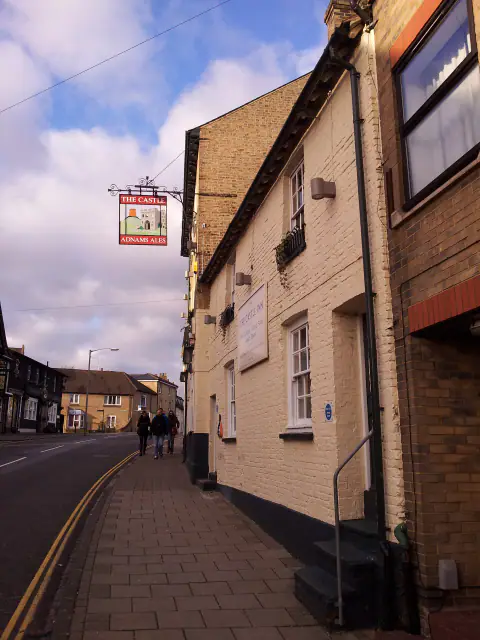 07Food & drinkThe Castle InnExplore experience →
 08Food & drinkThe Devonshire ArmsExplore experience →
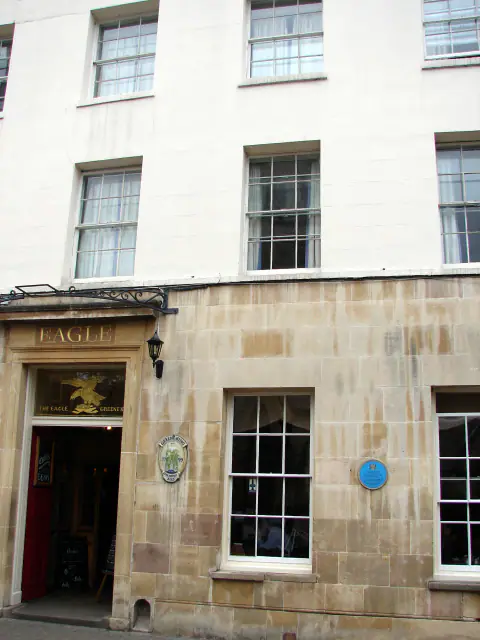 09Food & drinkThe EagleExplore experience →
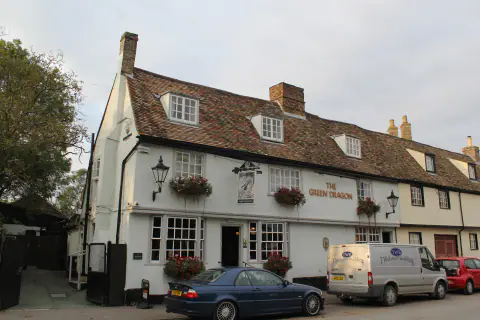 10Food & drinkThe Green DragonExplore experience →
 11Food & drinkThe HaymakersExplore experience →
 12Food & drinkThe Kingston ArmsExplore experience →
 13Food & drinkThe Live & Let LiveExplore experience →
 14Food & drinkThe MaypoleExplore experience →
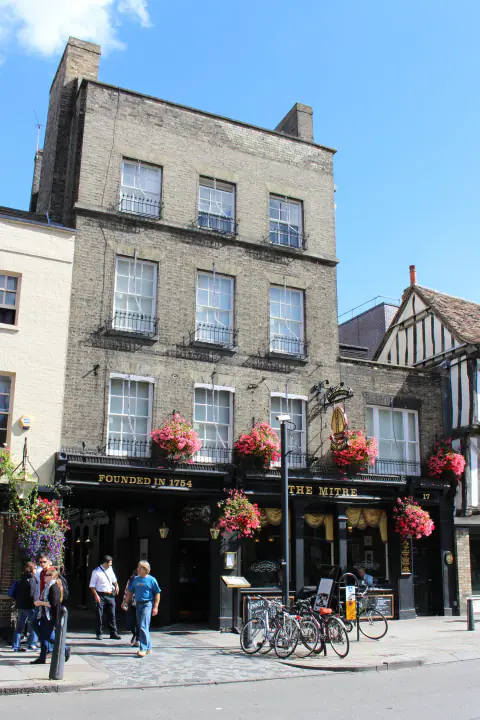 15Food & drinkThe MitreExplore experience →
 16Food & drinkThe Queen’s Head, NewtonExplore experience →
 17Food & drinkThe Royal StandardExplore experience →
 18Food & drinkThe St RadegundExplore experience →
 19OutdoorsCambridge University Botanic GardenExplore experience →
 20Water activitiesPunting the BacksExplore experience →
 35CollegesAll the collegesEvery Cambridge collegeOpen the college guide →Food & drink / a storyThe six oldest pubsWalk the timeline →Plan / Itinerary builderBuild your Cambridge dayStart planning →