In depth
Fort St George
A 16th-century timber-framed inn on Midsummer Common that stood on an island in the Cam until the 1830s, beside one of the busiest of the Cambridge ferries.
Story · Visit · Route · Links
Choose your depth
Essentials or more detail?
See visiting essentials, or read more about the history and places nearby.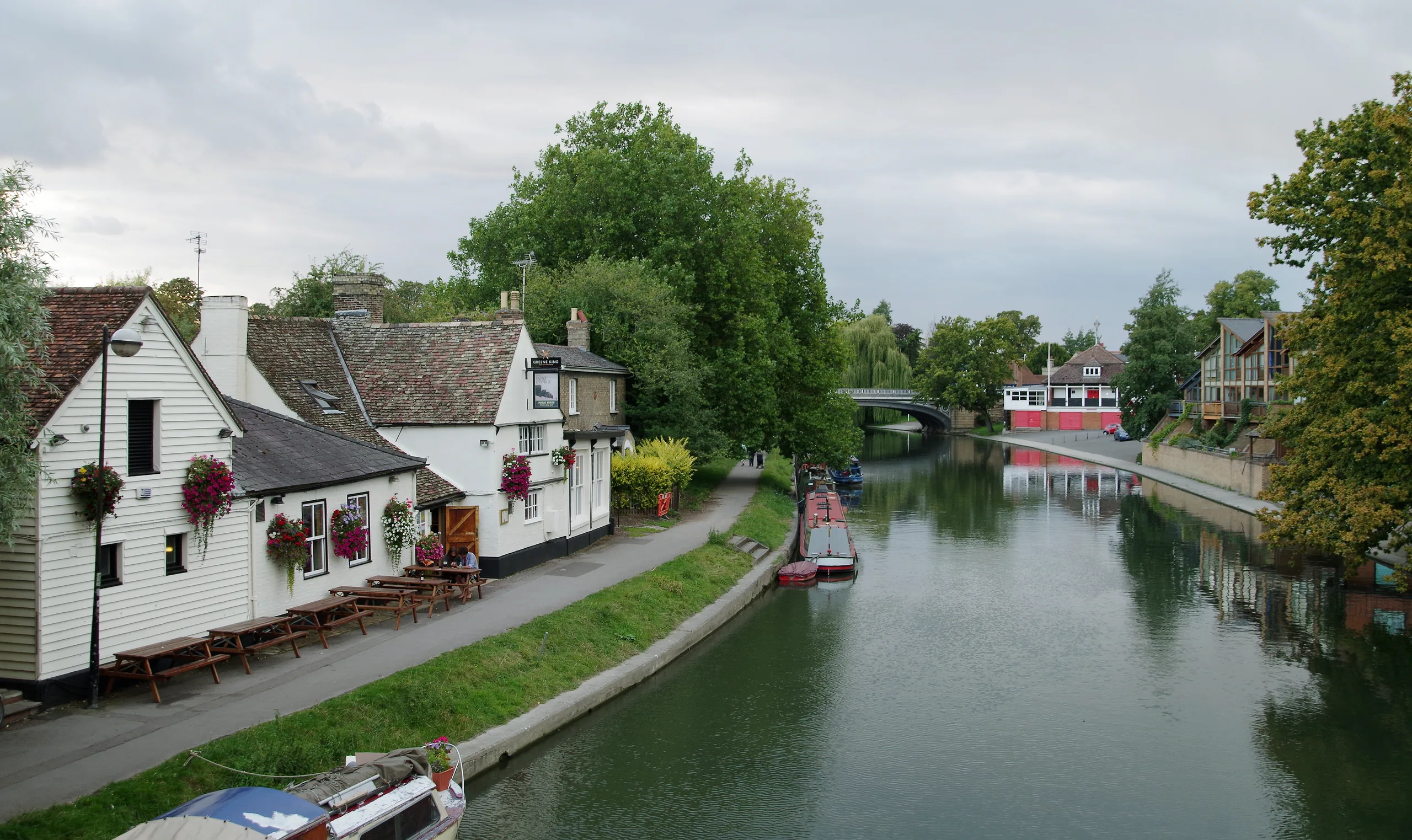
01 The experience
What to expect.
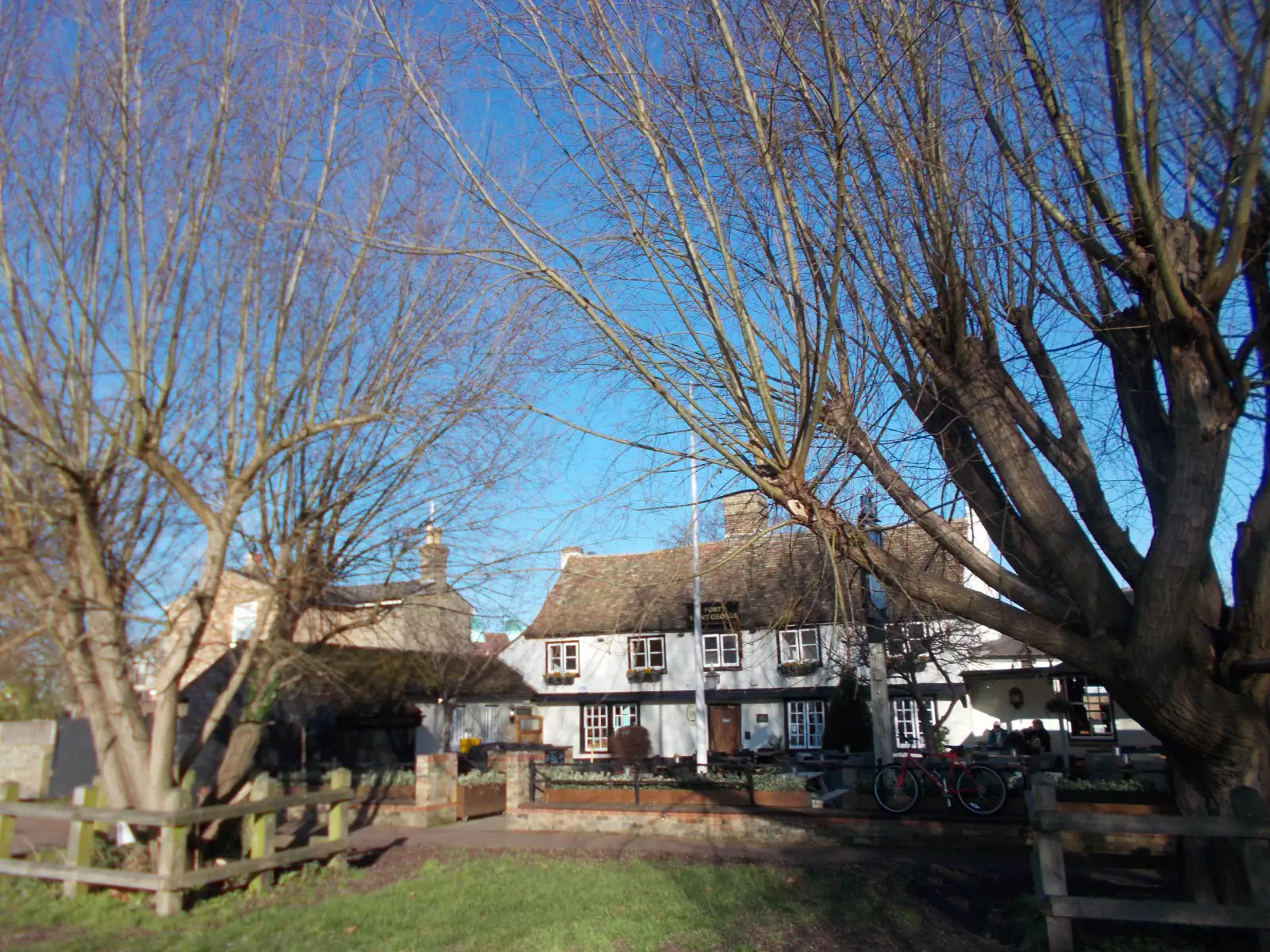
Fort St George is a 16th-century timber-framed riverside pub standing on Midsummer Common, on the south bank of the River Cam, about fifteen minutes' walk north-east of central Cambridge. It is Grade II listed (Historic England list entry 1126138, first listed in 1972) and run by the Greene King brewery. Two things make it unusual among Cambridge's historic pubs. The first is its position: river on one side, a wide expanse of grazed common land on the other, with the college boathouses directly opposite — arguably the best-sited pub in the city. The second is its name, which comes not from a saint or a landowner but from the East India Company's Fort St George at Madras, now Chennai, which the building was supposed to resemble.
Why it matters
Most of Cambridge's old pubs are urban: hemmed in by lanes, colleges and shopfronts. Fort St George is the opposite. It stands alone on open ground, and its history is the history of the river rather than the town. Until the 1830s it sat on an island between the Cam and a cut running to a lock — a sketch of 1827, once kept in the inn, shows exactly that arrangement — and for generations it was the landing point for the busiest ferry crossing between Cambridge and Chesterton. That ferry ran from eight in the morning until ten at night; in the 1920s the fare was a halfpenny each way. It was replaced by a footbridge in 1927, and the ferry itself sank in the same year.
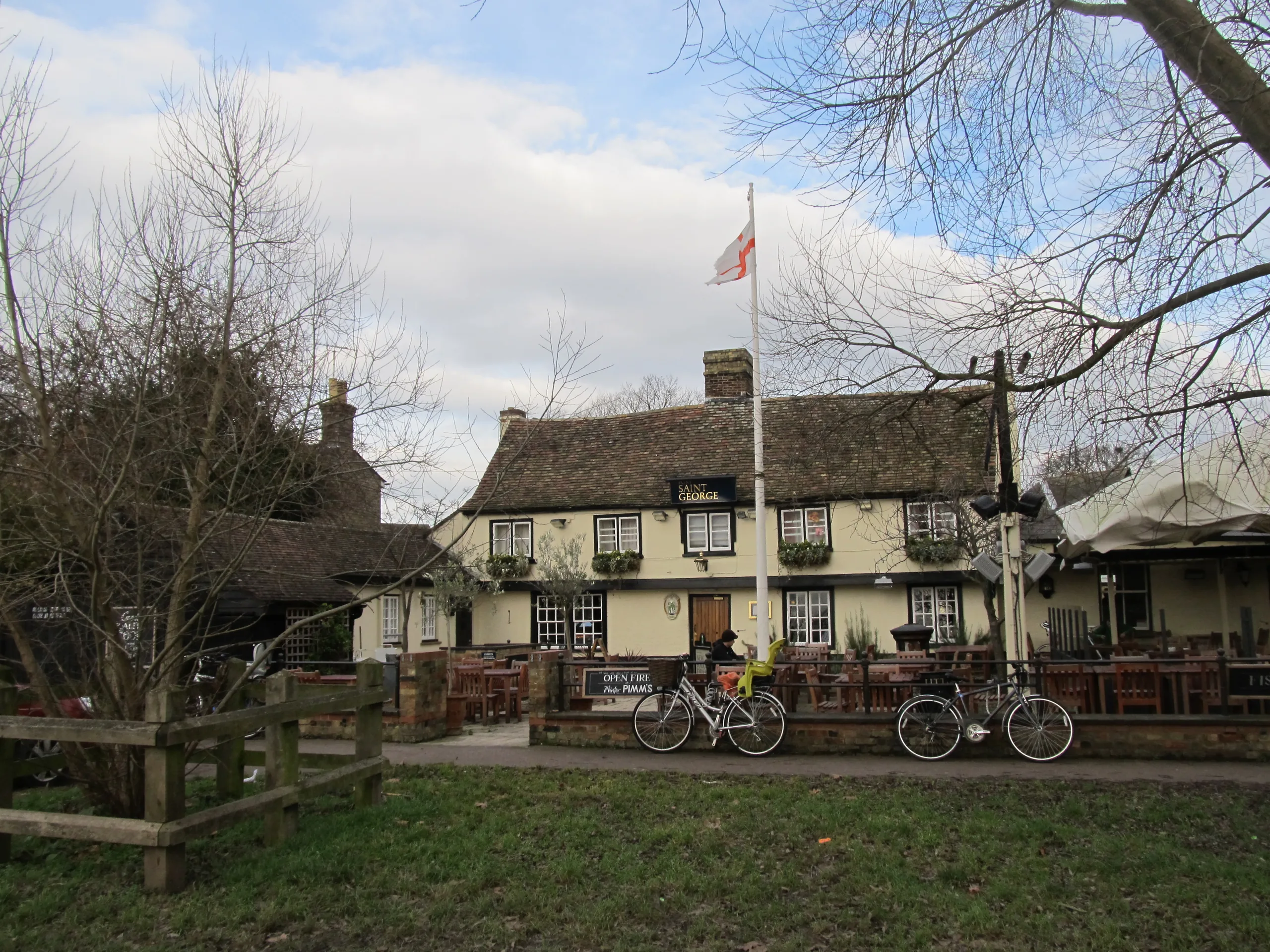
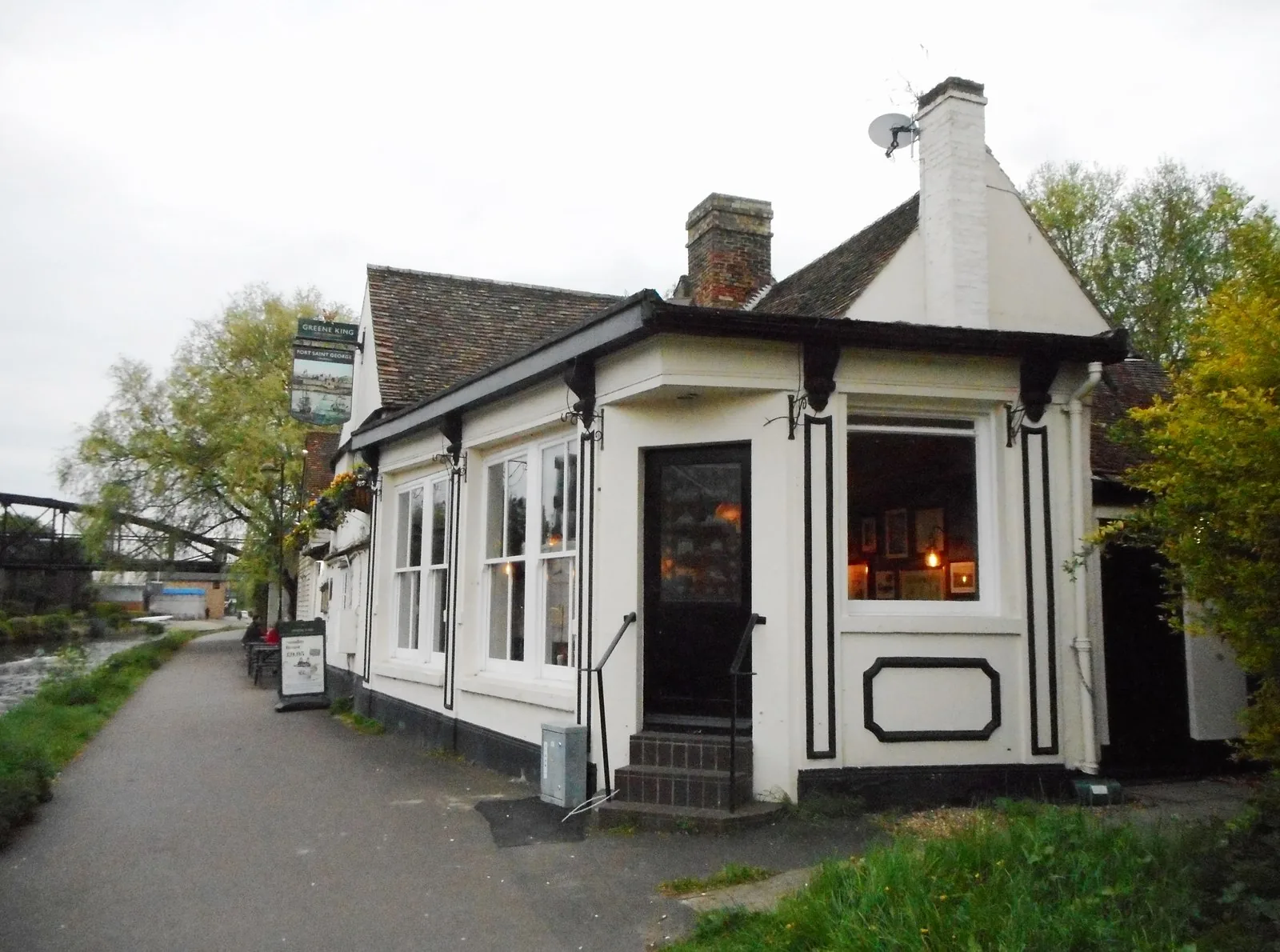
The fabric backs the story up. The Historic England list entry describes a 16th-century building, timber-framed, rendered and painted, partly refaced or rebuilt in brick, with a first-floor overhang on curved timber brackets, chamfered ceiling beams, a great central brick stack and an old tile roof — originally on a T-shaped plan, extended in the 19th century and later. That is a genuine Tudor building carrying four centuries of alteration, not a themed interior.
What visitors should notice
The pub reads as three distinct spaces. Turn right from the front door and you are in the snug — the oldest-feeling room, with a tiled floor and an open fire. Straight ahead is the large main bar, wood-boarded, with the best river views in the building. To the left is the restaurant, part herringbone parquet and part quarry tile. Outside, a large patio and garden face the common on one side and the water on the other. Look up for the chamfered beams and the central chimney stack; look out for the framed river photographs on the walls, which include the old ferry in operation and the building of the adjacent footbridge.
Above one table hangs a framed picture commemorating the visit of the Duke and Duchess of Cambridge, who ate here during their first official visit to the city in 2012 — the only royal association among Cambridge's historic pubs, and one that happened within living memory rather than being inherited from an inn sign.
Who will enjoy it
Anyone who wants an old pub with a view. It is the natural stop on a river walk between Jesus Green and Chesterton, the obvious place to watch the bumps if you can get a table during racing weeks, and the best pub in Cambridge for a warm afternoon outdoors. It rewards people interested in Cambridge's working river past — ferries, locks, boathouses, common rights — rather than its academic past, which is well covered elsewhere. Families and dog owners are explicitly catered for; the operator lists both.
Who may find it difficult
The queue is the thing everyone mentions. At busy times a single-file line forms at the bar, snakes through the room and can run out of the door and down the side of the building. It is orderly, it is local custom, and it is genuinely long on sunny weekends. Anyone who expects to catch a barman's eye in the normal English way should be warned; anyone who cannot stand for a long period should plan around it or book a table for food.
The pub is also busy in a way that has nothing to do with its history. Warm weekends, the Midsummer Fair, Strawberry Fair, bonfire night and the bumps all fill the common and the pub with it. The interior is a working Greene King managed house — the food is the standard chain menu, and parts of the fabric have been modernised over successive refurbishments, so the historic character is patchy rather than continuous. Visitors expecting an untouched Tudor interior will find fragments of one inside a busy contemporary pub.
Finally, it is not central. Fifteen to twenty minutes' walk from the market square, across open common with no shelter, is a pleasant approach in June and an exposed one in February. There is no useful visitor parking on the common itself.
Visitor verdict
Fort St George is worth the walk out from the centre, and the walk is half the point — the approach across Midsummer Common, with the boathouses on the far bank and cattle grazing in summer, is one of the better twenty minutes in Cambridge. Come for the setting first and the building second: this is a pub whose story is about ferries, islands and the river, not about scholars. Allow half an hour if you are only looking, and considerably longer if the sun is out, because you will not get served quickly and you will not want to leave. Treated as a riverside pub with a Tudor frame and a genuinely odd Anglo-Indian name, rather than as a museum, it is one of the most rewarding stops on the Cam.
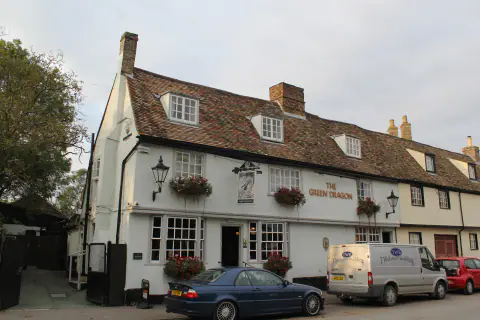
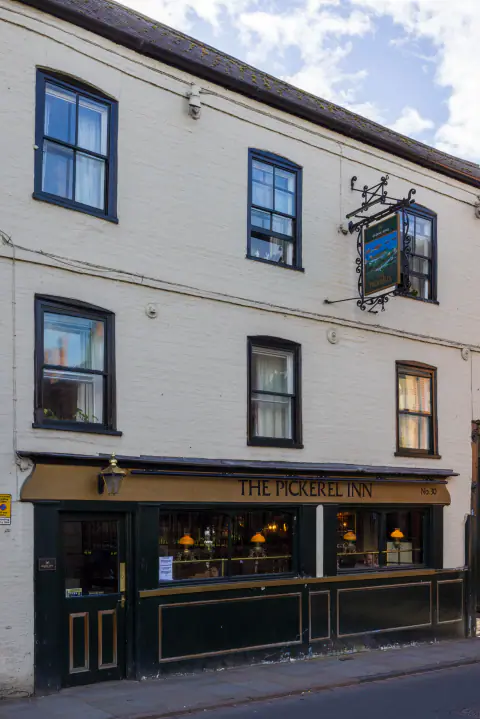
Two things to hold on to. It is not Cambridge's oldest pub — the Green Dragon in Chesterton is generally reckoned the oldest surviving pub building, and the Pickerel Inn on Magdalene Street the oldest continuously licensed house. And the Madras resemblance is a tradition rather than a documented origin; it is repeated by every source, but none of them produces the moment the name was given.
The story
History & character.
Origins: a Tudor building on the water's edge
The oldest part of Fort St George is 16th-century. That date is not a pub-trade claim: it comes from the statutory list entry, which describes the building as "C16, with alterations and additions in the C19 and later," and from the Royal Commission on Historical Monuments' Inventory of the Historical Monuments in the City of Cambridge, published in 1959, which the list entry cites (RCHM 219). The Commission recorded that "the walls are of plastered timber-framing in part refaced or rebuilt in brick; the roofs are tiled. It was built in the 16th cent. on a T-shaped plan, the cross range having been to the S."
The list entry, drafted in 1972, adds the architectural detail: timber-framed, rendered and painted, refaced or rebuilt in brick particularly at the east and west gables and across the ground-floor south front; two storeys; a first-floor overhang carried on curved timber brackets; some chamfered ceiling beams; a great central brick stack; an old tile roof. The 19th-century additions changed the plan, so the T-shape the Commission described is now legible only in parts.
Cambridge & District CAMRA, writing a pub profile in October 1981, put the same thing more loosely: "parts date back to the reign of Henry VIII" — that is, 1509 to
- It is a fair paraphrase of a 16th-century date, and the landlord of the day was fond of the joke, printing a cartoon that ran: "Q. Is it true this pub is 450 years old? A. I don't know, but I think the toilets are."
What the building was originally used for is not established. It stands well outside the medieval town, on Midsummer Common, which was and remains registered common land — the Midsummer Fair held on it was chartered by King John to the prior and canons of Barnwell in 1211, and the fair rights later passed to the town. A substantial timber-framed building on the river bank here in the 16th century is more likely to be connected with the river trade, the fair or the ferry than with any of the colleges.
The island years
The most striking fact about the pub's early modern life is that it was not on the mainland. The Royal Commission recorded that a sketch dated 1827, then hanging in the inn, showed that the building "stood on an island between the river and a cut to a lock close SE." The Cam here was a worked navigation, with cuts and locks managing levels for barge traffic, and the pub occupied the ground between the main channel and one of those cuts.
That arrangement ended in the 19th century. The cut and locks beside the pub were filled in and the island was joined to the common; the date usually given is the 1830s, though this is repeated in secondary accounts rather than documented in the statutory record. Jesus Lock, a short way upstream and the only lock now inside the city, was built in 1836, which is at least consistent with a reorganisation of the navigation in that decade. The change is invisible today: the ground in front of the pub is unbroken common, and nothing on the surface shows where the cut ran.
The ferry, 1800s to 1927
Before the footbridges, crossing the Cam between Cambridge and Chesterton meant a ferry, and there were several. The Fort St George ferry was probably the busiest of them all. It ran from 8 a.m. to 10 p.m., and in the 1920s the fare was a halfpenny each way.
The hours mattered. The Cambridge Daily News of 19 November 1904 complained about what happened after they ended: "No reasonable person expects to find a ferryman on duty after ten at night and is reconciled to the necessity of grinding himself across the few yards of water" — that is, hauling the chain ferry across single-handed. For a pub on the crossing, the ferry was not scenery. It was the reason people arrived and, at closing time, the reason they were stranded.
A footbridge replaced the ferry in 1927, and the ferry sank in the same year; a photograph in the Cambridgeshire Collection records it after the sinking. The footbridge beside the pub still carries the name — Fort St George Bridge — and is the direct route from the pub to the boathouses and Riverside on the far bank.
The name, and the "In England" that was lost
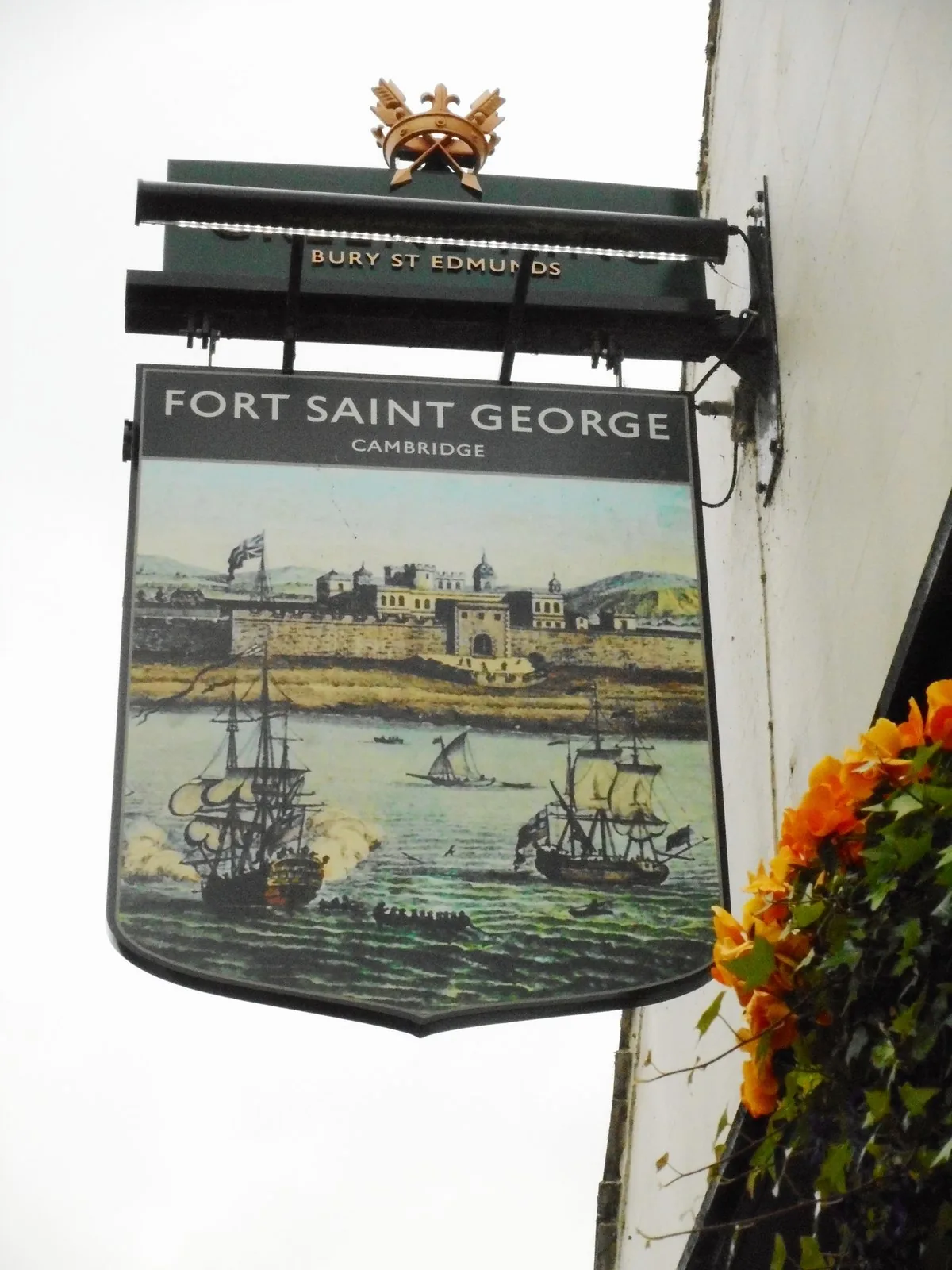
The pub's full historic name was Fort St George In England. It takes its name from the East India Company's Fort St George at Madras, now Chennai, founded in 1639 and the first English fort in India; the tradition is that the Cambridge building was thought to resemble it. The suffix "In England" was added precisely to distinguish the two, and it has since been dropped from ordinary use — which is why the standing local joke has it that tourists who ask for directions to Fort St George end up in Madras.
This should be handled carefully. Every reliable source repeats the Madras resemblance as the origin of the name, and the "In England" suffix is real and documented in the pub's own trading name and in CAMRA's records. What no source provides is a date, a document, or a named person attaching the name to the building. Treat the resemblance as long-standing tradition, not as an established event.
The 20th century: decline and revival
By the middle of the 20th century the Fort was in poor condition. Cambridge CAMRA's 1981 profile records that when Alan and Helen Winfield-Chislett took over the tenancy in November 1962 the pub was "very dilapidated": the public bar had a regular trade of three or four customers and the snug about the same, and the previous tenant's position was so weak that the only way he could get a delivery from the brewery was to pay cash on the dray.
The recovery over the following two decades was substantial, and by 1981 CAMRA described the Fort as one of Cambridge's busiest and best-known pubs, and one of the staunchest supporters of cask beer — the tenant is on record telling Greene King that he would resist any attempt to convert the pub to top pressure. A campaign of publicity, including cartoons drawn by the landlord needling the brewery about the state of the facilities, eventually produced money for improvements.
Those works, completed in 1981, renovated the kitchens, rebuilt and refitted the toilets, and moved the bottle store outside; the room it vacated became a small lounge bar — reported at the time as Cambridge's first non-smoking bar. During the work, carved wooden panels were exposed. The carvings show crossed oars, which led the landlord to suggest the room may once have served as a private bar for a rowing club. That is an inference rather than a documented fact, but it is a plausible one for a building facing the boathouse reach.
The river pub
The rowing connection is the thread that runs through the pub's modern life. The Cam here, between Jesus Lock and Baits Bite Lock, is the reach where Cambridge rowing happens: college and town boathouses line the far bank, and the bumping races — formal college racing in eights began in 1825, with organised bumps from 1827, the Lents and Mays separating in 1887 — are rowed past the pub's garden. In 1981 CAMRA recorded that the glasses behind the public bar hung from hooks set into oars suspended from the ceiling, and that the walls carried photographs of the river, among them the building of the adjacent footbridge, the old ferry in operation, and a sailing boat that once worked the Cam.
The common itself has its own calendar, and the pub sits inside it: the Midsummer Fair, chartered in 1211 and still held; Strawberry Fair; the May Day fair; and the 5 November fireworks, which draw crowds of the order of 25,000 to the common. Cattle — Red Poll bullocks were reintroduced in 2007 — graze around the pub in summer.
The royal lunch, 2012
In 2012, on their first official visit to Cambridge after taking the titles Duke and Duchess of Cambridge, William and Catherine ate at the Fort St George rather than at a formal University function. A framed picture commemorating the occasion was afterwards hung above their table. It is a modern association, well within living memory and well photographed, and it is the reason a good many visitors come.
The pub today
Fort St George is a Greene King managed house (the brewery's house number 1106), open all year, serving the standard Greene King menu alongside cask beer — Greene King IPA and Abbot, with Timothy Taylor Landlord and guests among the regulars listed by CAMRA. It has been recorded as an Asset of Community Value. Its neighbour on the common is Midsummer House, a two-Michelin-starred restaurant, which makes the short stretch of riverbank one of the more unlikely pairings of dining in England.
Look closer
Highlights and hidden details.
The objects, spaces and small observations that turn a visit into a memorable one.1. The setting: river on one side, common on the other
The single best thing about the pub, and the reason to walk out from the centre. Fort St George stands alone on Midsummer Common with the River Cam along its northern side and open, grazed common land — cattle included, in summer — stretching away to the south and west. The college and town boathouses line the opposite bank. No other pub in Cambridge has this much space around it, and the effect on a clear evening is of open country a quarter of an hour from the market square. Historical importance: high — the isolation is the reason the building's history is about the river rather than the town. Visitor experience: the point of the visit. Photography: the strongest compositions in the bundle. Time required: as long as you like.
2. The snug, its tiled floor and open fire
Turn right from the front door. The snug is the room that carries the most of the old building: a tiled floor, panelling, and a real fire that is lit in cold weather. It has been altered over the years — CAMRA's own guide notes it "has lost some of its character" — but it is still the room where the 16th-century frame is easiest to feel, and it is the place to sit between November and March. Historical importance: high. Visitor experience: the best interior room, and the first to fill in winter. Photography: dim; firelight helps. Time required: 10 minutes, or an evening.
3. The timber frame, the overhang and the great chimney stack
Look at the building from outside before you go in. The Historic England list entry records a first-floor overhang carried on curved timber brackets, a great central brick stack, an old tile roof, and brick refacing at the east and west gables and across the ground-floor south front — a timber-framed Tudor building repaired and extended for four hundred years. Inside, some of the chamfered ceiling beams are visible. Reading the exterior for where the render gives way to brick is the quickest way to see how much of it is not 16th-century. Historical importance: very high — this is the documented fabric. Visitor experience: rewarding if you know what to look for, invisible if you don't. Photography: good raking light in the early morning and late afternoon. Time required: 10 minutes.
4. The Fort St George footbridge and the vanished ferry
The footbridge beside the pub, opened in 1927, replaced what was probably the busiest ferry crossing on the Cam between Cambridge and Chesterton — running 8 a.m. to 10 p.m., a halfpenny each way in the 1920s. The ferry sank the same year the bridge opened. Walk out onto the bridge and look back at the pub: you are standing in the line the ferry took, and you are seeing the building from the water, as almost everyone who came here did before 1927. Historical importance: high. Visitor experience: a two-minute detour that changes how the site reads. Photography: the best angle on the pub is from the bridge and the far bank. Time required: 5–10 minutes.
5. The river photographs on the walls
The interior walls carry framed photographs of the Cam. Cambridge CAMRA recorded in 1981 that these included the construction of the adjacent footbridge, the old ferry in operation, and a sailing boat that once worked the river. Displays change with refurbishments, so treat the specific images as likely rather than guaranteed — but the wall of river history is a fixture, and it is the closest thing the pub has to interpretation. Historical importance: medium — secondary material, but well chosen. Visitor experience: something to read while you queue. Photography: reflections are the problem; shoot at an angle. Time required: 5–10 minutes.
6. The royal table and its framed picture
The Duke and Duchess of Cambridge ate here during their first official visit to the city in 2012, choosing the pub over a formal University function. A framed picture commemorating the visit was hung above the table they used. It is the newest piece of history in the building and the easiest to miss — ask a member of staff which table if you cannot find it. Historical importance: low as history, high as a talking point. Visitor experience: a thirty-second look. Photography: a straightforward record shot. Time required: 5 minutes.
7. The queue
Not a joke, and not really a complaint. Fort St George is known across Cambridge for the single-file queue that forms at the bar and, at peak times, runs out of the door and down the side of the building. It is self-organising and socially enforced, and it is genuinely unusual in an English pub, where bar service is normally a matter of being noticed. Join it properly. It is part of what the pub is. Historical importance: none. Visitor experience: infuriating or endearing, depending on the weather. Photography: the queue itself is a legitimate editorial subject — see the etiquette notes. Time required: longer than you think.
8. The bumps from the garden
Cambridge's bumping races — the Lents in late February and early March, the Mays in mid-June, and the Town Bumps in July — are rowed on this reach of the Cam, past the pub. Formal college racing in eights began in 1825 and organised bumps in 1827, so the pub has watched them for two centuries. A cannon starts each division; crews chase each other up the river trying to bump the boat ahead. On a bumps afternoon the garden is the best free grandstand in the city, and it fills accordingly. Historical importance: high, as Cambridge tradition. Visitor experience: superb, if you plan for it. Photography: fast action, long lens, crowded bank. Time required: an afternoon.
Details worth slowing down for.
You are standing on what used to be an island
The Royal Commission on Historical Monuments recorded, in its 1959 survey of Cambridge, that a sketch dated 1827 then hanging in the inn showed the building standing "on an island between the river and a cut to a lock close SE." For most of its life the pub was not on the common at all — it was on a scrap of ground between the main channel and a navigation cut, reached by water. The cut and the locks were filled in during the 19th century and the ground was joined to the common, and nothing on the surface now shows where the water ran. Stand in the garden and the flat grass to the south-east is the answer to a question most people never think to ask.
The full name was "Fort St George In England"
Not "Fort St George". The suffix existed for a practical reason: to distinguish the Cambridge pub from the East India Company's Fort St George at Madras — founded in 1639, the first English fort in India — which the building was said to resemble. The "In England" was dropped from ordinary use, which is the origin of the standing Cambridge joke that tourists who ask for directions to Fort St George end up in Madras. The resemblance itself is tradition rather than record: no source produces the moment or the person that gave the pub its name.
Crossed oars, found behind a wall in 1981
When Greene King finally paid for improvements in 1981 — after a campaign by the landlord that included drawing cartoons mocking the state of the facilities — builders converting the old bottle store exposed carved wooden panels. The carvings show crossed oars. The tenant's conclusion was that the room may once have been a private bar for a rowing club, which would fit a building facing the boathouse reach. The inference is his; the panels are documented. If the carving is still visible, it is the most interesting single object in the pub.
Glasses hung from oars
Cambridge CAMRA's 1981 profile records that the glasses behind the public bar hung from hooks set into a series of oars suspended from the ceiling. Fittings change, and this may well be gone — but it is worth looking up at the bar, because it tells you how completely this pub understood itself as a river pub rather than a town one.
Ringing the Bull
Enid Porter, in Cambridgeshire Customs and Folklore, recorded the traditional game of "ringing the bull" as still played at the Fort St George and at the Blue Ball in Grantchester. An iron ring about two inches across is hung from the ceiling on a cord, some distance in front of an iron hook fixed in the wall about six feet from the floor; the game is to swing the ring onto the hook. It is a genuinely old pub game and it survived in only a handful of houses. Whether the ring and hook are still in place is not confirmed — worth asking the staff, and worth recording if they are.
The ferryman's ten o'clock
The Cambridge Daily News of 19 November 1904, writing about the several ferries between Cambridge and Chesterton, observed: "No reasonable person expects to find a ferryman on duty after ten at night and is reconciled to the necessity of grinding himself across the few yards of water." The Fort St George ferry ran from eight in the morning until ten at night. Anyone drinking here past ten before 1927 had to haul the chain ferry across for themselves — a detail that puts the modern inconvenience of the bar queue in perspective.
The ferry sank in the year the bridge opened
The footbridge that replaced the ferry opened in 1927. The ferry itself sank in 1927, and a photograph of it after the sinking survives in the Cambridgeshire Collection. The two facts are usually reported separately and read very differently together: the crossing did not fade out, it was superseded and then, in the same twelve months, went under.
The pub was nearly finished in 1962
It is easy to assume a building this old has always been busy. Cambridge CAMRA's 1981 account of the tenancy taken on by Alan and Helen Winfield-Chislett in November 1962 says otherwise: the pub was "very dilapidated", the public bar had a regular trade of three or four customers and the snug about the same, and the previous tenant's credit was so poor that the brewery would only deliver against cash on the dray. Within twenty years it was one of the best-known pubs in Cambridge. The survival of a 16th-century building is not only a matter of fabric.
Cambridge's first non-smoking bar
The small lounge created out of the old bottle store in 1981 was reported at the time as Cambridge's first non-smoking bar — twenty-six years before the national smoking ban of 2007. It was primarily a food room, but non-smokers who were not eating were welcome in it. A small, easily lost piece of pub history that happens to have happened here.
The two-Michelin-star restaurant next door
Midsummer House, on the same short stretch of common, holds two Michelin stars. A 16th-century Greene King house serving a standard chain menu and one of the most decorated restaurants in England share a riverbank and a postcode. It is the sort of juxtaposition that only happens on common land, where nobody could build anything between them.
Make it work
Plan the visit properly.
Current practical detail, kept separate from the story so it is easy to scan when you need it.This is the most time-sensitive file in the bundle. Hours, food service and prices change; the details below were read from the pub's own Greene King listing and verified on 29 July 2026, and should be rechecked monthly.
How to use it
Fort St George is a working pub, not a paid attraction. There is no admission charge, no ticket and no tour. You walk in, you look at the rooms, and you buy a drink — which, given that you are standing in someone's business, is the courteous thing to do. Tables for food can be booked through Greene King; drinking is walk-in, subject to the queue.
Opening hours
Verified 29 July 2026 from the pub's Greene King listing. Recheck monthly.
Bar:
- Monday to Thursday: 12:00 – 23:00
- Friday and Saturday: 11:00 – 23:30
- Sunday: 11:00 – 22:30
Food service:
- Monday to Thursday: 12:00 – 21:00
- Friday and Saturday: 11:00 – 21:00
- Sunday: 11:00 – 20:00
Conflict note: Cambridge & District CAMRA's local listing gives Monday to Saturday 12:00–23:00 and Sunday 12:00–22:30 — earlier weekend closing and later weekend opening than the operator states. The Greene King listing has been used here because it is the operator's own record; the discrepancy is logged in the source register. If the exact hour matters to your plans, telephone.
Address and contact
- Address: Fort St George, Midsummer Common, Cambridge, CB4 1HA
- Telephone: 01223 354327
- Website: greeneking.co.uk/pubs/cambridgeshire/fort-st-george
- Operator: Greene King (managed house)
- Listing: Grade II, Historic England list entry 1126138
- Coordinates: 52.2124, 0.1278 (OS grid reference TL 45475 59270)
Note that the postal address is simply "Midsummer Common" — there is no street number and no street. Some third-party listings give "11 Victoria Avenue", which will get a taxi to roughly the right place but is not the address the operator uses. Satnav to CB4 1HA and expect to walk the last few hundred metres, because the pub stands on common land with no vehicle access to the door.
Admission and booking
Free to enter. No booking for drinks. Tables for meals can be reserved through the Greene King website or by telephone, and booking is worth doing on any warm weekend, during the bumps, and on fair and fireworks days. There are no guided tours — the history is self-guided.
The queue
Worth its own heading, because it surprises people. At busy times a single-file queue forms at the bar, snakes back through the room and, on the busiest days, runs out of the door and along the side of the building. It is an established local custom and it is enforced socially rather than by staff. Two practical consequences: allow real time for a round, and do not attempt to approach the bar sideways in the usual English manner — you will be corrected. If standing for long periods is difficult, book a table for food, where you will be served.
Best time to visit
- For the building and a quiet look round: a weekday late morning, shortly after opening, or mid-afternoon in term time.
- For the setting: a clear late afternoon or early evening in spring or autumn, when the light comes down the river and the common is not packed.
- For the rowing: the Lent Bumps (late February to early March), the May Bumps (mid-June, despite the name) and the Town Bumps (July). Spectacular, and the pub will be full — arrive very early or accept that you are watching from the common rather than from a table.
- Avoid if you want quiet: warm summer weekends, Midsummer Fair, Strawberry Fair, the May Day fair, and 5 November, when the common draws crowds of around 25,000.
How long to allow
Twenty to thirty minutes to look at the rooms, the river frontage and the framed photographs. An hour and a half or more if you eat, allowing for the queue. Most visitors fold it into a longer river walk rather than making a special trip.
Facilities
- Full Greene King food menu, served through the afternoon
- Cask ale (Greene King IPA and Abbot are the house beers; Timothy Taylor Landlord and guest beers regularly listed by CAMRA), plus keg, wine and spirits
- Real fire in the snug
- Large garden and patio facing the common and the river
- Toilets on site
- Free Wi-Fi
- Restaurant area and function/venue hire
- Card payment; Greene King app ordering
- CAMRA member discount on cask beer
- Five-star food hygiene rating; Cask Marque accredited
Accessibility (summary)
The operator advertises disabled facilities and step-free access. The approach is across level common ground, which is a genuine advantage over Cambridge's city-centre pubs, but the last stretch is unmade path and grass rather than pavement. See the dedicated accessibility file, which is explicit about what has and has not been verified.
Families, dogs, weather
Family-friendly and dog-friendly are both listed by the operator, and the common outside is the largest de facto beer garden in Cambridge. On a wet day the pub is sound but the appeal drops sharply — the setting is the reason to come, and the walk out is exposed. In winter, the snug's open fire is the room to aim for.
Getting there
- On foot: 15–20 minutes from the market square. The pleasant route is north from the city centre to Jesus Green, then east along the river past Victoria Avenue onto Midsummer Common; the pub is on the south bank, near the far (eastern) end.
- From Cambridge railway station: roughly 35 minutes on foot, or a bus into the centre and a short walk.
- By bus: several routes run along Victoria Avenue and Chesterton Road, a few minutes' walk away.
- By bike: the common and the towpath are heavily used cycle routes; cycle parking near the pub.
- By car: not recommended. There is no parking on the common. Use a Park & Ride site, or on-street parking in the Riverside/Chesterton streets across the footbridge, and walk.
- On the water: the Cam runs past the door; the pub is a well-known stop for punts, rowing boats and narrowboats on the lower river.
Crowd levels
Extremely seasonal. Quiet on a wet weekday, close to overwhelmed on a hot Saturday or a bumps afternoon. The pub's popularity is driven by weather and events on the common far more than by tourism, so a grey Tuesday in November is a different place from a bright Sunday in June.
Visit your way
Access and family planning.
Fort St George stands on Midsummer Common, with no vehicle access to the door. Plan the approach as well as the entrance: telephone 01223 354327 to discuss your route, seating and toilet requirements before travelling.
Getting there — the part most guides skip
The approach is the biggest single access question, and it is not about the building. Fort St George stands in the middle of Midsummer Common. There is no vehicle access to the door and no parking on the common. Whatever your mobility, you will cover the last few hundred metres on foot or by wheelchair, on a mixture of made path and grass.
Practical options:
- From Victoria Avenue (the road that separates Jesus Green from Midsummer Common): the shortest surfaced approach, with bus stops on the avenue. Still a several-hundred-metre crossing of the common.
- From the Riverside / Chesterton side: on-street parking is possible in the residential streets north of the river, but the crossing is by the Fort St George footbridge, which has steps or ramped approaches that we have not confirmed for wheelchair use. Do not rely on this route without checking.
- Drop-off: a taxi to CB4 1HA will get you to a road edge, not to the pub.
The ground itself is flat — genuinely level common — which is an advantage over Cambridge's city-centre historic pubs. The surface is the problem, not the gradient: unmade paths and grass, which are hard going after rain and impassable in mud for some wheelchair users.
Step-free access at the building
The snug, bar, restaurant and garden are on the ground floor, but the historic building has uneven surfaces and thresholds. Ask about entrance width, any ramp and the route between your table and the toilets before visiting.
Toilets
Standard toilets are available. An accessible toilet and its dimensions are not confirmed. Telephone the pub before travelling if you need one.
The queue — an access issue, not a quirk
Fort St George is known for a long single-file queue at the bar that at busy times extends out of the door. This is the pub's most significant practical barrier for anyone who cannot stand for extended periods, anyone using crutches or a frame, and anyone with fatigue-related conditions. Book a table for food: table service removes the problem entirely. If you are only drinking, come at a quiet time — a weekday shortly after opening, or a wet afternoon — when the queue does not form.
Sensory considerations
- Noise: Very variable. Empty on a wet weekday; extremely loud on a warm weekend, during the bumps, and on fair and fireworks days, when the common outside carries crowds of the order of 25,000. Hard for hearing-aid users and for anyone noise-sensitive at those times, and quite manageable at others.
- Lighting: The main bar has large windows onto the river and is among the brightest historic-pub interiors in Cambridge. The snug is darker, with firelight. This is better than most old pubs for low vision.
- Visual impairment: No large-print or tactile interpretation of any kind. The interest here is largely spatial and external — the river, the common, the sound of boats — which travels better without sight than a plaque-based site does. The unfenced river frontage is a hazard to be aware of.
- Outdoor space: The garden and the common are the most comfortable areas for anyone needing room to turn, and the least crowded except at peak times.
Assistance dogs and dogs generally
The pub is listed as dog-friendly, so assistance dogs are unquestionably fine. Note that cattle graze the common in summer, which is worth knowing if you work with a dog.
Seating and rest
Substantial seating inside and out, but it fills quickly in good weather, and there are no benches on the approach across the common where you could break the walk. If you need to sit at intervals, the route from Victoria Avenue is the one with the best chance of a bench.
The practical recommendation
The setting is level and open, which makes this an easier historic pub than most in Cambridge once you are there — but getting there and getting served are the two real barriers, and both are solvable with planning. Telephone ahead, book a table, come at a quiet time, and approach from Victoria Avenue on a dry day. On that basis, most visitors with mobility needs can have a good visit. Arriving unannounced on a hot Saturday is the version that goes wrong.
The honest picture
Fort St George is a better family pub than most historic pubs in Cambridge, and the reason has nothing to do with the pub. It is the common. The operator lists the pub as family-friendly and dog-friendly, and outside the door is a very large flat open space where children can run about within sight of a table. Add a river, a footbridge, cattle in summer and a constant traffic of punts, narrowboats and rowing eights, and there is a great deal for a child to look at. Inside, it remains a pub: no children's trail, no play area, and licensing rules on under-18s in bars apply as normal.
Ages and what they'll get from it
- Under 5s: Good, in dry weather. The common gives somewhere to put a toddler while the adults eat, and the boats going past hold attention better than any interior in the city. In wet or cold weather the calculation reverses sharply — the interior is busy and there is nowhere to let a small child loose.
- 5–10s: The best age here. The island story is the one that lands: this pub used to be on an island, you could only get to it by boat, and a ferry ran across the river until it sank in 1927. Walk out onto the footbridge and show them the line the ferry took. Cattle on the common in summer are a bonus.
- 11–16s: Works if there is rowing on. A bumps division — cannon start, eight crews chasing each other, the bank shouting — is genuinely exciting to watch and needs no explanation beyond "they are trying to hit the boat in front". Outside racing weeks, teenagers will find it a pub with a nice view.
Educational value
Moderate and specific. The site teaches river geography rather than history of ideas: what a navigation cut and a lock are for, why a ferry existed and why a bridge replaced it, what common land is and why nobody has built on it. Midsummer Common is registered common land whose fair was chartered by King John in 1211, and the pub, the ferry and the boathouses are all consequences of the river being a working waterway. It pairs naturally with a walk to Jesus Lock — the only lock in the city, built in 1836 — where the mechanism can be watched in operation.
Practical friction points
- The queue. The single most important thing to plan for with children. At busy times the bar queue is long, single-file and slow. Do not attempt it holding a toddler. Book a table for food, or send one adult to queue while the other stays outside.
- Water, unfenced. The river runs directly past the garden and there is no barrier along much of the frontage. Small children need watching, permanently.
- Cattle. Red Poll bullocks graze the common in summer. They are docile and used to people, but they are loose, and dogs must be under control around them.
- The walk. Fifteen to twenty minutes each way from the city centre across open ground. Fine with a pushchair on the made paths, less fine in rain, and a long way back with a tired child.
- Food waits. The kitchen is busy and service can be slow at peak times. Order early rather than at the point of hunger.
- It is a bar. The evening atmosphere is adult, particularly on match and event nights. Come at lunchtime.
The efficient family version
Walk out along the river from Jesus Green, timing it so you arrive around midday before the lunch queue builds. Book a table in advance. Eat outside if the weather allows, let the children watch the boats, then take ten minutes to walk onto the footbridge, look back at the pub and tell the island-and-ferry story. Walk back along the opposite bank past the boathouses. About two hours door to door, most of it outdoors, and one good story that a child will actually remember.
Self-guided walk
Explore beyond the venue.
A practical, step-by-step route connecting this experience with more of Cambridge.Stop 1 — Fort St George, Midsummer Common (start)
Begin outside, on the common side, and look at the building before you go in. Find the first-floor overhang on its curved timber brackets, the great central brick chimney stack, the old tile roof, and the places where painted render gives way to brick — those are the 19th-century repairs to a 16th-century timber frame. Then go in: right into the snug for the tiled floor and open fire, straight on into the main bar for the river windows and the framed photographs of the Cam, left for the restaurant. Ask a member of staff to point out the framed picture commemorating the Duke and Duchess of Cambridge's 2012 lunch. Have a drink now if the queue is short — it will not be later. Photo stop: the frontage from out on the grass, low and wide. 20–25 minutes.
Stop 2 — The Fort St George footbridge (1 minute)
Step out of the pub and onto the footbridge beside it. It opened in 1927, replacing the ferry that ran across this exact line — probably the busiest crossing between Cambridge and Chesterton, working 8 a.m. to 10 p.m., a halfpenny each way in the 1920s. The ferry sank in the same year the bridge opened. Stop in the middle and turn round: this is how everyone saw the pub before 1927, from the water. Photo stop: the pub from mid-bridge. 5 minutes.
Stop 3 — The boathouses, north bank (2 minutes)
Cross the bridge and turn left, downstream or upstream as you like, along the north bank. The college and town boathouses line this side of the river. The reach between Jesus Lock and Baits Bite Lock is where Cambridge rowing happens: formal college racing in eights began in 1825 and the bumping races from 1827, with the Lent and May Bumps separating in 1887. If there is racing on, you have found the best free viewing in the city. If not, read the boathouse names — most of the colleges are here. Photo stop: the boathouse frontages, and eights on the water. 10 minutes.
Stop 4 — Riverside and the moorings (5 minutes)
Continue along the north bank towards the city. This is Riverside: houseboats and narrowboat moorings, a working residential river rather than a scenic one. It is the best illustration on the walk of the Cam as a navigation — the same function that put a lock and a cut beside Fort St George, and made the pub an island, in the first place. 10 minutes.
Stop 5 — Victoria Bridge and Victoria Avenue (5 minutes)
Carry on upstream to Victoria Bridge and cross back to the south side. The foundation stone was laid by the Mayor of Cambridge in November 1889 and the bridge opened in December 1890; the road it carries, Victoria Avenue, is lined with horse chestnuts and is the thing that divided one continuous common into Midsummer Common to the east and Jesus Green to the west, in 1890. Photo stop: the horse-chestnut avenue looking south. 5 minutes.
Stop 6 — Jesus Green and Jesus Lock (10 minutes)
Walk west across Jesus Green, along the tree avenues, past the open-air lido, to Jesus Lock at the far end. Built in 1836, it is the only lock inside Cambridge; the low-level footbridge and the high-backed bridge over the lock were both erected in
- Watch a boat go through if one is locking. This is the machinery the Royal Commission was describing when it recorded that Fort St George stood on an island "between the river and a cut to a lock" — a lock like this one is what the pub sat beside for most of its life. Photo stop: the lock gates and the 1863 bridge. 15 minutes.
Stop 7 — Back east across the commons (15 minutes)
Turn round and walk the whole length of Jesus Green and Midsummer Common back to the pub, keeping the river on your left. This is the leg to do slowly. Midsummer Common is registered common land whose fair was chartered by King John in 1211 and is still held; cattle graze it in summer. Nothing has ever been built on it, which is the entire reason the pub still stands alone with a view. As you come back east, watch Fort St George appear out of the open ground ahead — the best approach to the building there is. Photo stop: the pub emerging across open common. 15–20 minutes.
Stop 8 — Fort St George again (end)
Back where you started. Take the second drink you did not have at the beginning, outside if the weather allows, facing the boathouses you have just walked past. If you have time and legs left, the walk extends naturally downstream along the north bank to Chesterton and the Green Dragon — a 16th-century riverside pub generally reckoned the oldest surviving pub building in Cambridge, and the house this one is measured against. End where you started. 30 minutes plus a drink.
Notes
The whole loop is flat and there is no admission charge anywhere on it. Surfaces are the limiting factor: much of the route is unmade path and grass, and it is hard going after heavy rain. In wet weather, compress the walk to Stops 1, 2 and 3 — the pub, the bridge and the boathouses — which are all within five minutes of each other, and save the commons for a dry day. In event weeks (the bumps, Midsummer Fair, Strawberry Fair, 5 November) the common will be crowded and the pub full; the walk still works but the pub stops will not be quick.
Make a record
Photograph it thoughtfully.
The strongest compositions
- The pub from the far bank. The signature shot, and the one most people never take because it means crossing the footbridge. From the Riverside/Chesterton bank the whole building reads at once — timber frame, tile roof, central chimney stack, river in the foreground — with the common behind it. This is also, near enough, the view everyone had before 1927, when they arrived by ferry.
- The pub from the footbridge. Higher and closer than the far bank, with the bridge structure available as a lead-in. The best compromise if you only have a few minutes.
- Across the common, low and wide. From forty or fifty metres out on the grass, with the building small in a big frame and sky above. This is the shot that explains why the pub matters: an isolated Tudor building on open common land in the middle of a city.
- The boathouses opposite, from the pub garden. Turn your back on the pub. The line of college and town boathouses along the far bank, with eights on the water, is a distinctly Cambridge composition and it is available from a pub table.
- The snug interior with the fire lit. Tiled floor, panelling, low light. Best in winter, in the first hour after opening, before it fills.
- The queue. A legitimate editorial subject and genuinely unusual — a single-file line snaking through a pub and out of the door. Shoot it as a phenomenon, not as individuals, and see the etiquette notes below.
Light and timing
The pub faces the river on its north side and the common to the south, which means the south front — the main frontage most photographs are taken of — takes sun through the middle of the day and into the afternoon, and the river elevation is better early and late.
- Golden hour, summer evening: the best single window. Low light down the river, warm on the render and brick, boats still moving.
- Early morning: empty common, mist off the water in autumn, no people. The quietest and cleanest conditions you will get, and the only realistic time for an uncluttered frontage.
- Winter afternoons: short, low light and bare trees open up sightlines across the common that are blocked in leaf.
- Midday summer weekends: avoid for architecture. The garden is full, the frontage is lined with drinkers and the light is flat.
Shooting the interior
The main bar is unusually well lit for a historic pub — large windows onto the river give you real daylight — so the interior is easier here than at most Cambridge pubs. The snug is the opposite: dark, low, and best photographed with the fire as the light source rather than fought with flash. Look for the chamfered ceiling beams, and for the framed river photographs, which reflect badly under direct light; shoot them at an angle or not at all. If the carved crossed-oars panelling recorded in 1981 is still exposed, it is the detail shot worth working for.
Seasonal and event photography
- The bumps (Lents, late February to early March; Mays, mid-June; Town Bumps, July): fast, crowded, and the best action available from this bank. Long lens, high shutter speed, and expect to be shoulder to shoulder.
- Cattle on the common (summer): Red Poll bullocks grazing with the pub behind them is the most characteristic Cambridge picture available here.
- Midsummer Fair and Strawberry Fair: the common transformed. Good editorial material, poor architectural conditions.
- 5 November fireworks: large crowds, roughly 25,000 people. The pub is incidental; the common is the subject.
- Flood and high water: the lower Cam rises. Worth returning for.
Etiquette and permissions
Fort St George is a working pub, and much of the year its garden is full of people relaxing on their day off. Photograph the building, the river and the common; photograph people only with consent, or from behind and anonymised. This applies particularly to the queue, which is funny to an outsider and is other people's Saturday afternoon — shoot it wide and anonymised, not as portraits of strangers.
Staff should be asked before being photographed at work. There are no general restrictions on personal photography of the exterior or the interior, but the interior is private property and the licensee's decision is final; if asked to stop, stop.
Commercial photography, filming and any use of a tripod inside would need Greene King's permission arranged in advance. Outside, Midsummer Common is public land managed by Cambridge City Council, and commercial shoots there are subject to the council's own permissions.
Drones: treat as not permitted without prior arrangement. Midsummer Common is open public land in a densely populated city, regularly holds large crowds, and adjoins a Grade II listed building; the UK Civil Aviation Authority's rules on flying over uninvolved people and congested areas apply, and Cambridge City Council controls its own open spaces. We have not verified a specific local drone prohibition — but do not fly here without asking the council and the pub first.
Around here
Make more of the area.
Good to know
Questions, answered.
01Where is Fort St George in Cambridge?
On Midsummer Common, on the south bank of the River Cam, north-east of the city centre (CB4 1HA). It is about 15–20 minutes' walk from the market square and there is no road to the door — you cross the common on foot.
02How old is Fort St George?
The oldest part of the building is 16th-century. That comes from the Historic England list entry, which describes it as "C16, with alterations and additions in the C19 and later," citing the Royal Commission's 1959 survey of Cambridge. Much of what you see inside is Victorian or modern.
03Is Fort St George the oldest pub in Cambridge?
No. The Green Dragon in Chesterton is generally reckoned the oldest surviving pub building in Cambridge, and the Pickerel Inn on Magdalene Street the oldest continuously licensed house, dating its licence to 1608. Fort St George is 16th-century in part and is often called the oldest pub on the River Cam, but the Green Dragon is also 16th-century and also on the Cam, so treat that as a claim rather than a settled ranking.
04Why is a Cambridge pub named after a fort in India?
It takes its name from the East India Company's Fort St George at Madras — now Chennai — founded in 1639 and the first English fort in India. The tradition is that the Cambridge building was thought to resemble it. No source produces the moment the name was given, so treat the resemblance as long-standing tradition rather than documented fact.
05What does "In England" mean in the pub's name?
The full historic name was Fort St George In England, with the suffix added precisely to stop people confusing it with the fort in Madras. The "In England" has been dropped from ordinary use — which is why the local joke runs that tourists who ask for directions to Fort St George end up in Madras.
06Was the pub really on an island?
Yes. The Royal Commission on Historical Monuments recorded that a sketch dated 1827, then hanging in the inn, showed the building standing on an island between the river and a cut running to a lock close to the south-east. The cut and locks were filled in during the 19th century and the ground joined to the common.
07When did the pub stop being on an island?
Secondary accounts give the 1830s. The island itself is well documented; the exact date it ceased to be one is not equally well attested, so "by the mid-19th century" is the safer phrasing. Jesus Lock, a short way upstream and the only lock now in the city, was built in 1836.
08What was the Fort St George ferry?
A river crossing between Cambridge and Chesterton, probably the busiest of the several ferries on this stretch. It ran from 8 a.m. to 10 p.m., and in the 1920s the fare was a halfpenny each way. A footbridge replaced it in 1927 — and the ferry sank in the same year.
09Is the footbridge next to the pub still there?
Yes. It opened in 1927 and still carries the name Fort St George Bridge. It is the direct route from the pub to the boathouses and to Riverside on the north bank, and it gives the best view back at the building.
10Who owns and runs Fort St George?
It is a Greene King managed house. The brewery's own listing describes it as a Grade II listed, timber-framed pub dating back to the 16th century.
11Is Fort St George listed?
Yes — Grade II, Historic England list entry number 1126138, first listed on 2 November 1972. It has also been recorded as an Asset of Community Value.
12What are the opening hours?
As read from the Greene King listing on 29 July 2026: bar Monday–Thursday 12:00–23:00, Friday–Saturday 11:00–23:30, Sunday 11:00–22:30. Food is served Monday–Thursday 12:00–21:00, Friday–Saturday 11:00–21:00 and Sunday 11:00–20:00. CAMRA's local listing differs slightly; confirm before travelling.
13Does Fort St George serve food?
Yes — the standard Greene King managed-house menu, served through the afternoon rather than in separate lunch and dinner sittings. Booking a table is sensible at busy times, and it is also the way to avoid the bar queue.
14Why is there a queue at the bar?
Because the pub is popular and the bar is small. Fort St George is known across Cambridge for a single-file queue that forms at the bar and, at peak times, runs out of the door and down the side of the building. It is self-organising and socially enforced, and it is unusual — in most English pubs you simply catch the barman's eye. Join it properly.
15How long is the queue likely to be?
Nothing at all on a wet weekday. Substantial on a warm weekend afternoon, during the bumps, and on fair days. If you cannot stand for a long period, book a table for food and be served instead.
16Do I need to book?
Not to drink or to look around. For a meal — and particularly on any sunny weekend, during racing weeks, or on event days on the common — booking through Greene King is strongly advised.
17When is the best time to visit?
A weekday late morning or mid-afternoon for the building and a quiet look round. A clear late afternoon or early evening in spring or autumn for the setting. Avoid warm summer weekends, Midsummer Fair, Strawberry Fair and 5 November if you want space.
18Can I watch the rowing from the pub?
Yes — this reach of the Cam is where Cambridge rowing happens, with the boathouses directly opposite. The bumping races are rowed past the garden: the Lent Bumps in late February and early March, the May Bumps in mid-June, and the Town Bumps in July. On a bumps afternoon the garden is the best free grandstand in the city, and it will be full.
19What is Midsummer Common?
Registered common land on the south bank of the Cam, on which the pub stands. Its Midsummer Fair was chartered by King John to the prior and canons of Barnwell in 1211 and is still held; Strawberry Fair, the May Day fair and the 5 November fireworks are also held there, the last drawing crowds of around 25,000. Red Poll bullocks were reintroduced to graze it in 2007.
20Are there really cows outside the pub?
In summer, yes. Cattle graze Midsummer Common under long-standing common rights. They are used to people, but they are loose, and dogs need to be under control around them.
21Did William and Kate really eat here?
Yes. The Duke and Duchess of Cambridge had a meal at the pub during their first official visit to the city in 2012, in preference to a formal University function. A framed picture commemorating the occasion was afterwards hung above their table.
22Is Fort St George suitable for children?
Better than most historic pubs, because of the common outside — a large flat open space with a river, a footbridge, boats and, in summer, cattle. The operator lists it as family-friendly. Inside it remains a pub, with the usual rules on under-18s in bars, and the bar queue is the thing to plan around.
23Are dogs allowed?
Yes — the operator and CAMRA both list the pub as dog-friendly. Keep dogs under control on the common, where cattle graze in summer.
24Is Fort St George wheelchair accessible?
Allow for several hundred metres across common land, with no vehicle access to the door. Accessible toilets and internal step-free routes are not confirmed. Telephone 01223 354327 before travelling to discuss your needs.
25Where can I park?
Not on the common — there is no parking and no vehicle access to the pub. Use Park & Ride, or on-street parking in the Riverside and Chesterton streets north of the river and cross by the footbridge, and expect to walk the last stretch either way.
26How do I get there from the city centre?
Walk north to Jesus Green, then east along the river past Victoria Avenue onto Midsummer Common; the pub is towards the eastern end, on the south bank. Fifteen to twenty minutes, flat all the way, and one of the better short walks in Cambridge.
27How do I get there from Cambridge railway station?
About 35 minutes on foot, or a bus into the city centre followed by the river walk. Buses along Victoria Avenue and Chesterton Road stop a few minutes away.
28Is there anything to see inside?
The snug, to the right of the entrance, keeps the most character — tiled floor, panelling and an open fire. The main bar has the river windows. The walls carry framed photographs of the Cam, historically including the old ferry and the construction of the footbridge. Look up for chamfered ceiling beams, and ask about the framed royal-visit picture.
29What is the two-Michelin-star restaurant next door?
Midsummer House, on the same stretch of common. It holds two Michelin stars and needs booking well in advance. The proximity of a chain-menu Tudor pub and one of England's most decorated restaurants is one of the odder facts about this riverbank.
30Which other historic pubs should I combine it with?
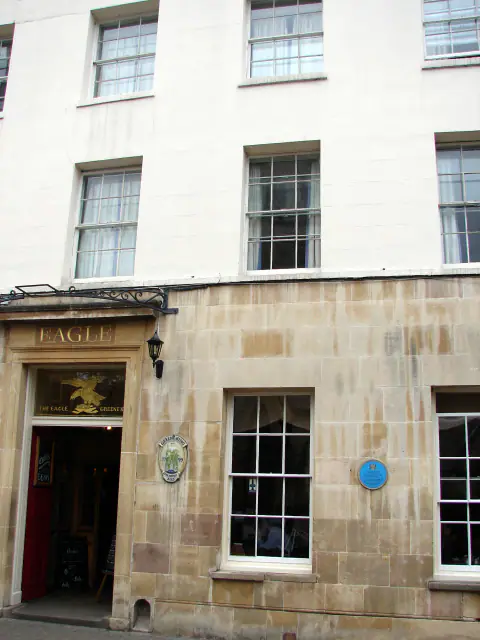
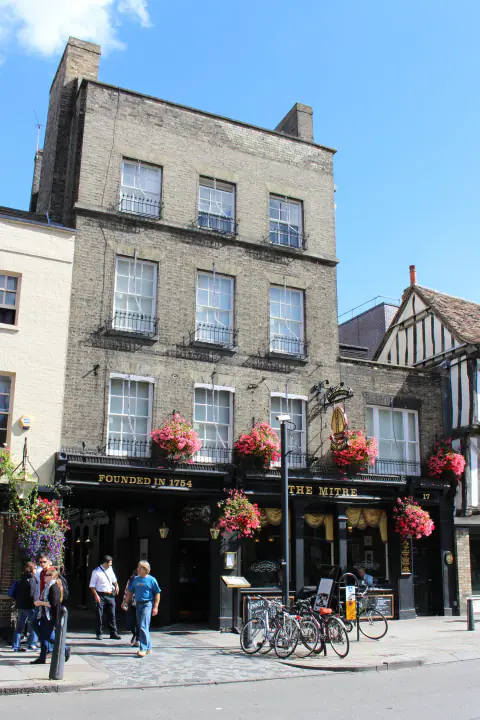
Fort St George is one of six in Above Guide's Cambridge historic-pub collection. The Green Dragon in Chesterton — the oldest surviving pub building, and a riverside walk downstream — is the natural pairing. The Pickerel Inn on Magdalene Street (oldest continuous licence, 1608), the Eagle on Bene't Street (inn by 1566, coaching house 1667, with the DNA plaque and the RAF Bar), the Castle Inn on Castle Street (1740s) and the Mitre on Bridge Street (licensee from 1752) complete the set.
Before you visit
Useful links.
Venue and visitor information
Every substantive factual claim in this bundle traces to a source below. Prioritised: Historic England and the Royal Commission on Historical Monuments for the fabric; Capturing Cambridge (Museum of Cambridge) for the local record; the operator (Greene King) for current operations; Cambridge & District CAMRA for the pub's 20th-century history and current beer offer. Verified 29 July 2026.
Primary sources
- Historic England, National Heritage List for England — Fort St George Public House, Midsummer Common. List entry 1126138, Grade II, first listed 2 November 1972. National Grid Reference TL 45475 59270. Used for: listed status, grade, list entry number and date; the C16 date "with alterations and additions in the C19 and later"; timber-framed, rendered and painted construction; brick refacing at the east and west gables and the ground-floor south front; two storeys; first-floor overhang on curved timber brackets; chamfered ceiling beams; great central brick stack; old tile roof; originally T-shaped plan with C19 additions; the grid reference used to check coordinates. The entry cites RCHM 219 and sources itself on the 1959 Inventory. https://historicengland.org.uk/listing/the-list/list-entry/1126138
- *Royal Commission on Historical Monuments (England), An Inventory of the Historical Monuments in the City of Cambridge (1959), item 219.* Quoted via Capturing Cambridge and cited in the Historic England list entry. Used for: "the walls are of plastered timber-framing in part refaced or rebuilt in brick; the roofs are tiled. It was built in the 16th cent. on a T-shaped plan, the cross range having been to the S…"; and for the record that "a sketch dated 1827 in the inn shows that it stood on an island between the river and a cut to a lock close SE."
- Capturing Cambridge (Museum of Cambridge) — "Fort St George", Riverside, Barnwell. Used for: the Grade II listing and the "dates in part from the 16th century" formulation; the RCHM 1959 quotation and the 1827 island sketch; the Madras name origin ("supposed to bear a resemblance to the East India Company's Fort St George at Madras, India"); the ferry running 8 a.m. to 10 p.m. and the halfpenny fare in the 1920s; the footbridge replacing it in 1927; the ferry sinking in 1927; the Cambridge Daily News of 19 November 1904 on ferrymen and the ten o'clock finish; Enid Porter's record of "ringing the bull"; and the archive photographs (c.1906, c.1920, 1926, 1927, 1928) held by the Cambridgeshire Collection and the Museum of Cambridge. https://capturingcambridge.org/barnwell/riverside/fort-st-george-public-house/
- Greene King — The Fort St George, Cambridge (official pub listing). Read 2026-07-29. Used for: current bar and serving hours; address (Midsummer Common, Cambridge CB4 1HA); telephone 01223 354327; coordinates 52.212442, 0.127752; the operator's description of the pub as "Grade II listed, timber-framed… dates back to the 16th century" with "free Wi-Fi and disabled access" and "a peaceful beer garden overlooking the River Cam"; the facilities list (Disabled Facilities, Dog Friendly, Family Friendly, Beer Garden, WiFi, Historic Pub, Offers Functions, Waterside Pub); Cask Marque accreditation and the five-star food hygiene rating; booking method. https://www.greeneking.co.uk/pubs/cambridgeshire/fort-st-george https://www.greeneking.co.uk/pubs/cambridgeshire/fort-st-george/find-us
- Cambridge & District CAMRA — Fort St George pub entry. Used for: the room-by-room interior description (snug to the right of the entrance with open fire and tiled floor; large main bar with wood-boarded floor and river views; restaurant to the left, part parquet and part quarry-tiled; large patio in front overlooking the common); regular beers (Greene King Abbot and IPA, Hardys & Hansons Bitter, Timothy Taylor Landlord); the email address 1106@greeneking.co.uk; an alternative set of opening hours (see conflict ledger); the Madras name origin and the loss of "In England"; the island origin; and the facilities markers including disabled access, real fire, family- and dog-friendly. https://pubs.cambridge-camra.org.uk/viewnode.php?id=1761 https://camra.org.uk/CAM/75
- *Cambridge & District CAMRA, ALE Monthly No. 211, October 1981 — "Pub Profile No. 21: The Fort St George In England", by Bill Noblett.* A contemporary, authored local record and the most valuable single source for the pub's 20th century. Used for: "parts date back to the reign of Henry VIII"; Alan and Helen Winfield-Chislett taking the tenancy in November 1962; the pub's dilapidated state and trade of three or four customers per bar; the previous tenant paying cash on the dray; the transformation to one of Cambridge's busiest pubs; the tenant's resistance to top pressure; the landlord's cartoon campaign and the "450 years old… I think the toilets are" joke; the 1981 works (kitchens renovated, toilets rebuilt and refitted, bottle store moved outside, that room converted to a small lounge described as Cambridge's first non-smoking bar); the carved wooden panels showing crossed oars exposed during that work and the tenant's rowing-club inference; the glasses hung from hooks in oars suspended from the ceiling; and the wall photographs of the river including the footbridge under construction, the old ferry in operation and a sailing boat that worked the Cam. https://old.cambridge-camra.org.uk/ale/211/fsg.html
Secondary / corroborating sources
- Wikipedia — "Fort St George In England." Used to corroborate: the Grade II listing; the 16th-century timber-framed fabric; the Madras name origin and the full "In England" name; Greene King ownership; the snug's "ancient panelling and a good tiled floor"; and coordinates. Also the source of the widely repeated claim that it is "the oldest pub on the River Cam in Cambridge" — see conflict ledger. Treated as corroboration, not as a primary source. https://en.wikipedia.org/wiki/Fort_St_George_In_England
- Wikipedia — "Midsummer Common." Used for: the common's position on the south bank of the Cam north-east of the city centre; college boathouses on the opposite bank; registration as common land under the Commons Registration Act 1965; the Midsummer Fair chartered by King John to the prior and canons of Barnwell in 1211; Strawberry Fair, the May Day fair and the 5 November fireworks drawing around 25,000 people; the reintroduction of Red Poll bullocks in April 2007; the separation of Jesus Green from the common in 1890 when Victoria Avenue was built; and Midsummer House as the pub's neighbour. https://en.wikipedia.org/wiki/Midsummer_Common
- Wikipedia — "Jesus Lock" and "Victoria Bridge, Cambridge." Used for: Jesus Lock built 1836 and the only lock in the city; the low-level footbridge and high-backed lock bridge erected 1863; Victoria Bridge foundation stone laid 4 November 1889 and opened 11 December 1890.
- Cambridge University Combined Boat Clubs / Camboats / Wikipedia "May Bumps." Used for: college and town boathouses lining the reach between Jesus Lock and Baits Bite Lock; formal college racing in eights from 1825 and organised bumping races from 1827; the Lent Bumps in late February/early March, the May Bumps in mid-June, the Town Bumps in July; the cannon start and the bumping format; the Mays separating from the Lents in 1887.
- Pints and Pubs, "Cambridge Pubs — Fort St George" (11 May 2017). A pub blog, used with care and only where it is reporting rather than joking. Used for: the single-file bar queue as an established phenomenon and its extent out of the door and down the side of the building; the pub's 16th-century character — timber frame, tiled floor and roof, snug with herringbone parquet, oak beams, open fire; the loss of the "In England" suffix and the resulting tourists-to-Madras joke; the setting with river on one side and Midsummer Common on the other; and the 2012 Duke and Duchess of Cambridge meal with the framed picture hung above their table and a plaque reserving a seat for Prince George. The same post's claim that the locks were filled in and the bridge built in order to lengthen the queue is plainly a joke and is not used; the 1830s date it attaches to the infilling is treated as unconfirmed (see conflict ledger). https://pintsandpubs.wordpress.com/2017/05/11/cambridge-pubs-fort-st-george/
- *Enid Porter, Cambridgeshire Customs and Folklore, p.223.* Cited via Capturing Cambridge. Used for: the game of "ringing the bull" still played at the Fort St George and at the Blue Ball, Grantchester — an iron ring about two inches in diameter suspended from the ceiling in front of an iron hook fixed in the wall about six feet from the floor.
- Contemporary press coverage of the 2012 royal visit to Cambridge. Used to corroborate that the Duke and Duchess of Cambridge ate at the pub during their first official visit to the city rather than attending a formal University function.
Sources consulted and NOT used
- Exploring Cambridge, "The Fort St George Pub." Consulted; used only for the 15–20 minute walking distance from the city centre. Its statement that "the pub was originally a coaching inn" is rejected — a building on an island reached by ferry until the 19th century cannot have been a coaching inn, and no primary source supports it. Its address "11 Victoria Avenue" is also not the operator's address and is not used.
- Aggregator and AI-generated listing sites (evendo, aroundus, grokipedia, wanderlog, mindtrip, scoot, useyourlocal, opening-hours-uk and similar) were returned by search and are not used as sources for any claim in this bundle. Several carry third-hand opening hours that conflict with the operator's own.
Conflict ledger
- Opening hours: operator vs CAMRA. Greene King's own listing (read 2026-07-29) gives bar hours Mon–Thu 12:00–23:00, Fri–Sat 11:00–23:30, Sun 11:00–22:30. Cambridge & District CAMRA gives Mon–Sat 12:00–23:00 and Sun 12:00–22:30 — later weekend opening and earlier weekend closing. Third-party aggregators give at least two further variants (including Mon–Sat 11:00–23:00). Resolution: the operator's own listing is used, dated, and flagged for monthly recheck; the discrepancy is stated in the visitor guide and readers are told to telephone.
- "Oldest pub" claims. Wikipedia and several tourism sites describe Fort St George as "the oldest pub on the River Cam in Cambridge"; other sources call it simply "one of Cambridge's oldest". Meanwhile the Green Dragon in Chesterton — also 16th-century, also on the Cam — is generally reckoned the oldest surviving pub building in Cambridge, and the Pickerel Inn the oldest continuously licensed house (1608). Resolution: the bundle never calls Fort St George the oldest pub in Cambridge. The "oldest on the Cam" claim is reported as a claim, with the Green Dragon named as the reason it cannot be treated as settled.
- The date the island ceased to be one. The island is documented by the RCHM via the 1827 sketch. The infilling of the cut and locks is dated to "the 1830s" by a pub blog and repeated elsewhere; no primary source consulted gives a date. Resolution: the island is stated as fact; the 1830s is given as what secondary accounts say, with "by the mid-19th century" recommended where a firm claim is needed. Jesus Lock's construction in 1836 is noted as consistent but not as proof.
- The Madras resemblance. Universally repeated as the origin of the name, by Historic-adjacent sources (Capturing Cambridge), the operator's trade, CAMRA and Wikipedia — but no source gives a date, a document or a person. Resolution: presented throughout as long-standing tradition and as the reported origin, never as a documented naming event.
- "Originally a coaching inn." Asserted by one tourism site, contradicted by the island-and-ferry record. Resolution: rejected, and named explicitly in the history file's Common historical errors to avoid and in the editor notes.
- The crossed-oars room. CAMRA 1981 documents that carved panels showing crossed oars were exposed during that year's works; the suggestion that the room had been a private rowing-club bar is attributed in the same article to the tenant. Resolution: the panels are stated as documented; the rowing-club use is stated as his inference, and the two are kept separate.
- Coordinates. Wikipedia gives 52.2124 N, 0.1278 E; Greene King's map link gives 52.212442, 0.127752; Historic England gives OS grid TL 45475 59270, which converts to approximately the same point. An earlier working figure of 52.2117, 0.1276 was discarded as slightly south of the building. Resolution: 52.2124, 0.1278 used, with the OS grid reference carried in the operational data as the authoritative survey point.
- The pub's address. Greene King and CAMRA both give simply "Midsummer Common, Cambridge CB4 1HA"; one tourism site gives "11 Victoria Avenue". Resolution: the operator's address is used, with a note in the visitor guide that there is no street number and no vehicle access to the door.
- Accessible toilet provision. "Disabled Facilities" and "disabled access" are advertised by Greene King and marked by CAMRA, but neither source describes the toilet, the entrance width, ramps or internal thresholds. Resolution: the bundle states what is advertised, states clearly that the specifics are unverified, and tells readers to telephone. No reassurance is offered that could waste a journey.
Opening hours, prices, programmes and access arrangements can change. Confirm critical details with the venue.
Continue exploring / Cambridge
More things to do
in Cambridge
Explore Cambridge activities, sights and places to eat. Compare the time to allow, costs and booking details, then save your favourites to your itinerary.
 01Culture & historyFitzwilliam MuseumExplore experience →
 02Culture & historyKettle's YardExplore experience →
 03Culture & historyKing's CollegeExplore experience →
 04Food & drinkThe Blue Ball, GrantchesterExplore experience →
 05Food & drinkThe Cambridge BlueExplore experience →
 06Food & drinkThe Castle InnExplore experience →
 07Food & drinkThe Devonshire ArmsExplore experience →
 08Food & drinkThe EagleExplore experience →
 09Food & drinkThe Green DragonExplore experience →
 10Food & drinkThe HaymakersExplore experience →
 11Food & drinkThe Kingston ArmsExplore experience →
 12Food & drinkThe Live & Let LiveExplore experience →
 13Food & drinkThe MaypoleExplore experience →
 14Food & drinkThe MitreExplore experience →
 15Food & drinkThe Pickerel InnExplore experience →
 16Food & drinkThe Queen’s Head, NewtonExplore experience →
 17Food & drinkThe Royal StandardExplore experience →
 18Food & drinkThe St RadegundExplore experience →
 19OutdoorsCambridge University Botanic GardenExplore experience →
 20Water activitiesPunting the BacksExplore experience →
 35CollegesAll the collegesEvery Cambridge collegeOpen the college guide →Food & drink / a storyThe six oldest pubsWalk the timeline →Plan / Itinerary builderBuild your Cambridge dayStart planning →