In depth
The Eagle
Cambridge's most storied pub — a 17th-century coaching inn where the structure of DNA was announced in 1953, with a wartime RAF Bar ceiling and a galleried courtyard.
Story · Visit · Route · Links
Choose your depth
Essentials or more detail?
See visiting essentials, or read more about the history and places nearby.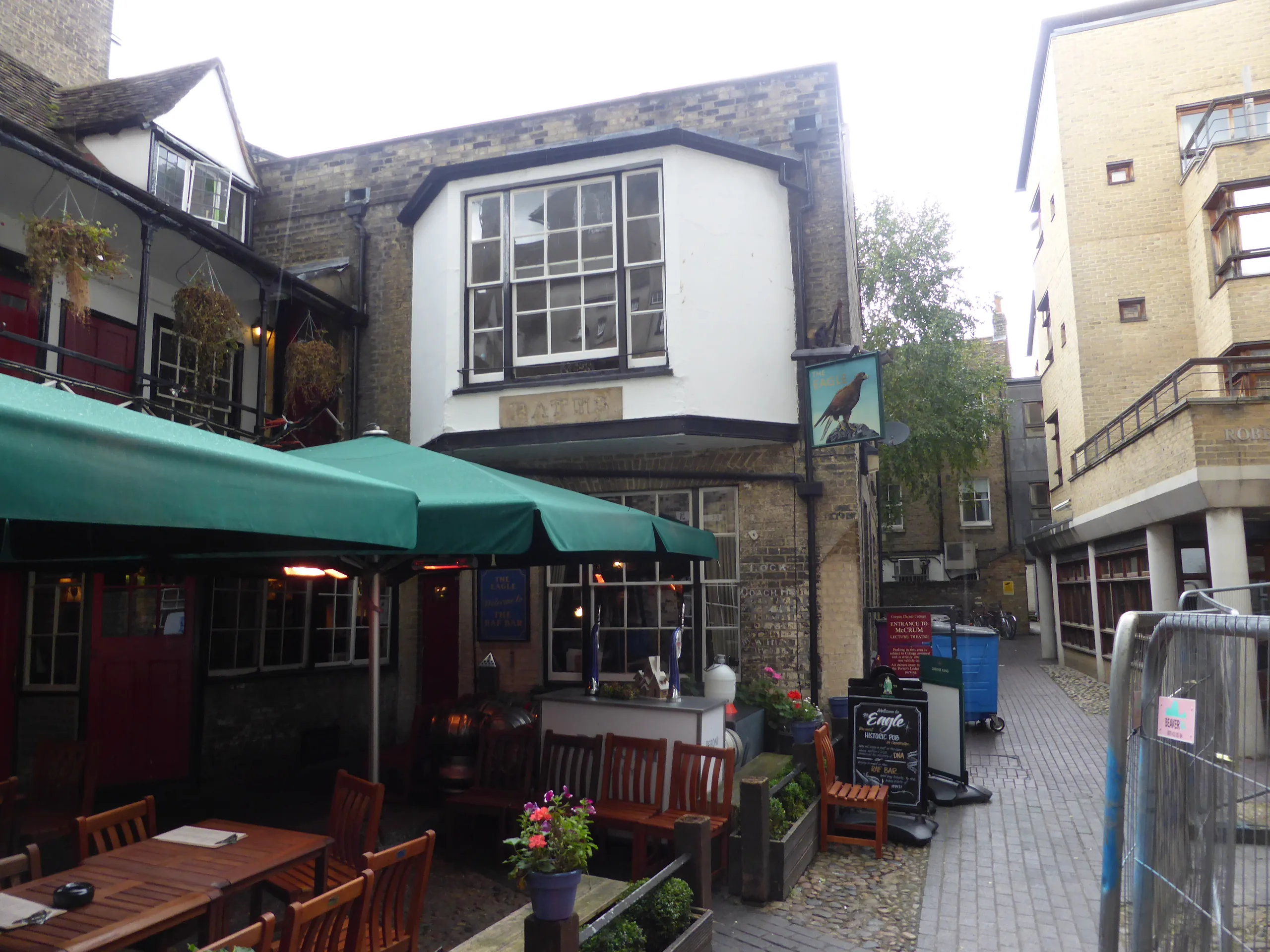
01 The experience
What to expect.
The Eagle is a 17th-century former coaching inn on Bene't Street, in the heart of central Cambridge, and the best-known pub in the city. It is Grade II listed, owned by Corpus Christi College — whose main gate stands almost opposite — and run by the Greene King brewery. Two quite separate claims to fame sit under one roof: it is generally reckoned Cambridge's second-oldest pub, after the Pickerel Inn on Magdalene Street, and it is the pub where, on 28 February 1953, Francis Crick interrupted the lunchtime trade to announce that he and James Watson had "found the secret of life" — the double-helix structure of DNA.
Why it matters
Most old pubs trade on one story. The Eagle carries several, and they are real rather than marketed. The building has been a licensed inn since at least 1566, became a coaching house in 1667, and served for two centuries as a place where Cambridge did its business — elections were fixed here, coaches to London left from the courtyard, and travelling salesmen took rooms upstairs. In the 20th century it acquired two further layers: the ceiling of its back bar, signed and scorched by RAF and USAAF airmen during the Second World War, and the DNA announcement, now marked by a blue plaque outside and a commemorative ale behind the bar. Few pubs anywhere hold that combination of coaching-inn fabric, wartime memory and a genuine turning point in the history of science.
What visitors should notice
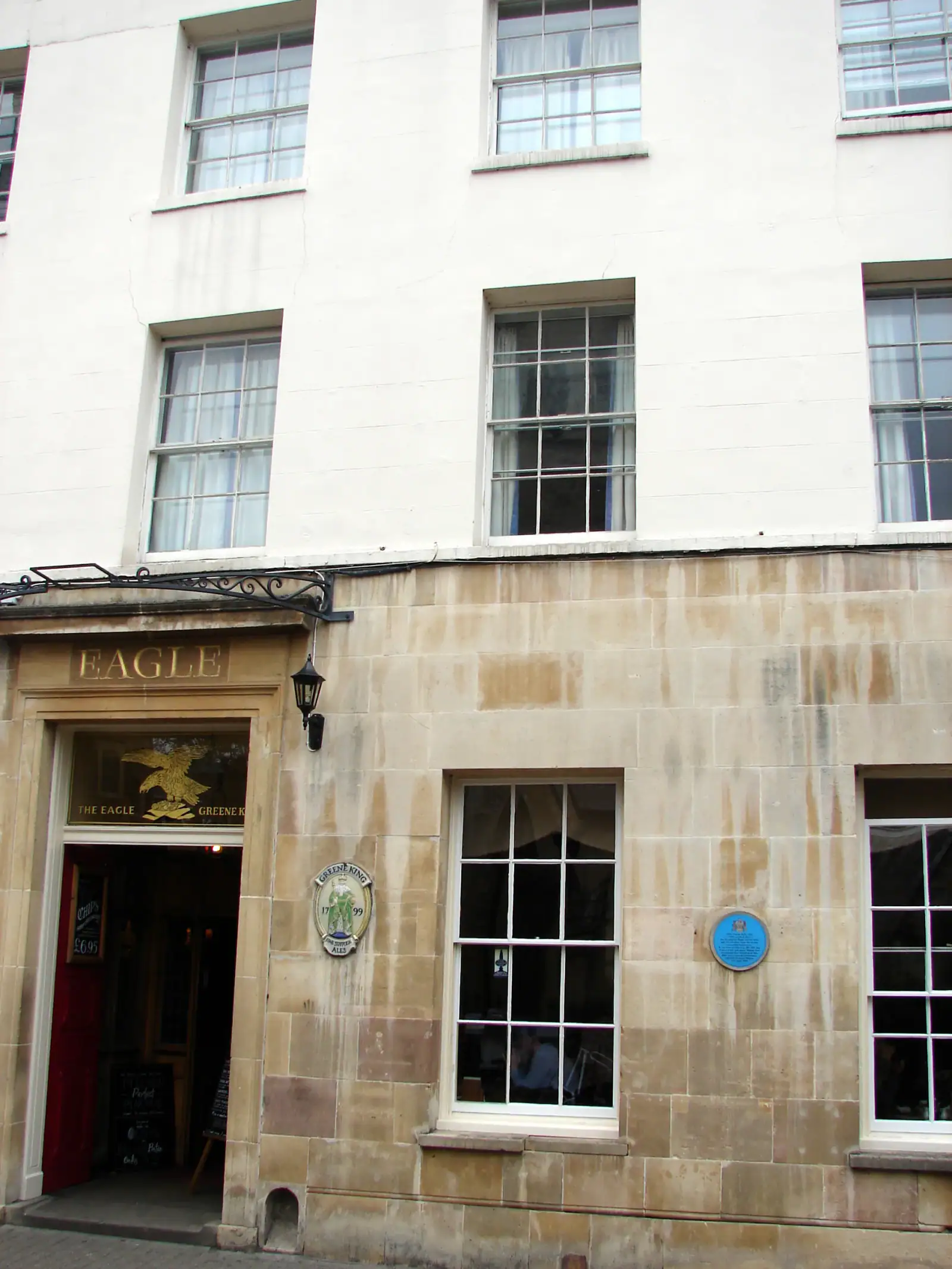
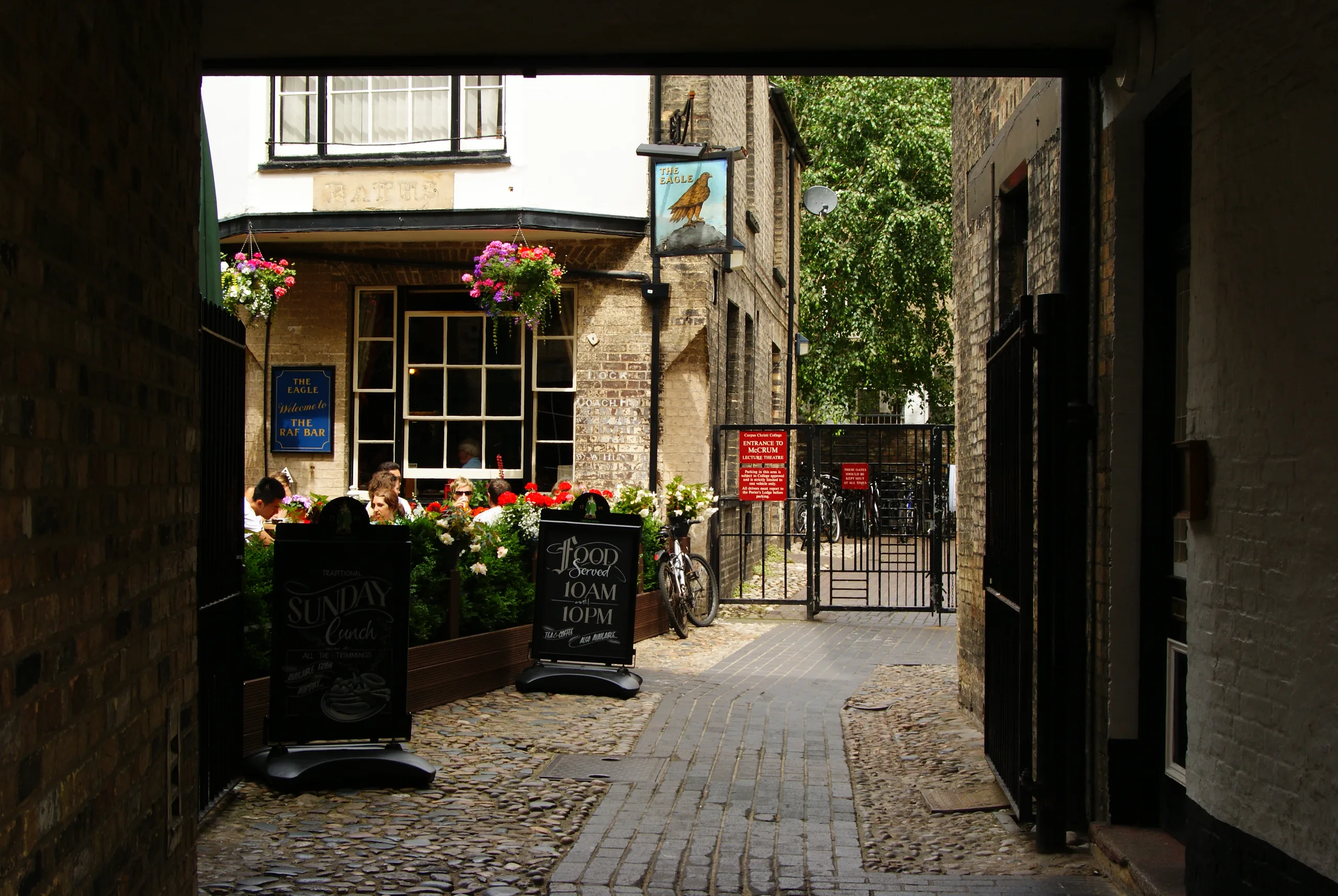
The Eagle is entered from Bene't Street through a passage into an open, galleried courtyard — the coaching yard, where horses were changed and passengers set down. The galleried upper walkway is a survival most English towns have lost. Off the courtyard and the street frontage are several low, panelled rooms; the one at the back, on the right, is the RAF Bar, whose ceiling carries names, squadron numbers and graffiti burned into the plaster with cigarette lighters, candles and lipstick. The room feels ordinary until you look up. The DNA plaque is on the Bene't Street frontage, and St Bene't's Church — whose Anglo-Saxon tower is the oldest surviving building in Cambridgeshire — stands directly across the street.
Who will enjoy it
Anyone interested in history will find more here than the beer. It rewards science-minded visitors, military and aviation-history readers, and anyone who likes a working pub with genuine age in its bones rather than a themed one. It is also simply a convenient, central place to eat and drink between college visits, with a full Greene King food menu and a courtyard that catches the sun.
Who may find it difficult
It is popular, central and often full, especially at weekends, on summer afternoons and during graduation weeks; at busy times the historic rooms are loud and shoulder-to-shoulder, and the RAF Bar can be hard to see properly. Anyone who wants to study the ceiling in peace should come mid-morning or mid-afternoon on a weekday. The building is old, with some low beams and thresholds; step-free access exists but the interior is tight when crowded (see the accessibility file). It is a pub, not a museum: there is no admission, no guide and no interpretation beyond the plaque and a few framed notes, so a visitor who wants the full story should read it before arriving.
Visitor verdict
The Eagle is worth going out of your way for, and it is barely out of anyone's way — it sits two minutes from King's College and the Cavendish's old site on Free School Lane. Come for the history, stay for a drink, and time your visit to avoid the crush if you actually want to see the ceiling and read the plaque. Half an hour is enough to take it in; longer if you eat. Treated as a pint with 450 years of documented history attached, rather than as a quiet historic site, it is one of the most rewarding stops in central Cambridge.
The story
History & character.
Origins: a medieval site and a Tudor inn
The Eagle stands on land that Corpus Christi College has owned since the early 16th century; 2025 marked the 500th anniversary of the College's ownership. The earliest firm evidence that the site was an inn is a lease in the College archives, dated 1566, to Andrew Pylkynton, "innkeeper", and his wife. It describes "their two tenements, a greater and a lesser nowe made an Inne called the Eagle and Child sett and built together in the parishe of St Benett in Cambridge." The name Eagle and Child — a heraldic device associated with the Stanley family — was common to a number of English inns; the Cambridge house was only later shortened to the Eagle.
Excavation has shown the site was in use long before it became a tavern. In 1996, archaeological work in Eagle Yard uncovered a 13th-century well; its upper shaft held a large deposit of cat carcasses, interpreted by the excavators as the by-product of skinning or butchering, deposited in what appears to have been a single episode. The find is a reminder that the courtyard now used for drinks was a working medieval plot centuries before the inn.
Rebuilding and the coaching inn, 17th–19th centuries
The Tudor tenements were substantially rebuilt in the 17th century, and the front range facing Bene't Street dates from around 1600. A lease of 1637 to a Mark Sherman set the rent partly in kind — "a good fat gammon of bacon at audit time and a load of hay" — a normal arrangement for the period, when a college's income came as much in produce as in cash.
The date usually given for the Eagle as a public house is 1667. In that year, on the election of John Spencer as Master of Corpus Christi, the College agreed that the rent owed by the tenant of the Eagle and Child, previously paid in hay, could instead fund wainscotting for the Old Combination Room. From this point the Eagle operated as a coaching house. David Loggan's celebrated map of Cambridge, printed in 1688, marks the building as "The Post House", showing that the innkeeper had secured the contract to supply post horses — a lucrative role on the road between London and the eastern counties.
For the next century and a half the Eagle was one of the busiest hostelries in Cambridge. By 1834 a passenger could board a fast coach to London from the courtyard for four shillings. The inn doubled as a place of public business: it hosted auctions, meetings of University and town societies, and lodgings for commercial travellers, all recorded in the College lease books and the local press. In the 18th and 19th centuries it was also a centre of political intrigue. From 1782 the banker John Mortlock — Member of Parliament and thirteen times Mayor of Cambridge — made the Eagle his base; the dinners he held there were known as the Rutland Club, and from them he ran a system of patronage that dominated the town's politics for nearly half a century. Mortlock is remembered for the line, "That which you call corruption I call influence." The Eagle remained the headquarters of the Cambridge Tories, and was pressed into service at elections, well past the middle of the 19th century.
Decline of the coaching trade and division of the building
The opening of the railway to Cambridge in 1845, and the growth of the network in the following years, ended the coaching business that had sustained the Eagle. By about 1850 the inn had lost its coaching status, and the building was divided: the rear became a tavern and the front a hotel. The hotel lasted only about a decade before the frontage was converted into offices, let for a time to a firm of solicitors and estate agents. The pub trade continued at the back, in the rooms that visitors drink in today, and the galleried courtyard survived the changes.
The RAF Bar and its ceiling, 1939–1945
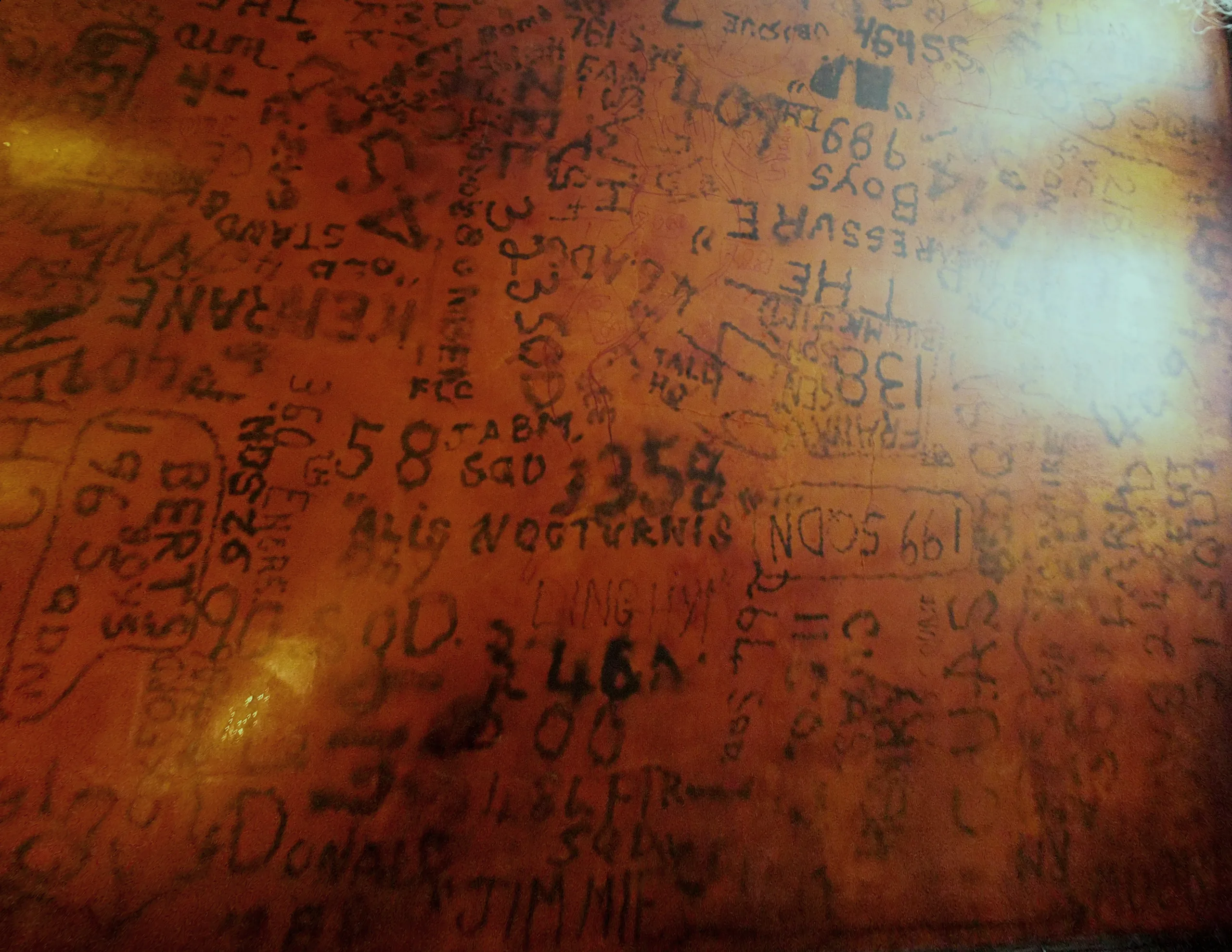
During the Second World War the Eagle was a favourite of aircrew from the many Royal Air Force and United States Army Air Forces bases across Cambridgeshire and East Anglia. In what is now called the RAF Bar — the back room on the right — men on leave began marking the ceiling: squadron numbers, names, the names of sweethearts and the occasional drawing, applied with cigarette lighters, candle smoke, lipstick and, reputedly, a can of burning fuel held up on a billiard cue. The graffiti was left in place after the war and is now preserved. It is a rare survival of ordinary wartime feeling, made by men many of whom did not return, and the room is treated with a degree of respect unusual for a pub back bar.
"The secret of life", 28 February 1953
The Eagle was the local of scientists working at the Cavendish Laboratory, whose old buildings stand a short walk away on Free School Lane. On 28 February 1953, Francis Crick and James Watson came into the Eagle at lunchtime and, in Watson's later account, Crick announced to the room that the pair had "found the secret of life" — they had worked out the double-helix structure of deoxyribonucleic acid, DNA. It was one of the defining moments of 20th-century biology. The pub marks it with a blue plaque on the Bene't Street frontage and with a beer, brewed for the purpose, sold behind the bar. As with all such stories the exact words are debated, but the announcement itself is well documented and the association is genuine, not invented for tourism.
Ownership and the building today
The Eagle remains owned by Corpus Christi College and operated by Greene King. It is listed at Grade II by Historic England (list entry 1126250). The fabric is a mixture of periods — a front of about 1600, much 17th-century rebuilding, and a galleried range around the courtyard behind — and the pub continues to trade as a food-led house while carrying its history openly. It is generally described as Cambridge's second-oldest pub, after the Pickerel Inn on Magdalene Street, a ranking that turns on how one counts the age of a licensed house against the age of a building; the two pubs are close in date and the distinction is a matter of definition rather than a settled fact.
Look closer
Highlights and hidden details.
The objects, spaces and small observations that turn a visit into a memorable one.1. The RAF Bar ceiling
The single most important thing to see, and the one most people walk past. The back room on the right is the RAF Bar, and its ceiling is covered in graffiti left by Royal Air Force and United States Army Air Forces aircrew during the Second World War — squadron numbers, names, sweethearts' names and drawings, applied with cigarette lighters, candle smoke and lipstick. It was kept after the war and is now protected. Look up before you look for a table: the marks are brown and faint against the plaster, and easy to miss in a crowded room. Historical importance: very high. Visitor experience: quiet reverence when the room is empty; hard to appreciate when full. Photography: possible but the ceiling is dim — see the photography file. Time required: 5–10 minutes.
2. The DNA plaque and the "secret of life"
On 28 February 1953 Francis Crick announced in the Eagle that he and James Watson had worked out the double-helix structure of DNA — in Watson's words, that they had "found the secret of life." A blue plaque on the Bene't Street frontage records it, and the pub sells a commemorative ale, "Eagle's DNA". The scientists worked at the nearby Cavendish Laboratory and the Eagle was their local. Read the plaque outside, then have the beer inside: it is one of the few places where you can stand in the room where a genuine scientific turning point was first said out loud. Historical importance: very high. Visitor experience: the plaque is small and easily missed on a busy frontage. Photography: the plaque photographs well. Time required: 5 minutes.
3. The galleried coaching courtyard
Enter from Bene't Street through the passage and you arrive in the open courtyard — the old coaching yard, where horses were changed and passengers set down for the London road. The galleried upper walkway that runs around it is a survival most English towns have lost, and it tells you at a glance what the Eagle was for two centuries: a working transport hub, not just a drinking house. It is now the pub's outdoor seating, and catches the sun late in the morning. Historical importance: high. Visitor experience: pleasant and photogenic; the best seats in warm weather. Photography: strong from the passage looking in. Time required: 5–10 minutes.
4. The Bene't Street frontage and its neighbours
The street front dates from around 1600 and is worth a look from the pavement before you go in — and worth turning around for, because directly opposite stands St Bene't's Church, whose Anglo-Saxon tower (of about 1000–1050) is the oldest surviving building in Cambridgeshire. The pub and the church together compress almost a thousand years of Cambridge into one short street. Historical importance: high. Visitor experience: a two-minute pavement pause that adds a great deal of context. Photography: good; frame the pub sign with the church tower behind. Time required: 5 minutes.
5. A pint of "Eagle's DNA"
The pub brews and sells an ale named for the DNA announcement. It is not a gimmick so much as a small, self-aware nod to the pub's own history, and it makes the obvious souvenir of a visit — a drink you can only order in context here. Ask at the bar; availability varies. Historical importance: low, but the point is the association. Visitor experience: a good excuse to sit down and take the room in. Time required: as long as a pint.
6. The interior rooms and panelling
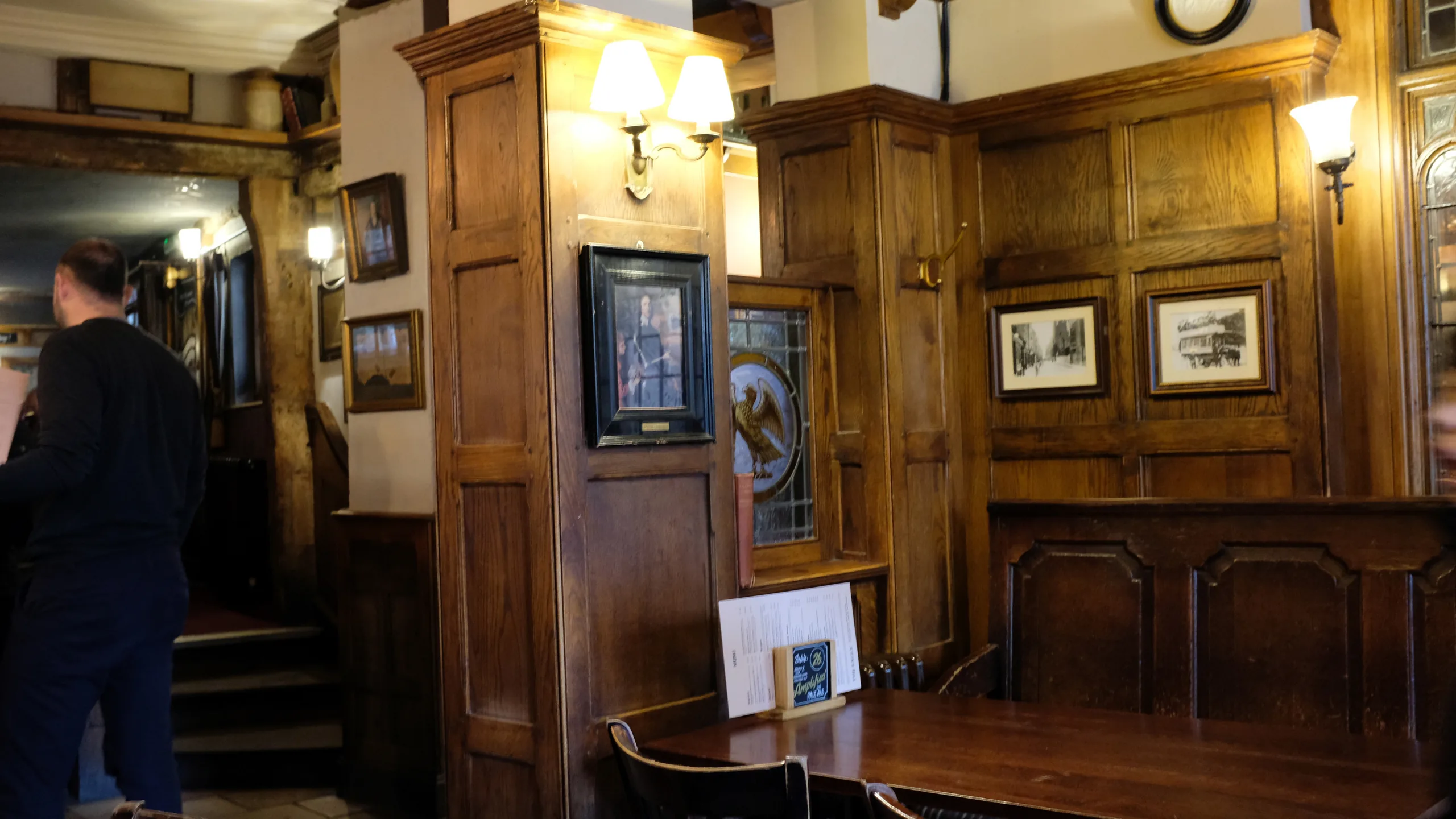
Beyond the headline sights, the Eagle is simply a fine old pub: several interlocking low rooms, 17th-century in feel, with panelling, settles and the worn comfort of a building that has been a bar for well over three hundred years. Away from the RAF Bar, take a moment in the smaller rooms off the courtyard, which are usually quieter and give the clearest sense of the coaching inn the Eagle once was. Historical importance: medium. Visitor experience: best appreciated at a quiet hour. Time required: 10 minutes.
Details worth slowing down for.
The graffiti was made with lighter flame and lipstick
The RAF Bar ceiling looks, from below, like old brown staining. Up close it resolves into deliberate marks: names and squadron numbers scorched into the plaster with cigarette-lighter and candle flame, and others written in lipstick. The stories attached to it — a serviceman standing on another's shoulders, a can of burning fuel raised on a billiard cue to reach the plaster — are pub tradition and cannot all be verified, but the marks themselves are genuine and contemporary. Read them as individual signatures, not decoration: many were made by men who did not come home.
"Eagle and Child", not just "Eagle"
The pub's full historic name was the Eagle and Child, recorded in the 1566 lease. The device — an eagle carrying a child — is a heraldic badge of the Stanley family and appears on inns across England; the Oxford pub of the same name (the "Bird and Baby" of Tolkien and Lewis fame) is unrelated but shares the sign. The Cambridge house dropped the "and Child" over time. Knowing the older name makes sense of the older documents.
Loggan's 1688 map calls it "The Post House"
David Loggan's engraved map of Cambridge, printed in 1688, does not label the building the Eagle at all but "The Post House" — the innkeeper had won the contract to supply post horses. It is a small detail that tells you what the inn actually did: it was part of the communications network of early-modern England, a place where horses and mail changed hands, long before it was a place people came to see.
A 13th-century well full of cats
When Eagle Yard was excavated in 1996, archaeologists found a medieval well whose upper shaft contained a large deposit of cat carcasses, apparently tipped in during a single episode and probably the residue of skinning or butchering. It is an unglamorous but telling reminder that the courtyard now used for lunch was a working plot in the 1200s, generations before the inn existed.
Mortlock's "corruption / influence"
The Eagle's back rooms were, in the late 18th century, the headquarters of John Mortlock's political machine — the Rutland Club dined here. Mortlock, banker, MP and thirteen-times Mayor, is remembered for the remark, "That which you call corruption I call influence." The pub that now trades on science and wartime sentiment was, for half a century, the room where Cambridge's elections were quietly arranged.
The pub is only part of the old inn
The building you drink in is the back of a larger inn. When the railway killed the coaching trade around 1850, the Eagle was divided: the frontage became first a hotel and then solicitors' offices, while the pub retreated to the rear. So the rooms feel slightly tucked-away because they are — the grand coaching frontage went to other uses, and the tavern kept the yard and the back range.
The church across the street is older than everything
It is easy to spend an hour on the Eagle's own history and never turn round. St Bene't's, directly opposite, has a late Anglo-Saxon tower of about 1000–1050 and is the oldest surviving building in Cambridgeshire — older than the University, older than any college, and roughly five centuries older than the inn. The pub's "ancient" reputation is real, but the genuinely ancient thing on Bene't Street is the church tower behind you.
Make it work
Plan the visit properly.
Current practical detail, kept separate from the story so it is easy to scan when you need it.This is the most time-sensitive file in the bundle. Hours, food service and prices change; the details below were verified on 29 July 2026 and should be rechecked monthly against the pub's Greene King listing.
How to use it
The Eagle is a working pub, not a paid attraction. There is no admission charge, no ticket and no need to book to look around — you walk in, and you are welcome to see the courtyard, the RAF Bar and the DNA plaque whether or not you buy anything, though buying a drink is the courteous thing to do. Tables for food can be booked through Greene King; casual drinking is walk-in.
Opening hours
Verified 29 July 2026. Recheck monthly — pub hours change with season and management.
- Monday to Wednesday: 11:00 – 23:00
- Thursday to Saturday: 11:00 – 00:00 (midnight)
- Sunday: 12:00 – 22:30
Kitchen / food service (approximate):
- Monday to Thursday: 11:30 – 22:00
- Friday and Saturday: 11:00 – 22:00
- Sunday: 12:00 – 21:00
Food times in particular drift; confirm on the day if you are travelling to eat.
Address and contact
- Address: 8 Bene't Street, Cambridge, CB2 3QN
- Website: greeneking-pubs.co.uk/pubs/cambridgeshire/eagle
- Operator: Greene King (pub); freehold owned by Corpus Christi College
Admission and booking
Free to enter. No booking for drinks. Tables for meals can be reserved through the Greene King website or by telephone; walk-in dining is usually possible outside peak times. There are no guided tours — the history is self-guided, so read ahead (see the history and highlights files).
Best time to visit
For the building and the RAF ceiling, come on a weekday between roughly 10:30 and 12:00, or mid-afternoon (14:00–16:00), when the rooms are quiet enough to look up and read. Avoid Friday and Saturday evenings, warm summer afternoons and graduation periods (late March, late June and July), when the pub is full and the historic rooms are standing-room. The courtyard is best on a sunny late morning.
How long to allow
Fifteen to thirty minutes to see the courtyard, the RAF Bar and the plaque. Allow an hour or more if you are eating. It combines naturally with King's College, the Corpus Clock and the Cavendish site, so most visitors fold it into a wider walk rather than making a special trip.
Facilities
- Full food menu (Greene King pub fare: pies, steaks, burgers, small plates, Sunday roasts), plus cask and keg beer, wine and spirits
- The "Eagle's DNA" commemorative ale is usually available
- Toilets on site
- Free Wi-Fi
- Outdoor seating in the galleried courtyard
- Card payment accepted
Accessibility (summary)
Step-free access to the ground floor and courtyard is available; the building is old, with some uneven surfaces, low beams and tight spaces when busy. See the dedicated accessibility file for detail. Anyone with access needs should consider visiting at a quiet time, when staff have more capacity to help.
Families, dogs, weather
Children are welcome when dining, subject to the usual licensing rules on under-18s in a bar; it is a pub rather than a family attraction, so manage expectations (see the family file). Well-behaved dogs are generally welcome in the bar areas, as at most Greene King pubs — confirm on arrival. The courtyard is part-sheltered but open to the weather; the interior rooms make it a sound rainy-day stop. On a wet day it is one of the more atmospheric places in the city to wait out a shower.
Getting there
Central, and best reached on foot. From Cambridge railway station it is about a 20–25 minute walk, or a short bus ride to the city centre. The pub is on Bene't Street, off King's Parade and Trumpington Street, a minute from the Corpus Clock and two minutes from King's College. Cambridge city centre is effectively car-free for visitors; use a Park & Ride site rather than driving in. Cycle parking is available on nearby streets.
Crowd levels
Consistently busy for a city-centre pub. Lunchtimes, early evenings, weekends and the University's ceremonial weeks are the peaks. Weekday mornings and mid- afternoons are the reliable quiet windows.
Visit your way
Access and family planning.
Written to help you decide whether a visit is feasible. Where a detail could not be verified from a reliable source, it says so — a wrong reassurance wastes a journey. Verified 29 July 2026; recheck with the pub before a special trip.
Step-free access
The pub advertises disabled access, and there is step-free entry from Bene't Street to the ground-floor rooms and the courtyard, which is where all the significant features are. The building is 17th-century, however, so expect some uneven floors, worn thresholds and low beams in places. None of the highlights — the RAF Bar, the courtyard, the DNA plaque — requires stairs.
Wheelchairs and mobility
Ground-floor circulation is workable when the pub is quiet and difficult when it is full, because the rooms are small and the furniture is close-set. A wheelchair user or anyone using a frame will have a far easier visit on a weekday morning or mid-afternoon than at a weekend or evening peak. The courtyard is the most comfortable space for wheeled access and for anyone who wants room to turn.
Toilets
Standard toilets are available. An accessible toilet and its dimensions are not confirmed; telephone the pub before visiting if you need step-free facilities.
Sensory considerations
- Noise: The Eagle can be very loud at busy times — hard for anyone sensitive to noise, and difficult for lip-reading or hearing-aid users. A quiet weekday hour is a different, calmer place.
- Lighting: The interior is deliberately dim and the historic rooms are low-lit; the RAF ceiling in particular is hard to see, which affects visitors with low vision. Daylight in the courtyard is much better.
- Visual impairment: There is no large-print or tactile interpretation. The key features are visual (a ceiling, a plaque), so a sighted companion's description adds a lot.
Seating and rest
Plenty of seating throughout, but it fills quickly; booking a table is the reliable way to secure a place to sit if standing is difficult. The courtyard has open seating in good weather.
The practical recommendation
If access matters, visit at a quiet time — weekday late morning or mid- afternoon — when staff have the capacity to help and the rooms are navigable, and phone ahead to confirm the accessible-toilet position. Treated that way, the ground-floor experience — courtyard, RAF Bar, plaque — is achievable for most visitors.
The honest picture
The Eagle is a pub, and a busy central one, not a family attraction. Children are welcome when the family is eating, within the normal licensing rules that apply to under-18s in bars, but there is no children's trail, no play area and nothing staged for young visitors. Families do come here — usually to eat, often as one stop on a wider Cambridge day — and it works well for that if you set expectations accordingly.
Ages and what they'll get from it
- Under 5s: Fine for a meal, but the history will pass them by. Bring the usual distractions; the courtyard gives a toddler somewhere to look at while you eat.
- 5–10s: The RAF ceiling can genuinely capture this age if you tell the story first — real airmen wrote their names up there during a war. The "secret of life" plaque is a harder sell but works for a curious child who likes "this is where a big discovery was announced."
- 11–16s: The best age for the Eagle. The DNA story lands for anyone doing school science, and the wartime ceiling is tangible history. Ten focused minutes, well told, is worth more than a full biology lesson.
Educational value
High, if you use it. The Eagle joins two school topics — the structure of DNA and the home front / air war of 1939–45 — to a real, standing place. Pair it with the Cavendish Laboratory's old site on Free School Lane (where the DNA work was done) and you have a short, self-contained science-history walk.
Practical friction points
- Crowds and noise: At busy times it is loud and packed; a pushchair is awkward and the historic rooms are hard to move through.
- Seating: Booking a table for food is the way to guarantee somewhere to sit with children; drinking areas fill fast.
- It's a bar: Alcohol is the main trade and the atmosphere is adult, especially in the evening. Come at lunchtime with children, not at night.
- Boredom risk: Real for younger children once the food is finished — the visit is short by design. Have the next stop ready.
The efficient family version
Arrive late morning on a weekday, look at the frontage and the church opposite, go in, find the RAF Bar and look up together, read the DNA plaque on the way out, and move on to King's College or the Fitzwilliam. Fifteen minutes, one good story told well, no fight over a long sit-down.
Self-guided walk
Explore beyond the venue.
A practical, step-by-step route connecting this experience with more of Cambridge.Stop 1 — The Eagle, Bene't Street (start)
Begin on the pavement outside, on Bene't Street. Look at the 17th-century frontage and find the blue DNA plaque before you go in. Step inside to the galleried courtyard, then find the RAF Bar (back room, right) and look up at the wartime ceiling. Have a drink now or save it for the end. When ready, come out and turn to face the church directly opposite. Photo stop: the pub sign with the church tower behind. 10–15 minutes.
Stop 2 — St Bene't's Church (30 seconds)
Cross Bene't Street to St Bene't's. Its tower, of about 1000–1050, is the oldest surviving building in Cambridgeshire — older than the University and every college. Step inside if it is open (it usually is, and it is free). Standing here, you have the city's oldest building and its most famous pub within thirty paces of each other. 5–10 minutes.
Stop 3 — Free School Lane and the old Cavendish Laboratory (3 minutes)
Walk east along Bene't Street to the corner, turn right down Free School Lane. This narrow lane holds the old Cavendish Laboratory, where Crick and Watson worked out the structure of DNA — the discovery they announced back at the Eagle. The Whipple Museum of the History of Science is here too (free; check opening times). This is the other half of the DNA story: the bench where it was done, a two-minute walk from the bar where it was told. Photo stop: the Cavendish doorway and lane. 10 minutes, longer with the museum.
Stop 4 — The Corpus Clock and Corpus Christi College (3 minutes)
Return to Bene't Street and continue to its western end at Trumpington Street / King's Parade. On the corner is the Corpus Clock — the gilded "Chronophage" with its grasshopper — on the frontage of Corpus Christi College, the Eagle's owner for 500 years. Look through the gate to Old Court if the College is open to visitors. Photo stop: the Corpus Clock. 5–10 minutes.
Stop 5 — King's Parade and King's College (5 minutes)
Walk north up King's Parade, one of the great street scenes in England, to King's College and its chapel. You need not go in to feel the scale; the frontage and the chapel's pinnacles are the point. This is the grand, ceremonial Cambridge that the Eagle — a working pub in a side street — quietly served for centuries. Photo stop: King's College Chapel from the Parade. 10–15 minutes.
Stop 6 — Market Square and back (5 minutes)
Cut north-east to Market Square for the daily market, then wind back south through the lanes to Bene't Street. If you saved your drink, this is the moment: back into the Eagle, order a pint of "Eagle's DNA", and sit in the room where the walk began. End where you started. 10 minutes plus a drink.
Notes
The whole loop is flat and central; nothing on it costs money to enter except food and drink. In wet weather, compress it — the Eagle, the church and Free School Lane are all close and partly sheltered — and save King's for a clear day.
Make a record
Photograph it thoughtfully.
The strongest compositions
- The frontage with the church behind. From the north pavement of Bene't Street, frame the Eagle's hanging sign and 17th-century front with St Bene't's Anglo-Saxon tower rising across the street. It is the one shot that tells the whole story of the place — old inn, older church — in a single frame.
- The courtyard from the passage. Standing in the entrance passage looking in, the galleried coaching yard reads clearly, with the upper walkway leading the eye. Best in late-morning sun, which reaches the yard and lights the gallery.
- The RAF ceiling. The signature detail shot. It is dim and high, so it is the hardest to take well (see below), but a clean frame of the scorched names is the image people remember.
- The DNA plaque. A simple, well-lit record shot on the frontage; include a little of the surrounding brick for context rather than filling the frame with the plaque alone.
Light and timing
The courtyard and frontage are best in the morning, when the sun is on Bene't Street and the yard is not yet full. Interiors are dim at any hour. For the building without crowds, the quiet weekday windows (10:30–12:00 and 14:00–16:00) are also the best photographic windows — an empty RAF Bar is both easier to shoot and more respectful to.
Shooting the RAF ceiling
The ceiling is high, brown against off-white plaster, and lit only by low ambient light. Practical advice: brace against a table or wall for a slow hand-held exposure rather than raising ISO until it is noise; do not use direct on-camera flash, which flattens the marks and disturbs other drinkers; a phone's night mode, held very still, often does better than a "correct" exposure. Expect to work the shot — this is not a grab.
Etiquette and permissions
The Eagle is a working pub full of people who are there to drink, not to be photographed. Keep other customers and staff out of frame, or ask first; photograph the room and the details, not the strangers at the next table. There are no general restrictions on personal photography of the building and its features, but the RAF ceiling is, in effect, a war memorial — photograph it quietly and without fuss. Commercial or drone photography would need the permission of Greene King and, for the building, potentially Corpus Christi College; arrange that in advance rather than turning up with a rig. Tripods are impractical and unwelcome inside a busy pub.
Around here
Make more of the area.
Good to know
Questions, answered.
01Where is the Eagle in Cambridge?
On Bene't Street, in the centre of the city (CB2 3QN), a minute from the Corpus Clock and King's Parade and about two minutes from King's College.
02Is the Eagle really where DNA was discovered?
Not discovered — announced. Francis Crick and James Watson worked out the double-helix structure of DNA at the nearby Cavendish Laboratory, and on 28 February 1953 announced it to the room at the Eagle, their local. A blue plaque outside records it.
03Is the Eagle the oldest pub in Cambridge?
No. It is usually described as the second-oldest, after the Pickerel Inn on Magdalene Street. The ranking depends on whether you date a pub by its building or its licence; the two are close in age.
04How old is the Eagle?
The site was a licensed inn — the Eagle and Child — by 1566, its front range dates from about 1600, and it opened as a coaching house in 1667. So it has been an inn for well over 400 years.
05What is the RAF Bar?
The back room on the right, whose ceiling carries graffiti — names, squadron numbers and drawings — left by RAF and American aircrew during the Second World War, burned and written into the plaster. It has been preserved ever since.
06Can I see the RAF ceiling for free?
Yes. There is no admission to the pub; you can walk in and look. Buying a drink is the courteous thing to do, and coming at a quiet time makes the ceiling far easier to see.
07Who owns the Eagle?
The freehold belongs to Corpus Christi College, which has owned the site for 500 years. The pub is run by the Greene King brewery.
08Do I need to book?
Not to drink or to look around — walk in. For a meal, especially at busy times, booking a table through Greene King is wise.
09What are the opening hours?
Roughly Monday–Wednesday 11:00–23:00, Thursday–Saturday 11:00–midnight, and Sunday 12:00–22:30 (verified July 2026; confirm before travelling, as pub hours change).
10Does the Eagle serve food?
Yes — a full Greene King menu of pub food (pies, steaks, burgers, small plates, Sunday roasts). Kitchen hours are shorter than bar hours; check on the day.
11What is "Eagle's DNA"?
An ale sold at the pub, named for the 1953 DNA announcement. It is the natural thing to order if you have come for the history.
12Is the Eagle suitable for children?
Children are welcome when eating, under the usual rules for under-18s in bars. It is a pub rather than a family attraction, and works best as a short, lunchtime stop rather than an evening one.
13Is the Eagle wheelchair accessible?
There is step-free access to the ground floor and courtyard, where all the main features are. The building is old and tight when busy; a quiet weekday visit is much easier. Phone ahead to confirm the accessible toilet.
14Are dogs allowed?
Well-behaved dogs are generally welcome in the bar areas, as at most Greene King pubs. Confirm on arrival.
15How long should I spend there?
Fifteen to thirty minutes to see the courtyard, RAF Bar and plaque; an hour or more if you eat.
16When is the best time to visit?
Weekday late morning (10:30–12:00) or mid-afternoon (14:00–16:00), when the historic rooms are quiet enough to see properly. Avoid weekend evenings and graduation weeks.
17Is the Eagle always busy?
Often, yes — it is a popular central pub. The reliable quiet windows are weekday mornings and mid-afternoons.
18Can I photograph the RAF ceiling?
Yes, for personal use, but it is dim and high, so it takes care. Avoid flash, keep other customers out of frame, and treat it as the war memorial it effectively is.
19What is the church opposite?
St Bene't's, whose Anglo-Saxon tower (about 1000–1050) is the oldest surviving building in Cambridgeshire — older than the University and any college.
20Is the Eagle connected to the Eagle and Child in Oxford?
No. Both used the "Eagle and Child" sign — a Stanley family badge common to many inns — but they are unrelated pubs in different cities.
21How do I get to the Eagle from the railway station?
About a 20–25 minute walk into the centre, or a short bus ride. The centre is effectively car-free for visitors; use Park & Ride if driving to Cambridge.
22Is there outdoor seating?
Yes — the galleried courtyard, which is the pub's outdoor area and catches the morning sun.
23Is the Eagle worth visiting if I'm not drinking?
Yes. The history — the RAF ceiling, the DNA plaque, the coaching courtyard — is the reason to come, and none of it requires a drink, though a pub appreciates custom.
24What was the Eagle originally called?
The Eagle and Child, recorded in a lease of 1566. The "and Child" was dropped over time.
25Why is it called the Post House on old maps?
David Loggan's 1688 map labels it "The Post House" because the innkeeper held the contract to supply post horses — a normal role for a coaching inn of the period.
26Did the Eagle really host political corruption?
In the late 18th century its back rooms were the base of John Mortlock's political machine (the "Rutland Club"). Mortlock, an MP and thirteen-times Mayor, is remembered for the line, "That which you call corruption I call influence."
27Is the DNA quotation accurate?
The "found the secret of life" line comes from James Watson's later account, so treat it as a well-known recollection rather than a recorded transcript. The announcement itself is well documented.
28Can I combine the Eagle with other sights?
Easily. St Bene't's is opposite, the Corpus Clock and Corpus Christi are a minute away, King's College and the old Cavendish Laboratory are five minutes off, and the Fitzwilliam Museum is about ten.
29Is the Eagle a Greene King pub?
Yes — it is operated by Greene King, though the building is owned by Corpus Christi College.
30Is there an entry fee or a tour?
No entry fee and no formal tour. The history is self-guided; read about it before you arrive to get the most from a short visit.
Before you visit
Useful links.
Venue and visitor information
Every substantive factual claim in this bundle traces to a source below. Prioritised: Historic England, Corpus Christi College (freeholder, with archival access), the operator (Greene King), and reference works. Verified 29 July 2026.
Primary sources
- Historic England, National Heritage List for England — The Eagle, Bene't Street, Cambridge. List entry 1126250, Grade II. Used for: listed status and grade; the c.1600 date of the front range; architectural description. https://historicengland.org.uk/listing/the-list/list-entry/1126250
- Corpus Christi College, Cambridge — "Corpus Christi and the Eagle Pub" (College feature, published 2025 for the 500th anniversary of College ownership). Used for: 1566 lease to Andrew Pylkynton naming the "Eagle and Child"; 17th-century rebuilding; 1637 lease to Mark Sherman; 1667 opening as a coaching house under Master John Spencer; Loggan's 1688 map labelling it "The Post House"; 1834 coach fare to London; John Mortlock / Rutland Club and the "corruption / influence" quotation; division of the building after the railway (c.1850); 1996 Eagle Yard excavation and the 13th-century well of cats. https://corpus-christi-college.shorthandstories.com/corpus-christi-and-the-eagle-pub/
- Greene King — The Eagle, Cambridge (official pub listing). Used for: current opening and kitchen hours (read 2026-07-29); address; "17th century, Grade II listed" description; food offer; free Wi-Fi and disabled access; "opposite St Bene't's, the oldest surviving building in Cambridgeshire"; the DNA association as told by the operator. https://www.greeneking-pubs.co.uk/pubs/cambridgeshire/eagle
Secondary / corroborating sources
- Wikipedia — "The Eagle, Cambridge" (citing Historic England and Greene King). Used to corroborate: opened 1667 as a coaching inn; front of c.1600; galleried 19th-century wing to the courtyard; freehold owned by Corpus Christi, managed by Greene King; "second oldest pub in Cambridge, after the Pickerel Inn." Treated as corroboration of the primary sources, not as a primary source. https://en.wikipedia.org/wiki/The_Eagle,_Cambridge
- James D. Watson, contemporary and later accounts of 28 February 1953. Used for: the "found the secret of life" announcement at the Eagle. Presented as a well-known recollection; the announcement's association with the pub is independently attested by the blue plaque and by the Cavendish/DNA literature.
- St Bene't's Church (parish information) and general Cambridgeshire heritage records. Used for: the Anglo-Saxon tower of c.1000–1050 being the oldest surviving building in Cambridgeshire.
Conflict ledger
- "Oldest vs second-oldest pub." Popular sources sometimes call the Eagle Cambridge's oldest pub; Corpus Christi, Wikipedia and most local histories rank it second, after the Pickerel Inn, and note the ranking depends on dating a licence versus a building. Resolution: the bundle states "second-oldest, after the Pickerel," and explains the ambiguity rather than picking a winner.
- The founding date (1566 vs 1667). The site was a licensed inn by 1566 but "opened as a coaching house" in 1667; loose sources give one or the other as "the" date. Resolution: both are stated with their meanings — 1566 the earliest inn record, 1667 the coaching house — and the bundle avoids a bare "dates from 1667."
- The DNA quotation. Exact wording of Crick's announcement varies between retellings. Resolution: attributed to Watson's account and flagged as a recollection, not a transcript.
- Kitchen hours. Greene King's listing shows food times that differ slightly by day and change often. Resolution: recorded with a
verified_ondate and a monthly recheck flag; readers are told to confirm on the day.
Opening hours, prices, programmes and access arrangements can change. Confirm critical details with the venue.
Continue exploring / Cambridge
More things to do
in Cambridge
Explore Cambridge activities, sights and places to eat. Compare the time to allow, costs and booking details, then save your favourites to your itinerary.
 01Culture & historyFitzwilliam MuseumExplore experience →
 02Culture & historyKettle's YardExplore experience →
 03Culture & historyKing's CollegeExplore experience →
 04Food & drinkFort St GeorgeExplore experience →
 05Food & drinkThe Blue Ball, GrantchesterExplore experience →
 06Food & drinkThe Cambridge BlueExplore experience →
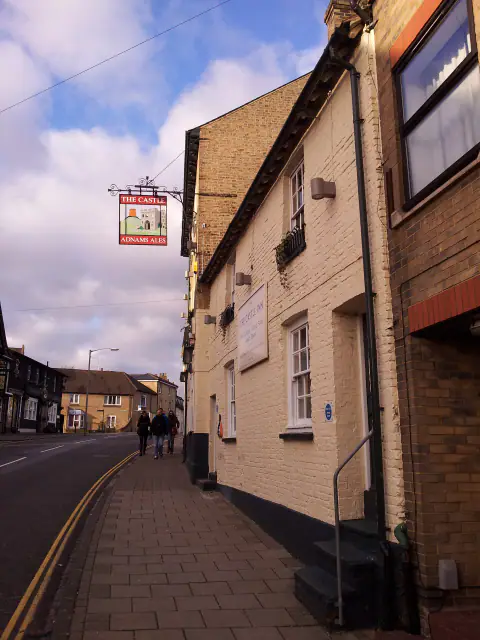 07Food & drinkThe Castle InnExplore experience →
 08Food & drinkThe Devonshire ArmsExplore experience →
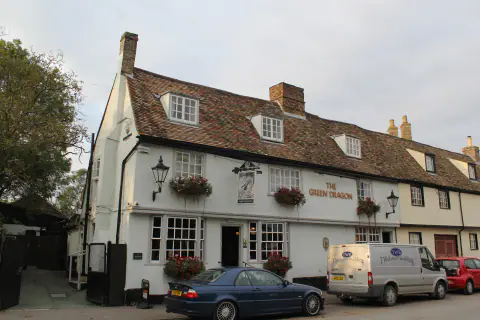 09Food & drinkThe Green DragonExplore experience →
 10Food & drinkThe HaymakersExplore experience →
 11Food & drinkThe Kingston ArmsExplore experience →
 12Food & drinkThe Live & Let LiveExplore experience →
 13Food & drinkThe MaypoleExplore experience →
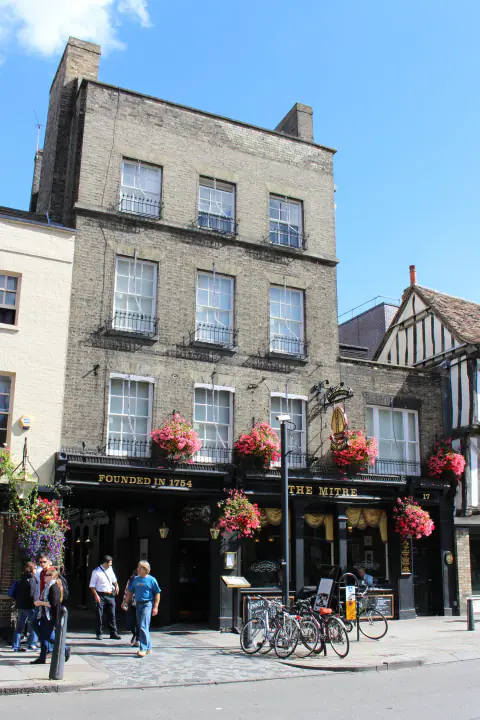 14Food & drinkThe MitreExplore experience →
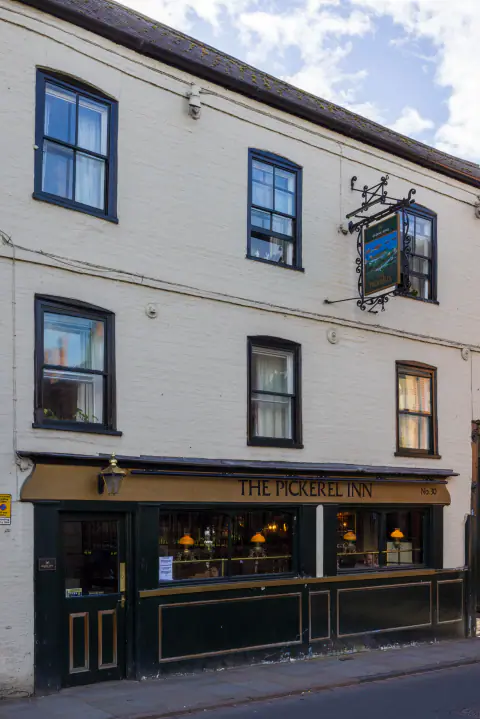 15Food & drinkThe Pickerel InnExplore experience →
 16Food & drinkThe Queen’s Head, NewtonExplore experience →
 17Food & drinkThe Royal StandardExplore experience →
 18Food & drinkThe St RadegundExplore experience →
 19OutdoorsCambridge University Botanic GardenExplore experience →
 20Water activitiesPunting the BacksExplore experience →
 35CollegesAll the collegesEvery Cambridge collegeOpen the college guide →Food & drink / a storyThe six oldest pubsWalk the timeline →Plan / Itinerary builderBuild your Cambridge dayStart planning →