Above Guide / The essential Cambridge guide
Plan your Cambridge.
Keep the surprise.
Understand the city before you arrive — how the collegiate city fits together, when to come, how to get here and around, and what you can actually get into.
The complete itinerary builder
Ready-made routes. Made flexible.
Choose the time you have and the mood you want. Compare complete Cambridge itineraries, see every stop and adapt the route to your day.
Build my Cambridge itinerary→04 / The useful reality
Know it
before you go.
Open only the details you need. The important thing is to understand access, movement and the rhythm of the working university before fixing your route.
01Start with how Cambridge is put together+
Cambridge isn't a single campus. The University and its 31 colleges form one institution but operate as complementary parts. The colleges are independent: they admit and house students, run their own libraries and chapels, and deliver the small-group supervision teaching Cambridge is known for. The central University provides the lectures, laboratories and examinations, and confers every degree. A student belongs to both at once.
The consequence for a visitor is the thing to grasp first: most of what you'll walk past is a private, working institution, not an attraction. That shapes what you can see and when — but it is also what makes Cambridge feel the way it does: brick and stone courts, chapels and gardens glimpsed through gatehouses along ordinary shopping streets.
02The lie of the city+
The historic core sits on the east bank of the River Cam: a tight medieval grid of college gatehouses, courts and the market square strung along King's Parade, Trinity Street and St John's Street. Behind the riverside colleges lie the Backs — the strip of lawns, meadows and bridges on the river's west side that gives the classic view of King's College Chapel. The Cam flows in from Grantchester in the south-west, curves past the Backs and under Magdalene Bridge below Castle Hill (the Norman town site, north-west of the river), then runs north-east past Jesus Green and Midsummer Common; the railway station and its modern quarter lie about a mile south-east of the centre, connected by Hills Road and Regent Street.
03When to come+
Cambridge works year-round. Late spring and summer suit punting and the riverside, though the colleges close to visitors during the exam period from roughly mid-April to mid-June — the trade-off of the prettiest season. Autumn term brings student life back to the streets; winter is quiet, with early light on the stone and the carol services of December.
04How long you need+
A full day covers King's College Chapel, a punt along the Backs and the historic core. Two days adds the Fitzwilliam Museum, the Botanic Garden and the walk out to Grantchester. Beyond that, the day trips — Ely, Anglesey Abbey, Duxford — start to earn their place.
05Getting here+
Two operators run direct trains from London: Great Northern from King's Cross, with non-stop services taking around 48–50 minutes (stopping services nearer 1 hour 15 minutes), and Greater Anglia from Liverpool Street, typically 1 hour 10 minutes to 1 hour 25 minutes. Cambridge has two stations: Cambridge, about a mile southeast of the centre (a 20–25 minute walk or short bus ride up Hills Road and Regent Street), and Cambridge North, roughly two miles north near Chesterton and the Science Park — useful for the river at Fen Ditton but not for the historic core. National Express coaches run from London Victoria in roughly 2 to 2.5 hours, and direct coaches link Stansted Airport (about 30 miles south) with the city. Drivers should avoid the restricted, camera-enforced centre and use the five Park & Ride sites on the main approach roads: Trumpington (south-west, off the M11), Babraham Road (south), Madingley Road (west), Milton (north) and Newmarket Road (east), each with frequent buses into the centre.
06Getting around+
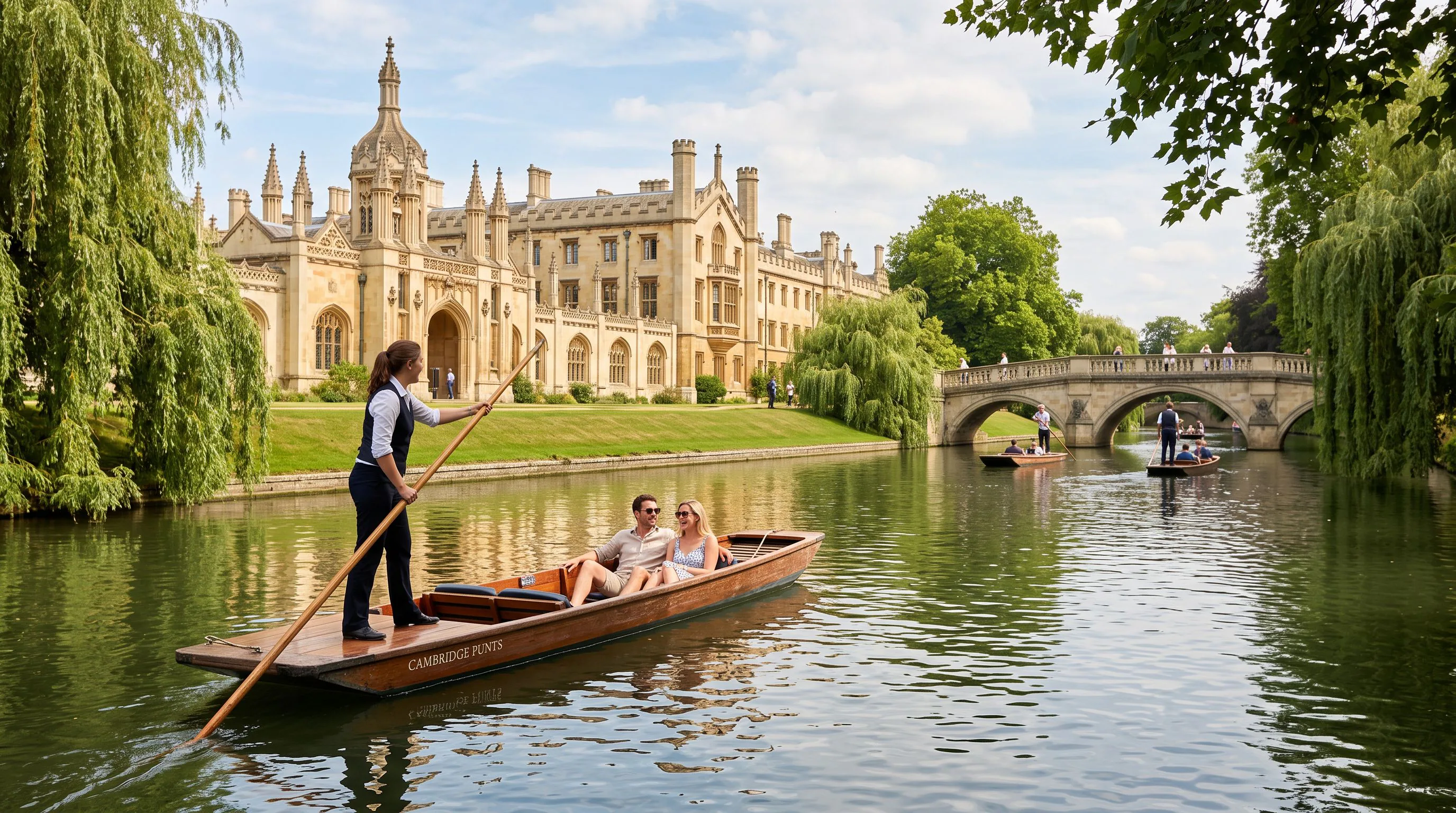
The historic centre is flat, compact and substantially pedestrianised — King's Parade, the market and the main college gates all sit within a 15-minute walk of each other, and no central sight is more than about 25 minutes on foot from the railway station. Cambridge is Britain's most-cycled city and hire bikes are widely available, though visitors on foot should treat every street as a cycle route. Punting along the Backs is as much a way of seeing the riverside colleges as an attraction in its own right — chauffeured or self-hire from Mill Lane, Garret Hostel Lane and Quayside by Magdalene Bridge. Local buses radiate from the centre, including the Universal (U) service linking the station, the city and West Cambridge, and the guided busway runs north to St Ives; most visitors need buses only for the Park & Ride and outlying trips.
07Visiting the colleges+
The 31 colleges are independent institutions that set their own visiting rules, hours and prices, so always check the individual college website before making a plan. A handful of the most famous charge admission — King's, Trinity, St John's and Queens' — while many others are free or open only at set times, and some admit no visitors at all. Nearly all colleges close or heavily restrict access during the exam period, roughly mid-April to mid-June, and may also close for events, graduations and the winter holidays. Visitors are asked to keep to marked routes, stay off the grass and remember the courts are working homes and workplaces.
08The river, the Backs and Grantchester+
The River Cam defines the city: the middle stretch past the Backs — under the Bridge of Sighs, the Mathematical Bridge and Clare Bridge — is the classic chauffeured punt route, while the quieter upper river winds three miles south-west through meadows to Grantchester. Scudamore's, punting on the Cam since 1910, operates from Mill Lane and Quayside alongside several other companies offering chauffeured tours (about 45–50 minutes for the Backs) and self-hire. The walk to Grantchester across Grantchester Meadows is a flat, well-trodden two miles or so each way from Newnham, ending at the village pubs and the Orchard Tea Garden; strong walkers combine it with a punt back. Swans, rowing eights (on the lower river beyond Jesus Lock) and cattle grazing the commons are all part of the traffic.
09Where to get a view+
The tower of Great St Mary's, the University Church opposite King's College on the market square, gives the best panorama in the city: 123 steps up a narrow spiral staircase (small admission charge) to a 360-degree view over King's College Chapel, the market and the colleges, with Ely Cathedral visible on a clear day. Castle Mound, the remains of the Norman motte off Castle Street north-west of the river, is free, open access and the highest ground in central Cambridge, with a short climb to a wide view back over the spires.
10Green Cambridge+
Cambridge's centre is threaded with open green space. The Backs runs behind the riverside colleges and frames the postcard views; Jesus Green, beside the river north of the centre, has plane-tree avenues, tennis courts and an outdoor lido; Midsummer Common, adjoining it downstream, still grazes cattle and hosts Midsummer Fair and the city's bonfire night. Parker's Piece, the flat 25-acre square of grass near the station side of town, is where the Cambridge Rules that shaped association football were played in the nineteenth century. The Cambridge University Botanic Garden, a 40-acre garden of glasshouses, systematic beds and a lake a short walk from the station on Trumpington Road, is a paid attraction and the best half-day of planting in the city.
11Beyond the city+
Ely, 15–20 minutes north by direct train, has one of England's great cathedrals — the Octagon lantern tower — plus Oliver Cromwell's House and a small riverside quarter. Grantchester, reachable on foot or by punt along the upper river, is the classic half-day out: meadows, the Orchard Tea Garden and village pubs. Anglesey Abbey (National Trust), about six miles north-east at Lode, combines a Jacobean-style house with celebrated gardens, a winter garden and the working Lode watermill. Imperial War Museum Duxford, some ten miles south beside junction 10 of the M11, is Europe's largest air museum, with hangars of historic aircraft, the American Air Museum and regular air shows; it is easiest reached by car, as bus links are limited.