The bridge Newton did not build
It is the most repeated story in the city, and it is not true in any of its parts.
Isaac Newton did not design, build or have anything to do with the Mathematical Bridge at Queens’ College. He died in 1727. The bridge was built in 1749 — twenty-two years later — to a design by William Etheridge, constructed by James Essex.
The rest of the story goes that the bridge was originally held together without fastenings, that students took it apart to see how it worked, and that it had to be reassembled with bolts because nobody could rebuild it. There is no evidence for any of this. The timbers have always been fastened with iron.
What is actually interesting is the engineering the legend obscures: the bridge is built from straight timbers arranged on tangents to a curve, so an arch is produced without a single curved beam. Look at the tangent and radial members — that geometry is the reason the bridge is worth stopping for, and the Newton story is the reason most people never look.
The bridge is best seen from the river, or from inside Queens’, which admits visitors through the Visitors’ Gate on Queens’ Lane.
Punting is not medieval
Pleasure punting on the Cam is an early twentieth-century invention, not an ancient tradition. The flat-bottomed punt itself has genuine working-water origins — it was a cargo and fishing craft for shallow rivers — but the chauffeured tourist route along the Backs is a modern leisure industry wearing an old hat.
Similarly, St John’s Bridge of Sighs is a nineteenth-century college bridge, not a replica of the Venetian one in purpose or in setting. It shares a nickname and a covered walkway. It does not share a function, and nobody was ever led across it to a prison cell.
Guide commentary is not automatically an authoritative source. The best tours are excellent on which college owns which bank and why the bridges differ; the worst are a chain of myths delivered as fact at a speed you cannot fact-check.
Which pub is the oldest
Cambridge has a genuine dispute here, and the honest answer is that it depends on what you mean by "oldest". Our pub pages are dated from archive records rather than from the sign outside.
- Sign vs archiveThe Pickerel — usually called the oldest
- It holds the longest continuous licence, conventionally dated to 1608, which is why it takes the title. The building complicates it: Historic England records the Magdalene Street frontage as early nineteenth century, while noting that the rear wing is sixteenth- and seventeenth-century timber-framing. The front is Georgian-era and the pub behind it is Tudor.
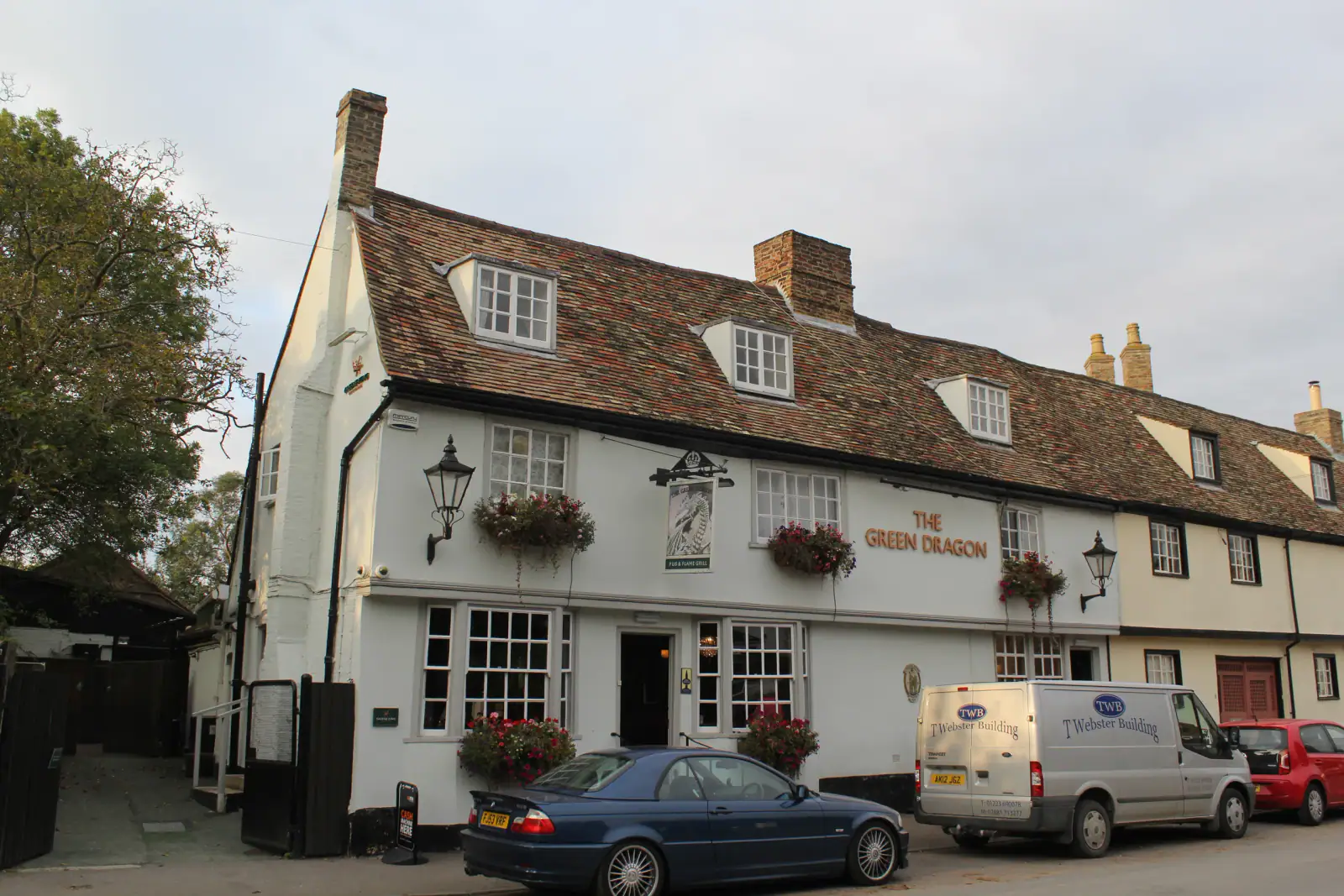
- The Green Dragon — the older building
- The Royal Commission recorded it as four tenements built in the sixteenth century, the oldest surviving pub building in the city. It was not in Cambridge at the time: Chesterton was a separate riverside village, and the pub served merchants travelling to Stourbridge Fair, for centuries among the largest fairs in Europe.
- Sign vs archiveThe Mitre — three dates, none of which agree
- The carriage arch carries 1754. The plaque outside records the earliest known licensee in 1752. The licensee sequence compiled from T. E. Faber’s parish history puts that same man in the house from 1744, with the site’s licensed history running back to an alehouse licence of 1615/16. Historic England dates the arch itself to the nineteenth century — so the carved date is about a century younger than the year it announces.
So: the Pickerel has the licence, the Green Dragon has the building, and the Mitre has an arch that postdates its own date by roughly a hundred years. Any of the three can be called oldest with a straight face, provided you say which sense you mean.
What actually happened at the Eagle
This one is largely true, and it is worth being precise about which part.
On 28 February 1953, Francis Crick announced in the Eagle that he and James Watson had worked out the structure of DNA. That is the documented event. What did not happen is the discovery itself: the work was done at the Cavendish Laboratory, not over lunch. The pub is where it was announced, which is a good enough claim without improvement.
The ceiling graffiti in the back bar is genuine — burned and written into the plaster by RAF and American aircrew during the Second World War.
The building has a longer history than either story suggests: a lease of 1566 in the Corpus Christi archive already describes an inn here called the Eagle and Child, and it opened as a coaching house in 1667. Corpus Christi College has held the freehold for five hundred years.
King’s College Chapel
It is not a cathedral. It is a college chapel. The cathedral for this diocese is at Ely, sixteen miles north, and the confusion is understandable given the scale — but the distinction is not pedantry, it is what the building is for.
Henry VI did not live to see it finished. He laid the foundation in 1446 and the chapel was not completed until the 1510s, under later kings and after a long interruption. It is not the product of a single medieval campaign, and the fan vault — the thing you are actually looking up at — is separated from the foundation by decades.
The composition you photograph from King’s Parade is not purely medieval either: major eighteenth- and nineteenth-century work sits in the frame alongside the chapel.
Two things we will not claim
- UnprovenThat the Pickerel’s sign is a Leach
- Frederick Richard Leach, who became Cambridge’s leading Victorian decorative painter, has a documented connection to the pub. That does not mean the sign hanging outside today is his work, and we have found no evidence that it is. The surviving Leach sign in public hands is in the Museum of Cambridge.
- UnprovenThat the Pickerel was a gin palace, opium den and brothel
- This is repeated confidently everywhere and sourced nowhere. It is colourful local tradition rather than documented record, and we are not going to launder it into fact by printing it as one.
One more, for the drinkers: most sources online will tell you the Castle Inn is an Adnams pub. It is not. Adnams sold the freehold in 2024 and it has been independently run since; Adnams beers are still on the bar, which is where the confusion comes from. Cambridge no longer has an Adnams pub.
Common questions
- Did Isaac Newton build the Mathematical Bridge?
- No, in every part of the story. Newton died in 1727 and the bridge was built in 1749 — twenty-two years later — to a design by William Etheridge, constructed by James Essex. Nor was it held together without fastenings and reassembled by baffled students: the timbers have always been fastened with iron.
- Which is the oldest pub in Cambridge?
- It depends what you mean. The Pickerel holds the longest continuous licence, conventionally dated to 1608, which is why it usually takes the title — though Historic England records its Magdalene Street frontage as early nineteenth century. The Green Dragon has the older building, recorded by the Royal Commission as sixteenth century, in what was then the separate village of Chesterton.
- Was DNA discovered in the Eagle pub?
- It was announced there, not discovered there. On 28 February 1953 Francis Crick announced in the Eagle that he and James Watson had worked out the structure of DNA. The work was done at the Cavendish Laboratory. The pub is where it was announced, which is a good enough claim without improvement.
- Is King’s College Chapel a cathedral?
- No — it is a college chapel. The cathedral for this diocese is at Ely, sixteen miles north. The confusion is understandable given the scale, but the distinction is what the building is for. Henry VI also did not live to see it finished: he laid the foundation in 1446 and it was not completed until the 1510s.
The verdict
The pattern is the same one Oxford has: the marketed date and the archive date are different numbers, and the archive one is usually the better story. A bridge whose real engineering is more interesting than Newton, a pub whose Tudor half is hiding behind a Georgian front, and a chapel that took seventy years and several kings.