Whipple Museum of the History of Science
Historic telescopes, a mechanical solar system and an attic gallery of globes inside the former Perse School hall on Free School Lane.
01 / The experience
The instruments that made scientific ideas visible
Historic telescopes, a mechanical solar system and an attic gallery of globes inside the former Perse School hall on Free School Lane.
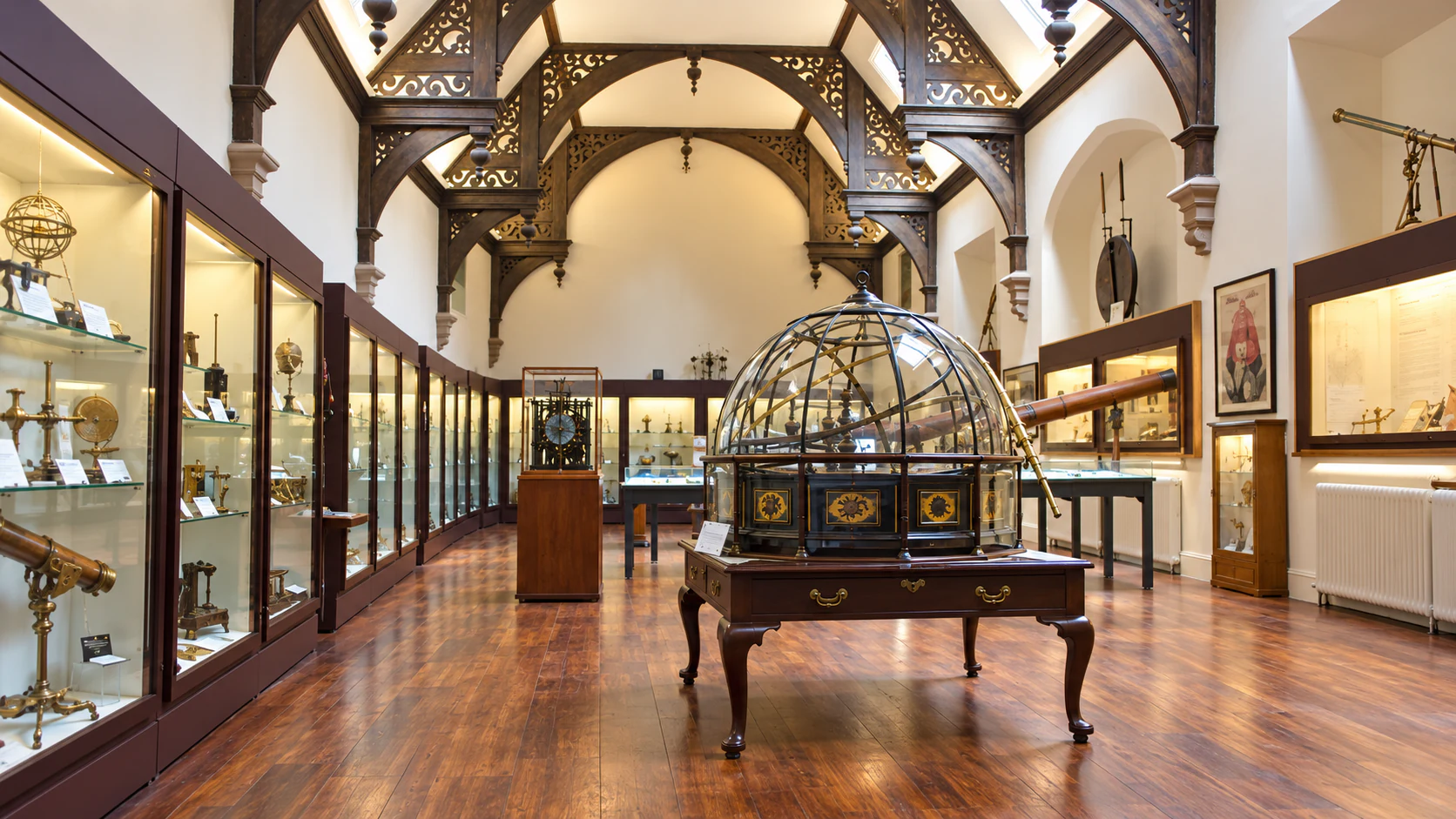
A mechanical solar system sits beneath an ornate timber roof at the Whipple. The Grand Orrery turns an abstract idea into an object of brass, wood and moving parts, surrounded by instruments made to measure the heavens and examine things too small to see unaided. This compact museum on Free School Lane gives Cambridge’s scientific history a different character from a laboratory tour: the tools themselves show how people tried to understand the world.
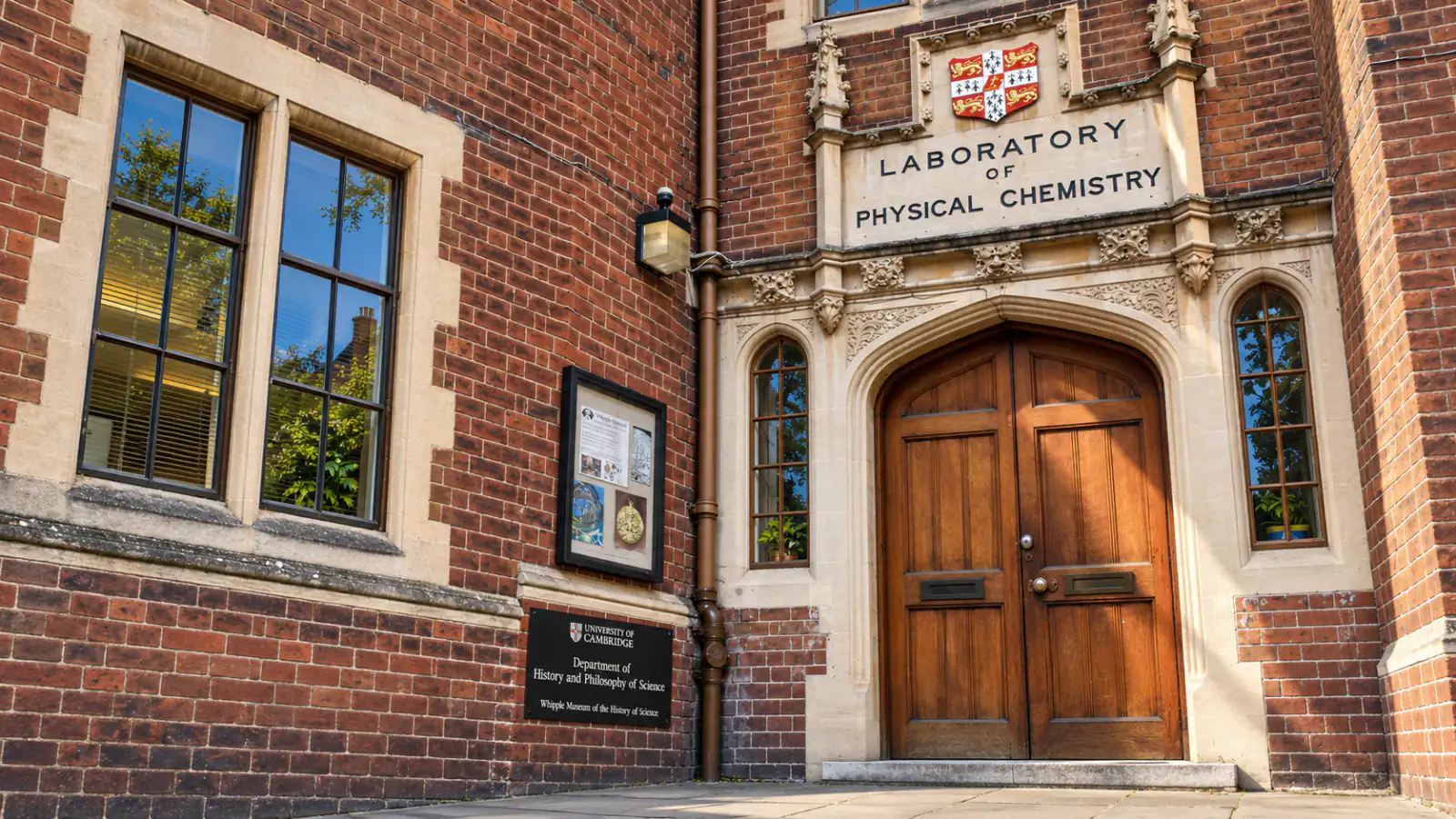
The main entrance is deliberately easy to underestimate. Its carved stone doorway still carries the words Laboratory of Physical Chemistry, while the museum shares the building with the Department of History and Philosophy of Science. Beyond the wooden doors and stairs is the former seventeenth-century Perse School hall. Dark timber trusses, tall white walls and glazed wooden cases make the Main Gallery part historic room, part working teaching collection.
The eighteenth-century Grand Orrery by George Adams is one of the gallery’s strongest starting points. A model of planetary motion, it connects the museum’s instruments with the practical work of explaining scientific ideas. William Herschel’s Newtonian telescope offers another route into the history of astronomy. Smaller objects in the surrounding cases move between scientific fields, so a visit can follow an interest in microscopes, calculation or observation rather than a single chronology.
The museum began with Robert Stewart Whipple’s gift of scientific instruments and rare books to the University in 1944. Whipple had worked in the instrument trade and became managing director of the Cambridge Scientific Instrument Company, founded by Horace Darwin. That background helps explain the collection’s emphasis on science as something built and handled. Its instruments are finely made objects, but their usefulness matters as much as their appearance.
Upstairs, the permanent Globes display changes the scale of the visit again. Terrestrial and celestial globes, planetaria and related objects sit in cases designed to let visitors walk around and see their full surfaces. A globe records choices about what to include, how to name it and how to turn a curved world into a usable model. Beside the larger instruments downstairs, these objects show that a scientific image can be both a teaching aid and an argument about how the world works.
Other rooms suit different kinds of visit. The Learning Gallery has family activity boxes and handling objects, while the Victorian Parlour presents scientific games and equipment in the setting of a nineteenth-century home. Its zoetrope and stereoscopic viewer connect moving pictures and three-dimensional images with domestic entertainment. The Art of Deception, the current special exhibition, considers forged scientific instruments and the work of identifying them; temporary displays have their own life beyond the permanent galleries.
Whipple is close enough to Zoology and Sedgwick for a concentrated afternoon of smaller museums. Its weekday opening begins at 13:00, while Saturday starts earlier. Free admission makes a focused hour worthwhile, especially if one gallery or instrument catches your interest. The street entrance uses stairs; the separate step-free route comes through Pembroke Arch into the New Museums Site, so it is worth choosing the appropriate approach before arriving.
04 / Before you go
Plan your visit
Admission
Admission free. Organised groups need advance arrangements; specialist tours have separate arrangements.
Opening hours
Monday–Friday 13:00–17:00; Saturday 10:00–17:00; closed Sunday. Advertised special closures apply.
Getting there
Free School Lane, Cambridge CB2 3RH
The main entrance is on Free School Lane, just off Pembroke Street, about 25 minutes on foot from Cambridge station. For step-free access, enter the New Museums Site through Pembroke Arch on Downing Street and follow signs to the rear entrance. No museum visitor car park.
Plan your visit
Individual admission is free during opening hours. Weekdays begin at 13:00; Saturday begins at 10:00.
Groups of more than ten must book at least a week ahead through the museum’s group-visit page. For a party of exactly ten, contact the museum about its arrangements.
Groups are limited to 30 people per 30-minute slot and should report to the visitor-services desk. Under-18 groups need at least one accompanying adult per twenty students.
Objects rotate between display and storage. Visits specifically to see an individual instrument should be arranged with the museum.
During your visit
No lunch room or cloakroom. Food should be eaten outside the galleries; no museum café is advertised.
Seating is available in the Main, Learning and Upper galleries. Family activity boxes, ear defenders and sensory resources can be borrowed.
Personal photography is allowed without tripods, selfie sticks or external flash. The replica Wallingford Clock sounds about every 15 minutes, away from exact quarter-hours.
Accessibility
Free School Lane entrance has stairs. The step-free entrance is reached through Pembroke Arch on Downing Street, across the New Museums Site. Accessible all-gender toilet and baby changing on the ground floor; a wheelchair, seating, ear defenders and sensory resources are available. The replica Wallingford Clock sounds periodically and can be silenced with advance notice.
Location & nearby places
Continue exploring / Cambridge
More to explore
in Cambridge
Find another place for your itinerary, or explore all things to do in Cambridge.
 Culture & historyMuseum of ZoologyExplore experience →
 Culture & historyMuseum of Archaeology and AnthropologyExplore experience →
 Food & drinkFitzbillies, Trumpington StreetExplore experience →
 Food & drinkThe EagleExplore experience →
Good to know
Whipple Museum of the History of Science: frequently asked questions
What is in the Whipple Museum?
The collection explores the history of science through instruments such as globes, microscopes and the Grand Orrery, a mechanical model of the solar system.
When is the Whipple Museum open?
Monday–Friday 13:00–17:00 and Saturday 10:00–17:00. It is closed on Sundays; advertised special closures also apply.
Which Whipple Museum entrance has step-free access?
Use the separate back entrance on the New Museums Site, reached through Pembroke Arch on Downing Street. The main wooden doors on Free School Lane lead to stairs.
Can children handle exhibits at the Whipple Museum?
The Learning Gallery has designated family activity boxes and handling objects. The historic instruments in display cases are collection objects, not general hands-on equipment.