
Sedgwick Museum of Earth Sciences
A free geology museum with Iggy the Iguanodon, fossil-filled timber cabinets and Darwin’s Beagle rocks, upstairs on Downing Site.
01 / The experience
A dinosaur above the cabinets, and geology beneath the glass
A free geology museum with Iggy the Iguanodon, fossil-filled timber cabinets and Darwin’s Beagle rocks, upstairs on Downing Site.
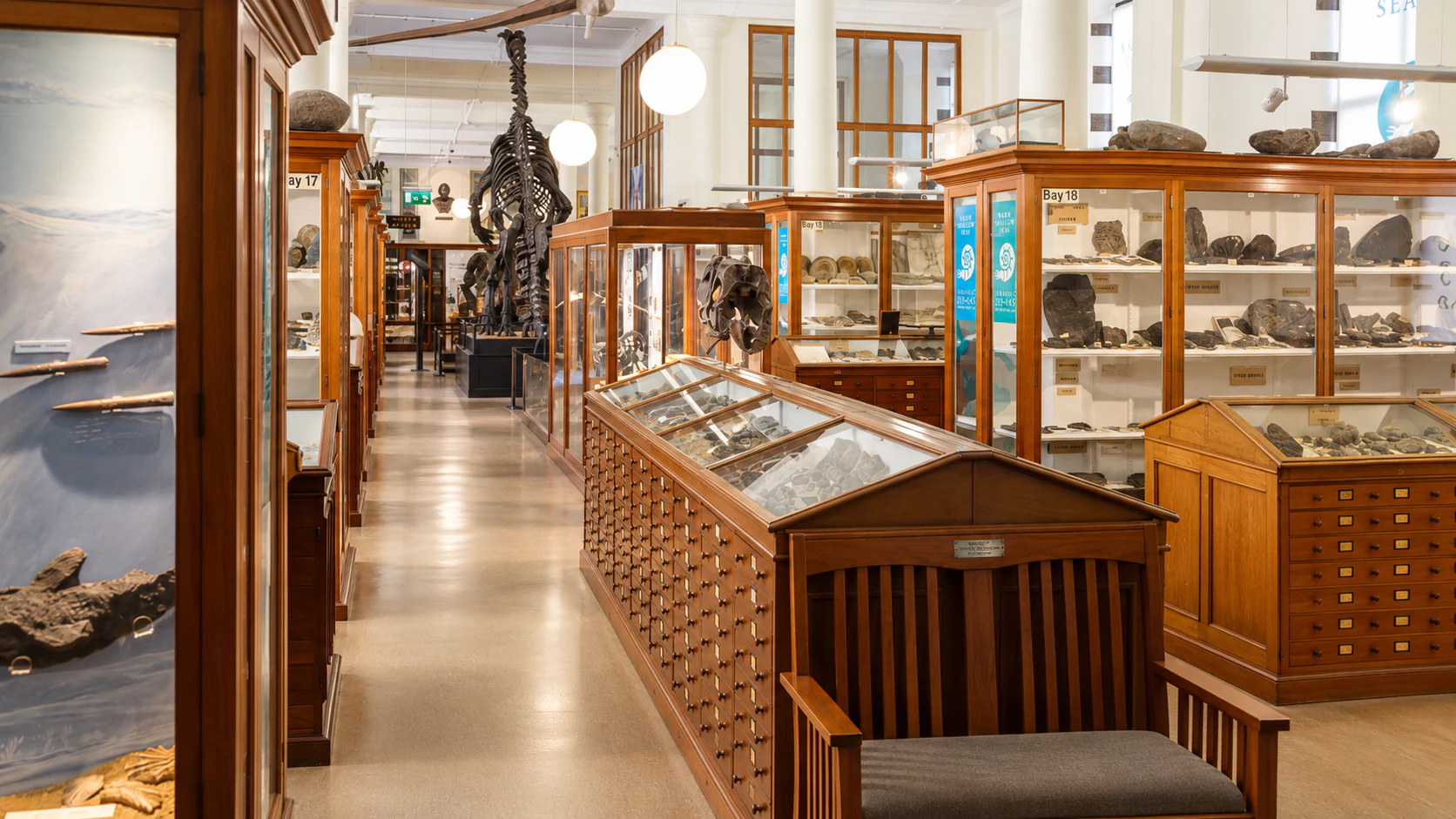
The Sedgwick is a museum of drawers, fossils and long views through timber cabinets, with a dinosaur rising above the cases. It rewards an interest in how rocks and bones become evidence, whether that begins with a child looking for a large skeleton or an adult following Darwin’s work as a geologist. Admission is free, and the first-floor galleries sit just inside the University’s Downing Site, close to the other central museums.
The entrance makes the first impression. A double stone staircase curves up to an ornate doorway, with carved creatures beside the lower ends of the balustrades. Inside, sloping glass-topped cabinets and tall wood-framed cases divide the long gallery. Small fossils and fragments sit beside larger specimens, giving the museum a different scale from an exhibition built only around complete skeletons. Its objects are part of a working Earth Sciences collection, with research stores elsewhere as well as material on public display.
Iggy, the Iguanodon cast, is the most conspicuous inhabitant. The plaster replica represents a skeleton found in a Belgian mine in 1878 and was given to the museum by the King of Belgium. Its upright, kangaroo-like stance records an earlier understanding of the animal. Research by Cambridge palaeobiologist David Norman showed that this posture was not how it would ordinarily have moved: the animal spent much of its time browsing and walking on all fours. The cast therefore tells two stories, about the dinosaur and about the changing science used to reconstruct it.
Elsewhere, the cases make comparison possible at a much smaller scale. Shells, teeth, bones and impressions are arranged in groups and geological periods, with the Oligocene and Miocene displays offering one example of the museum’s densely packed cabinet presentation. A short visit can concentrate on these differences rather than trying to read every label. The wider palaeontology collection includes marine reptiles acquired from Mary Anning, pterosaurs from the Cambridge Greensand and specimens used to describe and compare fossil species.
The museum’s roots reach back to John Woodward’s collection of rocks, fossils and minerals, assembled around the turn of the eighteenth century. His specimens were catalogued carefully and kept in collector’s cabinets. Darwin’s Beagle material belongs to a later chapter: rocks and soils gathered during the 1831–36 voyage, particularly in South America. Thinking about those collections together gives the visit a useful thread, from collecting and naming specimens to explaining the processes that shaped landscapes and life.
Sedgwick works well beside Zoology or the Whipple, with a distinct subject and a different set of opening hours. It has no café or luggage store; the nearby Whale Café is a separate stop. The entrance stairs also matter when choosing a visit. Assisted lift access has a narrow doorway, and one internal platform lift is currently unavailable, limiting step-free access to the first wing. Those restrictions are set out below so the museum’s attractive staircase does not imply an equally straightforward route for every visitor.
04 / Before you go
Plan your visit
Admission
Admission free. Arranged school and group visits are also free; donations welcome.
Opening hours
Monday–Friday 10:00–17:00; Saturday 10:00–16:00; closed Sunday. Christmas and New Year closure applies; bank-holiday openings are separately advertised.
Getting there
Downing Street, Cambridge CB2 3EQ
Enter Downing Site through the archway on Downing Street, turn left and find the double stone staircase above Earth Sciences. About 20 minutes on foot from Cambridge station and five minutes from the central bus station. Grand Arcade car park is opposite via Downing Street; no museum visitor car park.
Plan your visit
Individuals do not need to book for free admission. Organised groups must arrange a visit at least two weeks ahead through the museum’s group-visit page.
The museum is upstairs. A narrow assisted lift and an unavailable internal platform lift mean step-free access is currently limited to the first wing. Contact the museum before relying on that route.
Maximum group size is 35 plus adults, with one group at a time. Larger groups need two or more sessions; school supervision arrangements remain the group leader’s responsibility.
For restricted-mobility arrival, use the ramp to the door beneath the museum staircase and the staff-assisted route through Earth Sciences.
During your visit
No café and no eating or drinking in the museum. Whale Café at Zoology is nearby and has separate opening hours.
Museum toilet and baby changing available; staff provide access to the Earth Sciences accessible toilet. Coat hooks are used at visitors’ own risk; no luggage storage.
Personal non-commercial photography is permitted. Seating is available through the galleries.
Accessibility
First-floor museum reached by the double stone staircase. For assisted lift access, contact 01223 333456 or sedgwickmuseum@esc.cam.ac.uk in advance. Lift floor 105cm × 80cm, door 69cm wide; large wheelchairs and buggies do not fit. One internal platform lift is currently unavailable, so step-free access is limited to the first wing. A loan wheelchair is available for visitors who can transfer, with their own assistance if needed. Accessible toilet in Earth Sciences is available through staff.
Location & nearby places
Continue exploring / Cambridge
More to explore
in Cambridge
Find another place for your itinerary, or explore all things to do in Cambridge.
 Culture & historyMuseum of Archaeology and AnthropologyExplore experience →
 Culture & historyMuseum of ZoologyExplore experience →
 Culture & historyWhipple Museum of the History of ScienceExplore experience →
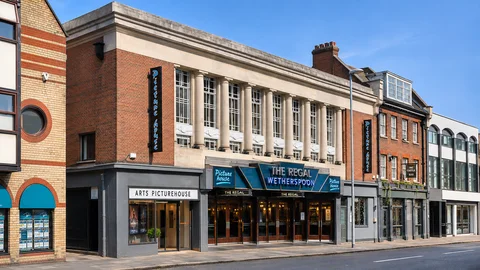 Live performanceArts Picturehouse CambridgeExplore experience →
Good to know
Sedgwick Museum of Earth Sciences: frequently asked questions
What can I see at the Sedgwick Museum?
The Earth sciences collections include fossils, rocks and minerals, with Iggy the Iguanodon cast among the best-known displays.
Is Iggy at the Sedgwick Museum a real dinosaur skeleton?
Iggy is a plaster cast of an Iguanodon skeleton found in Belgium. The upright pose reflects an older interpretation of how the animal stood; later research showed that it spent much of its time on all fours.
Can I visit the Sedgwick Museum without using stairs?
Assisted lift access is available by prior arrangement, but the door is only 69cm wide and one internal platform lift is unavailable. Step-free access is currently limited to the first wing.
Do groups need to book the Sedgwick Museum?
Yes. All organised groups must book at least two weeks ahead. Maximum 35 plus adults, with one group at a time. Admission and the museum’s school/group services are free.