Museum of Zoology
A 21-metre fin whale, two floors of animal specimens and Darwin’s beetle collection, reached through Pembroke Arch on Downing Street.
01 / The experience
A whale overhead, then the whole animal kingdom
A 21-metre fin whale, two floors of animal specimens and Darwin’s beetle collection, reached through Pembroke Arch on Downing Street.
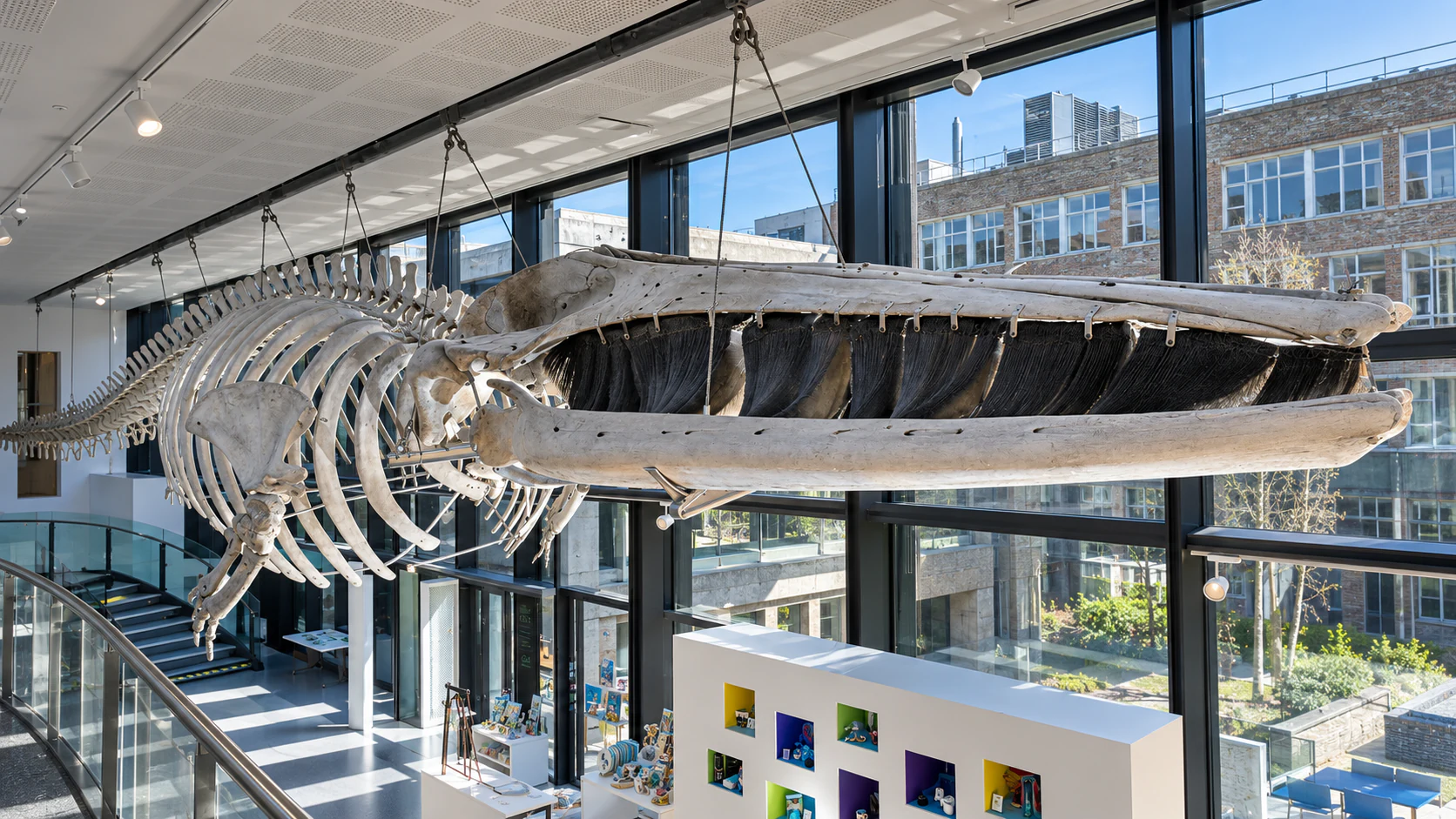
The fin whale arrives before the ticket desk. Its 21-metre skeleton hangs above the Museum of Zoology’s glazed entrance hall, long jaws and ribs filling a space built around the specimen. Beyond it, the galleries change scale repeatedly: an elephant skeleton, a butterfly drawer and a small animal preserved in a jar can all lead to different questions about how animals live. Free admission makes this a particularly useful central Cambridge museum for families or anyone with an hour between the colleges.
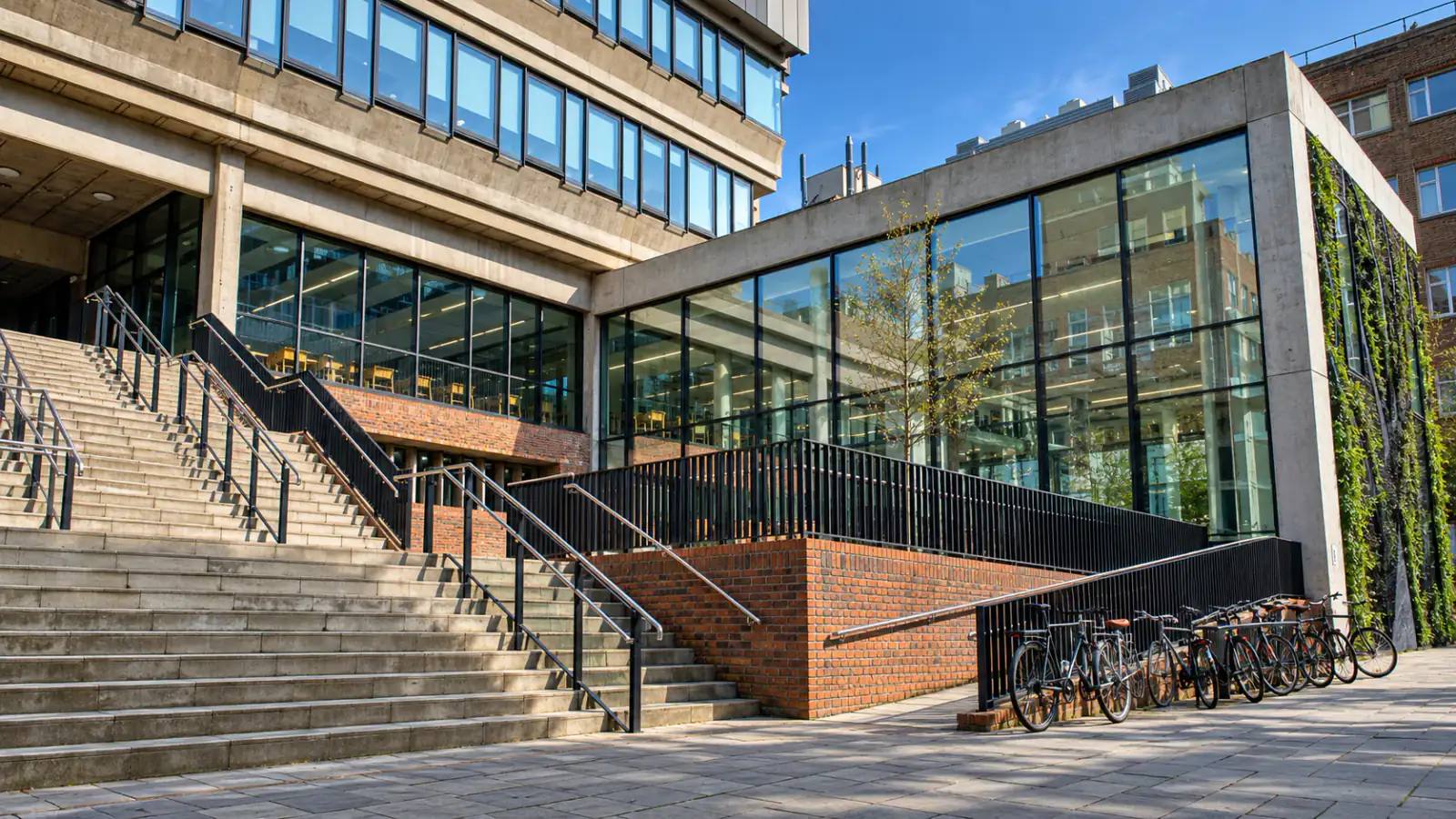
The building is easy to miss from Downing Street because its entrance is inside the New Museums Site. Through Pembroke Arch, the modern Whale Hall appears to the right, below the David Attenborough Building. A walkway brings visitors closer to the suspended whale, while the café and shop occupy parts of the same tall space. The hall gives the museum an immediate architectural identity without making the rest of the visit depend on one spectacular object.
Inside the Upper Gallery, skeletons and preserved specimens explore the variety of vertebrate life. The museum’s highlights include the leatherback turtle and the Nile crocodile, alongside fish and displays about the origin of limbs. Comparing these animals gives the cases a useful thread: the same broad body plan can develop into very different ways of swimming, walking or flying. There are specimens overhead as well as behind the glass, so the galleries use their height as part of the display.
Across the displays, the story extends into insects, corals, mammals and birds. An Asian elephant and the giant ground sloth offer the scale that children often look for first; British birds and the Wicken Fen display make connections with wildlife much closer to Cambridge. The dodo skeleton represents an extinct island bird, while the neighbouring story of the Rodrigues solitaire shows that its loss was part of a wider pattern. These are research collections as well as public displays, with only a fraction of the museum’s roughly two million specimens on show.
Darwin’s collections give the visit a direct connection with his Cambridge years. His beetle box recalls the collecting he did as a student between 1828 and 1831. Other material relates to the Beagle voyage and his later work on barnacles. Together, those objects connect his student collecting with the observations and comparisons that continued through his scientific career. Alfred Russel Wallace is also represented in the museum’s wider collections.
For a shorter family visit, the museum’s animal trails provide a manageable route through the cases. A longer visit can combine a gallery circuit with the Whale Café, which opens for fewer hours and days than the museum itself. Zoology also pairs naturally with the nearby Whipple and Sedgwick museums, though their different opening times mean they need to be treated as separate visits. The museum has a lift between its principal levels; the small mezzanine display has a separate access limitation, set out below.
04 / Before you go
Plan your visit
Admission
Individual admission free. Commercial and language-school groups pay a £3-per-person administration fee; non-commercial groups may be exempt by arrangement.
Opening hours
Tuesday–Saturday 10:00–16:30; Sunday 12:00–16:30; last entry 16:15. Closed Mondays except bank-holiday Mondays 12:00–16:30. Galleries closed 17–18 November 2026 and until 13:00 on 19 November; shop, café and Whale Hall remain open during that maintenance.
Getting there
Downing Street, Cambridge CB2 3EJ
Enter the New Museums Site through Pembroke Arch on Downing Street, opposite the end of Tennis Court Road; Whale Hall is to the right. About 20 minutes on foot from Cambridge station and five minutes from Drummer Street bus station. No general visitor parking.
Plan your visit
Individuals can visit the free museum during opening hours. Groups of ten or more must book in advance; a calendar request alone does not establish admission.
Galleries close for maintenance on 17–18 November 2026 and until 13:00 on 19 November. The fin whale in Whale Hall, shop and café remain accessible during that work.
The museum recommends booking groups at least two weeks ahead. Term-time Tuesday–Thursday group slots start at 14:00. Follow the applicable group form/payment process and retain the museum’s confirmation.
The group administration fee is £3 per person for commercial and language-school visits. Community and other non-commercial groups may qualify for an exemption by contacting the museum.
During your visit
Whale Café: Tuesday–Saturday 10:00–15:00. Food and drink cannot enter the galleries.
Toilets, accessible toilet, baby changing, lockers and a shop are in Whale Hall. Large suitcases, scooters and folding bicycles cannot enter the galleries; small stools are available to borrow.
Free animal trails suit family visits. Personal photography is permitted without flash, tripods or selfie sticks.
Children and young people under 18 must be accompanied by an adult. Organised student groups have the separate supervision ratio described above.
Accessibility
Ramp and automatic doors into Whale Hall. Lift serves the Upper and Lower galleries and café; the mezzanine between the main galleries has no lift access, with an information point in the Upper Gallery. Accessible toilet and baby changing are near reception. Borrowing a wheelchair can be arranged with the museum.
Location & nearby places
Continue exploring / Cambridge
More to explore
in Cambridge
Find another place for your itinerary, or explore all things to do in Cambridge.
 Culture & historyMuseum of Archaeology and AnthropologyExplore experience →
 Culture & historyWhipple Museum of the History of ScienceExplore experience →
 Culture & historySedgwick Museum of Earth SciencesExplore experience →
 Cambridge experienceHistoric CentreExplore experience →
Good to know
Museum of Zoology: frequently asked questions
What can I see at the Museum of Zoology Cambridge?
The collections include animal skeletons and specimens, with a large fin whale suspended in Whale Hall.
Do I need a ticket for the Museum of Zoology Cambridge?
Individual admission is free without a group booking. Groups of ten or more must book and receive confirmation; commercial and language-school visits carry a £3-per-person administration fee.
Can I see the whale during the November closure?
Yes. During the gallery closure on 17–18 November 2026 and before 13:00 on 19 November, Whale Hall, the shop and café remain open. The rest of the museum galleries are unavailable.
Is the Museum of Zoology Cambridge step-free?
A ramp serves Whale Hall and a lift connects the main galleries and café. The mezzanine has no lift access; an information point in the Upper Gallery covers its displays.