Central · Founded 1441
King's College
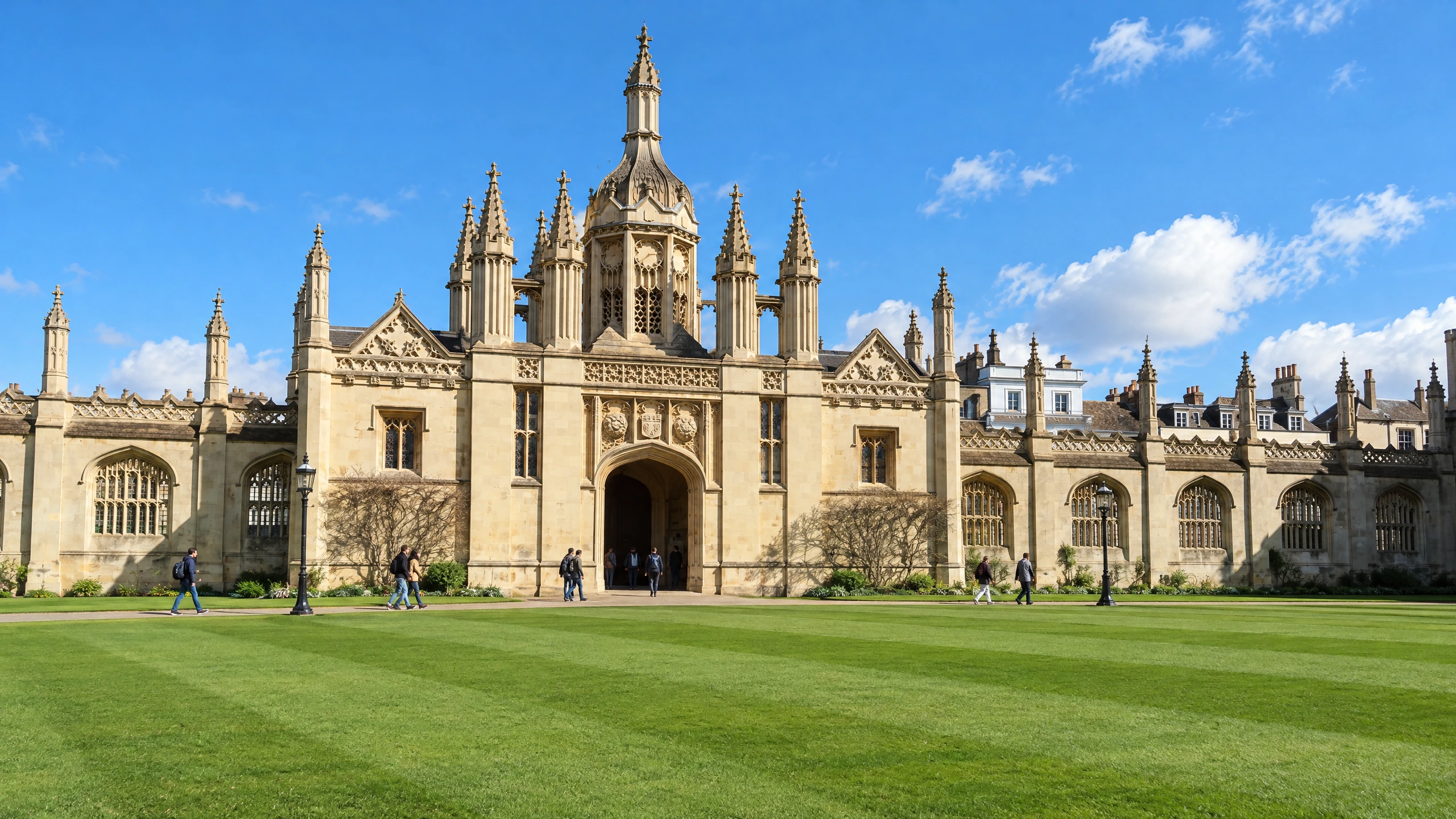
The defining image of Cambridge: Henry VI's chapel with the world's largest fan vault, home of the Festival of Nine Lessons and Carols broadcast worldwide each Christmas Eve.
- Founded
- 1441
- Location
- King's Parade
- Visiting
- Dated ticketed visits
- Institution
- College
01 The experience
What to expect.
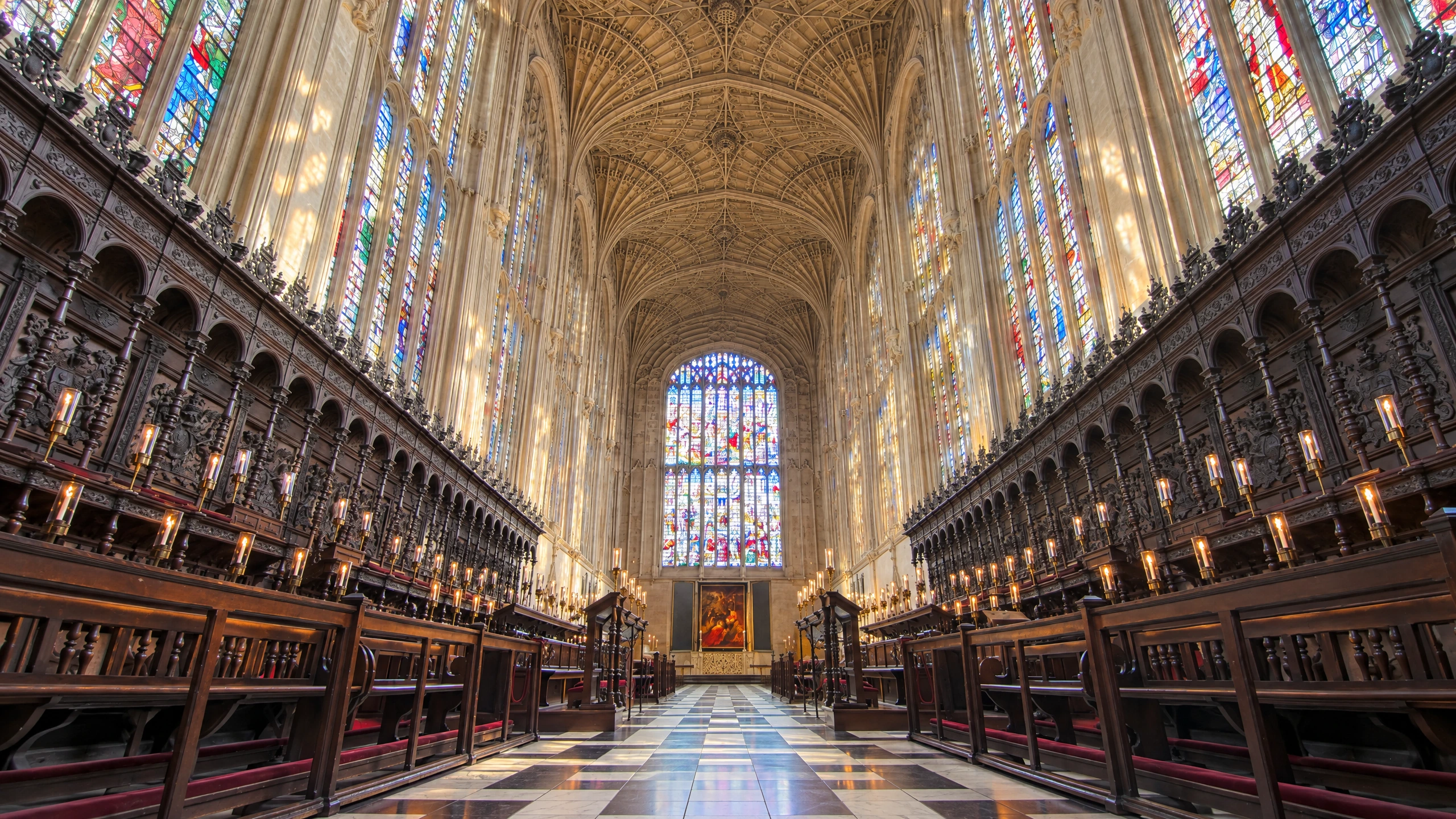
The fan vault is the first reason to go inside King’s College Chapel, but the view changes as you move along the choir aisle. Tall stained-glass windows rise above dark carved stalls, the stone ceiling opens into repeating fans, and Rubens’s Adoration of the Magi stands behind the High Altar. A Chapel-and-grounds ticket combines that interior with the college’s riverside setting; a grounds-only date offers a different visit.
The scale comes from Henry VI’s ambitions for his new college. He founded King’s in 1441, and work on the Chapel began in 1446 with a design modelled on a cathedral choir. The Wars of the Roses interrupted construction, leaving later monarchs to continue it. Henry VII supplied funds to finish the work, and the main structure was complete by 1515 under Henry VIII. The Chapel is the oldest surviving building on the present college site, and its long building history connects the late medieval exterior with Tudor glass and woodwork inside.
Within the Chapel, the tall windows and continuous fan vault give the room its unusual proportions. The sixteenth-century stained glass is a substantial part of the visit in its own right, while the carved choir stalls bring the scale back down to individual seats and wooden details. The central aisle leads towards the east window and the Rubens painting. Seating is available through the main areas, so the interior does not have to be visited as one uninterrupted walk.
The college remains a place of worship and study. Tourist opening fits around services, events and academic life, and the dated calendar distinguishes Chapel access from days when only the grounds are open. A sightseeing ticket does not give access to other college buildings where students live, eat and work. For music, use the separate Chapel services and concert information rather than treating a daytime admission slot as a performance booking.
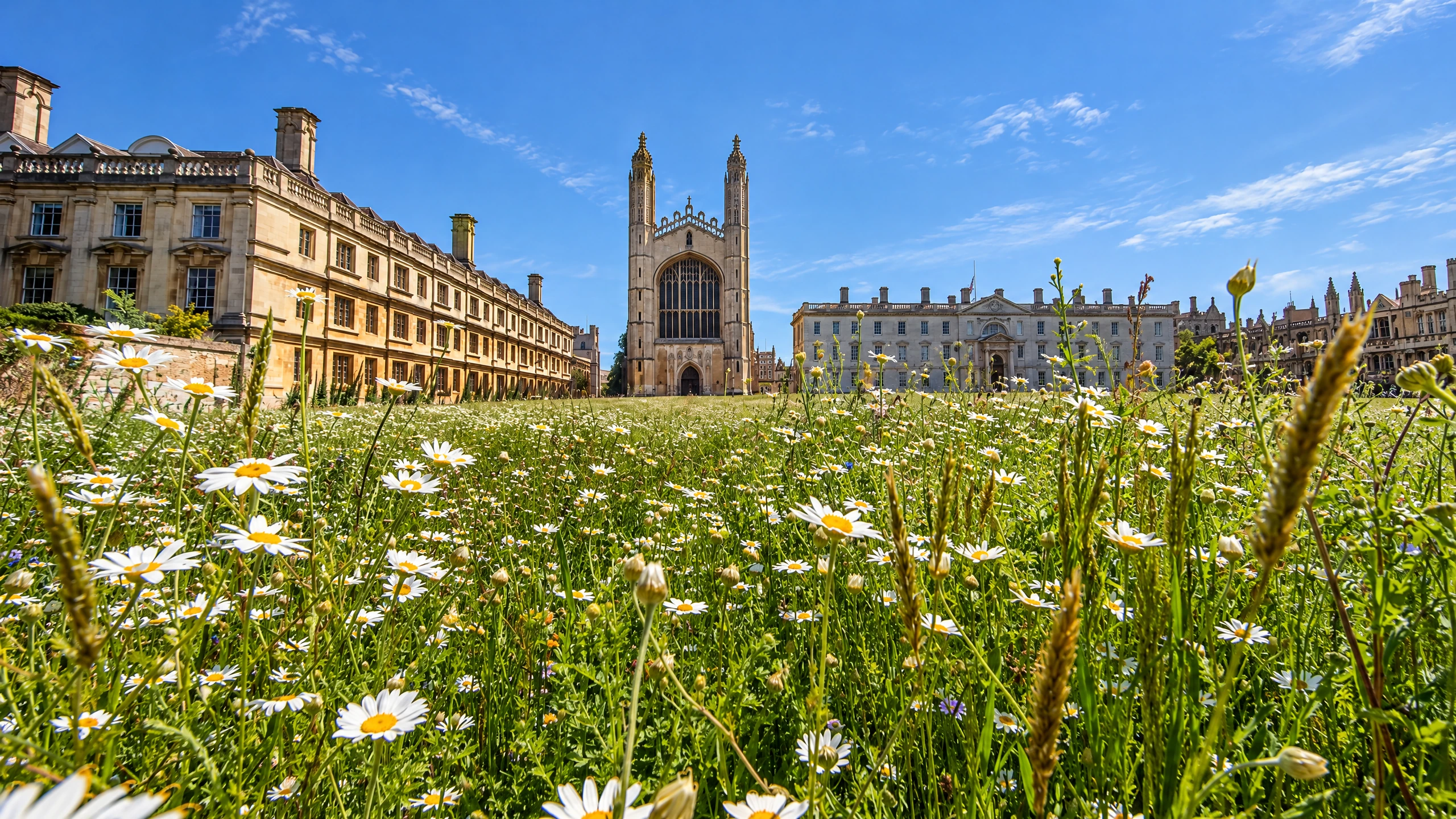
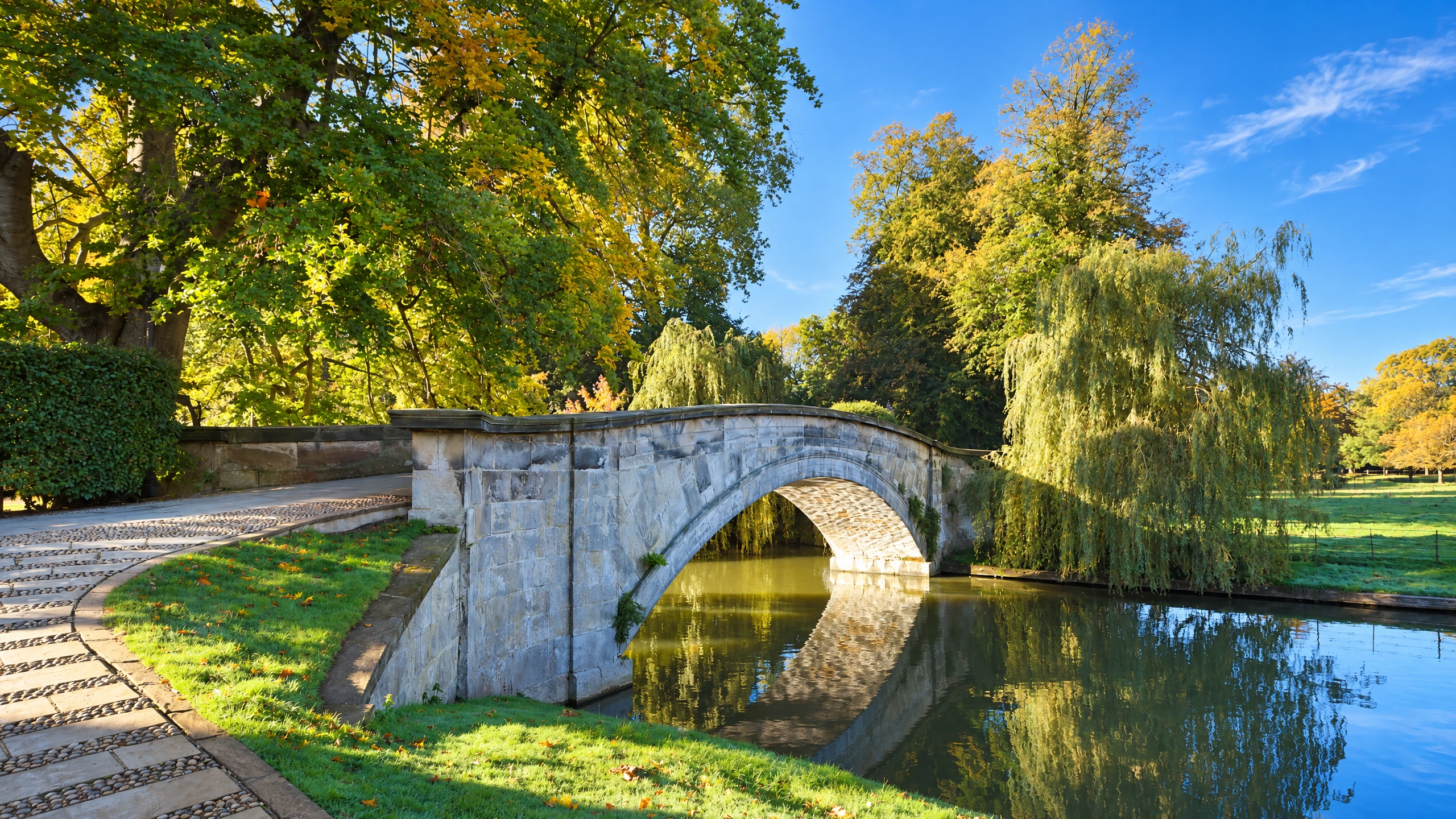
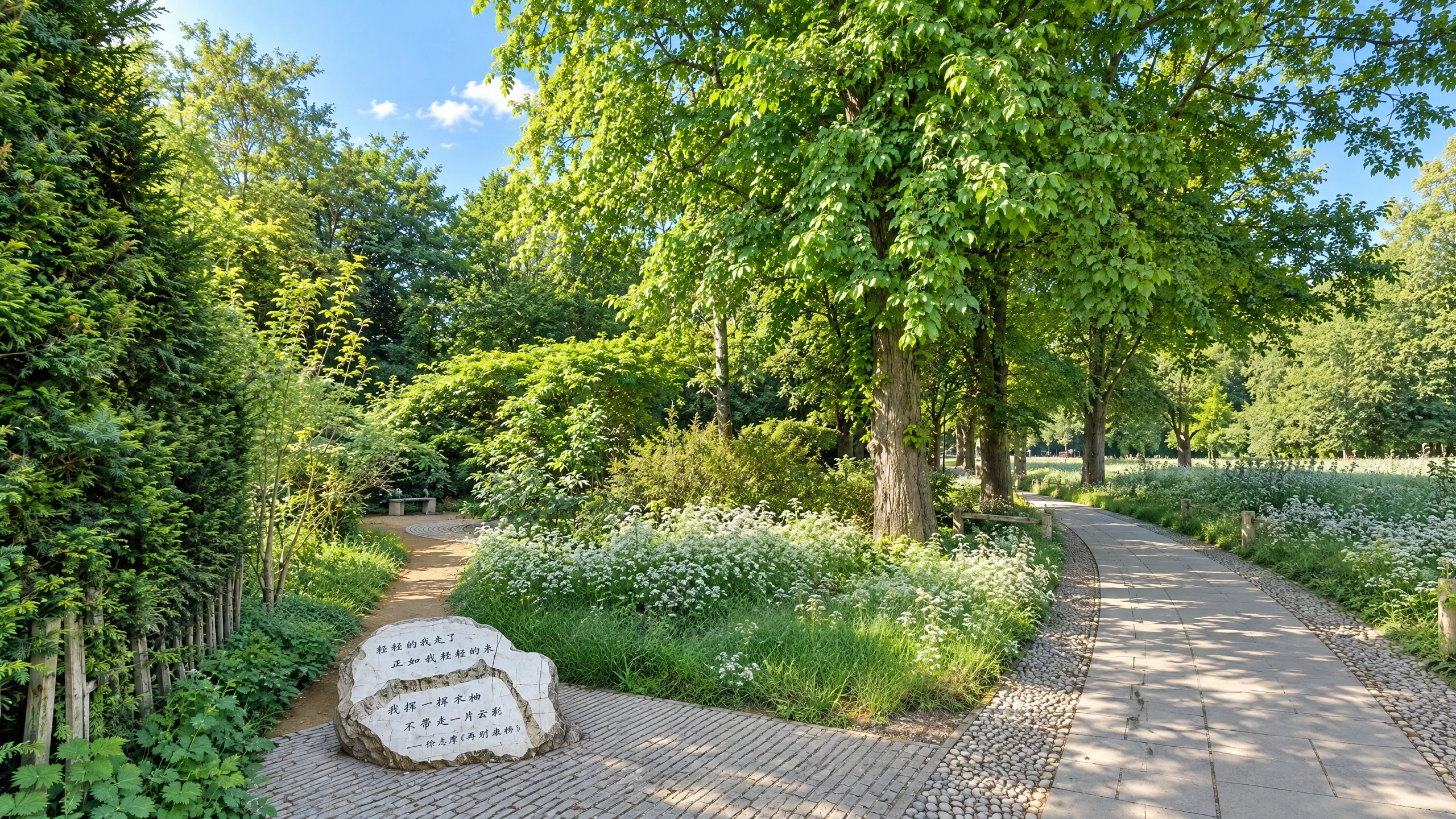
The grounds make the change from interior architecture to the river. In summer, the meadow’s daisies and grasses can frame the Chapel’s west end, with Clare’s buildings and the pale Gibbs Building forming the wider view. Along the Cam, the stone bridge and planted banks connect the college landscape with the Backs. The route towards the Xu Zhimo garden crosses a steep bridge; visitors who need an easier route can still use the broad paths and main Chapel areas without assuming every garden path has the same access.
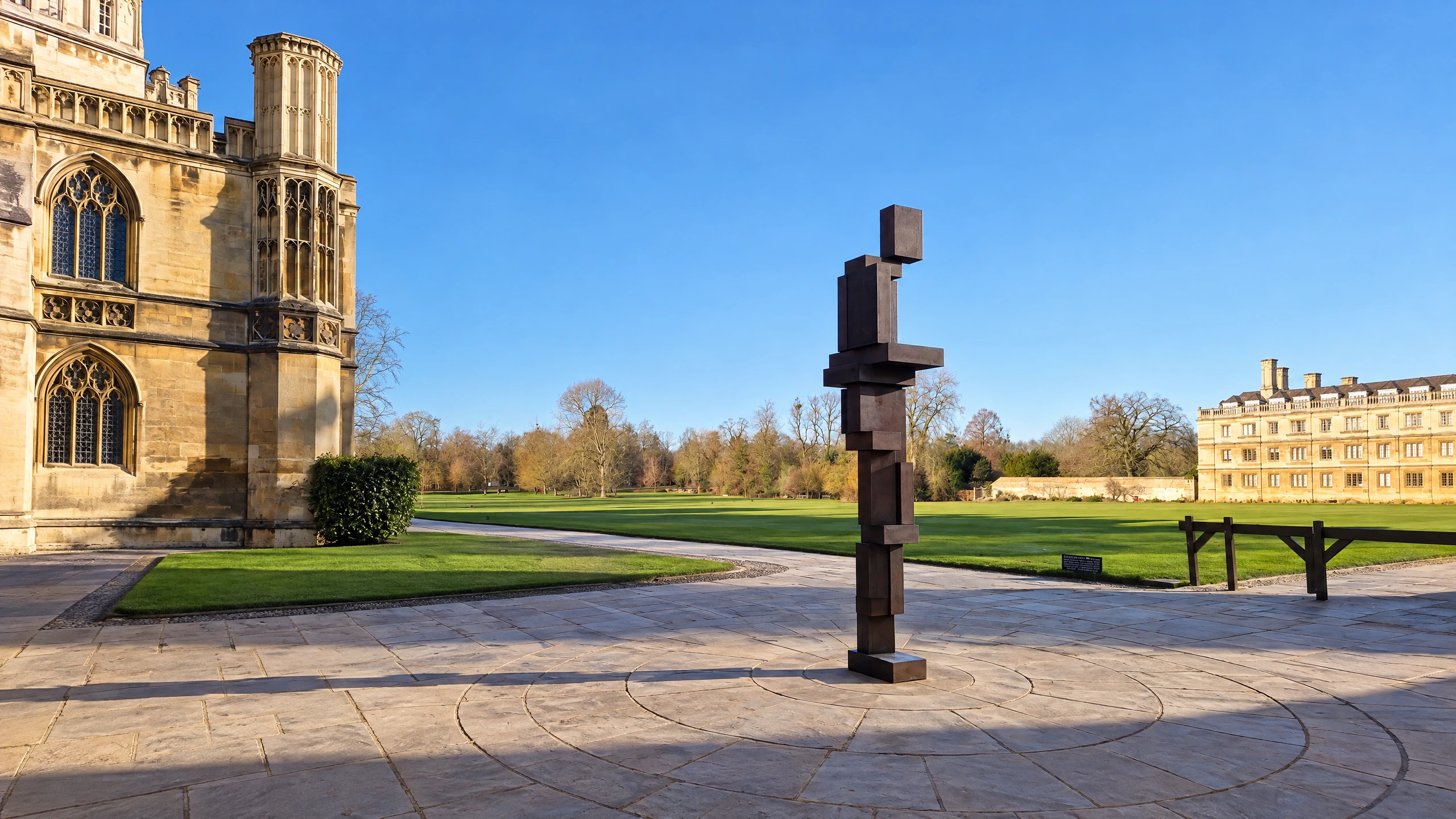
King’s also has an Antony Gormley sculpture commemorating Alan Turing, but it sits outside the standard visitor route. Access needs an advance request and a college escort, and is unavailable during the usual April–June quiet period. It should be planned as a separate arrangement, rather than an extra stop to find after entering.
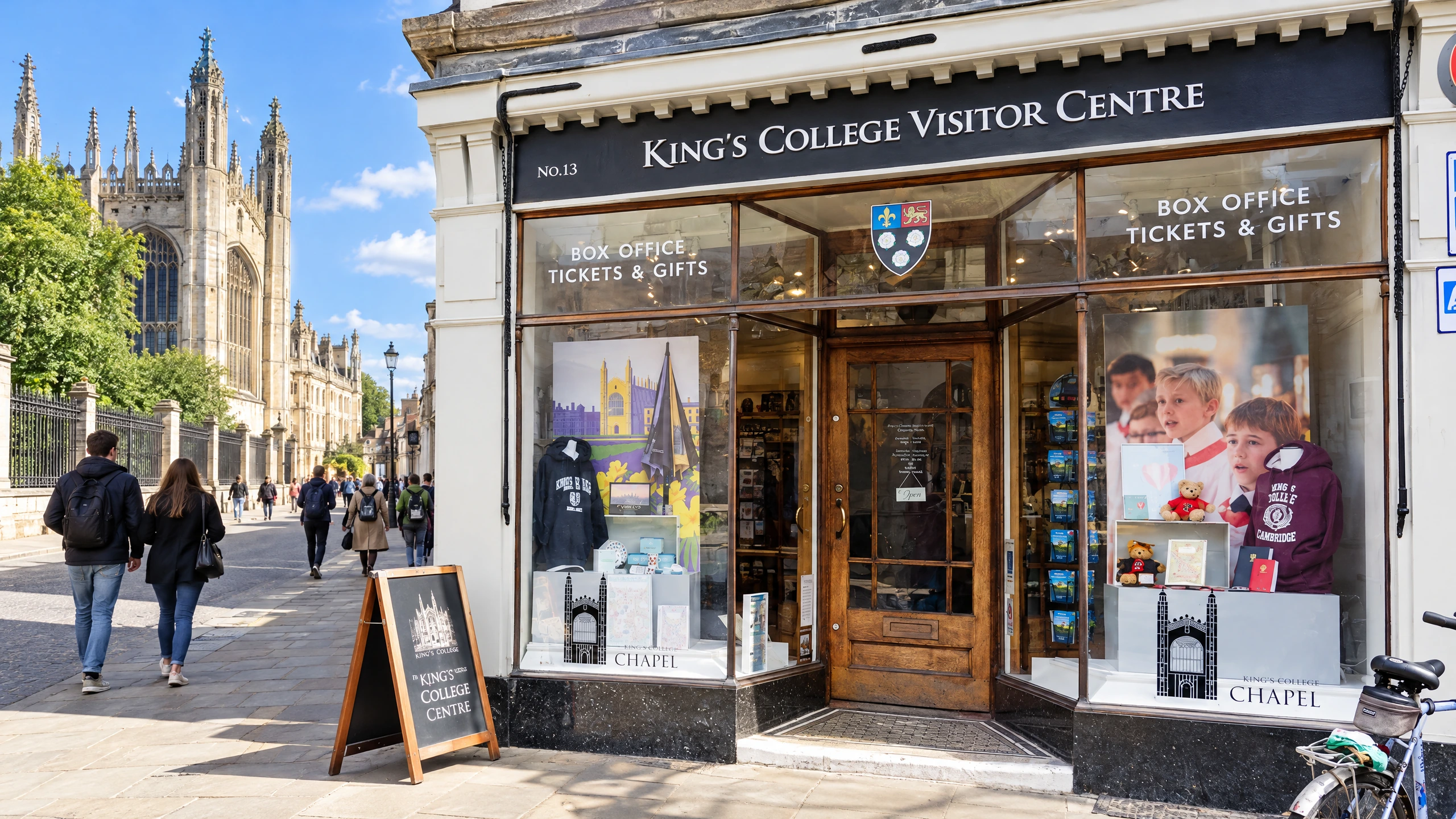
The visitor centre at 13 King’s Parade stands opposite the main gate and provides the box office and shop. It is a useful landmark for arrival, although the centre itself has a step and a portable ramp available through staff. There are no public toilets within the visitor site. Choose the date and the parts of King’s you want to see before buying a non-refundable ticket, particularly if the Chapel interior is the main purpose of the visit.
People and ideas
Famous former students

Alan Turing
The mathematician came to King’s in 1931 and became a Fellow in 1935. His work helped establish the foundations of computing.

John Maynard Keynes
The economist came to King’s in 1902 and became a Fellow. His papers are held in the college archives.

E. M. Forster
The novelist studied classics at King’s from 1897. His books include A Passage to India and Howards End.

Zadie Smith
The novelist studied English at King’s from 1994. Her books include White Teeth and On Beauty.
Fellows, founders and other connections

Sydney Brenner
The molecular biologist became a King’s Fellow in 1959 and shared the 2002 Nobel Prize in Physiology or Medicine.
The story
History & character.
A royal college
Henry VI founded the College of Our Lady and Saint Nicholas in 1441, when he was nineteen. It was paired with his foundation at Eton: for centuries the two formed a direct educational route, and King’s initially admitted Eton scholars. The scale of the plan was royal rather than collegiate. Henry intended a great court and a chapel capable of expressing dynasty, worship and learning in one building.
Creating the site altered medieval Cambridge. The College’s own history records the purchase and clearance of houses, shops, lanes, wharves and a church between the high street and river. The process took three years. The result is still visible in the unusually large enclosure between King’s Parade and the Cam.
1446: the Chapel begins
The Chapel’s foundation stone was laid in 1446. Its plan was extraordinarily ambitious: a single, tall vessel with side chapels contained between powerful buttresses. The Wars of the Roses interrupted progress and Henry VI’s deposition removed the project’s patron. For long periods the building stood incomplete.
That interruption matters. The Chapel is often read as a single medieval masterpiece, but its century-long construction crossed dynasties and changing architectural practice. The building remained faithful to a late-Gothic concept while the political world around it changed completely.
Tudor completion
Work resumed on a large scale in 1508. Henry VII died the following year, but his will provided funds to continue. By 1512 the shell was finished and roofed in timber and lead. Further money from his executors paid for the vault, and the main structure was complete by 1515.
The fan vault is the decisive intervention. Its stone conoids spread in repeated fans across the width of the Chapel and join into a continuous ceiling. The effect is both structural and visual: the wall, vault and long axis read as one ordered system.
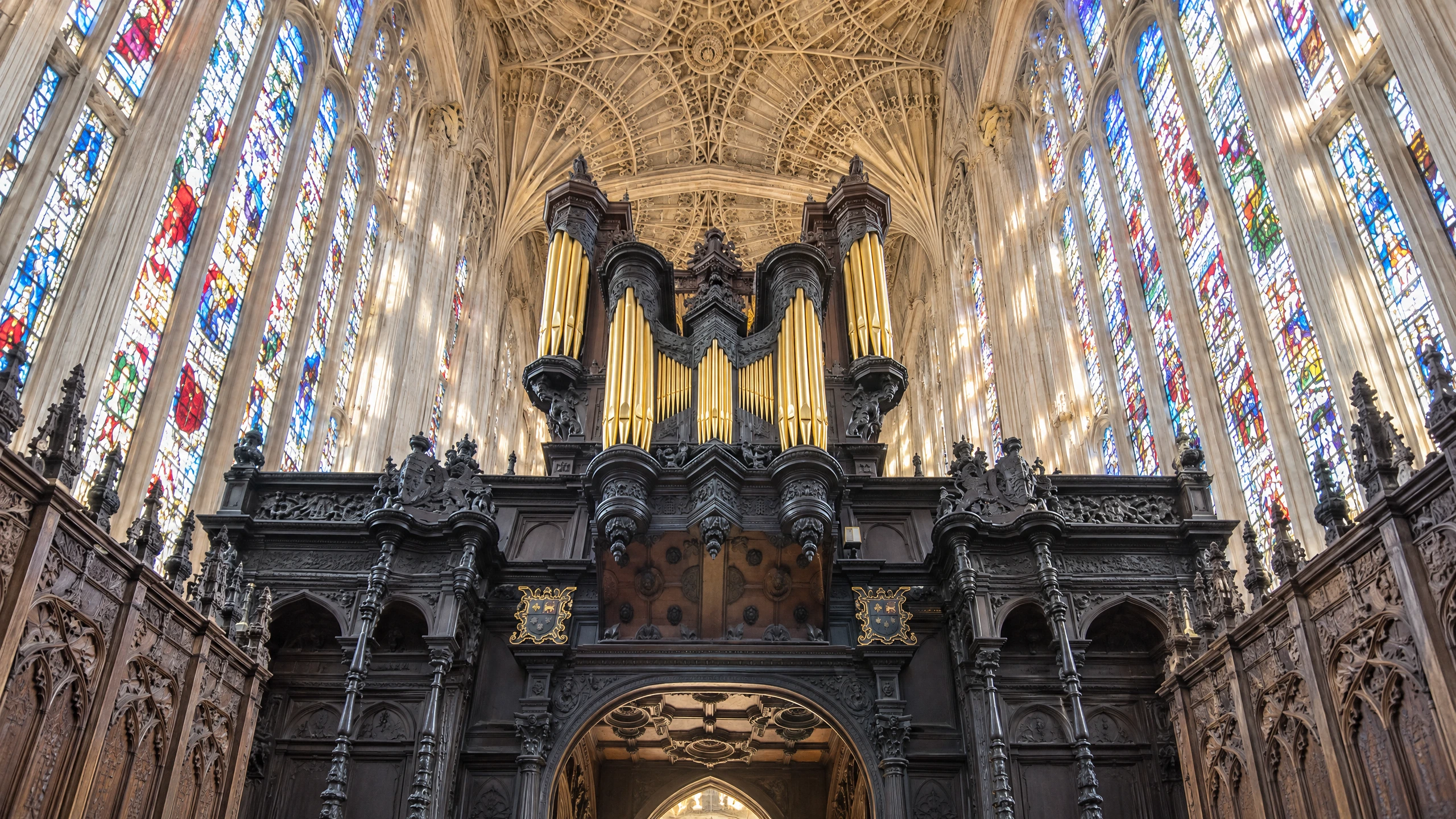
Henry VIII’s reign brought the screen, much of the woodwork and most of the glazing. Heraldic emblems throughout the Chapel record royal patronage. The building that began as Henry VI’s Lancastrian project was completed as a Tudor monument.
The stained glass
The great windows contain an unusually complete scheme of early-sixteenth-century glass. Their survival is central to the Chapel’s importance. The images combine biblical narratives with typological pairings and royal imagery; they were designed to be read across the building, not simply admired as coloured surfaces.
Survival did not mean immunity. Religious change, civil conflict, repair and environmental damage all affected the Chapel. Conservation is therefore a continuing responsibility rather than a completed historic episode.
The College after the Chapel
Henry VI’s proposed great court was never realised. For generations, the College’s daily life remained concentrated in Old Court. The contrast between the completed Chapel and the incomplete wider plan is one of the site’s most revealing facts: the building succeeded even when its intended urban composition did not.
In the eighteenth century James Gibbs designed the Fellows’ Building, completed as the surviving part of another unrealised court scheme. Its measured classical front is the architectural opposite of the Chapel, and the two now define the college lawn together.
The nineteenth century reshaped the King’s Parade frontage. William Wilkins’s Gothic screen and gatehouse gave the College a formal public face, helping create the street scene visitors recognise today. These later works should not be treated as background: they explain how a medieval royal foundation became the composed college landscape now seen from the city.
Music and worship
Choral worship is not an attraction added to the Chapel; it is part of the reason the building exists. The choir’s modern international profile, particularly through the Festival of Nine Lessons and Carols, has made the sound of King’s as recognisable as its exterior.
The Festival began in 1918, in the aftermath of the First World War, and the Christmas Eve broadcast created a global audience. The service remains worship within a working chapel. That distinction governs visitor behaviour and access: tourist photography stops, the congregation remains for the service, and entry closes once worship begins.
King’s in modern intellectual life
The College’s later history includes figures whose work reaches far beyond Cambridge. John Maynard Keynes, Alan Turing, E. M. Forster, Rupert Brooke and others connect King’s with economics, computing, literature and the political history of the twentieth century. Their presence belongs to the College’s story, but the visitor route is not an alumni museum. Avoid turning every doorway into a celebrity anecdote.
A landscape still in use
The lawns, river, bridge and meadow remain a working college environment. Seasonal management, College events, examinations and services determine what visitors can enter. The tension between public icon and private institution is not a modern inconvenience; it is the condition under which the site continues to be a college rather than a preserved monument.
Look closer
Highlights and hidden details.
The fan vault
A continuous stone fan vault covers the tall Chapel interior.
Stained glass and choir stalls
Sixteenth-century windows rise above carved dark wooden choir stalls.
Rubens at the High Altar
Adoration of the Magi stands behind the altar beneath the east window.
The riverside grounds
Meadow, college ranges, the River Cam and the stone bridge form the outdoor visit.
The visitor centre
The box office and shop at 13 King’s Parade stand opposite the main gate.
Details to look for.
The building is a century-long project
Look for changes in heraldry and finish rather than assuming one medieval moment. The Chapel carries Lancastrian foundation and Tudor completion in the same room.
The vault changes with your position
From directly beneath a fan, the ribs radiate like a palm. From the centre line, they lock into a continuous net. Walk both views before photographing it.
The screen is political architecture
The screen is not only liturgical furniture. Its Tudor carving announces the dynasty that completed a Lancastrian project.
The windows are paired arguments
The glazing was designed around correspondences between scriptural scenes. Reading only the brightest panel loses the intellectual structure of the scheme.
The Chapel was meant to belong to a larger court
The royal great court was never built. The vast lawn around the Chapel is not evidence that the original plan was spacious and complete; it is partly evidence of what was not realised.
Gibbs stands in deliberate contrast
The Fellows’ Building is often treated as background. Frame it with the Chapel and the contrast becomes one of the strongest lessons on the site.
The best exterior is behind you
Visitors enter from the iconic street front and keep looking forward. The strongest explanation of the Chapel’s scale comes after crossing the lawn and looking back from the river.
Sound reveals the room
Even outside services, listen to footsteps and speech. The long reverberation explains why choral music behaves here as architecture rather than decoration.
Make it work
Plan your visit.
Opening hours
Visitor hours and Chapel access vary by date around services, events and college use. Some dates are grounds-only or closed; choose the dated visitor calendar before buying.
Prices
Admission varies by date and Chapel access. Advance discounts are available.
For 2–8 November 2026, standard adult tickets are £17–18; early-bird adult tickets are £15.75–16.75 when booked by 1 November. The selected date and access determine the amount.
The early-bird offer for a week ends on the preceding Sunday. Student, child, family and group products have separate rates.
Tickets and arrival
Choose the dated calendar and confirm whether your product includes the Chapel and grounds or grounds only. A time slot is your arrival time; the visit is self-guided.
Other College buildings are excluded. Access to the Turing sculpture needs an advance request and escort, and is unavailable during the usual April–June quiet period.
There are no public toilets on the visitor site. Arrange any specific access requirements with Visitor Services on 01223 331212.
Tickets are non-refundable. A tourist admission ticket does not reserve a concert place or a seat at a Chapel service.
Getting there
Use King’s Parade. The arrival location is what3words ///latest.cable.senses; the visitor centre at 13 King’s Parade is opposite the main gate. No public parking is provided.
Visit your way
Access and family planning.
The main entrance, main Chapel areas and grounds have level access and ramps. Side chapels have steps, and parts of the exhibition have steps and narrow doorways. The bridge towards the Xu Zhimo garden is steep. The visitor centre has one step and a portable ramp through staff. No public toilets are available within the visitor site.
Children’s and family ticket products are available, with the selected date determining prices. There are no public toilets within the site. Keep children beside an adult near the river and use the main paths; the bridge towards the Xu Zhimo garden is steep.
Self-guided walk
Explore beyond the venue.
A practical, step-by-step route connecting this experience with more of Cambridge.The fan vault
A continuous stone fan vault covers the tall Chapel interior.
Stained glass and choir stalls
Sixteenth-century windows rise above carved dark wooden choir stalls.
Rubens at the High Altar
Adoration of the Magi stands behind the altar beneath the east window.
The riverside grounds
Meadow, college ranges, the River Cam and the stone bridge form the outdoor visit.
The visitor centre
The box office and shop at 13 King’s Parade stand opposite the main gate.
Make a record
Photograph it thoughtfully.
Visual proposition
The task is to show the Chapel as both building and landscape. A frontal King’s Parade photograph records the icon; the better story combines stone, lawn, river and the contrasting Gibbs’ Building.
Best exterior angles
King’s Parade: strongest for the public facade and scale against street life. Early morning reduces crowds.
The lawn: place Gibbs’ Building and the Chapel in one frame to show the site’s architectural range.
The river: photograph back toward the Chapel with bridge, meadow or water as foreground. Late light is strongest.
From a punt: use a faster shutter than expected; the boat and water both move.
Inside the Chapel
Centre-line symmetry is tempting but overused. Shoot the fan vault obliquely to show how ribs rise from the wall. Use window reveals as frames and expose for the glass rather than lifting every shadow.
No flash, tripods or disruptive equipment. Photography and recording are prohibited during services. Respect worshippers and avoid identifiable close-ups without consent.
Difficult conditions
The Chapel has extreme contrast between windows and stone. Phones handle this better than a single unbracketed camera exposure. Low light around the exhibition requires steady technique, but do not block narrow passages.
Commercial work
Commercial photography and filming require advance permission. Drone use should not be assumed anywhere over the College or central Cambridge.
See it
In pictures.
10 views, full screen. Tap any one to open the viewer.Around here
Make more of the area.
Good to know
Questions, answered.
Who founded King’s College Cambridge?
Henry VI founded King’s in 1441, and construction of the Chapel began in 1446. His plans connected King’s with his school at Eton.
Why is King’s College Chapel famous?
Its vast fan-vaulted ceiling, sixteenth-century stained glass and choral tradition make it one of Cambridge’s best-known buildings. Inside, Rubens’ Adoration of the Magi hangs behind the high altar.
Did Henry VI finish King’s College Chapel?
No. Building was interrupted during the Wars of the Roses. Henry VII funded a major resumption, and the main structure was complete in 1515, during Henry VIII’s reign.
Does King’s College Chapel have the world’s largest fan vault?
Yes. The stone fans span the Chapel ceiling in a continuous sequence; King’s describes it as the world’s largest fan-vaulted ceiling.
Is King’s College Chapel in Cambridge a cathedral?
King’s College Chapel in Cambridge is a working college chapel, used for worship as well as open to sightseeing visitors.
What painting is behind the altar at King’s College Chapel?
Peter Paul Rubens’ Adoration of the Magi stands behind the high altar. The Chapel’s sixteenth-century windows and carved choir stalls are other highlights of a visit.
What is King’s College’s connection to Christmas carols?
The College Choir sings the Festival of Nine Lessons and Carols on Christmas Eve. The service began in 1918 and its broadcasts have made the choir familiar to listeners around the world.
Can the public attend a service at King’s College Chapel?
Yes. King’s welcomes visitors to its public services, including people of all faiths and none. Attending worship is different from a sightseeing visit; see the Chapel schedule for service times.
Did Alan Turing study at King’s College Cambridge?
Yes. Turing arrived as a student in 1931 and became a Fellow in 1935. His work helped establish the foundations of computing.
Which other famous people studied at King’s College?
The economist John Maynard Keynes and novelists E. M. Forster and Zadie Smith studied at King’s. Forster’s novels include Howards End and A Passage to India.
Does every ticket include the Chapel?
No. The dated calendar includes grounds-only days and closures. Choose a Chapel-and-grounds date if the interior is the main reason for your visit. Opening times and tickets
How much does it cost to visit King’s College Chapel?
For 4 November 2026, an adult Chapel-and-grounds ticket costs £17, or £15.75 when booked at the advance rate. Prices and access depend on the date selected. Opening times and tickets
Are there public toilets inside King’s?
No. There are no toilet facilities for members of the public.
Can I see the Alan Turing sculpture at King’s College in Cambridge with a standard ticket?
The Turing sculpture at King’s College in Cambridge is outside the ordinary visitor route. Request access in advance through Visitor Services. An escort is required, and access is unavailable during the usual April–June quiet period. Admission tickets are still needed for the Chapel and grounds.
Is King’s College Chapel step-free?
The Chapel entrance and main areas have step-free access. Some side chapels and exhibition rooms have steps, and staff can help with the entrance doors.
Editorial notes
Sources and further reading.
Sources for this guide
Method
Research was completed 28 July 2026 using King’s College’s own visitor, history, access and worship pages. The official Visit Cambridge site was used only for city context. No third-party ticket reseller or AI-generated source was used.
Sources
| ID | Source | Used for | Retrieved |
|---|---|---|---|
| S01 | King’s — Visiting King’s | Address, visitor structure and contact | 2026-07-28 |
| S02 | King’s — Opening Times and Tickets | Prices, advance booking and dated calendar | 2026-07-28 |
| S03 | King’s — History of the Chapel | Foundation, site clearance, construction and Tudor completion | 2026-07-28 |
| S04 | King’s — Accessibility Guide | Step-free route, widths, steps, surfaces, seating and contact | 2026-07-28 |
| S05 | King’s — Attend Chapel Services | Free worship, duration, arrival and photography rules | 2026-07-28 |
| S06 | King’s — Group Information | Behaviour, food, lawns, flash and tripods | 2026-07-28 |
| S07 | Visit Cambridge — Things to See and Do | City-level significance and nearby context | 2026-07-28 |
Conflict ledger
Ticket presentation
The official ticket page and official shop present weekday and weekend prices in slightly different layouts. The bundle records the weekday advance and standard figures from the College page and tells readers to confirm the dated booking screen rather than pretending one price applies every day.
Opening pattern
No conflict: the College intentionally publishes a dated calendar. Any secondary source that supplies generic daily hours is less reliable and has not been used.
Superlatives
The bundle repeats only the College’s documented “world’s largest fan vaulted ceiling” claim. Broader claims such as “greatest chapel in Europe” are editorial judgements and are not stated as facts.
Visitor and imagery refresh — 1 November 2026
- https://www.kings.cam.ac.uk/your-visit-kings
- https://www.kings.cam.ac.uk/getting-kings
- https://www.kings.cam.ac.uk/kings-college-chapel
- https://www.tickettailor.com/events/kings
- https://www.tickettailor.com/events/kings/2412914
- https://what3words.com/latest.cable.senses
Published visitor conditions and exact action reviewed. King’s prices are explicitly dated to the reviewed weekly ticket product rather than presented as a permanent tariff. Garden April 2026 walkway-repair notice described a few weeks, so it is not carried forward as a confirmed November closure; no full present-day access to every Glasshouse is promised. Punting retains the official licensed-operator directory as a comparison action, with the operator-linked Quayside point and actual-confirmation arrival distinction. Private image references and reviews remain local.
Further reading and sources
Opening hours, prices, programmes and access arrangements can change. Confirm critical details with the venue.
Keep exploring