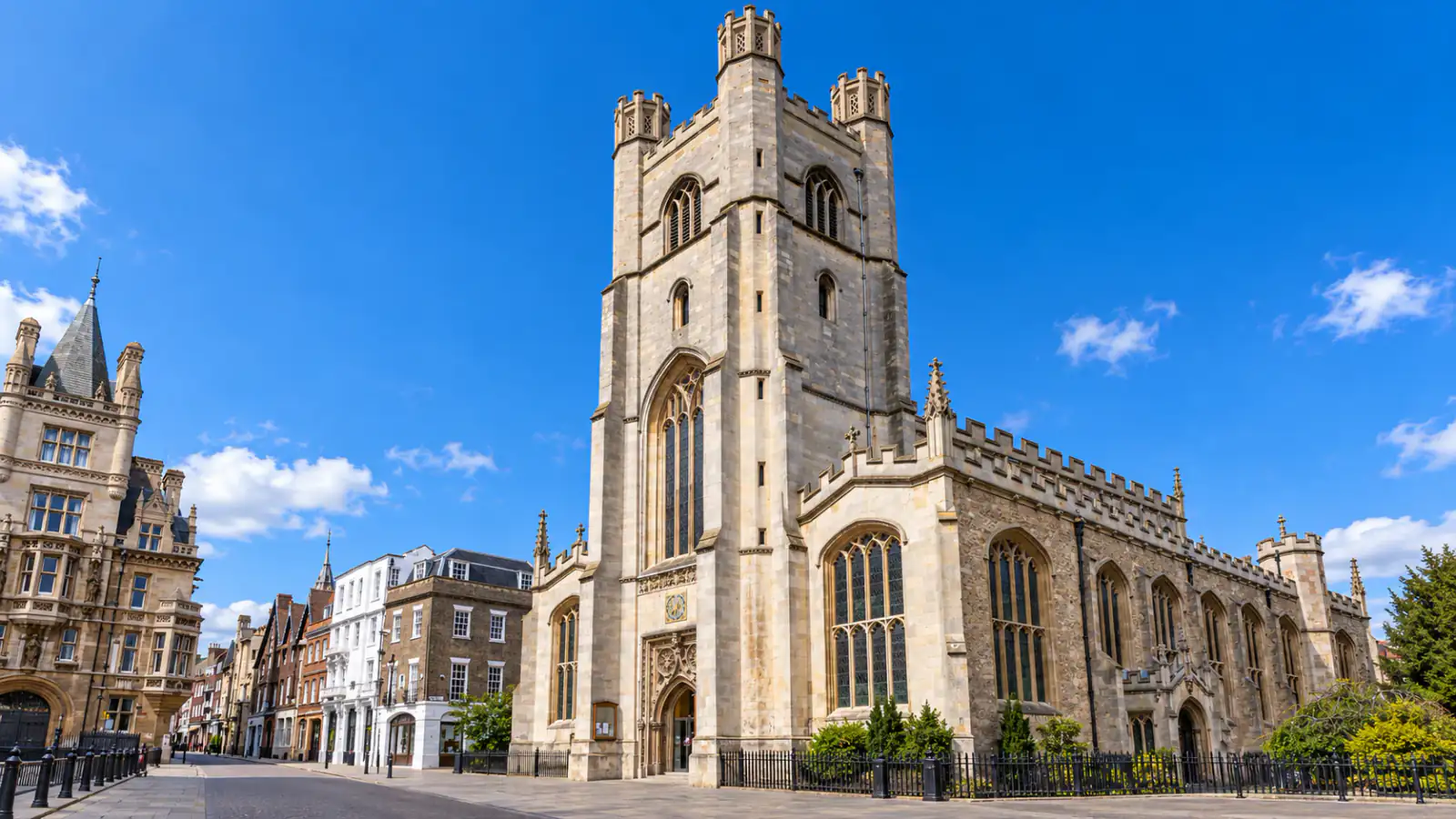
Great St Mary’s
Cambridge’s University Church, with a medieval nave and a ticketed tower panorama reached by 123 steps. Tower access requires stairs.
01 / The experience
The University Church, from the nave to the roofscape
Cambridge’s University Church, with a medieval nave and a ticketed tower panorama reached by 123 steps. Tower access requires stairs.
From the top of Great St Mary’s, Cambridge changes from a sequence of streets into a connected roofscape. Caius lies close below, Trinity Street leads north towards St John’s, and the colleges gather around the centre. The tower is a compact outing with a clear physical commitment: 123 steps stand between the gift shop and the outdoor viewing platform. The church below offers a different visit, with stained glass, timber galleries and a history closely bound to the University.
The site appears in a record from 1205. When scholars moved from Oxford to Cambridge in 1209, the nave became a place for university meetings and degree ceremonies. Great St Mary’s therefore belongs to the University’s early life without being a college chapel. Its position between King’s Parade and the market also places it in the middle of the town, with academic ceremony on one side and everyday trading on the other.
The building tells several periods of that history. Fire destroyed the earlier church in 1291, and rebuilding continued into the fourteenth century. A later campaign enlarged the nave: Richard, Duke of Gloucester, contributed to fundraising in 1475, and work began three years later. The nave was completed by 1519; the tower reached its present height in 1608. From outside, the long line of Gothic windows and the square tower make those different scales easy to read together.
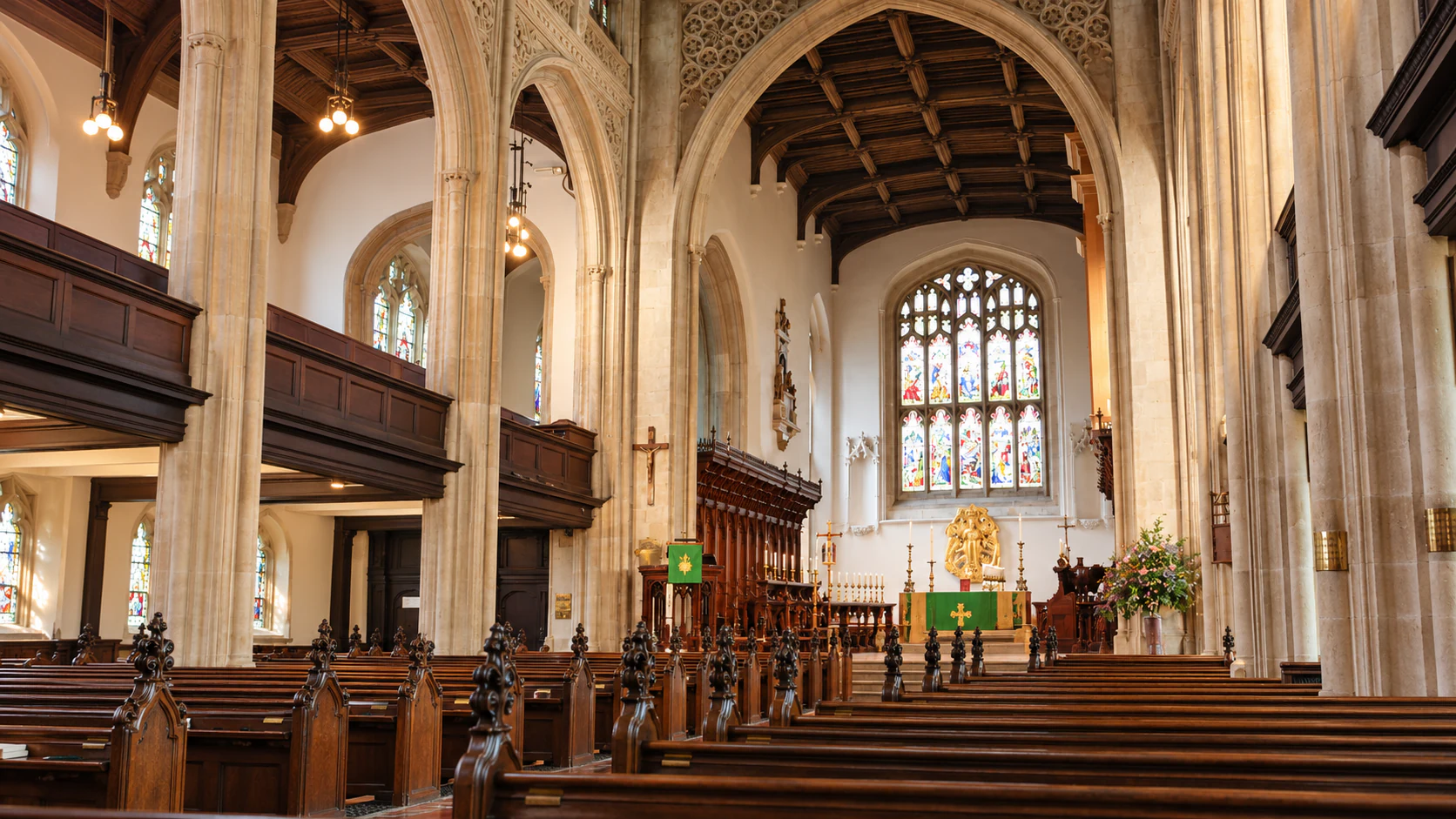
Inside, the east window supplies a useful thread through the church’s decoration. Installed in 1872, its scenes follow the early life of Jesus, from the Annunciation through the Nativity to the Flight into Egypt. The higher windows beside the central aisle date from 1902–04. They brought colour into an interior that had lost much of its earlier decoration during the Reformation. The church’s heritage touchscreens add context for the building and the city beyond it.
Martin Bucer’s story gives that religious change a personal focus. The Reformation scholar lived in Cambridge and was buried here, but under Mary I his remains were exhumed and burned in the marketplace. During Elizabeth I’s reign, symbolic remains were gathered and reinterred. A brass plate on the south side of the High Altar marks the original burial place. The chancel currently has two steps from the nave, so this part of the church has a different access condition from its step-free entrances.
For the tower, buy an individual ticket in the gift shop; groups of ten or more need advance arrangements. The platform gives a high view over places that can then be explored at street level, making the climb useful near the beginning of a central walk. Sunday timing follows services. The church remains a working place of worship, and neither the tower stairs nor the chancel should be assumed accessible because the main doors have step-free routes.
04 / Before you go
Plan your visit
Admission
Tower: adult £8.50; accompanied child aged 5–16 £4.50; under five free; student with ID £6.50; family of two adults and two children £21.
Opening hours
Tower and shop: Monday–Thursday 10:00–17:30, last ticket 17:00; Friday–Saturday 10:00–18:00, last ticket 17:30; Sunday 12:00–16:30, published last ticket 16:15. Sunday timing varies with services.
Getting there
Great St Mary’s, Senate House Hill, Cambridge CB2 3PQ
Beside King’s Parade and Market Hill in the pedestrian centre. Step-free church entry is through the west and south doors; buy tower tickets at the gift shop. Vehicle access in the centre is restricted.
Plan your visit
Buy individual tower tickets in the church gift shop; reservations are not required. Groups of ten or more need advance arrangements with the church.
The climb has 123 steps. There is no lift to the platform, and service dogs cannot accompany visitors up the tower.
Sunday opening follows service times. Ticket sales finish before closing; use the advertised day-specific cut-off above.
A saved itinerary stop does not reserve a tower visit. Group organisers need direct confirmation and the applicable group rate.
Allow time before the final ticket cut-off. The operator also advises that last entry is generally 30–45 minutes before closing; Sunday service changes may affect the timetable.
During your visit
Gift shop and heritage touchscreens inside the church. Accessible toilet with baby changing by the south entrance; ask the front desk to open it.
Michaelhouse Café is a separate venue a short distance north on Trinity Street, rather than a café inside the tower.
Working church: worship and scheduled events affect access. Step-free main entry does not provide step-free chancel or tower access.
Accessibility
Step-free church entry at west and south doors. Two steps separate nave and chancel; St Andrew’s Chapel has a very narrow doorway. The tower has 123 steps and is unsuitable for wheelchair users, people with limited mobility and service dogs. Guide, hearing and service dogs are welcome in the church itself. Accessible toilet and baby changing by the south entrance are opened by staff on request. Hearing loop serves the nave when the sound system is in use.
Location & nearby places
Continue exploring / Cambridge
More to explore
in Cambridge
Find another place for your itinerary, or explore all things to do in Cambridge.
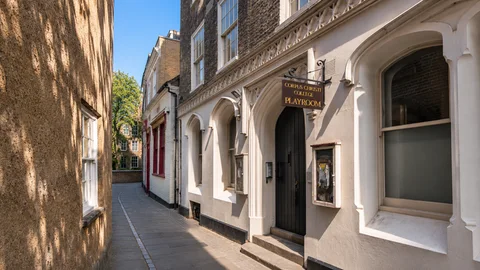 Live performanceCorpus PlayroomExplore experience →
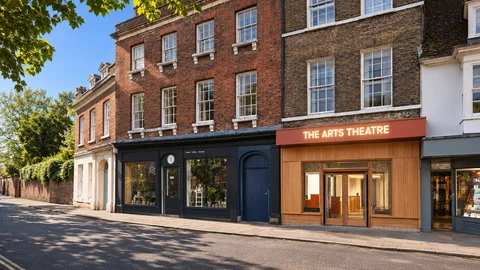 Live performanceThe Arts Theatre CambridgeExplore experience →
 Food & drinkCambridge MarketExplore experience →Cambridge experienceHistoric CentreExplore experience →
Good to know
Great St Mary’s: frequently asked questions
Can I climb Great St Mary’s tower in Cambridge?
Yes. The tower has a viewing platform above the city, reached by 123 steps. It is unsuitable for wheelchair users and people with limited mobility.
Can I reserve a Great St Mary’s tower ticket online?
Individuals buy tickets in the gift shop and do not need reservations. Groups of ten or more should book directly in advance; group rates apply.
Is Michaelhouse Café inside Great St Mary’s Church in Cambridge?
Michaelhouse Café in Cambridge occupies a separate medieval chapel and community building just north on Trinity Street.