The Polar Museum
Arctic clothing and transport, Antarctic expedition equipment and polar research in the Scott Polar Research Institute, with free admission.
01 / The experience
Equipment, communities and journeys at the ends of the Earth
Arctic clothing and transport, Antarctic expedition equipment and polar research in the Scott Polar Research Institute, with free admission.
A sledge, a hooded garment and a case of expedition instruments tell different stories about living in the polar regions. The Polar Museum brings those stories into a compact ground-floor collection on Lensfield Road, where Arctic communities, Antarctic exploration and present-day research share the same building. It is a useful free visit between Cambridge station and the central museums, with enough distinct material for a focused hour rather than a full-day commitment.
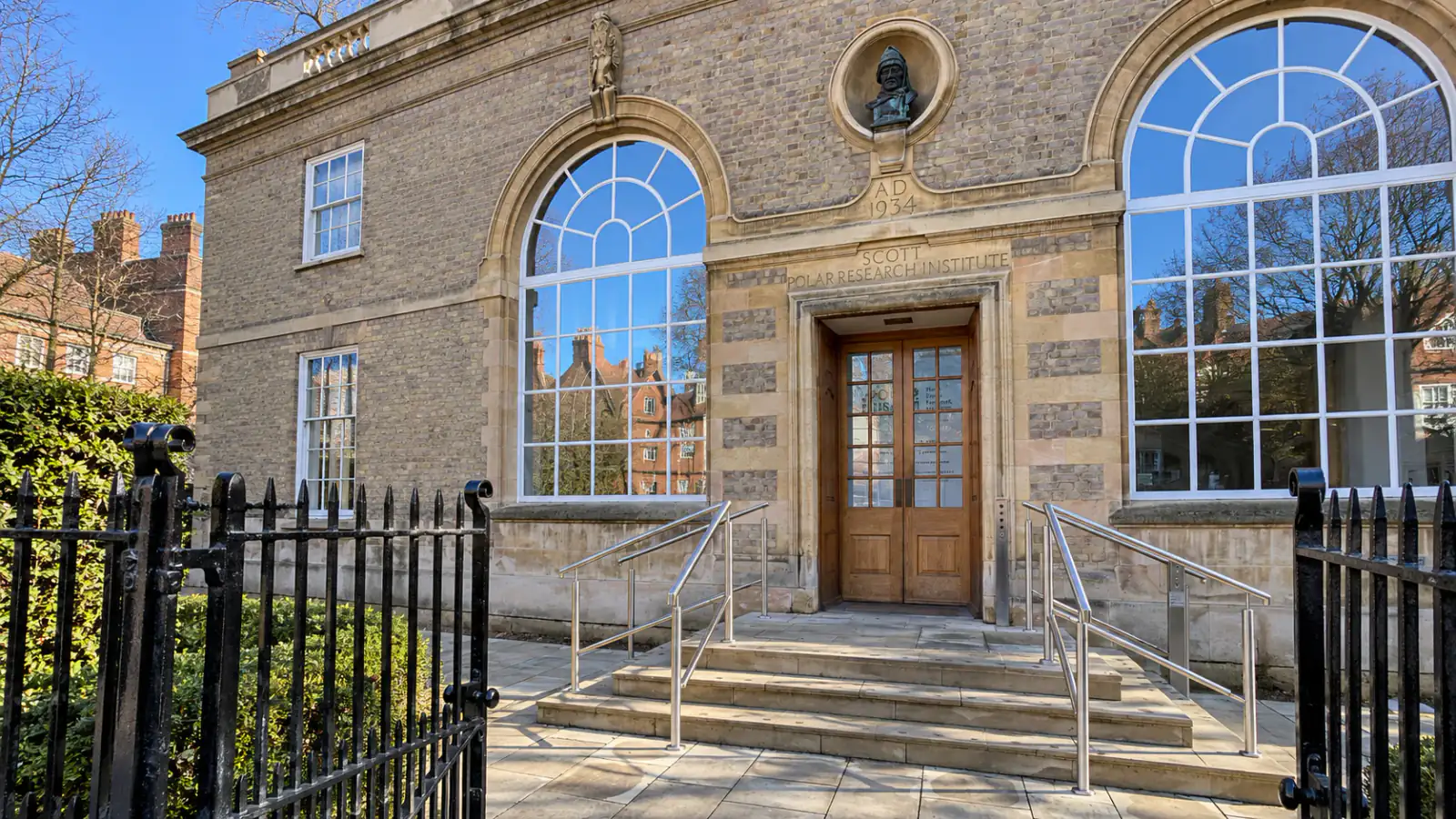
The Scott Polar Research Institute was founded in 1920, following proposals by Frank Debenham, a geologist on Scott’s Terra Nova expedition. Its purpose combined research with a memorial to Scott and his companions, who died returning from the South Pole in 1912. The present building opened in 1934. Polar subjects are part of its architecture: maps decorate the domes in Memorial Hall, and a bust of Scott by his wife, Kathleen Scott, looks over the front garden.
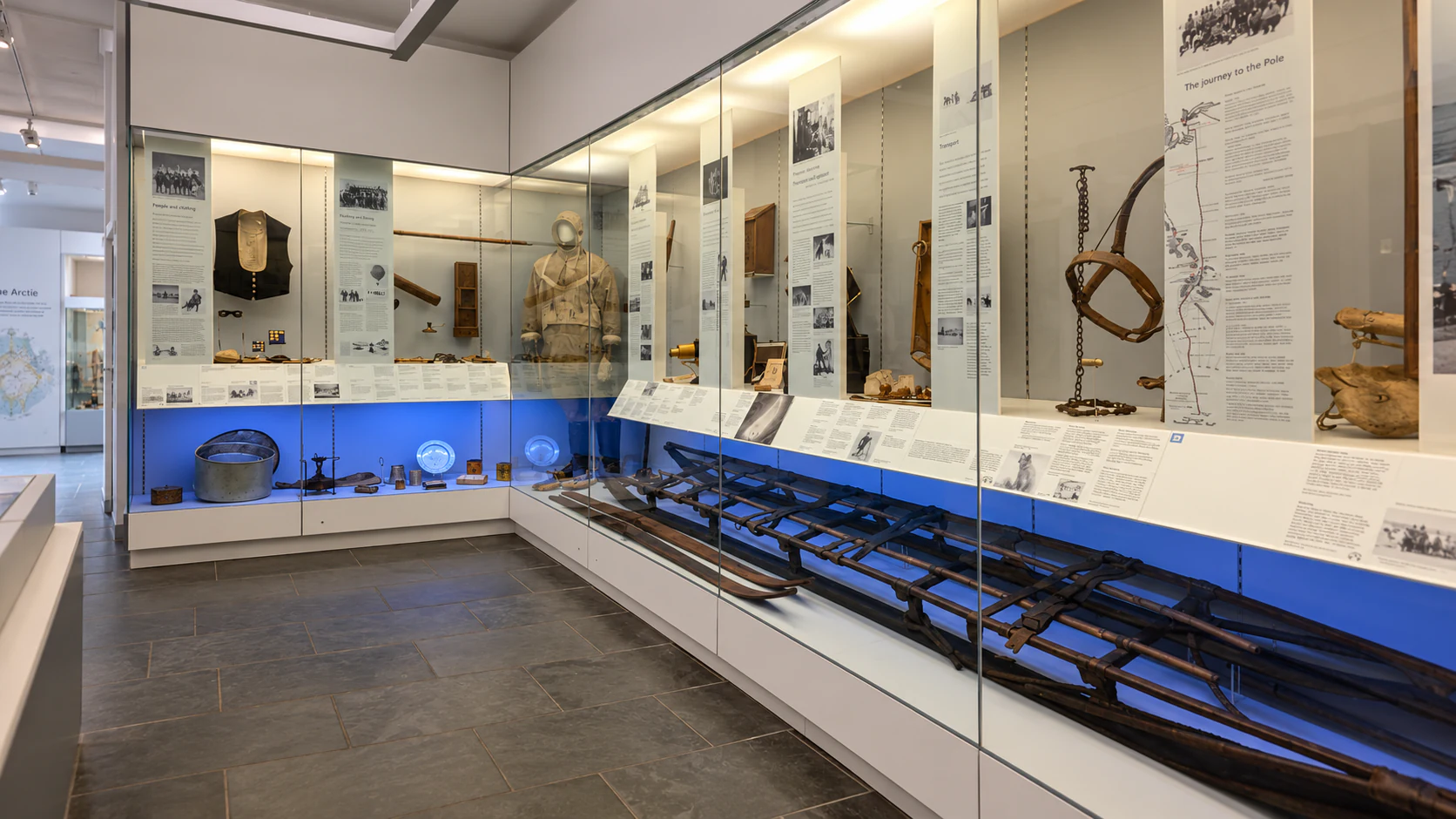
The museum’s Arctic displays consider places that are homes as well as destinations for expeditions. Clothing, tools, artworks and transport objects show ways in which communities have worked with demanding environments. The pale hooded garment in the Arctic Peoples area sits alongside smaller objects, while a long case explores transport. Those displays make an effective starting point before moving towards the British exploration material, because they place human knowledge of the regions ahead of the later journeys made into them.
Antarctic expedition equipment brings the practical choices into focus. Clothing, food containers, scientific instruments and the long wooden sledge in the Journey to the Pole displays show what people carried and how they travelled. Elsewhere, a large historic Union flag, portraits, papers and instruments connect the equipment with particular expedition histories. The scale is often domestic rather than monumental: a small tool or piece of kit can explain a problem that a map of the journey cannot.
Scott and Shackleton are central figures in the collections, but their material extends beyond a single story of endurance. The Institute holds photographs, documents and objects relating to their expeditions, alongside collections connected with earlier Arctic exploration and the search for Franklin’s ships. Audio descriptions and handling resources provide other ways into selected objects, with advance arrangements for some materials. The museum is also part of an active research institute studying polar environments and societies, so historical equipment sits within a much longer scientific conversation.
Outside, the sculpture garden and the replica James Caird lifeboat add another scale to the visit. The boat stands beside the side approach, which also provides the museum’s ramped entrance. The main front doors have three steps; the step-free route is separate. Autumn 2026 grounds maintenance does not close either entrance, but barriers around the work must be respected when looking at outdoor objects. Inside, drawers add smaller discoveries to the glass cases, and the shop offers a short final stop. There is no luggage storage, so a visit straight from the station needs to account for bags before arrival.
04 / Before you go
Plan your visit
Admission
Individual admission free. Self-guided groups require a confirmed request; guided group tours cost £200 plus VAT and depend on staff arrangements.
Opening hours
Tuesday–Saturday 10:00–16:00. Closed Sunday and Monday. Christmas closure dates and special openings are advertised separately.
Getting there
Scott Polar Research Institute, Lensfield Road, Cambridge CB2 1ER
On Lensfield Road between the station area and the city centre, roughly a kilometre from Cambridge station. Enter through the black gates; use the right-side path for the ramped entrance. No general visitor parking. The museum’s accessible parking bay requires advance arrangements.
Plan your visit
Free individual admission Tuesday–Saturday, 10:00–16:00. Christmas closures and special openings are advertised separately.
Groups must request a visit in advance and wait for an email confirmation. Up to twenty people per request; larger parties need separate requests.
Autumn 2026 grounds work does not close the main or ramped side entrance. Respect the barriers around outdoor objects.
The self-guided group calendar leads to a booking request, not an instant reservation. Do not travel as a group without the museum’s confirmation.
Guided group tours cost £200 plus VAT and must be arranged directly. For step-free arrival, use the side ramp; accessible parking should be reserved with the museum in advance.
During your visit
One fully accessible toilet at the back of the temporary-exhibition gallery. Museum shop and seating available; no luggage storage.
Ask in advance for handling collections, tactile maps/drawings and audio descriptions. A wheelchair can be reserved with the museum.
The replica James Caird lifeboat is beside the side approach. Outdoor objects may sit beside maintenance barriers during autumn 2026.
Accessibility
Main entrance has three steps. For step-free entry, turn right inside the Lensfield Road gates and follow the path along the right side of the building to the curved ramp near the James Caird replica. Accessible toilet at the back of the temporary-exhibition gallery. A loan wheelchair and accessible parking space can be arranged in advance; handling/tactile and audio-description resources are available by arrangement.
Location & nearby places
Continue exploring / Cambridge
More to explore
in Cambridge
Find another place for your itinerary, or explore all things to do in Cambridge.
 Culture & historyFitzwilliam MuseumExplore experience →
 Live performanceHoward Theatre at Downing CollegeExplore experience →
 Live performanceGreat Hall at The LeysExplore experience →
 Live performanceArts Picturehouse CambridgeExplore experience →
Good to know
The Polar Museum: frequently asked questions
What can I see at the Polar Museum in Cambridge?
The Polar Museum in Cambridge tells stories of Arctic communities, Antarctic expeditions and polar research through clothing, equipment and other objects.
Do I need to book the Polar Museum Cambridge?
Individuals can visit free during opening hours. Organised groups need a pre-booked request and an email confirmation. The museum accommodates up to twenty per request; larger parties need separate arrangements.
Where is the Polar Museum’s step-free entrance?
Turn right inside the Lensfield Road gates and follow the path down the right side of the building to the curved ramp by the James Caird replica. The main front doors have three steps.
Can I leave a suitcase at the Polar Museum?
No. The museum has no luggage storage. Keep belongings with you; bags may be searched on arrival.