In depth
Pitt Rivers Museum
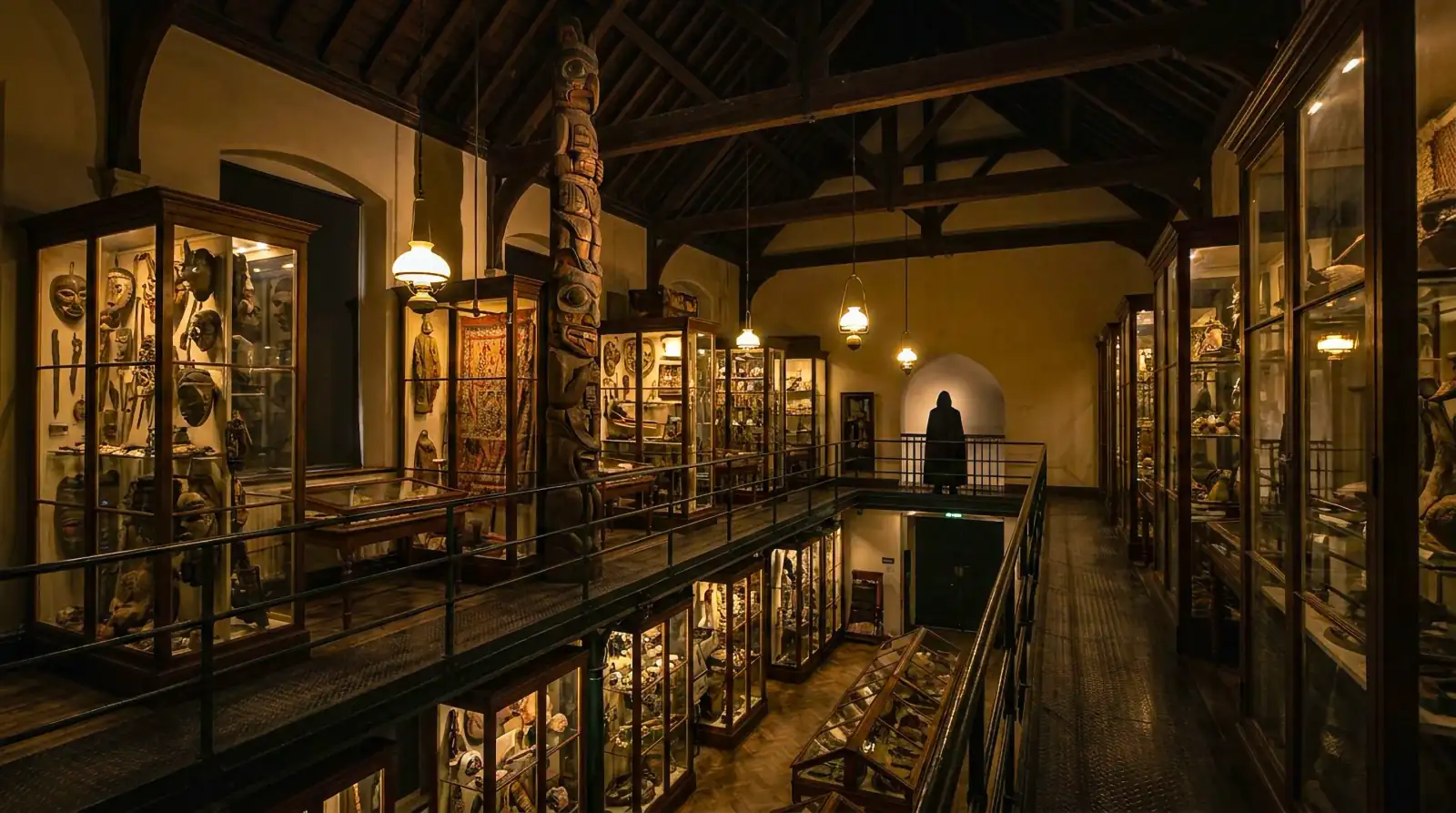
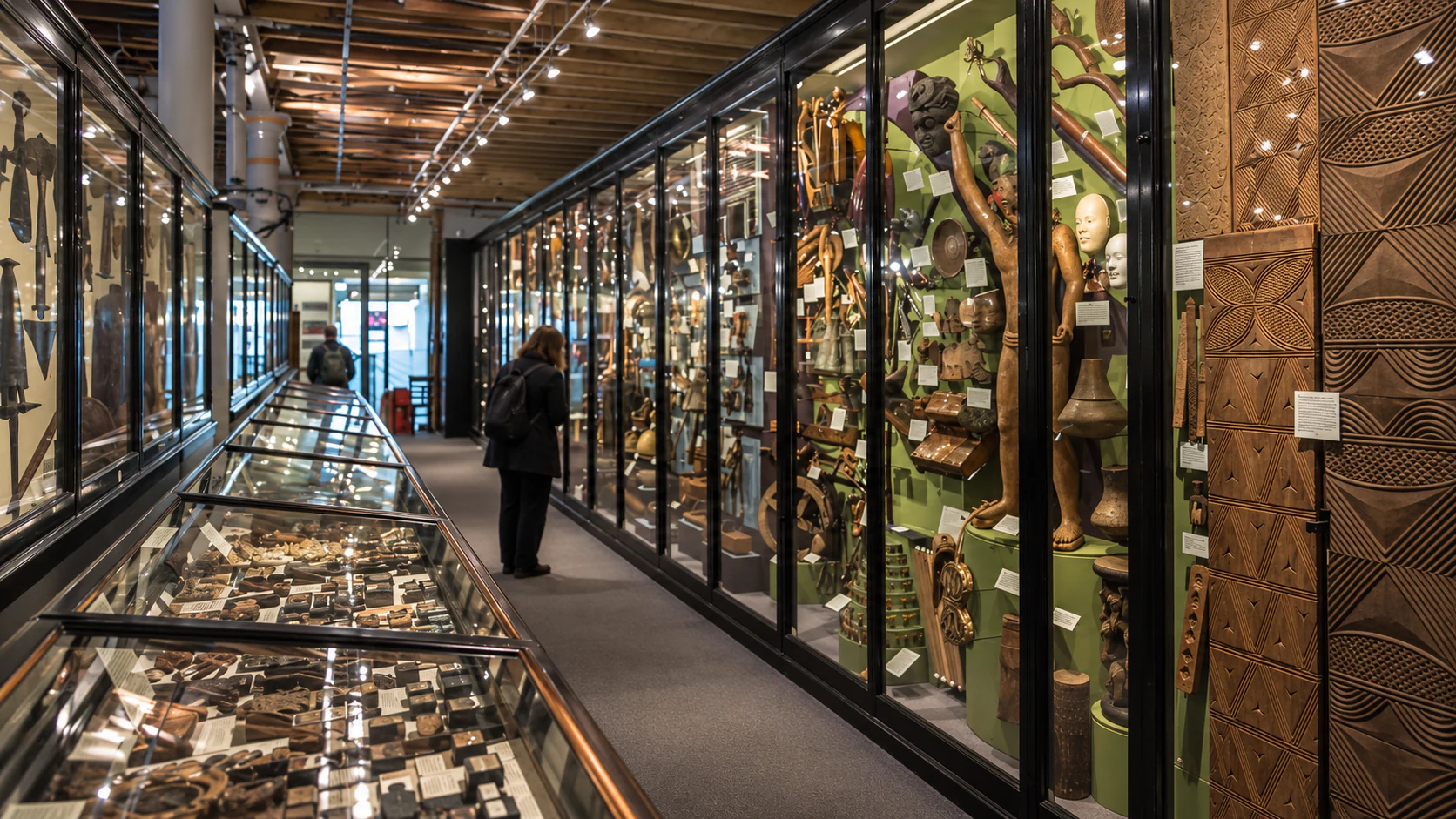
Dense cases of instruments, boats, tools and other objects invite comparisons across cultures. Enter this free museum through Natural History.
Story · Visit · Route · Links
Visitor Essentials & Quick Answers
Why is the Pitt Rivers Museum so different?
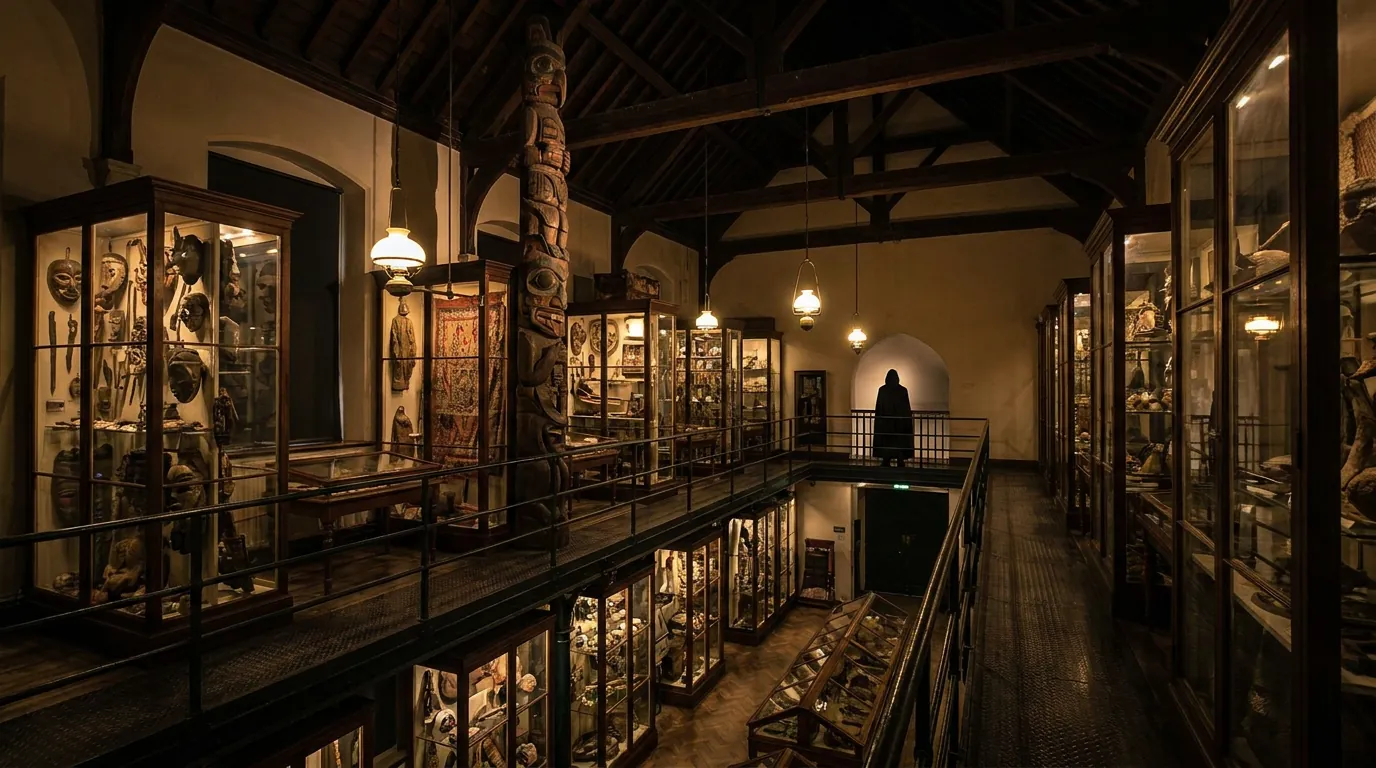
Its cases group objects by type and use rather than simply by country or date: instruments, boats, locks and amulets invite comparisons across cultures. The dense arrangement is part of the attraction, but also reflects Victorian ideas the museum now questions. Read the interpretation as well as admiring the extraordinary cases.
How do I enter the Pitt Rivers Museum?
Enter through the Oxford University Museum of Natural History on Parks Road. The Pitt Rivers is at the back of the building; it normally opens at noon on Mondays and 10am Tuesday–Sunday.
Can I still see the shrunken heads at the Pitt Rivers Museum?
No. In 2020 the museum removed human remains, including the Shuar tsantsa, from display. Its review found the display encouraged stereotyped views of Shuar culture; the museum is working with Shuar partners on a fuller account.
Pitt Rivers or Ashmolean: what is the difference?
The Pitt Rivers asks how people across cultures make and use things, with comparison built into its displays. The Ashmolean offers a broader art-and-archaeology journey through civilisations, paintings and individual masterpieces. Choose Pitt Rivers for dense discovery and unexpected connections; choose the Ashmolean for a more expansive gallery visit.
Choose your depth
Essentials or more detail?
See visiting essentials, or read more about the history and places nearby.
01 The experience
What to expect.
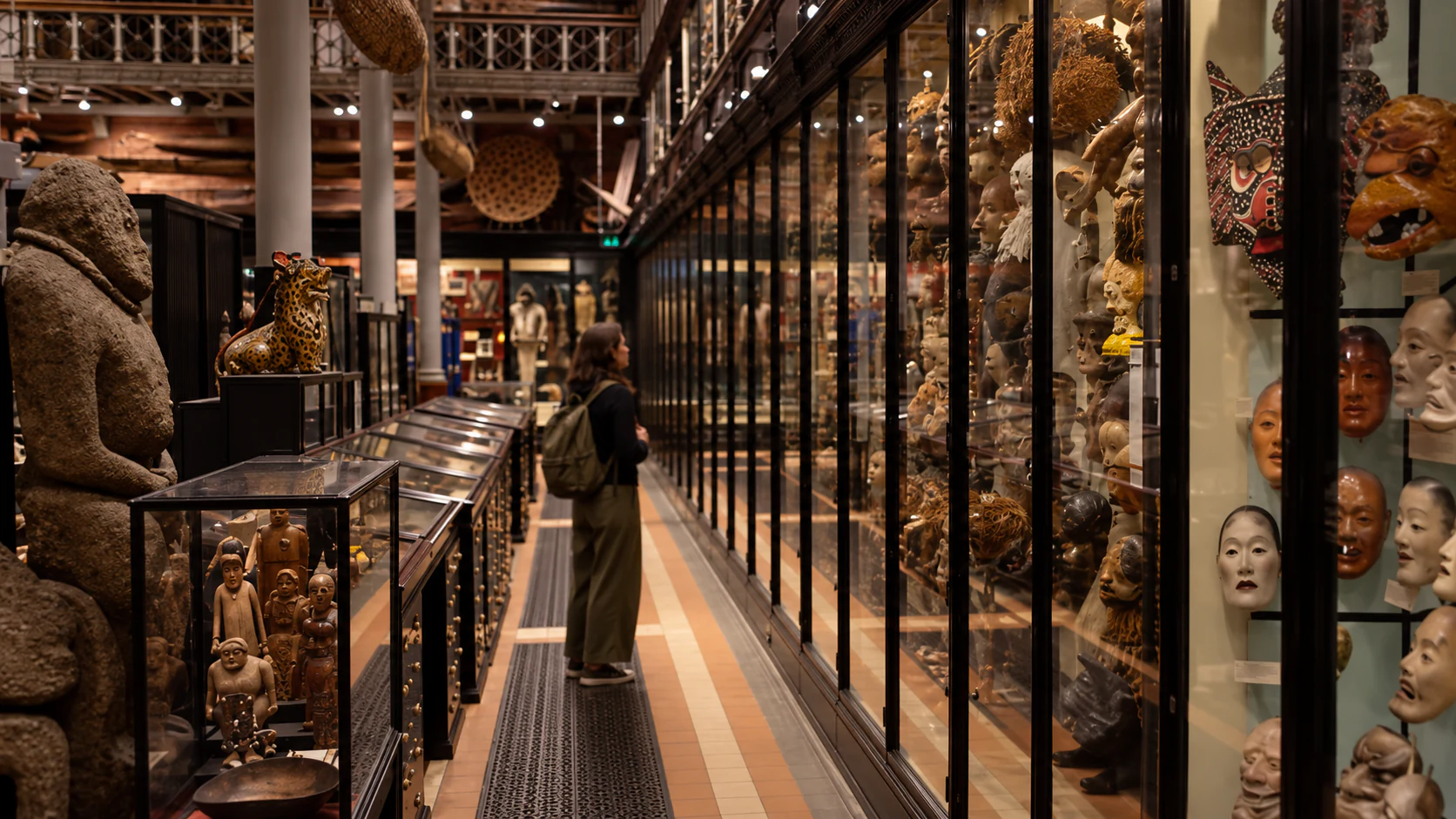
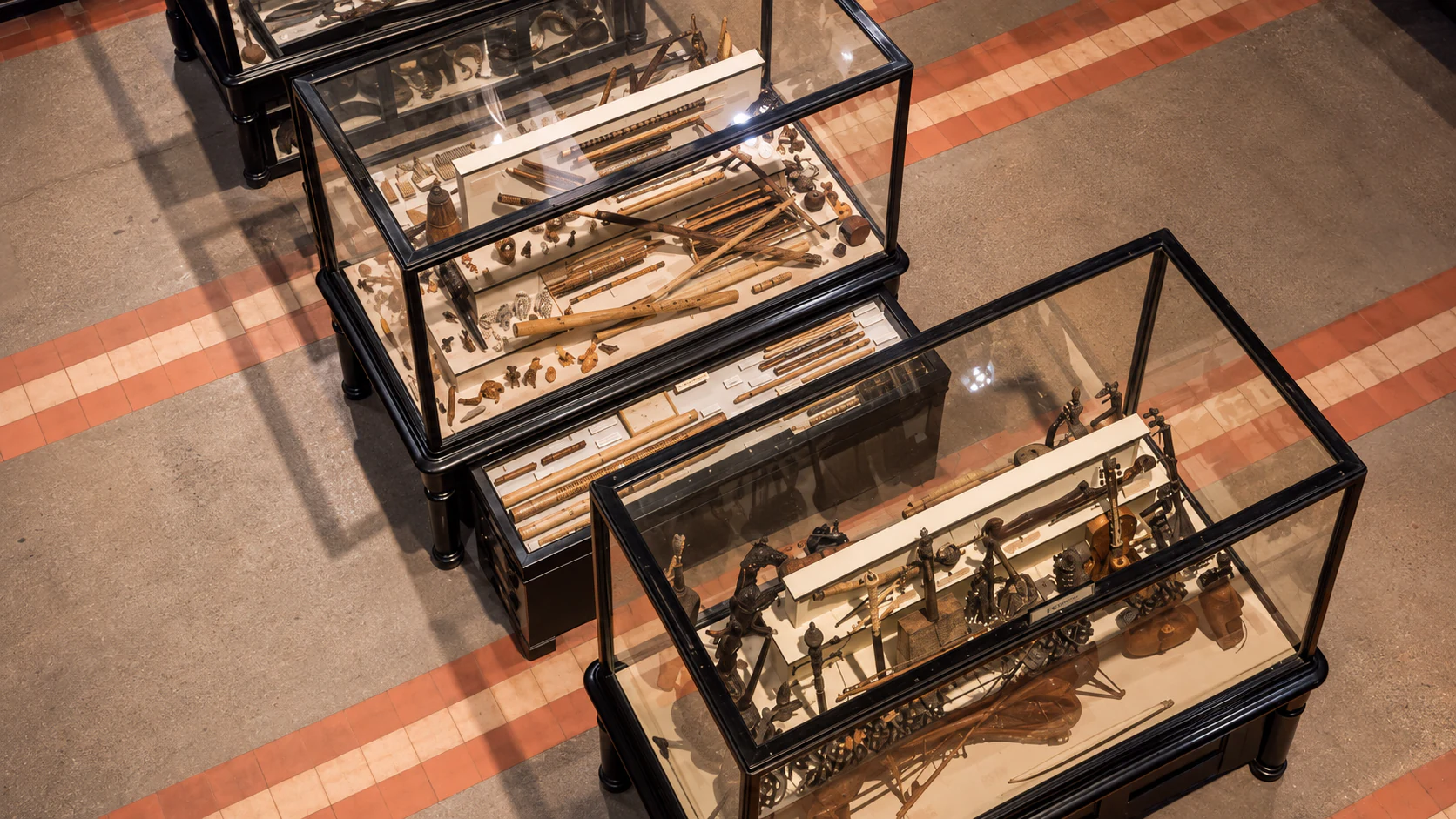
Musical instruments, boats and fire-making tools share cases with objects made centuries apart on different continents. The Pitt Rivers groups its collection by what things do, creating comparisons across cultures rather than a route through countries or periods.
Cases, labels and drawers
The galleries are dense and deliberately dim. Objects rise above eye level, old handwritten labels sit beside them, and drawers beneath and beside the cases hold further displays. Some labels are more than a century old: their vocabulary and attributions reveal as much about earlier collecting as the objects themselves.
The Star House Pole, carved by the Haida of Haida Gwaii, rises through the court. Smaller cases reward closer attention to materials and technique: how different makers shaped a boat, built an instrument or started a fire.
The collection and its history
Augustus Pitt Rivers gave his collection to Oxford in 1884. His gift required a dedicated building and a permanent lecturer in anthropology; Edward Burnett Tylor took up the post in 1885. The museum’s arrangement grew from Pitt Rivers’s belief that objects could demonstrate a single sequence of human development. Anthropology later rejected that framework, while the displays retained their comparative form.
Colonial collecting and the terms on which objects reached Oxford remain central to the museum’s work. In July 2020, it removed 120 human remains from public display after an ethical review, including the Shuar tsantsa. These are no longer exhibited. Reinterpreted cases explain the change and the concerns about stereotyping that prompted it.
Planning a visit
Enter through the Museum of Natural History on Parks Road, walking past the dinosaurs and turning left at Darwin’s statue. The bright glazed court gives way to smaller, darker galleries. Allow around ninety minutes, or longer for labels and drawers; together, the two free museums can fill half a day.
The Pitt Rivers opens at noon on ordinary Mondays, later than the museum in front. Low light, small labels, high displays and close-set cases can make viewing difficult, particularly from a seated position or with limited vision. The access section describes the facilities and details to discuss before travelling.
The story
History & character.
The collector
Augustus Henry Lane Fox Pitt Rivers was a career soldier who came to archaeology through the study of firearms. Tracing small changes in the design of the rifle convinced him that objects, like organisms, could be arranged in developmental sequences — that material culture evolved, and that the sequence could be shown on a shelf.
He assembled a large private collection organised on that principle. It is the principle, not merely the objects, that he gave to Oxford.
1884: the Deed of Gift and its conditions
In 1884 Pitt Rivers transferred his collection to the University of Oxford. The Deed of Gift attached two conditions:
- That the University appoint a permanent lecturer in anthropology.
- That a building be provided to house the collection, and used for no other purpose.
Both were met. Edward Burnett Tylor was appointed Reader in Anthropology in 1885 and became the first lecturer in anthropology in the United Kingdom. Anthropology as a taught British subject and this museum therefore begin at the same moment and by the same instrument — a connection between the collection and the teaching of anthropology.
1885–86: the building
The University engaged Thomas Manly Deane to build an extension at the rear of the Oxford University Museum of Natural History. Deane was the son of Thomas Newenham Deane, who with Benjamin Woodward had designed the Natural History Museum itself three decades earlier — so the two buildings are, in a literal sense, family.
Construction ran from 1885 to 1886. The arrangement it created persists: the Pitt Rivers has no street frontage of its own for visitors and is entered through its neighbour, which is why arriving feels like passing through one museum to reach another.
The University Museum and the Pitt Rivers are protected together as a single Grade I listed building (National Heritage List for England entry 1081534).
The typological method
The displays group objects by what they do rather than where they are from. Instruments with instruments, boats with boats, fire-making with fire-making, across continents and centuries in one case.
To Pitt Rivers this demonstrated evolution: simple forms giving rise to complex ones, with human ingenuity progressing along a single track. That framework — cultural evolutionism — was abandoned by anthropology during the twentieth century. The arrangement outlived the theory.
The retained arrangement now invites comparison between how different cultures address similar needs, alongside questions about the assumptions behind the original display. Visitors are, in effect, looking at two things at once — the world's objects, and a Victorian idea about them.
Growth
The founding gift has become more than 500,000 objects, photographs and manuscripts. The collection grew through university expeditions, colonial administrators, missionaries, soldiers, collectors and purchase — the ordinary channels of nineteenth- and twentieth-century acquisition, with all the questions those channels raise.
July 2020: the human remains come off display
Following an internal ethical review, the museum removed 120 human remains from public display ahead of its post-lockdown reopening. Among them were the tsantsa — Shuar shrunken heads, acquired between 1884 and 1936 — which had been the museum's most photographed objects for generations.
The museum's stated reasoning was that the displays "did not sufficiently help visitors understand the cultural practices related to their making and instead led people to think in stereotypical and racist ways about Shuar culture".
The collection holds 12 tsantsa, and seven human heads, of which the museum believes three are authentic and four are probably forgeries — made from bodies taken from morgues or hospitals to meet European collector demand. That detail matters: a substantial part of the display's fame rested on objects manufactured for the market that came to see them.
The removal sits within continuing projects including Changing Curatorial Legacies and Rethinking Relationships, and within a wider debate about the return of material to originating communities.
Look closer
Highlights and hidden details.
The arrangement itself
Not an object but the reason to come. Every case groups things by what they do rather than where they came from: instruments with instruments, boats with boats, fire-making with fire-making, across four continents and several centuries at once.
Why it matters: the arrangement originated in Pitt Rivers’s Victorian belief that human ingenuity developed along a common track. Anthropology abandoned the theory; the museum kept the arrangement and now frames it as a productive comparison rather than a proof. You are looking at the world's objects and at a nineteenth-century idea about them simultaneously.
The visit: pick one case and read across it rather than along it. The parallels are the exhibit.
Time: the whole visit.
The handwritten labels
Many labels are handwritten, some more than a century old, in the hand of whoever catalogued the object.
Why it matters: they record how the museum thought at the moment of acquisition — the vocabulary, the confidence, the attributions. Modern museums rewrite labels; this one has largely kept them, which makes the labelling a primary source in its own right.
Photography: hard. Small, low-contrast, badly lit. A phone will struggle.
Time: 10 minutes of close reading changes how you see the rest.
The drawers
Beneath and beside the cases are drawers you are invited to open, holding more of the collection than the surfaces show.
Why it matters: it is the clearest expression of the museum's refusal to thin itself down to a few lit highlights. The store is part of the display.
The visit: open them. Visitors routinely walk the galleries without realising.
Time: as long as you like.
The density and the darkness
The galleries are deliberately dim and the cases are packed to above head height.
Why it matters: the low light is partly conservation and partly character. The contrast with the bright Natural History Museum court is pronounced.
The visit: give your eyes a couple of minutes on arrival before judging the room.
The Natural History Museum you walk through
Not part of the Pitt Rivers, but unavoidable and free.
Why it matters: the transition is the experience. Deane and Woodward's soaring glass-and-iron court, dinosaurs, daylight — then a left turn at Darwin's statue into the opposite of all of it. The Deane family’s architectural practices worked on the two museums three decades apart.
Time: 30–45 minutes if you stop.
The Haida totem pole
The tall cedar pole standing in the court is the single most eye-catching object in the museum — the Star House Pole, carved by the Haida of Haida Gwaii and brought from the village of Masset in British Columbia.
Why it matters: it commemorates a Haida chief's adoption of a girl in 1878, which makes it a family record as much as a monument. It is also the object that most directly raises the question the museum now asks of itself — how such things came to Oxford, and on what terms. The museum maintains dedicated Haida collections pages and has worked with Haida representatives on their interpretation.
The visit: it dominates the court and is impossible to miss; what is easy to miss is the label and the story behind it.
Photography: the hardest object in the building to frame — very tall, in a confined and dim space. Shoot detail rather than attempting the whole.
Time: 10 minutes.
What is no longer there
In July 2020 the museum removed 120 human remains from display, including its tsantsa — Shuar shrunken heads that had been its most photographed objects.
Why it matters: the museum has left the change legible rather than tidying it away, and explains its reasoning: the displays "did not sufficiently help visitors understand the cultural practices related to their making and instead led people to think in stereotypical and racist ways about Shuar culture". A museum publicly revising what it shows, and saying why, is now part of what this museum is about.
Display change: the tsantsa are no longer exhibited.

Details to look for.
The museum exists because of a contract
The 1884 Deed of Gift was conditional. Oxford had to appoint a permanent lecturer in anthropology and provide a building used for no other purpose. Everything you are standing in is the University discharging a legal obligation — including, arguably, the discipline itself: Edward Burnett Tylor took the post in 1885 and became the first lecturer in anthropology in the UK. Very few museums can be said to have created a subject.
The two buildings are by three generations of one family
Sir Thomas Deane (1792–1871), with Benjamin Woodward, built the Oxford University Museum of Natural History in 1855–60, to Woodward's design. Three decades later the practice of his son — T N Deane & Son, the son being Thomas Manly Deane — built the Pitt Rivers extension behind it, 1885–86.
So it is grandfather and grandson, with the father's name on the firm. You walk out of one and into the other, and the change in temperature is total.
The Grade I listing credits Sir Thomas Deane and Benjamin Woodward for the Natural History Museum and T N Deane & Son for the Pitt Rivers extension.
Read across a case, not along it
Compare related objects within a case. Because objects are grouped by function, a case is a comparison: the same human problem solved in a dozen places. Reading left to right along a shelf gives you a list. Reading a case as a set gives you the argument the museum was built to make.
The labels are exhibits
Handwritten, many over a century old, in the hand of the cataloguer. They preserve the language and the confidence of the moment of acquisition — including attributions a modern curator would not make. The museum has largely kept them rather than rewriting, which turns the labelling into a primary source about the museum itself.
The drawers open
Under and beside the cases. Most visitors walk the galleries without touching one. There is more collection below the eye-line than on it.
Four of the seven heads are probably forgeries
Of the human heads the museum holds, it believes three are authentic and four are probably forgeries — made from bodies taken from morgues or hospitals to supply European collectors. The most famous display in the museum's history therefore rested substantially on objects manufactured to satisfy the market that came to look at them. They are no longer displayed, but the fact is worth carrying.
The gaps are deliberate
Where human remains were removed in 2020, the museum did not close ranks and re-dress the cases to hide it. The change is left legible. The remaining spaces help explain the change in display policy.
The lighting is a conservation decision, not atmosphere
The dimness reads as theatrical and is largely functional — textiles, feather, pigment and paper degrade under light. The atmosphere is a by-product of taking the objects seriously.
You are in a museum inside a museum
The Pitt Rivers has no public street entrance of its own. The 1884 deed required a building for the collection; what it got was an extension at the back of another institution, and that arrangement still governs how every visitor arrives — past the dinosaurs, left at Darwin.
It calls itself contested
Not a critic's word — the museum's own. It describes being "a contested space that calls for innovative curation to engage with the more difficult aspects of its history", with objects from Britain's colonial past sitting beside older and newer ones. An institution naming that on its own about page is doing something most of its peers still avoid.
Make it work
Plan your visit.
Opening and entrance arrangements can change during holidays and building work.
Where it is, and how you get in
The museum's address is Pitt Rivers Museum, South Parks Road, Oxford, OX1 3PP — but visitor entry is through the Museum of Natural History on Parks Road, OX1 3PW. There is no separate public street entrance.
Once inside the Natural History Museum, walk past the dinosaurs and turn left at Darwin's statue. The entrance is behind the Natural History Museum’s main court.
A South Entrance in Robinson Close serves evening events and disabled access. Ask the museum about current access and parking if you need this entrance.
Opening hours
| Day | Hours |
|---|---|
| Monday | 12:00 – 17:00 |
| Monday (bank holidays and half-term) | 10:00 – 17:00 |
| Tuesday – Sunday | 10:00 – 17:00 |
The Natural History Museum opens at 10:00 on ordinary Mondays; the Pitt Rivers opens at noon.
Admission
Free. No ticket, no booking for individuals. Group visits must be booked in advance.
How long to allow
90 minutes is a fair first visit; two hours if you read labels, and considerably more if you start opening drawers. Thirty minutes is enough only to register the atmosphere, not the collection.
Many visitors combine it with the Museum of Natural History, which you walk through anyway — together they make a comfortable half day.
What is not on display
The tsantsa were removed from display in July 2020, as part of the removal of 120 human remains following an ethical review.
Best time to visit
- Quietest: weekday mornings in term time, or the first hour after opening.
- Busiest: weekends, school holidays, and rainy afternoons — this is one of Oxford's default wet-weather destinations and it fills accordingly.
- Best conditions: bright days. The galleries are deliberately dim, and what daylight reaches them helps.
Facilities
- Café — Horsebox Coffee Company, 08:30–17:00 daily. Food and drink may only be consumed outside the galleries.
- Shop — gift shop, with a print service.
- Toilets — on site, including accessible provision.
- Lockers — availability is unconfirmed; contact the museum before arriving with large bags.
Photography
Personal photography is permitted. Tripods are not, without written permission. The low light makes this a genuine constraint rather than a formality — use a handheld camera in the low light.
Getting there
- On foot: about 12 minutes north from Carfax, via Broad Street and Parks Road.
- Bus: stops on Parks Road and South Parks Road.
- Train: Oxford station, roughly 20 minutes on foot.
- Car: not advised. Central Oxford is heavily restricted; use Park & Ride. Disabled parking is normally available in Robinson Close; ask about current bays and any alternative parking before arrival.
Families
Good for children who like looking. There are no large interactive galleries; the appeal is density, strangeness and drawers you may open. Buggies can be manoeuvred but the cases are close together and the museum is busy in holidays.
Rain
One of the best wet-weather options in Oxford — entirely indoors, free, and paired with the Natural History Museum through the same door. Expect others to have had the same idea.
Postal address and visitor entrance
The postal address is South Parks Road, OX1 3PP. For a normal museum visit, navigate to the Museum of Natural History on Parks Road, OX1 3PW.

Visit your way
Access and family planning.
Discuss the entrance, parking and viewing arrangements with the museum if your visit depends on a particular facility.
Facilities
The museum provides:
- Wheelchair accessibility
- Accessible toilets
- Hearing support systems
- Assistance animals welcome
The galleries form part of a purpose-built museum complex.
The entrance — the thing to plan
There is no separate public street entrance. Visitors enter through the Museum of Natural History, Parks Road, OX1 3PW, then go past the dinosaurs and turn left at Darwin's statue. Factor in that distance.
A South Entrance in Robinson Close normally serves disabled access and evening events. Ask about current entrance arrangements before travelling.
This is the single most important thing to confirm by telephone before travelling if you need step-free arrival or blue-badge parking: +44 (0)1865 613000.
Parking
Disabled parking is normally available in Robinson Close. Ask whether alternative bays at the Museum of Natural History are needed for your visit. Central Oxford is otherwise heavily restricted.
Vision
Low light is a significant limitation. The galleries are deliberately dimly lit for conservation, the cases are densely packed, and many labels are small and handwritten, some over a century old. Visitors with limited vision will find a large proportion of the interpretation hard to read in situ.
Whether large-print guides, audio description or magnifiers are available remains unconfirmed. Ask when you arrive or telephone ahead — given the lighting, it is worth the call.
Hearing
Hearing support systems are provided. The specific arrangement — induction loop coverage, which spaces, whether tours are supported — remains unconfirmed. Ask about support for your visit.
Mobility inside the galleries
Wheelchair access is available. Note that the display style means narrow gaps between cases and objects mounted well above eye level; some of the collection is not viewable from a seated position. That is a consequence of a Victorian display retained deliberately, not a failing of maintenance, but it affects what a visit gives you.
Seating
Rest points within the galleries remain unconfirmed. The café area outside the galleries has seating.
Sensory considerations
- Low light throughout.
- Visual density — cases packed floor to above head height; some visitors find this overwhelming.
- Noise — busy at weekends and in school holidays, and the space is hard.
- Subject matter — colonial collecting, weapons, and material relating to death and belief.
Assistance dogs
Assistance dogs are welcome.
Toilets
Accessible toilets are available.
Planning for low vision
Dim light, densely packed cases and small handwritten labels can make the collection difficult to see. Telephone ahead to ask about large print, audio description or other formats that suit your needs.
Short answer
Good for children who like looking, from roughly 5 upwards. There are no big interactive galleries — the appeal is density, strangeness and drawers you are allowed to open. Free entry means a short visit costs nothing, which takes the pressure off.
Age by age
Under 5. Manageable but not aimed at them. The galleries are dim and the cases are close together; small children see a lot of case-leg. Buggies fit but are awkward at busy times. The Natural History Museum you walk through on the way is the better room for this age — dinosaurs, daylight, space.
5–8. Works well. Boats, instruments, masks, weapons, fire-making. The drawers are the winner at this age: being permitted to open something in a museum is a novelty that carries a lot of goodwill.
9–12. The sweet spot. Old enough to grasp the arrangement — that a case compares how different people solved the same problem — which turns looking into a game with a rule.
Teenagers. Depends on interest. The colonial-collecting question is genuinely engaging for anyone doing history or politics, and the museum's openness about it invites discussion rather than closing it down.
Educational value
- Comparison as a method — the typological arrangement is an explicit intellectual model that children can be taught to read in five minutes.
- Material culture — how people make, solve and adapt.
- Where museums come from — collecting, empire, and who decides what is shown. The museum's own candour makes this teachable rather than awkward.
- Anthropology as a subject — this collection created the UK's first lectureship in it.
Friction points — read before going
- The shrunken heads are gone. If a child has been promised them, tell them before you arrive, not at the case. Removed July 2020.
- Low light. The dim, close-set galleries may be difficult for children who need bright or open spaces.
- Lots of reading, much of it handwritten and above child height.
- No eating in the galleries. Food and drink from the café must be consumed outside them.
- Monday mornings closed — opens at noon outside bank holidays and half-term. The Natural History Museum opens earlier.
- Weapons and human-related material are present. These subjects may need explanation for younger children.
Practicalities
- Toilets on site, including accessible provision.
- Café — Horsebox Coffee Company, 08:30–17:00, seating outside the galleries.
- Free, so a 40-minute visit is not a waste of a ticket.
- Combine with the Museum of Natural History, which you enter through anyway — together a comfortable half day with a change of pace built in.
Making it work
Go Tuesday to Friday in term time, first thing. Give each child one case to "solve" — find the same thing made in three places — and let them open drawers. A return to the bright Natural History Museum court provides a change from the darker galleries.
Self-guided walk
Explore beyond the venue.
A practical, step-by-step route connecting this experience with more of Oxford.Museum of Natural History, Parks Road
Enter here for the normal public route into the Pitt Rivers.
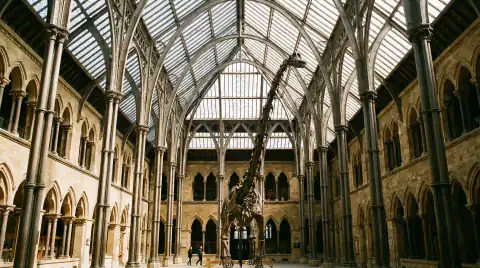
Deane and Woodward's 1860 court: glass roof, iron columns carved with leaves, daylight everywhere. Look up before you look at anything else. Note the building, because in ten minutes you will be standing in its opposite.
30 minutes.
The Pitt Rivers Museum
Past the dinosaurs, left at Darwin's statue.
Give your eyes two minutes. Then pick one case and read it as a comparison rather than a list — the same human problem solved in a dozen places. Open the drawers. Read one handwritten label closely.
Remember the building you have just left was by Sir Thomas Deane with Benjamin Woodward; this one, thirty years later, is by the firm of his son — T N Deane & Son, the son in question being Thomas Manly Deane. Grandfather, father, grandson, one site.
60–90 minutes.
Keble College, Parks Road
Out of the museums, straight across Parks Road. Three minutes.
Butterfield's streaky polychrome brick — red, white and blue, in a city of limestone. It was hated on arrival. Standing here after the Pitt Rivers, the point lands: the college and museum show different Victorian approaches to architecture and display.
15 minutes.

University Parks
North-east from Keble, through the gates. Four minutes.
Seventy acres along the Cherwell. The open lawns provide a change from the enclosed galleries. If the weather allows, walk to the river and back.
30 minutes.
Broad Street via Parks Road
South down Parks Road, past Wadham, into Broad Street. Eight minutes.
You are walking from the Victorian university into the medieval one. The Sheldonian, the Clarendon Building and the Bodleian arrive in quick succession.
10 minutes walking.
Museum of the History of Science
Broad Street, in the original Ashmolean building.
Instruments grouped by what they measure — astrolabes with astrolabes, microscopes with microscopes. It is the Pitt Rivers' logic applied to science, in a fraction of the space, and free. Einstein's blackboard is upstairs.
30 minutes.
Blackwell's, Broad Street
Two doors along.
Down into the Norrington Room. The anthropology shelves are worth the detour after where you have been.
20 minutes.
Back up Parks Road
North, retracing Broad Street to Parks Road. Eight minutes.
Closes the loop, and gives you the museum quarter from the other direction — Wadham, the Science Area, then the two museum roofs.
10 minutes.
90 min to two hours
Shorter version
Natural History → Pitt Rivers → University Parks → back. Both museums, one green space, no city-centre crossing.

Make a record
Photograph it thoughtfully.
The rules first
Personal photography is permitted. Tripods are not, without written permission from the museum. Commercial shoots require prior arrangement.
Those two facts together define the problem: this is one of the darkest major interiors in Oxford, and you may not stabilise your camera.
The conditions
The galleries are deliberately dim — a conservation decision protecting textile, feather, pigment and paper. Expect to be working several stops below comfortable. There is some daylight from above, but it does not reach the lower cases.
Add glass. Almost everything is behind it, much of it old, some of it curved, all of it reflecting a gallery full of other cases.
What actually works
Shoot wide open and accept the ISO. A fast prime — f/1.8 or better — is worth more here than any other piece of kit. Modern noise is a smaller problem than motion blur.
Reduce reflections. Move sideways and keep the lens close to the glass without touching the case. Keep equipment and hands off the displays.
Shoot the density, not the object. Individual items are hard — small, dim, behind glass, competing with reflections. The museum's real subject is abundance: a full case, a run of drawers, a wall of instruments. Those compositions are both easier and more truthful.
Include the labels. Handwritten, century-old, part of the exhibit. A tight frame of a label with its object is the most characteristic image the museum offers.
Use the transition. Coming from the Natural History Museum's glass-roofed daylight into the Pitt Rivers' near-dark is the experience; a frame that holds both is the strongest establishing shot available.
Best compositions
- A case read as a whole — the typological comparison in one frame.
- The gallery from a gap between cases, letting the packed shelves recede.
- Drawers pulled out, showing that the store is the display.
- A single handwritten label, close, with the object soft behind it.
- Looking up — objects mounted above head height against the roof structure.
- The doorway from the Natural History Museum, dark against light.
Etiquette
- No flash. It is bad for the objects and worse for the room.
- The galleries are narrow. Take the frame and move; do not colonise a gap between cases at a weekend.
- Other visitors. Easy to include accidentally in a crowded space — be deliberate about it, and avoid identifiable faces without consent.
- Human remains and sacred material. The museum has thought hard about how such objects are shown. Photograph with the same seriousness, and do not treat what remains on display as a curiosity.
Kit
- Fast prime, 35mm or 50mm equivalent, f/1.8 or wider — the one essential.
- Wide for gallery context, but it will be your slowest lens.
- Lens hood to reduce stray light without touching display cases.
- No tripod — not permitted without written permission.
- A camera you are happy to hand-hold at high ISO.
See it
In pictures.
12 views, full screen. Tap any one to open the viewer.Around here
Make more of the area.
Good to know
Questions, answered.
Is the Pitt Rivers Museum free to visit?
Yes. Entry is free. Individuals can visit without booking, while all groups must book in advance. Visit the museum
What are the opening hours of the Pitt Rivers Museum in Oxford?
The Pitt Rivers Museum in Oxford opens Monday 12pm–5pm and Tuesday–Sunday 10am–5pm. On bank holiday and half-term Mondays it opens at 10am. Occasional closures can affect these hours. Visit the museum
Where is the entrance to the Pitt Rivers Museum?
Enter through the Oxford University Museum of Natural History on Parks Road, OX1 3PW. The Pitt Rivers galleries are behind the Natural History Museum. Visit the museum
Can you still see the shrunken heads at the Pitt Rivers Museum?
No. The South American tsantsa, sometimes called shrunken heads, were removed from public display in 2020 along with other human remains. Critical changes
Why did Oxford’s Pitt Rivers Museum remove the tsantsa from display?
An ethical review at the Pitt Rivers Museum in Oxford found that the display encouraged stereotyped and racist interpretations of Shuar culture. The museum is working with Shuar partners to tell a fuller story. Proyecto Tsantsa
How are the Pitt Rivers Museum’s displays arranged?
Many objects are grouped by type or use, bringing examples from different places together. The arrangement reflects the museum’s history and has been accompanied by work to reconsider old labels and interpretation. Museum history Critical changes
Who founded the Pitt Rivers Museum in Oxford?
The Pitt Rivers Museum in Oxford was founded in 1884, when General Augustus Pitt Rivers gave his collection to the University of Oxford. The building for it was completed behind the Natural History Museum in 1886. Museum history
Is the Pitt Rivers Museum accessible to wheelchair users?
Wheelchair access and accessible toilets are available. Visitors with access requirements can contact the museum in advance to discuss the South Entrance and parking. Access information
Is the Pitt Rivers Museum suitable for children?
Yes. Families can explore the displays together, and the museum provides information and activities for family visits. Entry is free, so a shorter visit is possible. Families
Is there a café at the Pitt Rivers Museum?
There is no café inside the Pitt Rivers Museum. The neighbouring Museum of Natural History has a café serving food and drinks. Families
Is Oxford’s Pitt Rivers Museum returning objects or remains to communities of origin?
The Pitt Rivers Museum in Oxford works with communities on individual collections and requests. Its work with Naga partners, for example, concerns the return of ancestral remains taken during the colonial era. A Path Home
Editorial notes
Sources and further reading.
Sources for this guide
Every factual claim in this bundle traces to a source below. Sources are prioritised: the museum's own website → university → statutory heritage → academic and specialist press → encyclopaedic. No AI-generated source is cited.
Research and verification carried out 2 August 2026.
Sources
S01 — Pitt Rivers Museum, official visitor information
https://www.prm.ox.ac.uk/visit-us Used for: opening hours including the Monday variation and the bank-holiday / half-term exception; free admission and the group-booking requirement; the entrance arrangement via the Museum of Natural History (Parks Road, OX1 3PW) and the "past the dinosaurs, left at Darwin's statue" direction; the South Entrance in Robinson Close and its roadworks closure; the postal address (South Parks Road, OX1 3PP); telephone and email; accessibility provisions (wheelchair access, accessible toilets, hearing support, assistance animals); café operator and hours and the no-food-in-galleries rule; shop; photography policy including the tripod restriction; disabled parking arrangements. Accessed 2 August 2026.
S02 — Pitt Rivers Museum, about page
https://www.prm.ox.ac.uk/about Used for: the 1884 founding date; the collection size — "more than 500,000 objects, photographs and manuscripts"; the typological arrangement and the museum's own description of it ("reveals fascinating distinctions and parallels across cultures, and encourages questions about the ways in which humanity tackles problems"); the museum's self-description as "a contested space that calls for innovative curation to engage with the more difficult aspects of its history"; the named projects Changing Curatorial Legacies and Rethinking Relationships. Accessed 2 August 2026.
Note: this page did not state the Deed of Gift conditions, the founding collection size, or the building's architect and dates. Those come from S06.
S03 — Museums Association: coverage of the 2020 removals
https://www.museumsassociation.org/museums-journal/news/2020/09/pitt-rivers-museum-removes-shrunken-heads-from-display-after-ethical-review/ Museum-sector professional press. Used for: the removal of the tsantsa from display following an ethical review, and the framing of the decision within the museum's decolonisation work.
S04 — BBC News: shrunken heads removed from Pitt Rivers display
https://feeds.bbci.co.uk/news/uk-england-oxfordshire-54121151 Used for: corroboration of the removal and its timing, and the museum's own quoted statement — that the displays "did not sufficiently help visitors understand the cultural practices related to their making and instead led people to think in stereotypical and racist ways about Shuar culture".
Further corroboration of the same facts, and of the figure of 120 human remains removed, appears in Smithsonian Magazine's coverage and in Cherwell (7 October 2020). The tsantsa holdings — 12 tsantsa; seven human heads, of which three are believed authentic and four probable forgeries made from bodies taken from morgues or hospitals — and the acquisition window of 1884–1936 come from this reporting cluster.
S05 — Historic England, National Heritage List for England: entry 1081534
https://historicengland.org.uk/listing/the-list/list-entry/1081534 The University Museum and Pitt Rivers Museum, Parks Road — Listed Building, Grade I. Used for: the designation, the grade, and the fact that it is a single listing covering both museums. Accessed 2 August 2026. Retrieved via Firecrawl; the site returns HTTP 403 to direct automated requests.
S06 — Pitt Rivers Museum history project and Wikipedia
https://history.prm.ox.ac.uk/ · https://en.wikipedia.org/wiki/Pitt_Rivers_Museum Used for: the two conditions of the 1884 Deed of Gift (a permanent lecturer in anthropology, and a building for the collection used for no other purpose); Edward Burnett Tylor's appointment as Reader in Anthropology in 1885 and his status as the first lecturer in anthropology in the UK; the architect Thomas Manly Deane, his place in the Deane family, and the 1885–86 construction of the extension.
The museum's own history project (history.prm.ox.ac.uk) is an institutional academic resource and is the stronger of the two. Where this bundle depends on S06 alone, the claims are institutional history rather than interpretation, and should be upgraded to a direct citation of the history project's own pages at the next revision.
S07 — Wikidata, Q1456119 (Pitt Rivers Museum)
https://www.wikidata.org/wiki/Q1456119 Used for: the entity identifier used in sameAs and the structured data. Accessed 2 August 2026 via the Wikidata API.
S08 — Existing Above Guide experience record
exp_pitt-rivers-museum Used for: the coordinates (51.7587, −1.2556), carried forward from the V1 page rather than independently re-derived for this upgrade. Marked production_status: carried-forward in the operational data.
S09 — Pitt Rivers Museum, Haida collections and Star House Pole
https://www.prm.ox.ac.uk/haidaculture · https://www.prm.ox.ac.uk/event/star-house-pole Used for: the Haida totem pole in the court — the Star House Pole, from the village of Masset on Haida Gwaii, commemorating a chief's adoption of a girl in 1878 — and the existence of the museum's dedicated Haida collections work. Accessed 2 August 2026.
Not used: a height figure. One secondary source gave "36 metres", which is implausible for an interior pole and is not corroborated by the museum. No dimension is stated anywhere in this bundle.
Conflict ledger
C1 — Which address to use
- Postal address (S01): Pitt Rivers Museum, South Parks Road, OX1 3PP
- Visitor entrance (S01): Museum of Natural History, Parks Road, OX1 3PW
Not a contradiction but a genuine trap: both are correct and they are different doors. Mapping services routinely route visitors to the postal address, which has no public entrance. This bundle gives both and states which is which, in 03-visitor-guide.md and in the operational data's visitor_entrance_note.
C2 — The year of the roadworks notice
- S01 gave "Monday 22 June until approximately Friday 28 August" without a year on the fragment retrieved.
Used: recorded as published, with year_uncertain: true, rather than assigned to a year. Flagged for resolution in 16-editor-notes.md. An undated disruption notice should not survive the next update.
C3 — What the official about page does and does not say
- S02 confirms the 1884 founding and the collection size but is silent on the Deed of Gift conditions, the architect and the building dates.
- S06 supplies those.
Used: both, cited separately, so a future editor can see which claims rest on the museum's own current pages and which on its history project and encyclopaedic sources.
C4 — Two claims carried by the V1 page that this upgrade corrects
The V1 experience record, written before this bundle, asserted three things that the sources do not support. They are recorded here because the V1 text is the prior published position and the change should be traceable.
- "Torches are lent for peering into the cases." The museum did issue torches historically, but installed lighting in 2016. The claim is roughly a decade out of date and is not carried forward.
- "Tens of thousands of objects." The museum's own figure is more than 500,000 objects, photographs and manuscripts (S02). The V1 figure understated the collection by an order of magnitude.
- The "cabinet of curiosities" framing was the V1 page's dominant register. It is not wrong, but it sits awkwardly beside the museum's own description of itself as "a contested space", and the V2 bundle leads with the typological argument instead.
C5 — Which Deane built the Museum of Natural History
- This bundle, as first written: Thomas Newenham Deane, with Benjamin Woodward, designed the Oxford University Museum of Natural History.
- Historic England, NHLE 1081534: "University Museum of 1855-60 by Sir Thomas Deane (1792-1871) and Benjamin Woodward (1816-1861); abutting to the rear the Pitt Rivers Museum of 1885-6 by T N Deane & Son."
Corrected on 3 August 2026, while researching the Natural History Museum's own bundle. Three generations worked on this site — Sir Thomas Deane, his son Thomas Newenham Deane, and Thomas Manly Deane — and the original text was out by one, making the two buildings "father and son" when the statutory record makes them grandfather and grandson with the father's name on the firm.
The error is near-universal in published accounts, which is how it got in.
Claims deliberately not made
Recorded so a future editor knows these were considered and rejected, not overlooked.
- That the tsantsa are being repatriated. The museum has stated they are off display and that related work continues. It has not, in the sources consulted, announced a repatriation outcome. The bundle points readers to the museum's own statements rather than summarising a moving position.
- A founding collection size. Frequently given as around 20,000 objects, but not confirmed by S01 or S02, so it is not stated as fact anywhere in the bundle.
- That Tylor was the first professor of anthropology. He was appointed Reader in 1885; the bundle says first lecturer, and
02-history.mdwarns future writers off the upgrade. - Any claim that the museum is a "hidden gem". It is one of Oxford's best-known museums.
- Large-print materials, hearing-loop coverage, in-gallery seating and lockers — recorded as unverified rather than assumed either way.
Opening hours, prices, programmes and access arrangements can change. Confirm critical details with the venue.
Continue exploring / Oxford
More to explore
in Oxford
Find another place for your itinerary, or explore all things to do in Oxford.
 Culture & historyOxford University Museum of Natural HistoryExplore experience →
 Culture & historyThe Eagle and ChildExplore experience →
 Food & drinkThe Lamb & FlagPub or barExplore experience →
 Food & drinkParsonage GrillBritishExplore experience →