museum / Oxford
In depth
The Ashmolean Museum
Oxford’s free museum of art and archaeology: a vast collection spanning ancient civilisations, the Alfred Jewel, Eastern Art, European painting and the institution’s own 1683 founding story.
Story · Visit · Route · Links
Visitor Essentials & Quick Answers
Is the Ashmolean worth visiting?
Yes, especially if you enjoy objects with extraordinary stories. Ancient Egyptian collections, the Alfred Jewel, Renaissance paintings and a remarkably preserved Stradivari violin sit under one roof. Choose a few interests rather than trying to see everything: this is a substantial art and archaeology museum, not just a collection of Oxford memorabilia.
What should I not miss at the Ashmolean?
Build a first visit around the Alfred Jewel, the “Messiah” Stradivari violin and Uccello’s The Hunt in the Forest. They reward different kinds of looking: tiny gold and enamel details, violin craftsmanship, and a painting whose perspective draws you deep into the trees. The Egypt and Sudan galleries make a contrasting fourth stop.
Why is the Ashmolean so famous?
Its story begins with collections assembled by the Tradescants and given to Oxford by Elias Ashmole; the museum opened in 1683. Start with the Ashmolean Story gallery to understand that origin. Objects such as Powhatan’s Mantle reveal both the ambition of early collecting and unanswered questions about how possessions reached Britain.
Ashmolean or Natural History Museum: which should I choose?
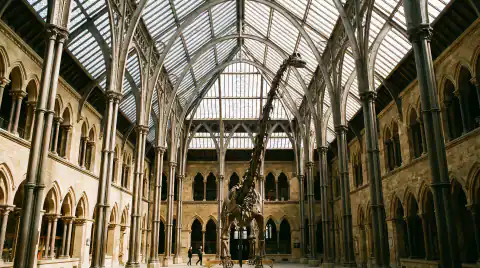
Choose the Ashmolean for human history, paintings, ancient civilisations and craftsmanship. Choose the Museum of Natural History for dinosaurs, animals, fossils and the spectacular glass-roofed court. With children, a focused Ashmolean route through Egypt and Japanese armour can be more rewarding than an attempt to cover every floor.
Choose your depth
Essentials or more detail?
See visiting essentials, or read more about the history and places nearby.Start here
Understand the place.
The context, character and reasons this experience earns time in your Oxford plans.Why it matters
The Ashmolean is not simply Oxford’s largest art museum. It is an institution through which the modern idea of a public museum can be examined. Elias Ashmole gave his collection to the University in 1682; the original museum opened on Broad Street in 1683 and admitted members of the public from the outset. The Ashmolean describes itself as Britain’s first public museum and the world’s first university museum. [S04]
That founding story is important, but it is not uncomplicated. Much of the original collection came through John Tradescant the elder and younger, whose Lambeth collection known as “The Ark” mixed natural specimens with human-made objects gathered through early modern travel, trade and colonial contact. The museum now explicitly acknowledges that its formation coincided with British colonial expansion and that colonial power shaped later collecting too. [S04][S10]
The visitor value lies in range and proximity. Within one free building, you can move from Egyptian mummies and Minoan pottery to the Alfred Jewel, Japanese armour, Chinese ceramics, Paolo Uccello, J. M. W. Turner and a Stradivari violin. The collections are strong enough that the right strategy is not to “do the Ashmolean” but to choose a route. [S05][S06][S11][S12]
What visitors should notice
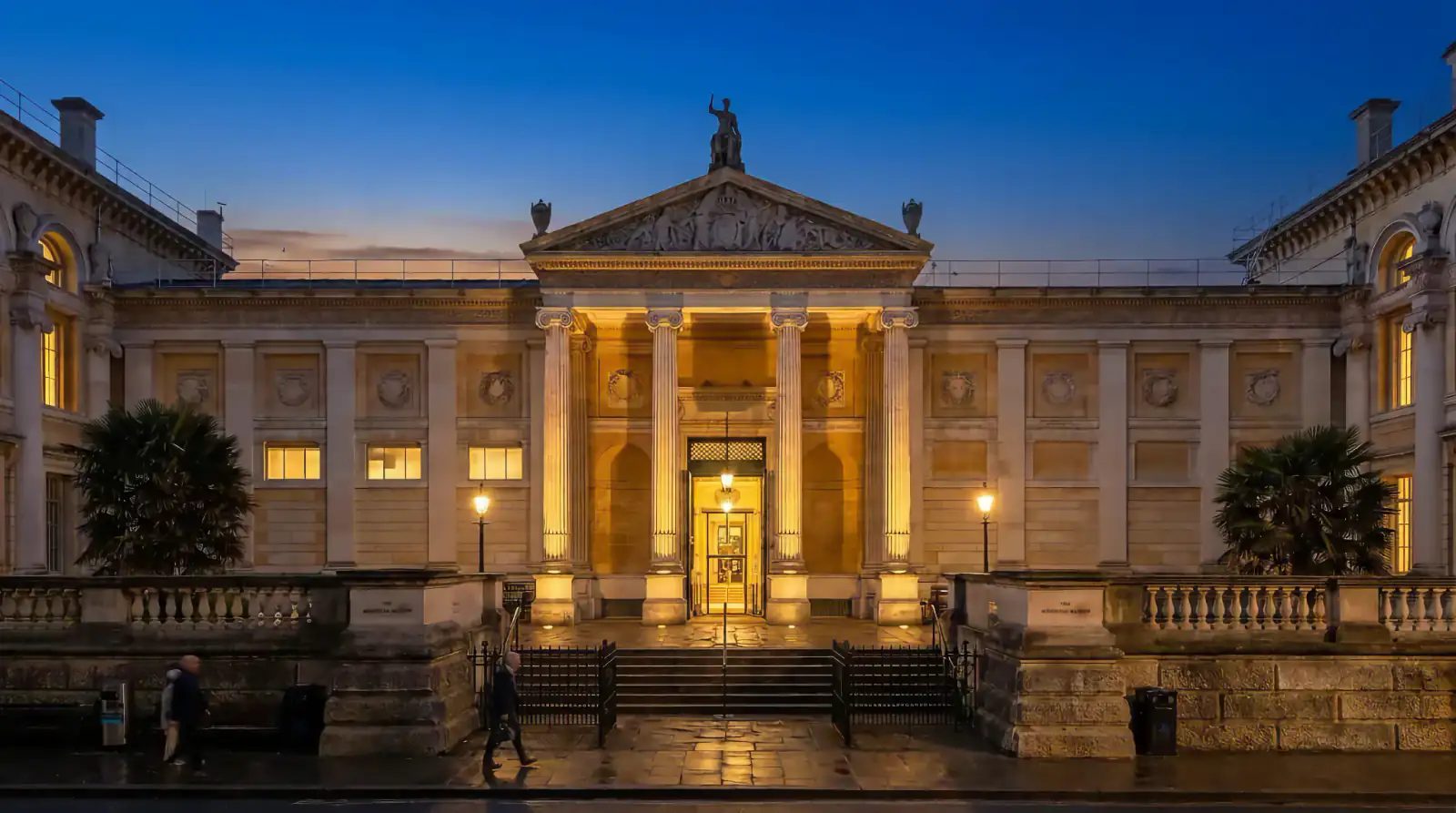
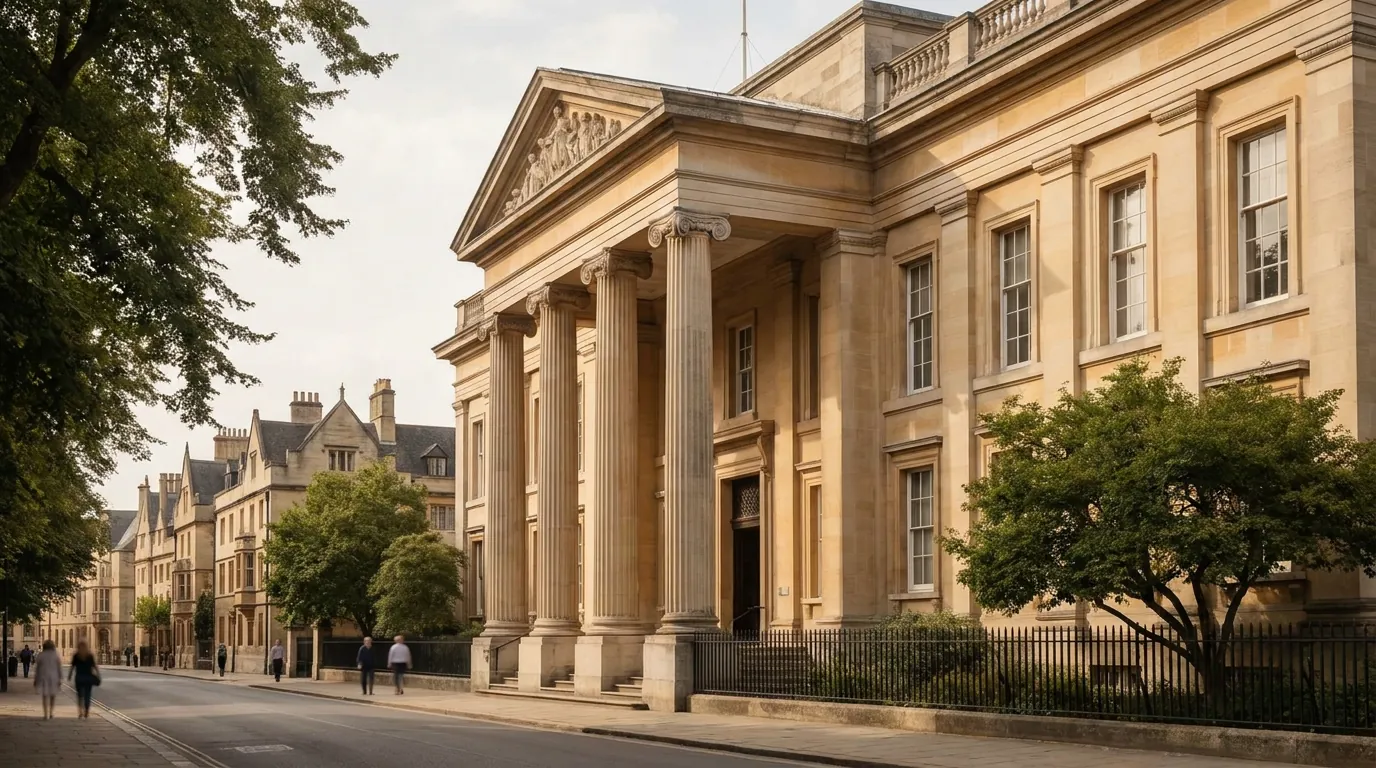
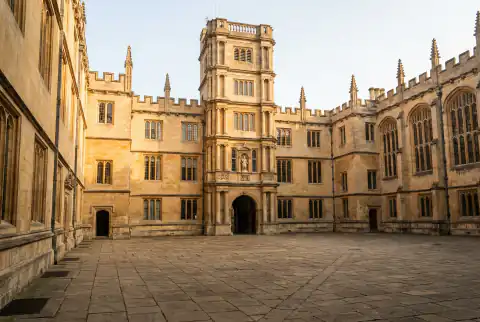
Begin with the building. Cockerell’s Beaumont Street frontage belongs to the combined Ashmolean and Taylor Institution complex, built in 1841–45 in a Neo-Greek design and now listed Grade I. The public museum moved here in stages; it is not the original 1683 Ashmolean, which survives on Broad Street as the History of Science Museum. [S04][S16][S23]
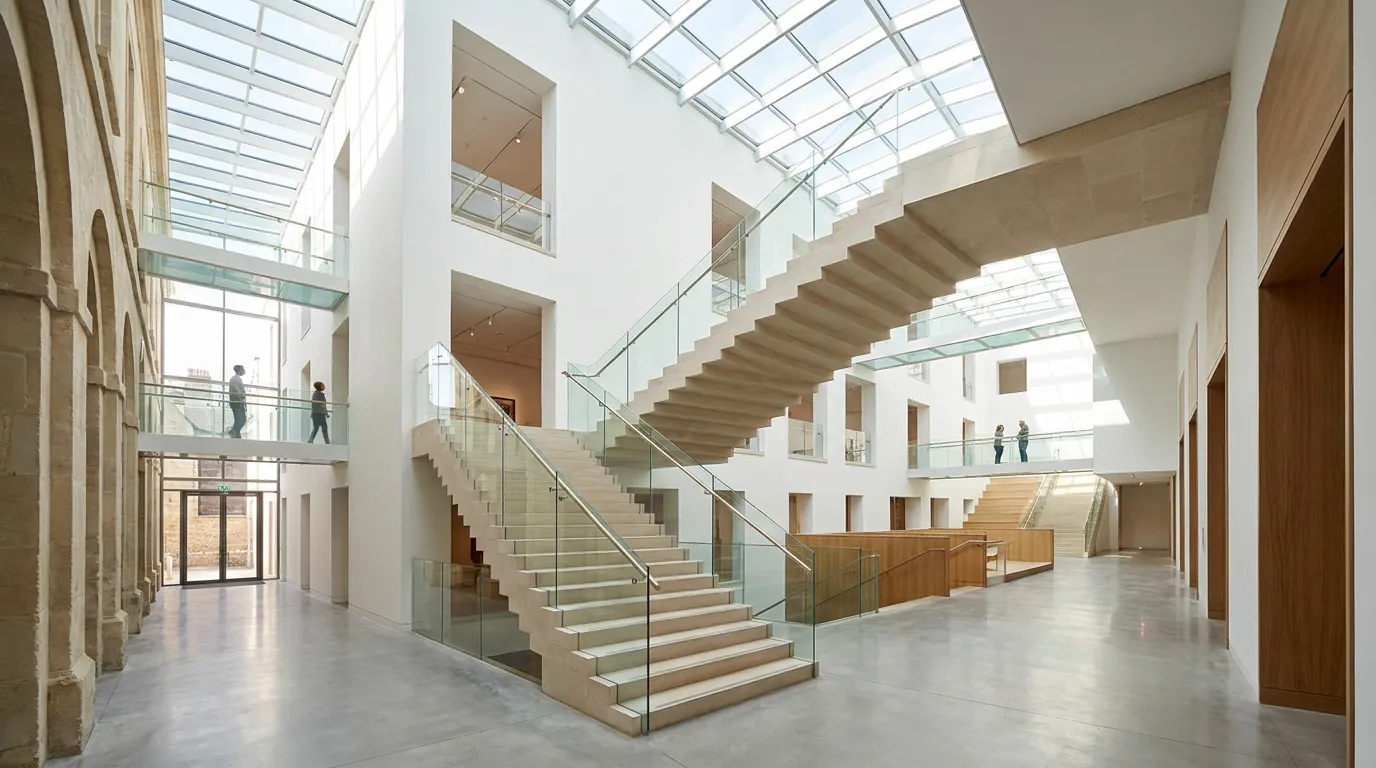
Inside, the 2009 Rick Mather redevelopment changes the experience completely. An older classical shell opens into a bright, interconnected sequence of galleries arranged around the idea of “crossing cultures, crossing time”. Sightlines and half-levels encourage comparison rather than a single chronological march. This is rewarding, but the colour-coded lifts and intermediate floors can be confusing; take a floor plan. [S17][S21]
Give the lower ground floor more time than its position suggests. The Ashmolean Story gallery contains Guy Fawkes’s lantern and Powhatan’s Mantle, objects that connect the museum’s founding story with seventeenth-century Britain, Indigenous North America and questions of provenance. The Money Gallery nearby provides a more tactile, family-friendly way into history. [S08][S09][S19]
On the upper floors, resist equating “highlights” with fame alone. The Alfred Jewel is tiny but exceptional; Uccello’s The Hunt in the Forest rewards close looking at perspective; the ceremonial Japanese armour complicates the stereotype of battlefield equipment; and the near-unplayed 1716 “Messiah” violin is remarkable because its condition preserves the maker’s work. [S07][S11][S13][S14]
Who will enjoy it
The museum works for first-time Oxford visitors, art and archaeology specialists, families, solo travellers and anyone needing a serious rainy-day plan. General admission is free, so a focused forty-five-minute visit is as legitimate as a full afternoon. Visitors staying centrally can also return on another day without paying twice.
It is particularly strong for mixed-interest groups. One person can choose Egypt and Greece, another Western Art or Eastern Art, then meet in the café or rooftop restaurant. Families have free trails and explorer packs, while the official Spotlight Trail links twelve objects in roughly an hour. [S05][S19][S20]
Who may find it difficult
The scale can produce museum fatigue. Five public levels, numerous half-levels and a very broad collection make an unplanned visit feel less satisfying than a selective one. Some object labels are small, some galleries use low light for conservation, and the lifts serve different combinations of floors. [S17]
Visitors coming only for a single painting or gallery should check temporary closures first. At the research date, four Western Art galleries on Level 3M are closed from 1 June to mid-October 2026 for essential work, although Turner’s High Street and Millais’s John Ruskin have been temporarily relocated to Gallery 44. [S01][S02]
Visitor verdict
The Ashmolean earns at least ninety minutes, but not because every case must be seen. It is at its best when treated as several excellent museums sharing one building. Choose one civilisations route, one art route and the Ashmolean Story; add a ticketed exhibition only if it is a genuine priority. The result is one of Oxford’s strongest free experiences and a useful counterweight to the city’s college-and-library image. [S01][S05]
The full story
How it came to matter.
Before the Ashmolean: the Tradescants’ Ark
The Ashmolean’s history begins outside Oxford. John Tradescant the elder and his son, also John, were gardeners and collectors whose work for elite patrons took them into international networks of travel and exchange. By 1634 their Lambeth home contained a collection of botanical, geological and zoological specimens alongside human-made objects. It became known as the Ark and was opened to paying visitors. [S04]
The collection embodied seventeenth-century curiosity, but also the unequal world through which objects moved. The Ashmolean now states directly that its foundation coincided with early British colonial expansion. Asian objects reached the Tradescants through East India Company traders, while Powhatan’s Mantle came from the first period of contact between Indigenous peoples of the Chesapeake and English colonists. The exact route by which the mantle entered the Tradescant collection is not known. [S09][S10]
Elias Ashmole acquired the Tradescant collection through a history that has long attracted legal and ethical scrutiny. The museum’s public history concentrates on the collection’s transfer into his possession and his subsequent gift to Oxford. The significant point for visitors is that “Ashmolean” names the donor, while the foundation rests heavily on the Tradescants’ earlier work and on objects whose makers and original communities had no part in creating an Oxford museum. [S04][S10]
The 1683 museum
Ashmole gave his collection to the University in 1682. It was combined with an older University collection that included the lantern associated with Guy Fawkes and, according to the museum, a supposed “Jacob’s Coat of Many Colours” that no longer survives. The purpose-built museum opened on Broad Street in 1683. [S04][S08]
The original institution was more than a display cabinet. It included teaching space and a chemical laboratory, reflecting the period’s limited separation between natural philosophy, antiquarianism and collecting. Public admission was controversial but present from the outset. The building survives and is now the History of Science Museum, making it possible to visit the Ashmolean’s original home separately from its current collection. [S04][S23]
Claims about “the world’s oldest museum” should be avoided because definitions differ and earlier collections were open in other forms. The Ashmolean’s own careful claims are stronger: Britain’s first public museum and the world’s first university museum. Those formulations should be retained. [S04]
Loss, decay and dispersal
The early museum did not preserve everything successfully. Eighteenth-century audits revealed serious decay and loss. The most famous example is the Tradescant dodo, which was removed from display when much of the specimen had deteriorated. Its head and one foot survive at Oxford University Museum of Natural History. This story is not a quaint footnote: it shows how the practices of museum conservation developed through failure as well as expertise. [S04]
By the early nineteenth century, natural science had expanded beyond what the Broad Street building could support. Reforming work under John and Philip Duncan improved the museum, but the University’s new Museum of Natural History opened on Parks Road in 1860 and took the surviving natural-history material. The founding collection is therefore now distributed among several Oxford institutions, including the Ashmolean, Bodleian, Museum of Natural History and Pitt Rivers. [S04][S06]
Cockerell’s University Galleries
The present Beaumont Street frontage was not originally built as the new home of the entire Ashmolean. Charles Robert Cockerell designed the combined University Galleries and Taylor Institution complex, built in 1841–45. Historic England describes it as Neo-Greek, constructed largely in Bath stone with Portland-stone architectural elements. The complex is Grade I listed as NHLE 1047111. [S16]
The museum side occupied the central range and west wing, while the Taylor Institution formed the east wing. The building was repeatedly altered and extended in 1892–95, 1900, 1908, 1923–28, 1933 and 1937–40. Its apparent classical unity therefore contains several phases of institutional growth. [S16]
Arthur Evans and the museum of art and archaeology
Sir Arthur Evans became Keeper of the Ashmolean in 1884. His twenty-four-year keepership transformed the remaining institution by building internationally important archaeological collections. In 1894 he moved the Ashmolean collection from Broad Street to Beaumont Street behind the University Galleries. In 1908 the institutions combined as the Ashmolean Museum of Art and Archaeology. [S04]
Evans is inseparable from Knossos. His excavations and interpretations helped make Minoan Crete central to modern archaeology, and the Ashmolean holds major Aegean material. His legacy must also be read within the methods and assumptions of late nineteenth- and early twentieth-century archaeology, including the power of European excavators to remove and divide finds. [S04][S06]
The Bodleian’s coin collection joined the Ashmolean in 1922 and became the core of the Heberden Coin Room. Other departments expanded through excavation, purchase and donation. Martha Combe’s 1893 gift strengthened the Pre-Raphaelite holdings, while later collections enlarged Western Art, Eastern Art, musical instruments and decorative arts. [S04][S12]
Colonial collecting and departmental histories
The antiquities collections grew through excavations in Britain, Europe, Egypt and the Middle East. The museum’s own history acknowledges that British colonial power enabled the division of excavated objects between foreign teams and the countries in which they worked. That statement should sit inside the main historical narrative, not in a token disclaimer. [S04][S10]
The Eastern Art department also reflects imperial institutions. The Indian Institute had served partly as a training ground for colonial civil servants; after Indian independence, its collection became central to the Ashmolean’s Eastern Art department. The department now covers the Islamic Middle East, India, the Himalayas, Southeast Asia, China, Korea and Japan. [S04][S11]
Departmental divisions helped scholarship develop, but they also encoded older hierarchies between “Western” and “Eastern” art and between “art” and “archaeology”. The modern museum increasingly addresses provenance, colonial interpretation and the need for collaboration with source communities. [S10]
Twentieth-century growth
The twentieth century brought major gifts and specialist strengths. Sir Herbert Ingram’s 1956 gift helped establish the museum’s exceptional holdings of early Chinese greenware; the Ashmolean describes these as the largest collection outside China. Japanese art includes a notable collection of export porcelain and ceremonial armour given to Magdalen College by Prince Chichibu in 1937. [S11]
Western Art ranges from Renaissance painting to the Pre-Raphaelites, Impressionism and modern art. The museum holds the world’s largest collection devoted to Camille Pissarro, including an extensive archive. Musical instruments include the 1716 “Messiah” violin by Antonio Stradivari, presented by Alfred and Arthur Hill in 1939 and preserved in unusually unworn condition. [S12][S14]
The 2009 redevelopment
The museum closed for a major redevelopment and reopened in 2009. Designed by Rick Mather, the project inserted a large modern gallery structure behind Cockerell’s historic frontage, expanded temporary-exhibition capacity and reorganised the visitor route. The curatorial concept “crossing cultures, crossing time” deliberately encouraged comparison across geography and chronology rather than keeping every department in isolation. [S21]
The redevelopment is why the museum feels much larger inside than the Beaumont Street façade suggests. It also created navigational complexity: multiple lifts serve different floors, Level 3M is an intermediate level, and galleries loop around central orientation spaces. This is architecture supporting curatorial ambition, but a floor plan remains useful. [S17]
The museum today
The Ashmolean now combines free permanent galleries, ticketed exhibitions, research and study rooms, learning programmes, conservation, digital collections and public interpretation. It describes its purpose as preserving and displaying collections for enjoyment and the advancement of knowledge, while acknowledging a responsibility to reassess collecting histories and decolonise language and practice. [S04][S10]
The institution’s significance therefore lies in more than age. It offers a record of how museums were created, how objects were moved and classified, how preservation sometimes failed, and how interpretation continues to change. A responsible visitor guide should celebrate the Alfred Jewel, Uccello and the “Messiah” violin while also making the Tradescants, Powhatan’s Mantle and colonial archaeology part of the same story.
Look closer
Highlights and hidden details.
The objects, spaces and small observations that turn a visit into a memorable one.1. The Ashmolean Story
Start on Level -1, Gallery 2. Guy Fawkes’s lantern, Powhatan’s Mantle and portraits from the founding collection explain how this museum was assembled. It is the essential context for everything upstairs, because it treats the institution itself as part of the collection. Allow 15–20 minutes. [S04][S08][S09]
2. Ancient Egypt and Sudan
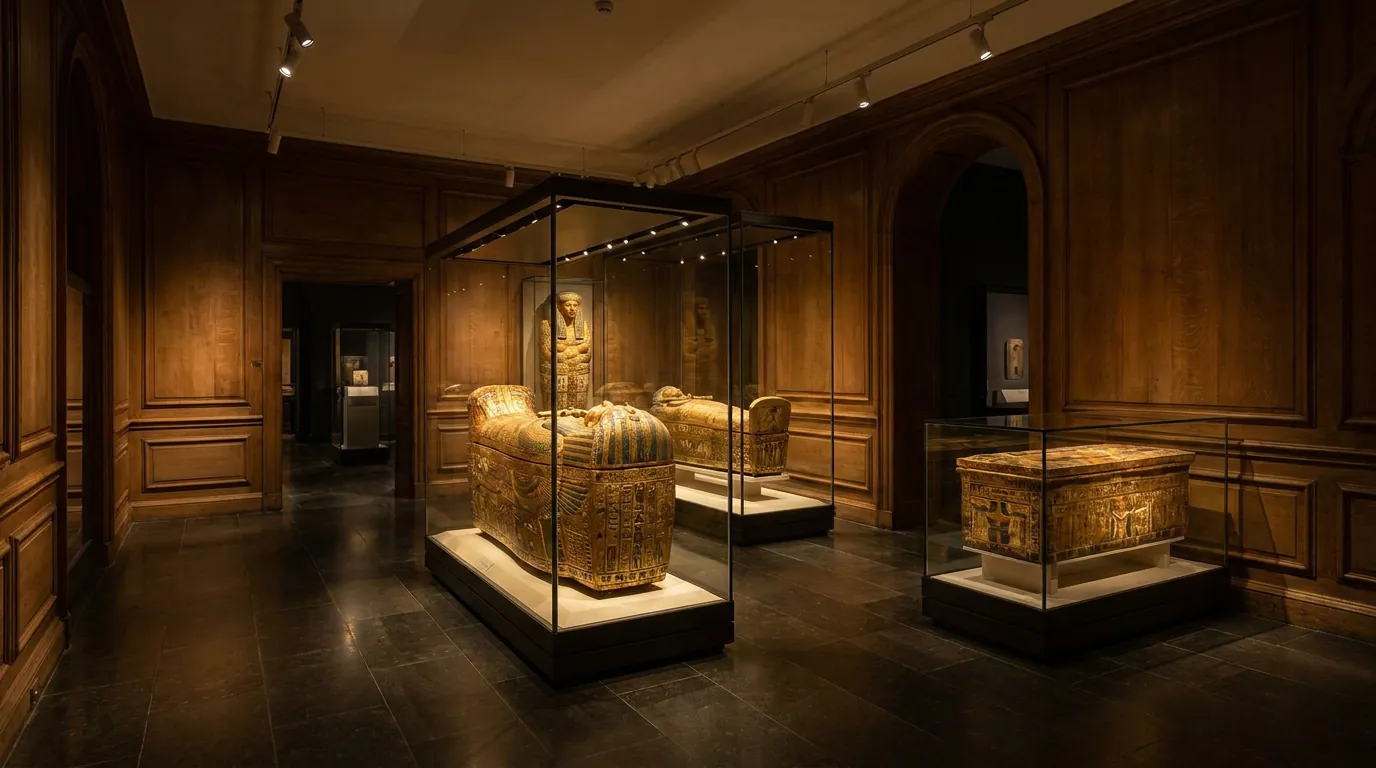
The ground-floor galleries make a strong first route for families and first-time visitors: mummies, monumental sculpture and objects of daily and ritual life. Avoid treating mummified people as spectacle; read the interpretation and leave enough time for the cases around them. Allow 20–30 minutes. [S05][S06]
3. The Knossos octopus pot and Aegean collections
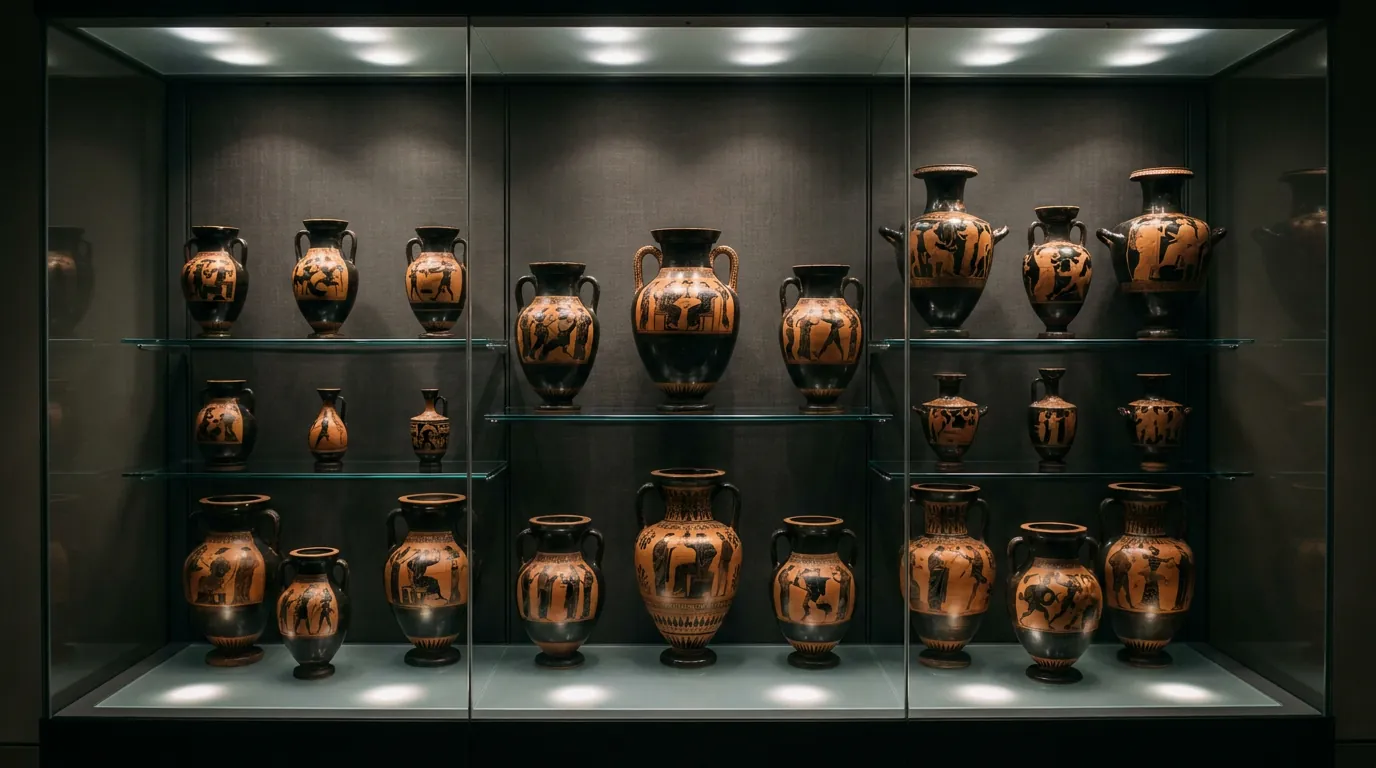
The storage jar with an octopus connects the Ashmolean to Arthur Evans’s work at Knossos and to the visual culture of the Bronze Age Aegean. Look at how the animal’s arms work with the curve of the vessel rather than reading it as a flat picture. Allow 10 minutes within a wider Greek and Aegean route. [S05][S06]
4. The Alfred Jewel
Made in the reign of Alfred the Great, the gold, enamel and rock-crystal object carries the inscription “Alfred ordered me to be made”. It was probably the handle for a reading pointer. Its scale is easy to underestimate, so approach slowly and look for the animal-headed socket at its base. Gallery 41, Level 2; allow 10 minutes. [S07]
5. Powhatan’s Mantle
This large deer-hide hanging with shell beadwork comes from the southern Chesapeake and the first period of contact between Powhatan peoples and English colonists. The name “mantle” may mislead: its original function is uncertain, and its precise route into the Tradescant collection is unknown. Study the central figure, two animals and surviving shell circles, then read the provenance carefully. [S09][S10]
6. Guy Fawkes’s lantern
Tradition holds that Guy Fawkes carried this iron-and-horn lantern when arrested beneath Parliament in November 1605. It entered the University collection in 1641 and moved to the Ashmolean in 1887. The object’s modest appearance is part of its power: a small practical tool attached to an enormous political story. [S08]
7. Samurai armour and Japanese galleries
The full armour in Gallery 37 is ceremonial rather than a simple battlefield suit. Its helmet dates to around 1560 and other elements to the eighteenth century; Prince Chichibu gave it to Magdalen College in 1937. Use it as an entry into Edo-period peace, status, dress and craftsmanship, then examine the nearby netsuke and export porcelain. [S05][S11]
8. Chinese greenware
The Ashmolean holds the largest collection of early Chinese greenware outside China, strengthened by Sir Herbert Ingram’s 1956 gift. Instead of searching for one trophy, compare glaze colour, form and ceramic technology across several cases on Levels 1 and 2. Allow 15–20 minutes. [S04][S11]
9. Uccello’s The Hunt in the Forest
This long, dark Renaissance panel is organised around a central vanishing point. Spears, branches, logs, water and diminishing figures draw the eye into the forest. Stand back to see the geometry, then move close enough to find surviving traces of gold and crescent-moon imagery. Gallery 43, Level 2; allow 10 minutes. [S13]
10. The “Messiah” Stradivari violin
Made in 1716, the violin survives with unusually unworn varnish, crisp carving and intact painted edgework because it spent much of its life as a collector’s object. The nickname came from a dealer who praised it but rarely produced it—like a long-awaited messiah. Gallery 39, Level 2; allow 5–10 minutes. [S14]
11. Turner’s High Street, Oxford
Turner painted the Oxford High Street in 1809–10 after detailed correspondence with local print-seller James Wyatt. Look for the architectural precision and the figures introduced for movement and colour. At the research date it is temporarily in Gallery 44 while its usual Level 3M gallery is closed. [S01][S15]
12. Cockerell outside, Rick Mather inside
The Grade I Neo-Greek frontage and the modern internal redevelopment create two distinct architectural experiences. Photograph the Beaumont Street façade before entering; inside, use a high landing to understand how the 2009 galleries connect across levels. Allow ten minutes at the beginning or end. [S16][S21]
Details worth slowing down for.
The famous 1683 museum is somewhere else
The classical building on Beaumont Street is not the original Ashmolean. The 1683 building survives on Broad Street as the History of Science Museum. Visiting both reveals the institution’s movement from a compact cabinet, laboratory and teaching space to a large museum of art and archaeology. [S04][S23]
The name hides the Tradescants
Elias Ashmole gave the collection to Oxford, but much of its foundational material had been assembled by John Tradescant the elder and younger. Their Lambeth Ark was already open to visitors. The museum name can make Ashmole seem like the sole creator; the objects tell a more complicated story. [S04]
The dodo survives as a fragment and a lesson
The Tradescants’ dodo deteriorated so badly that most of it was discarded. Its head and one foot now survive at the Museum of Natural History. The episode is a useful reminder that early museums were not automatically places of permanent preservation. [S04]
Powhatan’s Mantle may not be a mantle
The object is a wall-sized construction of four deer hides with shell beadwork. Its purpose is unknown; “mantle” is a historic label rather than a secure identification. Thirty-four shell circles surround a central human-like figure and two animals, but the meaning remains debated. [S09]
The Alfred Jewel is a reading tool, not a crown jewel
Its royal inscription and precious materials suggest ceremony, yet the best interpretation is practical: it probably held a pointer used to follow text. The missing pointer would have fitted into the animal-headed socket at the base. [S07]
The “Messiah” is famous for not being played
The Stradivari violin’s value to scholarship comes from its exceptional condition. Dealers and collectors kept it largely out of performance, preserving varnish, carving and painted details that use would normally wear away. [S14]
The samurai armour is a diplomatic Oxford object
The Japanese suit is ceremonial, assembled from elements of different dates, and reached the University through Prince Chichibu’s gift to Magdalen College in 1937. Its Oxford biography matters as much as the generic “samurai” label. [S11]
Uccello built depth with repeated lines
In The Hunt in the Forest, spears, branches, logs, water and shrinking figures all point towards a central vanishing point. The surface was once more luminous: flecks of gold in the foliage would have caught candlelight in its original domestic setting. [S13]
Turner negotiated Oxford detail by letter
Turner’s High Street was not a spontaneous street impression. James Wyatt’s surviving correspondence records discussion of architectural details, cost and the later addition of figures. The painting combines exact local observation with calculated stagecraft. [S15]
The façade belongs to two institutions
Historic England lists the Ashmolean and Taylor Institution together. Cockerell designed the combined complex, with the Taylor Institution to the east and the University Galleries—the basis of the present Ashmolean frontage—to the west and centre. [S16]
The lifts reveal the hidden building
The blue, pink and yellow lifts do not serve identical floors. Level 3M and the Cast Gallery expose how the modern museum has been threaded through older fabric and multiple extensions. The navigation problem is also an architectural clue. [S17]
“Crossing cultures” is a curatorial decision
The post-2009 layout is designed to encourage comparison across time and place. Objects are not arranged neutrally: gallery sequence, labels, sightlines and departmental categories all shape the story visitors receive. [S21]
Make it work
Plan the visit properly.
Current practical detail, kept separate from the story so it is easy to scan when you need it.The practical version
The Ashmolean is open daily 10:00–17:00, with last entry at 16:45. General admission is free. Advance booking is not required for the permanent galleries, although the museum recommends it to guarantee entry at busy times. Major exhibitions are ticketed and should normally be booked ahead; groups must book. [S01][S02][S03]
Allow 90 minutes for a selective first visit, two to three hours for several departments, or half a day if adding a major exhibition and meal. The official Spotlight Trail links twelve objects in about an hour and is the safest first-visit structure. [S05]
Temporary closures at the research date
From 1 June to mid-October 2026, Galleries 63, 65, 66 and 67 on Level 3M are closed for essential work. These include Sickert and his Contemporaries, Pissarro, Pre-Raphaelites and nineteenth-century art. Turner’s High Street and Millais’s John Ruskin are temporarily displayed in European Art Gallery 44. Recheck the official visit page before planning around these rooms. [S01][S02]
Best time to visit
The museum identifies 10:00–11:00 and 16:00–17:00 as generally quieter. Arrive at opening for the best balance of low crowds and sufficient time. Late afternoon works for one focused route, but last entry is 16:45 and the museum closes at 17:00. [S02]
Weekends, school holidays, wet days and major-exhibition periods can be busy. If you need lifts, allow extra time: each lift serves a different combination of floors and queues develop at peaks. [S17]
How to plan the collection
Choose one of these approaches:
- One-hour first visit: follow the official Spotlight Trail.
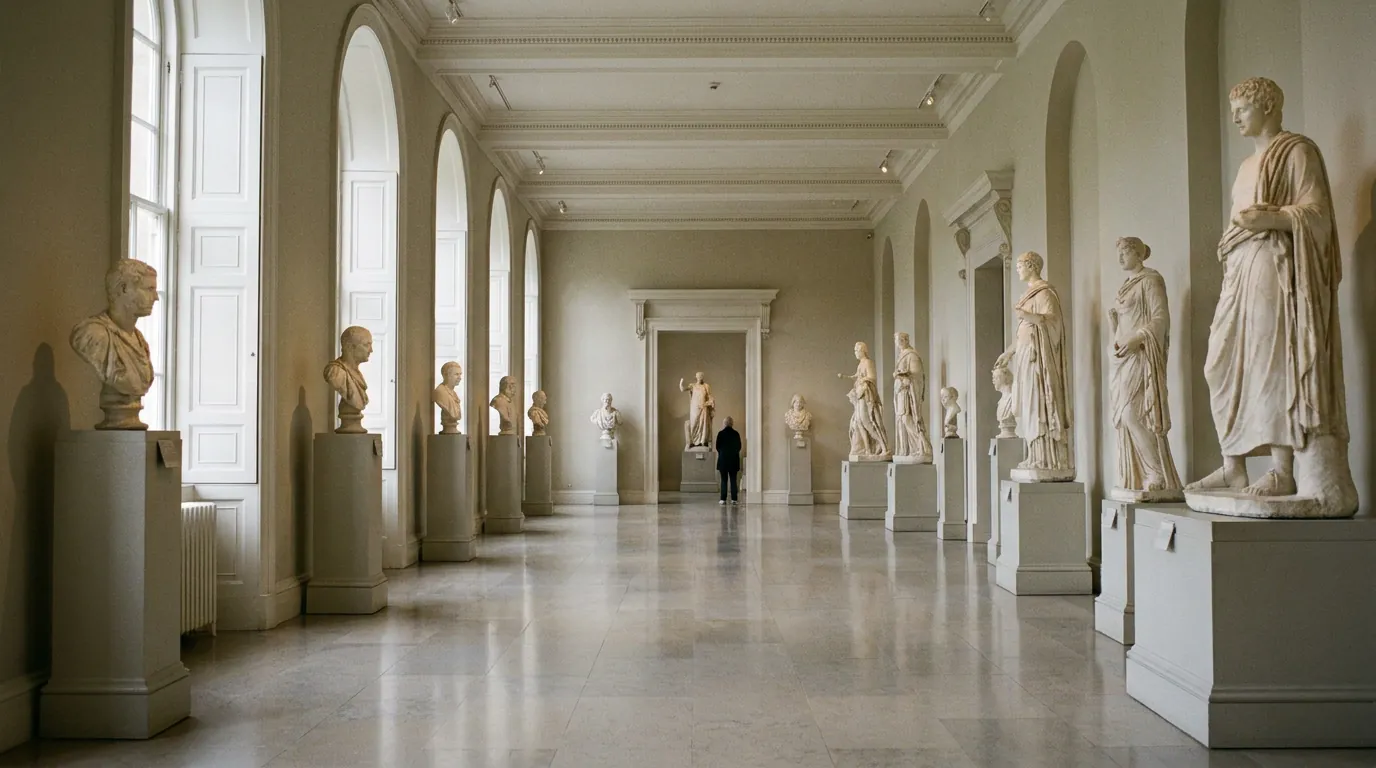
- Ancient worlds: Egypt, Greece, Rome and the Aegean, then the Cast Gallery.
- Oxford and England: Ashmolean Story, Money Gallery, Alfred Jewel, Turner’s High Street.
- Art route: Italian Renaissance, European Art and open Western Art galleries.
- Asia route: Islamic Middle East, India, China and Japan.
- Family route: ancient world on the ground floor, Money Gallery, samurai armour and Alfred Jewel. [S05][S19]
Take a floor plan. The museum’s half-levels and colour-coded routes are logical once understood, but not immediately intuitive. Do not spend the first hour trying to cover every gallery in numerical order.
Tickets and booking
General museum entry is free. Advance general-admission booking is recommended, not compulsory. Ticketed exhibitions, family multimedia experiences and restaurant packages have separate arrangements. Carer tickets for paid exhibitions are free but require booking alongside the visitor’s ticket. [S01][S02][S03]
Food, drink and facilities
The lower-ground café serves hot and cold food and can become crowded. The rooftop restaurant on Level 4 opens daily from 11:00 for drinks and pastries; lunch is served 11:30–15:30 and afternoon tea 11:30–16:00, subject to current arrangements. Restaurant booking is strongly recommended. [S20]
Toilets, accessible toilets, cloakrooms, the main shop and lifts are available. Accessible toilets are on the lower ground and upper levels. Portable folding stools can be borrowed around the museum, and some galleries have benches or armchairs. [S02][S17]
Large or wet bags should be left in the cloakroom or lockers where directed. Food and drink are not permitted in galleries. Check current bag rules before arriving with luggage.
Photography
Personal, non-commercial photography is normally allowed unless signs restrict it for loans or works in copyright. Flash, additional lighting and camera supports are not allowed in gallery spaces. Consent is required before photographing other visitors. Commercial use must be cleared with the museum’s Picture Library. [S03]
Getting there
The entrance is on Beaumont Street. The museum describes Oxford railway station as a 5–10-minute walk and Carfax as about five minutes away. Gloucester Green bus station and Magdalen Street bus stops are close. Five bicycle racks on the forecourt accommodate ten bikes, with more racks near Beaumont Street. [S18]
Central parking is limited. The museum recommends Park and Ride. Blue Badge bays are available on Beaumont Street, opposite near the Randolph Hotel, on St Giles and St John’s Street, first come first served. [S02][S18]
Weather and seasonality
The Ashmolean is one of Oxford’s best all-weather attractions, but that makes it busier in heavy rain. The rooftop terrace depends on weather. The permanent galleries work year-round; temporary programmes, room closures and festive opening dates are volatile and should be rechecked.
Families and dogs
Pushchairs are welcome, baby-changing facilities are available, and free trails and explorer packs can be collected from the Welcome Desk. Assistance and companion animals are welcome; ordinary pets are not. [S02][S19]
What to verify before travel
- Daily and festive opening dates.
- Temporary gallery closures and object loans.
- Major-exhibition tickets and prices.
- Restaurant service and private-event closures.
- Family activities and multimedia-guide availability.
- Bag, cloakroom and group-booking rules.
Operational information researched 31 August 2026; recheck the official site for the visit date.
Visit your way
Access and family planning.
Step-free arrival
The Beaumont Street entrance has ramped and stepped approaches from the pavement. A powered swing door sits beside the central revolving door. The museum also describes a level route from the pavement to the front door. The St Giles group/schools entrance is step-free but is not the normal independent-visitor arrival. [S02][S17]
Wheelchairs and mobility
Manual wheelchairs are available to borrow free at the entrance. Lifts provide access to all public floors, and a platform lift serves the Cast Gallery. Most public spaces are step-free, including galleries, shop, café and restaurant. The University access guide identifies the Print Room as stepped-only and says most, not every, area is step-free. [S02][S17]
Three principal lifts serve different floor combinations. The blue lift covers most floors but not Level 3M; the pink lift omits Level 4; the yellow lift serves a smaller set including Level 3M. Lift queues can be significant at busy times. Ask staff for the simplest route rather than changing lifts repeatedly. [S17]
Toilets
Accessible toilets are available on the lower ground and upper levels; the detailed University guide records four across the building. Baby-changing facilities are also available. Locations are not intuitive on every floor, so use the current floor plan or ask at the Welcome Desk. [S02][S17]
Seating and fatigue
Portable folding stools are available around the museum. Many galleries have benches or armchairs, though not all seats have backs or arms. A selective route is strongly recommended for anyone managing pain or fatigue; the museum is large and the lift network adds distance. [S02][S17]
Hearing access
Induction loops are installed at both ends of the information desk and in the Headley Lecture Theatre. Check the format of any tour, talk or audio guide before booking, because hearing provision varies by programme. [S17]
Visual access
The University access guide reports large-print information in orientation and art galleries, but some case labels are small. Some galleries have low ambient light to protect sensitive material. Large-print guides may be available for special exhibitions. Check with the museum in advance if a specific format is essential. [S17]
Neurodivergent visitors and sensory needs
The museum says 10:00–11:00 and 16:00–17:00 are often quieter. It identifies calmer seating areas in the Islamic Middle East, Mughal India and Still-Life galleries and provides social guides for families and school visitors. Crowding, echoing orientation spaces, low-light galleries and lift queues are the main sensory variables. [S02]
Assistance animals
Guide, assistance and companion animals, including those in training, are welcome when appropriately identified and kept with the visitor. Water bowls are available through the café. Ordinary pets should not be expected to enter. [S02]
Blue Badge parking
Nine public Blue Badge spaces are identified close to the museum: three directly outside, three opposite near the Randolph Hotel, two on St Giles and one on St John’s Street. They are first come first served; the museum does not have its own reservable designated parking. [S02][S17]
Accessibility verdict
The public museum is substantially step-free and provides wheelchairs, lifts, accessible toilets, seating and hearing loops. The main limitations are navigation complexity, lift queues, small labels, low light in some galleries and a few exceptions such as the stepped-only Print Room. Use the detailed Oxford Access Guide and contact the Visitor Experience Team if one route or facility determines whether the visit is feasible. [S02][S17]
Is it good with children?
Yes, if adults choose a route rather than trying to cover the building. General admission is free, galleries are indoors, and the collections offer strong visual anchors: mummies, giant sculpture, coins, armour, animals, jewellery and paintings. The museum recommends the ancient-world galleries on the ground floor and the Money Gallery on Level -1 for families. [S19]
Best ages
- Under 5: aim for 30–45 minutes, one gallery and a food or drawing break.
- Ages 5–7: use a free trail or explorer pack and choose three objects.
- Ages 7–11: the Ashmolean Adventure multimedia guide is designed for this range, though current availability and charges should be checked. [S03]
- Ages 12+: use the Spotlight Trail or let each child choose one department.
Strong family objects
Look for Egyptian mummies and large sculpture on the ground floor, hands-on elements in the Money Gallery, the crystal ball in the Ashmolean Story, the ancient ostrich egg, ceremonial samurai armour and the Alfred Jewel. Free leaflet trails, two explorer packs, stickers and an Artful Encounters card activity are offered through the Welcome Desk, subject to availability. [S19]
A 60-minute family route
- Spend ten minutes in the Ashmolean Story.
- Use the Money Gallery for a more interactive section.
- Take the ground-floor ancient-world route for mummies and large forms.
- Go to Level 2 for the samurai armour.
- Finish at the Alfred Jewel, then choose café or shop.
Keep the number of promised stops low. The building’s scale and changing levels can tire children faster than the objects do.
Pushchairs and baby care
Pushchairs can use the step-free entrance and lifts. Expect lift queues at busy times and note that the three main lifts serve different combinations of levels. Toilets include baby-changing provision, and the museum’s family information should be checked for current pushchair storage and lunch-room arrangements. [S17][S18]
Food and breaks
The lower-ground café is convenient but can be busy. On weekends and during holidays, a family lunch room may operate near the Learning Studio; confirm before relying on it. The Islamic Middle East Gallery has seating and games and is identified by the museum as a useful calm space. [S02]
Friction points
- Object labels can be small.
- Some galleries are deliberately dim.
- The collection is too large for a completionist visit.
- Lifts may involve queues and route changes.
- Food and drink are not allowed in galleries.
- Ticketed exhibitions may not match a child’s attention span.
Family verdict
Treat the Ashmolean as a free sequence of short discoveries. One hour with four memorable objects is a better family visit than three hours of enforced completeness. Download or collect a trail, include a seated break, and stop while the museum still feels exciting.
Self-guided walk
Explore beyond the venue.
A practical, step-by-step route connecting this experience with more of Oxford.Route length
Allow 75–90 minutes for this selective first-visit route. It begins at the Beaumont Street façade and ends at the rooftop or forecourt. Gallery locations reflect information researched on 31 August 2026; take the current floor plan because objects move and rooms close.
Stop 1 — Cockerell’s façade
Stand across Beaumont Street where safe and read the building before entering. The 1841–45 Neo-Greek complex was designed by C. R. Cockerell for the University Galleries and Taylor Institution. The original 1683 Ashmolean is on Broad Street, not here. Allow five minutes. [S16]
Stop 2 — The Welcome Desk and modern museum
Enter via the revolving or powered door and collect a floor plan. Look beyond the classical shell into the connected modern levels created by the 2009 Rick Mather redevelopment. Decide now whether stairs or lifts suit you; the lifts do not all serve the same floors. Allow five minutes. [S17][S21]
Stop 3 — Ashmolean Story, Gallery 2, Level -1
Go down to the founding-collection gallery. Find Guy Fawkes’s lantern and Powhatan’s Mantle. Read the labels for how each entered Oxford and why “mantle” is not a secure description of the deer-hide hanging. This stop turns the museum from a treasure house into a historical subject. Allow 15 minutes. [S08][S09]
Stop 4 — Ancient worlds, ground floor
Move to the Egyptian and Aegean sequence. Choose one mummified person or funerary group and the Knossos octopus pot rather than trying to clear every room. Look for how material, use and belief are explained, and remember the archaeological history through which objects reached Oxford. Allow 15 minutes. [S05][S06]
Stop 5 — Eastern Art, Levels 1 and 2
Take the route through Islamic, Indian, Chinese and Japanese collections. Choose one group of early Chinese greenware, then continue to the ceremonial samurai armour in Gallery 37. Compare the quiet ceramic surfaces with the armour’s staged public identity. Allow 15 minutes. [S11]
Stop 6 — Alfred Jewel, Gallery 41, Level 2
Find the small gold, enamel and rock-crystal object and read its inscription. Look at the animal-headed socket where a reading pointer probably fitted. Its importance comes from the connection to Alfred and literacy, not physical size. Allow five minutes. [S07]
Stop 7 — “Messiah” violin, Gallery 39, Level 2
Backtrack as required to the musical-instrument gallery. Study the varnish, carving and edgework that survive because the 1716 Stradivari spent so much time as a collector’s object. Allow five minutes. [S14]
Stop 8 — Uccello and Turner, Level 2
Continue to Uccello’s The Hunt in the Forest in Gallery 43. Stand centrally and trace the lines into the vanishing point. Then find Turner’s High Street in Gallery 44 while its normal room is closed. Compare an imagined Renaissance night forest with an exact but staged Oxford city view. Allow 15 minutes. [S01][S13][S15]
Stop 9 — Rooftop or forecourt finish
If the Level 4 restaurant or terrace is open and you are using the hospitality offer, finish with a drink or meal; advance booking is recommended. Otherwise return to the forecourt and look back at Cockerell’s façade. The building you leave now contains the 1683 founding story, nineteenth-century institutional expansion and a twenty-first-century museum route. [S20]
Optional continuation — the original Ashmolean
Walk five minutes east along Broad Street to the History of Science Museum. Its building opened as the Ashmolean in 1683 and completes the architectural history that Beaumont Street alone cannot show. Check its separate opening arrangements. [S23]
Make a record
Photograph it thoughtfully.
Rules first
Personal, non-commercial photography is welcome unless signage says otherwise. Restrictions apply to some loans and works in copyright. Flash, additional lighting and camera supports are not permitted in gallery spaces. Obtain consent before photographing identifiable visitors. Commercial use must be discussed with the Ashmolean Picture Library. [S03]
These rules make handheld, available-light photography the default. Do not bring a tripod expecting to use it indoors, and never move furniture or lean equipment against cases.
Beaumont Street façade
The full Neo-Greek frontage is best photographed from the Randolph side of Beaumont Street when traffic and pedestrians allow. A slightly off-centre composition shows the steps, ramps, columns and relationship with the Taylor Institution. Morning or overcast light usually handles the pale stone better than hard midday sun. Keep clear of carriageways and entrances. [S16]
The modern interior
Use the upper landings to show the Rick Mather redevelopment: stacked galleries, bridges, stairs and visitors moving through the central space. Vertical compositions work well, but wait for a clean sightline rather than pointing a wide-angle lens directly into strangers’ faces. [S21]
Photographing objects
The strongest object photographs include enough case context to avoid looking like uncredited collection reproductions. Reflections are the main technical problem. Move sideways, darken the screen, keep the lens close without touching glass, and accept that some cases cannot be photographed cleanly without prohibited filters or supports.
Best subjects
- Alfred Jewel: record its small scale and inscription without blocking the case.
- The Hunt in the Forest: photograph the whole long panel, then a permitted detail.
- Samurai armour: use a vertical composition and retain gallery context.
- Powhatan’s Mantle: avoid reducing it to decorative pattern; include interpretation.
- Guy Fawkes’s lantern: a close, quiet object requiring reflection control.
- Turner’s High Street: a strong Oxford-in-Oxford composition, when displayed.
- The Cast Gallery: depth, repetition and changing scale.
- Rooftop terrace: city roofs rather than intrusive zooms into private windows.
Low light
Some galleries are dim for conservation. Raise ISO, brace your arms against your body and accept modest motion blur rather than using flash. Additional lights and camera supports are prohibited. [S03][S17]
People and etiquette
The museum explicitly requires consent before photographing other visitors. A busy gallery is not implied permission. For editorial scene-setting, wait for unidentifiable figures at distance or ask. Never photograph children as recognisable subjects without a parent or guardian’s explicit consent. [S03]
Rooftop and exterior views
The restaurant terrace can provide a broad city context, but it is a hospitality space, not an unrestricted viewing platform. Access may depend on opening, weather, private events and table arrangements. Buy or book appropriately, avoid blocking service routes and do not promise a sunset view after the museum’s normal closing time. [S20]
Drones and commercial work
Do not launch a drone from the museum or central Oxford streets. Airspace, landowner permission, crowds and city restrictions require specialist checking. Commercial photography, publication and product use are separate from normal visitor permission and must be cleared with the museum’s Picture Library. [S03]
See it
In pictures.
All 5 photographs from this page, full screen. Tap any one to open the viewer.Around here
Make more of the area.
Martyrs’ Memorial — 1 minute
Step east towards St Giles for this nineteenth-century Gothic memorial to Cranmer, Latimer and Ridley. It is the shortest historical extension to an Ashmolean visit and a useful orientation point where Beaumont Street meets Broad Street and Magdalen Street.
The Randolph Hotel — opposite
The Grade II Victorian Gothic hotel provides the clearest architectural contrast with Cockerell’s classical museum. Its public bar and restaurant can work after a gallery visit, but hotel opening and reservations are independent of the Ashmolean.
Oxford Playhouse — 1 minute
Directly along Beaumont Street, the theatre pairs well with a late-afternoon museum visit followed by an evening performance. Check schedules and allow for the Ashmolean’s 17:00 closure.
Worcester College — 3 minutes
Continue west to Walton Street for one of central Oxford’s most spacious college landscapes. Visitor access is variable, so use it as an optional booked or opening-dependent contrast to the museum rather than a guaranteed add-on.
History of Science Museum — 5 minutes
Walk east along Broad Street to the building that opened as the original Ashmolean in 1683. This is the most intellectually coherent pairing: the Beaumont Street museum shows what the collection became, while Broad Street shows where the public museum began. [S23]
Sheldonian Theatre and Bodleian quarter — 6 minutes
Continue past the History of Science Museum to Wren’s Sheldonian and the Bodleian. The route links museum history, university ceremony and library architecture without requiring transport.
Covered Market — 7 minutes
Use the market for a quicker, less formal food stop than the rooftop restaurant. It also changes the pace after case-heavy galleries: independent shops, food counters and active city life rather than another institution.
Museum of Natural History and Pitt Rivers — 10–12 minutes
Walk north along St Giles and east towards Parks Road. The Natural History Museum holds surviving dodo material from the Tradescant collection, while the Pitt Rivers provides a different, historically loaded approach to ethnographic display. Together with the Ashmolean, they reveal how Oxford divided and reclassified collections. [S04]
Oxford Castle and Prison — 10–12 minutes
Walk west and south via New Road for a contrasting paid heritage experience focused on site, architecture and guided interpretation. It works better after a selective Ashmolean visit than after a full half-day in the museum.
Suggested combinations
- Museum origins: Ashmolean → History of Science Museum → Broad Street.
- Three collections: Ashmolean → Museum of Natural History → Pitt Rivers.
- Rainy day: Ashmolean → Covered Market → Bodleian tour.
- Art and performance: Ashmolean → early meal → Oxford Playhouse.
- Free highlights: Ashmolean → Martyrs’ Memorial → Broad Street → Bridge of Sighs.
Good to know
Questions, answered.
01Is the Ashmolean Museum free?
Yes. General admission to the permanent museum is free. Major temporary exhibitions are ticketed. [S01][S02]
02Do I need to book the Ashmolean in advance?
Not for ordinary general admission, but advance booking is recommended to guarantee entry at busy times. Groups and ticketed exhibitions require booking. [S01][S03]
03What are the Ashmolean’s opening hours?
The museum is normally open daily 10:00–17:00, with last entry at 16:45. Festive closures and exceptional dates vary. [S02][S03]
04How long should I spend at the Ashmolean?
Allow 90 minutes for a selective first visit and two to three hours for several departments. A major exhibition and meal can make it a half-day.
05What should I see if I have only one hour?
Use the official Spotlight Trail, which links twelve highlights in about an hour, or choose the Ashmolean Story, one ancient-world gallery and two Level 2 objects. [S05]
06What are the most famous objects?
Core highlights include the Alfred Jewel, Guy Fawkes’s lantern, Powhatan’s Mantle, the Knossos octopus pot, ceremonial samurai armour, Uccello’s The Hunt in the Forest, Turner’s High Street and the “Messiah” Stradivari violin. [S05]
07Where is the Alfred Jewel?
It is normally displayed in Gallery 41, England 400–1600, on Level 2. Check the current floor plan in case of loans or gallery changes. [S07]
08Is Guy Fawkes’s lantern really at the Ashmolean?
Yes. Tradition says Fawkes carried it when arrested in 1605. It entered the University collection in 1641 and is displayed in the Ashmolean Story, Gallery 2 on Level -1. [S08]
09What is Powhatan’s Mantle?
It is a large early-seventeenth-century deer-hide hanging with shell beadwork from the southern Chesapeake. Its original purpose and precise route into the Tradescant collection are uncertain. [S09]
10Is the Ashmolean the oldest museum in the world?
Avoid that broad claim. The museum describes itself as Britain’s first public museum and the world’s first university museum, opened in 1683. [S04]
11Is this the original 1683 museum building?
No. The original Ashmolean building is now the History of Science Museum on Broad Street. The current Beaumont Street complex was begun in 1841–45. [S04][S16][S23]
12Who designed the Ashmolean Museum?
C. R. Cockerell designed the 1841–45 Neo-Greek University Galleries and Taylor Institution complex. Rick Mather designed the major internal redevelopment that reopened in 2009. [S16][S21]
13Is the Ashmolean building listed?
Yes. The Ashmolean and Taylor Institution are jointly Grade I listed as Historic England entry 1047111. [S16]
14Is the Ashmolean good for children?
Yes, especially with a short route. The museum offers free trails and explorer packs, and recommends the ancient-world and Money galleries for families. [S19]
15Can I take a pushchair inside?
Yes. Step-free entrance routes and lifts are available, though lift queues and the different floor combinations they serve can slow a visit. [S17]
16Is the Ashmolean wheelchair accessible?
Most public areas are step-free, with lifts to public floors and a platform lift to the Cast Gallery. The Print Room is identified as stepped-only. Free wheelchairs can be borrowed at the entrance. [S02][S17]
17Are accessible toilets available?
Yes. Accessible toilets are available on the lower ground and upper levels; use the current floor plan or ask staff for the easiest route. [S02][S17]
18Does the Ashmolean have seating?
Yes. Portable folding stools are available and many galleries have benches or armchairs, although seat design varies. [S02]
19When is the museum quietest?
The museum says 10:00–11:00 and 16:00–17:00 are often quieter. School holidays, weekends and wet days can be busier. [S02]
20Can I take photographs?
Yes, for personal non-commercial use unless signs restrict a loan or work in copyright. Flash, extra lighting and camera supports are not allowed. [S03]
21Is there a café?
Yes. A café operates on the lower ground floor, serving hot and cold food. It can become busy at peak times. [S17]
22Is there a rooftop restaurant?
Yes, on Level 4. It normally opens daily from 11:00, with lunch and afternoon tea services; advance booking is strongly recommended and current times should be checked. [S20]
23Can I visit only the rooftop restaurant?
Restaurant arrangements and access can vary, especially around private events. Use the museum entrance during normal hours and bring any booking confirmation. [S20]
24Are dogs allowed?
Guide, assistance and companion animals are welcome when appropriately identified. Ordinary pets should not be expected to enter. [S02]
25How far is the Ashmolean from Oxford station?
The museum describes the walk as roughly 5–10 minutes; allow longer with luggage, mobility needs or current road works. [S18]
26Is there parking at the Ashmolean?
There is no large visitor car park. Central parking is limited and Park and Ride is recommended. Public Blue Badge spaces are available nearby on a first-come basis. [S18]
27Can I leave luggage at the museum?
Cloakroom and locker arrangements exist, but capacity and bag rules can change. Do not rely on the museum for large travel luggage without checking current FAQs.
28Are all galleries always open?
No. Objects are loaned and galleries close for maintenance or redisplay. In summer 2026, four Level 3M Western Art galleries are temporarily closed. [S01]
29Is Turner’s High Street on display?
At the research date it is temporarily displayed in European Art Gallery 44 while its usual Level 3M gallery is closed. Recheck before a single-object visit. [S01][S15]
30What should I combine with the Ashmolean?
The best historical pairing is the History of Science Museum in the original 1683 Ashmolean building. The Natural History Museum and Pitt Rivers also reveal how Oxford’s collections were divided and reclassified. [S04][S23]
Before you visit
Useful links.
Venue and visitor information
Method
Research was completed on 31 August 2026. Official Ashmolean pages were used for current visitor information, history, collection interpretation and object locations. Historic England supplied statutory building data. The University of Oxford Access Guide supplied detailed route limitations. University material supplied the 2009 redevelopment context. No user reviews or AI-generated sources were used as factual evidence.
Sources
| ID | Source | Used for | Retrieved |
|---|---|---|---|
| S01 | Ashmolean — Plan Your Visit, https://www.ashmolean.org/plan-your-visit | Free entry, booking, facilities, address, phone, temporary gallery closures and relocated paintings | 2026-08-31 |
| S02 | Ashmolean — Access, https://www.ashmolean.org/access | Hours, quieter times, step-free access, lifts, Blue Badge bays, accessible toilets, wheelchairs, assistance animals, seating and calm spaces | 2026-08-31 |
| S03 | Ashmolean — Frequently Asked Questions, https://www.ashmolean.org/faqs | Booking, festive closure pattern, photography rules, family guide and ticket distinctions | 2026-08-31 |
| S04 | Ashmolean — History of the Ashmolean, https://www.ashmolean.org/history-ashmolean | Tradescants, Ashmole gift, 1683 opening, public access, dodo loss, 1860 transfer, Arthur Evans, 1894 move, 1908 merger, departmental and colonial history, 2009 reopening | 2026-08-31 |
| S05 | Ashmolean — Spotlight Trail, https://www.ashmolean.org/node/1216951 | Twelve-object one-hour route and current highlight/gallery sequence | 2026-08-31 |
| S06 | Ashmolean — Antiquities, https://www.ashmolean.org/antiquities | Department scope, founding collections and highlighted archaeological objects | 2026-08-31 |
| S07 | Ashmolean — Alfred Jewel, https://www.ashmolean.org/alfred-jewel | Date, materials, inscription, reading-pointer interpretation, findspot and gallery | 2026-08-31 |
| S08 | Ashmolean — Guy Fawkes's Lantern, https://www.ashmolean.org/node/178726 | Object tradition, provenance into Oxford, 1887 transfer and display location | 2026-08-31 |
| S09 | Ashmolean — Powhatan's Mantle, https://www.ashmolean.org/powhatans-mantle | Materials, dimensions, Indigenous origin, imagery, uncertainty of function and acquisition, first record | 2026-08-31 |
| S10 | Ashmolean — The Ashmolean and Colonialism, https://www.ashmolean.org/colonialism | Colonial formation, East India Company networks, collection interpretation and provenance commitments | 2026-08-31 |
| S11 | Ashmolean — Eastern Art and gallery pages, https://www.ashmolean.org/eastern-art | Geographic scope, Chinese greenware, Japanese armour and export porcelain | 2026-08-31 |
| S12 | Ashmolean — Oil Painting Collection, https://www.ashmolean.org/node/190506 | Western Art strengths, Uccello, Turner, Pissarro and Dutch/Flemish still life | 2026-08-31 |
| S13 | Ashmolean — The Hunt in the Forest, https://www.ashmolean.org/hunt-forest | Uccello attribution, date, materials, perspective, original context and visual details | 2026-08-31 |
| S14 | Ashmolean — Messiah Violin by Stradivari, https://ashmolean.org/node/179001 | Date, materials, condition, nickname, collecting history and gift | 2026-08-31 |
| S15 | Ashmolean — Turner's High Street, https://www.ashmolean.org/node/178951 | Commission, correspondence, date, price, artistic process and temporary location | 2026-08-31 |
| S16 | Historic England — The Ashmolean Museum and Taylor Institute, https://historicengland.org.uk/listing/the-list/list-entry/1047111 | Grade I, NHLE number, 1841–45 Cockerell design, materials, combined complex and extension phases | 2026-08-31 |
| S17 | University of Oxford Access Guide — Ashmolean Museum, https://www.accessguide.ox.ac.uk/ashmolean-museum | Entrances, powered door, lifts, Print Room exception, toilets, hearing loops, seating, label sizes, lighting and café/restaurant access | 2026-08-31 |
| S18 | Ashmolean — Directions, https://www.ashmolean.org/directions | Station and city-centre walks, buses, cycling, Park and Ride, Blue Badge parking and current transport caveats | 2026-08-31 |
| S19 | Ashmolean — Families, https://www.ashmolean.org/families | Family-friendly galleries, must-see objects, trails, explorer packs, stickers and activities | 2026-08-31 |
| S20 | Ashmolean — Café and Restaurant, https://www.ashmolean.org/cafe-and-restaurant | Rooftop location, service times, advance-booking advice, terrace and volatile closures | 2026-08-31 |
| S21 | University of Oxford Development — The Ashmolean, https://www.development.ox.ac.uk/report/the-ashmolean?chid=11 | 2009 reopening, Rick Mather design and expanded exhibition capacity | 2026-08-31 |
| S22 | Ashmolean — Founding Collections, https://www.ashmolean.org/founding-collections | Distribution of founding material and surviving collection scope | 2026-08-31 |
| S23 | History of Science Museum — History of the Museum, https://hsm.ox.ac.uk/history-museum | Original 1683 Ashmolean building, laboratory/teaching role and later History of Science Museum use | 2026-08-31 |
Conflict ledger
1. “Oldest museum” wording
- Ashmolean official history: Britain’s first public museum and the world’s first university museum.
- Popular shorthand: oldest museum in Britain or the world.
Used: the official, qualified formulations. Avoid unqualified global “oldest” claims.
2. Founding date
- Collection gifted to the University in 1682.
- Museum opened to the public in 1683.
- Some founding-collection records use 1677 for Ashmole’s presentation or transfer documentation.
Used: founded/opened 1683; mention the 1682 gift in extended history. Do not collapse the documentary stages into a single unsupported date.
3. Present building
- Visitors may assume the Beaumont Street façade is the 1683 museum.
- Official and Historic England sources identify the present core as the 1841–45 University Galleries/Taylor Institution complex.
- The 1683 building survives as the History of Science Museum.
Used: separate institutional foundation, original building and present building in all structured fields.
4. Powhatan's Mantle
- Historic label calls it a mantle or “habit” associated with Powhatan.
- Museum research says it is a deer-hide hanging; function, imagery and exact acquisition route remain uncertain.
Used: “deer-hide hanging known as Powhatan’s Mantle”; no claim that Wahunsenacawh wore or personally owned it.
5. Booking
- Plan page says free entry and groups/ticketed exhibitions require booking.
- Access and FAQ pages recommend advance general tickets at busy times but say on-door/general entry remains available.
Used: booking recommended, not required for ordinary individual general admission; required for groups and ticketed exhibitions.
6. Step-free access
- Museum summary describes lifts and level access to public spaces.
- Detailed University guide says most areas are step-free and identifies the Print Room as stepped-only.
Used: “most public areas are step-free”, with the Print Room and lift-network limitations retained.
7. Western Art availability
- Evergreen collection pages describe Pissarro, Pre-Raphaelites and nineteenth-century rooms.
- Current visit/access pages record Galleries 63, 65, 66 and 67 closed from 1 June to mid-October 2026.
Used: collections remain central to the museum, but current closure is stated and dated. Recheck monthly.
Reverification schedule
| Content | Cadence |
|---|---|
| Opening hours and temporary closures | Monthly |
| Exhibition tickets and prices | Monthly |
| Object and gallery locations | Quarterly |
| Café and rooftop restaurant | Quarterly |
| Accessibility and lift routes | Quarterly |
| Founding and colonial-history interpretation | Annual |
| Historic England record | Annual |
Opening hours, prices, programmes and access arrangements can change. Confirm critical details with the venue.
Continue exploring / Oxford
What will you
do next?
Compare the practical essentials first, then open the experiences that earn a place in your plans.
 01Culture & historyBate Collection of Musical InstrumentsExplore experience →
 02Culture & historyBodleian Library guided tourExplore experience →
 03Culture & historyChrist ChurchExplore experience →
 04Culture & historyChrist Church CathedralExplore experience →
 05Culture & historyHistory of Science MuseumExplore experience →
 06Culture & historyOxford CastleExplore experience →
 07Culture & historyOxford University Museum of Natural HistoryExplore experience →
 08Culture & historyPitt Rivers MuseumExplore experience →
 09Culture & historySheldonian TheatreExplore experience →
 10Culture & historyStephen A. Schwarzman Centre for the HumanitiesExplore experience →
 11Culture & historyThe Radcliffe CameraExplore experience →
 12Culture & historyThe Weston LibraryExplore experience →
 13Culture & historyUniversity Church of St Mary the VirginExplore experience →
 14Food & drinkHead of the RiverExplore experience →
 15Food & drinkLe Manoir aux Quat’SaisonsExplore experience →
 16Food & drinkOxford Covered MarketExplore experience →
 17Food & drinkThe Bear InnExplore experience →
 18Food & drinkThe ChequersExplore experience →
 19Food & drinkThe Eagle and ChildExplore experience →
 20Food & drinkThe King’s ArmsExplore experience →
 21Food & drinkThe Lamb & FlagExplore experience →
 22Food & drinkThe PerchExplore experience →
 23Food & drinkThe Trout InnExplore experience →
 24Food & drinkThe Turf TavernExplore experience →
 25Food & drinkThe White HorseExplore experience →
 26Food & drinkWestgate OxfordExplore experience →
 27Walks & viewsThe Bridge of SighsExplore experience →
 28Parks & meadowsChrist Church MeadowExplore experience →
 29Parks & meadowsOxford Botanic GardenExplore experience →
 30Parks & meadowsPort MeadowExplore experience →
 31Parks & meadowsUniversity ParksExplore experience →
 32On the waterPunt the CherwellExplore experience →
 33On the waterSalter's SteamersExplore experience →
 43CollegesAll the collegesEvery Oxford collegeOpen the college guide →Food & drink / a storyThe nine oldest pubsWalk the timeline →
 Plan / Itinerary builderBuild your Oxford dayStart planning →