The short answer
Oxford is a city that contains a university. Cambridge is a university that contains a city. That single sentence predicts almost every practical difference between visiting them.
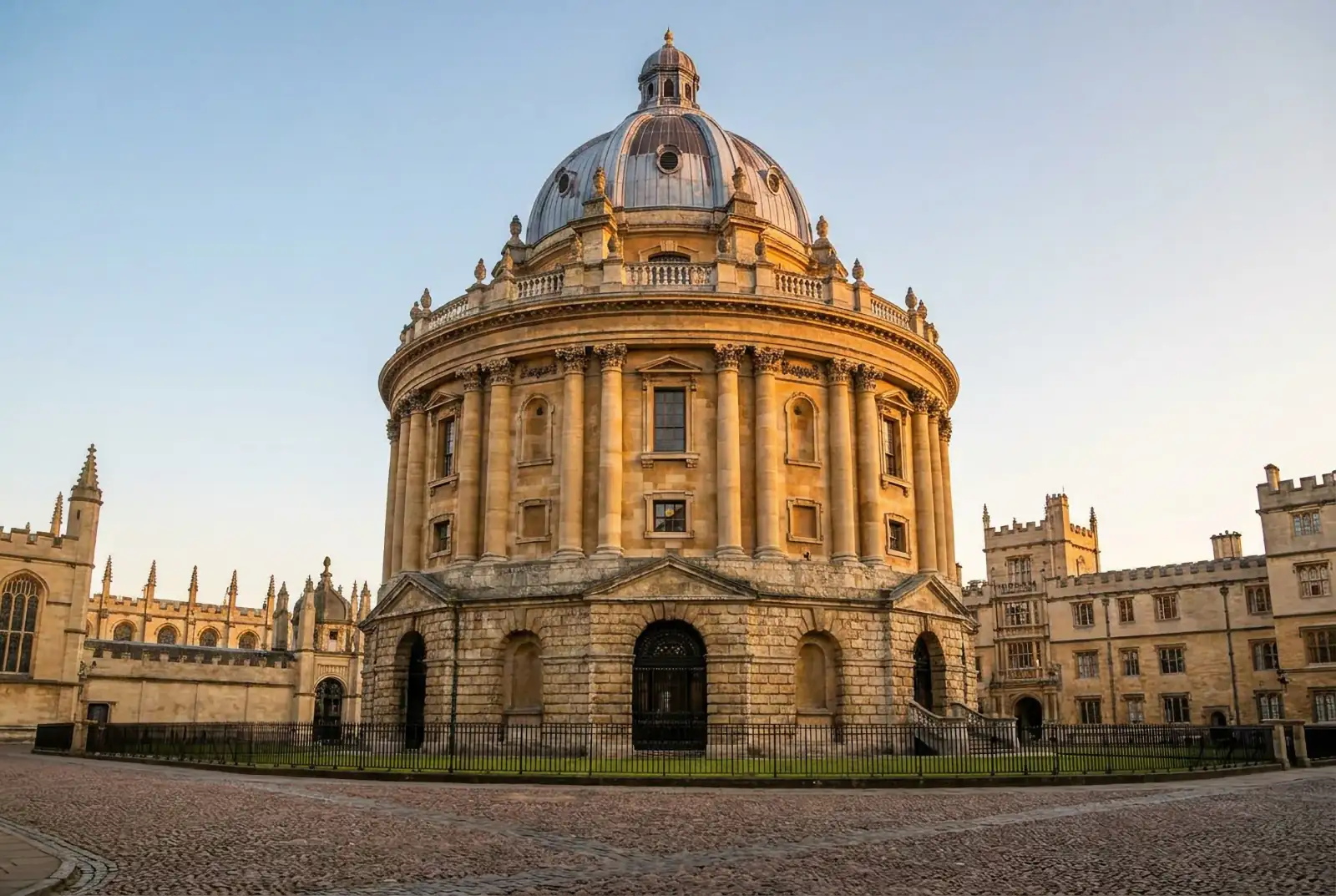
Oxford’s colleges are woven into a working city centre, so you walk between them past shops, buses and a covered market that has traded since the eighteenth century. Cambridge gathers its grandest colleges along one riverbank, so the best of it is concentrated into a single walk.
If you want one continuous set-piece, go to Cambridge. If you want a city you can wander and keep discovering, go to Oxford.
What the day actually looks like
Neither city needs a car, and neither rewards one. Both are compact enough that the whole day is walking.
- Oxford
- A dense, walkable centre where the sights are interleaved with ordinary streets. Radcliffe Square, the Bodleian and the Sheldonian sit within a hundred metres of each other; the Covered Market, the museums and the meadow are all within fifteen minutes on foot.
- Cambridge
- One outstanding linear walk — the Backs — with King’s College Chapel as its anchor, plus the Fitzwilliam a few minutes south. Punting is more central to the visit here than it is in Oxford.
Getting in is the real difference
This is the part most comparisons skip, and it matters more than the architecture.
In both cities, most colleges are private institutions that admit visitors as a courtesy, not an obligation. Access is seasonal, subject to term, services and events, and it changes without much notice. Neither city is a museum with a single ticket.
Cambridge concentrates its paid access. King’s College Chapel is the thing most visitors come for and it is a defined, ticketed visit.
Oxford spreads its access out. Christ Church operates as an organised ticketed attraction; many others admit visitors at published times with a seasonal charge; a few admit almost nobody. The practical consequence is that an Oxford day needs slightly more planning and offers slightly more room for luck.
We keep a separate guide to which Oxford colleges you can realistically get into — it is the question we are asked most.
What each city has that the other does not
- Only in Oxford
- The Pitt Rivers Museum, which is unlike anything else in Britain; the Bodleian’s reading rooms; the Covered Market; and a genuinely good historic pub circuit with archive dates behind the claims.
- Only in Cambridge
- The Backs as a single composed landscape; King’s College Chapel’s fan vault; Kettle’s Yard; and a walk out to Grantchester that has no Oxford equivalent.
Choosing by what you actually want
- One perfect photograph
- Cambridge. King’s from the Backs is the more composed view, and it is designed to be seen from where you will be standing.
- Museums
- Oxford, comfortably. The Ashmolean, the Natural History Museum and the Pitt Rivers are all free and all first-rank.
- Going inside things
- Oxford, with planning. More colleges admit visitors, but the rules differ college by college.
- A river day
- Cambridge. Punting the Backs is the central experience rather than an add-on.
- Rain
- Oxford. The free museums and the Covered Market absorb a wet afternoon far better.
- A short visit
- Cambridge. Two hours on the Backs is a complete experience; two hours in Oxford is a sample of one.
The verdict
For a first visit and a single day, Cambridge is the easier win and Oxford is the richer one. Cambridge gives you a concentrated, reliably beautiful walk that needs almost no planning. Oxford asks for a little research and repays it with more to go inside, better museums and a city that keeps going after the set-piece ends.