museum / Oxford
In depth
Oxford University Museum of Natural History
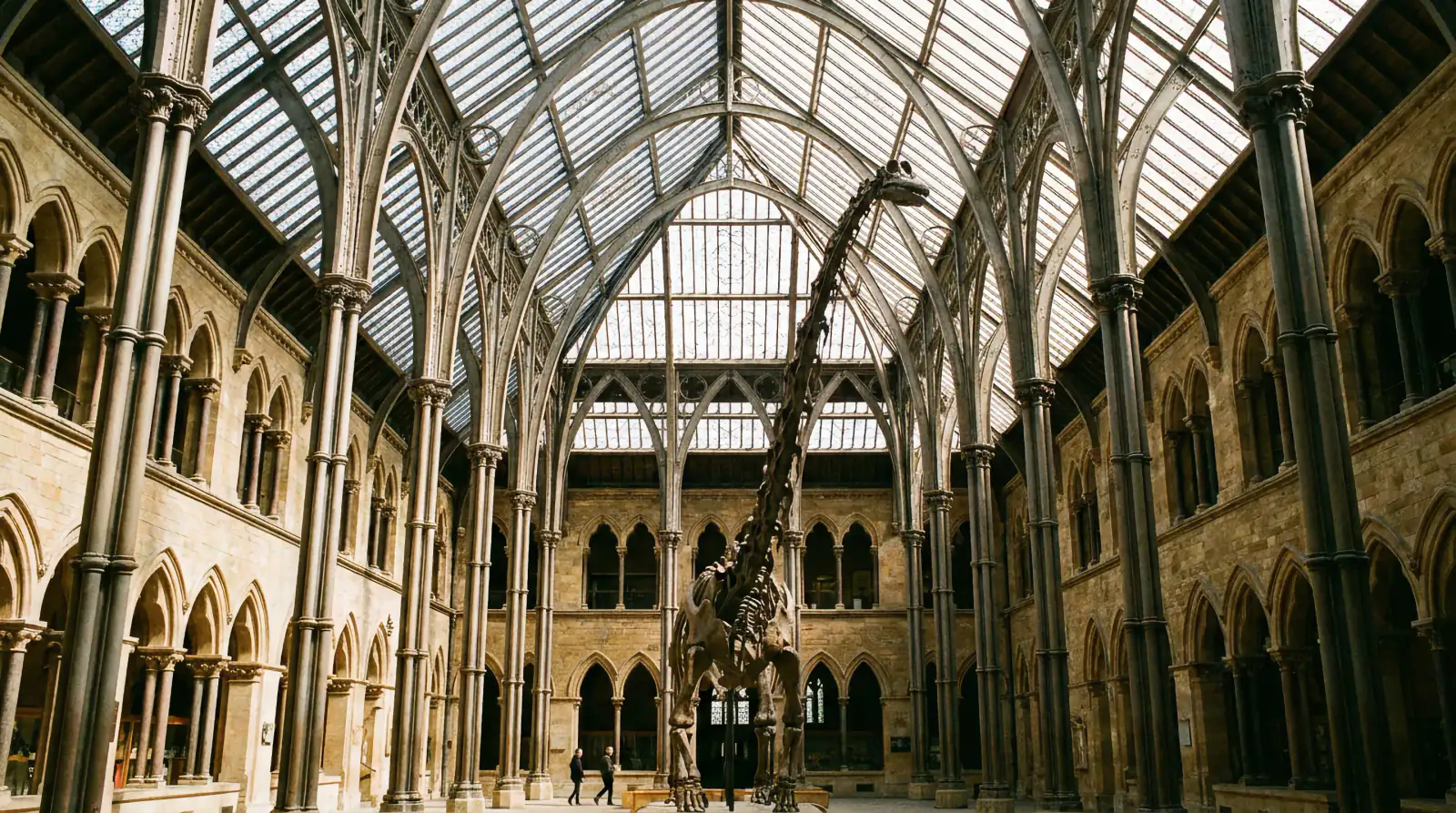
Seven million specimens under a glazed iron court whose stone columns are labelled with their own geology. Free, and the way in to the Pitt Rivers.
Story · Visit · Route · Links
Visitor Essentials & Quick Answers
What should I not miss in the Natural History Museum?
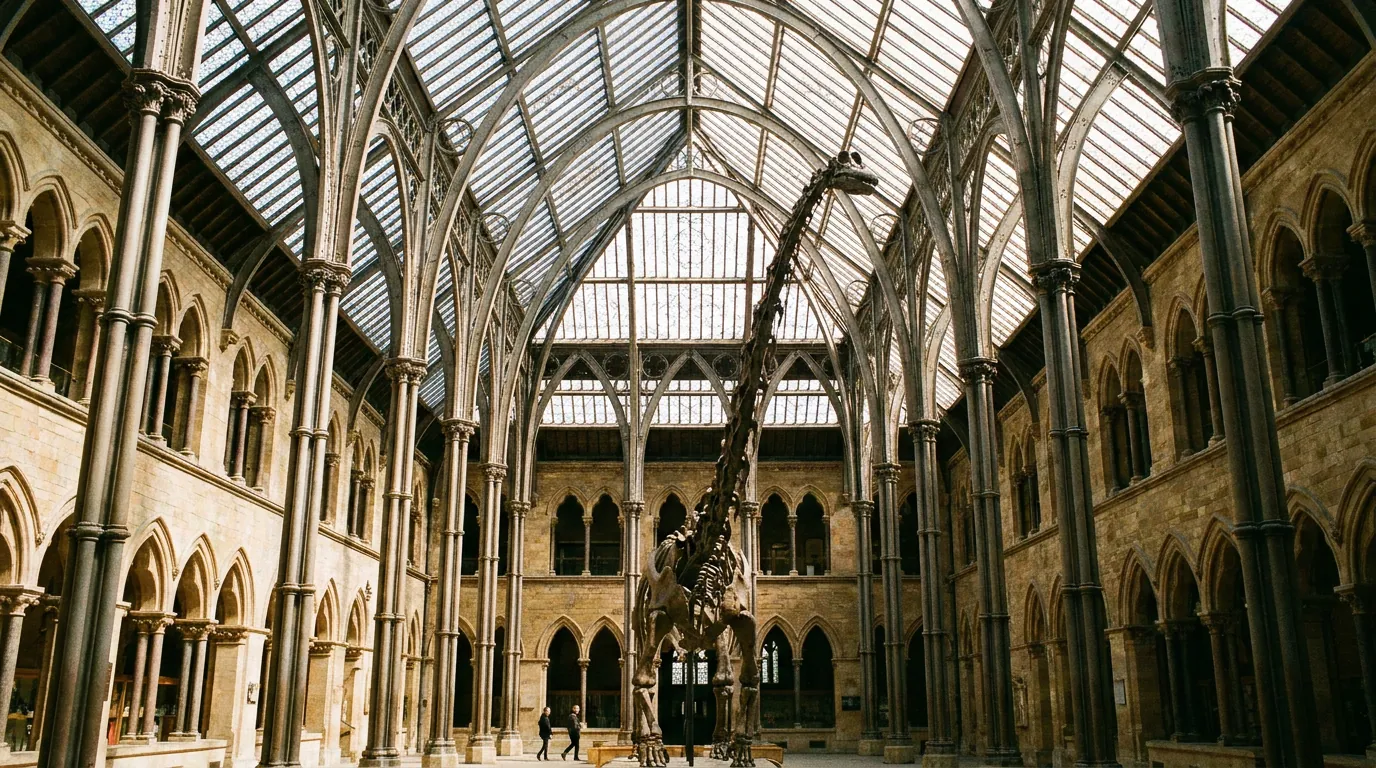
Look beyond the large skeletons to Megalosaurus, the first dinosaur scientifically described, and the museum’s extraordinary dodo material. Then look up: the iron-and-glass court is an attraction in itself. A visit that includes both the specimens and the building gives a richer picture of Oxford’s scientific history.
Is the Oxford dodo a complete stuffed bird?
No. The museum’s exceptional dodo remains include surviving soft tissue, rather than a complete taxidermy bird. That distinction is why they matter scientifically. Distinguish original remains from models and reconstructions: the story is about what survives of an extinct animal, not an intact specimen.
Why is the museum building so unusual?
Its architecture was designed to teach. The arcade columns use different stones, with their types and sources recorded at the bases, while carved plants and leaf-shaped ironwork bring botany into the structure. Try reading several column bases in sequence: the building becomes a geology collection around the exhibits.
Is the Pitt Rivers part of the same museum?
They are separate museums connected by the visitor route. Natural History explores animals, fossils and the natural world; the Pitt Rivers, entered at the back, explores objects made and used by people. The shift from the bright central court to densely packed cases makes a memorable two-museum visit.
Choose your depth
Essentials or more detail?
See visiting essentials, or read more about the history and places nearby.Start here
Understand the place.
The context, character and reasons this experience earns time in your Oxford plans.Most museums are containers. This one is an argument, and the argument is built into the walls.
The University Museum went up between 1855 and 1860 because Oxford had, until then, largely declined to teach science. The campaign to build it began in 1847; a meeting in 1849 resolved that the new museum should house "all the materials explanatory of the organic beings placed upon the globe". What the University put up was not a shed for specimens but a building in which the fabric itself teaches — and then, within months of its completion, it hosted the most famous argument in the history of British science.
Entry is free. It is also the way in to the Pitt Rivers Museum, which is attached to the back and reached through the court.
Why it matters
Three things, and the building is one of them.
The collections run to over seven million specimens, and they include the world's first scientifically described dinosaur, Megalosaurus bucklandii, and the Oxford Dodo — the only surviving soft tissue of a dodo anywhere in the world. Not the most complete dodo skeleton, which is a different and lesser claim: the only preserved dodo tissue, which is why the specimen still matters to genetics.
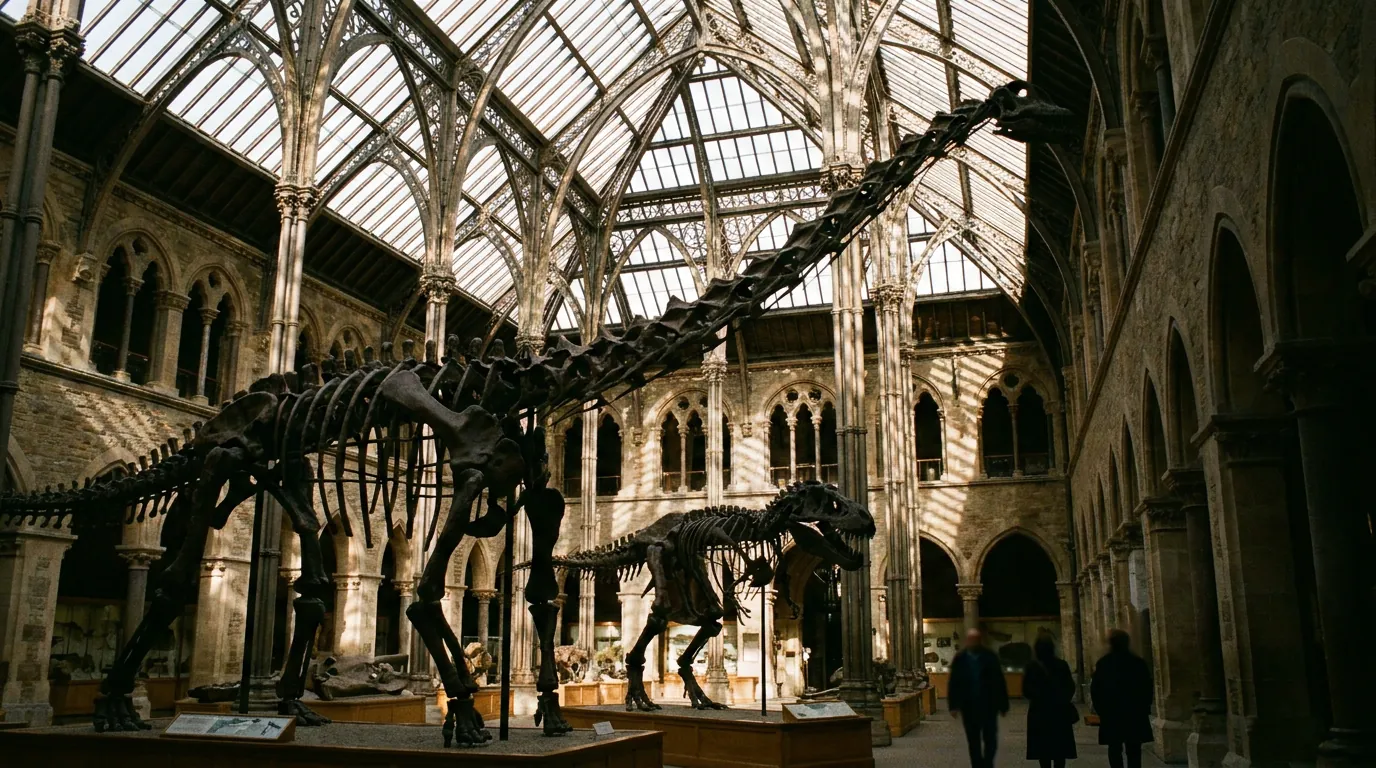
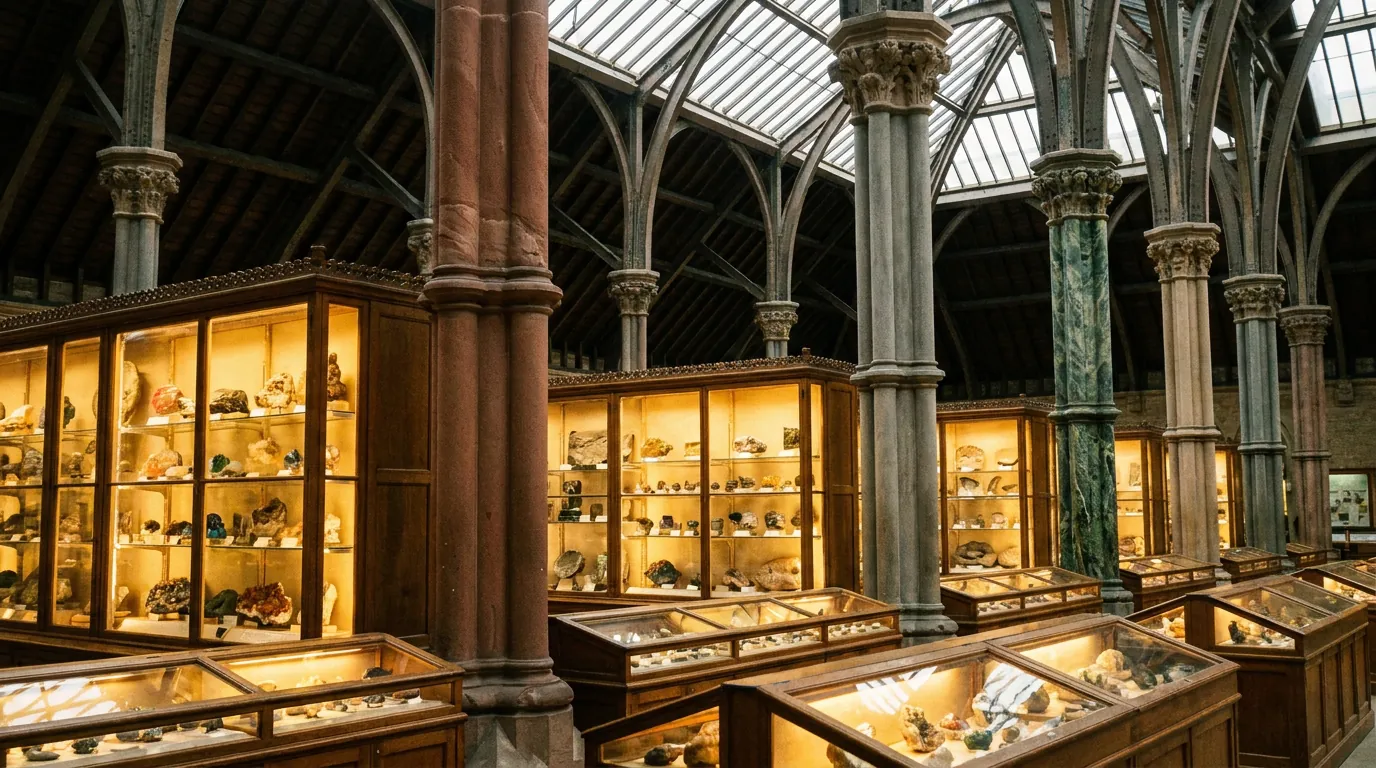
The building is a Grade I listed teaching instrument. The stone columns of the arcade carry the name and source of their own stone, inscribed at the base. The capitals are carved with thistles, daisies, ivy and honeysuckle. The cast-iron shafts of the great glazed court have wrought-iron capitals shaped into palm, oak, chestnut and sycamore leaves. You are meant to read the architecture as part of the collection, and the listing says so explicitly — the decoration and ironwork "form exhibits in their own right".
The debate. On 30 June 1860, in what was then the Radcliffe Library on the first floor of this building, Thomas Huxley and Samuel Wilberforce, Bishop of Oxford, argued about evolution in front of around 500 people. It is the origin of the most quoted exchange in Victorian science. It is also, as the museum itself points out, an event nobody accurately recorded.
What visitors should notice
The court first: 110 feet square, glass and iron, five bays. Then the columns around it, because the geology lesson is hiding in plain sight and almost everyone walks past it.
The carving on the façade, which is unfinished. The Irish O'Shea brothers and their nephew Edward Whellan were dismissed before they completed it, and the building still shows where the work stops.
The swifts, if you come between late April and early August. The colony nesting in the tower has been studied continuously since May 1948, making it one of the longest continuous studies of a single bird species anywhere. Cameras in two of the boxes stream online from May to early September.
Who will enjoy it
Families, unreservedly — this is the most child-friendly major museum in Oxford and the dinosaurs do the work. Anyone interested in Victorian architecture, who will get more out of the columns than out of the cases. Anyone following the history of evolutionary thought. And anyone who wants two museums for one walk, since the Pitt Rivers is through the back.
Who may find it difficult
It is loud. The court is a glass and iron box full of school groups, and it amplifies. If you want quiet contemplation this is the wrong building on a weekday in term time.
It is also bright and hard-surfaced in a way that suits some visitors and not others — the exact opposite of the Pitt Rivers next door, which is dim and enclosed. Doing both in one visit is a sharp sensory switch.
And the labelling is uneven. Some cases are recent and excellent; others are old, dense and assume you already know what you are looking at.
Visitor verdict
One of the few museums where arriving early and looking up, then down at the column bases, before looking at any specimen at all, is genuinely the right order. The dinosaurs will hold children for an hour. The building will hold an adult for longer than expected, and it is free, so a short visit costs nothing and a long one costs nothing either.
The full story
How it came to matter.
Oxford's scientific awakening
The museum exists because of an argument about what a university is for. Until the middle of the nineteenth century Oxford taught classics and theology; the natural sciences had no proper home and, in the words of the Historic England listing, this building marks the moment when "finally the study of science at Oxford was given importance".
The campaign began with an initiative of 1847. At a meeting in 1849 it was determined that the planned museum should house "all the materials explanatory of the organic beings placed upon the globe" — an ambition that explains the building's scale and its refusal to be merely a store.
The driving forces were David Williams, Warden of New College, and Dr Henry Ackland, Professor of Clinical Medicine. Ackland matters twice over: he was also a friend of John Ruskin, with whom he travelled to Scotland with Millais in 1853, the year the final part of The Stones of Venice appeared.
Ruskin, and how much credit he is due
Ruskin's convictions — the superiority of Gothic, and above all the primacy of the workman's hand and of nature as the source of ornament — shaped the climate in which this building was commissioned.
But the statutory listing is careful, and so should any account be: Ruskin's beliefs "probably influenced" the selection of Benjamin Woodward's design and its decorative treatment. Probably. He was not the architect, he did not win the competition, and the building is not his. He is the reason it looks the way it does in the same sense that a critic is the reason a generation paints a certain way.
The one place his circle is directly visible is upstairs: the former Geological Lecture Room, now the Director's Office, carries geologically-themed gable-wall murals of 1859–60 by the Revd Richard St John Tyrwhitt, vicar of St Mary Magdalen's and a friend of Ruskin.
The architects — and a family that is easy to confuse
A site was bought in 1854. The building went up between 1855 and 1860, by the Irish practice of Sir Thomas Deane (1792–1871) and Benjamin Woodward (1816–1861). The design was Woodward's.
This is where almost every popular account goes wrong, because three generations of Deanes worked in Oxford:
- Sir Thomas Deane (1792–1871) — partner, with Woodward, on this building.
- Thomas Newenham Deane — his son. The firm T N Deane & Son designed the Pitt Rivers Museum of 1885–6 at the rear.
- Thomas Manly Deane — the "& Son" of that practice.
The University Museum and the Pitt Rivers were built by members of the same family thirty years apart, but not by the same architect.
A building made of specimens
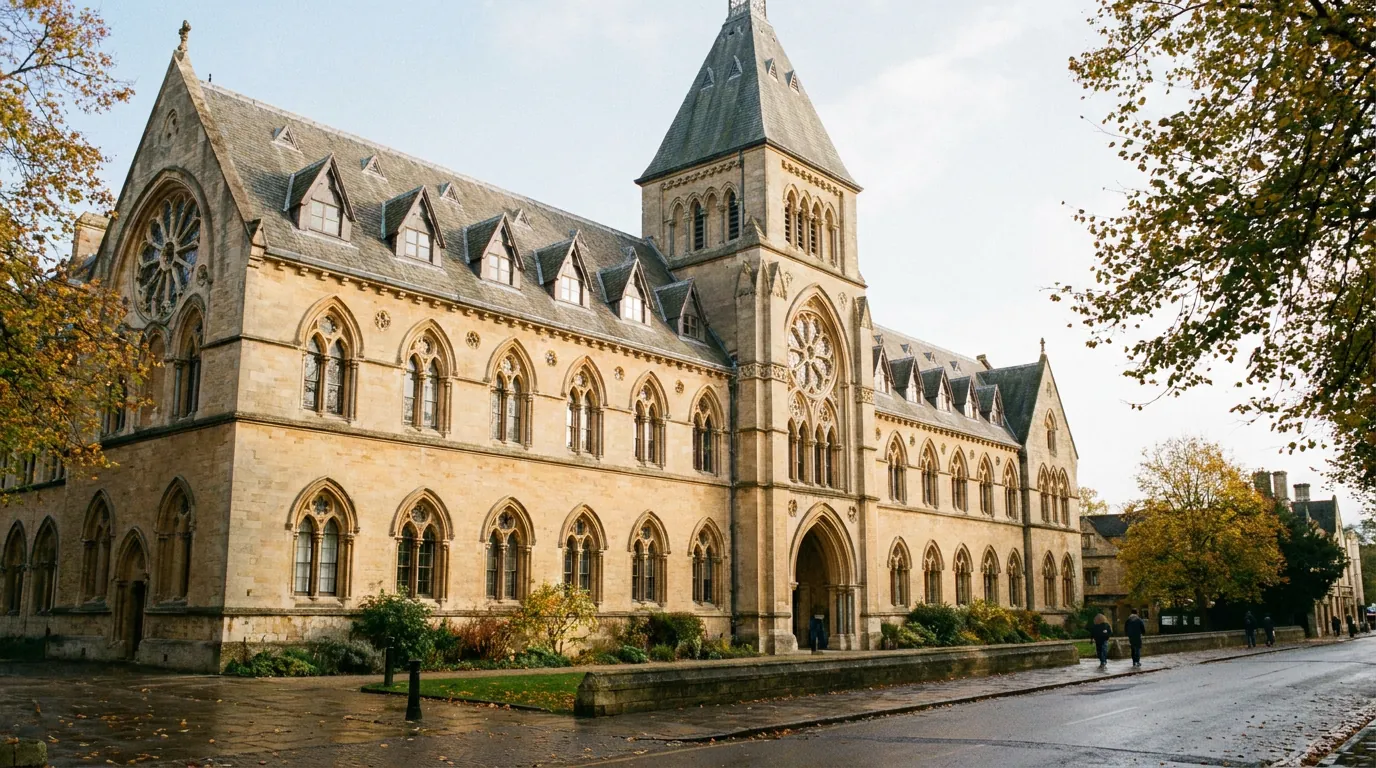
What Woodward produced was a façade "reminiscent of a Flemish cloth hall" in buff ashlar with banded reddish-brown detailing, two storeys with a tall central tower, wrapped around three sides of a glazed court.
The materials list reads like a geology collection because it is one: Bath (Box Ground) stone, Red Bristol sandstone, Hornton Ironstone, Irish Mountain limestone in the tower cornice, red Irish limestone, green marlstone and white Italian marble in the porch arch, Portland stone in the spandrels, Caen stone for the arcade bases and caps.
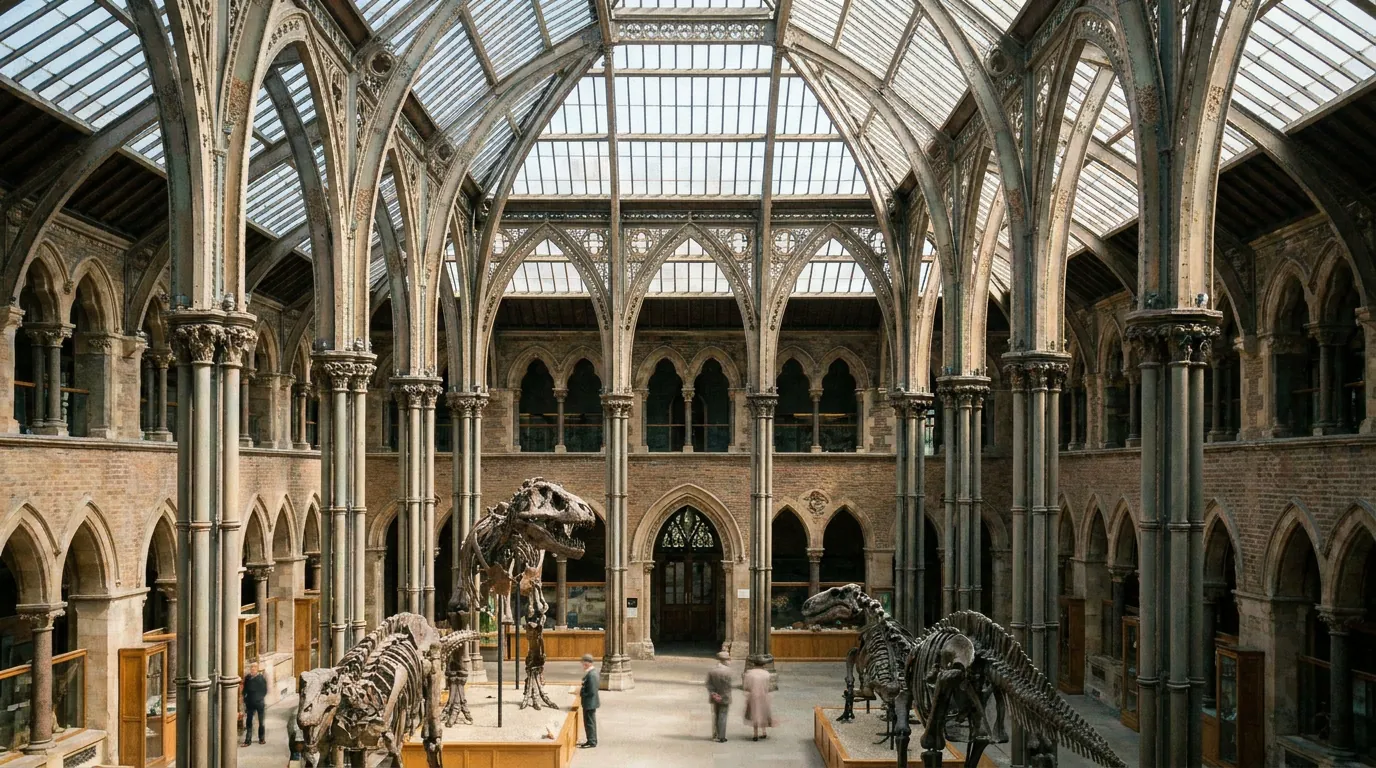
Inside, the court measures 110 by 110 feet, divided into five bays by iron columns in an A:B:A:B:A rhythm, the central bay taller than the rest. The ornamental cast ironwork is by F A Skidmore of Coventry, and it is the thing most visitors photograph without knowing whose it is.
The teaching runs through every surface. The arcade's stone columns mostly carry the type of stone and its source inscribed at the base. Their capitals are carved with thistles, daisies, ivy and honeysuckle. The iron shafts' capitals are worked into palm, oak, chestnut and sycamore leaves. Life-size statues of eminent scientists stand against the ground-floor columns. The listing calls the whole ensemble an "encyclopaedia of nature", and that is the design intent, not a flourish.
The O'Shea brothers and the carving that stops
The naturalistic carving on about a third of the windows and the door surround was executed by the Irish O'Shea brothers and their nephew Edward Whellan.
They were dismissed before their work was completed, and the remainder was not finished until 1910.
The building therefore shows, permanently, where a dispute stopped the work. The usual telling makes this a romantic tale of craftsmen sacked for insolence; the statutory record says only that they were dismissed. The visible fact — carving that simply ceases — is more interesting than any of the versions of why.
30 June 1860 — the debate nobody recorded
Months after the building opened, it hosted the British Association meeting at which Thomas Huxley and Samuel Wilberforce, Bishop of Oxford, argued over Darwin's On the Origin of Species, published the previous November. It took place in what was then the Radcliffe Library on the first floor, before around 500 people.
The story everyone knows is that Wilberforce asked Huxley whether he was descended from a monkey on his grandfather's or his grandmother's side, and that Huxley replied he would rather be descended from an ape than from a man who used his gifts to obscure the truth.
The museum's own account says plainly that this is not a record. In its words: "Although no-one accurately recorded what was said in front of the noisy crowd of almost 500 people, the story that has emerged is of a sharp intellectual volley between Wilberforce and Huxley." The celebrated retort is described as what Huxley "is claimed to have retorted".
That caveat is the honest position and it is the museum's own. The debate happened; the quotations are reconstruction, largely written down long afterwards by people with an interest in how it was remembered.
The collections
Over seven million specimens. Over five million of those are in the Life (Zoology) collections, including some five million insects; around 400,000 fossils; over 30,000 mineral specimens and over 50,000 petrological samples; roughly 20,000 books and half a million manuscripts in the archive.
Two holdings carry the museum's reputation:
Megalosaurus bucklandii — the first dinosaur ever scientifically described, named by William Buckland, and the specimen from which the entire category of dinosaur ultimately descends.
The Oxford Dodo — of which more in the highlights, and which is routinely misdescribed.
The swifts
Since May 1948, the colony of swifts nesting in the museum tower has been studied continuously — begun by David Lack of the Edward Grey Institute in the Department of Zoology. It is one of the longest continuous studies of a single bird species anywhere in the world.
The birds arrive in the last days of April; fledglings leave around the beginning of August and the parents a week or so later. Cameras in two of the nest boxes stream online from May to early September.
Look closer
Highlights and hidden details.
The objects, spaces and small observations that turn a visit into a memorable one.1. The glazed court
110 feet square, five bays, glass and iron, with a two-storey stone arcade running round it. The ornamental cast ironwork is by F A Skidmore of Coventry and the iron shafts carry wrought-iron capitals worked into palm, oak, chestnut and sycamore leaves.
Why it matters: this is a mid-Victorian attempt to make a structure that teaches while holding a roof up. The listing is explicit that the ironwork and carving "form exhibits in their own right" — they are not decoration applied to a museum, they are part of its collection.
The visit: look up on arrival, before you look at a single specimen. Then look at the ironwork where it meets the stone, which is where the argument between the two materials is most visible.
Time: five minutes to see it, longer to stop noticing the dinosaurs.
2. The column bases nobody reads
The stone columns of the arcade mostly carry the type of stone and its source inscribed at the base. Their capitals are carved with thistles, daisies, ivy and honeysuckle.
Why it matters: it is a geology collection and a botany collection built into the load-bearing structure of the room. Walk the arcade reading the bases and you have taken a tour of British and Irish stone without opening a case.
The visit: this is the single most overlooked thing in the museum. Start at any corner of the arcade and read four or five in sequence.
Time: ten minutes, and it permanently changes how the room looks.
3. Megalosaurus bucklandii
The first dinosaur ever scientifically described, named by William Buckland in Oxford.
Why it matters: everything the word "dinosaur" now means descends from this specimen being described. It is the museum's most historically important holding by a wide margin, and it is quieter and less photographed than the mounted skeletons a few metres away.
Manage expectations: it is fragmentary — this is a jaw and bones, not a towering mount. Its significance is intellectual, not theatrical.
4. The Oxford Dodo
What survives is "the skull with left side of skin, the sclerotic ring from the eye, the skeleton of the foot, the sectioned femur, a feather (removed from the head in 1986) and various tissue samples".
Why it matters: it is the only surviving soft tissue of a dodo anywhere in the world — mummified skin from the head — which is why it remains central to dodo genetics. It is not "the most complete dodo remains", a lesser and commonly repeated claim.
It reached Oxford through the Tradescant collection, one of the founding collections of the Ashmolean, and appears in a catalogue of 1656 as "Dodar, from the Island Mauritius; it is not able to flie, being so big." How the Tradescants got it is unknown.
Research on the specimen found the bird had been shot in the back of the head.
Time: ten minutes, and read the label properly.
5. The dinosaurs in the court
An Iguanodon and a Tyrannosaurus rex stand in the centre court. The T. rex is a cast. Both were considered too big to move and too complex to dismantle during the museum's conservation work.
Why it matters: they are the reason a large proportion of visitors under ten are here at all, and they earn it. This is also the clearest demonstration of why the court was built the way it was — the roof height exists so that things this size can stand under it.
6. The whale skeletons overhead
Five cetaceans hang from the roof: a northern bottlenose whale, a common minke whale, a killer whale, a beluga and a common bottlenose dolphin.
Why it matters: seen from the upper gallery rather than the floor, they read as a comparative anatomy lesson — five related animals at five scales, in one sightline.
Manage expectations: there is no blue whale here, despite what a great deal of published material says. The largest of these is the minke, and the difference in scale between a minke and a blue whale is not a detail.
7. The unfinished carving
Naturalistic carving covers about a third of the windows and the door surround, executed by the Irish O'Shea brothers and their nephew Edward Whellan — who were dismissed before the work was completed. The remainder was not finished until 1910.
Why it matters: the building carries a visible seam where a dispute stopped the work. Most Victorian buildings hide their interruptions; this one cannot.
The visit: outside, on the façade. Compare the richly worked windows with their plainer neighbours.
8. The swifts in the tower
A colony has nested in the tower since before May 1948, when David Lack of the Edward Grey Institute began studying it — now one of the longest continuous studies of a single bird species in the world.
Why it matters: it is live science running in the roof of a museum about dead specimens, and it has been running for more than seventy-five years.
The visit: the birds arrive in the last days of April; fledglings go around the beginning of August, parents a week or so later. The boxes themselves are hidden and reached by a cramped climb, so cameras in two boxes stream online from May to early September — that is how you see them.
Details worth slowing down for.
The columns are labelled, and the labels are the exhibit
Most of the arcade's stone columns carry the type of stone and its source cut into the base. Not on a card beside them — cut into the stone itself.
It is a permanent, unstealable, unloseable catalogue, and it is beneath eye level, which is why several hundred thousand people a year walk past it. Read four in a row and the room stops being a backdrop.
The capitals are two different sciences
The stone capitals of the arcade are carved with thistles, daisies, ivy and honeysuckle. The iron capitals of the court's shafts are worked into palm, oak, chestnut and sycamore leaves.
Stone gets the native flora; iron gets the trees, including a palm. The listing calls the effect "an encyclopaedia of nature", and once you have noticed that the two materials carry different vocabularies you cannot stop checking.
The building is a stone collection
The materials list is a deliberate geological range: Bath (Box Ground) stone, Red Bristol sandstone, Hornton Ironstone, Irish Mountain limestone in the tower cornice, red Irish limestone, green marlstone from Hornton and white Italian marble in the porch arch, Portland stone in the spandrels, Caen stone for the arcade bases and caps.
The porch arch alone contains three stones from three countries. That was the point: the building demonstrates its subject.
Where the carving stops
The O'Shea brothers and their nephew Edward Whellan carved about a third of the windows and the door surround, and were dismissed before finishing. The rest was completed by 1910.
Stand outside and compare adjacent windows. The seam between the richly naturalistic work and the plainer completion is visible from the pavement, and it is a permanent record of an industrial dispute in a Grade I listed façade.
A first-floor library, not a lecture theatre
The 1860 debate happened in what was then the Radcliffe Library on the first floor — not in the court, which is where almost everyone assumes it took place and where the crowd of 500 would more naturally fit.
Knowing that changes the mental picture entirely: a packed upstairs library, not a grand arena.
The museum tells you the famous quote is not a quote
The single most repeated exchange in Victorian science — the monkey and the grandfather — is presented on the museum's own website as what Huxley "is claimed to have retorted", prefaced by the acknowledgement that "no-one accurately recorded what was said".
An institution declining to bank its own most marketable anecdote is unusual, and it is a better reason to trust the rest of its labelling than any amount of assertion would be.
The octagon next door was a kitchen
Attached to the south side is the octagonal former Chemistry Laboratory, modelled on the Abbot's Kitchen at Glastonbury Abbey. It is separately listed. The arcaded link joining it to the museum is of 1901.
A Victorian chemistry lab modelled on a medieval monastic kitchen makes an unusual detour, just a hundred metres from the front door.
The 2007 work is not listed
The Pitt Rivers extension and the new staircase, both completed around 2007, are explicitly not included in the listing. Neither is the late twentieth-century shop and display area at the front of the Pitt Rivers.
Worth knowing if you are trying to work out which parts of the complex are protected fabric and which are recent insertion.
Three generations of one family
Sir Thomas Deane built this with Woodward, 1855–60. His son's firm, T N Deane & Son, built the Pitt Rivers behind it in 1885–6. The "& Son" was Thomas Manly Deane.
Grandfather, son, grandson, one site, thirty years apart — and almost every published account collapses at least two of them into one man.
A gone building
Behind the Chemistry Laboratory stood the large curator's house. It was demolished in the 1950s. The arcaded link of 1901 and the octagon survive; the house does not, and nothing marks it.
Live science in the roof
While you look at seven million dead specimens, a swift colony overhead has been under continuous study since May 1948 — one of the longest-running studies of any bird species anywhere.
The nest boxes are, in the museum's own words, "well hidden", and reaching them "involves a cramped climb to the very top of the tower". So the research happens directly above the court and is completely invisible from it.
Make it work
Plan the visit properly.
Current practical detail, kept separate from the story so it is easy to scan when you need it.Verified 3 August 2026 from the museum's own visitor pages. Hours and access arrangements are the volatile facts here.
Finding it
Museum of Natural History, University of Oxford, Parks Road, Oxford OX1 3PW. About twelve minutes' walk north from Carfax by Broad Street and Parks Road, or four minutes from Keble College.
The building is unmistakable — a tall Gothic façade with a central tower, set back behind a lawn on the east side of Parks Road.
Opening hours
Monday to Sunday, 10:00–17:00. Last admission 16:45. Closed 24, 25 and 26 December.
Unlike the Pitt Rivers behind it, there is no late Monday opening to catch you out — this museum keeps the same hours every day.
Admission
Free, and not ticketed. No booking for individuals.
Groups of more than ten people visiting on the same day must book in advance. That threshold is lower than most people expect and it applies to any organisation, not just schools.
Two museums, one door
The Pitt Rivers Museum is in the same building, attached at the rear and reached through the court — walk to the far end and turn left at Darwin's statue. It is also free.
Their hours differ. The Pitt Rivers does not open until 12:00 on ordinary Mondays, so a Monday morning gets you this museum only. If you intend to do both, come after noon on a Monday or any time on another day.
The two are also a sharp contrast: this building is bright, tall and loud; the Pitt Rivers is dim, dense and enclosed. Doing both back to back is a real sensory switch and is worth knowing about in advance.
Best time to visit
Weekday mornings in term time are the busiest, not the quietest — this is the most heavily booked school-visit museum in Oxford and the court amplifies every voice in it.
For quiet, come late afternoon, after about 15:30, when the school groups have gone. Weekends are busy but with families rather than coach parties, which is a different kind of busy.
Late April to early August adds the swifts. Winter is genuinely calm.
Duration
An hour covers the court, the dinosaurs and the dodo. Ninety minutes lets you actually read the building — the inscribed column bases, the capitals, the ironwork. Add another ninety minutes if you are continuing into the Pitt Rivers, which is a separate visit rather than an extension of this one.
Thirty minutes registers the court and nothing else, which is still worth doing if that is all you have.
Facilities
Café — Taylors Museum café inside, for hot lunches, salads, sandwiches, snacks and drinks, plus the Horsebox outside for cakes and hot and cold drinks. Food may only be eaten in the café area or outside on the front lawn, not in the galleries.
Shop — on site, with an online shop at shop.oumnh.ox.ac.uk.
No cloakroom. The museum states it has no facilities for storing coats or bags. Plan for what you are carrying, particularly if you are combining this with a longer day in the city.
Photography
Non-commercial photography is welcome. Tripods require prior arrangement.
The court is the hardest and best subject — very high contrast between the glazed roof and the shaded arcade. See 08-photography.md.
Families
This is the strongest family museum in Oxford, and the dinosaurs do most of the work. See 06-family-guide.md. The court's open floor tolerates children far better than a conventional gallery does, and the free entry means a twenty-minute visit is not a waste of money.
Access
Step-free entry is available, and the main court is level and spacious. Check the museum’s accessibility information for the upper gallery and tower before planning your route.
Weather
Entirely indoors and free, which makes it one of Oxford's default wet-weather destinations along with the Ashmolean and the Pitt Rivers. Expect it to be full when it rains, particularly in school holidays.
The court is glazed, so it is bright on a sunny day and genuinely gloomy under heavy cloud — the building's character changes with the weather more than most museums do.
Getting here
Walking — twelve minutes north from Carfax via Broad Street and Parks Road.
Bus — stops on Parks Road and South Parks Road, a minute away.
Rail — Oxford station, about twenty minutes on foot.
Car — not advised. Central Oxford is heavily restricted and there is no visitor car park. Use Park & Ride.
Cycling — Parks Road is a main cycle route; racks are nearby.
Visit your way
Access and family planning.
Verified 3 August 2026 from the museum's published visitor information. Where something could not be confirmed it is recorded as unverified rather than assumed — a wrong "accessible" wastes a journey.
What the museum states
The museum provides an accessible entrance, identified by the what3words address ///jolly.locked.lived, and maintains a dedicated accessibility page.
The most useful structural fact is that the main court is level, wide and open. Unlike most historic Oxford interiors, the principal space here is a single large flat floor, so the main experience of the museum is reachable without steps.
Getting there
Parks Road has wide, level pavements and the museum is set back behind a lawn. Bus stops on Parks Road and South Parks Road are within a minute.
The walk from Carfax is about twelve minutes and is flat but long; from Keble College it is four.
No visitor car park. Central Oxford is heavily restricted; Park & Ride is the practical option.
Inside
The court is the strong point: level, generously wide, and easy to move around even when busy.
The arcade running round it provides circulation at two levels. The upper gallery is where published information runs out — see below.
Not confirmed
Recorded as unknown rather than guessed:
- Lift access to the upper gallery. The whale skeletons read best from the gallery, so this materially affects what a visitor can see. Not described in the information consulted.
- Accessible toilet provision and dimensions.
- Hearing loop coverage.
- Seating within the galleries — the café has seating, but in-gallery rest points are not described.
- Large-print or audio interpretation.
The museum publishes a dedicated accessibility page, which is the right place to resolve all of these; where a visit depends on one, telephone +44 (0)1865 272 950 before travelling.
The tower is not accessible and is not open to visitors in the ordinary way — the swift nest boxes are reached by what the museum describes as "a cramped climb to the very top". The webcam exists partly for this reason.
Sensory notes
This is the significant section for this building, because its character is the opposite of its neighbour's.
- Loud. The glazed court is hard-surfaced on every side and amplifies. On a weekday morning in term time it is full of school groups and the noise is considerable. After 15:30 is markedly quieter, and winter more so again.
- Bright, and variable. The court is glazed, so it is very bright in sun and genuinely gloomy under heavy cloud. There is little control over this.
- Open and exposed. There are few enclosed or quiet corners off the main court.
- No cloakroom, so everything you arrive with stays with you — relevant if carrying capacity is a factor.
The switch to the Pitt Rivers
Worth planning for deliberately. The Pitt Rivers is entered through the back of this court, and it is dim, dense and enclosed where this building is bright, tall and loud.
For a visitor with sensory sensitivities that transition is abrupt in both directions. Neither museum is a gentle version of the other, and doing both in one visit is a bigger ask than the shared front door suggests.
The Pitt Rivers also has its own access arrangements and its own disruption notices; check that separately rather than assuming the two buildings share provision.
The practical summary
If your visit is the court, the dinosaurs, the dodo and the column bases, this is one of the more straightforwardly accessible major attractions in Oxford: level, free, unticketed, on a bus route.
If it depends on the upper gallery, on in-gallery seating, or on hearing support, telephone first. Those are precisely the things the published information does not settle.
Short version
The best family museum in Oxford, and it is free. Dinosaurs in an enormous skylit hall, things hanging from the roof, floor space to move, and no entry charge to justify — a twenty-minute visit costs nothing.
Ages
Under 3 — good. The court is open, level and pushchair-friendly, and there is plenty to point at overhead. Nothing here needs to be understood to be enjoyed.
3 to 7 — the sweet spot. The Iguanodon and the Tyrannosaurus cast do the work, and the scale of the court means small children can be loud without anyone minding, which is not true of most Oxford interiors.
7 to 12 — strong, and the point at which the dodo lands. The story is genuinely gripping at this age: an extinct bird, the only preserved tissue in the world, and research showing it was shot in the back of the head.
Teenagers — depends entirely on interest. The evolution debate and Megalosaurus are the hooks. The building itself will interest some and none of the rest.
The thing to do first
Go into the middle of the court and look up. Then send them to find the whales overhead and count them — there are five, and they are all different animals, not five of the same. It orients everyone and buys you a few minutes.
Making the columns work for children
The inscribed column bases are a ready-made game. Ask a child to find the stone that came from furthest away, or to collect five different stone names. It turns the most-ignored feature in the building into the most memorable one, and it costs nothing.
The capitals work the same way: stone capitals carry flowers, iron ones carry tree leaves. Find a palm.
Practicalities
Food — the Taylors café inside and the Horsebox outside. Food may only be eaten in the café area or outside on the front lawn, not in the galleries, which is worth knowing before you unpack a lunch beside a dinosaur.
The front lawn is the picnic answer in good weather, and it is where most families end up.
No cloakroom. The museum has no facilities for storing coats or bags, so whatever you bring, you carry all day. With small children and a wet-weather forecast this is a real consideration.
Toilets and baby-changing are available.
Pushchairs — the court is level and wide. The upper gallery is the part to check on arrival if you need step-free access to it.
Noise, honestly
The court is a glass and iron box and it amplifies everything. On a weekday morning in term time it is full of school groups and it is loud.
For most families that is liberating — your children are not the loudest thing in the room. For a child who finds noise difficult it is the opposite, and the answer is to come after 15:30, when the school parties have gone.
Doing the Pitt Rivers as well
The Pitt Rivers is through the back of the court and also free, so families routinely do both. Two warnings.
First, it does not open until 12:00 on ordinary Mondays. Second, the sensory switch is abrupt: from a bright, loud, tall hall into a dim, dense, quiet one. Some children love the change and some find it a wall. It costs nothing to walk in and find out, and nothing to walk straight back.
Boredom risk
Low for an hour, real after ninety minutes. There is no dedicated play space, and once the dinosaurs and the whales have been done the appeal is display cases. Treat an hour as the plan and anything more as a bonus.
University Parks is four minutes away and is the obvious release valve when the museum has run its course.
Self-guided walk
Explore beyond the venue.
A practical, step-by-step route connecting this experience with more of Oxford.Stop 1 — The façade, from across Parks Road
Start outside, on the far pavement.
From here the composition reads: a façade "reminiscent of a Flemish cloth hall", two storeys of buff ashlar with reddish-brown banding, dormers and ventilators piercing the slate, and a tall central tower with the main door at its base.
The swifts are up in that tower, and have been studied there since 1948.
5 minutes.
Stop 2 — The carving that stops
Move along the façade and compare adjacent windows.
About a third of them, and the door surround, carry rich naturalistic carving by the Irish O'Shea brothers and their nephew Edward Whellan. The rest are plainer. The carvers were dismissed before finishing, and the remainder was not completed until 1910.
Raking light helps. You are looking at an unresolved argument, fixed in stone.
10 minutes.
Stop 3 — The porch arch
At the main door, before you go in.
Three stones from three countries in one arch: red Irish limestone, green marlstone from Hornton, white Italian marble. Portland stone in the spandrels above.
The building has begun teaching before you are through the door.
5 minutes.
Stop 4 — The centre of the court
Walk to the middle of the court and look up. Do not stop at a case yet.
110 feet square, five bays, the roof running A:B:A:B:A with the central bay taller. The ornamental ironwork is F A Skidmore's of Coventry.
This is the room the whole campaign of 1847 was for.
10 minutes.
Stop 5 — The arcade, reading the bases
Now go to any corner of the arcade and walk it slowly, reading the column bases.
Most carry the name of their stone and where it came from, cut into the stone itself. Read five in a row. Then look up at the same columns: the stone capitals carry thistles, daisies, ivy and honeysuckle.
Then find an iron shaft and look at its capital — palm, oak, chestnut, sycamore. Stone gets the flowers, iron gets the trees.
15 minutes, and the most rewarding quarter-hour in the building.
Stop 6 — The statues
Still in the arcade: life-size statues of eminent scientists stand against the ground-floor columns.
They are easy to walk past as furniture. They are the museum naming its own lineage at the moment it was arguing for the right to exist.
5 minutes.
Stop 7 — Megalosaurus
Find Megalosaurus bucklandii.
The first dinosaur ever scientifically described, named here in Oxford by William Buckland. Fragmentary, undramatic, and the origin of the entire category.
5 minutes.
Stop 8 — The Oxford Dodo
The skull with the left side of its skin, the sclerotic ring, the foot skeleton, a sectioned femur, a feather taken from the head in 1986.
The only surviving soft tissue of a dodo anywhere in the world — not the most complete skeleton, which is a different and lesser claim. It came through the Tradescant collection and appears in a catalogue of 1656. Research found the bird had been shot in the back of the head.
10 minutes.
Stop 9 — The upper gallery and the whales
Go up to the gallery and look across.
Five cetaceans hang from the roof: northern bottlenose whale, common minke, killer whale, beluga, common bottlenose dolphin. From the floor they are silhouettes; from here they are a comparative anatomy lesson at five scales.
There is no blue whale, whatever you may have read.
10 minutes.
Stop 10 — The first floor, and 30 June 1860
Still upstairs. What is now offices and gallery was, in 1860, the Radcliffe Library.
Here, on 30 June 1860, Huxley and Wilberforce argued about evolution in front of around 500 people, months after the building opened. Not in the court below, where everyone imagines it — in a packed upstairs library.
And nobody accurately recorded what was said. The museum says so itself.
5 minutes, and it is the stop that justifies the route.
Stop 11 — Out past the octagon
Leave and walk round to the south side to see the octagonal former Chemistry Laboratory, modelled on the Abbot's Kitchen at Glastonbury Abbey, joined by an arcaded link of 1901.
Or turn left at Darwin's statue inside and carry straight on into the Pitt Rivers — free, through the back of the court, and after 12:00 on an ordinary Monday.
5 minutes, or another two hours.
Make a record
Photograph it thoughtfully.
The rules first
Non-commercial photography is welcome. Tripods require prior arrangement with the museum — do not simply set one up in the court.
Anything commercial, and any shoot involving lighting or crew, needs permission in advance: +44 (0)1865 272 950.
The problem to solve
The court is a glazed roof over a shaded stone arcade. That is four or five stops of range in a single frame, and it defeats most phone cameras: expose for the arcade and the roof burns out, expose for the roof and the arcade goes black.
Two answers. Shoot on an overcast day, when the roof is a soft even source and the range collapses to something manageable. Or shoot HDR deliberately rather than letting the camera decide.
The building is genuinely a different subject in sun and in cloud, and cloud is the easier one.
Best angles
Standing in the centre of the court, looking up. The obvious shot and still the best. Five bays, the A:B:A:B:A rhythm of the roof, iron tracery against sky.
From the upper gallery, along the court. The only viewpoint that puts the whale skeletons at eye level and shows the arcade as a receding perspective rather than a wall.
Low, close to an iron shaft, looking up its length to the wrought-iron leaf capital. This is the shot that shows what Skidmore's ironwork actually is, and almost nobody takes it.
The façade from across Parks Road, which is the only place the Flemish cloth-hall composition reads — tower, two storeys, dormers and ventilators piercing the slate.
The carving seam, outside: two adjacent windows, one richly worked by the O'Sheas and one plain. It needs raking light, so morning or late afternoon.
Details worth close work
- Inscribed column bases — the stone name and source cut into the base. Requires getting low. Flat light.
- Stone capitals: thistles, daisies, ivy, honeysuckle.
- Iron capitals: palm, oak, chestnut, sycamore.
- The porch arch, which contains red Irish limestone, green Hornton marlstone and white Italian marble together — a colour study in three stones.
- The statues of scientists against the ground-floor arcade columns.
Specimens
The dinosaurs are hard because they are large, dark, and lit from a bright roof directly above. Shoot them from the gallery rather than the floor and the lighting works with you instead of against you.
The dodo is in a case and small; expect reflections, and shoot at an angle to the glass rather than square to it.
The whales need the gallery. From the floor they are silhouettes.
People and consent
The court is full of school groups. For anything beyond personal use, frame the architecture and the specimens rather than the visitors, and do not photograph children. If a group is in the frame, wait — the court empties and refills constantly.
Museum staff at work should be asked before being photographed.
Drones
No. This is central Oxford, over a Grade I listed building, a public highway and crowds. There is no lawful casual flight here.
Equipment
A wide lens for the court, something longer for the roof detail and the whales, and a polariser for the display cases — it does more for the specimen shots than any other single piece of kit. No tripod without arranging it first.
See it
In pictures.
All 5 photographs from this page, full screen. Tap any one to open the viewer.Around here
Make more of the area.
Pitt Rivers Museum — 1 minute
Attached to the rear and reached through the court. Free.
Why it complements this museum: it is the same building and the opposite experience — objects arranged by what they do rather than where they came from, in deliberate low light. Note it does not open until 12:00 on ordinary Mondays, and that the sensory switch from this bright hall is abrupt.
The octagonal former Chemistry Laboratory — 2 minutes
Attached to the south side, separately listed, joined by an arcaded link of 1901.
Why it complements this museum: it is modelled on the Abbot's Kitchen at Glastonbury Abbey — a Victorian chemistry building in the shape of a medieval monastic kitchen, which tells you everything about how Oxford dressed its new science in old clothes.
Keble College — 3 minutes
Butterfield's polychrome brick, directly across Parks Road.
Why it complements this museum: built 1868–70, immediately after this one, and the other great Victorian Gothic statement in the quarter. Seeing them within five minutes of each other makes both legible.
University Parks — 4 minutes
Seventy acres of open parkland along the Cherwell. Free.
Why it complements this museum: the release valve. After an hour in a loud glass hall, particularly with children, this is where to go next.
Museum of the History of Science — 10 minutes
Broad Street, in the Old Ashmolean building. Free.
Why it complements this museum: it holds the instruments to this museum's specimens — the apparatus of scientific enquiry rather than its subjects — and between them they cover both halves of Oxford's scientific awakening.
Weston Library — 10 minutes
Broad Street. Free exhibition galleries.
Why it complements this museum: manuscripts and printed record against physical specimen. Also a reliably quiet room ten minutes from a very loud one.
Ashmolean Museum — 12 minutes
Beaumont Street. Free.
Why it complements this museum: the direct ancestor. The Tradescant collection that came to the Ashmolean is where the Oxford Dodo entered Oxford before transferring here. Doing the two in one day traces the specimen's own route through the city.
Blackwell's — 12 minutes
Broad Street.
Why it complements this museum: the Norrington Room, and the best natural history and science sections in the city if the museum has started something.
Bodleian Library and the Sheldonian — 12 minutes
Broad Street.
Why it complements this museum: the old university, three centuries older than this building and representing exactly the curriculum this museum was built to displace. The contrast is the point.
Planning a day
The efficient version: this museum, then the Pitt Rivers through the back (after noon on a Monday), then ten minutes down Parks Road to Broad Street for the History of Science Museum, the Weston and Blackwell's.
All of those are free except lunch. With children, substitute University Parks for the Broad Street leg.
Good to know
Questions, answered.
01Is the Oxford University Museum of Natural History free?
Yes. Entry is free and not ticketed. Groups of more than ten people visiting on the same day must book in advance.
02What are the opening hours?
Monday to Sunday, 10:00–17:00, last admission 16:45. Closed 24, 25 and 26 December. The hours are the same every day.
03Where is it?
Parks Road, Oxford OX1 3PW — about twelve minutes' walk north from Carfax by Broad Street and Parks Road.
04Do I need to book?
Not as an individual. Only organisations or groups of more than ten on the same day.
05Is the Pitt Rivers Museum in the same building?
Yes. It is attached at the rear and reached through the court — walk to the far end and turn left at Darwin's statue. It is also free.
06Do the two museums have the same opening hours?
No, and this catches people out. The Pitt Rivers does not open until 12:00 on ordinary Mondays. A Monday morning gets you this museum only.
07How long do you need?
An hour for the court, the dinosaurs and the dodo. Ninety minutes to read the building properly. Add a separate ninety minutes if you are continuing into the Pitt Rivers.
08What is the Oxford Dodo?
The surviving remains of a dodo: the skull with the left side of its skin, the sclerotic ring from the eye, the foot skeleton, a sectioned femur, a feather removed from the head in 1986, and tissue samples.
09Is it the most complete dodo in the world?
No — that claim is common and wrong. It is the only surviving soft tissue of a dodo anywhere in the world, which is a different and more significant fact, because it is why the specimen still matters for DNA research.
10How did the dodo get to Oxford?
Through the Tradescant collection, one of the founding collections of the Ashmolean. It appears in a catalogue of 1656 as "Dodar, from the Island Mauritius; it is not able to flie, being so big." How the Tradescants acquired it is unknown.
11How did the Oxford Dodo die?
Research on the specimen found that the bird had been shot in the back of the head.
12What is Megalosaurus?
Megalosaurus bucklandii, the first dinosaur ever scientifically described, named by William Buckland in Oxford. It is the museum's most historically important specimen, though far less dramatic than the mounted skeletons.
13Is there a Tyrannosaurus rex?
Yes, in the centre court, as a cast, alongside an Iguanodon. Both were judged too big to move and too complex to dismantle during the museum's conservation work.
14Is there a blue whale skeleton?
No. The five cetaceans suspended from the roof are a northern bottlenose whale, a common minke whale, a killer whale, a beluga and a common bottlenose dolphin. The blue whale claim appears in a lot of published material and is incorrect.
15What was the 1860 evolution debate?
On 30 June 1860, months after the building opened, Thomas Huxley and Samuel Wilberforce, Bishop of Oxford, argued over Darwin's On the Origin of Species before around 500 people, in what was then the Radcliffe Library on the first floor.
16Did Wilberforce really ask Huxley if he was descended from a monkey?
Nobody knows. The museum's own account states that "no-one accurately recorded what was said in front of the noisy crowd of almost 500 people", and presents the famous retort as what Huxley "is claimed to have retorted". The debate happened; the quotations are reconstruction.
17Who designed the building?
Sir Thomas Deane and Benjamin Woodward, built 1855–60, with the design Woodward's. It is often misattributed to Thomas Newenham Deane, who was Sir Thomas's son and whose firm designed the Pitt Rivers behind it in 1885–6.
18Did John Ruskin design it?
No. Ruskin's beliefs about Gothic and about nature as the source of ornament "probably influenced" the choice of Woodward's design, in the words of the statutory listing. He was neither the architect nor the client.
19Is the building listed?
Yes — Grade I, National Heritage List for England entry 1081534, first listed 12 January 1954, as "The University Museum and Pitt Rivers Museum". A single listing covers both museums.
20Why are the columns labelled?
Because the building is a teaching instrument. Most arcade columns carry the type of stone and its source cut into the base, and the capitals are carved with real plants — thistles, daisies, ivy, honeysuckle in stone; palm, oak, chestnut and sycamore in iron.
21Who made the ironwork?
F A Skidmore of Coventry. The listing treats it as an exhibit in its own right rather than as decoration.
22Why does the carving on the front look unfinished?
Because it is. The Irish O'Shea brothers and their nephew Edward Whellan carved about a third of the windows and the door surround, and were dismissed before completing the work. The rest was not finished until 1910.
23What are the swifts?
A colony nesting in the tower, studied continuously since May 1948 — begun by David Lack of the Edward Grey Institute, and one of the longest continuous studies of a single bird species in the world.
24Can I see the swifts?
Not in person — the boxes are hidden and reached by a cramped climb to the top of the tower. Cameras in two boxes stream online from May to early September. The birds arrive in the last days of April and leave from around the beginning of August.
25How many specimens are there?
Over seven million — including over five million in the Life collections, around 400,000 fossils, over 30,000 minerals and over 50,000 petrological samples.
26Is there a café?
Yes — Taylors Museum café inside, and the Horsebox outside. Food may only be eaten in the café area or outside on the front lawn, not in the galleries.
27Is there a cloakroom?
No. The museum states it has no facilities for storing coats or bags.
28Can I take photographs?
Yes, non-commercial photography is welcome. Tripods need prior arrangement.
29Is it good for children?
It is the best family museum in Oxford — dinosaurs, a huge open hall, and free entry. The main caution is noise: the glazed court amplifies, and weekday mornings in term time are full of school groups. After 15:30 is much quieter.
30Is it accessible?
There is an accessible entrance and the main court is level and wide, which makes the principal experience step-free. Lift access to the upper gallery, hearing-loop coverage and in-gallery seating are not described in published information — telephone +44 (0)1865 272 950 if a visit depends on them.
31Is it a good rainy-day option?
One of the best in Oxford: indoors, free, and paired with the Pitt Rivers through the same door. Expect it to be busy when wet, especially in school holidays.
Before you visit
Useful links.
Venue and visitor information
Every factual claim in this bundle traces to a source below. Sources are prioritised: statutory heritage → the museum's own website → the existing experience record. No AI-generated source is cited.
Research and verification carried out 3 August 2026.
Sources
S01 — Historic England, National Heritage List for England: entry 1081534
https://historicengland.org.uk/listing/the-list/list-entry/1081534 The University Museum and Pitt Rivers Museum, Parks Road — Listed Building, Grade I, first listed 12 January 1954, formerly listed as "PARKS ROAD THE UNIVERSITY MUSEUM". National Grid Reference SP 51483 06927.
The single most productive source in this bundle. Used for: the grade, entry number and date; the shared listing covering both museums; the architects Sir Thomas Deane (1792–1871) and Benjamin Woodward (1816–1861) and the 1855–60 construction; the materials list; the "Flemish cloth hall" façade description; the court's 110 by 110 feet dimensions and A:B:A:B:A bay rhythm; the ironwork by F A Skidmore of Coventry; the carving by the O'Shea brothers and their nephew Edward Whellan and their dismissal before completion, with the remainder finished by 1910; the inscribed column bases and the carved stone and iron capitals; the statues of scientists; the 1847 initiative and the 1849 resolution quoted verbatim; David Williams and Dr Henry Ackland; Ruskin's beliefs having "probably influenced" the selection of Woodward's design; the Tyrwhitt murals of 1859–60; the octagonal former Chemistry Laboratory modelled on the Abbot's Kitchen at Glastonbury Abbey and its arcaded link of 1901; the demolished curator's house; T N Deane & Son as architects of the Pitt Rivers of 1885–6; and the exclusion of the c2007 extension and staircase from the listing.
Accessed 3 August 2026. Retrieved via Firecrawl; the site returns HTTP 403 to direct automated requests.
S02 — Oxford University Museum of Natural History, visitor information
https://oumnh.ox.ac.uk/visit-us Used for: opening hours "Monday – Sunday 10:00 – 17:00" with "Last admission: 16:45"; the closure on 24, 25 and 26 December; "Entry to the Museum is FREE and not ticketed"; the group booking requirement for "organisations/groups of more than ten people visiting on the same day"; the address Parks Road, OX1 3PW; telephone and email; the accessible entrance and its what3words address; the Taylors café and the Horsebox, and the rule that eating is permitted only in the café area or outside on the front lawn; the shop; the statement that "The Museum does not have facilities for storing coats or bags"; the photography policy including the tripod restriction; and the confirmation that the museum is "in the same building as the Pitt Rivers Museum". Accessed 3 August 2026.
S03 — OUMNH, about page
https://oumnh.ox.ac.uk/about Used for: the 1860 establishment date; the neo-Gothic description; the identification of Megalosaurus bucklandii as "the world's first scientifically described dinosaur"; and — critically — the description of the Oxford Dodo as "the only soft tissue remains of the extinct dodo". Accessed 3 August 2026.
Note: this page did not give a total specimen figure, the architects, or any detail of Ruskin's involvement. Those come from S04 and S01 respectively.
S04 — OUMNH, collections
https://oumnh.ox.ac.uk/collections Used for: "over seven million historical and modern specimens"; the breakdown — over five million in Life (Zoology) including five million insects, around 400,000 fossils, over 30,000 minerals and over 50,000 petrological samples, approximately 20,000 books and half a million manuscripts; the highlighting of Mary Anning's ichthyosaur; and the description of Megalosaurus as the first dinosaur to be scientifically described. Accessed 3 August 2026.
S05 — OUMNH, The Great Debate
https://oumnh.ox.ac.uk/great-debate Used for: the date 30 June 1860; the participants Thomas Huxley and Samuel Wilberforce; the location in what was then the Radcliffe Library on the first floor; the attendance of approximately 500 people; and — the load-bearing point — the museum's own caveat that "no-one accurately recorded what was said in front of the noisy crowd of almost 500 people", with the famous retort presented as what Huxley "is claimed to have retorted". Accessed 3 August 2026.
S06 — OUMNH, the Oxford Dodo
https://oumnh.ox.ac.uk/learn-the-oxford-dodo Used for: the exact list of what survives — "the skull with left side of skin, the sclerotic ring from the eye, the skeleton of the foot, the sectioned femur, a feather (removed from the head in 1986) and various tissue samples taken over the years"; the statement that this is the only surviving soft tissue from any dodo; the Tradescant provenance and the 1656 catalogue entry quoted verbatim; the fact that how the Tradescants acquired it is unknown; and the finding that the bird "was shot in the back of the head". Accessed 3 August 2026.
S07 — OUMNH, Swifts in the Tower
https://oumnh.ox.ac.uk/learn-swifts-in-the-tower Used for: the study running "since May 1948"; David Lack of the Edward Grey Institute as its originator; the description as "one of the longest continuous studies of a single bird species in the world"; the arrival "in the last days of April" and departure of fledglings "around the beginning of August" with parents "a week or so later"; the cameras in two nest boxes streaming "from May to early September"; and the description of the boxes as "well hidden", reached by "a cramped climb to the very top of the tower". Accessed 3 August 2026.
S08 — OUMNH, whale skeletons and museum highlights
https://oumnh.ox.ac.uk/learn-whale-skeletons · https://oumnh.ox.ac.uk/learn-museum-highlights Used for: the identification of the five suspended cetaceans — northern bottlenose whale (Hyperoodon ampullatus), common minke whale (Balaenoptera acutorostrata), killer whale (Orcinus orca), beluga (Delphinapterus leucas) and common bottlenose dolphin (Tursiops truncatus) — and for the Iguanodon and Tyrannosaurus rex in the centre court, the T. rex being a cast, both too big to move and too complex to dismantle during conservation work. Accessed 3 August 2026.
S09 — Existing Above Guide experience record
exp_museum-natural-history Used for: the V1 coordinates (51.7586, −1.2559), retained as corroboration rather than as the primary authority — see the geo block in the operational data, where the value used is derived from S01's National Grid Reference and the two agree to within about 20 metres.
Also the source of the five claims corrected by this upgrade, recorded in the conflict ledger below.
Conflict ledger
C1 — The blue whale that is not there
- S09 (V1 record): "A blue whale skeleton hangs above the court, alongside ichthyosaurs collected by Mary Anning."
- S08: the five suspended specimens are a northern bottlenose whale, a common minke whale, a killer whale, a beluga and a common bottlenose dolphin.
Used: S08. There is no blue whale. The largest of the five is the minke, and the difference in scale between a minke and a blue whale is not a rounding error. The Anning ichthyosaur half of the V1 sentence is correct and is confirmed by S04; it is the whale that fails.
C2 — "Most complete" versus "only soft tissue"
- S09 (V1 record): "the world's most complete dodo remains".
- S03: "the world-famous Oxford Dodo, the only soft tissue remains of the extinct dodo".
Used: S03, the museum's own wording. These are different claims. The V1 version is the more impressive-sounding and the less true; the museum's is the more specific and the more significant, because soft tissue is what makes the specimen matter to genetics.
C3 — Which Deane
- S09 (V1 record): "Thomas Newenham Deane & Benjamin Woodward".
- S01: "University Museum of 1855-60 by Sir Thomas Deane (1792-1871) and Benjamin Woodward (1816-1861); abutting to the rear the Pitt Rivers Museum of 1885-6 by T N Deane & Son."
Used: S01. Three generations worked on this site — Sir Thomas Deane, his son Thomas Newenham Deane, and Thomas Manly Deane. The V1 attribution collapses a grandfather into his son.
This error also appears in `research/pitt-rivers-museum/`, which credits the University Museum to Thomas Newenham Deane. Flagged for correction in 16-editor-notes.md.
C4 — The debate as fact versus the debate as story
- S09 (V1 record): "Setting of the celebrated 1860 Huxley–Wilberforce debate on evolution" — stated without qualification.
- S05: "Although no-one accurately recorded what was said in front of the noisy crowd of almost 500 people, the story that has emerged is of a sharp intellectual volley."
Used: S05. The debate demonstrably happened, on a known date, in a known room, before a known-sized crowd. The celebrated exchange is reconstruction. The bundle states both, and attributes the caveat to the museum rather than presenting it as this site's own scepticism.
Claims deliberately not made
Recorded so a future editor knows these were considered and rejected, not overlooked.
- The Lewis Carroll / Alice connection. Widely repeated and probably true, but absent from the museum's own dodo page (S06), so not asserted here.
- The 1755 destruction story — that the decayed dodo was ordered burnt and only the head and foot rescued. Famous, contested, and not mentioned by S06.
- A precise wording for the Huxley retort. See C4.
- Ruskin as designer. S01 says "probably influenced". Nothing stronger is claimed.
- Any figure for the number of swift nest boxes. S07 mentions cameras in two of them but gives no total.
- Accessible bedroom-equivalent detail — lift access to the upper gallery, hearing-loop coverage, in-gallery seating, accessible toilet dimensions and large-print interpretation are all recorded as unverified rather than assumed.
- That the museum is a hidden gem. It is one of the most visited free attractions in Oxford.
Opening hours, prices, programmes and access arrangements can change. Confirm critical details with the venue.
Continue exploring / Oxford
What will you
do next?
Compare the practical essentials first, then open the experiences that earn a place in your plans.
 01Culture & historyBate Collection of Musical InstrumentsExplore experience →
 02Culture & historyBodleian Library guided tourExplore experience →
 03Culture & historyChrist ChurchExplore experience →
 04Culture & historyChrist Church CathedralExplore experience →
 05Culture & historyHistory of Science MuseumExplore experience →
 06Culture & historyOxford CastleExplore experience →
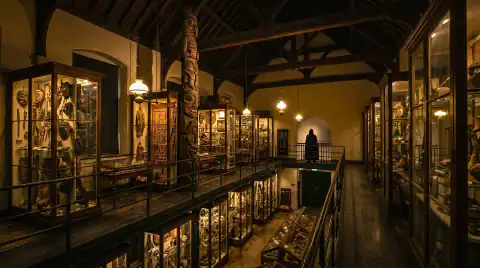 07Culture & historyPitt Rivers MuseumExplore experience →
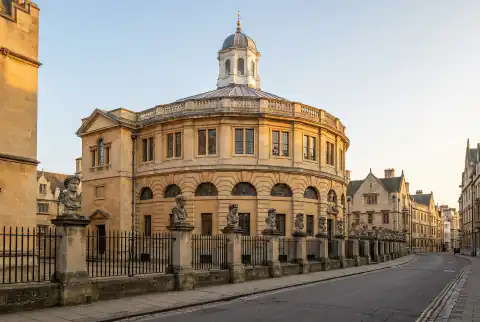 08Culture & historySheldonian TheatreExplore experience →
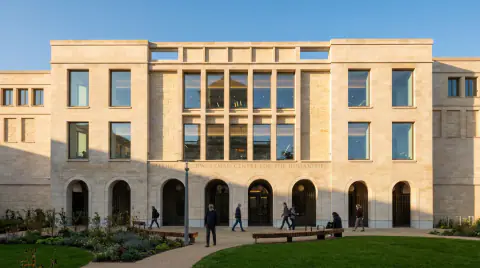 09Culture & historyStephen A. Schwarzman Centre for the HumanitiesExplore experience →
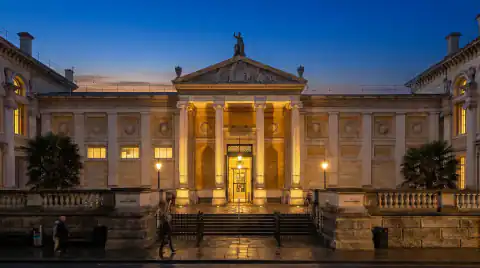 10Culture & historyThe Ashmolean MuseumExplore experience →
 11Culture & historyThe Radcliffe CameraExplore experience →
 12Culture & historyThe Weston LibraryExplore experience →
 13Culture & historyUniversity Church of St Mary the VirginExplore experience →
 14Food & drinkHead of the RiverExplore experience →
 15Food & drinkLe Manoir aux Quat’SaisonsExplore experience →
 16Food & drinkOxford Covered MarketExplore experience →
 17Food & drinkThe Bear InnExplore experience →
 18Food & drinkThe ChequersExplore experience →
 19Food & drinkThe Eagle and ChildExplore experience →
 20Food & drinkThe King’s ArmsExplore experience →
 21Food & drinkThe Lamb & FlagExplore experience →
 22Food & drinkThe PerchExplore experience →
 23Food & drinkThe Trout InnExplore experience →
 24Food & drinkThe Turf TavernExplore experience →
 25Food & drinkThe White HorseExplore experience →
 26Food & drinkWestgate OxfordExplore experience →
 27Walks & viewsThe Bridge of SighsExplore experience →
 28Parks & meadowsChrist Church MeadowExplore experience →
 29Parks & meadowsOxford Botanic GardenExplore experience →
 30Parks & meadowsPort MeadowExplore experience →
 31Parks & meadowsUniversity ParksExplore experience →
 32On the waterPunt the CherwellExplore experience →
 33On the waterSalter's SteamersExplore experience →
 43CollegesAll the collegesEvery Oxford collegeOpen the college guide →Food & drink / a storyThe nine oldest pubsWalk the timeline →
 Plan / Itinerary builderBuild your Oxford dayStart planning →