In depth
Bodleian Library guided tour
Medieval vaulting, historic reading rooms and the University’s former governing chambers. Compare the rooms included in each named tour.
Story · Visit · Route · Links
Visitor Essentials & Quick Answers
Can visitors go inside Duke Humfrey’s Library?
Yes. The Bodleian’s 30- and 60-minute guided tours visit Duke Humfrey’s, a working historic reading room. They also include the Divinity School when it is open; the routes have stairs and no lift.
What is the difference between the Divinity School and the library tour?
The Divinity School is the vaulted medieval room below Duke Humfrey’s Library; it contains no library shelves. A visit to that room alone will not give you the historic book-lined interior. Choose a tour including Duke Humfrey’s if that is the experience you have in mind.
Why is the Bodleian important beyond its beautiful rooms?
Thomas Bodley restored the neglected university library and reopened it in 1602. An agreement with the Stationers’ Company in 1610 helped establish its legal-deposit tradition. Those stories explain how rooms built for Oxford scholars became part of a library with a much wider role in preserving published knowledge.
Should I choose the shorter or longer library tour?
The shorter route suits visitors whose priority is Duke Humfrey’s and the Divinity School. The longer route adds Convocation House and Chancellor’s Court, giving more context about how the university governed itself. Neither should be assumed to include the Radcliffe Camera: choose by the named rooms, not just the tour’s duration.
Choose your depth
Essentials or more detail?
See visiting essentials, or read more about the history and places nearby.
01 The experience
What to expect.
Why it matters
Duke Humfrey’s bookshelves, the Divinity School’s carved vault and the Old Schools Quadrangle reveal different parts of university life: the Divinity School was built for teaching and disputation; Duke Humfrey’s Library was created above it for manuscripts; Thomas Bodley restored the derelict room and reopened it in 1602; the Schools Quadrangle gathered academic teaching around a formal court; and the legal-deposit agreement of 1610 helped turn a university library into a collection of national importance.
That layered identity explains why the visit feels different from a stately home or museum. Duke Humfrey’s remains a reading room. Tours enter around the needs of scholars, ceremonies and private events. Visitors share these buildings with a working university, so room access can change around its activities.
The 60-minute library tour gives the broadest introduction to the historic rooms. It joins four distinct rooms: the Divinity School, Convocation House, Chancellor’s Court and Duke Humfrey’s Library. The shorter 30-minute tour prioritises the two most visually immediate spaces, Duke Humfrey’s and the Divinity School when available. Both have stairs and an 11+ age rule.
Choose the right visit
There are four useful levels of access.
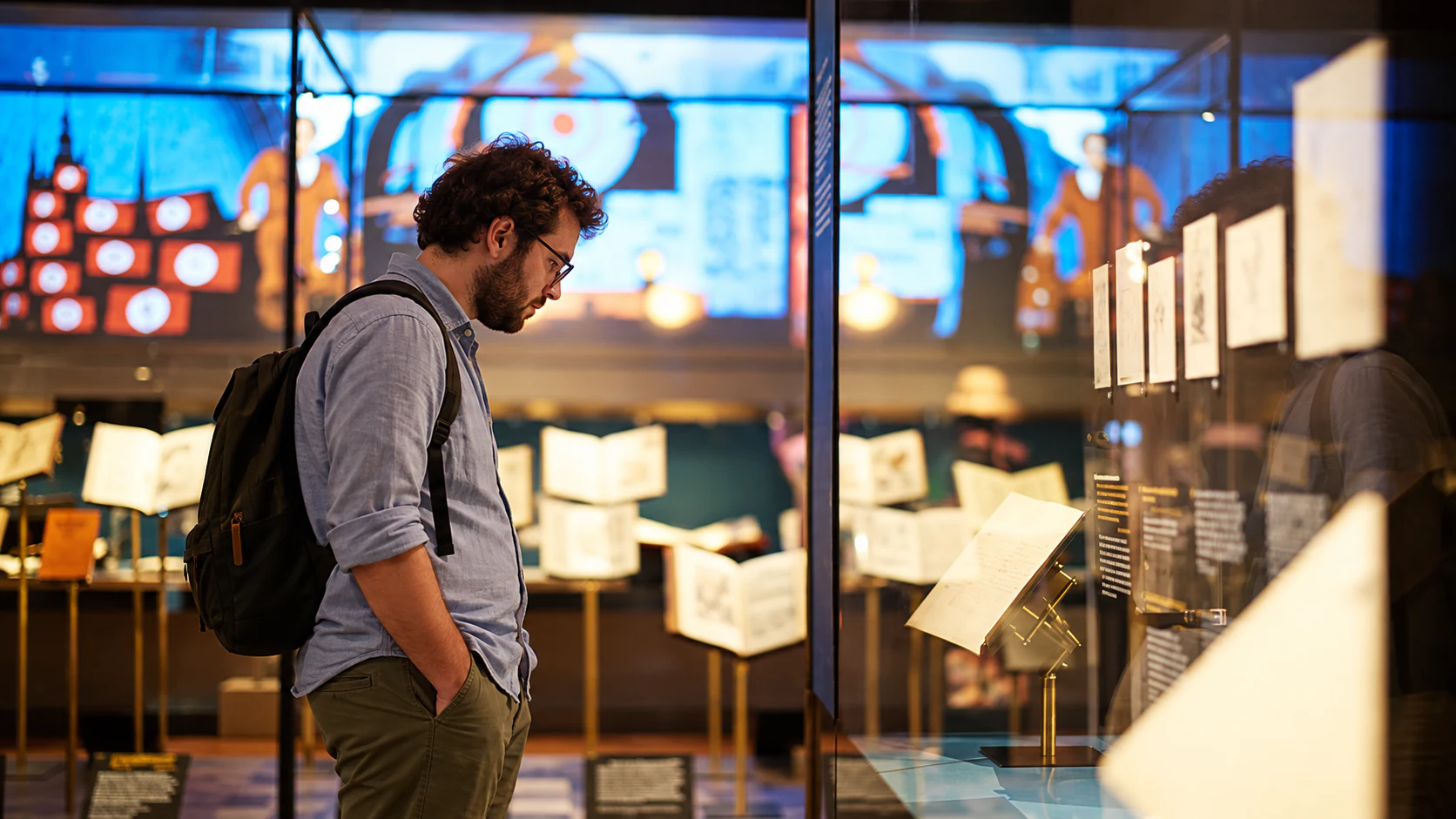
Free and flexible: begin at the Weston Library. Blackwell Hall, the exhibition galleries, café, shop and Space for Reading are public, step-free and free to enter. This is the best choice with young children, buggies, limited time or mobility requirements. Exhibitions rotate, so check what is on rather than assuming a particular manuscript will be displayed.
A quick historic interior: the Divinity School has a separate self-guided visit when available. It gives around 15 minutes beneath the late-medieval stone vault but does not include any room containing books. That distinction matters: a Divinity School ticket is not a library tour.
The essential library room: the 30-minute tour enters Duke Humfrey’s Library and normally includes the Divinity School when that room is open. It is the compact answer for visitors whose priority is the medieval reading room.
The fuller historical route: the 60-minute tour adds Convocation House and Chancellor’s Court. The additional rooms connect the library with the university’s government and courts.
The Radcliffe Camera is part of the Bodleian but is not included in the standard 30- or 60-minute routes described above. Access is offered through specific Radcliffe Camera and city walking tours or occasional specialist products. Book the named tour, not a generic “Bodleian tour”, if entering the Camera is essential.
What visitors should notice
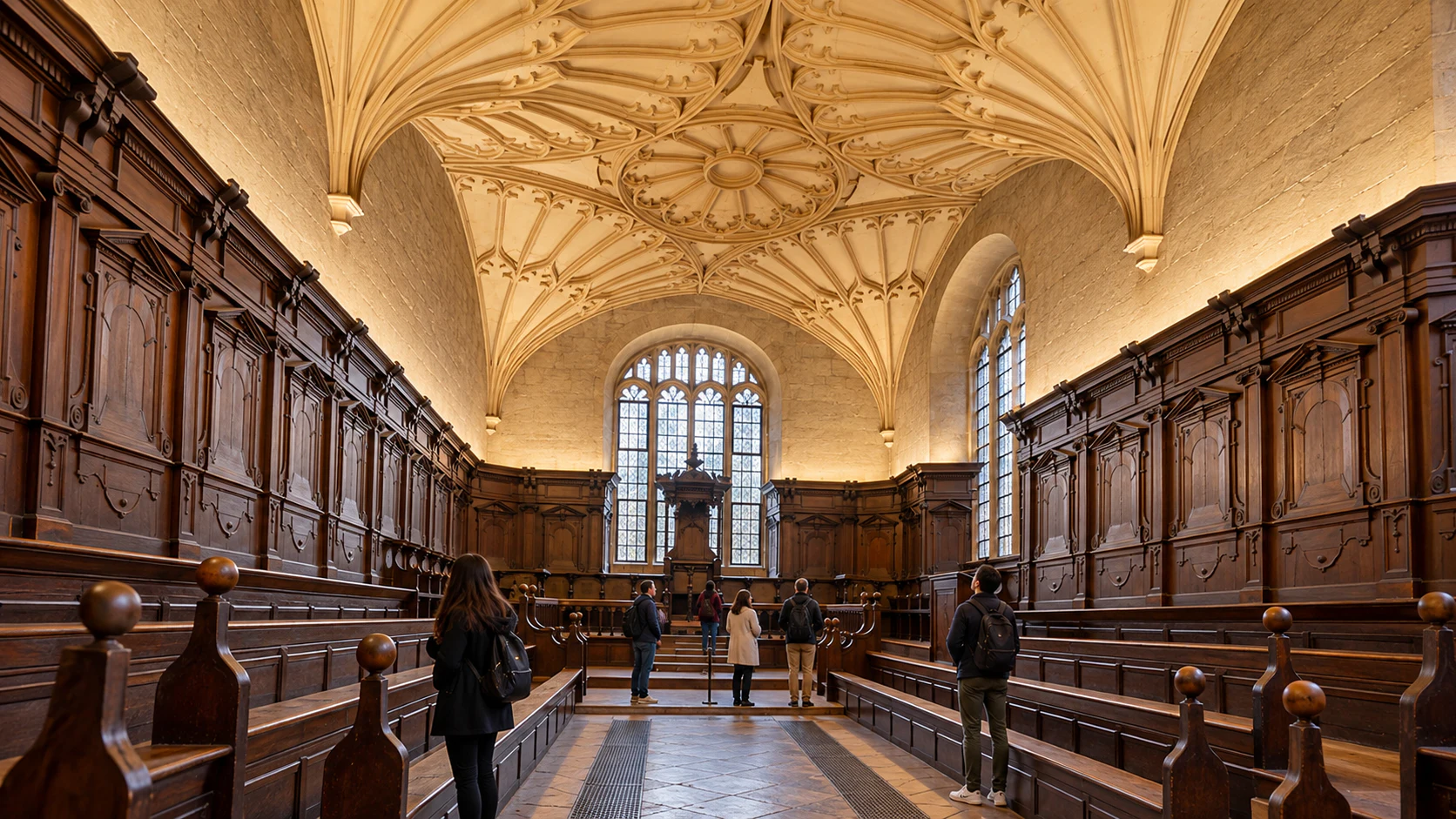
In the Divinity School, look closely at the lierne vault. More than 400 carved bosses and shields turn the ceiling into a record of donors, institutions and late-medieval craftsmanship. The room was made for spoken examination and debate, not worship; the ecclesiastical appearance can disguise its academic purpose.
In Duke Humfrey’s, notice the tension between intimacy and scale. The timber desks, bookcases, painted ceiling panels and filtered light create a room that feels enclosed, yet it represents a system designed to gather knowledge from far beyond Oxford. The books were historically chained, and Bodleian material is still consulted in reading rooms rather than borrowed in the ordinary public-library sense.
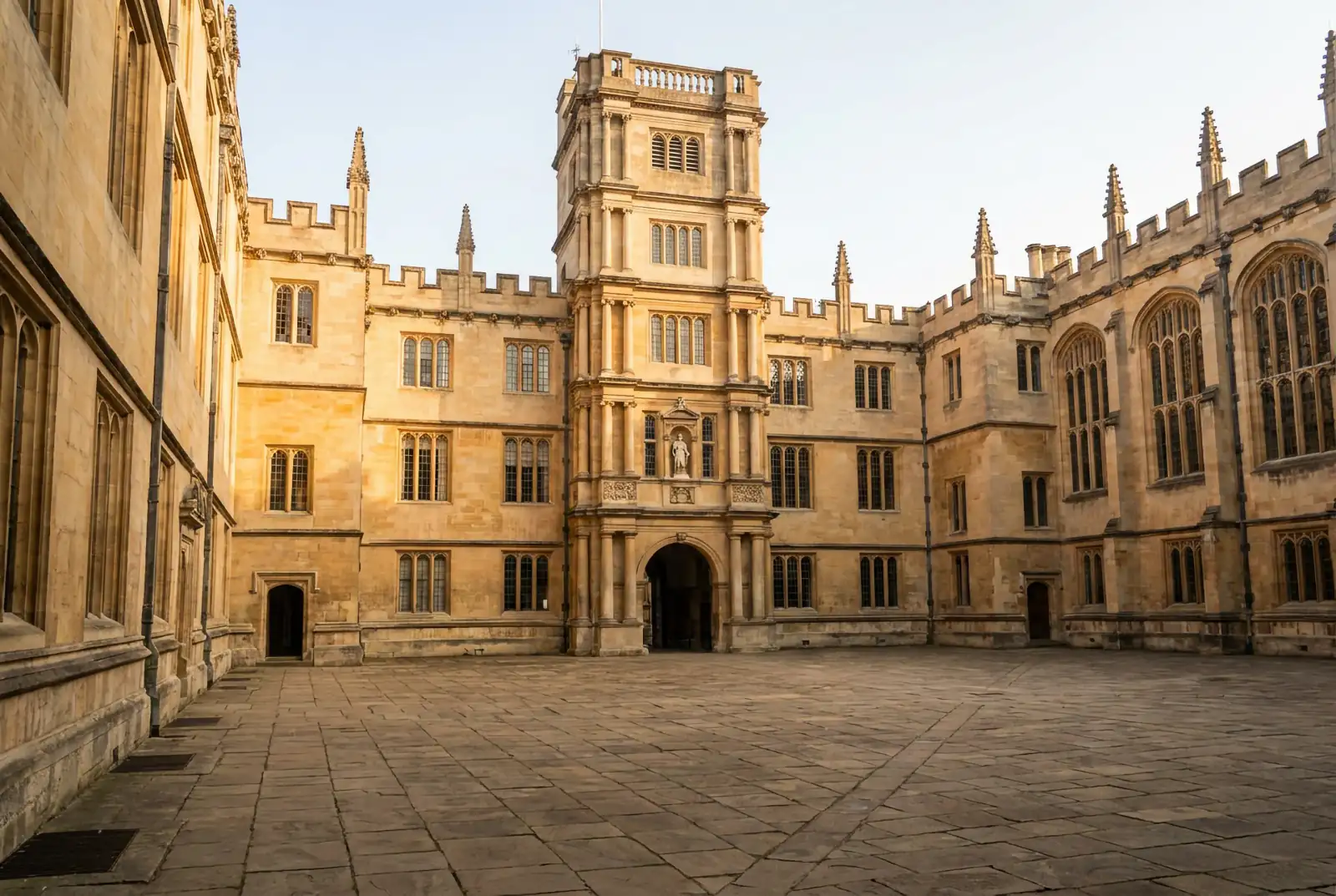
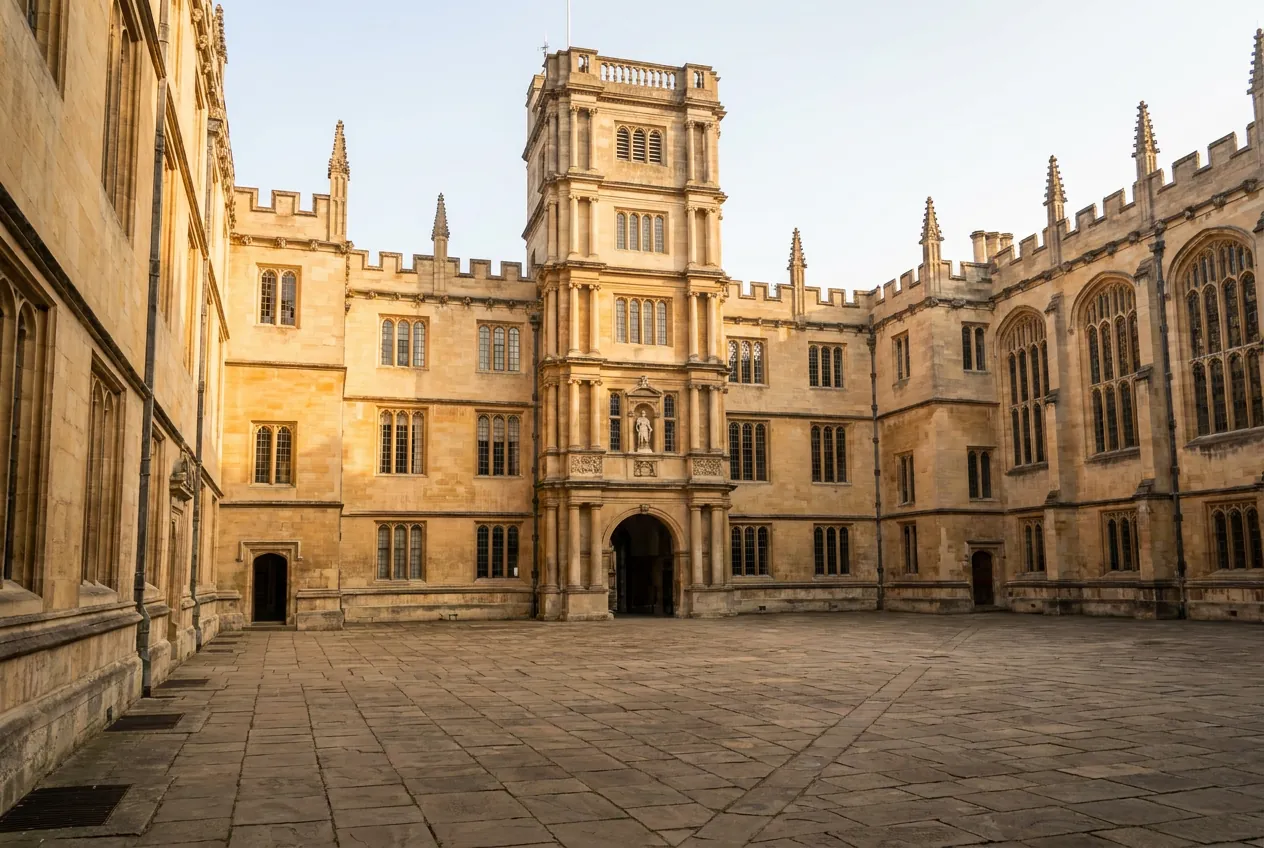
In the Schools Quadrangle, read the architecture as a diagram. Doorways once led to different academic schools; the Tower of the Five Orders displays classical architectural orders vertically. This is not merely an attractive courtyard but a purpose-built academic complex.
Who will enjoy it
The tour is particularly strong for visitors interested in books, architecture, university history, manuscripts, Harry Potter locations and the everyday reality behind Oxford’s collegiate image. The 60-minute route rewards people who want a connected historical story; the 30-minute route suits a tightly planned day.
Families with children under 11 should choose the Weston Library, exhibitions, family spaces or the Divinity School visit rather than a standard library tour. The official family programme also includes school-holiday activities and occasional children’s literature walks.
Who may find it difficult
Standard library tours involve stairs and Duke Humfrey’s has no lift. The Divinity School, Convocation House, Chancellor’s Court and Weston Library public areas have step-free routes, but the advertised 30- and 60-minute tours are not wheelchair-accessible in full. Contact the tours team before booking if access needs affect the route.
Visitors who dislike tightly timed, guided experiences may prefer the free Weston Library and a self-guided Divinity School ticket. Ceremonies, private events and library work can change the route.
Visitor verdict
Book the 60-minute tour if you want the best account of how Oxford governed, taught and stored knowledge; choose 30 minutes if Duke Humfrey’s is the priority; use the Divinity School ticket for a brief Gothic interior; and treat the Weston Library as the free, accessible public front door. Each ticket has a specific route, so compare the named rooms when choosing.
The story
History & character.
Before Bodley: Oxford’s first university libraries
Oxford’s first purpose-built university library was begun around 1320 in the University Church of St Mary the Virgin. The room survives, but by the fifteenth century a major gift demanded a larger home. Humfrey, Duke of Gloucester, younger brother of Henry V, gave the University more than 281 manuscripts, including important classical texts. A new library was built above the Divinity School, begun in 1478 and opened in 1488. That upper room became Duke Humfrey’s Library, now the oldest surviving part of the Bodleian.
The arrangement was characteristic of medieval Oxford. The lower room served teaching and examination; the upper room stored and made scholarship available. Historic England dates the Divinity School’s construction to 1424–1490, records Richard Winchcombe and Thomas Elkyn among its master masons, and attributes the fan vault of 1480–83 to William Orchard. The statutory listing describes the whole group as being of the highest importance at the centre of the University.
The first library did not survive the Reformation intact. In 1550 the Dean of Christ Church removed its books in a campaign against material judged superstitious; some were burnt. The impoverished University could not rebuild the collection, and in 1556 the abandoned room was taken over by the Faculty of Medicine.
Thomas Bodley and the reopening of 1602
Sir Thomas Bodley was a former Merton fellow and Elizabethan diplomat. In retirement he chose the ruined university library as his project. From 1598 the room was repaired and refitted, and a new collection of about 2,500 books assembled. Thomas James became librarian. On 8 November 1602 the restored library opened to scholars.
Bodley restored and endowed an existing medieval university library, giving it a new collection and a lasting financial foundation.
In 1610 Bodley reached an agreement with the Stationers’ Company that allowed the library to claim a copy of books published under royal licence. The arrangement anticipated statutory legal deposit and created a permanent problem of success: a collection entitled to keep receiving publications must keep finding space. The agreement established the first legal-deposit library in the British Isles; the privilege later entered legislation.
Arts End and the Schools Quadrangle
Bodley financed a westward extension in 1610–12, now known as Arts End. He also planned a quadrangle to replace what he called the “ruinous little rooms” in which university teaching took place. Work on the Schools Quadrangle began after his death in 1613. The structure was substantially complete by 1619, with work continuing to at least 1624. Its lower rooms were academic schools; the upper level provided additional book storage and housed a public museum and picture gallery.
The quadrangle’s famous Tower of the Five Orders makes architecture into teaching material. Superimposed classical orders climb the façade, turning the entrance into a display of architectural grammar. Within the court, the former school doorways preserve the memory of a university organised by disputation and faculty before modern departmental buildings existed.
Between 1634 and 1637 a further western extension created Selden End above Convocation House and Chancellor’s Court. It commemorates the lawyer John Selden, whose gift of 8,000 books enlarged the collection. Historic England dates the range to 1634–36 and identifies the rooms below: a reminder that library, university parliament and university court were physically stacked together.
No lending, even to a king
Bodleian books were not to leave the library. The most famous illustration came in 1645, when Charles I was refused permission to borrow a book. The story survives because it expresses an institutional rule rather than mere royal embarrassment: readers came to the collection; the collection did not circulate.
The romance of an old library can hide the discomfort of using it. The buildings had no heating until 1845 and no artificial lighting until 1929. In 1831 there were on average only three or four readers a day, with short seasonal opening windows. Duke Humfrey’s present atmosphere is the product of centuries of adaptation, not an unchanged medieval experience.
Convocation House, Chancellor’s Court and Civil War Oxford
Convocation House was built as a meeting place for Convocation and Congregation, the University’s governing bodies. Its importance extended beyond academic administration. During the English Civil War, while Charles I’s court occupied Oxford, Parliament met in the room on three occasions. The adjacent Chancellor’s Court heard university disciplinary matters.
These rooms make the 60-minute tour historically richer than a library-only visit. They show a university that governed people, enforced rules and became entangled in national politics. The books above were only one part of the complex.
Radcliffe’s library and the nineteenth-century Bodleian
Physician John Radcliffe left money to acquire land and establish a library. James Gibbs designed the monumental domed building in Radcliffe Square, built from 1737 to 1748 and opened in 1749. For more than a century it operated independently. In 1860 it was taken over by the Bodleian and renamed the Radcliffe Camera—camera here meaning “room”.
Meanwhile, collecting accelerated. By 1849 the Bodleian was estimated to contain 220,000 books and about 21,000 manuscripts. What had once been a mixture of library, teaching rooms and displays gradually became library space: by 1859 the whole Schools Quadrangle was in Bodleian use.
The historic core was repeatedly restored. Historic England records work in Headington stone in 1660 and repairs in 1701–02, followed by extensive nineteenth-century restoration in Clipsham stone, especially between 1878 and 1885. The Old Library is therefore historically layered fabric, not a building frozen at a single completion date.
Underground expansion and the New Bodleian
The collection reached one million books by 1914. Between 1909 and 1912, an underground store was excavated beneath Radcliffe Square; the Bodleian calls it the largest such store in the world at the time. A conveyor system later connected the historic rooms and stores, making the postcard square part of an unseen logistics network.
In 1931 the University decided to build a New Bodleian on Broad Street. Sir Giles Gilbert Scott designed a structure intended to accommodate five million books as well as staff and reading rooms. Construction took place from 1937 to 1940. Its sober mass facing the Clarendon Building belongs to the modern story of collection growth, even though visitors often concentrate on the medieval and Jacobean interiors.
The Clarendon Building, originally created for the University Press in 1712–13, came into Bodleian use in 1975. By then the linked library territory extended from Radcliffe Camera through the historic core to Broad Street.
Weston Library and the public Bodleian
The New Bodleian underwent a major transformation and reopened as the Weston Library in 2015. The project created modern storage and research facilities while giving the library a much clearer public face: Blackwell Hall, exhibition galleries, a café, shop and public events.
This changed how a visitor should understand the site. The Old Library is the controlled historic core; the Weston is the free public threshold where collections can be displayed and interpreted. They are not competitors. One preserves the atmosphere and continuing work of historic rooms; the other allows broad public access without pretending that a working research library can operate like an unrestricted museum.
The Bodleian today
“The Bodleian” can mean the principal university library, its historic buildings, or the wider group of Bodleian Libraries. The group holds more than thirteen million printed items and is Britain’s largest library after the British Library. The visitor route shows only a minute fraction of that system.
Collection growth has shaped every period of its history. The institution has repeatedly solved the same problem: how to preserve and make available an expanding record of knowledge. Duke Humfrey’s, Arts End, Selden End, the Radcliffe Camera, underground stores, the New Bodleian and the Weston transformation are successive answers.
Myths and useful corrections
The Bodleian was not founded from nothing in 1602; it reopened a medieval university library. The Divinity School is not a chapel, despite its vault. The Radcliffe Camera is not automatically included in every Bodleian tour. A Divinity School ticket does not enter a room containing books. And the famous no-lending rule should not be confused with the experience of ordinary public-library borrowing: this is a legal-deposit research collection whose materials are consulted under controlled conditions.
Look closer
Highlights and hidden details.
Duke Humfrey’s Library
The oldest reading room in the Bodleian is the reason most visitors book. Its fifteenth-century core, timber fittings, painted ceiling panels and long view through the bookcases create the interior people imagine when they hear “Oxford library”. It is still a working reading room, which is why access is guided and behaviour controlled. Follow the guide’s instructions around readers and historic furniture.
The Divinity School vault
Built between 1424 and 1488, the Divinity School was Oxford’s first purpose-built teaching and examination room. William Orchard’s extraordinary late-medieval vault contains more than 400 carved bosses, shields and images. The room’s Harry Potter association is immediately recognisable, but its real distinction is institutional: generations of scholars disputed beneath a ceiling whose donors and affiliations were literally carved above them.
Convocation House
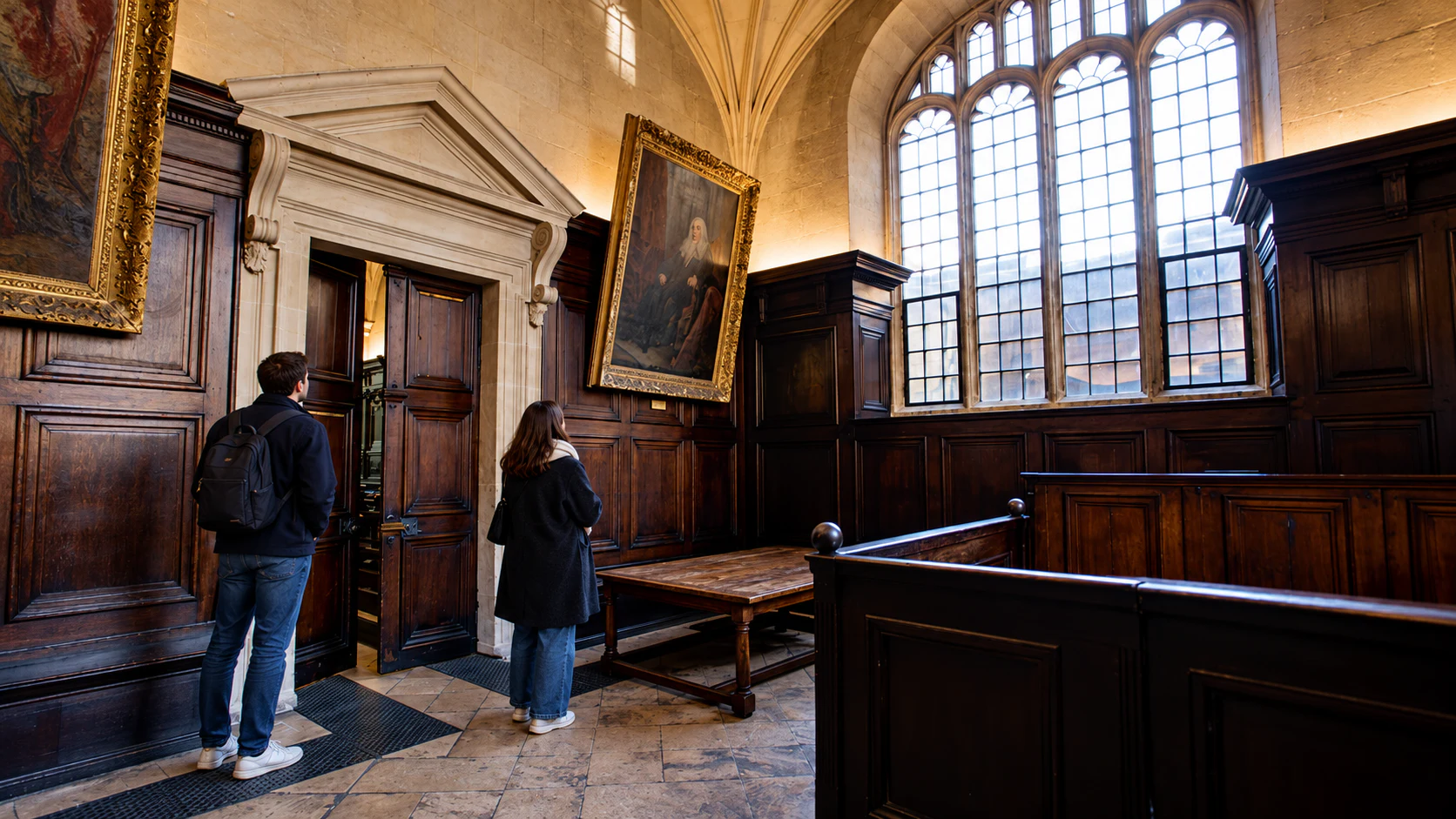
The 60-minute route enters this seventeenth-century university assembly room. Its fan vault consciously continues a medieval visual language even though the institution using it was moving into a new political age. Convocation and Congregation met here for more than 300 years, and Charles I’s Parliament used it during the Civil War.
Chancellor’s Court
Smaller and more austere than the showpiece rooms, Chancellor’s Court turns university governance into a human story. Students once faced the University’s own jurisdiction here. The room helps explain Oxford as a corporation with courts, rules and disciplinary power—not only a collection of colleges and libraries.
Old Schools Quadrangle
The quadrangle is generally the easiest historic Bodleian space to see without a tour when its gates are open. Built principally from 1613 to 1624, it once organised academic schools around a single court. Look for the former school labels and the way the upper floors absorbed expanding library functions.
Tower of the Five Orders
The Catte Street tower stacks the five classical architectural orders into a vertical lesson. It is both entrance and emblem: a scholarly building displaying architectural knowledge on its own façade. From inside the quadrangle, the tower also provides the strongest overall composition of court, sculpture and skyline.
The Proscholium
This vaulted entrance space behind the Divinity School is where standard tours assemble. It is easy to rush through while checking a ticket, but it is the hinge between public quadrangle and controlled library route. Arrive early enough to notice the stonework and the transition from city movement to institutional quiet.
Selden End
The western extension of 1634–37 commemorates John Selden, whose gift of 8,000 books helped expand the library. It makes a useful interpretive endpoint: the Bodleian’s architecture repeatedly grew in response to gifts, privileges and the practical pressure of books.
Weston Library exhibitions
The free galleries are where visitors can encounter the collection rather than only its historic container. Displays change, drawing on manuscripts, printed books, maps, archives and visual material. Exhibitions rotate, so use the current programme to see which books, manuscripts and objects will be on display.
The hidden connected campus
From the Old Library, Radcliffe Camera, Clarendon Building and Weston Library, the Bodleian occupies a linked historic zone rather than one monument. Above ground it reads as separate landmarks; below and behind the scenes it operates as a library system. Walk the perimeter after the tour to understand that urban scale.

Details to look for.
The Divinity School is an academic room, not a chapel
Its stone vault and church-like proportions encourage the wrong assumption. The room was designed for theology lectures, oral disputations and examinations. Reading it as a working room for argument changes the meaning of the benches and pulpits beneath the decorative ceiling.
The ceiling records patronage
The Divinity School’s hundreds of bosses are not generic Gothic decoration. Arms and devices acknowledge donors and institutions whose money made the long construction possible. The ceiling therefore records how a medieval university funded ambition: one carved contribution at a time.
Duke Humfrey’s is older than “the Bodleian” name
The library room opened in 1488. Thomas Bodley restored and reopened it in 1602, more than a century later. Calling the whole room a seventeenth-century creation erases the medieval library Bodley rescued.
The empty medieval shelves tell a Reformation story
Humfrey’s manuscripts did not simply grow into the modern collection. The sixteenth-century purge removed the books, some for burning, and the room lost its library function. The Bodleian’s foundation narrative therefore includes destruction and recovery, not seamless continuity.
A reading booth was made for Charles I
Duke Humfrey’s includes a special reading booth associated with King Charles I. The same king later appears in the library’s most repeated rule story—refused permission to borrow a book in 1645. Together, the details capture the Bodleian’s balance of ceremonial respect and institutional independence.
The no-lending rule shaped the furniture
Historically chained books and controlled consultation explain why this library feels unlike a circulating collection. Readers worked where the books were kept. The desks, shelves and oversight were part of a system for use without removal.
The quadrangle was once a map of subjects
The rooms around the Old Schools Quadrangle were academic schools before the library absorbed them. Doorways and inscriptions make the court legible as an earlier university plan, with disciplines arranged around shared space. By 1859 the entire quadrangle had become library territory.
The Tower of the Five Orders is a stone diagram
Its architectural orders rise one above another. Visitors often treat the tower as an ornate gateway, but the ordered façade is also an educational display appropriate to a court originally built for teaching.
Selden End sits above government and law
The library extension is physically above Convocation House and Chancellor’s Court. Books, legislation and discipline occupy one structural stack. The arrangement makes the 60-minute tour a compact lesson in how Oxford’s academic authority worked.
The postcard square hides book logistics
Between 1909 and 1912, storage was excavated beneath Radcliffe Square. Visitors see a coherent historic surface of stone and dome; underneath, the library had to engineer movement and storage for a rapidly expanding collection.
Darkness is historically authentic—but not timeless
Duke Humfrey’s had no artificial lighting until 1929 and no heating until 1845. Its atmospheric gloom is partly architectural and partly the legacy of a room created before modern environmental comfort.
The Weston is the former New Bodleian
The modern public hall on Broad Street occupies Sir Giles Gilbert Scott’s 1937–40 New Bodleian, transformed and reopened in 2015. It is not a detached visitor centre but the latest major stage in the same long expansion.
Harry Potter used real academic architecture
The Divinity School’s screen fame works because the film location was already visually persuasive. It represented Hogwarts’ infirmary, while Duke Humfrey’s served as a library location. Their medieval architecture provided the setting for the fictional school.
Make it work
Plan your visit.
The practical answer
Start by deciding which room you actually want to see. The Weston Library is free. A separate Divinity School visit is short and does not include library rooms. The 30-minute guided tour enters Duke Humfrey’s Library and normally the Divinity School. The 60-minute tour adds Convocation House and Chancellor’s Court. The Radcliffe Camera requires a specifically named tour rather than either standard route.
Public visitor hours are normally Monday–Friday 09:00–17:00 and Saturday–Sunday 10:00–17:00, but room closures and tour availability vary around ceremonies and events. Use the closure list and ticket calendar for your visit date.
Ticket choices
Weston Library: free, no ticket required for Blackwell Hall and the public exhibition galleries. This is also the practical place for tour tickets, maps, café, shop, toilets and a pause between sights.
Divinity School self-guided visit: around 15 minutes. Guide prices are £3 standard admission and £11.75 for a family ticket, plus a transaction fee; carer and under-five tickets are free. It does not include any library room.
30-minute library tour: daily, age 11+, from £12.50 per person. It includes Duke Humfrey’s Library and the Divinity School when the latter is open. Up to half of tickets are released online in advance; the remainder follow different same-day arrangements in peak and off-peak periods.
60-minute library tour: daily, age 11+, from £17.50 per person. It includes the Divinity School, Convocation House, Chancellor’s Court and Duke Humfrey’s Library. Tickets are released online in advance.
The ticket page gives the price, named rooms and release dates for each visit.
Booking strategy
Book the 60-minute route in advance when it is central to your day. The 30-minute tour keeps a meaningful same-day allocation, but popular times sell out, especially in summer and at weekends. Official advance batches are released at 09:00 UK time on the first and fifteenth of each month for defined date ranges. Check the current release table because those ranges can change.
Arrive early enough to find the correct entrance and store bags if asked. Guided tours meet in the Proscholium, the entrance to the Divinity School, through the glass doors behind the statue in the Old Schools Quadrangle. Pre-booked ticket holders can go directly to the Great Gate on Catte Street rather than starting at the Weston Library.
How long to allow
Allow 45–55 minutes around a 30-minute tour and 75–90 minutes around a 60-minute tour. The extra time covers finding the entrance, ticket checks, bags and a few minutes in the quadrangle. Add another 30–60 minutes for Weston exhibitions, depending on the programme.
For a free exterior-and-exhibition visit, allow 45 minutes: Broad Street and the Weston, the Old Schools Quadrangle, Catte Street and Radcliffe Square. For a serious collection-led visit, check the current Weston exhibitions and give them at least an hour.
Best time to visit
The first tours of the day reduce the risk that a tightly packed Oxford itinerary slips. They also pair well with a quieter circuit of Radcliffe Square and New College Lane. Late afternoon can be atmospheric, but there is less recovery time if a room closes or tickets have sold out.
Oxford’s academic calendar matters less than the published closure list. University ceremonies, private hire and operational needs can alter access on apparently ordinary dates. Check again within 24 hours of travel.
Getting there
The Old Library entrance is on Catte Street, OX1 3BG. The Weston Library entrance is on Broad Street at the same postcode. Oxford station is approximately one mile away, usually a 15–20 minute walk. Central bus and coach stops are closer. The Bodleian recommends public transport or Park and Ride; central parking is extremely limited.
Cycle racks are available around Parks Road, Catte Street and Broad Street, but cycles are not a practical way to move between the adjacent visitor buildings. Walk once you reach the historic centre.
Facilities
The Weston Library is the facilities base. It has a café serving hot and cold food, public galleries, shops, Space for Reading, accessible toilets and baby changing. Food and drink are not allowed in exhibition galleries. The Old Schools Quadrangle has a shop, but visitors should not expect museum-style facilities inside the historic tour route.
Secure lockers may be required for bags on tours. Travel light. Large luggage is a poor fit for the historic site, and the library’s no-unattended-bags rule applies across public spaces.
Photography
Personal, non-commercial photography is generally permitted in visitor spaces, without flash, tripods, selfie sticks or video. Do not photograph readers or staff. Photography is prohibited inside the Radcliffe Camera. Filming requires prior permission. A guide may give room-specific instructions, and those instructions take precedence.
Families
Standard 30- and 60-minute tours are for children aged 11 and over; under-16s must be accompanied. Children of all ages can visit the Divinity School, and the Weston’s ground-floor public spaces welcome buggies. Very large double buggies may be restricted in narrow exhibition layouts. The Toddleian, Space for Reading, café and changing facilities make the Weston a much better base for younger children than a historic-room tour.
Accessibility
The Weston Library public areas and Divinity School have step-free access. Convocation House and Chancellor’s Court are also wheelchair-accessible, but standard library tours include Duke Humfrey’s Library, reached only by stairs; there is no lift. Contact tours@bodleian.ox.ac.uk before booking so the team can explain what route is feasible. Assistance dogs are welcome.
Weather and clothing
Most of the paid experience is indoors, making it a strong wet-weather choice. The buildings can feel cool, and visitors move between exposed streets and controlled interiors, so layers are useful. Comfortable shoes matter because of stone floors and stairs. Umbrellas should be closed and managed carefully around other visitors and library fabric.
What not to assume
- A ticket called “Divinity School” does not include Duke Humfrey’s Library.
- A standard Bodleian tour does not necessarily include the Radcliffe Camera.
- A tour advertised daily is not immune to closures.
- The free Weston Library is not merely a ticket office; its exhibitions are a substantial visit.
- Harry Potter recognition is part of the appeal, but the rooms’ academic history is the more important story.
Recheck before travel
Check the official plan-your-visit page for closures, the specific tour page for route and age rules, and the ticket portal for the price and time. Room access and schedules can change around university events.

Visit your way
Access and family planning.
The essential limitation
Duke Humfrey’s Library can only be reached by stairs and there is no lift. Because the standard 30- and 60-minute tours include Duke Humfrey’s, neither standard route is wheelchair-accessible in full. Contact tours@bodleian.ox.ac.uk before buying a ticket if stairs are not possible.
Step-free spaces
The Weston Library’s public areas are step-free. The Broad Street entrance has a broad integrated stone ramp and automatic doors into Blackwell Hall. Exhibition galleries, café, shop, Space for Reading and ground-floor accessible toilets can be used without joining a historic-room tour.
The Divinity School has step-free access. Convocation House and Chancellor’s Court are also identified by the Bodleian as wheelchair-accessible, but standard tour products continue to include the inaccessible upper library. Ask the tours team what alternative or adapted access can actually be offered on your date rather than inferring that a listed accessible room guarantees an accessible booking.
Old Library approach
The Access Guide recommends the Great Gate on Catte Street for level access to the Old Schools Quadrangle and Old Library public threshold. From the Proscholium there is ramped access to the Divinity School. Historic paving around the quadrangle can be uneven, and drainage channels may affect wheelchair movement.
Assistance dogs
Guide and assistance dogs are welcome on tours; other dogs and animals are not. If a route modification might be needed, advise the team in advance.
Seating and stamina
The 30-minute tour is the shorter standing and stair-based option. The 60-minute route involves more movement through several rooms. Do not assume regular seating or the ability to pause independently within a guided group. Visitors who need frequent rests should discuss the route with the tours office.
The Weston Library is the better low-stamina visit because Blackwell Hall and the café offer opportunities to sit and the galleries can be left at any time.
Visual access
Large-print object information is available in booklets inside Weston exhibition galleries, and audiovisual content in Blackwell Hall and exhibitions is subtitled. The Bodleian also publishes an easy-read visual story for the Weston Library.
Historic rooms can have low, variable light to protect collections and preserve reading conditions. Visitors with low vision should ask whether the guide can position them near key features and should not rely on flash photography, which is prohibited.
Hearing and communication
Tours are delivered in English. Historic stone rooms can produce reverberation while the working library requires controlled volume. Contact the tours team in advance about hearing or communication requirements and ask what support is available for the booked product. Do not assume a loop or transcript unless confirmed.
Toilets and changing
Accessible toilets and baby-changing facilities are on the ground floor of the Weston Library. Plan to use these before crossing to the Old Library tour meeting point.
Neurodiversity and sensory conditions
The Weston Library offers the most controllable visit: visitors can choose their own pace, use Blackwell Hall as an orientation space and leave exhibitions when needed. Guided tours are timed, group-based and quiet. Duke Humfrey’s may feel dim and constrained; the Divinity School and quadrangle can become noisy when multiple groups overlap.
Use the Bodleian’s visual story before travel and contact the team if queueing, group size or an emergency exit from the route is a concern.
Best choice by age
For children under 11, build the visit around the Weston Library and, if useful, the separate Divinity School ticket. Standard 30- and 60-minute library tours have an 11+ minimum age, and under-16s must be accompanied by an adult. Children of all ages can enter the Divinity School when its separate visitor admission is operating.
For ages 11–15 who like books, architecture, university stories or Harry Potter, the 30-minute tour is often the better first choice. It reaches Duke Humfrey’s without asking for a full hour of quiet attention. The 60-minute tour works for historically curious teenagers who will enjoy Civil War and university-court material as much as the famous library room.
Weston Library with younger children
The Weston is unusually practical for an Oxford historic-core stop. Its public ground floor is step-free and buggy-friendly, with accessible toilets, baby changing, café, shop and free exhibitions. The Toddleian provides a soft mat, low furniture, books and toys for babies and toddlers. Space for Reading offers books for adults and children with a changing theme.
The exhibitions are object-led and can be done selectively. Pick one display case or story rather than trying to read every label. Because exhibitions rotate, check the current programme and use its theme as the hook for the visit.
Buggies and bags
Buggies are welcome in Blackwell Hall, galleries, café and shop. Very large double buggies may be excluded from galleries when narrow routes or crowds make them unsafe. Standard library tours include stairs and have no lift, so do not assume a folded buggy solves the access problem.
Travel light. Tours may require bags to be placed in secure lockers, and managing belongings during a timed departure adds avoidable friction.
Keeping the history alive
Give children three things to find:
- A shield or animal among the Divinity School bosses.
- The difference between a room for arguing and a room for reading.
- The reason a king could be allowed a special desk but still refused permission to borrow a book.
Those questions connect decoration, function and institutional rules without turning the tour into a film-location checklist.
Harry Potter expectations
The Divinity School is recognisable as the Hogwarts infirmary setting, and Duke Humfrey’s as a library location. Explain beforehand that visitors are entering working and protected rooms, not a studio set. There may be no time for posed photographs, video is prohibited and readers or staff must not be photographed.
Food and breaks
Use the Bodleian Café in Blackwell Hall before or after the historic rooms. It serves hot and cold food and has received the Kids in Museums Family Café Standard. Food and drink, including bottled water, are not permitted in the exhibition galleries.
Honest friction points
The historic tours require quiet listening, stairs and staying with a group. There is little freedom to leave and rejoin. Children who need movement or frequent breaks will have a better experience in the Weston. The Old Library atmosphere is powerful, but a working reading room is less forgiving than a conventional family museum.
A simple 75-minute family plan
Spend 20 minutes in a Weston exhibition, 10 minutes in Space for Reading or the Toddleian, pause at the café, then walk across Broad Street and Catte Street to see the Old Schools Quadrangle. Add the 15-minute Divinity School visit only if its time and the family’s energy fit. This gives the Bodleian story without forcing a standard tour designed for older visitors.
Self-guided walk
Explore beyond the venue.
A practical, step-by-step route connecting this experience with more of Oxford.Weston Library, Broad Street · 15–30 minutes
Enter Blackwell Hall from Broad Street. Use the free galleries to see what the Bodleian preserves rather than only admiring where it stores books. Check the current exhibition before visiting; displays rotate. The café, toilets, shop and Space for Reading make this the place to prepare for the historic core.
The Weston colonnade · 3 minutes
Step back onto Broad Street and look at the building as the transformed 1937–40 New Bodleian. Sir Giles Gilbert Scott’s exterior belongs to the library’s twentieth-century storage crisis; its reopening as the Weston in 2015 created the public front door you have just used.
Clarendon Building and Broad Street axis · 4 minutes
Walk east with the Clarendon Building ahead. Built for the University Press in 1712–13, it came into Bodleian use in 1975. From here, the Weston, Clarendon and Old Library read as an institutional sequence rather than isolated monuments.
Sheldonian edge · 3 minutes
Pause where Broad Street opens around the Sheldonian Theatre. Wren’s ceremonial building and the library complex face each other across a space shaped by university functions. Keep to the pedestrian route and watch for cycles.
Great Gate, Catte Street · 5 minutes
Turn south into Catte Street and find the Bodleian’s Great Gate beneath the Tower of the Five Orders. The stacked classical orders make the façade a visual lesson. This is also the recommended level approach to the Old Schools Quadrangle and the direct entrance for pre-booked tour holders.
Old Schools Quadrangle · 10 minutes
Enter when the gate is open. Read the court as a former set of academic schools, built principally between 1613 and 1624 and later absorbed by the expanding library. Locate the central statue, former school doorways and the upper library ranges. Do not block tour assembly points.
Proscholium and Divinity School threshold · 5 minutes
At the western side, identify the Proscholium behind the statue. Standard tours meet here. If you hold a separate timed Divinity School ticket, enter as directed; otherwise respect the controlled threshold. The Divinity School below and Duke Humfrey’s above are the medieval core around which the Bodleian grew.
New College Lane and Bridge of Sighs · 5 minutes
Leave by Catte Street and turn east briefly into New College Lane. Hertford Bridge crosses the road almost immediately. The detour adds Oxford’s tight college-street texture and a clear contrast with the formal quadrangle.
Radcliffe Square · 10 minutes
Return along Catte Street and enter Radcliffe Square. Circle the Radcliffe Camera exterior. Opened as an independent library in 1749 and absorbed by the Bodleian in 1860, it represents eighteenth-century expansion. Remember that standard Bodleian tours do not automatically enter it.
University Church finish · 5 minutes
End at St Mary the Virgin on the south side of the square. Oxford’s first purpose-built university library began here around 1320, before Duke Humfrey’s superseded it. The route therefore ends at the Bodleian’s institutional beginning. Add the tower only if its opening, queue and stair climb fit your day.
Optional coffee stop
Use the Bodleian Café before leaving the Weston or walk six minutes to the Covered Market after Radcliffe Square. The first is efficient; the second gives more choice and a change of atmosphere.
Optional interiors
Duke Humfrey’s, Convocation House, Chancellor’s Court and the Radcliffe Camera require the relevant guided tour. This self-guided walk stays in public spaces.

Make a record
Photograph it thoughtfully.
The rules first
Personal, non-commercial photography is generally allowed in visitor spaces, but flash, tripods, selfie sticks and video are prohibited. Do not photograph readers or staff. Photography is not allowed inside the Radcliffe Camera. Commercial photography and any filming require prior permission. Follow the guide’s room-specific instructions even when the general policy would otherwise permit a photograph.
Old Schools Quadrangle
The strongest overall view is from the western side looking towards the Tower of the Five Orders. Keep verticals straight and leave enough foreground to show the court as a place, not just the tower as a façade. Early morning gives cleaner paving and fewer groups; overcast light suits the pale stone.
Try a second frame from beneath one of the arcades. A dark edge or arch can make the central court feel more enclosed and emphasise the transition from public street to academic precinct.
Divinity School
The ceiling is the subject. Stand close to the centre line and use a wide lens sparingly so the ribs remain credible rather than bending dramatically. Include benches or a figure at the bottom of the frame for scale when permitted.
Details of bosses and shields work better than repeated full-room views. The carvings are high, so stabilise through posture rather than a tripod. Do not use flash; allow the stone’s natural tonal range.
Duke Humfrey’s Library
Expect limited time and working-library etiquette. Compose before raising the camera. A view along the central axis captures rhythm, while a diagonal across a desk and shelf gives a better sense of reading-room intimacy. Avoid photographing people at work, and accept that the protected light level is part of the room rather than a problem to overpower.
Broad Street and the Weston Library
The Weston’s colonnade is strongest with pedestrians providing scale. From Broad Street, include the Clarendon Building or Sheldonian edge to show the modern public library within the historic group. Inside Blackwell Hall, use the height and open public character as a deliberate contrast with Duke Humfrey’s enclosure.
Best light
Morning suits the Catte Street gateway and quieter quadrangle. Late light can warm Broad Street and the exterior stone, though the narrow historic streets create sharp contrasts. Interiors depend on available light and operational conditions rather than golden hour.
Etiquette
This is a working library. A permitted image is not permission to delay a group, lean on furniture, cross barriers or stage another visitor. Keep shutters and phone sounds unobtrusive. Never move books or objects for a composition.
Drone and commercial work
Do not propose drone photography over the historic core as an ordinary visitor activity. Central Oxford airspace, crowds, property rights and University permissions make it a specialist operation. Commercial stills and all filming must be arranged with the Bodleian in advance through its events or imaging contacts.
See it
In pictures.
12 views, full screen. Tap any one to open the viewer.Around here
Make more of the area.
Good to know
Questions, answered.
Can tourists visit the Bodleian Library (Oxford)?
Yes. Bodleian Library guided tours in Oxford visit historic Old Library spaces including Duke Humfrey’s Library. The Weston Library’s public areas and exhibitions are free to enter. Bodleian visitor information
How much does a Bodleian Library tour cost?
The 30-minute tour costs from £12.50 per person and the 60-minute tour from £17.50 per person. 30-minute tour 60-minute tour
What is the difference between the 30- and 60-minute Bodleian (Oxford) tours?
Both the 30- and 60-minute Bodleian Library tours in Oxford visit Duke Humfrey’s Library and normally the Divinity School. The 60-minute route also includes Convocation House and Chancellor’s Court. Room closures can affect the tour. 30-minute tour 60-minute tour
Does a Bodleian Library tour include the Radcliffe Camera?
The standard 30- and 60-minute library tours do not enter the Radcliffe Camera. The Radcliffe Camera and City of Oxford Walking Tour includes the reading room and costs £30 per person. 30-minute tour 60-minute tour Radcliffe Camera walking tour
Can I visit the Divinity School without taking a library tour?
Yes. A separate self-guided Divinity School visit is available when the room is open. It does not include the historic library reading rooms. Divinity School visit
Do Bodleian Library tours need to be booked in advance?
The 60-minute tour is released online in advance. About half the 30-minute tour tickets are reserved for sale on the day; these can sell out quickly, especially at busy times. 30-minute tour 60-minute tour
Where do Bodleian Library tours start?
The 30- and 60-minute tours meet in the Proscholium, at the entrance to the Divinity School in the Old Library. 30-minute tour 60-minute tour
Can children join a Bodleian Library tour?
Children must be at least 11 for the standard 30- and 60-minute library tours and must be accompanied by an adult. The Weston Library’s public exhibitions welcome younger children. 30-minute tour 60-minute tour Family visits
Are Bodleian Library tours wheelchair accessible?
The standard library tours include stairs and there is no lift to Duke Humfrey’s Library. The Divinity School and Weston Library’s public spaces have step-free access. 30-minute tour Accessibility
Was Harry Potter filmed at the Bodleian Library (Oxford)?
Yes. The Divinity School and Duke Humfrey’s Library at the Bodleian Library in Oxford were used as Harry Potter filming locations. Duke Humfrey’s remains a working reading room and is visited on a guided tour. Experience Oxfordshire guide Bodleian spaces
When did the Bodleian Library (Oxford) open?
At the Bodleian Library in Oxford, Duke Humfrey’s medieval library opened in 1488. Sir Thomas Bodley restored the University library and reopened it in 1602. History of the Bodleian
Is there a café at the Bodleian Library?
The Bodleian Café is in Blackwell Hall at the Weston Library, which also has free public exhibitions. Café and shops
Editorial notes
Sources and further reading.
Sources for this guide
Research verified on 1 September 2026. Operational details need monthly review; historical and statutory sources need annual review.
S01 — Bodleian Libraries: Plan your visit
URL: https://visit.bodleian.ox.ac.uk/plan-your-visit/
Authority: Official visitor website, Bodleian Libraries, University of Oxford.
Supports: Overall public opening pattern; Weston Library free entry; ticket requirement for Old Library and Radcliffe Camera; Weston facilities; closure warnings; visitor photography rules; public starting point.
S02 — Bodleian Libraries: 30-minute library guided tour
URL: https://visit.bodleian.ox.ac.uk/tours/30-minute-library-guided-tour
Authority: Official tour product page.
Supports: Duke Humfrey’s and Divinity School route; daily operation; age 11+; stairs and no lift; English delivery; Proscholium meeting point; price from £12.50; split advance/same-day inventory and release pattern.
S03 — Bodleian Libraries: 60-minute library guided tour
URL: https://visit.bodleian.ox.ac.uk/tours/60-minute-library-guided-tour
Authority: Official tour product page.
Supports: Divinity School, Convocation House, Chancellor’s Court and Duke Humfrey’s route; daily operation; age 11+; stairs and no lift; price from £17.50; advance ticket release pattern.
S04 — Bodleian Libraries: Spaces to visit
URL: https://visit.bodleian.ox.ac.uk/plan-your-visit/our-spaces
Authority: Official visitor interpretation.
Supports: Old Schools Quadrangle 1613–1624; Divinity School date and function; Duke Humfrey’s features and working-library status; Convocation House use; separate ways of entering each space.
S05 — Bodleian Libraries: History of the Bodleian
URL: https://visit.bodleian.ox.ac.uk/plan-your-visit/history-bodleian
Authority: Official institutional history.
Supports: Library chronology from c.1320; Humfrey’s gift; 1488 library; 1550 dispersal; Bodley’s restoration and 1602 reopening; Stationers’ agreement; Arts End, Schools Quadrangle and Selden End; Charles I borrowing refusal; heating and lighting; Radcliffe Camera; underground store; New Bodleian and Weston transformation.
S06 — Bodleian Libraries: Accessibility
URL: https://visit.bodleian.ox.ac.uk/node/594311
Authority: Official access information.
Supports: Step-free Divinity School and Weston public areas; Duke Humfrey’s stairs-only access and absence of lift; accessible entrance detail; large-print gallery information; subtitles; easy-read visual story.
S07 — Bodleian Libraries: Tour FAQs
URL: https://visit.bodleian.ox.ac.uk/node/4054176
Authority: Official visitor FAQ.
Supports: Three-library distinction; route overview; photography and filming rules; accessible and inaccessible rooms; assistance-dog policy; tours team contact.
S08 — Bodleian Libraries: Getting here
URL: https://visit.bodleian.ox.ac.uk/plan-your-visit/how-to-get-here
Authority: Official visitor directions.
Supports: Weston and Old Library addresses; Great Gate and Proscholium directions; train-station walking estimate; public transport and Park and Ride advice; cycle racks; limited parking.
S09 — Historic England: Bodleian Library and Schools Quadrangle
URL: https://historicengland.org.uk/listing/the-list/list-entry/1047185
Authority: National Heritage List for England statutory record.
Supports: Grade I status, list entry 1047185, listing date, grid reference; Divinity School masons and vault; Arts End, quadrangle and Selden End fabric; restoration chronology; significance of the Radcliffe Square group.
S10 — Bodleian Libraries: Legal deposit historical background
URL: https://www.bodleian.ox.ac.uk/collections-and-resources/legal-deposit/historical-background
Authority: Official collections and legal-deposit history.
Supports: 1610 Stationers’ Company agreement; development into statutory legal deposit; position of Oxford, Cambridge and Trinity College Dublin among university legal-deposit libraries.
S11 — Bodleian Libraries: Families
URL: https://visit.bodleian.ox.ac.uk/plan-your-visit/families
Authority: Official family visitor information.
Supports: Weston family spaces; Toddleian; Space for Reading; Family Café Standard; age suitability; buggy access and limitations; baby changing; breastfeeding and food policy.
S12 — University of Oxford ticket portal: Divinity School visit
URL: https://tickets.ox.ac.uk/webstore/shop/viewItems.aspx?c=divinityschool&cg=bodgroups
Authority: Official University ticketing system.
Supports: 15-minute self-guided access; no library rooms; all-ages suitability; £3 standard, free carer and under-five tickets, £11.75 family ticket and transaction fee when verified.
S13 — Bodleian Libraries: Group tour enquiries
URL: https://visit.bodleian.ox.ac.uk/tours/group-enquiries
Authority: Official group booking information.
Supports: Secure locker requirement for bags; stairs; age rules; route changes; minimum advance period and group size for group products.
S14 — University of Oxford Access Guide: Old Bodleian Library
URL: https://www.accessguide.ox.ac.uk/node/724656
Authority: University accessibility guide.
Supports: Recommended level entrance through the Great Gate; ramped route from Proscholium to Divinity School; uneven surfaces and gift-shop access context.
Conflict ledger
Sunday public opening hours
The live official plan-your-visit page opened on 1 September 2026 showed Saturday–Sunday 10:00–17:00. An older indexed version of the same official page showed Sunday 11:00–16:00. The bundle uses the live page and flags Sunday for monthly review.
Divinity School completion date
Official visitor interpretation uses 1424–1488. Historic England gives 1424–1490 and identifies the vault as 1480–83. The bundle uses 1424–1488 as the concise visitor range and Historic England’s detailed dates for fabric.
What “Bodleian Library” means
Official pages use the name for a group of buildings and libraries as well as the historic institution. The bundle distinguishes Weston Library, Old Library and Radcliffe Camera whenever access is discussed.
Opening hours, prices, programmes and access arrangements can change. Confirm critical details with the venue.
Continue exploring / Oxford
More to explore
in Oxford
Find another place for your itinerary, or explore all things to do in Oxford.
 Culture & historyThe Weston LibraryExplore experience →
 Culture & historyThe Radcliffe CameraExplore experience →
 Walks & viewsThe Bridge of SighsExplore experience →Walks & viewsCity CentreExplore experience →