landmark / Oxford
In depth
The Radcliffe Camera
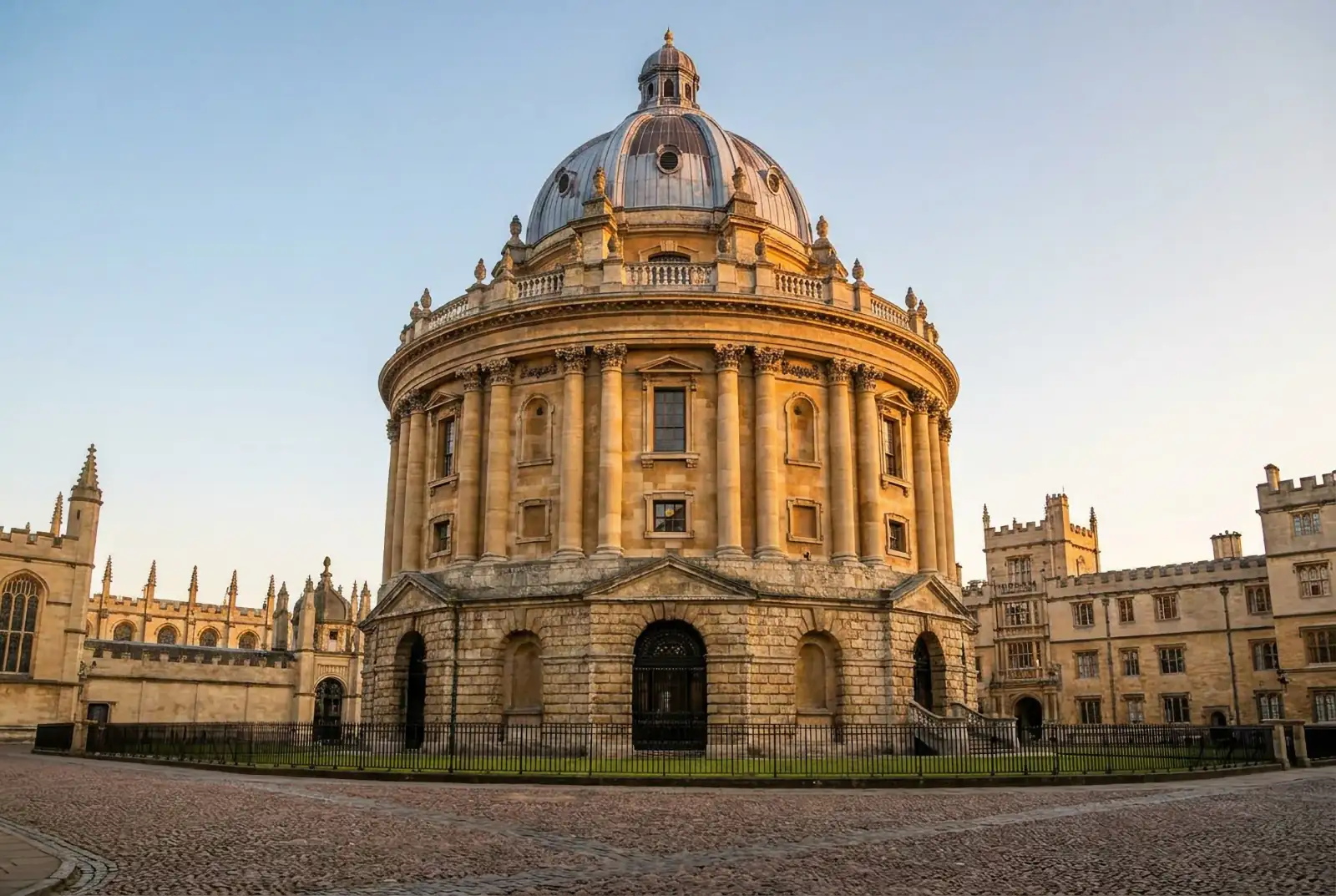
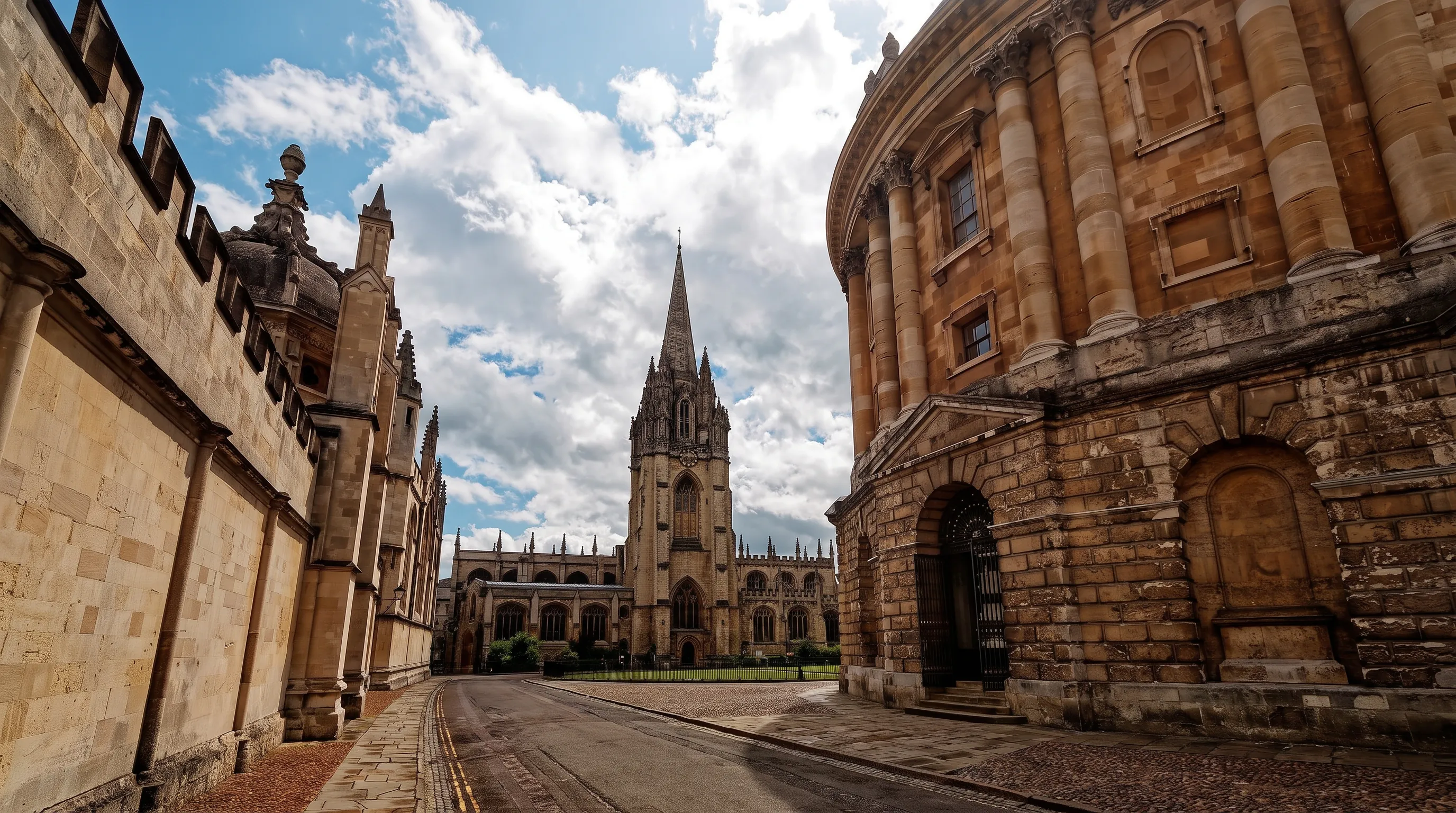
Oxford's most photographed building is a working library that is closed to the public. Radcliffe Square is free at any hour — and exactly one £30 Bodleian tour goes inside.
Story · Visit · Route · Links
Visitor Essentials & Quick Answers
Why is the Radcliffe Camera called a camera?
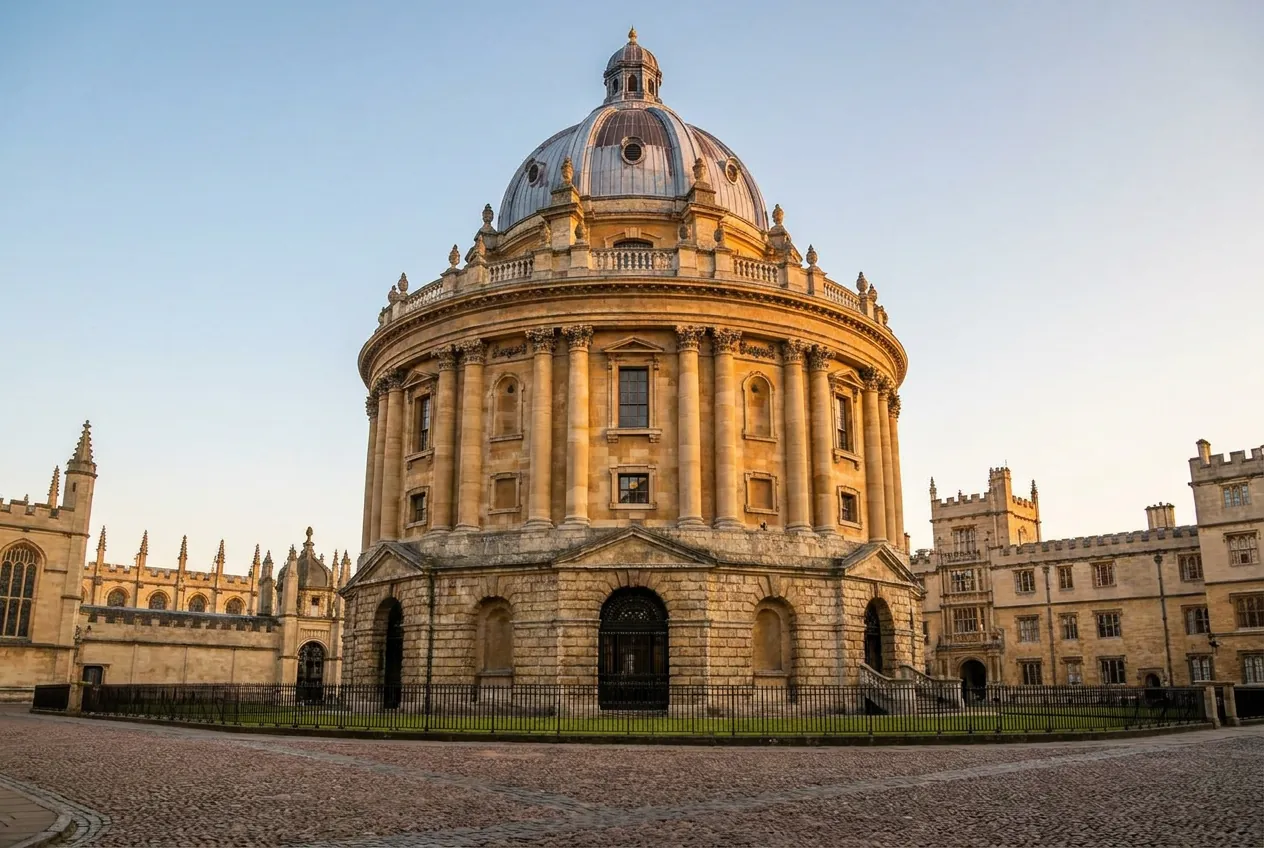
Camera is Latin for a room or vaulted chamber: the name means the Radcliffe Room. It has nothing to do with photography or a camera obscura. Radcliffe refers to John Radcliffe, the physician whose bequest funded the library designed by James Gibbs and built between 1737 and 1749.
Why is the Radcliffe Camera so famous?
Its circular form and great dome make a striking centrepiece among Radcliffe Square’s college and library buildings. Walk around it to see how the proportions change against the surrounding streets. Its importance is more than photographic: it was built as a library and remains part of Oxford’s working scholarly landscape.
Is the Radcliffe Camera the same as the Bodleian Library?
It belongs to the Bodleian Libraries, but it is a separate building from the Old Library and Duke Humfrey’s reading room nearby. The Camera contains reading rooms and connects underground to the Old Bodleian through the Gladstone Link. A Bodleian visit does not automatically include it: choose your tour by the buildings named.
Is it worth seeing the Radcliffe Camera from outside?
Yes. The relationship between the dome, Radcliffe Square, the University Church and neighbouring colleges is the main experience for many visitors. Walk around the square rather than taking one photograph and leaving. The University Church tower offers another perspective; interior Camera access requires a tour that specifically names the building.
Choose your depth
Essentials or more detail?
See visiting essentials, or read more about the history and places nearby.Start here
Understand the place.
The context, character and reasons this experience earns time in your Oxford plans.Why it matters
It is the first of its kind in England. Free-standing circular libraries were essentially unknown here before Gibbs. Nicholas Hawksmoor had conceived the round form for the site, but he died in 1736, and the commission passed to Gibbs, who built it. What went up fuses Bramante's Tempietto and the Italian baroque with the cooler English Palladian manner — an Italian idea executed with English restraint, standing in a medieval square.
The bequest is the whole reason it exists. John Radcliffe was physician to William III and Queen Anne, and among the wealthiest doctors in England. He died in 1714 leaving £40,000 for a library. Building did not begin for twenty-three years. The man whose name is on it never set foot in it, and the "Radcliffe" in Radcliffe Square, Radcliffe Observatory and the Radcliffe Infirmary is the same bequest working its way across the city.
"Camera" means room, not photography. It is the Latin for a vaulted chamber — the same root as the Italian camera. The building is the Radcliffe Room. The coincidence with the object hanging round every visitor's neck is one of the better accidents in Oxford place-naming, and it is worth knowing before you ask someone for directions.
It changed jobs. It opened as the Radcliffe Science Library, a free-standing scientific collection. The science moved out; the Bodleian moved in. Today it houses the History Faculty Library and is joined to the Old Bodleian by the Gladstone Link, an underground passage on two levels running beneath the square you are standing in.
What visitors should notice
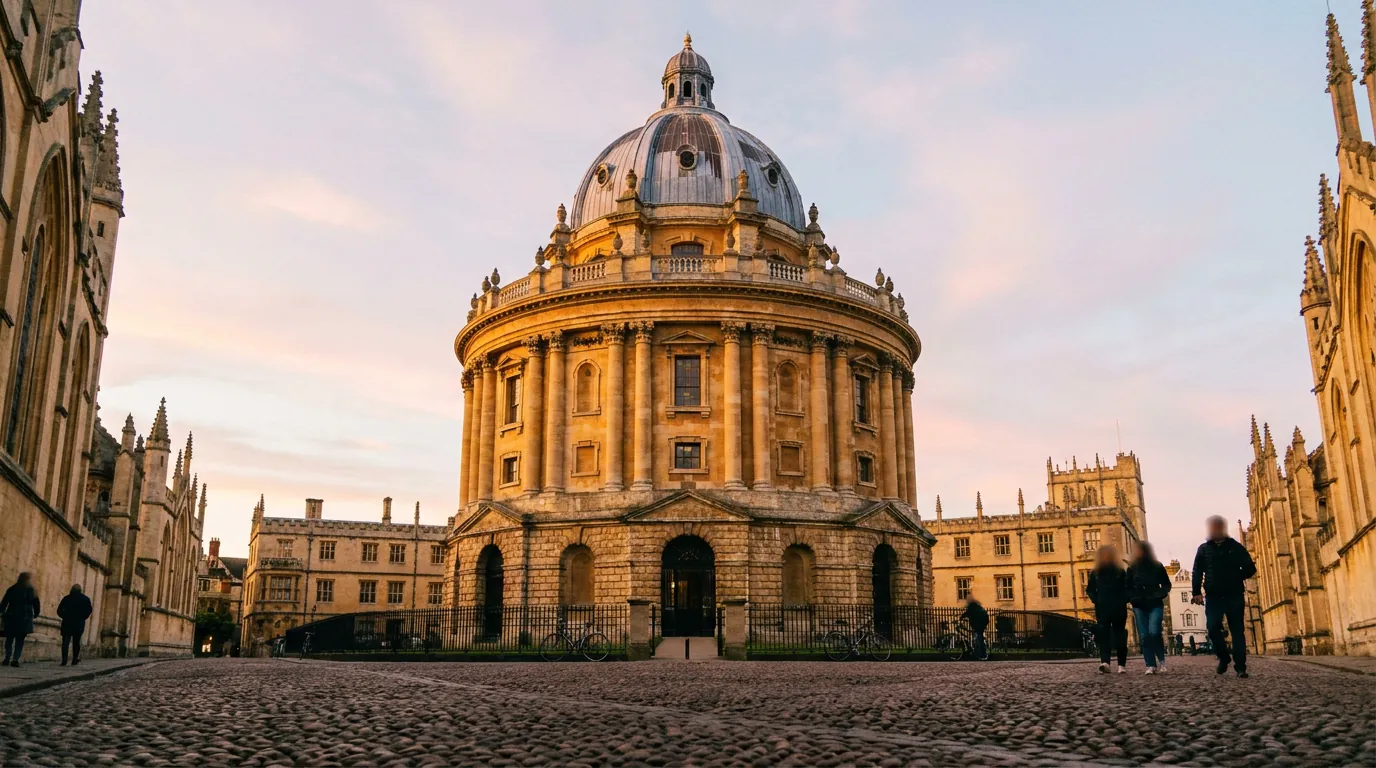
The base was open. The ground stage is a rusticated arcade, and those arches were originally open to the weather — a covered ambulatory you could walk through. They were enclosed later. Once you know, the building reads as a rotunda set on a screen of arches rather than a solid drum.
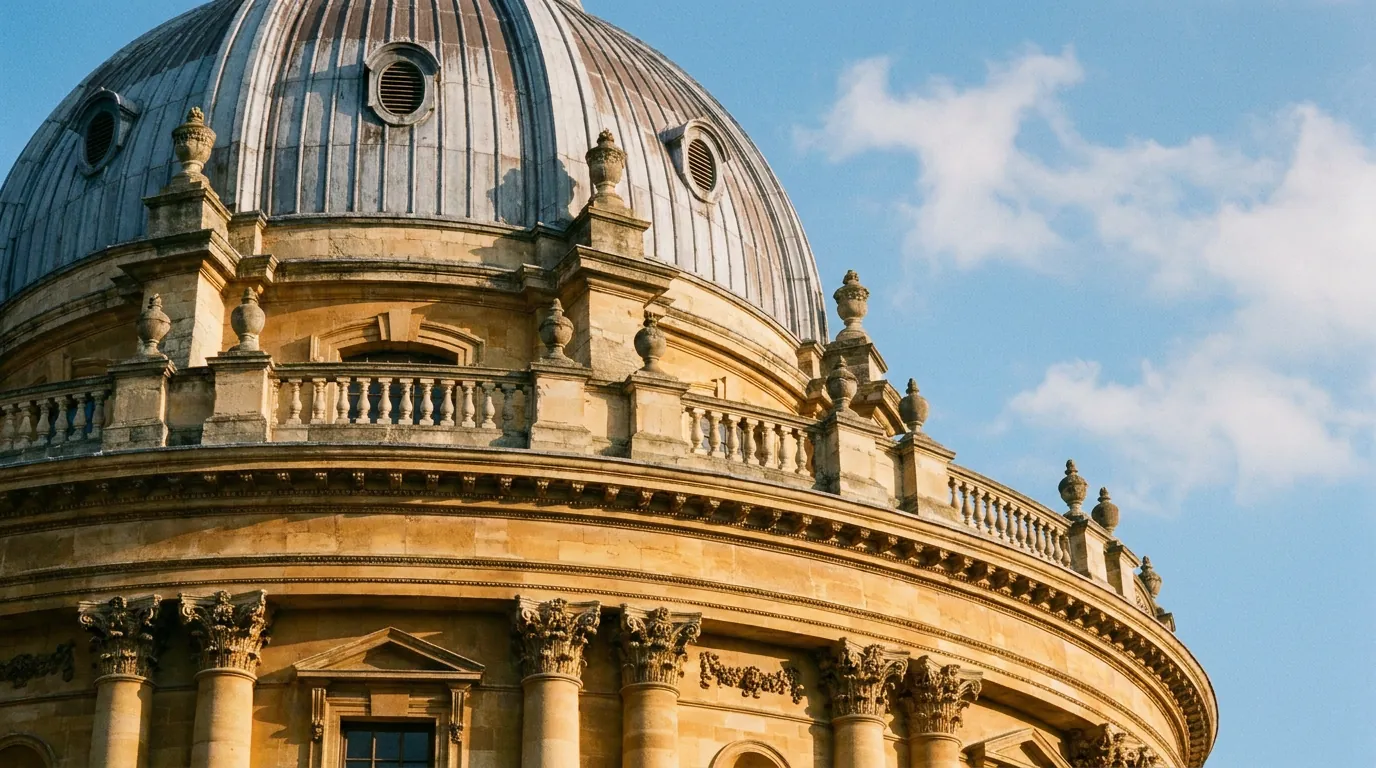
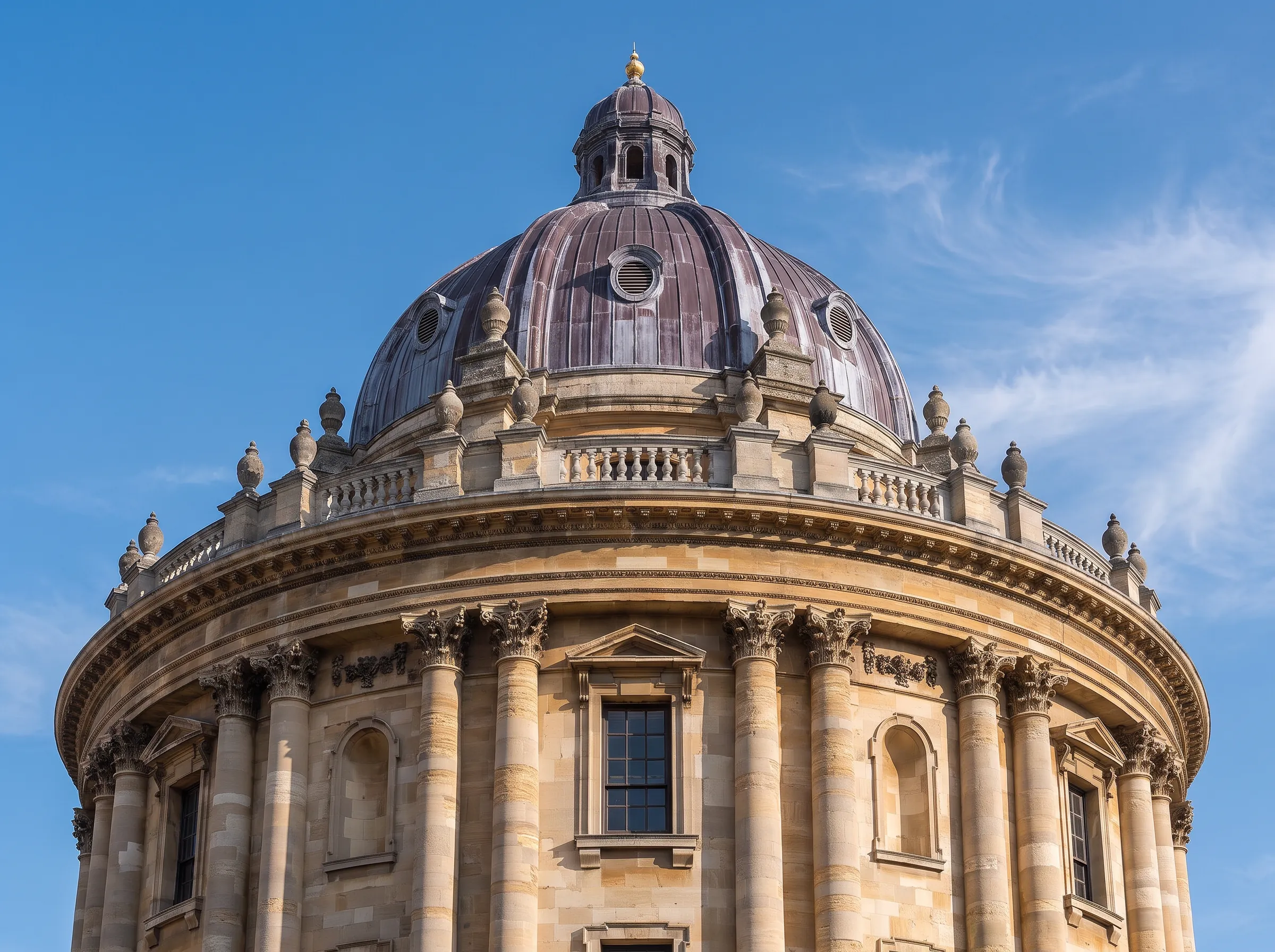
The buttressed dome. Gibbs ringed the dome's base with paired Corinthian columns and a heavy balustrade, then set the lead dome and its lantern above. The bulk at the bottom and the lightness at the top are doing deliberate work.
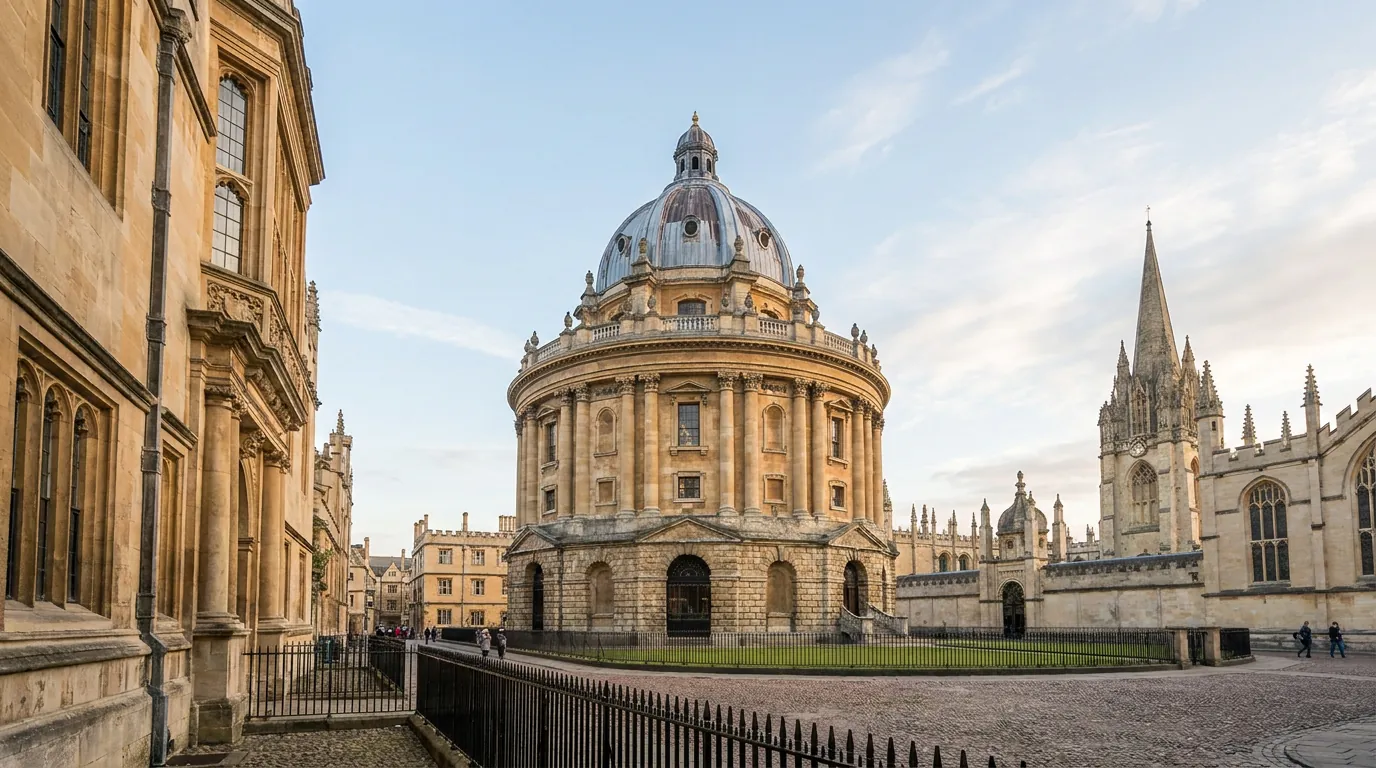
The square is the exhibit. Radcliffe Square is enclosed by the Camera, the Bodleian's Old Library, the university church of St Mary the Virgin and All Souls. There is almost no modern fabric in the sightline and no through traffic. This — not the interior — is what people come for, and it is free and open at any hour.
Look up from the south. From the St Mary's end the dome sits against the Bodleian and All Souls' towers in the composition that has been photographed since photography existed.
Who will enjoy it
- Anyone who wants the defining image of Oxford, which costs nothing and takes ten minutes.
- Visitors interested in eighteenth-century architecture, and in Gibbs specifically — this and St Martin-in-the-Fields are his monuments.
- Anyone taking the £30 walking tour, which is a genuinely good tour and the only public route into the building.
- Photographers, at either end of the day.
Who may find it difficult
- You cannot simply go inside, and most visitors arrive assuming they can. This is the most common disappointment in central Oxford. It is a working library, not a monument with a ticket office.
- The two tours are easy to confuse. £25 does not go in. £30 does. See Plan your visit, which sets them side by side.
- Tours have a minimum age of 11. Families with younger children cannot take the Camera tour at all. The square remains free to everyone.
- Most tour tickets are sold in person on the day. Only a limited number go online, released at 9am on the first of the month for the following month. In July and August, and at weekends, they go early.
- No photography inside. If your reason for going in is the picture, the answer is no; reading rooms are in use.
Visitor verdict
Go to the square, which is free, unenclosed and open at any hour, and is the thing you actually pictured. Go inside only if you book the £30 Radcliffe Camera and City of Oxford Walking Tour specifically, in advance, and everyone in your party is 11 or over. Fifteen minutes for the square; two hours if you take the tour, which also gets you into the Divinity School afterwards.
The full story
How it came to matter.
A doctor's money, and a twenty-three-year wait
John Radcliffe (1650–1714) was the most successful physician of his generation: attendant to William III and to Queen Anne, famously blunt with both, and rich enough that his estate reshaped a city. He had been a member of University College. When he died in 1714 he left £40,000 for a library at Oxford, along with money that would in time also produce the Radcliffe Infirmary and the Radcliffe Observatory.
Nothing happened for over two decades. Sites had to be cleared — the ground between the Bodleian and St Mary's was occupied — and the trustees were slow. Building did not begin until 1737, twenty-three years after the bequest, and did not finish until 1749. Radcliffe never saw a stone of it.
Hawksmoor conceived it; Gibbs built it
The round form was Nicholas Hawksmoor's idea. Hawksmoor — Wren's assistant, then a major architect in his own right — worked up designs for a circular library on the site and campaigned for the clearing of the square around it.
He died in 1736, the year before construction started. The commission went to James Gibbs, the Scottish architect of St Martin-in-the-Fields, who produced the building that stands. How much of the result is Hawksmoor's conception and how much is Gibbs's execution has been argued over ever since; the honest summary is that the idea of a rotunda here is Hawksmoor's and every built detail is Gibbs's.
Gibbs had trained in Rome. The debt to Bramante's Tempietto is direct, and so is the debt to the Italian baroque — but it is filtered through the sober English Palladianism that dominated British building at the time. That tension is why the Camera looks like nothing else in Oxford.
What it was for, and what it became
It opened in 1749 as the Radcliffe Library — in practice a science library, free-standing and independent of the Bodleian, an almost unknown building type in England at the time. This was England's first purpose-built circular library.
The science collections eventually outgrew it and moved out, becoming the Radcliffe Science Library elsewhere in the city. The Bodleian took the building over as a reading room in the nineteenth century, and it has been one ever since.
Underneath the square, vast book stores were excavated in the late nineteenth century to hold the Bodleian's growth. Part of that space was reopened to readers in 2011 as the Gladstone Link, a two-level underground reading and shelving area connecting the Camera to the Old Bodleian. Readers cross beneath Radcliffe Square without surfacing.
Today
The Camera holds the History Faculty Library in the Lower Camera, with Bodleian reference collections in the Upper Camera and in the Gladstone Link below. It seats readers at desks under the dome, and it is busy in term.
It is, in other words, still doing the job it was built for — which is precisely why you cannot walk in.
Look closer
Highlights and hidden details.
The objects, spaces and small observations that turn a visit into a memorable one.The dome from Radcliffe Square
The standard view, and standard for a reason. From the middle of the square the building has no front and no back — a rotunda is the same from every angle, which is why it photographs from anywhere and why the square had to be cleared around it. Gibbs's lead dome sits on a drum ringed with paired Corinthian columns, with a stone balustrade above them and a lantern on top.
The rusticated arcade at the base
The ground stage is a heavy rusticated arcade, and those arches were open when the building went up — a covered walk you could pass through, with the library proper raised above it. They were glazed and enclosed later. It is the single detail that most changes how you read the building: a rotunda floating on a screen of arches, not a solid drum planted on the ground.
Radcliffe Square as an enclosure
The Camera is the object; the square is the composition. Four sides, four different centuries, no traffic, no modern intrusion: the Camera itself, the Bodleian's Schools Quadrangle to the north, St Mary the Virgin to the south and All Souls to the east, with its Hawksmoor towers. Very few European cities have a space this coherent and this small.
The view from St Mary's tower
The one paid view that changes the building. From the university church's tower you look down onto the Camera — dome foreshortened, square laid out flat, Bodleian and All Souls framing it. Separate ticket, narrow spiral stair, and the best photograph in Oxford.
The Gladstone Link, underfoot
Beneath the square, on two levels, runs the passage joining the Camera to the Old Bodleian. Readers walk from one building to the other without coming up. It was built out of the nineteenth-century underground book stores and reopened for readers in 2011. You cannot see it, but standing in the square you are standing on it.
All Souls' north gate
On the east side of the square, the screen and gate into All Souls give a sightline through to Hawksmoor's twin towers — the man who wanted a round library here, working on the college next door. Worth thirty seconds even though All Souls' own access is very restricted.
The interior, if you get in
On the £30 tour: the reading room under the dome, the gallery running round it, and the quality of light through the upper windows. It is furnished and occupied — readers at desks, books on shelves — which is the point. No photography.
Brasenose Lane at the west
The lane running west from the square keeps its central cobbled gutter — a kennel, and the last one in Oxford — and is otherwise almost unaltered between high college walls. It is the quickest way in from Turl Street and the best approach: you come out of a dark lane straight into the square with the dome filling it.
Details worth slowing down for.
The name means "room"
Camera is Latin for a vaulted chamber, and Italian still uses it that way. The building is the Radcliffe Room. The photographic sense of the word arrives much later, from the camera obscura — the darkened room. So the coincidence is not quite a coincidence: both are rooms. But the Camera was never an optical instrument, and no part of its history involves photography.
Radcliffe never saw it
He died in 1714. Construction began in 1737. The man whose money paid for it, whose name is on it, and whose bequest also produced the Radcliffe Infirmary and the Radcliffe Observatory, was twenty-three years dead before the first stone went down.
The architect who lost the commission by dying
Nicholas Hawksmoor designed a circular library for this site and pushed for the square to be cleared around it. He died in 1736. Gibbs got the job in 1737. The round shape is Hawksmoor's; everything you can actually touch is Gibbs's.
It was built as a science library
Not an arts library, not a general one. It opened as a free-standing scientific collection, which is why it stands apart from the Bodleian rather than attached to it. The science left; the historians arrived. The Lower Camera is now the History Faculty Library.
The arches used to be open
The rusticated ground stage was an open arcade — weather passing through it, people walking under the library. The enclosure came later. Look at the arch heads and the way the glazing sits back within them.
There is a two-storey library under the square
The Gladstone Link runs beneath Radcliffe Square, connecting the Camera to the Old Bodleian on two levels, with reader desks, PCs and shelving. Everyone standing in the square photographing the dome is standing on a working library.
The railings, listed separately
Around the Camera and across the square, the ironwork and stonework have their own heritage status distinct from the buildings they enclose. The square was designed as a set piece, and the enclosure is part of the design rather than an afterthought.
The bicycles are a genuine problem
The racks around the square are heavily used and are in every photograph ever taken from ground level. There is no angle from which they entirely disappear at midday. Early morning is the only reliable fix. This is not a complaint about the building; it is a working university and the bikes belong to people at work.
Gibbs's other monument
If the Camera looks familiar in an unplaceable way, it may be because you know St Martin-in-the-Fields in Trafalgar Square. Same architect, entirely different problem, and the two together are what Gibbs is remembered for.
Make it work
Plan the visit properly.
Current practical detail, kept separate from the story so it is easy to scan when you need it.The short answer
You cannot walk into the Radcliffe Camera. It is a working Bodleian reading room, open to members of the University of Oxford and holders of a Bodleian reader card. There is no public entrance, no ticket desk and no drop-in access.
Radcliffe Square, which is what you came to see, is free and open at any hour. No gate, no ticket, no closing time.
One public tour goes inside, and it is not the one most people book.
The two tours, side by side
These are different products with names that differ by four words. They cost different amounts, run on different days, and only one enters the building.
| City of Oxford Walking Tour | Radcliffe Camera and City of Oxford Walking Tour | |
|---|---|---|
| Price | £25 | £30 |
| Inside the Camera? | No — exteriors only | Yes — about 30 minutes |
| Length | 90–120 min | 90–120 min |
| Runs | Check current schedule | July–August daily; September–June weekends only |
| Minimum age | Under-18s with an adult; under-5s free | 11 |
| Also includes | Divinity School after the tour | City walk, and Divinity School after |
| Meets | Weston Library front steps | Weston Library front steps |
Book the £30 one, by that exact name, if going inside is the point.
The library tours do not go inside either
This catches people who reason that a Bodleian library tour must include the Bodleian's most famous building. It does not.
| Tour | Price | Enters |
|---|---|---|
| 30 minutes | £12.50 | Divinity School, Duke Humfrey's Library |
| 60 minutes | £17.50 | Divinity School, Convocation House, Chancellor's Court, Duke Humfrey's |
| Tour and Tea | from £47.50 | As the 60-minute tour, plus afternoon tea (Mon–Fri) |
None of the three enters the Radcliffe Camera. All have a minimum age of 11.
These are excellent tours — Duke Humfrey's and the Divinity School are extraordinary rooms — but book them for what they are.
Booking
Most tour tickets are sold in person on the day, at the information desk in the Weston Library on Broad Street.
A limited number are released online, at 9am on the first of each month, for tours in the following month, through tickets.ox.ac.uk.
In July and August, and at weekends year round, plan on the online release. Same-day tickets in peak season are frequently gone by early afternoon. There is no telephone booking.
- Enquiries:
tours@bodleian.ox.ac.uk - Telephone: +44 (0)1865 287400, Monday to Friday 9am–4pm
Radcliffe Square
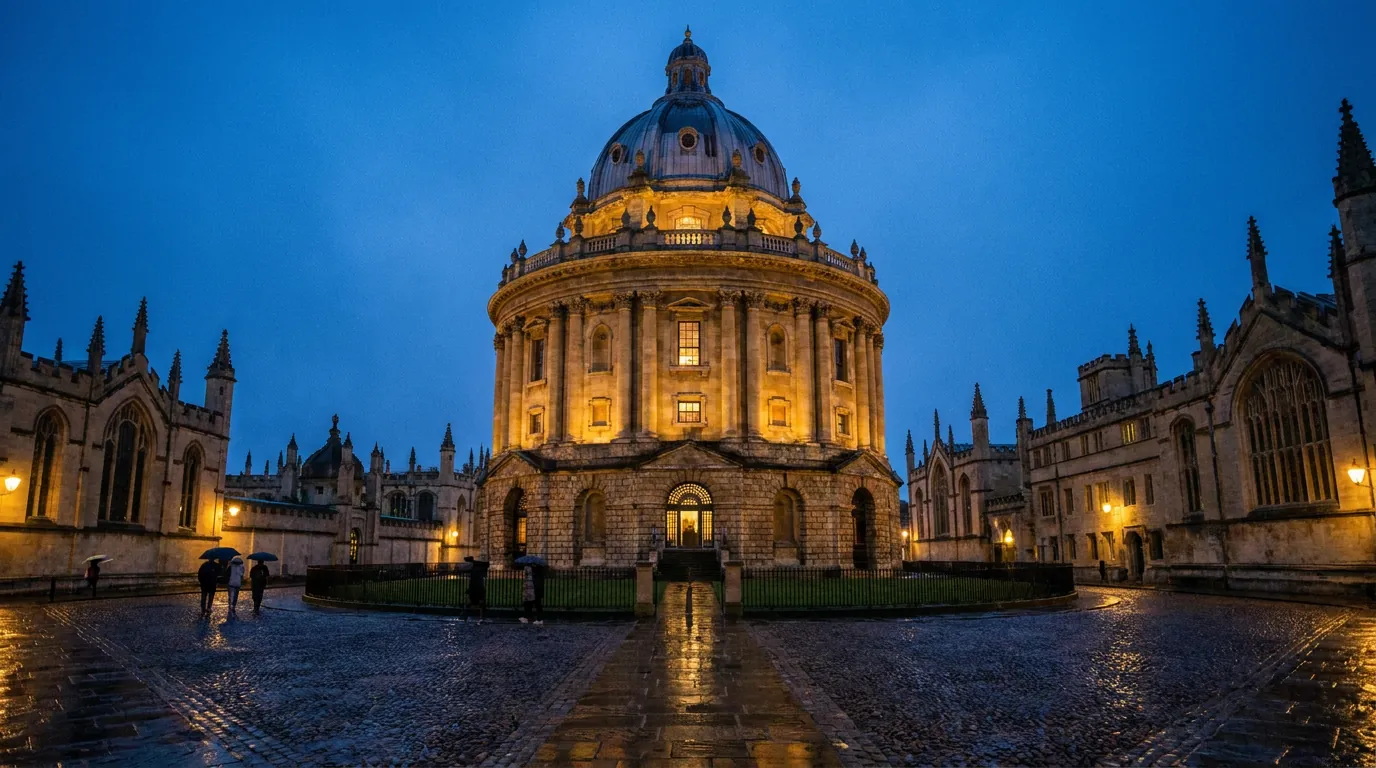
Free. Ungated. Open at any hour, including after dark, when the Camera is lit and the square is usually empty.
It is bounded by the Camera, the Bodleian's Old Library and Schools Quadrangle, the university church of St Mary the Virgin, and All Souls College. There is no traffic and almost nothing modern in the sightline.
St Mary's tower is the paid view worth having. It is the vantage point from which the Camera is photographed from above, looking down into the square with the dome in the middle — a different building entirely from the one you see at street level. Separate ticket, separate opening hours, and a narrow spiral staircase.
If you are a reader
Reading room hours for those entitled to use them are generally Monday to Friday 9am–9pm, Saturday 10am–6pm, Sunday 11am–7pm. The Gladstone Link closes thirty minutes before the library, with last entry forty-five minutes before.
The Lower Camera holds the History Faculty Library's lending material; the Upper Camera holds Bodleian reference collections.
Getting there
Radcliffe Square is reached on foot only, through Catte Street from the north or Brasenose Lane and Radcliffe Square itself from the west. There is no vehicle access and no parking.
From Carfax, five minutes on foot up the High Street and left into Catte Street. From the railway station, about twenty minutes.
How long to allow
- Radcliffe Square: 10–15 minutes, longer if you are photographing it.
- The £30 tour: 90–120 minutes, plus the Divinity School afterwards at your own pace.
- Square, St Mary's tower and the Divinity School together: half a morning.
Visit your way
Access and family planning.
Two different questions
Almost all published accessibility information for the Radcliffe Camera is written for readers, not for visitors — because visitors, with one exception, do not go inside. Both are covered below, and they are not the same thing.
Radcliffe Square
Free, open at all hours, no gate and no admission. The square is paved and broadly level, and there is no traffic.
The approaches are the difficulty rather than the square itself. Brasenose Lane from the west has a cobbled drainage channel down its centre, with the road surface falling towards it from both sides, and is not comfortable for wheelchairs, walking frames or anyone unsteady. Catte Street from the north is a smoother, wider approach and is the one to use.
There are no seats in the square and no public toilets. The nearest accessible facilities are in the Weston Library on Broad Street, three minutes north, which is a modern building with step-free access.
The tour that goes inside
The £30 Radcliffe Camera and City of Oxford Walking Tour is a 90–120 minute walking tour of the city with about thirty minutes inside the building. The walking component, over cobbles and kerbs, is the limiting factor for many visitors before the building is.
Whether the tour route inside the Camera is step-free is not published, and the Bodleian's own accessibility guidance covers readers rather than tour groups. Contact the tours office before booking rather than assuming: tours@bodleian.ox.ac.uk, +44 (0)1865 287400, Monday to Friday 9am–4pm.
If the walk is the problem but the building is the goal, ask the same office whether any arrangement is possible; there is no published alternative, but it is a question worth putting to a person.
For readers with reduced mobility
The Bodleian is specific, and the specifics are limiting. Its own statement is that "only the lower reading room of the Radcliffe Camera and the upper floor of the Gladstone Link are accessible to those with reduced mobility." The Upper Camera and the lower Gladstone Link level are not.
There are two entry routes — through the Camera itself, or via the Old Bodleian Quad and the Gladstone Link beneath the square.
Registration is required in advance. Readers with reduced mobility must register their card and agree a personal evacuation plan before using the building. This is not optional and cannot be arranged on arrival.
Provision includes six height-adjustable desks, four ergonomic chairs at the Camera, and a hearing loop at the staff desk. Staff will fetch material from high or awkward shelves on request.
Assistance dogs are always welcome. The Bodleian's position is that guide dogs and hearing dogs are permitted throughout its libraries.
Discuss requirements in advance with access@bodleian.ox.ac.uk, and consult the University Access Guide for room-level detail.
Sensory and cognitive
The square is open, uncrowded outside peak hours and has no amplified sound.
Inside, it is a silent working library. Tour groups are asked to be quiet and photography is prohibited. For a visitor who needs to talk through what they are seeing, the square is the better experience.
Facts we do not have
- Whether the tour route inside the building is step-free.
- Whether any step-free alternative exists for tour visitors specifically.
- Seating availability inside during the tour.
- Toilet provision accessible to tour visitors rather than readers.
These are unpublished rather than absent, and one telephone call to the tours office would settle all four.
The blunt version
Children under 11 cannot go inside. Every Bodleian tour that enters a historic interior, including the £30 Radcliffe Camera tour, has a minimum age of
- There is no family route into the building.
Radcliffe Square is free, open and fine for any age. No traffic, no gate, no ticket, and it takes ten minutes.
What works with children
The square itself. It is an enclosed, car-free space with something to look at on all four sides. Small children can move around safely. Bicycles are the only hazard and they are moving slowly.
"Camera means room." It is a good fact and children like it, because it sounds wrong. The building is called The Radcliffe Room and has nothing to do with photography.
The dome from St Mary's tower. If your children will manage a narrow spiral staircase, this is the payoff — looking down on the dome from above. Check the church's own age and height guidance before committing; the stair is tight and there is no lift.
The Divinity School, two minutes north, has a spectacular vaulted ceiling and is included after either walking tour. It is also the room used as the Hogwarts infirmary, which for many children is the entire reason they are in Oxford.
Ages
- Under 5: the square, briefly. Free on the City of Oxford Walking Tour, but a 90–120 minute walking tour is unrealistic at this age.
- 5–10: square, Brasenose Lane, the Bodleian quadrangle next door. Interiors are closed to them.
- 11–15: the £30 tour becomes possible and is worth it. Under-16s must be accompanied by an adult.
- 16+: everything, including the library tours.
What to skip
Do not build a day around getting inside. Do not book the £25 City of Oxford Walking Tour expecting to go in — it does not, and a 90-minute exterior walking tour is a hard sell to a child who was promised a library.
Practical
There are no toilets, seats or facilities in Radcliffe Square. The nearest public options are in the Weston Library on Broad Street, three minutes north, and the Covered Market, five minutes west.
No cafés open onto the square. The Vaults & Garden café at St Mary's is the closest, in the churchyard on the south side.
A ten-minute version
Come in along Brasenose Lane from Turl Street so the square arrives all at once. Stand in the middle. Name the four sides. Explain camera. Walk out north under the arch into the Bodleian's Schools Quadrangle, which is also free and open.
Self-guided walk
Explore beyond the venue.
A practical, step-by-step route connecting this experience with more of Oxford.1. Turl Street, at the top of Brasenose Lane
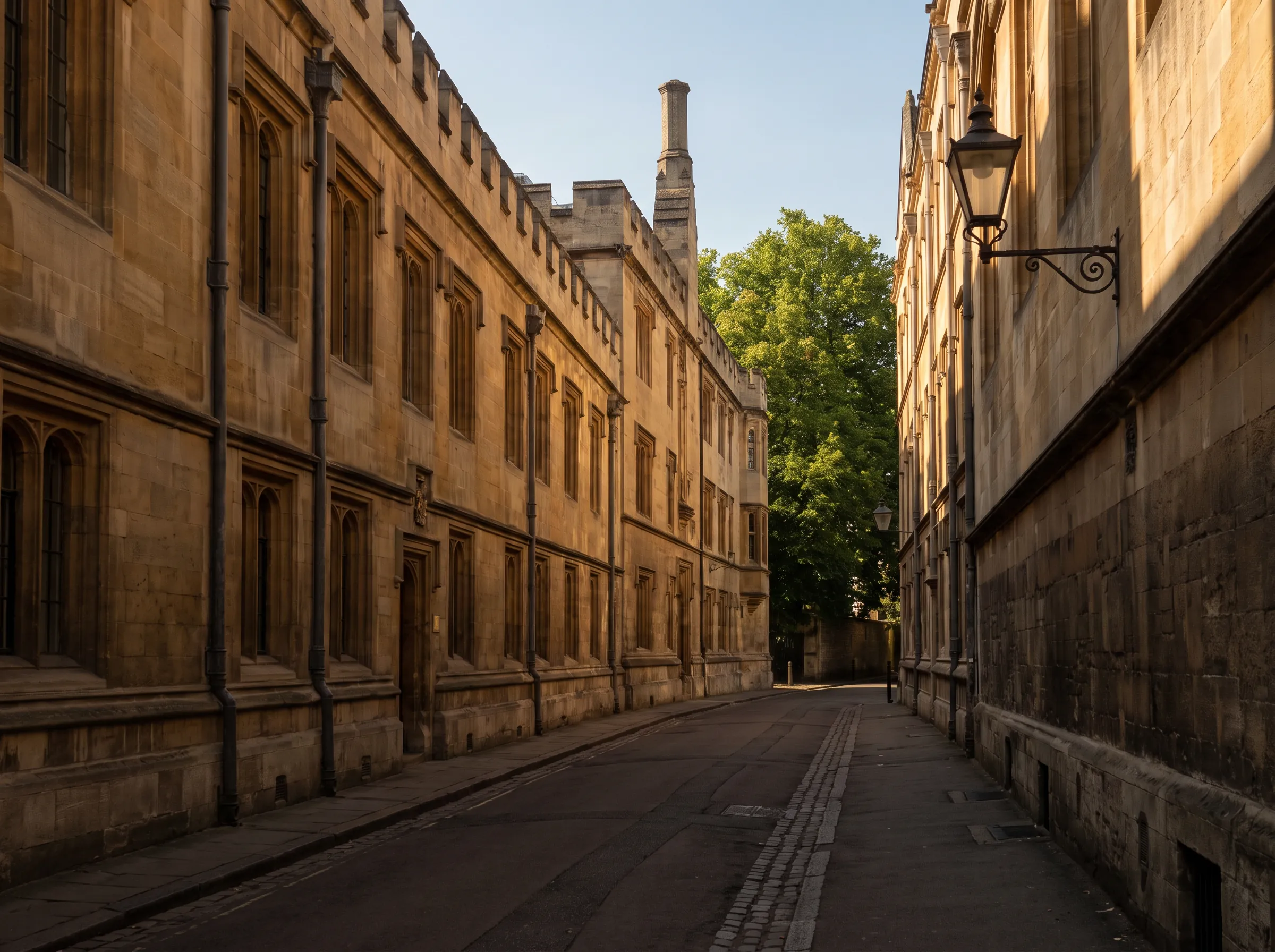
Start here rather than in the square. Brasenose Lane runs east between high college walls, and it keeps its medieval central gutter — a shallow cobbled channel down the middle of the road, with the surface falling towards it from both sides rather than cambering away to kerbs.
The technical term is a kennel, and every thoroughfare in the city once had one. Brasenose Lane is the last lane in Oxford that still does.
Walk down it. The lane is dark and narrow and gives away nothing.
2. Radcliffe Square, arriving from the west
The lane opens and the Camera is directly in front of you, filling the space. This is the best approach in Oxford and it costs nothing.
Stand still for a moment before walking on. A rotunda has no façade, so you are not seeing "the front" — you are seeing all of it, which is the point Gibbs was making.
3. The base of the building
Walk to the arcade at ground level. Look at the rustication — deep-cut stone courses meant to read as weight — and at the arches.
Those arches were open. You could once walk through this stage of the building; the library floated above an open ambulatory. The glazing sits back inside the arch heads, which is how you can still see what happened.
4. Round to the south side
Circle clockwise towards St Mary's. As you move, watch the paired Corinthian columns around the drum slide past each other — the building animates as you walk, which a flat façade cannot do.
Look up at the balustrade and the lantern on the dome.
5. The south-west corner, by St Mary's
The photograph. Camera on the left, All Souls' Hawksmoor towers to the right, the Bodleian behind. Late afternoon light hits the west face.
Note how little of what you can see is later than 1750, and that there is no traffic and no shopfront in any direction.
6. The east side, at the All Souls screen
Look through the gate into All Souls. Hawksmoor designed those towers, and Hawksmoor is the man who wanted a round library on the spot you have just walked around. He died before it was built. Gibbs finished the idea; Hawksmoor's own work is the thing you are looking through a gate at.
7. North, under the arch into the Schools Quadrangle
Pass out of the square under the arch. You are now in the Bodleian's Old Schools Quadrangle — free, open, and lined with the painted names of the old faculties above each door.
Turn and look back south: the Camera framed in the arch, which is the composition that solves the bicycle problem.
8. The Divinity School door
On the west side of the quadrangle. You can go in here — the finest interior in Oxford, and included at the end of either Bodleian walking tour, or on its own admission.
9. Finish on Broad Street
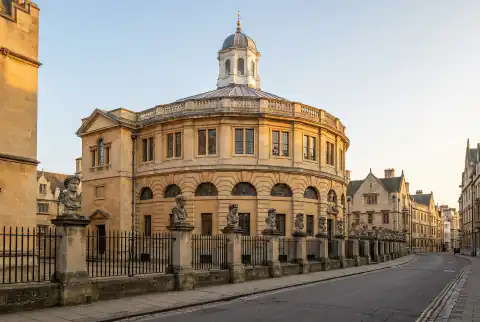
Out of the quadrangle to the north and you are on Broad Street, with the Sheldonian and its Emperors' Heads in front of you and the Weston Library opposite.
If the Camera has left you wanting an interior, the Sheldonian is the answer, and it lets you climb to the cupola for the view back over everything you have just walked.
Timing
Twenty-five minutes at a walk. Add ninety minutes for the Divinity School and Sheldonian, or two hours if you have booked the £30 tour, which begins on the Weston Library steps where this route ends.
Best done first thing. Before 8am the square is empty, the bicycle racks are half full, and Brasenose Lane is yours.
Make a record
Photograph it thoughtfully.
The rule that matters
No photography inside. The Camera's interiors are working reading rooms with people at desks, and the prohibition is enforced on tours. If your reason for paying £30 is the interior shot, do not book it.
Outside, photograph freely. Radcliffe Square is public and open at any hour.
The problem everyone has
Bicycles. The racks around the square are heavily used all day, and at ground level they are in every frame. There is no angle at midday that loses them.
The fixes, in order of reliability:
- Early morning. Before about 8am the racks thin out and the square is empty of people.
- Shoot from above — St Mary's tower removes the problem entirely.
- Go long and tight on the dome and drum, cropping the base out.
- Come at night, when the building is lit and the square is deserted.
The best positions
South-west corner, by St Mary's. The classic three-quarter view with the dome against sky, All Souls' towers to the right. Best in late afternoon, when the west face is lit.
North side, under the Bodleian arch. Frames the Camera through stonework — the most reliable composition when the square is busy, because the arch hides the ground clutter.
Brasenose Lane, looking east. A dark, high-walled lane opening onto the lit square, with the cobbled kennel running down the middle of the road. Best in morning, when light comes down the lane towards you.
St Mary's tower. The definitive view. Looking down on the dome with the square laid out. Paid, ticketed, narrow spiral stair, and a small platform — expect to queue for position at peak times. Wide lens.
Catte Street, looking south-west. Camera and All Souls together, with the Bridge of Sighs behind you if you turn round.
Light
- Sunrise to about 8am — the only time the square is genuinely empty.
- Golden hour, late afternoon — the west and south faces warm up; the Bodleian's stone behind goes gold.
- Blue hour and after dark — the Camera is floodlit, the square is empty, and this is the most underused window of the day. Bring a tripod, but note the square is a public thoroughfare.
- Overcast — flattering to Headington stone and forgiving on the dome, which blows out easily against bright sky.
Technical
- The dome against a bright sky is a high-contrast problem. Expose for the stone and lift shadows, or bracket.
- A wide lens exaggerates the dome's foreshortening from close in. Backing off to the square's edge and going slightly longer keeps the proportions Gibbs intended.
- Verticals converge badly here because you are close to a tall round building. Correct in post, or shoot from further back.
- At night, the floodlighting is uneven — the lit side is much brighter than the shaded side.
Drones
Do not. Central Oxford is dense, the square is enclosed by occupied buildings, and the colleges and university do not permit it.
Courtesy
The square is a working route between libraries and colleges, and the Camera is full of people trying to work. Tripods should not block the north–south line through the square, and flash towards the windows is unwelcome at any hour.
See it
In pictures.
All 9 photographs from this page, full screen. Tap any one to open the viewer.Around here
Make more of the area.
Bodleian Library — Old Library and Divinity School
One minute north, through the arch.
The building most people mean when they say "the Bodleian", and the one the library tours actually enter. The Divinity School, with its fifteenth-century lierne vault, is the finest room in Oxford and is included at the end of either walking tour. Duke Humfrey's Library above it is reached only on a 30- or 60-minute library tour.
The Schools Quadrangle between them is free to walk into.
University Church of St Mary the Virgin
One minute south, on the square.
Free to enter. The tower is the paid view down onto the Camera and is the single best photograph in the city. Narrow spiral stair, no lift. The Vaults & Garden café in the churchyard is the nearest place to sit.
All Souls College
On the square's east side.
Hawksmoor's twin towers, seen through the gate screen. A graduate-only college with no undergraduates, and very restricted public access — check its own opening arrangements, which are limited and seasonal. Worth the sightline even when shut.
Sheldonian Theatre
Three minutes north on Broad Street.
Wren's first major building, and the university's ceremonial hall. Unlike the Camera, you can go in — the auditorium, the Streater ceiling, and the 114-step climb to the cupola for a 360-degree view over the rooftops. If the Camera has left you wanting an interior, this is the answer.
Weston Library
Three minutes north on Broad Street.
Free, modern, step-free, with changing exhibitions from the Bodleian's collections and a good café. This is also where tours meet and where same-day tour tickets are sold, so you may be here anyway. Public toilets.
Bridge of Sighs and New College Lane
Two minutes north-east on Catte Street.
The Hertford Bridge, and the lane running under it to the Turf Tavern — a pub reached only through passages, which is most of its appeal.
Brasenose College
On the square's west side.
Entered from Radcliffe Square itself. Small, and one of the closest colleges to the Camera; check current visitor hours, which vary in term.
Covered Market
Five minutes west via Brasenose Lane and Turl Street.
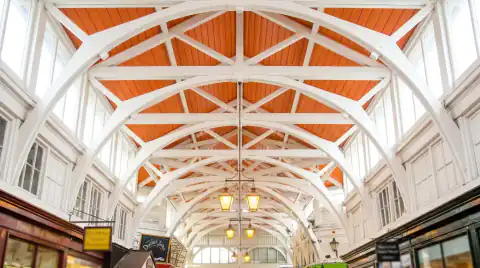
Roofed market with food stalls, butchers and cafés — the best cheap lunch within walking distance, and indoors when it rains.
History of Science Museum
Four minutes north on Broad Street.
Free. Einstein's blackboard, and the world's finest collection of early scientific instruments in the original Ashmolean building. Small, and a good forty minutes.
A half-day that works
Radcliffe Square → Bodleian Schools Quadrangle → the £30 Camera tour, or the Divinity School alone → St Mary's tower for the view down → Broad Street for the Sheldonian and the Weston → Covered Market for lunch.
Good to know
Questions, answered.
01Can you go inside the Radcliffe Camera?
Not on your own, and not by turning up. It is a working Bodleian reading room open to members of the University of Oxford and Bodleian reader card holders.
The public can get inside on one tour: the Radcliffe Camera and City of Oxford Walking Tour, £30, which spends about thirty minutes in the building.
02Which tour actually goes inside?
The £30 "Radcliffe Camera and City of Oxford Walking Tour". Book it by that full name.
The £25 "City of Oxford Walking Tour" does not go inside — it shows the exteriors of the Bodleian and the Camera, and includes the Divinity School afterwards. The names are very similar and both meet on the Weston Library steps.
03Do the Bodleian library tours include the Radcliffe Camera?
No. None of the three does:
- 30 minutes, £12.50 — Divinity School and Duke Humfrey's Library
- 60 minutes, £17.50 — plus Convocation House and Chancellor's Court
- Tour and Tea, from £47.50 — the 60-minute route plus afternoon tea
They are very good tours of other rooms. The Bodleian's own library web page says the Camera is closed to the public "except those on library guided tours", but its individual tour pages show that none of the library tours enters it. Book the £30 walking tour if the Camera is the goal.
04How much does it cost to see the Radcliffe Camera?
Nothing to see it. Radcliffe Square is public, ungated and open at any hour.
£30 to go inside, on the tour named above.
05What are the opening hours?
There are no public opening hours, because there is no public admission. Access is by tour only.
Reader hours are generally Monday to Friday 9am–9pm, Saturday 10am–6pm, Sunday 11am–7pm — these apply to people entitled to use the library, not to visitors.
06How do I book, and how far ahead?
Most tour tickets are sold in person on the day at the Weston Library information desk on Broad Street.
A limited number are released online at 9am on the first of each month, for tours the following month, at tickets.ox.ac.uk. There is no telephone booking.
In July and August, and at weekends year round, use the online release — same-day tickets frequently sell out.
07Is there a minimum age?
Yes, 11, for the Radcliffe Camera tour and for all Bodleian library tours. Under-16s must be accompanied by an adult. Radcliffe Square itself is open to everyone.
08When does the Camera tour run?
July and August: daily. September to June: Saturdays and Sundays only.
09Can I take photographs?
Outside, yes, freely, at any hour. Inside, no — photography is not permitted in the reading rooms.
10Why is it called a "camera"?
Camera is Latin for room or vaulted chamber. It means the Radcliffe Room. It has nothing to do with photography and was never a camera obscura.
11Is the Radcliffe Camera the Bodleian Library?
It is part of the Bodleian Libraries but it is not the building people usually mean. The Old Library, the Divinity School and Duke Humfrey's are immediately north, across a quadrangle, and are where the library tours go.
12Who built it, and when?
James Gibbs, between 1737 and 1749, paid for by a £40,000 bequest from the physician John Radcliffe, who died in 1714. The idea of a circular library on the site was Nicholas Hawksmoor's; he died in 1736, before building began.
13What is inside it now?
The History Faculty Library in the Lower Camera, and Bodleian reference collections in the Upper Camera. Below the square, the Gladstone Link joins it to the Old Bodleian on two underground levels.
14Where is the best view of it?
The tower of St Mary the Virgin, on the south side of the square — a paid climb up a narrow spiral stair that puts you above the dome looking down. It is the best photograph in Oxford.
15Is it wheelchair accessible?
Radcliffe Square is level and open; approach via Catte Street, not Brasenose Lane, which has a cobbled gutter running down its centre.
For readers, the Bodleian states that only the lower reading room and the upper floor of the Gladstone Link are accessible to those with reduced mobility, and that registration and a personal evacuation plan are required in advance.
Whether the tour route inside is step-free is not published — ask tours@bodleian.ox.ac.uk before booking.
16How long should I spend there?
Ten to fifteen minutes for the square. Ninety minutes to two hours if you have booked the tour.
Before you visit
Useful links.
Venue and visitor information
Sources used
| ID | Source | Used for | Retrieved |
|---|---|---|---|
| S01 | Bodleian — Radcliffe Camera and City of Oxford Walking Tour | The only public route inside. £30; 90–120 minutes; about 30 minutes inside the Radcliffe Camera; a 60–90 minute city walk; Divinity School entry afterwards. July and August daily, September to June weekends only. Minimum age 11, under-16s accompanied. Meets at the front steps of the Weston Library. Tickets released online at 9am on the 1st of each month for the following month | 2026-08-06 |
| S02 | Bodleian — City of Oxford Walking Tour | The tour that does NOT go inside, and the reason this page exists. £25, 90–120 minutes. Shows "the beautiful exteriors of the Bodleian Library and the Radcliffe Camera"; the only interior entered is the Divinity School, after the tour. Under-18s accompanied; under-5s free. Meets at the same Weston Library steps | 2026-08-06 |
| S03 | Bodleian — Library guided tours | That none of the three library tours enters the Camera: 30 minutes £12.50 (Divinity School, Duke Humfrey's); 60 minutes £17.50 (plus Convocation House and Chancellor's Court); Tour and Tea from £47.50, Monday to Friday. All minimum age 11. Booking: most tickets in person on the day at the Weston Library desk, with a limited online release one month ahead | 2026-08-06 |
| S04 | Bodleian Libraries — Radcliffe Camera | The building's status as a working library closed to the public; that only University members and Bodleian reader card holders may use it; the Upper and Lower Camera; reader hours (Mon–Fri 9–9, Sat 10–6, Sun 11–7); the Gladstone Link and its closing times; and that the Camera houses the History Faculty Library. Also the phrase recorded in the conflict ledger below | 2026-08-06 |
| S05 | Bodleian — Radcliffe Camera for disabled readers | Accessibility, for readers: that "only the lower reading room of the Radcliffe Camera and the upper floor of the Gladstone Link are accessible to those with reduced mobility"; the requirement to register a card and agree a personal evacuation plan; two entry routes; six height-adjustable desks, four ergonomic chairs, a hearing loop at the staff desk; staff retrieval from high shelves; and that guide and hearing dogs are always allowed | 2026-08-06 |
| S06 | Architectural and historical reference on the building, including Wikipedia — Radcliffe Camera and Historic England list entry 1099146 | James Gibbs, built 1737–1749; the £40,000 bequest of John Radcliffe, who died in 1714; that Nicholas Hawksmoor conceived the round form and died in 1736; that it is England's first purpose-built circular library; that it opened as a free-standing science library; the debt to Bramante's Tempietto and the Italian baroque fused with English Palladianism; and Grade I listing | 2026-08-06 |
| S07 | Wikipedia — Gladstone Link and S04 | The two-level underground reading and shelving area joining the Camera to the Old Bodleian beneath Radcliffe Square, built from the nineteenth-century book stores and reopened for readers in 2011; 120 reader spaces, Wi-Fi and PCs; reference material in the Upper Camera and lower Link, History Faculty lending material in the Lower Camera and upper Link | 2026-08-06 |
| S08 | Above Guide's own repo data | The verified coordinates carried forward from src/data/oxfordPlaces.js, and the walking relationships to the Sheldonian, Weston Library, Divinity School, St Mary the Virgin, All Souls and the Covered Market | 2026-08-06 |
| S09 | Wikipedia — Brasenose Lane and Oxford local coverage | That Brasenose Lane runs east–west between Turl Street and Radcliffe Square; that it retains the medieval pattern of a single drainage channel down its centre; that the correct term is a kennel; that every thoroughfare once had one; and that this is the last lane in Oxford to keep it. Also that the surrounding buildings date from the fifteenth century | 2026-08-06 |
Where sources disagree
Does any tour go inside? — RESOLVED, and it is the bundle's purpose
The web carries three incompatible answers: that the Camera cannot be entered at all; that any Bodleian tour includes it; and that "a 90-minute tour" includes it without naming which.
All three are wrong, and the correct answer is specific. Exactly one product — the £30 Radcliffe Camera and City of Oxford Walking Tour (S01) — enters the building, for about thirty minutes. The £25 City of Oxford Walking Tour (S02) does not, and the two names differ by four words.
The error is extremely easy to make. S02 states plainly that the tour does not enter the Camera; read alone, it supports the conclusion that no public access exists. Only S01, at a different URL, shows otherwise.
Used: the £30 tour is named in full everywhere it appears, always with its price, and the £25 tour is named alongside it as the thing not to book.
The Bodleian contradicts the Bodleian — RECORDED, NOT HIDDEN
S04, the library's own page for the building, says the Camera is closed to the public "except those on library guided tours".
S03, the library's own page listing those tours, shows that none of them enters the Camera.
Used: S03. It is the more specific source, it is product-level, and it enumerates each tour's contents individually rather than characterising them in a clause.
The discrepancy is stated in the FAQ rather than resolved silently. A reader who has seen S04 needs to know why this guide differs from it. This is the third occasion in the current bundle set where an institution's own page has been loose or wrong where other evidence from the same institution was right.
Brasenose Lane — a claim tightened, 2026-08-06
The first draft of this bundle described the lane as "cobbled" in four places. Reference photography gathered for the image set showed that it is not: the running surface is asphalt with stone edging.
The underlying claim survives and is better than what was written. S09 confirms the lane keeps a central drainage channel, that the channel itself is cobbled, that the term is a kennel, and that Brasenose Lane is the last lane in Oxford to have one.
Used: the gutter, not the lane, is cobbled — and the "last in Oxford" fact, which the first draft did not have. Corrected in the highlights, the route, the accessibility chapter, the photography chapter and the FAQ.
Worth recording as a method note. The correction came from gathering image references, not from re-reading text sources. Looking for a picture of a thing is a surprisingly good way to find out whether you have described it correctly.
Hawksmoor or Gibbs? — NOT A CONFLICT
Sources variously credit the design to Hawksmoor and to Gibbs. Both are defensible and the bundle states the sequence rather than picking one: Hawksmoor conceived a circular library for the site and died in 1736; Gibbs took the commission in 1737 and built what stands. The idea is Hawksmoor's; every built detail is Gibbs's.
Facts deliberately not asserted
| Fact | Where this guide says so |
|---|---|
| Whether the tour route inside the building is step-free | Accessibility, FAQ |
| Whether any step-free alternative exists for tour visitors | Accessibility |
| Toilet provision for tour visitors, as opposed to readers | Accessibility, facilities |
| Seating inside during the tour | Accessibility |
| Any minimum age for the £25 City of Oxford Walking Tour | Plan your visit |
The first four are unpublished rather than absent, and a single call to the tours office on +44 (0)1865 287400 would settle all of them.
A note on the reader hours
Reader opening hours are recorded in 13-operational-data.json and are deliberately never presented as opening hours anywhere a visitor reads.
The building is open to card-holding readers twelve hours a day and to the public not at all. Publishing the former as though it were the latter would be the most damaging error this page could make, and the operational data and SEO files both carry an explicit prohibition on emitting them as structured data.
Opening hours, prices, programmes and access arrangements can change. Confirm critical details with the venue.
Continue exploring / Oxford
What will you
do next?
Compare the practical essentials first, then open the experiences that earn a place in your plans.
 01Culture & historyBate Collection of Musical InstrumentsExplore experience →
 02Culture & historyBodleian Library guided tourExplore experience →
 03Culture & historyChrist ChurchExplore experience →
 04Culture & historyChrist Church CathedralExplore experience →
 05Culture & historyHistory of Science MuseumExplore experience →
 06Culture & historyOxford CastleExplore experience →
 07Culture & historyOxford University Museum of Natural HistoryExplore experience →
 08Culture & historyPitt Rivers MuseumExplore experience →
 09Culture & historySheldonian TheatreExplore experience →
 10Culture & historyStephen A. Schwarzman Centre for the HumanitiesExplore experience →
 11Culture & historyThe Ashmolean MuseumExplore experience →
 12Culture & historyThe Weston LibraryExplore experience →
 13Culture & historyUniversity Church of St Mary the VirginExplore experience →
 14Food & drinkHead of the RiverExplore experience →
 15Food & drinkLe Manoir aux Quat’SaisonsExplore experience →
 16Food & drinkOxford Covered MarketExplore experience →
 17Food & drinkThe Bear InnExplore experience →
 18Food & drinkThe ChequersExplore experience →
 19Food & drinkThe Eagle and ChildExplore experience →
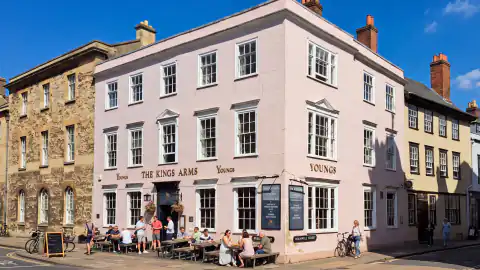 20Food & drinkThe King’s ArmsExplore experience →
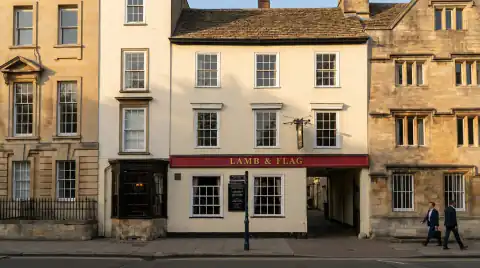 21Food & drinkThe Lamb & FlagExplore experience →
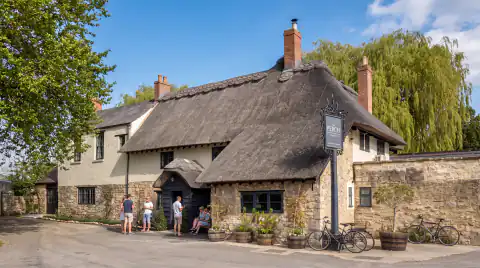 22Food & drinkThe PerchExplore experience →
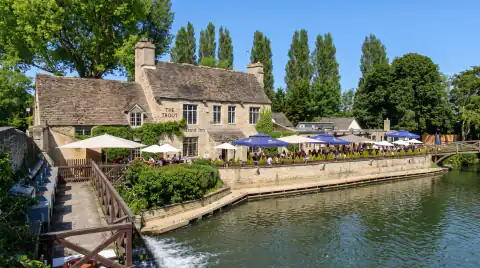 23Food & drinkThe Trout InnExplore experience →
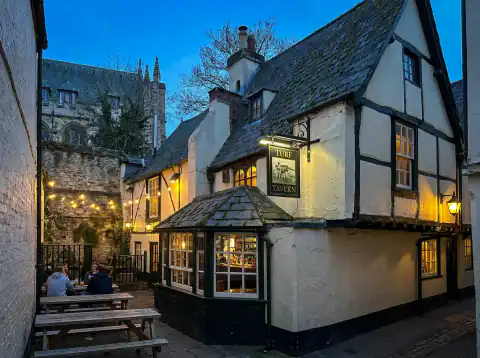 24Food & drinkThe Turf TavernExplore experience →
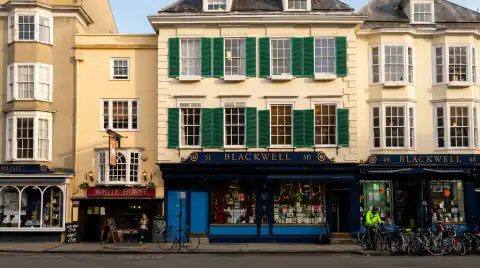 25Food & drinkThe White HorseExplore experience →
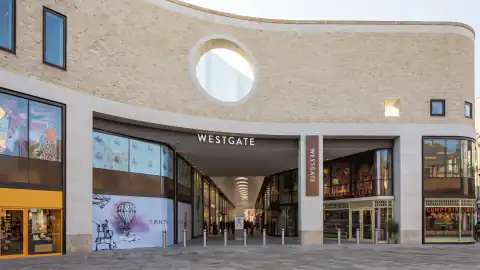 26Food & drinkWestgate OxfordExplore experience →
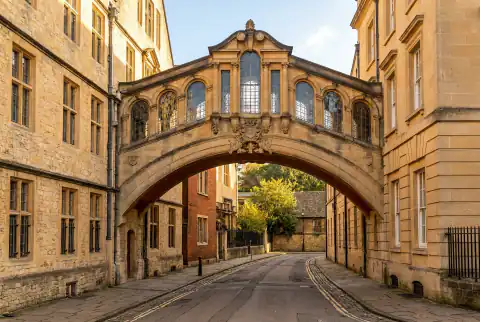 27Walks & viewsThe Bridge of SighsExplore experience →
 28Parks & meadowsChrist Church MeadowExplore experience →
 29Parks & meadowsOxford Botanic GardenExplore experience →
 30Parks & meadowsPort MeadowExplore experience →
 31Parks & meadowsUniversity ParksExplore experience →
 32On the waterPunt the CherwellExplore experience →
 33On the waterSalter's SteamersExplore experience →
 43CollegesAll the collegesEvery Oxford collegeOpen the college guide →Food & drink / a storyThe nine oldest pubsWalk the timeline →
 Plan / Itinerary builderBuild your Oxford dayStart planning →