In depth
Old Parsonage Hotel
A small seventeenth-century Oxford house with Parsonage Grill, a walled terrace and a private residents’ library.
Story · Visit · Route · Links
Visitor Essentials & Quick Answers
What gives the Old Parsonage its character?
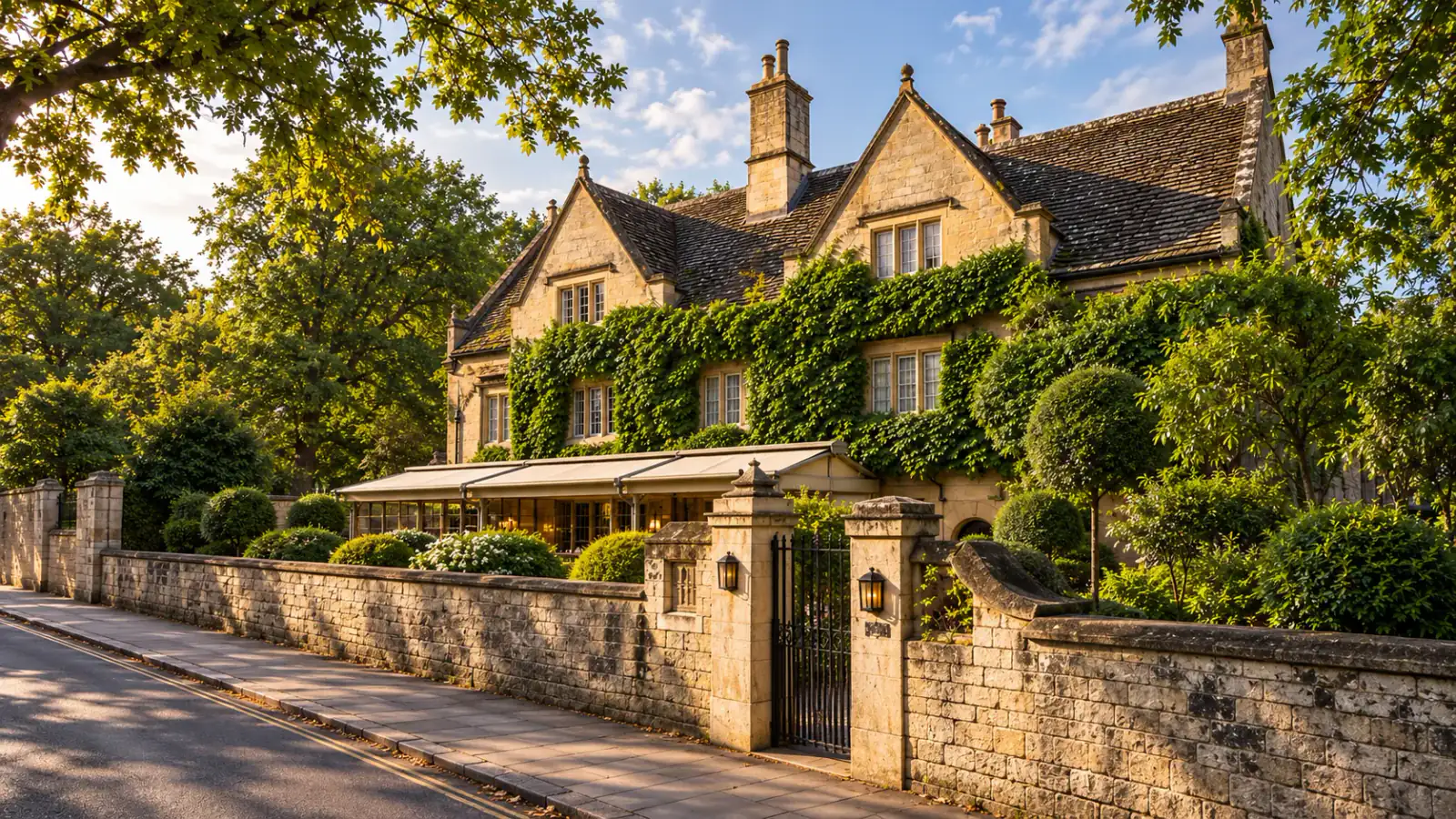
The 1659 doorway, oak door and stone fireplace retain the scale of an old Oxford house. Portraits, books and deeply coloured rooms surround Parsonage Grill, while the residents’ library provides a quieter retreat upstairs.
Can I enjoy the Old Parsonage without booking a room?
A meal or afternoon tea at Parsonage Grill is the clearest way in. The portrait-lined dining rooms and walled terrace carry much of the hotel’s character. Do not expect to explore every part of the house: the residents’ library is specifically for staying guests.
Is it a good base for the museums and Jericho?
Its position at the northern end of St Giles suits the Ashmolean, University Parks and the walk towards the Natural History and Pitt Rivers museums. Jericho adds independent places to eat and explore. It is especially appealing when your Oxford plans extend beyond the central college quarter.
How old is the Old Parsonage Hotel?
The house has seventeenth-century origins, and its doorway is dated 1659. Later additions and restoration have shaped the hotel visitors see today.
Choose your depth
Essentials or more detail?
See visiting essentials, or read more about the history and places nearby.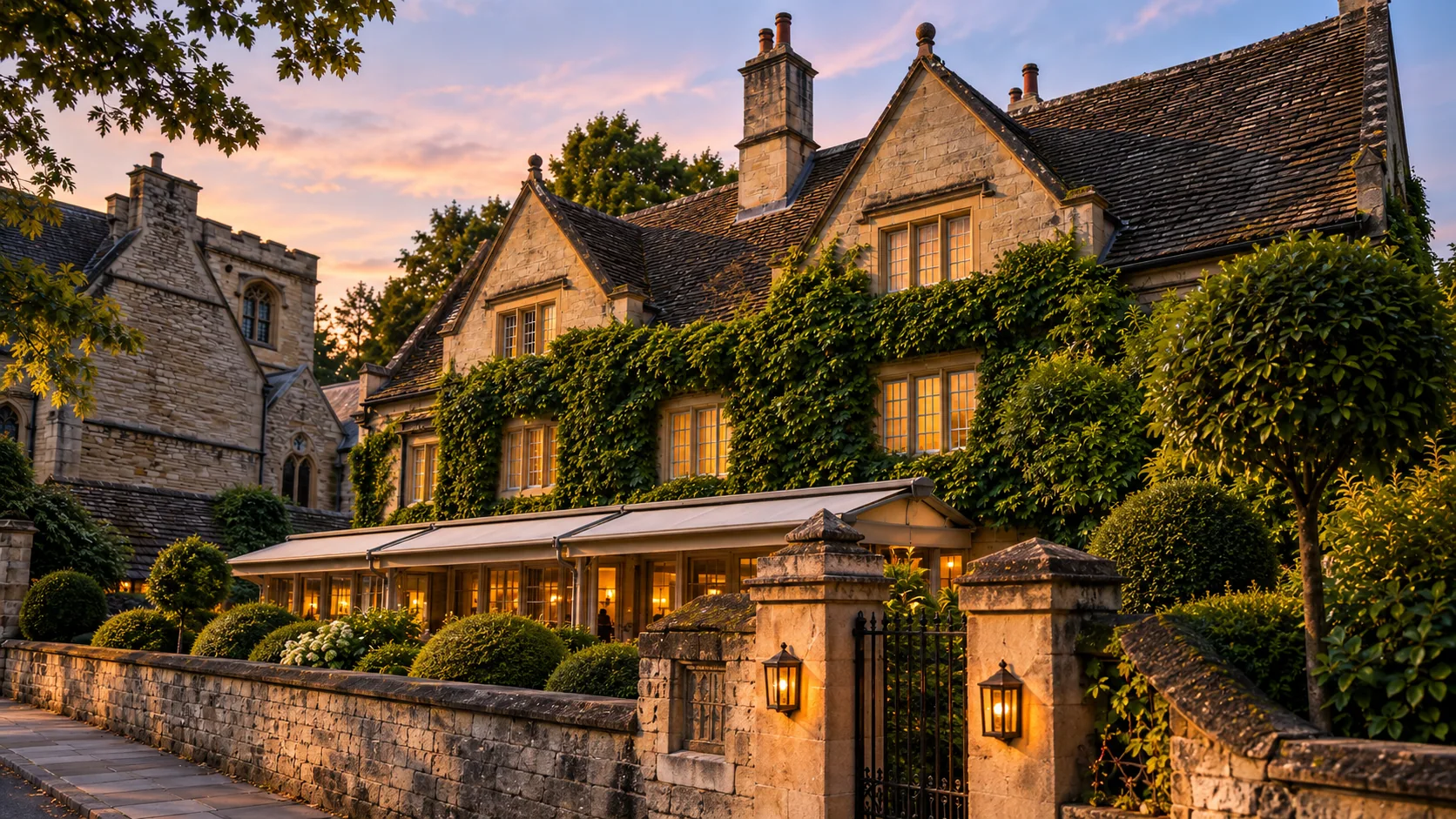
01 The experience
What to expect.
A dated doorway and a small historic house give Old Parsonage a more intimate presence than Oxford’s larger hotels. The house was begun in 1639 and completed around 1660; its position at the northern end of St Giles puts the Ashmolean, University Parks and the streets of Jericho close by.
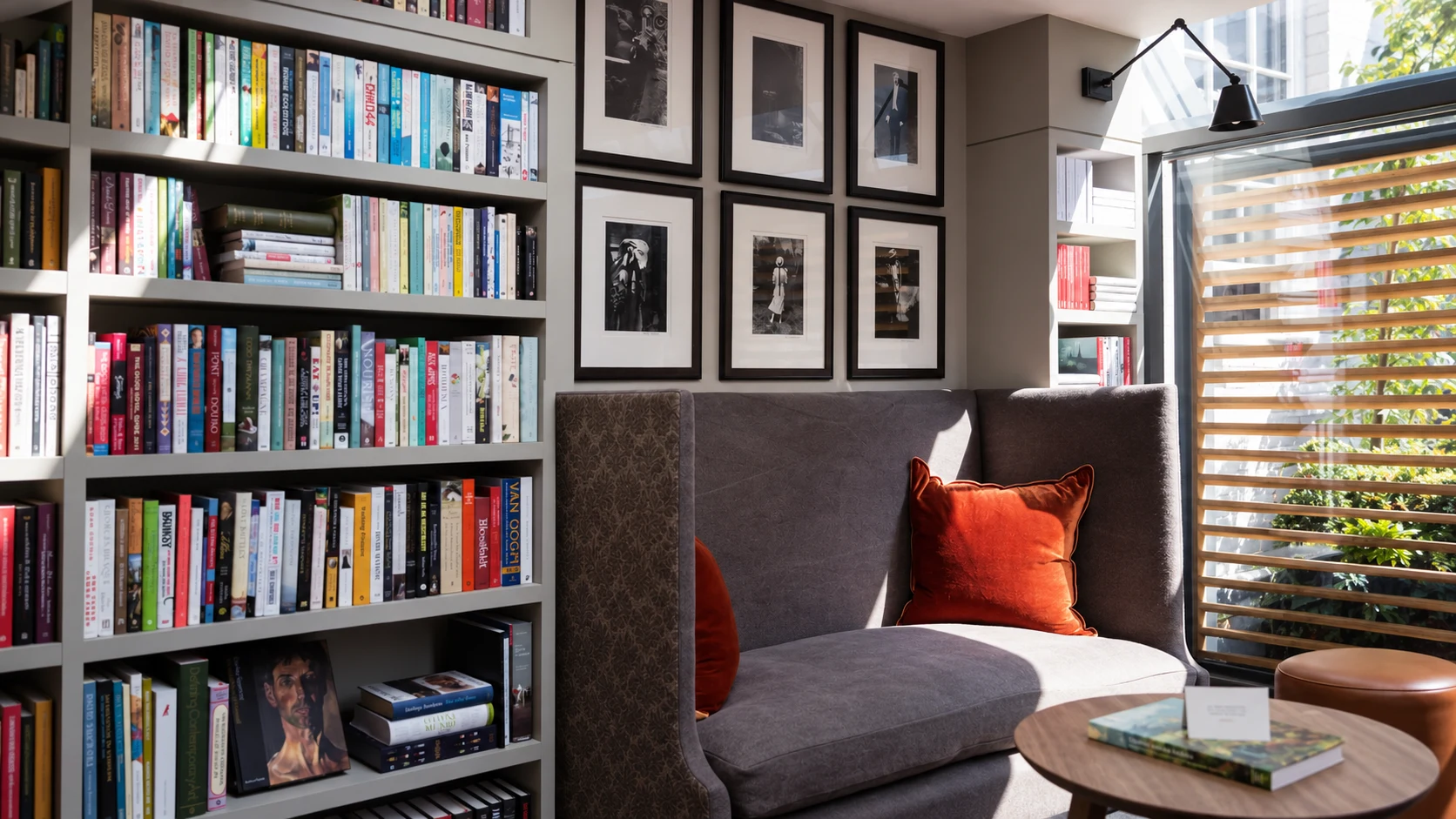
Parsonage Grill is central to the stay. Open to non-residents, it serves breakfast, all-day meals and afternoon tea, with a walled terrace adding an outdoor setting. Hotel guests also have a first-floor library, a quieter room away from the public restaurant.
There are 35 individually designed rooms, including two Churchill Suites. The linked historic interiors retain stairs and some tight circulation, so the two accessible ground-floor rooms are an important choice rather than simply another category. A private ramped entrance from the car park provides an alternative arrival.
The hotel has belonged to the Oxford Collection since 1989, following its opening as a modern hotel in 1971. Its appeal remains that of a small, independently owned city house: a good restaurant, a private room to return to and much of Oxford within walking distance. Parking is limited to the hotel’s small car park.
The story
History & character.
Before the present house
The name recalls a priest’s dwelling associated with a medieval hospice for the poor and infirm beside St Giles’ Church. The dwelling stood on or close to this site, before the present house.
University College acquired the land as an endowment and has remained its ground landlord for more than six centuries. Like many Oxford properties outside college walls, the site developed through leases to householders and businesses.
The hospice is traditionally associated with the Norman period, though that early date is uncertain. The present house has early-seventeenth-century origins.
Edward Selwood and the seventeenth-century house
Edward Selwood, a prosperous cook at St John’s College, began rebuilding the house in 1639 and completed its principal portion around 1660. He was letting lodgings before the work was finished. Selwood also ran a chop house in Broad Street and leased a farm in St Giles parish, illustrating how senior college cooks could build income and status beyond their institutional wages.
Construction spanned the Civil War and Commonwealth. Oxford served as Charles I’s Royalist capital from 1642 to 1646, with defences crossing land associated with the Old Parsonage. The house survived the war and was extended around the Restoration of Charles II in 1660.
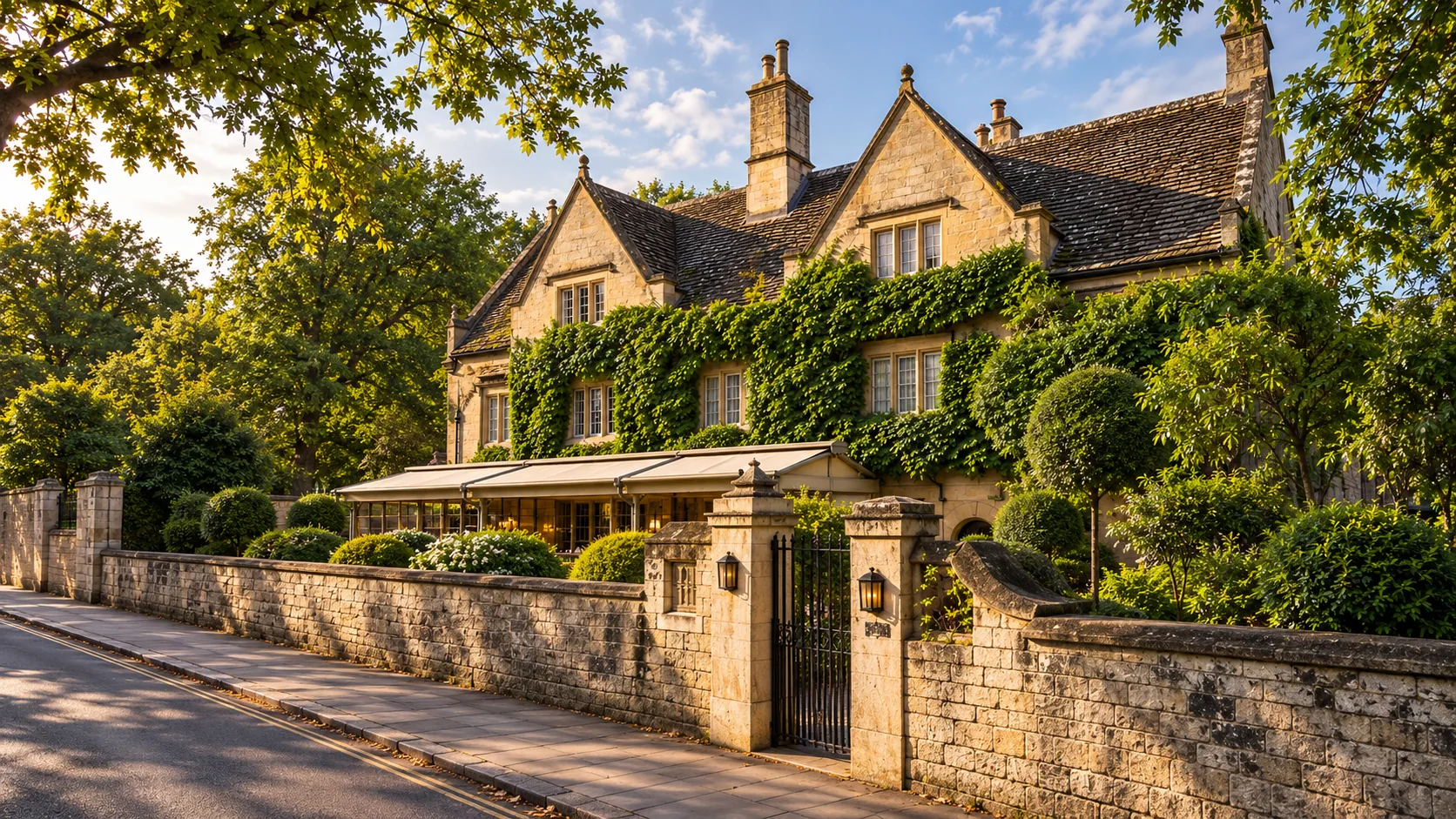
The Banbury Road frontage is built in coursed rubble stone beneath a stone-slate roof, with two gables, stone copings and ball finials. The central four-centred doorway carries the date 1659. Headington stone, mullioned windows and a chimney stack serving six principal rooms—three on each side—give the house its domestic scale.
The two-door, two-stair arrangement allowed part of the house to be let separately. Surviving or reported early fabric includes the heavy oak entrance door with old ironwork and nails, a broad arched stone fireplace, a stone window frame in the hall, oak panelling, the northern stair and roof timbers visible on the upper floor. Tradition connects the carved saints in the front window jambs with St Giles’ Church, suggesting they were moved during or after Puritan iconoclasm. Their origin is unconfirmed.
Later occupants and changing uses
Lawyers, civic figures, craftspeople, maltsters, cooks and a sculptor occupied or leased the house at different times. It moved through domestic occupation, lodging and commercial hospitality as the northern edge of Oxford changed around it.
The house also contains later work. Early-eighteenth-century carpentry and Queen Anne-period panelling survive alongside the older structure. Restoration and modern additions have altered the house repeatedly; its frontage and selected interiors retain the earlier fabric.
By the late nineteenth century the Brett family occupied the whole house and let rooms to undergraduates. This lodging phase is the setting for its best-known literary story.
Oscar Wilde: tradition rather than proof
A longstanding tradition places Oscar Wilde among Robert Brett’s undergraduate lodgers. It links his possible stay with the loss of his Magdalen rooms after a late return from Greece in 1877. No confirmed dates or room number establish the stay.
Oscar Fingal O’Fflahertie Wills Wilde studied at Magdalen. His possible connection with this house remains a lodging tradition rather than a proven residence.
Local Oxford history also associates the building with the novelist Compton Mackenzie during its student-lodging years. That connection also belongs to the house’s student-lodging years, though the details remain uncertain.
Guesthouse to hotel
From 1954 to 1989, the Harding and Simmonds families were resident tenants. They expanded their occupation, continued university lodgings and converted the guesthouse into a hotel in 1971. This is the beginning of the property’s continuous modern hotel identity.
Jeremy Mogford acquired the Old Parsonage in 1989. The Oxford Collection’s history positions the purchase within a locally owned group that also includes Old Bank Hotel, Quod, Gees and Parsonage Grill. Mogford’s model has been to combine historic Oxford buildings, restaurants and modern art rather than standardise them behind a chain identity.
The restaurant and hotel grew together. Parsonage Grill dates its current operation from 1989 and remains open to the public for breakfast, an all-day menu and afternoon tea. Its portrait-dense, maroon-toned rooms developed the club-like atmosphere now inseparable from the hotel’s brand.
The 2013–14 refurbishment
Old Parsonage closed in late 2013 for a major refurbishment and reopened in spring 2014. Contemporary project coverage describes a new upper level to the rear, additional bedrooms, a new first-floor library and complete renewal of existing bedrooms and bathrooms. The hotel now has thirty-five rooms.
The 2014 work is important because it established the present balance: historic frontage and selected original interiors, modern bedrooms, marble bathrooms and a residents’ library. The refurbishment retained the historic frontage while adding bedrooms and renewing the interiors for a working hotel.
Art, literature and the modern house
The present interior is defined by collection-building as much as architecture. Parsonage Grill describes eclectic portraits of writers and artists; the library displays photographs by Paddy Summerfield; guest rooms use Oxford sketches; and the Churchill Suites assemble photographs and memorabilia around Winston Churchill, Randolph Churchill and sculptor Oscar Nemon.
The hotel also ran the Mogford Prize for Food and Drink Writing for more than a decade. The short-story competition has now concluded. Its final anthology is placed in bedrooms and available to buy.
Protection and modern significance
Historic England listed The Old Parsonage, 1 and 3 Banbury Road, at Grade II on 12 January 1954 under list entry 1047358. The designation recognises special architectural or historic interest; it does not freeze the building in one period or certify every story attached to it.
The designation is Grade II, under National Heritage List entry 1047358.
Old Parsonage matters today because it preserves a rare domestic scale at one of Oxford’s busiest thresholds. It is neither a college nor a country estate. Its significance comes from accumulated uses—house, lodgings, guesthouse, hotel and restaurant—and from the combination of art, food and accommodation within a small Oxford house.
Look closer
Highlights and hidden details.
- Historic house at the north end of St Giles
- Parsonage Grill and a walled terrace
- Private first-floor residents’ library
- 35 rooms, including two Churchill Suites
- Two accessible ground-floor rooms
Details to look for.
The date above the doorway
The date 1659 is carved in one spandrel of the central doorway. Edward Selwood began rebuilding in 1639, with the main house completed around 1660.
Two doors and two stairs reveal a letting strategy
The original plan reportedly used two front doors and two staircases so that one half of the house could be let while the owner retained the other. This is a practical clue to the property’s long lodging history. The house was not simply a sealed private mansion later converted to hospitality; income from rooms was embedded in the way it could operate.
The chimney stack was an organising device
Six principal rooms were grouped three on either side of a central chimney stack. A single stack served the hearths on either side, concentrating heating at the centre of the house. The broad fireplace inside the entrance is part of that arrangement.
The carved saints are a tradition, not a proven rescue
Carved figures in the front window jambs are said to have been removed from St Giles’ Church during or after the Civil War, when religious imagery was vulnerable under Puritan rule. Their transfer from the church remains an unconfirmed tradition.
Later panelling sits inside the earlier house
Restoration exposed Queen Anne-period panelling and an old bed recess in a principal room. This is a reminder that “seventeenth-century hotel” compresses several layers. Early-eighteenth-century carpentry, later reglazing, nineteenth-century lodging use, twentieth-century hotel conversion and twenty-first-century bedrooms coexist. The interior brings these periods together.
The stone is local, but the building is not a college
The hotel history links the façade’s stone to Headington stone used across Oxford’s colleges. That material connection helps the house sit naturally within Oxford, but its scale and plan remain domestic. Its small frontage contrasts with the much larger college buildings nearby.
Paddy Summerfield changes the library’s mood
The library’s black-and-white photographs by Paddy Summerfield are not background decoration. Summerfield spent decades photographing Oxford, often focusing on parks, relationships, students and everyday life rather than formal monuments. Their presence helps the residents’ room feel rooted in the lived city rather than in a general English-house aesthetic.
The Churchill story belongs to Oscar Nemon
The Churchill Suites are as much about sculptor Oscar Nemon as their more famous subjects. Nemon met and sculpted Churchill at La Mamounia in Marrakesh in 1951, beginning a friendship with the family. The suites’ photographs and memorabilia connect the artist with Winston and Randolph Churchill.
The Mogford writing prize
Wilde’s possible lodging remains uncertain. The Mogford Prize for Food and Drink Writing ran for more than a decade, drew judges including well-known writers and chefs, and ended with an anthology now placed in guest rooms. The anthology continues the hotel’s connection with food and writing.
“Country house” describes mood, not geography
Old Parsonage repeatedly uses country-house language, but it stands on Banbury Road at a busy urban fork. The walled terrace, fireplaces and small scale create the mood; the location remains central Oxford. The sheltered terrace sits within the city, close to museums and university streets.
A Grade II-listed house
The house is protected at Grade II under National Heritage List entry 1047358.
The courtyard quiet is conditional
The walled setting softens Banbury Road, but Old Parsonage is not an isolated retreat. Restaurant service, events, church activity, deliveries and central traffic remain part of the soundscape. A courtyard-facing room and a road-facing room can produce different stays; ask rather than assuming universal silence.
Make it work
Plan your visit.
The essential decision
Book Old Parsonage if you want an intimate, highly walkable Oxford base with a historic atmosphere and a strong restaurant downstairs. There is no gym or pool. The smallest rooms are compact, parking is limited and the historic building has internal level changes.
Non-residents can visit Parsonage Grill, its bar and terrace by booking breakfast, lunch, afternoon tea or dinner. Bedrooms and the first-floor library are for hotel guests. Private rooms and the Garden Room are available through the events team rather than as public sightseeing spaces.
Booking and room choice
There are thirty-five individually designed rooms and suites. Current categories include Small Double, Classic, Deluxe, Superior Deluxe, Junior Suites, two Churchill Suites and two dedicated accessible rooms. The self-contained 36 St Giles residences are nearby, in a separate building.
Room size and layout vary materially. Small Doubles are listed at 12 sq m and work best for solo travellers or short stays. Accessible rooms are 22 sq m on the ground floor. Junior Suites are 24 sq m with living, dining and writing space, while the Churchill Suites are 30 sq m and can sleep up to three with an additional bed. Confirm bed type, bath versus shower, outlook, floor and lift-free stair requirements before paying.
Room prices depend on dates, category and offer. Direct rates may carry different cancellation terms, advance-purchase restrictions and a discretionary accommodation service charge. Read the final booking conditions rather than relying on a search-result price.
Check-in, check-out and luggage
Guaranteed check-in is from 15:00 and check-out is by 11:00. Reception can store luggage for early arrivals and after departure. Late checkout is subject to availability and may incur hourly or full-night charges. Reception operates around the clock.
One night works for a focused city visit. Two nights gives enough time for a museum-and-college day, a slower morning in the library and dinner or afternoon tea without treating the hotel as somewhere merely to sleep. Three nights suits visitors adding Blenheim, a long university tour or a family pace.
Dining
Parsonage Grill is open daily. Service times are breakfast from 07:00–10:30, the all-day menu from 12:00–23:00 and afternoon tea from 12:00–17:00.
Walk-ins are possible but a table is not guaranteed. Book dinner, Sunday lunch and afternoon tea, particularly at weekends or during university ceremonies. Give at least seven days’ notice for halal or kosher arrangements and discuss other dietary needs when booking. Allergens cannot be guaranteed absent.
The bar area and terrace welcome well-behaved dogs, but overnight stays normally accept assistance dogs only, with other requests considered case by case.
Getting there without a car
Oxford station is approximately twenty minutes on foot; Gloucester Green coach station about fifteen. A taxi is sensible with luggage. From the central railway route, approach via Beaumont Street and St Giles, then take the Banbury Road fork at the northern end.
Local buses and Park & Ride services stop nearby. The hotel identifies Pear Tree as the most convenient Park & Ride, just under three miles away. Check Oxford’s current traffic and congestion-charge rules before setting out because access routes and charges can change.
Driving and parking
There are fifteen complimentary parking bays for residents, but a room booking does not guarantee a space. Contact reception before arrival, provide vehicle details if requested and ask for the current approach route. Nearby pay-and-display spaces may be available around Keble Road, but restrictions and availability change.
Accessible drop-off is possible in the private car park, and the ramped accessible entrance is reached from there. A guest who depends on that route should arrange it in advance.
Walking, cycling and hotel-arranged experiences
Most central visits are easiest on foot. Somerville and Keble are around three to four minutes away; the Ashmolean, Museum of Natural History, Pitt Rivers, University Parks, Jericho and Oxford Playhouse are all natural walks. The High Street and Old Bank Hotel are about ten minutes away.
Hotel bicycles are available through reception and do not usually need advance reservation, though size, helmets and availability should be checked on the day. The hotel can arrange private two-hour guided walking tours tailored around literary, architectural and university subjects. These are booked services, not automatically included in every rate.
Families
Children of all ages are welcome. The hotel offers cots for infants, extra beds for children aged three to sixteen in suitable rooms, children’s books and board games in the library, colouring materials and a children’s menu at Parsonage Grill. An extra child’s bed costs £80 per night; confirm room suitability and the amount with your booking.
The hotel is compact and has no children’s club, pool or play area. Families gain more from the walkable museums and parks outside. Interconnecting Superior Deluxe rooms or a suite may be more practical than trying to make a small room work.
Accessibility
There are two ground-floor accessible rooms with king beds, wide doors, handrails and marble wet rooms. A private ramped entrance leads from the car park directly to them. The hotel can help arrange wheelchair-accessible transport from the station or Gloucester Green.
This is not a uniformly step-free building. Original stairs remain; several internal changes require portable ramps; and alternative routes may be needed between the restaurant, bar, accessible toilet and exits. Ask the hotel to describe the complete route from arrival to room, restaurant, library and emergency exit. The library is on the first floor and should not be assumed accessible without confirmation.
Dogs, smoking and other practical rules
Assistance dogs are accepted for overnight stays. Other dogs are not routinely accepted in bedrooms, although individual requests may be considered. Parsonage Grill welcomes well-behaved dogs in the bar and outside terrace.
Rooms, public areas, restaurants and balconies are non-smoking and non-vaping. The designated smoking area is in the car park.
Wi-Fi is available. Rooms have air conditioning, safes, minibars, tea and coffee, and fresh milk; higher room categories may add Nespresso machines. There is no hotel gym.
Best time to stay
Oxford is year-round. Spring and early autumn give the best balance of daylight, gardens and university atmosphere. Summer is busy and expensive; degree ceremonies, open days and major events can tighten inventory. Winter suits the firelit interiors and museums, but book a room category you will enjoy spending time in. Restaurant terraces are seasonal even when heaters and covers extend their use.
Before booking
Confirm the details that affect your stay:
- room rates, deposits, cancellation rules and service charges;
- restaurant service times and afternoon-tea sittings;
- parking availability, arrival route and Oxford traffic restrictions;
- accessible route and portable-ramp arrangements;
- extra-bed charges and permitted room categories;
- bicycle availability and guided-tour prices;
- dog exceptions and current dining policy.
Visit your way
Access and family planning.
The short answer
Old Parsonage has made specific provision for wheelchair users, including two accessible ground-floor rooms and a private ramped entrance from the car park. It is not uniformly step-free: original staircases and several internal level changes remain, and portable ramps or alternative routes are required. Contact the hotel before booking and agree the complete journey, not only the bedroom.
Arrival and drop-off
Vehicles can stop briefly in the private car park for drop-off. The accessible entrance has a ramp from the car park and leads directly to the two dedicated accessible rooms. The hotel can arrange wheelchair-accessible transport from Oxford station or Gloucester Green on request. Parking is limited, so an accessible bay or drop-off arrangement should be confirmed rather than assumed.
The main Banbury Road entrance is historic and should not be treated as the default wheelchair route. Ask reception for arrival instructions before travel so the car-park entrance is ready and staff know when to expect you.
Accessible bedrooms
The two accessible rooms are on the ground floor and measure approximately 22 sq m. They have king beds, wide doorways, additional handrails, a low-level basin, a shower seat and a marble wet room with a walk-in rainfall shower large enough for two. The bed height is 65–70 cm.
Turning-circle measurements, transfer sides, toilet height, hoist provision, alarm type and exact thresholds remain unconfirmed. A wheelchair user should ask for photographs or measurements relevant to their equipment and confirm whether furniture can be moved.
Restaurant, bar and toilets
Wheelchair access to the restaurant and bar uses alternative entrances or routes. A portable ramp must be deployed for several steps between the main dining room, accessible bathroom and entrances or exits. This means independent spontaneous movement may not always be possible; staff coordination is part of the route.
Reserve a suitable table and explain mobility requirements. Ask whether the terrace is step-free on the chosen route and whether the accessible toilet remains available during private events.
Upper floors and library
A passenger lift has not been confirmed. Original staircases remain, and the residents’ library is on the first floor. The Churchill Suites are on the second floor. Do not book an upper-floor category or assume library access without a direct discussion of lift provision and stairs.
Visual, hearing and sensory access
Detailed provision for blind or partially sighted guests, hearing loops, vibrating alarms, captioned media and sensory sensitivities remains unconfirmed. The historic public rooms can be dim, visually dense and busy at restaurant peaks. Ask about room lighting, emergency alerts, menu formats and quieter dining times.
Assistance dogs are accepted for overnight stays. Confirm relief arrangements and the most direct route from the accessible room to outside space.
Rest and fatigue
The hotel has seating in public rooms and a residents’ library, but central Oxford involves uneven pavements, crossings and long standing periods inside attractions. The hotel’s location helps by allowing returns between visits. A two-attraction day with a midday hotel break is more realistic than a continuous city loop for many guests.
Accessible transport and the city
Oxford station is around twenty minutes away on foot and Gloucester Green about fifteen; those estimates are not mobility-access times. Pre-book an appropriate taxi if distance, gradients, luggage or surfaces create difficulty. Nearby buses and Park & Ride may be useful, but current vehicle accessibility and stop arrangements should be checked with the operator.
What to ask before booking
- Is one of the two accessible rooms available for the entire stay?
- What is the exact step-free route from drop-off to bedroom?
- Can staff deploy portable ramps whenever needed, including late evening?
- Is the restaurant table and accessible toilet reachable without stairs?
- Can the first-floor library be reached step-free?
- What are the bed, toilet and transfer measurements?
- How are emergency alarms communicated to deaf or hard-of-hearing guests?
- Where is the nearest assistance-dog relief area?
- Can accessible transport be arranged from the station?
- Is accessible parking reserved or only prioritised?
Overall suitability
Old Parsonage is family-welcoming but not a family resort. Its strengths are central location, a manageable 35-room scale, cots, selected extra beds, interconnecting options, a children’s menu and easy walks to museums and parks. Its limitations are compact rooms, old-building stairs, no pool, no gym, no playroom and no children’s club.
It works best for families whose Oxford plans are outside the hotel. The Museum of Natural History and Pitt Rivers are close enough to return for a rest; University Parks supplies open space; the Ashmolean gives a reliable rainy-day option. The hotel library has children’s books and games, but it is a shared residents’ room where quiet behaviour matters.
Room choice
Do not book purely by the number of advertised sleepers. Ask which category can physically take a cot or extra bed and how much circulation space remains after it is installed. Small Doubles are 12 sq m and are poor family choices. Superior Deluxe interconnecting rooms, selected larger rooms, Junior Suites or the Churchill Suites are more realistic.
Cots are complimentary for infants under three. Extra beds for children aged three to sixteen are currently charged at £80 per night including breakfast, subject to room suitability. Children aged sixteen to eighteen may occupy their own room when parents are also staying. Confirm the room arrangement and supplement when booking.
Babies and toddlers
The central location reduces transport friction, but the historic building creates steps and narrow transitions. A lightweight pushchair is easier than a large travel system. Families who need step-free movement should discuss the accessible entrance and room route even if no family member uses a wheelchair.
Cots are available, but bottle-warming, baby monitors, nappy bins and babysitting arrangements remain unconfirmed. Ask reception directly. Restaurant highchairs and children’s food should also be confirmed with the booking.
School-age children
The best age is roughly six and above, when the hotel’s art, old door, carved details and city location can become part of the trip. Turn the building into a short observation exercise: find 1659 above the doorway, compare the oak door with college doors, identify an Oxford drawing, then use the nearby museums for the larger story.
Hotel-arranged walking tours can be tailored, but two hours may be too long for younger children. Ask for a private family pace and specify interests rather than accepting a generic literary route. Bicycles are useful only for confident riders who can manage Oxford traffic; families may prefer University Parks and riverside routes on foot.
Eating with children
Parsonage Grill has a children’s menu and welcomes families. Breakfast is convenient, and an early lunch or supper is less formal than peak dinner. Afternoon tea can work well for older children but is a long seated experience. Book and disclose dietary needs; the restaurant cannot guarantee complete absence of allergens.
The dining room is intimate and closely spaced. Families needing room for a pushchair, a quieter table or rapid service should make that request in advance. The terrace can provide more breathing space in suitable weather, but it is still a restaurant rather than a play area.
A practical family day
After breakfast, walk to the Museum of Natural History and Pitt Rivers before crowds build. Continue into University Parks for movement and a snack, then return to the hotel for downtime. Use the Ashmolean or Oxford Castle after lunch depending on age and energy. A short early dinner downstairs avoids a second journey across town.
Family verdict
Choose Old Parsonage for a culturally focused city break with older children, or for a baby stay where the room and route have been discussed carefully. Choose Estelle Manor or another resort if a pool, childcare and on-site activities are central to the holiday. The hotel’s family value is Oxford at the doorstep, not a programme inside the building.
Self-guided walk
Explore beyond the venue.
A practical, step-by-step route connecting this experience with more of Oxford.Read the Old Parsonage façade
Allow 8 minutes. Begin on the opposite side of Banbury Road where it is safe to stand back. Identify the two gables, stone-slate roof, ball finials, mullioned windows and central doorway dated 1659. Notice how small the house is compared with the institutional buildings ahead. Cross only at a formal or clear safe point; this fork carries steady traffic.
St Giles’ Church and the old parsonage story
Allow 7 minutes outside. Move a few steps to the neighbouring churchyard. The hotel name recalls a priest’s dwelling associated with an earlier hospice beside St Giles, not a claim that the current hotel was built as a grand rectory. If the church is open, enter quietly and keep any visit separate from services.
Somerville’s edge and Little Clarendon Street
Allow 10 minutes. Walk west along the southern side of St Giles, then turn right towards Little Clarendon Street and the Somerville frontage. This is the transition from formal St Giles into Jericho’s mixed university and neighbourhood streets. Do not enter college gates unless visitor access is clearly advertised.
St Giles from north to south
Allow 10 minutes. Return to St Giles and walk south beneath the broad tree-lined space. St John’s College extends along the east side. Look back periodically: the Old Parsonage becomes a small stone punctuation mark at the fork, which explains its role as a northern threshold rather than a building in the medieval core.
Martyrs’ Memorial and the Ashmolean
Allow 10 minutes outside. At the southern end, pause by the Martyrs’ Memorial, then look west to the Ashmolean on Beaumont Street. The memorial commemorates Cranmer, Latimer and Ridley, executed for heresy under Mary I. If visiting the museum, pause the route here and allow at least an hour; otherwise continue east towards Broad Street.
Broad Street and the Sheldonian
Allow 10 minutes. Pass Balliol and Trinity frontages along Broad Street. Continue towards the Sheldonian Theatre and Clarendon Building. This is Oxford at its most institutional: ceremonial, collegiate and monumental—the opposite scale from the house where the walk began. Keep to pavements and watch for cycles.
Bridge of Sighs and Radcliffe Square
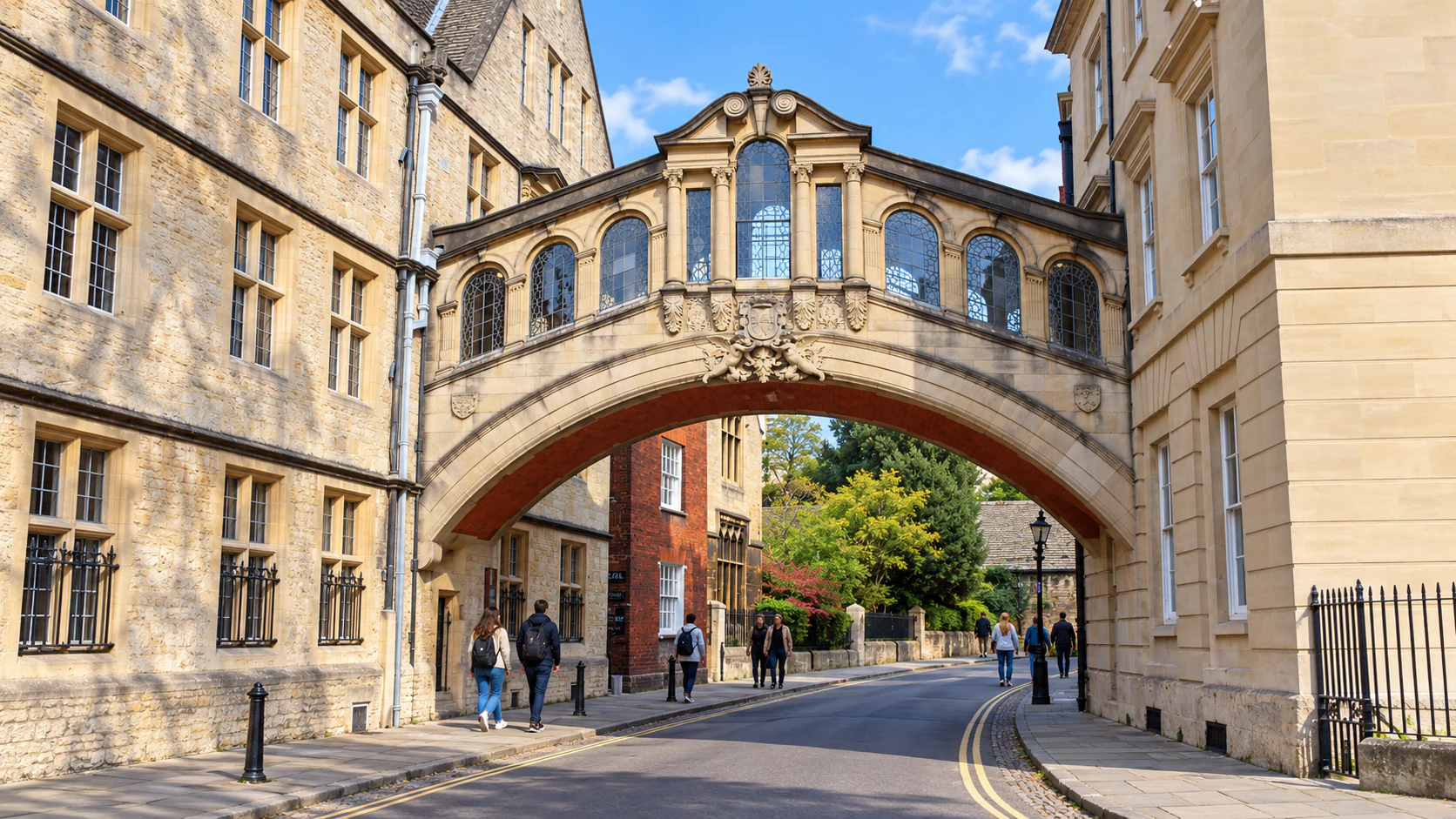
Allow 12 minutes. Turn into Catte Street for the Bridge of Sighs exterior, then continue to Radcliffe Square. Do not block the narrow lane for photographs. The Radcliffe Camera, Bodleian ranges and University Church form the classic city image; early morning and evening are calmer than midday.
Parks Road and the museums
Allow 15 minutes walking. Leave Radcliffe Square north via Catte Street, turn left on Broad Street, then right up Parks Road. Continue past university buildings to the Museum of Natural History. If open, the entrance court provides a worthwhile short look, but Pitt Rivers deserves more than a rushed add-on. Both can become a separate half-day.
Keble’s brickwork
Allow 8 minutes. Continue north on Parks Road and turn left along Keble Road. Keble College’s patterned red, blue and cream brick makes the strongest material contrast on the loop. Compare Butterfield’s assertive Victorian polychromy with the Old Parsonage’s quieter seventeenth-century stone. Check visitor access rather than following students through a gate.
Return to the oak door
Allow 5 minutes. Follow Keble Road west to Banbury Road, turn left and return to the hotel. Finish by comparing the exterior with the interior sequence: dated doorway, oak door, stone fireplace and portrait-lined restaurant. Hotel guests can continue to the library; non-residents should use a dining reservation rather than treating the building as open house.
Short version
For a thirty-minute loop, walk Old Parsonage → St Giles’ Church → Martyrs’ Memorial → Broad Street → Parks Road → Keble Road → hotel. This keeps the threshold, civic boulevard and university architecture while omitting Radcliffe Square.
Coffee and rest
Parsonage Grill is the logical start or finish and is open to the public. Jericho and Broad Street provide alternatives along the route. Book afternoon tea or a meal; do not assume a restaurant table merely because the walk ends at the hotel.
Accessibility note
The street route avoids steps where possible but Oxford paving, crossings and crowds vary. The hotel’s accessible entrance is from the car park, not necessarily the historic front door. Wheelchair users should check current dropped kerbs and consider omitting Radcliffe Square’s cobbled edges.
Make a record
Photograph it thoughtfully.
The essential rule
This is a working hotel and restaurant, not a public heritage interior. Photograph the exterior from public space with normal street awareness. Inside, ask permission, avoid other guests and never treat bedrooms, the library or private-event rooms as open photographic locations. Commercial, staged or tripod work requires advance approval from the hotel.
Best exterior view
The clearest establishing frame is from the east side of Banbury Road, far enough back to show both gables, the stone boundary wall and the beginning of the St Giles fork. A slightly oblique angle reveals the building’s depth without allowing parked cars or road signs to dominate. The dated central doorway should remain legible in a closer second frame.
Morning light generally favours the east-facing front. Late winter or early spring can reveal the stone and gable profile before foliage thickens. At night, warm light through leaded windows and the oak entrance creates a strong hospitality image, but preserve shadow detail and do not over-brighten the stone into a theatrical set.
The entrance sequence
With permission, build an interior sequence rather than one wide room shot: oak door and ironwork; date spandrel; stone fireplace; mullioned or leaded window; carved timber; then a portrait wall. These details explain the transition from seventeenth-century house to modern hotel.
Avoid flash near diners and do not photograph the reception desk with guest documents or screens visible. A small camera at quiet times is more appropriate than lights and stands.
Parsonage Grill
The restaurant is visually strongest when a few occupied tables establish scale without making identifiable diners the subject. Seek permission for any recognisable person. Use the warm, dark palette as it is; lifting every shadow destroys the club-like atmosphere. A portrait wall, stone hearth and leaded window in the same frame tell the room’s story better than a plate close-up alone.
For the terrace, photograph across planting and wisteria towards the old stone rather than isolating decorative furniture. Breakfast gives clean light; dusk balances ambient blue with warm table lighting. A reserved dining table does not confer a commercial-shoot right.
Library and guest spaces
The library is for residents. If photographing during a stay, keep other guests and their work out of frame. Strong compositions pair the shelves with a Paddy Summerfield photograph, or use the terrace doorway to connect reading space and city light. Do not move books, artworks or furniture without permission.
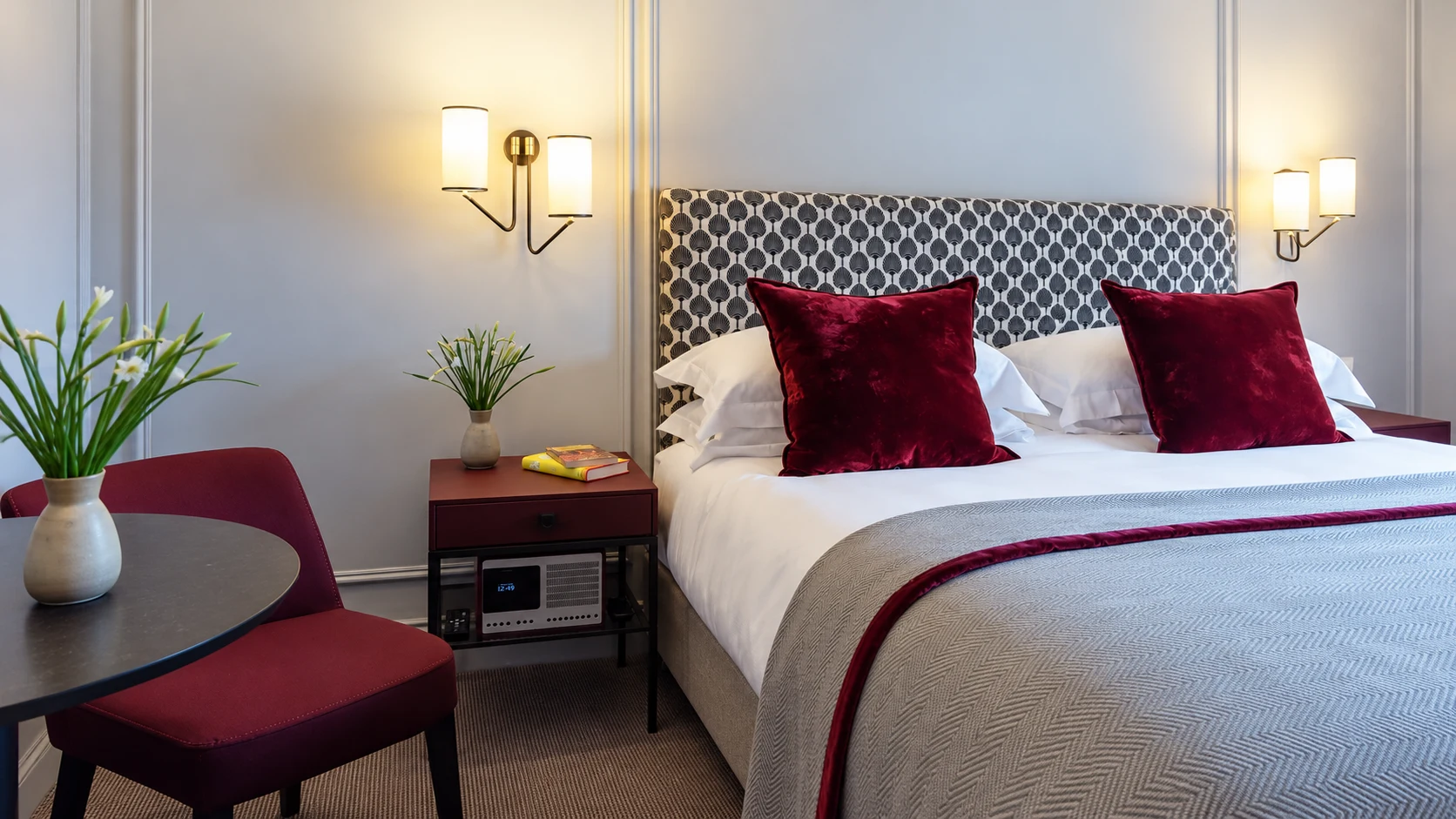
Bedrooms vary. Photograph the actual room category rather than presenting a Churchill Suite as representative of every stay. Include enough of a small room to communicate scale honestly; wide-angle distortion that doubles the apparent floor area is misleading.
Art and copyright
The hotel contains modern and twentieth-century art whose copyright may still be active. An artwork incidental to an editorial room view is different from a full-frame reproduction. Do not publish straight-on, high-resolution copies of individual paintings, photographs or memorabilia without rights clearance. Paddy Summerfield photographs and Churchill-suite materials require particular care.
People and privacy
Hotel guests have a high expectation of privacy. Never photograph room numbers with occupants, luggage tags, registration material, children without guardian consent or private events. Restaurant and wedding imagery requires explicit permission from both the venue and identifiable subjects.
Drones and elevated equipment
Do not fly a drone from or over the hotel without written permission, compliant aviation operation and a realistic assessment of dense central Oxford airspace, roads, neighbours and privacy. A drone is unnecessary for the principal story: the building’s human scale is better understood from street level. Poles or equipment projecting over the carriageway are likewise inappropriate.
See it
In pictures.
4 views, full screen. Tap any one to open the viewer.Around here
Make more of the area.
Good to know
Questions, answered.
Is Old Parsonage Hotel in central Oxford?
The Old Parsonage Hotel stands at 1–3 Banbury Road at the northern end of St Giles, around ten minutes’ walk from the High Street and close to the university museums, Somerville, Keble, Jericho and University Parks. Source Further information
How many rooms does Old Parsonage Hotel in Oxford have?
Old Parsonage Hotel in Oxford has 35 rooms and suites, including two accessible rooms, three Junior Suites and two Churchill Suites. Source Further information Further information
Is Old Parsonage Hotel in Oxford a seventeenth-century building?
Construction of the building now occupied by Old Parsonage Hotel in Oxford began in 1639. Its central doorway is dated 1659, and the principal house was completed around 1660. The property has subsequently been restored and extended. Source Further information Further information
Is Old Parsonage Hotel in Oxford Grade II or Grade II* listed?
Old Parsonage Hotel in Oxford is Grade II listed, under Historic England entry 1047358. Source Further information
Did Oscar Wilde live at Old Parsonage Hotel in Oxford?
Oscar Wilde’s stay at the Old Parsonage site in Oxford is unconfirmed. A longstanding tradition places him among Robert Brett’s undergraduate lodgers after Wilde lost his Magdalen rooms in 1877. Source
Is the Old Parsonage Hotel in Oxford independently owned?
The Old Parsonage Hotel in Oxford is part of the independently owned Oxford Collection, which also operates Old Bank Hotel, Quod, Gees and Parsonage Grill. Source Further information
Does Old Parsonage have a Michelin Key?
Yes. MICHELIN lists Old Parsonage with One Key in the 2025 UK & Ireland hotel selection. A Key is a hotel distinction, not a restaurant star. Source Further information
Can non-residents visit Old Parsonage?
Non-residents can book Parsonage Grill for breakfast, lunch, afternoon tea, dinner or drinks. Bedrooms and the first-floor library are for hotel guests; private rooms require an event booking. Source Further information Further information
What are check-in and checkout times at Old Parsonage Hotel in Oxford?
Old Parsonage Hotel in Oxford guarantees check-in from 15:00; checkout is by 11:00. Luggage storage is available. Late checkout depends on availability and may carry a charge. Source
Does Old Parsonage Hotel in Oxford have parking?
Old Parsonage Hotel in Oxford has fifteen complimentary parking bays for residents. Guest priority does not guarantee a reserved bay, so contact reception before driving. Source Further information
How far is Old Parsonage Hotel from Oxford’s railway and coach stations?
Old Parsonage Hotel in Oxford is about twenty minutes’ walk from the railway station and fifteen minutes from Gloucester Green coach station. A taxi may be easier with luggage. Source Further information
Does Old Parsonage Hotel in Oxford have a gym or swimming pool?
Old Parsonage Hotel in Oxford has neither a gym nor a swimming pool. Reception can suggest running routes and local alternatives. Source Further information
Does the Old Parsonage Hotel in Oxford have a spa?
The Old Parsonage Hotel in Oxford is not a full spa hotel. Wellness treatments may be bookable; ask about current availability. Do not expect a pool, thermal suite or permanent spa complex. Source
Is breakfast included at Old Parsonage Hotel?
That depends on the booked rate. Parsonage Grill serves breakfast daily, but room-only and package terms vary. Read the final rate conditions. Source Further information
What are the opening hours at Parsonage Grill in Oxford’s Old Parsonage Hotel?
Parsonage Grill at Old Parsonage Hotel in Oxford serves breakfast from 07:00 to 10:30, its all-day menu from 12:00 to 23:00 and afternoon tea from 12:00 to 17:00. Ask about the final breakfast sitting when booking. Source Further information
Do I need to book Parsonage Grill at Old Parsonage Hotel in Oxford?
Reservations are recommended for Parsonage Grill at Old Parsonage Hotel in Oxford. Walk-ins are accepted when space allows, but a table is not guaranteed, particularly for dinner, Sunday lunch or afternoon tea. Source
Is Old Parsonage Hotel in Oxford suitable for children?
Old Parsonage Hotel in Oxford offers cots, selected extra beds, connecting-room options, children’s books and games, and a children’s restaurant menu. There is no swimming pool or children’s club. Source Further information
How much is a child’s extra bed at Old Parsonage Hotel in Oxford?
At Old Parsonage Hotel in Oxford, an extra bed for a child aged three to sixteen costs £80 per night including breakfast, in a suitable room. Cots for children under three are complimentary. Confirm the charge and room arrangement when booking. Source
Does Old Parsonage Hotel allow dogs?
Assistance dogs are accepted for overnight stays. Other bedroom requests are considered case by case. Parsonage Grill welcomes well-behaved dogs in the bar area and on the outside terrace. Source Further information
Is Old Parsonage Hotel in Oxford wheelchair accessible?
Old Parsonage Hotel in Oxford has two accessible ground-floor rooms and a ramped car-park entrance. Original stairs and internal level changes remain, with portable ramps or alternative routes needed in places. Agree the complete route to the facilities you need before booking. Source
Does Old Parsonage Hotel in Oxford have a lift?
A passenger lift at Old Parsonage Hotel in Oxford has not been confirmed. The library is on the first floor and the Churchill Suites are on the second, so ask directly about access before booking an upper-floor room. Source Further information Further information
Who can use the library at Old Parsonage Hotel in Oxford?
The library at Old Parsonage Hotel in Oxford is exclusively for hotel residents. It has books, newspapers, sofas, a terrace and photographs by Paddy Summerfield. Source
Can guests borrow bicycles at Old Parsonage Hotel in Oxford?
Old Parsonage Hotel in Oxford provides bicycles through reception, usually without advance reservation. Ask about availability, size and equipment on the day. Source
Can Old Parsonage Hotel arrange a guided walking tour of Oxford?
Old Parsonage Hotel in Oxford can arrange private or limited-group two-hour walking tours tailored to literary, architectural, university and other interests. Book through reception or reservations. Source
Which room at Old Parsonage Hotel in Oxford suits a solo traveller?
Small Doubles at Old Parsonage Hotel in Oxford are designed for solo travellers and short stays, but measure only about 12 sq m. A Classic room offers more space. Source
Which rooms at Old Parsonage Hotel in Oxford suit families?
Family options at Old Parsonage Hotel in Oxford include connecting Superior Deluxe rooms, selected larger rooms, Junior Suites and Churchill Suites. Confirm the permitted extra-bed layout for your party before booking. Source Further information Further information
Do all rooms at Old Parsonage Hotel in Oxford have baths?
Not all rooms at Old Parsonage Hotel in Oxford have baths. Most Deluxe rooms and all higher categories offer baths and showers; Classic rooms generally have walk-in showers. Confirm the exact room arrangement when booking. Source Further information
Editorial notes
Sources and further reading.
Sources for this guide
Method
Research was completed on 21 August 2026. Current hotel and restaurant pages were used for accommodation, dining, access and guest policies. Historic England and Oxford City Council were used for heritage status. MICHELIN supplied the hotel distinction. Secondary sources were retained only where they added attributable operator or refurbishment context and did not override current primary facts.
No user reviews were used as factual evidence. Dynamic prices were observed only to explain the rate model and must not be treated as guaranteed availability.
Sources
| ID | Source | Used for | Retrieved |
|---|---|---|---|
| S01 | Old Parsonage Hotel official homepage, https://www.oldparsonagehotel.co.uk/ | 35 rooms, hotel positioning, art, library, bicycles, One MICHELIN Key and contact | 2026-08-21 |
| S02 | History, https://www.oldparsonagehotel.co.uk/history | House begun 1639 and completed 1660, Edward Selwood, Civil War context, 1659 doorway, surviving fabric, cautious Wilde tradition, hotel conversion in 1971 and acquisition in 1989 | 2026-08-21 |
| S03 | Rooms & Suites, https://www.oldparsonagehotel.co.uk/rooms-and-suites | Room categories, sizes, amenities and dynamic from-rates | 2026-08-21 |
| S04 | Hotel information, https://www.oldparsonagehotel.co.uk/information | 35 bedrooms, two suites, average size, 15 parking bays, check-in/out, transport, families, hotel services and no gym | 2026-08-21 |
| S05 | Accessibility, https://www.oldparsonagehotel.co.uk/accessibility and https://www.oldparsonagehotel.co.uk/rooms-and-suites/accessible | Two ground-floor accessible rooms, car-park entrance, portable ramps, room measurements, wet room, accessible transport and assistance dogs | 2026-08-21 |
| S06 | Location, https://www.oldparsonagehotel.co.uk/location | Address, central-Oxford position, walking, rail, coach, car and parking context | 2026-08-21 |
| S07 | Library, https://www.oldparsonagehotel.co.uk/library | Residents-only status, books, newspapers, terrace, Paddy Summerfield photography and Mogford Prize anthology | 2026-08-21 |
| S08 | Churchill Suites, https://www.oldparsonagehotel.co.uk/rooms-and-suites/the-churchill-suites | Winston and Randolph suites, 30 sq m, capacity and Oscar Nemon connection | 2026-08-21 |
| S09 | Parsonage Grill official homepage, https://www.parsonagegrill.co.uk/ | Public restaurant, British cooking, portraits, fireplace and terrace | 2026-08-21 |
| S10 | Parsonage Grill booking and menus, https://www.parsonagegrill.co.uk/book-a-table/ | Breakfast 07:00–10:30, all-day menu 12:00–23:00, afternoon tea 12:00–17:00, reservations and dietary context | 2026-08-21 |
| S11 | Hotel terms and conditions, https://www.oldparsonagehotel.co.uk/terms-and-conditions | Cot and extra-bed rules, child charges, teenage occupancy and overnight dog policy | 2026-08-21 |
| S12 | Guided walking tours, https://www.oldparsonagehotel.co.uk/experiences/guided-walking-tours | Private and limited-group two-hour guided Oxford walks arranged through the hotel | 2026-08-21 |
| S13 | Historic England — The Old Parsonage, https://historicengland.org.uk/listing/the-list/list-entry/1047358 | Grade II status, list number, first listing date, statutory address, early-seventeenth-century date and grid reference | 2026-08-21 |
| S14 | Oxford City Council planning report 15/01733/FUL, https://mycouncil.oxford.gov.uk/documents/s27119/Old%20Parsonage%20Hotel%20Banbury%20Road%2015-01733-FUL%20report.pdf | Grade II status, coursed-rubble construction, two gables, stone-slate roof, ball finials and central doorway dated 1659 | 2026-08-21 |
| S15 | Oxford City Council hotel and short-stay accommodation study, https://www.oxford.gov.uk/downloads/file/1810/oxford-hotel-and-short-stay-accommodation-study | Luxury classification, 35 rooms and absence of leisure facilities, gym and pool | 2026-08-21 |
| S16 | MICHELIN Guide — Old Parsonage Hotel, https://guide.michelin.com/gr/en/hotels-stays/oxford/old-parsonage-hotel-5927 | One MICHELIN Key, 35 rooms and hotel character | 2026-08-21 |
| S17 | MICHELIN Guide — Every MICHELIN Key Hotel in the UK & Ireland, https://guide.michelin.com/pl/en/article/travel/all-the-michelin-key-hotels-in-the-uk-ireland | Old Parsonage Hotel in Oxford within the 2025 One-Key selection | 2026-08-21 |
| S18 | The Oxford Collection — History, https://www.theoxfordcollection.co.uk/history/ | Jeremy Mogford, independent collection and relationships among Old Parsonage, Old Bank, Quod and Gees | 2026-08-21 |
| S19 | Premier Hospitality / refurbishment coverage, https://premierconstructionnews.com/2014/07/28/the-old-parsonage-hotel/ | 2014 refurbishment context only; conflicting room figure rejected | 2026-08-21 |
| S20 | Independent Oxford — Old Parsonage Hotel, https://independentoxford.com/directory/old-parsonage-hotel/ | Independent ownership and local business context | 2026-08-21 |
| S21 | Old Parsonage treatment menu, https://www.oldparsonagehotel.co.uk/assets/files/old-parsonage-hotel-treatment-menu.pdf | Evidence that treatments have been offered; availability and delivery location treated as volatile | 2026-08-21 |
| S22 | OpenStreetMap — way 66710277, https://www.openstreetmap.org/way/66710277 | Building footprint and coordinate cross-check | 2026-08-21 |
Conflict ledger
1. Statutory grade
- Hotel accessibility page: Grade II*.
- Historic England and Oxford City Council: Grade II, list entry 1047358.
Used: Grade II. Statutory evidence takes precedence.
2. Breakfast finish
- Hotel information page: 11:00.
- Dedicated Parsonage Grill booking and breakfast material: 10:30.
Used: 10:30 as the more specific restaurant source; advise readers to confirm the final sitting.
3. Oscar Wilde
- Short-form hotel marketing associates Wilde with the property.
- Detailed official history says he was “said to have” lodged there and reasons from circumstance rather than presenting documentary proof.
Used: “Traditionally associated with Oscar Wilde”; never a categorical residence claim.
4. Room inventory
- Current hotel information: 35 bedrooms including two suites.
- Room-selection journeys can include 36 St Giles residences.
- 2014 refurbishment coverage reports 65 bedrooms.
Used: 35 rooms in the hotel. Do not fold residences into the historic-house inventory, and reject the inconsistent secondary figure.
5. Wellness classification
- A hotel treatment menu exists.
- Official information and the council study identify no gym, pool or leisure complex.
Used: treatments may be available by arrangement; not a spa hotel and not a full-spa stay.
6. MICHELIN terminology
- MICHELIN gives the hotel One Key in its 2025 selection.
- A Key does not describe the restaurant.
Used: One MICHELIN Key for the hotel; no restaurant-star claim.
7. Wikidata identity
- Search results can surface Q26666941 for “Old Parsonage”.
- That item describes a different listed building in Stanton St John.
Used: no Wikidata identifier until the Oxford hotel is independently verified.
Reverification schedule
| Content | Cadence |
|---|---|
| Room rates, packages and cancellation | Monthly |
| Restaurant hours and menus | Monthly |
| Parking and Oxford driving rules | Monthly |
| Treatment availability | Monthly |
| Inventory, child and dog rules | Quarterly |
| Accessibility routes | Quarterly |
| MICHELIN Key | Annually |
| Heritage and identifiers | Annually |
Last full research pass: 21 August 2026. Next operational review: 21 September 2026.
Opening hours, prices, programmes and access arrangements can change. Confirm critical details with the venue.
Continue exploring / Oxford
More to explore
in Oxford
Find another place for your itinerary, or explore all things to do in Oxford.
 Food & drinkParsonage GrillBritishExplore experience →
 Food & drinkBrowns OxfordBritishBrasserieExplore experience →
 Food & drinkThe Royal OakPub foodSunday roastsExplore experience →
 Food & drinkKIBOU OxfordJapaneseSushiExplore experience →