museum / Oxford
In depth
Bate Collection of Musical Instruments
More than 1,000 historical instruments reveal how music was made, played and studied — in a free specialist collection built around sound and craft.
Story · Visit · Route · Links
Visitor Essentials & Quick Answers
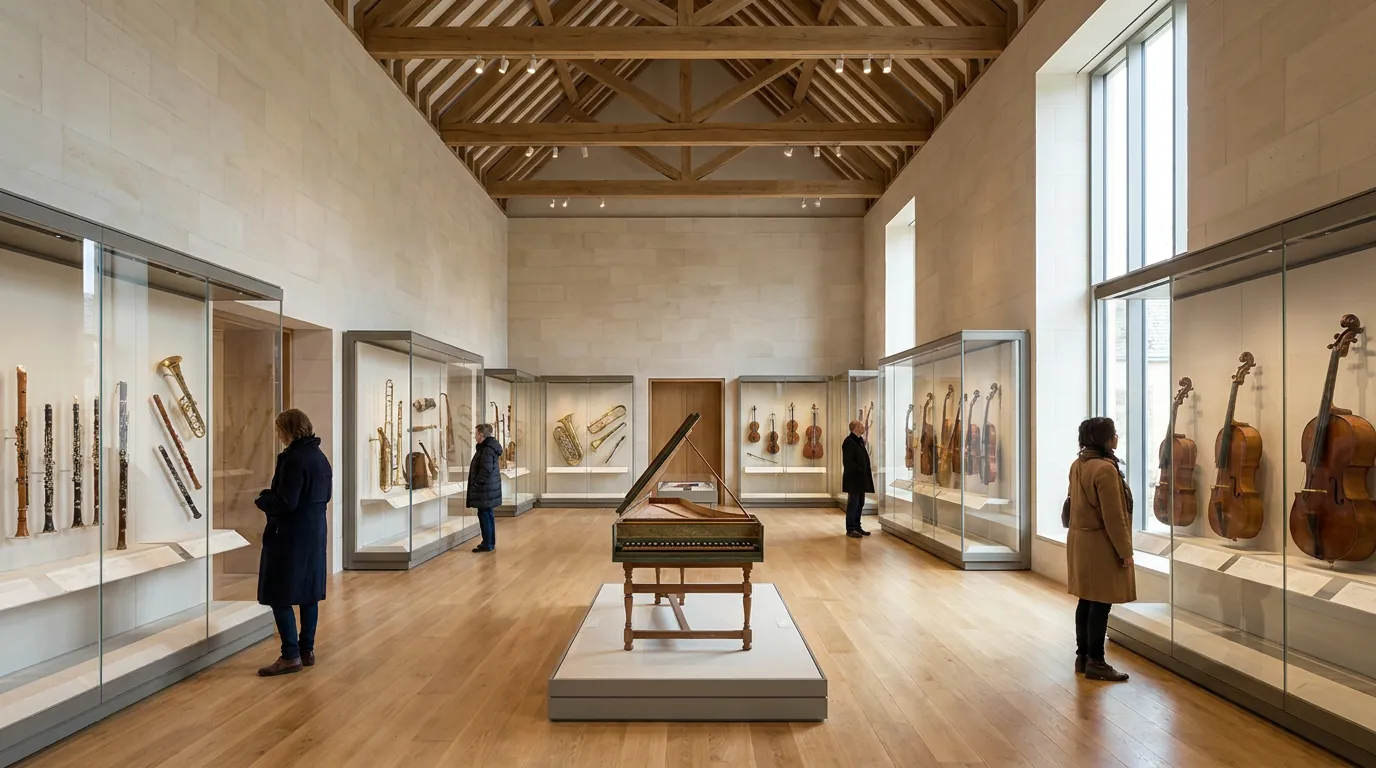
Is the Bate Collection interesting if I am not a musician?
Yes, if you enjoy ingenious objects and the stories behind them. Compare a trumpet without valves with later instruments, or look at how extra keys changed woodwind playing. You do not need to read music: shape, materials and the problem each maker was trying to solve give you a way into the collection.
Which instruments have the best stories?
Look for the Bressan recorder that survived the bombing of its collector’s London home, and the 1667 Beale Trumpet, made by a trumpeter who served both Cromwell and Charles II. The contrast turns a row of instruments into a story about survival, court ceremony and changing musical life.
Why does Oxford keep a collection of playable instruments?
Philip Bate wanted his gift to support practical learning as well as preservation. Suitable instruments help supervised students and researchers discover how older music worked in performance. That does not make the gallery a public instrument try-out: conservation and expert supervision govern what can be played.
What should I combine with the Bate Collection?
Pair the instruments with the architecture and public arts programme of the Schwarzman Centre, their new home. Historical instruments, music teaching and performance spaces belong to the same building. Plan around the collection’s own visiting arrangements rather than assuming access whenever the wider Centre is open.
Choose your depth
Essentials or more detail?
See visiting essentials, or read more about the history and places nearby.Start here
Understand the place.
The context, character and reasons this experience earns time in your Oxford plans.The Bate Collection of Musical Instruments is the University of Oxford’s teaching collection of historical instruments and one of Britain’s most substantial specialist collections of woodwind, brass and percussion. It also holds important keyboards, strings, bows, instrument-making tools, archives and instruments from beyond Europe. More than a thousand objects are displayed, illustrating how instruments were made, modified, played and understood from the Renaissance and Baroque periods to the modern era.
Since 2026 the collection has occupied a purpose-designed ground-floor gallery in the Stephen A. Schwarzman Centre for the Humanities. Its permanent exhibition, Resonant Histories: Material Culture, Sound, and Craft, treats instruments not as silent decorative objects but as evidence of makers, materials, performers, trade, technology and cultural exchange. This approach reflects the principle on which the collection was founded: historical instruments should support practical study as well as preservation.
Why it matters
Philip Argall Turner Bate was a BBC producer, geologist, palaeontologist, instrument scholar and amateur clarinettist. He assembled a systematic group of European orchestral woodwind instruments and gave it to the University in the 1960s. His gift was conditional on students being able to play suitable instruments under expert care. That condition made the collection distinctive. Many museums preserve musical instruments primarily as visual and material artefacts; the Bate also asks what knowledge can be recovered through sound, handling and performance.
The collection subsequently expanded through major gifts, bequests, loans and purchases. These include the Reginald Morley-Pegge Memorial Collection of horns and other wind instruments; the Anthony Baines Collection and archive; the Edgar Hunt Collection of recorders; keyboard collections associated with Roger Warner and Michael Thomas; the William Retford workshop tools and memorial bows; the Javanese gamelan Kyai Madu Laras; and many individual instruments.
The result is not a single chronology of Western orchestral development. It is a layered history of collecting and classification. Visitors can examine technological solutions—keys, bores, valves, reeds, stringing, cases and mechanisms—but should also ask whose musical traditions were collected, how objects travelled, and how museum categories have changed. The new exhibition’s title, Resonant Histories, signals this broader reading.
What to see
Several objects have exceptional stories. A treble recorder made around 1720 by Pierre Jaillard, known as Peter Bressan, survived the bombing of collector Edgar Hunt’s London flat and was recovered from the rubble wrapped in a shirt. It is considered one of the finest and least-altered surviving instruments by the maker.
The Beale Trumpet was made in 1667 by Simon Beale, who served as a state trumpeter under Oliver Cromwell and later Charles II. In a later phase of its life it became the “luck” of Woodsome Hall and was reportedly used by the butler to call people to dinner. Its altered construction and unusually large mouthpiece also make it an object of technical investigation rather than a perfect relic.
A violin labelled by Jacob Rayman and dated 1641 is thought to be the earliest known English-made violin. The William Smith harpsichord, made around 1720, is the only known surviving instrument by its maker and closely resembles the harpsichord shown in Philippe Mercier’s portrait of George Frideric Handel. The resemblance is intriguing but is not proof that Handel owned or played it.
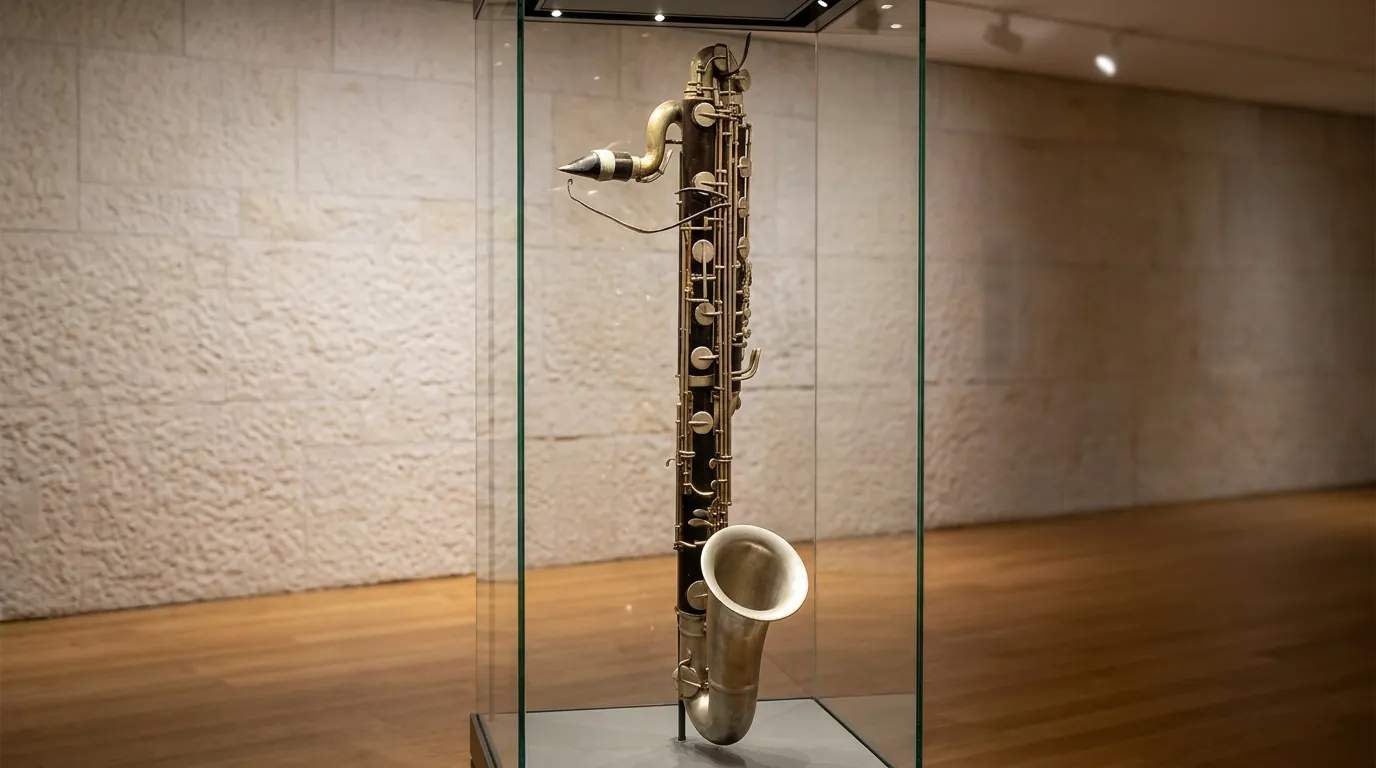
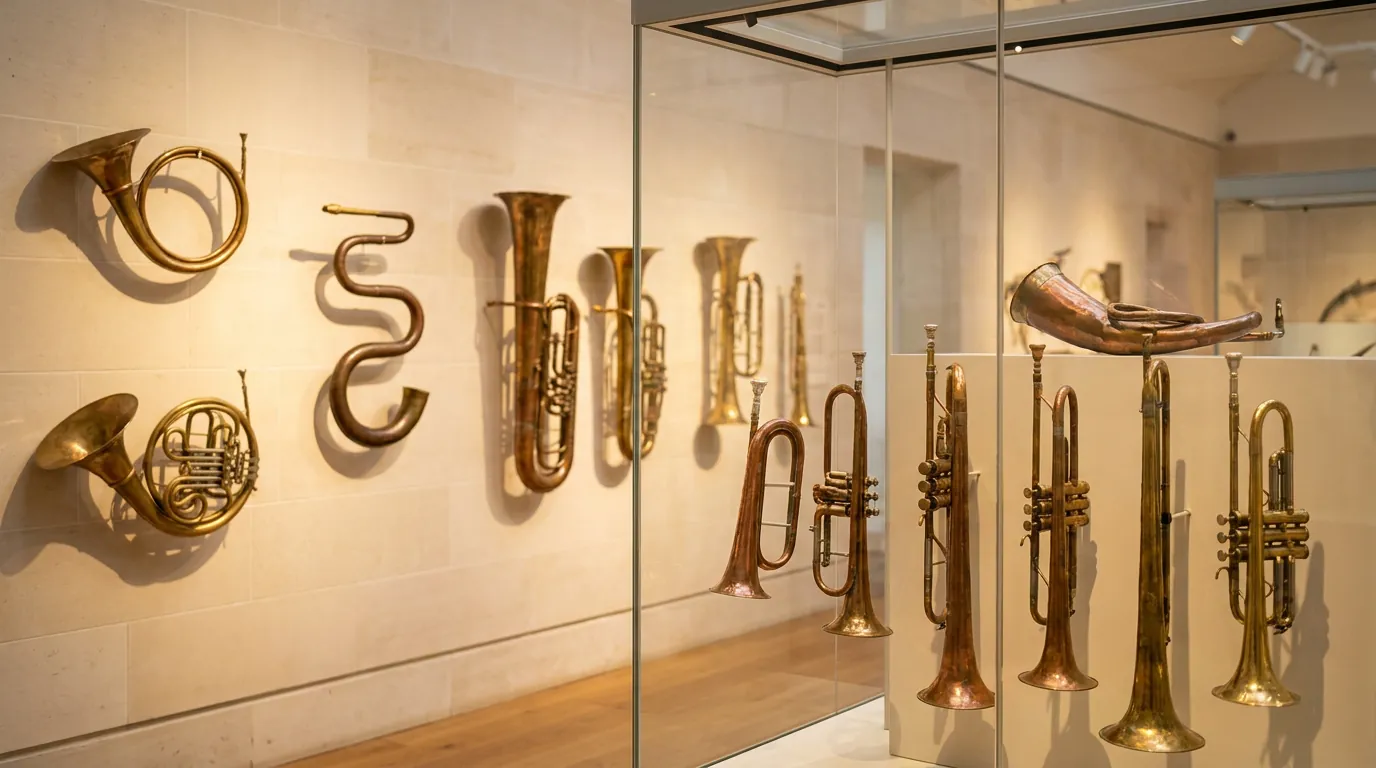
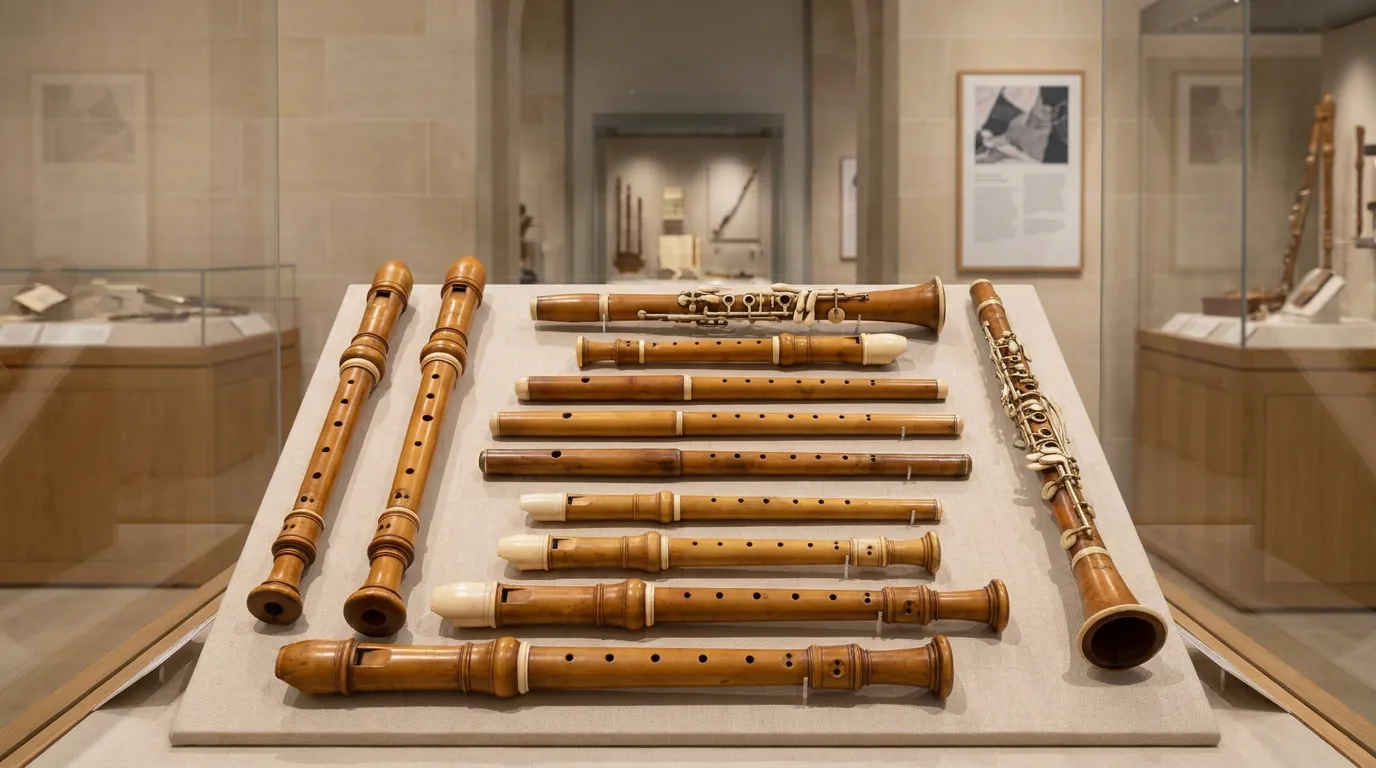
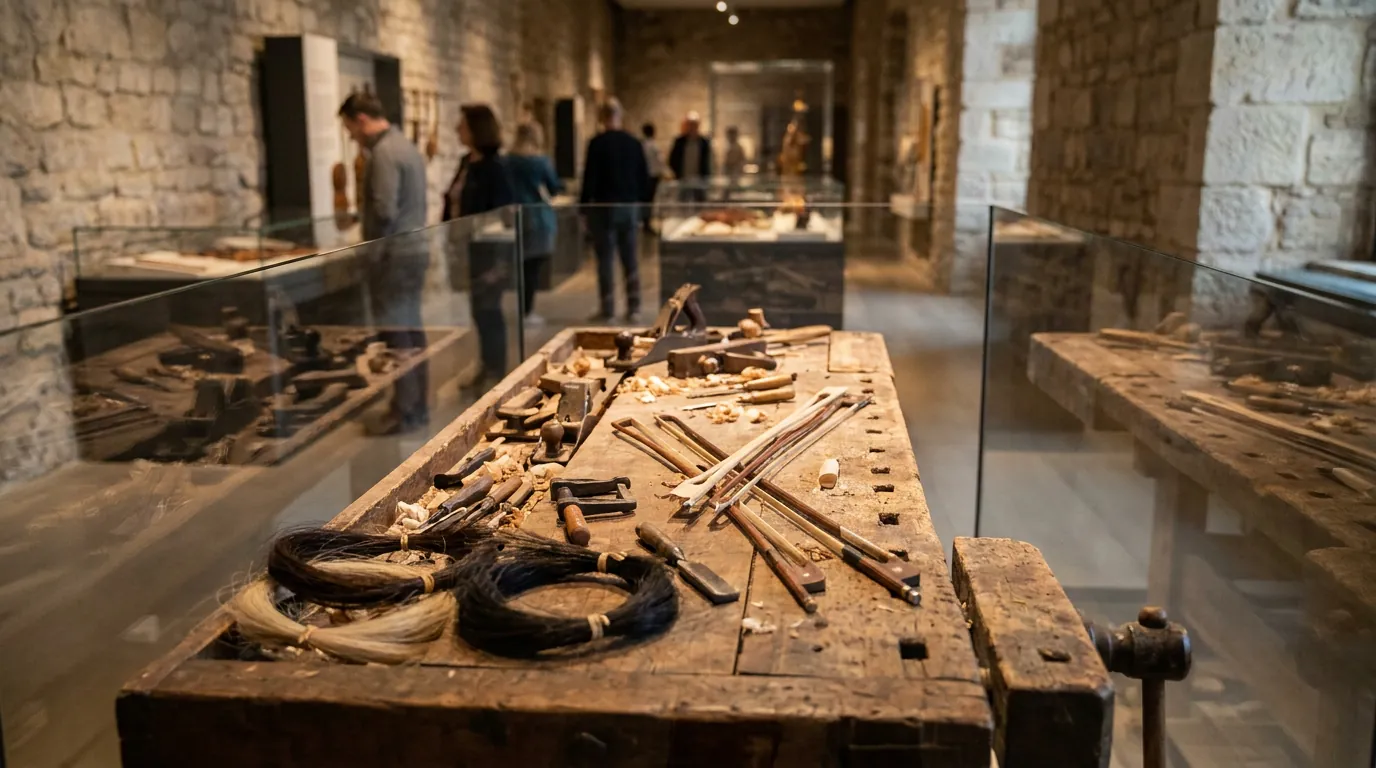
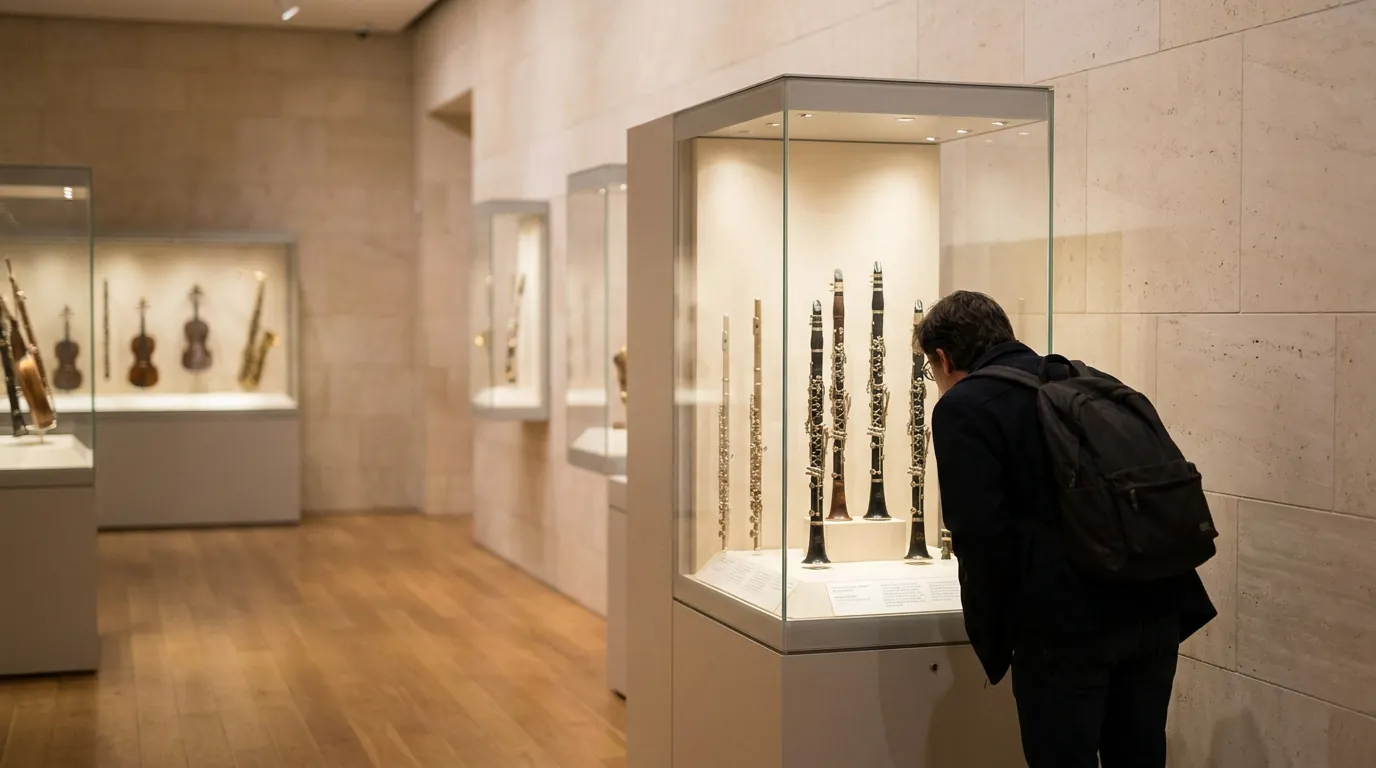
The collection’s strength lies equally in groups rather than masterpieces. Sequences of flutes, oboes, clarinets, bassoons, horns and trumpets show changing pitch, fingering and mechanics. Keyboards demonstrate different ways of setting strings into vibration. The Retford tools reveal the specialised craft behind bow-making. The gamelan reminds visitors that musical systems, ensembles and material traditions cannot be understood through European orchestral categories alone.
The visitor experience
The Bate is not a large general museum. It rewards close looking. A useful visit compares instrument families, examines joints and mechanisms, reads the histories of individual makers, and uses available sound or digital interpretation to reconnect displayed objects with performance.
The Collection currently opens only from 14:00 to 17:00 on Mondays and Thursdays. Admission is free. These hours are far narrower than the Schwarzman Centre’s daily building hours, so visitors must plan carefully and check the official Bate website before travelling. Groups, researchers and education sessions should contact the collection in advance.
The move to the Schwarzman Centre improves physical access. There is a level route from the pavement, powered entrance doors, lifts, accessible WCs on every floor and a Changing Places facility at basement level. The Bate itself is on the ground floor. The wider Centre provides a café, coffee bar and public seating, though those facilities have their own schedules.
Who it appeals to
- Musicians and music students can trace the physical development of instruments they know by sound.
- Makers and conservators can study materials, tooling and technical adaptation.
- Social and cultural historians can investigate trade, domestic music, military signalling, court ceremony and collecting.
- Families can use shape, size and sound as accessible entry points, particularly during handling sessions.
- General visitors can discover a quieter Oxford collection with strong object stories.
- Researchers can consult catalogues and archives by arrangement.
Visitors do not need to read music. Mechanical curiosity is enough: why does this trumpet have no valves, why are these clarinet keys different, why is a harpsichord not a piano, or how can an instrument survive while its sound changes?
What makes it unique
The defining feature is the relationship between object and use. “Playable” does not mean every visitor may handle or perform on historical instruments. It means trained staff make careful judgements about which objects can support supervised teaching, research or performance. Replicas and modern copies may be used when originals are too fragile. The practice produces knowledge while accepting conservation limits.
The new location strengthens that mission. A collection object can now move conceptually—and sometimes practically—from gallery case to seminar, studio or performance hall within the same complex. The Bate sits beside the Faculty of Music and near the Sohmen Concert Hall, recording studios and experimental performance spaces.
For visitors, the collection offers a different image of Oxford scholarship. It is precise, material and audible: history discovered through turned wood, cast brass, stretched strings, worn finger holes, repair marks, makers’ tools and the disciplined attempt to hear the past without pretending it can be recovered unchanged.
The full story
How it came to matter.
Philip Bate before the collection
Philip Argall Turner Bate was born in 1909 and died in 1999. His professional life was unusually varied. Trained in geology and palaeontology, he spent much of his career at the BBC as a radio and television producer. He worked on live broadcasts, interviews, ballet and cultural programming, while maintaining a deep practical and scholarly interest in musical instruments.
Bate was an amateur clarinettist and began collecting while young, searching markets and second-hand shops. Scientific training encouraged him to examine instruments systematically: not simply as antiques, but as designed objects whose bores, materials and mechanisms affected performance. He developed woodworking and metalworking skills, restored instruments and made reproductions.
In 1946 Bate helped found the Galpin Society, the first society devoted specifically to the history and study of musical instruments. The society connected players, collectors, makers and scholars at a time when organology—the study of instruments—was becoming more formally established.
The founding gift
The University’s own official histories differ on the precise way the first gift is dated. The Bate website’s short history states that Philip Bate gave his extensive collection of European orchestral woodwind instruments in 1963. Its biographical page says he presented the collection to the University in 1968. The difference may distinguish an initial offer or transfer from formal institutional acceptance; editors should not conceal the discrepancy.
What is clear is that the gift was built around a condition. Bate wanted students to be able to play suitable historic instruments. He believed that an instrument’s purpose and development could not be understood solely through visual inspection. The collection would therefore require expert care, teaching and practical use.
The University took time to establish the collection. For seven years Dr Horace Fitzpatrick served as honorary curator and worked towards formal acceptance. In 1970 Anthony Baines became the first full-time curator. The collection was then based on Holywell Street.
Reginald Morley-Pegge
Reginald Morley-Pegge, a horn player and instrument historian, gave instruments and allowed the collection to purchase material from his holdings. After his death in 1972, his son William presented the remaining instruments and library as a memorial.
The Morley-Pegge library is particularly important for French material and early instrumental tutors. Such printed sources explain how instruments were taught and described, allowing physical evidence to be compared with historical practice.
Anthony Baines
Anthony Baines was one of the leading organologists of the 20th century. As the first full-time curator, he expanded the collection’s scope and developed it as a practical research centre. His publications on woodwind, brass and musical-instrument history became standard works.
Baines’s own collection and archive later came to the Bate. The archive documents research, correspondence, photographs and the post-war development of organology. It is significant not only for individual instruments but for understanding how scholars and collectors constructed the field.
Growth through collections and gifts
The original woodwind focus broadened through many acquisitions:
- The Edgar Hunt accession added more than 60 instruments, including the celebrated Bressan treble recorder.
- The Roger Warner and Michael Thomas material strengthened the historical keyboard holdings.
- Instruments and loans associated with Taphouse and Jean Henry added further depth.
- William Retford’s bow-making tools came to the collection after his death in 1970, alongside the nucleus of a memorial bow collection.
- The collection acquired instruments associated with Jeremy Montagu and other scholars.
- The Wally Horwood Collection added books and recordings.
These named groups matter because a museum collection is partly a history of choices. Each donor had interests, networks and assumptions that influenced what entered the institution.
The Bressan recorder
Pierre Jaillard, called Bressan after his origin in Bourg-en-Bresse, made the famous treble recorder around 1720. He had moved to England in the late 17th century and became associated with royal musical service.
The instrument later belonged to Edgar Hunt. During the Second World War, Hunt’s London flat was bombed. He returned to the ruins and found the recorder wrapped in a shirt. Its survival story is memorable, but the instrument’s scholarly value is more important: it remains one of the least modified examples by a leading maker and has influenced modern copies.
The Beale Trumpet
Simon Beale made the trumpet in 1667. Beale’s career crossed a profound political transition: he served as State Trumpeter under Oliver Cromwell and later under the restored monarchy of Charles II.
The trumpet shows continental influence and may reflect exchange among royal trumpeters. Its later history at Woodsome Hall transformed it from ceremonial instrument into household signal. Alterations complicate the object: soldered joints and a probably replaced bell mean it is not intact in an idealised sense. X-rays and metallurgical work have helped interpret its construction, while modern copies test how the design performs.
The Rayman violin
A violin dated 1641 and labelled by Jacob Rayman is thought to be the earliest known English-made violin. Rayman was a German-born maker working in London. The object demonstrates how apparently national traditions depend on migration, workshop knowledge and international exchange.
The wording “thought to be” is essential. Claims about earliest surviving instruments depend on attribution, dating and future discoveries.
Historical keyboards
The Bate holds harpsichords, spinets, virginals, clavichords and early pianos, many maintained for supervised use. The William Smith harpsichord, made in London around 1720, is the only known surviving instrument by its maker.
Its keyboard has distinctive “skunktail” sharps striped with ebony and ivory. The instrument closely resembles the harpsichord in Philippe Mercier’s portrait of Handel, down to unusual details. The correspondence has led to speculation, but provenance has not established that the depicted and surviving instruments are identical.
Gamelan and global scope
In 1985 the Indonesian Minister of Forestry, Sudjarwo, presented Kyai Madu Laras (“Venerable Sweet Harmony”), a complete Javanese slendro and pelog gamelan. It has been regularly played, reinforcing the collection’s practical ethos.
The gamelan also exposes the limitations of treating all objects as individual “instruments”. A gamelan is a named ensemble with tuned relationships, social meaning and performance practice. Its presence encourages a global perspective beyond the linear development of the European orchestra.
From Holywell Street to St Aldate’s
The collection was initially housed in Holywell Street under Anthony Baines. It later moved with the Faculty of Music to St Aldate’s, where generations of visitors encountered densely displayed cases. The location supported teaching but was less prominent than Oxford’s major museums and had physical and interpretive constraints.
Accreditation and research
The Bate became an accredited museum under Arts Council England’s Museum Accreditation Scheme and participates in the International Council of Museums’ committee for musical-instrument collections, CIMCIM.
Research expanded beyond catalogue description. Projects have examined the Anthony Baines Archive, instrument collecting, digital access, Renaissance instruments, hybrid cultural objects and electroacoustic relationships with gamelan. Digital Bate and online sound resources make parts of the collection accessible beyond Oxford.
Planning the move
When the Stephen A. Schwarzman Centre for the Humanities was planned, the Bate was included as a central collection rather than an isolated store. A Wolfson Foundation grant supported new display and engagement provision. The stated aims included better access, more visible objects, education, performance and links with the Faculty of Music’s new facilities.
Moving historical instruments required inventory control, condition assessment, conservation, packing and phased disruption to loans. An instrument that is normally playable may still be highly vulnerable to changes in humidity, shock and handling.
Resonant Histories
The new permanent exhibition, Resonant Histories: Material Culture, Sound, and Craft, was curated by Dr Emanuela Vai and opened during the Schwarzman Centre’s public Open House on 25 April 2026.
The exhibition shifts attention from a purely technical development sequence to the relationships surrounding instruments. Materials come from landscapes and trade networks; craft embeds skill and labour; sound depends on bodies and spaces; collections preserve some histories while marginalising others.
The opening programme included historical keyboard, horn, trumpet, violin, harmonium, hurdy-gurdy and theremin performances, together with handling and research sessions. It made explicit that the Bate’s new gallery remains connected to sound.
Myths and controversies
“Every instrument can be played”
No. Use depends on condition, significance, conservation risk and staff permission. Some historical objects may be played under supervision; replicas or modern copies may be used instead.
“The collection began in a single uncontested year”
Official pages cite both 1963 and 1968. A responsible history records that ambiguity pending clarification from accession or University archive records.
“A museum instrument preserves its original sound”
Instruments change through ageing, repair, replacement parts, pitch standards and player technique. Performance can investigate possibilities, not reproduce an unquestionable original sound.
“The Smith harpsichord belonged to Handel”
Its resemblance to the instrument in a portrait is striking, but documented provenance has not proved ownership.
Collecting and global representation
Like many musical-instrument collections, the Bate grew from European scholarly and collecting traditions. Current interpretation must examine provenance, colonial contexts, classification and the authority to play or represent instruments from living cultures.
Modern significance
The Bate’s importance lies in the productive tension between preservation and use. Handling and playing can create knowledge but also cause wear. Keeping an instrument silent may protect material while obscuring its designed function. The collection’s task is not to resolve that tension once, but to make careful, transparent decisions object by object.
Its new home creates opportunities for teaching, performance and wider public access. It also creates obligations: to maintain conservation standards, expand provenance research, represent global traditions responsibly, publish catalogue knowledge, and ensure that restricted opening hours do not undermine the promise of wider access.
The Bate is therefore both a collection of historical instruments and a continuing experiment in how musical heritage should be kept alive.
Look closer
Highlights and hidden details.
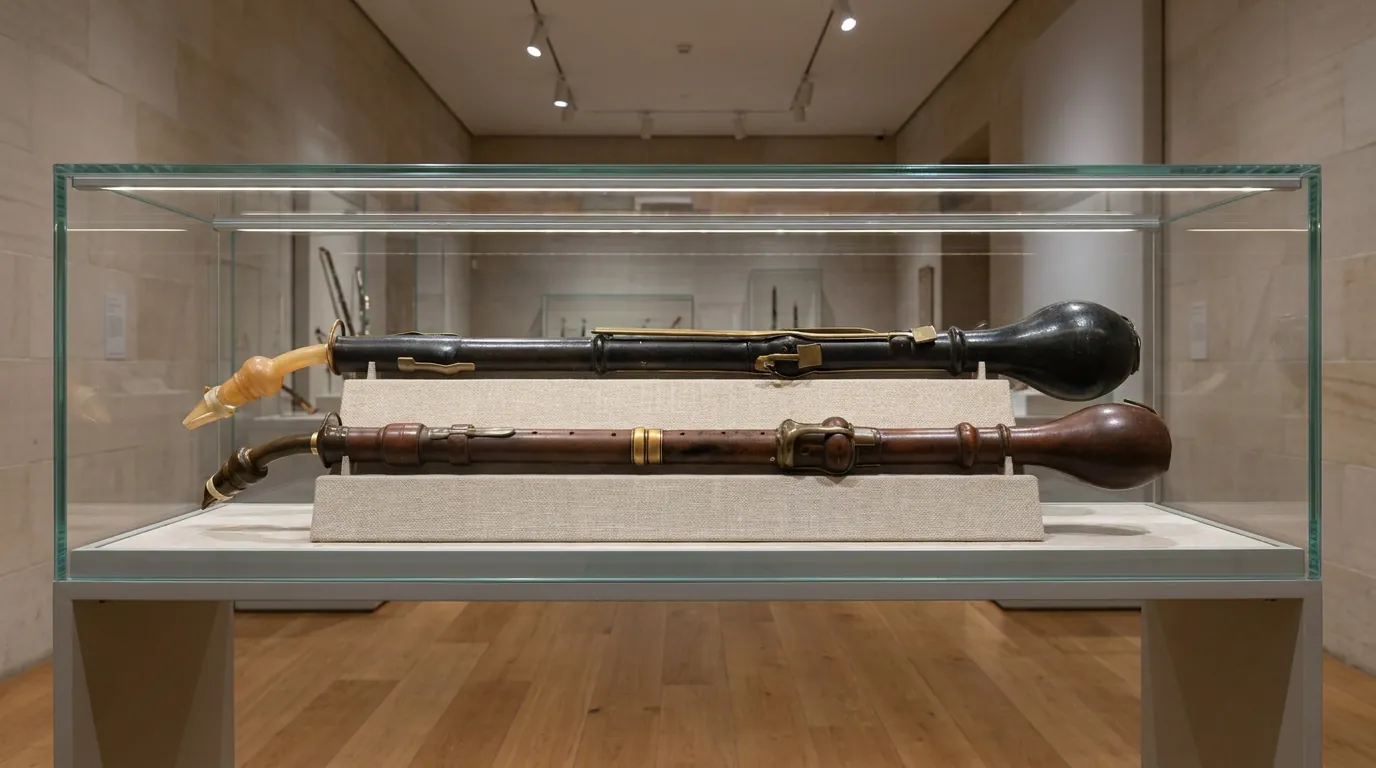
The objects, spaces and small observations that turn a visit into a memorable one.Bressan treble recorder, c.1720
Description: A recorder by Pierre Jaillard, known as Peter Bressan, preserved with relatively little alteration.
Historical importance: It is regarded as one of the finest surviving instruments by the maker and has informed modern reproductions. It survived the bombing of Edgar Hunt’s London home.
Visitor experience: Examine the elegance of its turned wooden joints and compare it with later recorder designs.
Photography: Use a slight diagonal to reduce case reflections; include the label.
Time: 8–10 minutes.
Beale Trumpet, 1667
Description: A natural trumpet made by Simon Beale, former state trumpeter to Cromwell and Charles II.
Historical importance: It links court and state music across the Restoration. Its altered construction, X-ray evidence and later domestic use make it a rich object biography.
Visitor experience: Look at the long tubing, large mouthpiece and absence of valves.
Photography: A profile view best explains the tube and bell.
Time: 8–10 minutes.
Jacob Rayman violin, 1641
Description: A labelled London violin by the German-born maker Jacob Rayman.
Historical importance: It is thought to be the earliest known English-made violin, illustrating the international movement of makers.
Visitor experience: Compare its outline, varnish and construction with familiar modern violins.
Photography: Capture front, scroll and label imagery where visible.
Time: 6–8 minutes.
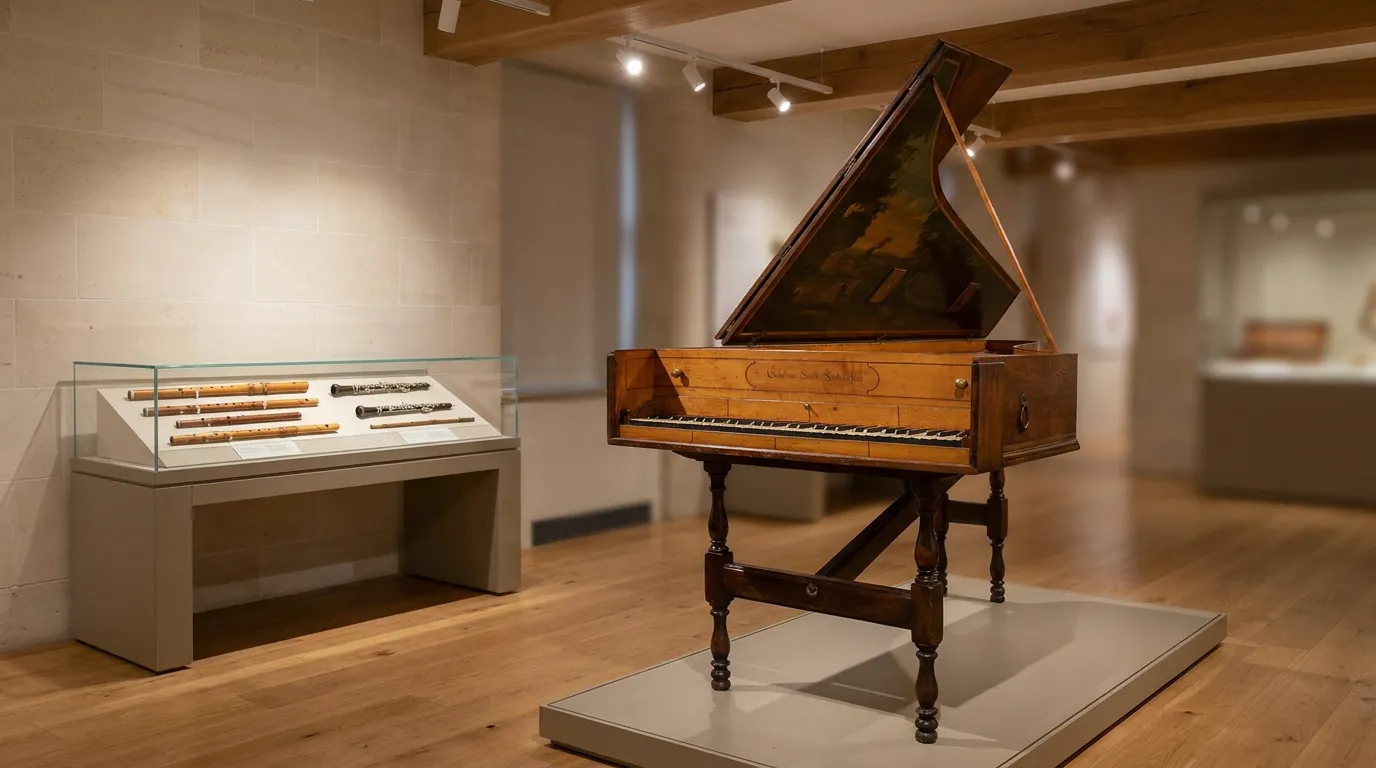
William Smith harpsichord, c.1720
Description: A walnut-cased single-manual English harpsichord with distinctive striped “skunktail” sharps.
Historical importance: It is the only known surviving instrument by Smith and closely resembles the keyboard in Mercier’s portrait of Handel.
Visitor experience: Look for the diagonal soundboard arrangement, case fittings and key decoration.
Photography: A three-quarter view shows case and keyboard together.
Time: 10 minutes.
Historical woodwind sequences
Description: Groups of flutes, oboes, clarinets and bassoons from leading makers and periods.
Historical importance: These sequences reveal changing bores, keys, pitch, materials and orchestral demands.
Visitor experience: Choose one family and follow its mechanics chronologically.
Photography: Details of keys and joints are more informative than a distant full case.
Time: 15–20 minutes.
Retford bow-making tools
Description: Tools and workshop material associated with the bow maker William Retford.
Historical importance: They document production knowledge often absent when museums display only finished instruments.
Visitor experience: Identify how specialised hand tools shape, bend and finish components.
Photography: Close details with scale and labels.
Time: 8 minutes.
Kyai Madu Laras gamelan
Description: A complete Javanese slendro and pelog gamelan presented in 1985.
Historical importance: It broadens the collection beyond European organology and functions as a named, tuned ensemble.
Visitor experience: Seek interpretation about collective tuning and performance rather than viewing each component in isolation.
Photography: A wide ensemble view is essential; details of carved and bronze elements can follow.
Time: 10–15 minutes.
Details worth slowing down for.
Repairs are evidence
Solder, replacement parts, plugged holes and changed keywork are not simply damage. They record how owners kept instruments useful or adapted them to new musical expectations.
Makers’ marks
Look for stamped names, symbols and labels. Attribution may depend on tiny marks that link an object to a workshop or city.
Bores and interiors
The most acoustically important geometry is often invisible. Digital images, diagrams or X-rays can reveal internal bores that distinguish instruments with similar exteriors.
Skunktail sharps
The William Smith harpsichord’s raised keys use longitudinal ebony–ivory–ebony stripes. The pattern is a practical clue to relationships among English keyboard makers.
The Beale Trumpet’s missing back-bore
X-ray examination indicates that its soldered mouthpiece lacks a back-bore, creating intonation challenges. The detail warns against assuming an old object survives in ideal playing condition.
Finger-hole wear
On woodwind, worn holes and surfaces can preserve traces of repeated touch. These marks may help visitors imagine technique while remaining cautious about assigning wear to one player.
Instrument families as experiments
Compare several clarinets, flutes or horns. Incremental changes show that modern forms emerged through many competing solutions, not one clean invention.
A gamelan is not a cabinet of separate objects
Kyai Madu Laras is a named ensemble whose instruments are tuned in relation to one another. Museum cataloguing can separate objects that musical practice treats as a whole.
The collection behind the display
Archives, tutors, drawings, photographs, recordings and tools are essential to understanding the objects. A gallery visit reveals only part of the research resource.
Best viewpoint
Stand at the end of a long case and look along repeated bells, keys or bodies. The view turns a dense display into a visible history of mechanical variation.
Make it work
Plan the visit properly.
Current practical detail, kept separate from the story so it is easy to scan when you need it.Essential information
- Location: Ground floor, Stephen A. Schwarzman Centre for the Humanities
- Address: Radcliffe Observatory Quarter, Woodstock Road, Oxford OX2 6GG
- Opening hours: Monday and Thursday, 14:00–17:00
- Admission: free
- Suggested duration: 45–75 minutes
- Website: bate.ox.ac.uk
Opening and booking
The Bate’s hours are independent of the Schwarzman Centre, which opens daily. Do not assume the gallery is open whenever the building is. Check the official homepage immediately before visiting, particularly around University closures and exhibition work.
Individuals do not normally need to book for standard opening hours. Groups, school sessions, tours, research appointments and archive access should be arranged in advance through the collection.
Best time
Arrive shortly after 14:00 for the quietest and least rushed visit. Monday and Thursday are both normal working days in the surrounding academic building. University term may bring teaching activity; vacation can affect staffing.
What to expect
The permanent exhibition is called Resonant Histories: Material Culture, Sound, and Craft. More than a thousand instruments are displayed across the collection as a whole. Interpretation combines individual object stories with materials, craft, technology and cultural context.
The gallery is suited to close looking rather than rapid sightseeing. Compare related instruments, notice repairs and mechanisms, and use available sound or digital resources. Displayed historical instruments should never be touched unless staff explicitly invite handling in a supervised session.
Facilities
The wider Schwarzman Centre has public toilets, accessible WCs on all floors, a Changing Places facility on Basement Level 2, baby changing, café, coffee bar, seating and free Wi-Fi. Food and drink should not be taken into the collection unless staff state otherwise.
Accessibility
The Bate is on the ground floor with step-free access from wide powered entrances. Main routes are level. The Schwarzman Centre has lifts, hearing-support systems and bookable Blue Badge parking. Contact the collection or Centre for object-label, seating, lighting or sensory requirements not described online.
Families
Children are welcome and admission is free. The cases include visually distinctive objects, but family engagement is strongest during advertised handling sessions or learning events. Children under 12 must be accompanied in the wider Centre.
Photography
Follow gallery signs and staff instructions. Use hand-held equipment without flash unless explicitly permitted. Commercial work, tripods, lighting and filming require advance permission from the venue. Reflections can be reduced by photographing at a slight angle to cases.
Food, weather and duration
The collection is fully indoors and excellent for rain. Allow one hour, adding time for the Great Hall or café. The Centre’s café and coffee bar usually open weekdays 08:00–16:00, so they overlap with most Bate visits.
Getting there
Walk north from central Oxford via St Giles and Woodstock Road, or approach from Jericho via Walton Street. Local buses serve Woodstock Road and St Giles. Oxford railway station is roughly a 20–25-minute walk. General parking is scarce; use public transport or Park & Ride. Cycle parking is available around the Quarter.
Practical advice
- Confirm the Monday/Thursday schedule.
- Bring a light layer: conservation environments can feel cool.
- Keep bags close and follow any Schwarzman Centre security search.
- Use pencil, not ink, if staff permit study notes near objects.
- Ask before sketching with materials; pigment use is restricted in the wider building.
- Treat “playable collection” as a curatorial principle, not permission for visitor handling.
Visit your way
Access and family planning.
Arrival
The Bate Collection occupies the ground floor of the Schwarzman Centre. A level route leads from the pavement to wide powered entrance doors. The building has entrances at both ends.
Wheelchair access
The collection and all public ground-floor routes are step-free. Lifts serve the rest of the building. Internal doors on main routes are powered or held open.
Parking
Nine on-site Blue Badge spaces are available by advance request through the University Estates Helpdesk. Public Blue Badge bays are also available on Walton Street. Include date and start/end times when requesting a University space.
Toilets
Accessible WCs are available on every floor of the Schwarzman Centre. A Changing Places toilet is located on Basement Level 2. Baby-changing facilities are provided.
Seating and fatigue
The official access page confirms accessible circulation but does not give a detailed inventory of gallery seating. Visitors who need frequent rest points should contact the Bate before travelling. Additional seating is available in the wider ground-floor public area, though it may be busy.
Hearing access
The wider building provides hearing-support systems in teaching and performance spaces. The published Bate access page does not specify induction or infra-red provision for every element of gallery interpretation. Contact staff about tours, events or audio content.
Visual access
Cases, labels and object lighting may create glare or low-contrast conditions. No comprehensive public description of large-print, tactile or audio-described gallery resources was identified at the time of research. Ask the collection what formats are available.
Noise and sensory conditions
The gallery is likely to be quieter than the Great Hall, but sound demonstrations, groups and surrounding academic activity can change conditions. Monday/Thursday opening periods are short, so a guaranteed quiet hour is not published. Contact staff for current advice.
Assistance animals
Assistance animals are welcome in the Schwarzman Centre. Non-service animals are not admitted.
Research and individual adjustments
Researchers requiring object access should arrange an appointment and state handling, desk, lighting or communication needs. Access to original objects always remains subject to conservation.
Contact
Use the Bate Collection’s official contact page for gallery-specific requirements, or enquiries@schwarzmancentre.ox.ac.uk for building access.
Suitability
The Bate is a good free visit for children interested in music, making or unusual objects. It is a looking-and-listening collection rather than a general hands-on gallery, except during supervised sessions.
Age recommendations
- Under 5: keep the visit to 20–30 minutes and focus on large shapes, colours and “how might it sound?”
- 5–8: compare the biggest and smallest instruments and find wood, metal, strings, keys and drums.
- 9–12: explore how mechanisms changed and why instruments belong in families.
- Teenagers: connect objects to music, physics, craft, migration, empire and museum ethics.
Educational value
Useful questions include:
- How does an instrument make air or strings vibrate?
- Why were keys and valves added?
- What can repair marks tell us?
- Can a museum preserve sound?
- Who decides whether an old instrument may be played?
- Why is a gamelan understood as an ensemble?
Facilities
The ground-floor gallery is step-free. The Schwarzman Centre provides toilets, baby changing, a nursing room, café and public seating. Pushchairs are welcome.
Handling and behaviour
Do not touch instruments or cases unless staff run a handling activity. Children should remain with an adult and should not run in the gallery or wider academic building. Food and drink should be consumed outside the collection.
Suggested family trail
Choose five stops: the oldest-looking object, the longest instrument, the most decorated object, an instrument nobody in the group can name, and one whose sound is available digitally. End by inventing a careful museum label that includes material, place, date and sound.
Self-guided walk
Explore beyond the venue.
A practical, step-by-step route connecting this experience with more of Oxford.Overview
- Start and finish: Bate Collection
- Length: approximately 3.5 km
- Walking time: 50–60 minutes
- Total duration: 2.5–3.5 hours
- Best day: Monday or Thursday afternoon
1. Bate Collection — 60 minutes
Begin at 14:00. Follow one wind-instrument family, then study the Bressan recorder, Beale Trumpet, Rayman violin, Smith harpsichord and gamelan. Record one question for each object rather than trying to read every label.
2. Schwarzman Centre performance spaces — 15 minutes
Walk the public ground floor and note the relationship between collection, Music Faculty and auditoria. Do not enter event spaces without permission or a ticket.
3. Radcliffe Observatory Quarter — 10 minutes
Exit and look at the Observatory. Consider the parallel between musical and scientific instruments: both translate physical phenomena into organised observation.
4. Museum of Natural History — 20 minutes
Walk east to Parks Road. Focus on materials used in instruments—woods, metals, ivory substitutes, skins—and the ethical questions that now surround some historic materials.
5. Pitt Rivers Museum — 35–45 minutes
Enter through the Natural History Museum. Find musical instruments from different regions and compare their display with Resonant Histories. Avoid assuming that visual similarity means identical musical function.
6. St Giles and Broad Street — 15 minutes
Walk towards Broad Street. The Sheldonian Theatre’s exterior introduces Oxford’s older architecture of public ceremony and performance.
Photo stop: Sheldonian cupola and surrounding University buildings.
7. Coffee stop — 20 minutes
Use Broad Street, St Giles or Little Clarendon Street depending the return route. Keep enough time to reach the Bate or Schwarzman Centre before closing if collecting belongings or attending an evening event.
8. Return via Somerville — 15 minutes
Walk north through St Giles and past Somerville College to the Radcliffe Observatory Quarter.
Optional evening
Book a concert, film or performance at the Schwarzman Centre. A live event completes the route’s movement from historical object to present sound.
Accessibility
The main route uses paved city streets and step-free museum entrances, but gradients, crowds and crossings require care. Confirm each museum’s opening and access information. A shorter step-free loop can omit Broad Street and return directly from the Pitt Rivers.
Make a record
Photograph it thoughtfully.
Permission
Follow the signs and instructions in the Bate gallery. The wider Schwarzman Centre permits hand-held, non-commercial photography except where restricted. Flash, tripods, lighting, commercial filming and arranged object photography require advance permission.
Working with cases
- Photograph at a slight angle to reduce reflections.
- Wear dark, plain clothing if possible; bright clothing reflects in glass.
- Keep the lens close to the case without touching it.
- Use a moderate ISO and steady hand rather than flash.
- Include the accession label in a separate reference frame.
- Never block circulation or lean equipment on cases.
Best subjects
- Full profile of the Beale Trumpet.
- Turned joints and grain of the Bressan recorder.
- Front and scroll of the Rayman violin.
- William Smith harpsichord at three-quarter angle.
- Skunktail key detail.
- Repeated woodwind keys and tone holes.
- Brass bells aligned through a case.
- Retford workshop tools.
- Gamelan ensemble wide view.
- Exhibition design connecting objects, text and sound.
Light and colour
Museum lighting protects sensitive materials and may be dim. Preserve the warm colour of wood and brass with careful white balance. Avoid aggressive editing that removes patina, scratches or repair evidence.
People
Obtain consent before photographing staff, researchers, performers or other visitors. A collection visit is not permission to document identifiable members of the public.
Commercial and editorial work
Arrange access with the Bate and Schwarzman Centre. A professional session may require object handling by staff, condition checks, rights clearance, insurance and a reproduction fee. Allow substantial lead time.
Drone
Drone photography is irrelevant to the indoor collection. Exterior aerial work at the Schwarzman Centre requires separate landowner approval and full aviation compliance.
See it
In pictures.
All 18 photographs from this page, full screen. Tap any one to open the viewer.Around here
Make more of the area.
Within 2 minutes
Schwarzman Centre Great Hall
The collection’s host building provides contemporary architecture, public art, café facilities and performance spaces. It explains why the Bate can now connect gallery interpretation with live performance.
Radcliffe Observatory Quarter
Walk the public routes to compare the Centre with the Mathematical Institute, Blavatnik School and historic Observatory.
Within 5 minutes
Radcliffe Observatory
The exterior of Oxford’s 18th-century observatory connects the collection’s instrument technologies with a broader history of scientific instruments and measurement. Access to college-controlled areas is restricted.
Somerville College
Its history of women’s education complements questions about whose work, performance and collecting enter institutional histories. Visitor access varies.
Jericho
Walton Street and Little Clarendon Street provide cafés and food before or after the Bate’s short afternoon opening window.
Within 10 minutes
Pitt Rivers Museum
Its global musical instruments provide an essential comparison. The two institutions have different collecting histories, display traditions and disciplinary contexts.
Oxford University Museum of Natural History
The building’s collections and material-science interpretation complement the Bate’s attention to wood, metal, animal material and acoustic design.
Ashmolean Museum
The Ashmolean’s art and archaeology collections, including musical objects, place Bate instruments within wider visual and social histories.
Within 15 minutes
Sheldonian Theatre
One of Oxford’s historic performance and ceremonial spaces. It offers an architectural contrast with the Sohmen Concert Hall.
Weston Library
Exhibitions of manuscripts, books and archives can complement the Bate’s printed tutors and Anthony Baines Archive.
Faculty of Music’s former St Aldate’s setting
The Bate previously occupied the Faculty of Music building in St Aldate’s; reaching it is closer to 20 minutes for many walkers, so it is best treated as an extended historical connection rather than a core nearby stop.
Good to know
Questions, answered.
01What is the Bate Collection?
It is the University of Oxford’s collection of historical musical instruments, archives, tools and related material.
02Where is it now?
On the ground floor of the Stephen A. Schwarzman Centre for the Humanities, OX2 6GG.
03What are its opening hours?
It currently opens Mondays and Thursdays from 14:00 to 17:00.
04Is it free?
Yes, standard admission is free.
05Do I need to book?
Individuals usually do not; groups, education sessions, tours and research visits should book.
06How long does a visit take?
Allow 45–75 minutes.
07Who was Philip Bate?
He was a BBC producer, instrument scholar, collector and clarinettist who founded the collection through his gift.
08When was the collection founded?
Official Bate pages cite 1963 for the gift and 1968 for presentation to the University; the institutional process spanned several years.
09What is organology?
The study of musical instruments, including their construction, history, classification and use.
10How many instruments are displayed?
The Bate states that more than a thousand instruments are on display.
11What types of instruments are included?
Woodwind, brass, percussion, strings, keyboards, bows, gamelan and other instruments.
12What is *Resonant Histories*?
The permanent exhibition opened in 2026, focused on material culture, sound and craft.
13Can visitors play the instruments?
No, not during ordinary visits. Selected handling or playing occurs only under staff supervision.
14Why are some historic instruments played?
Philip Bate intended suitable instruments to support practical teaching; every use is balanced against conservation.
15What is the Bressan recorder?
A c.1720 treble recorder by Pierre Jaillard, valued for its condition and survival history.
16Did it survive a bombing?
Yes. Edgar Hunt recovered it from the rubble of his bombed London flat.
17What is the Beale Trumpet?
A natural trumpet made in 1667 by Simon Beale, a state trumpeter under Cromwell and Charles II.
18Was it used to call people to dinner?
According to the Bate’s history, a butler at Woodsome Hall later used it as a dinner signal.
19Why is the Rayman violin important?
The 1641 violin is thought to be the earliest known English-made violin.
20Did Handel own the William Smith harpsichord?
That is unproven. It closely resembles one in a portrait of Handel, but provenance does not establish ownership.
21What is special about the gamelan?
Kyai Madu Laras is a complete Javanese slendro and pelog ensemble presented in 1985 and regularly used.
22Are there sound recordings online?
Yes. The Bate publishes recordings and digital resources, including SoundCloud material and Digital Bate.
23Can researchers inspect instruments?
Potentially, by appointment and subject to conservation and staff approval.
24Does the museum value private instruments?
No. Museum ethics prevent staff from giving commercial valuations, though they may offer historical guidance.
25Is the gallery wheelchair accessible?
Yes. It is on a step-free ground floor inside a building with powered doors and accessible WCs.
26Are children welcome?
Yes, with adult supervision. Handling is limited to organised activities.
27Can I take photographs?
Follow current gallery signs. Non-commercial hand-held photography may be permitted; flash and professional equipment require approval.
28Is there a café?
Yes, in the Schwarzman Centre, with hours separate from the collection.
29What else is nearby?
The Pitt Rivers Museum, Museum of Natural History, Ashmolean Museum, Radcliffe Observatory Quarter and Jericho.
30Where should I confirm current details?
Use bate.ox.ac.uk immediately before visiting.
Before you visit
Useful links.
Venue and visitor information
Accessed 23 July 2026 unless stated.
Primary official sources
- Bate Collection homepage Current opening hours, free admission, exhibition and featured objects.
- Opening Times & Address Monday/Thursday schedule and new Oxford OX2 6GG address.
- About the Bate Scope, constituent collections, more than 1,000 instruments and accreditation.
- Short History Founding, named gifts, curators, keyboards, Retford material and gamelan.
- Philip Bate Biography, Galpin Society, collecting, 1968 gift account and practical-use principle.
- Anthony Baines Archive Curatorial history, archive and organological research.
- Bate Collection opening and Resonant Histories Permanent exhibition, curator and April 2026 programme.
- Bressan Recorder Maker, date, wartime survival and condition significance.
- The Beale Trumpet Date, state service, later history, analysis and modern use.
- Jacob Rayman Violin Date, label, maker and “earliest known” attribution.
- William Smith Harpsichord Construction, decoration, provenance and Handel-portrait comparison.
- String Instruments String holdings and supervised practical use.
- Keyboard Instruments Keyboard categories and playing condition.
- Bate Collection Access Free admission, level access, parking, lifts and WCs.
- University Humanities — Wolfson Foundation support Move rationale, public access and relationship to performance spaces.
- Schwarzman Centre visitor guidelines Host-building bags, animals and photography.
Secondary and research sources to add
- Accession records and University archive material resolving the 1963/1968 founding stages.
- Galpin Society Journal articles for object-specific scholarship.
- Peer-reviewed provenance and conservation studies.
- Current Arts Council England accreditation record.
Editorial cautions
- Operational details are volatile.
- The embedded map on older Bate pages may retain coordinates from the former St Aldate’s site; use the Schwarzman Centre coordinates for the new location.
- Walking times are editorial estimates.
Opening hours, prices, programmes and access arrangements can change. Confirm critical details with the venue.
Continue exploring / Oxford
What will you
do next?
Compare the practical essentials first, then open the experiences that earn a place in your plans.
 01Culture & historyBodleian Library guided tourExplore experience →
 02Culture & historyChrist ChurchExplore experience →
 03Culture & historyChrist Church CathedralExplore experience →
 04Culture & historyHistory of Science MuseumExplore experience →
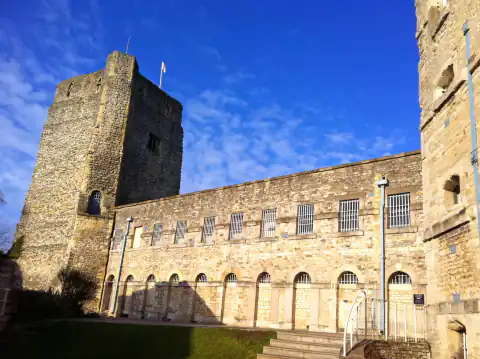 05Culture & historyOxford CastleExplore experience →
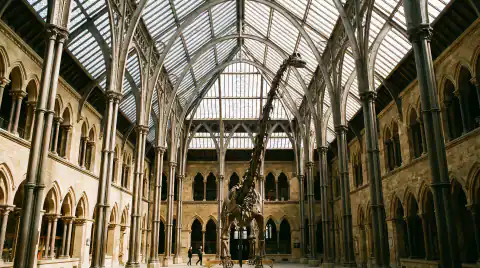 06Culture & historyOxford University Museum of Natural HistoryExplore experience →
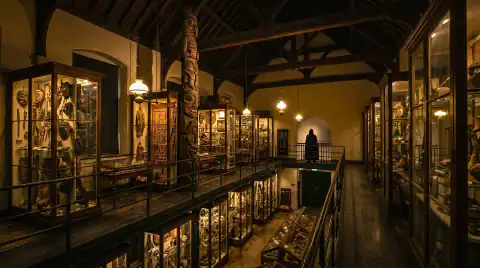 07Culture & historyPitt Rivers MuseumExplore experience →
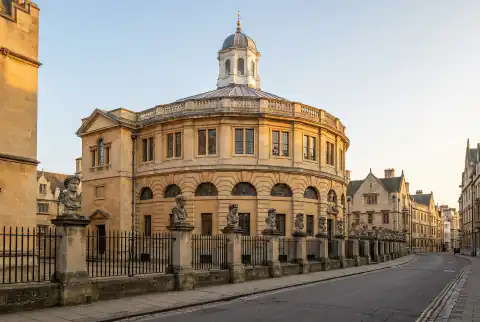 08Culture & historySheldonian TheatreExplore experience →
 09Culture & historyStephen A. Schwarzman Centre for the HumanitiesExplore experience →
 10Culture & historyThe Ashmolean MuseumExplore experience →
 11Culture & historyThe Radcliffe CameraExplore experience →
 12Culture & historyThe Weston LibraryExplore experience →
 13Culture & historyUniversity Church of St Mary the VirginExplore experience →
 14Food & drinkHead of the RiverExplore experience →
 15Food & drinkLe Manoir aux Quat’SaisonsExplore experience →
 16Food & drinkOxford Covered MarketExplore experience →
 17Food & drinkThe Bear InnExplore experience →
 18Food & drinkThe ChequersExplore experience →
 19Food & drinkThe Eagle and ChildExplore experience →
 20Food & drinkThe King’s ArmsExplore experience →
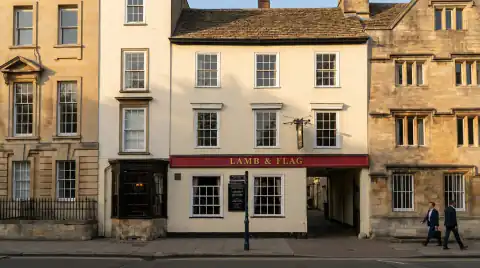 21Food & drinkThe Lamb & FlagExplore experience →
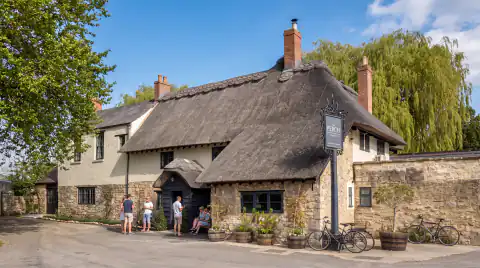 22Food & drinkThe PerchExplore experience →
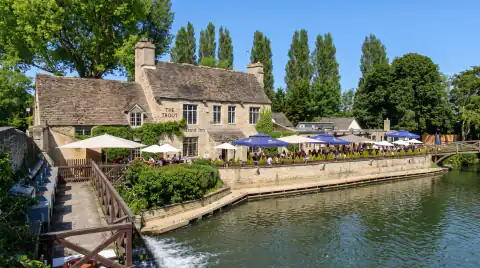 23Food & drinkThe Trout InnExplore experience →
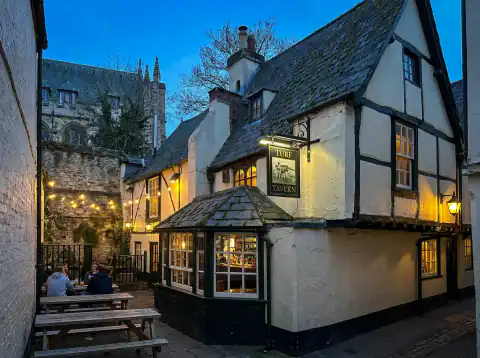 24Food & drinkThe Turf TavernExplore experience →
 25Food & drinkThe White HorseExplore experience →
 26Food & drinkWestgate OxfordExplore experience →
 27Walks & viewsThe Bridge of SighsExplore experience →
 28Parks & meadowsChrist Church MeadowExplore experience →
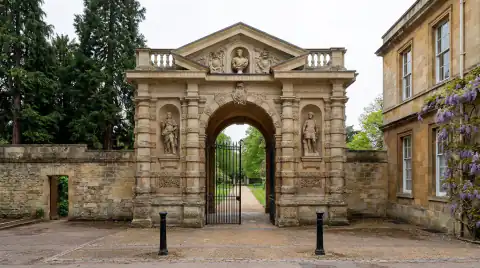 29Parks & meadowsOxford Botanic GardenExplore experience →
 30Parks & meadowsPort MeadowExplore experience →
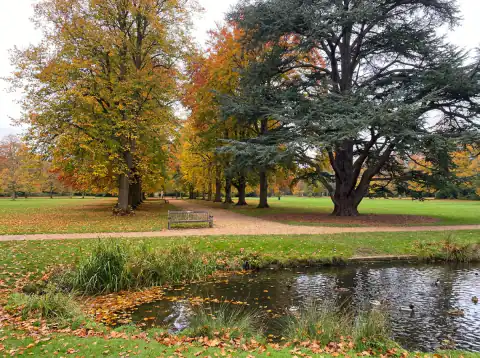 31Parks & meadowsUniversity ParksExplore experience →
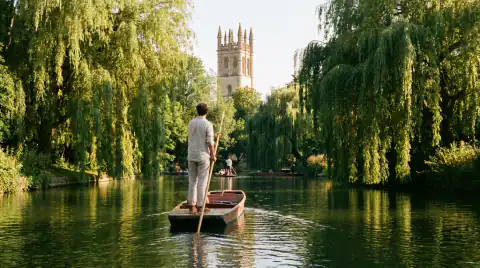 32On the waterPunt the CherwellExplore experience →
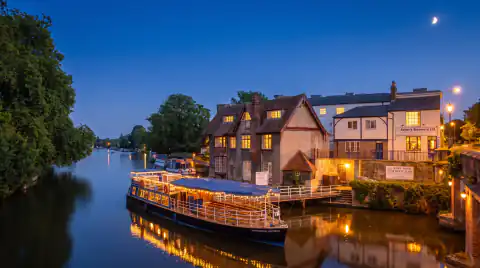 33On the waterSalter's SteamersExplore experience →
 43CollegesAll the collegesEvery Oxford collegeOpen the college guide →Food & drink / a storyThe nine oldest pubsWalk the timeline →
 Plan / Itinerary builderBuild your Oxford dayStart planning →