In depth
Head of the River
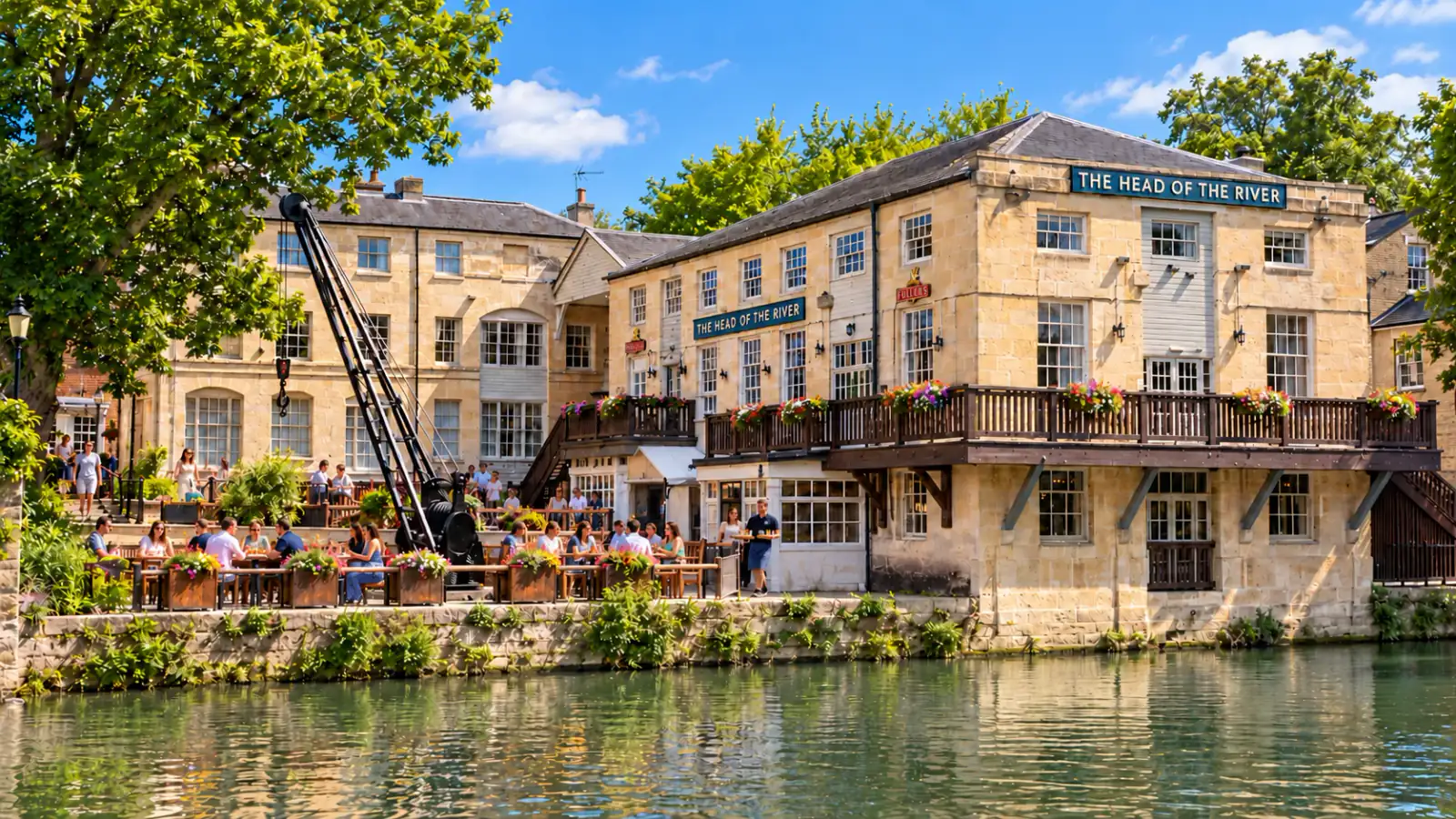
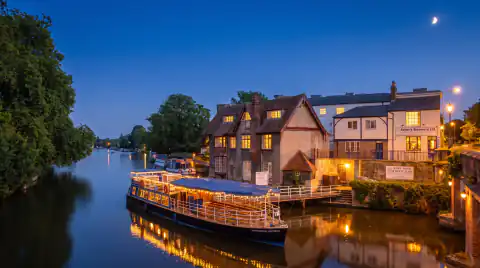
An 1827 warehouse turned riverside pub, with a terrace on the old wharf beside Folly Bridge and Salter’s boats.
Story · Visit · Route · Links
Visitor Essentials & Quick Answers
Why choose the Head of the River over a central Oxford pub?
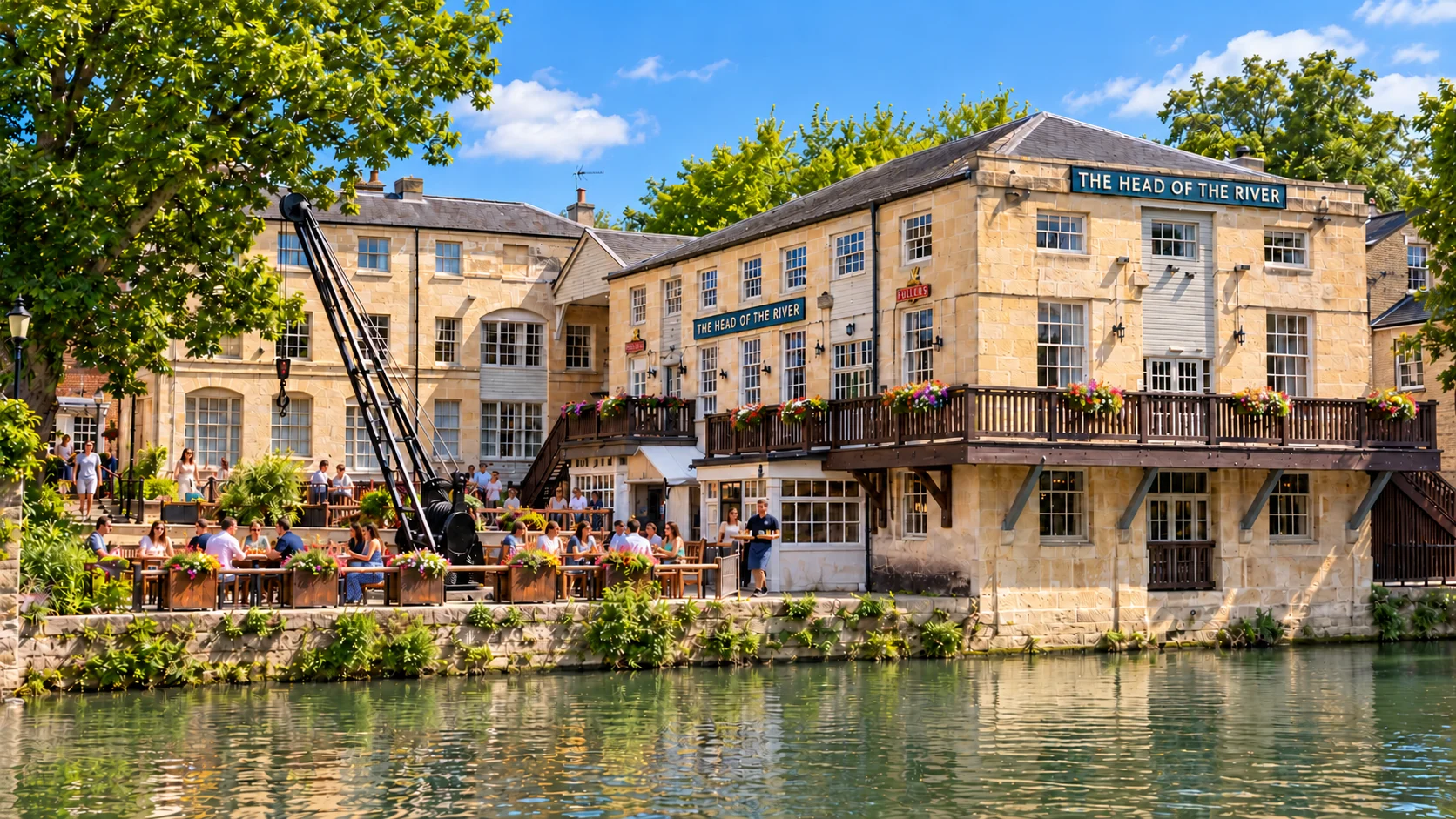
Come for the Thames setting at Folly Bridge: boats, water and an open terrace create a different experience from Oxford’s enclosed historic lanes. It fits naturally after Christ Church Meadow or a river trip. The reason to choose it is the riverside atmosphere rather than the promise of an ancient pub interior.
What is the old crane on the terrace?
It is surviving cargo-handling equipment from the working wharf, not a sculpture installed for the pub. Look for the winding drum and gear wheels at its base. It explains why the terrace meets the water as it does: this was a place for loading boats before it became somewhere to sit with a drink.
Was this always a pub?
No. Its warehouse and wharf belonged to Oxford’s working riverside, and the building became a pub in 1977. Salter’s boatbuilding history is closely connected with the site. Looking between the old crane, warehouse and boats gives you a glimpse of commercial Oxford that the college streets rarely reveal.
What is a good walk to combine with it?
Combine the pub with Christ Church Meadow for a route that links college views with Oxford’s river landscape. Alternatively, make it a stop around a boat trip from Folly Bridge. Both combinations give the location a purpose beyond travelling across town just for a meal.
Choose your depth
Essentials or more detail?
See visiting essentials, or read more about the history and places nearby.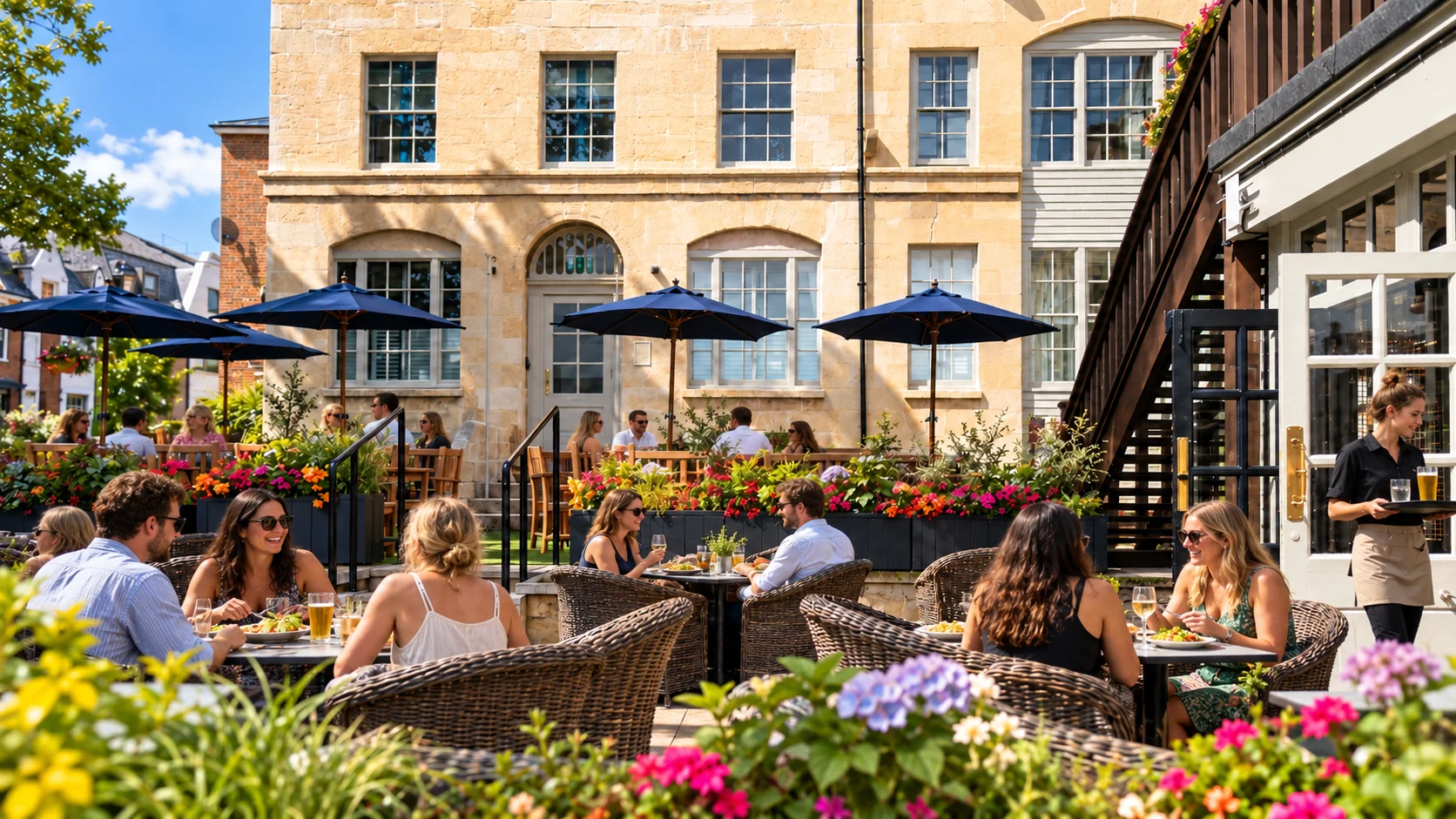
01 The experience
What to expect.
The terrace at Head of the River occupies a former working wharf beside Folly Bridge. The brick warehouse was built in 1827, and the surviving cargo winch in the courtyard gives a visible connection to the boats that once loaded here.
Salter’s Steamers later took over the site. Its passenger operation still runs from the bridge area, with punting nearby, so a riverside meal can sit naturally beside a boat trip. These are the waters of the Thames, locally called the Isis, flowing past Christ Church Meadow towards Iffley.
The warehouse became a pub in 1977. On warm weekends the terrace is a busy place to eat or drink, while the building also contains nineteen bedrooms. The appeal is its position at the meeting of city streets and river traffic, south of Oxford’s university centre.
The story
History & character.
The wharf comes first
Everything about this site follows from the fact that Folly Bridge is where Oxford meets navigable water. Goods coming up the Thames stopped here, and a wharf has been working on the east side of St Aldate's since at least 1638 — three centuries before anyone poured a pint in the building that stands on it.
The wharf is the oldest thing on the site and the only part that has been in continuous use throughout. It has been a landing stage, a coal yard, a boatyard and a beer garden, and the sequence matters: the pub is the most recent tenant of a piece of ground that has always earned its living from the river.
St Aldate's Yard and Isaac King
By the early nineteenth century the site was a boatyard belonging to Isaac King, known as St Aldate's Yard. It was not a single building but a working complex: a wharf house and warehouse, a second warehouse, a dwelling house, two stables, several covered sheds, and the wharf itself.
The pub occupies the largest surviving building from the yard. Open ground between the former working buildings now forms its courtyard.
1827 — the warehouse
The wharf house and the main warehouse were built in 1827, the year Folly Bridge was rebuilt. The two events are the same event: a new bridge meant new approaches, new levels and a reason to rebuild what stood beside it.
The Historic England list entry describes the surviving north-west wing as "Early C19. Brick, ashlar fronted. 3 storeys, 5 bays, 4 windows and door, on the ground floor. 4-panelled door with semi-circular fanlight. Tripartite sash either side of the door, the rest are sashes with glazing bars. Hipped slate roof."
The detail that repays attention is ashlar fronted. The building is brick, but its street face is dressed stone. This was a warehouse that had to look presentable to St Aldate's while doing rough work at the back — a distinction between the public and working faces of a building that is still exactly how the pub uses it today.
Salter's at Folly Bridge
The site was taken over by Salter's Steamers, the Thames boat firm founded in 1858 and still operating from Folly Bridge. For well over a century the yard was theirs.
The pub occupies the former boatyard. Salter's simply moved its passenger operation to the other side of the bridge, where it remains — so the pub and the boats are two halves of one nineteenth-century business that were separated, not two neighbours that happened to end up together.
1971 — listing
The north-west wing of Wharf House was listed Grade II on 1 December 1971, National Heritage List for England entry 1348481, statutory address "Wharf House (North West Wing Only), St Aldate's Street".
Only the north-west wing is listed. The designation does not cover the whole complex, later additions or the yard.
1977 — the pub
The warehouse was converted into a pub in 1977, and the wharf became its courtyard garden. The winch used to lift material on and off the boats was left in place and is still there.
The nineteenth-century warehouse gives the pub its historic setting; the pub business itself dates from 1977.
The name
The pub was named through a competition run in the local Oxford Mail. There were 2,700 entries. The winner, Lewis Fisher, received a gallon of whisky.
"Head of the River" is a rowing term. In Oxford's Summer Eights — the four-day bumps regatta on the Isis — the crew finishing first at the end of each day is the Head of the River. The finishing line is just to the east of the pub, linking the name to the stretch of river beside the terrace.
So the name is not decorative. It marks the pub's position on the course.
Modern significance
Today the building is a Fuller's hotel, pub and restaurant with nineteen bedrooms. Its significance is less architectural than functional: it is the building at the point where Oxford's leisure river traffic concentrates, and it serves the punters, the steamer passengers and the towpath walkers who pass through Folly Bridge in very large numbers between Easter and October.
The terrace remains closely connected to the boats and towpath around Folly Bridge.
Look closer
Highlights and hidden details.
The wharf crane
Standing in the middle of the terrace, left where it stood when the warehouse was converted, is the crane that lifted material on and off the boats: a tall black riveted lattice jib on a stone plinth, with a heavy winding drum and toothed gear wheels at its base.
Why it matters: it is the one object on the site that makes the building's former life unmistakable. Everything else can be read as decoration; cargo handling gear cannot. It was structural to the work of the yard, and it survived because somebody in 1977 decided not to remove it.
The visit: look at the winding drum and toothed gears beneath the lattice jib. The crane remains where it handled cargo, with terrace tables around it.
Photography: better in flat light than in sun — direct sunlight blows out the metalwork and loses the mechanism.
Time: two minutes, and it changes how the rest of the building looks.
The wharf you are drinking on
The terrace and courtyard are not a garden that was built for the pub. They are the wharf, in use since at least 1638.
Why it matters: this is the oldest thing on the site by a wide margin — older than the warehouse by nearly two centuries, older than the pub by more than three. Barges loaded here. The ground has been doing the same job, at the same water level, for four hundred years.
The visit: stand at the river edge and look at how the ground meets the water. The working relationship between the two is the reason the building is where it is.
The ashlar front
From St Aldate's the building presents a dressed stone face: three storeys, five bays, sash windows with glazing bars, a four-panelled door under a semi-circular fanlight, hipped slate roof.
Why it matters: behind that front it is brick. A warehouse of 1827 had to look respectable to the street while working roughly at the back, and the building still splits its personality exactly that way — a formal face to St Aldate's, a working face to the river.
The visit: cross to the far pavement of St Aldate's to see the front properly. From inside the terrace you never see it at all.
Time: five minutes, and it is the only highlight best seen from outside.
The punts going out
Immediately beside the pub, Salter's hires punts onto the Isis from Easter to October.
Why it matters: it is the pub's real function. This is where a large share of Oxford's punting trips begin and end, and watching the handover — the wobble, the first push, the pole stuck in the mud — is the most entertaining thing visible from the terrace.
Manage expectations: hire here is self-drive only. For a chauffeured trip, use Magdalen Bridge and the Cherwell Boathouse.
Time: as long as you like from a table. An hour if you take one out.
The Salter's pier
On the other side of the bridge approach, Salter's passenger boats run downstream to Iffley Lock and on to Abingdon.
Why it matters: Salter's once operated from the boatyard the pub now occupies. The pier and the pub are the two halves of one nineteenth-century business. The two sites share the same boatyard history.
The visit: the Iffley service is the short one — roughly hourly, 11:00 to 17:00, April to September. Abingdon is a two-hour trip each way and a half-day commitment.
The Eights Week finishing line
The bumps races finish just east of the pub.
Why it matters: this is where the name comes from. In Summer Eights, the crew finishing first at the end of each day is the Head of the River — and the name was chosen by public competition in the Oxford Mail, which drew 2,700 entries. The winner, Lewis Fisher, was given a gallon of whisky.
The visit: during Eights Week in late May the bank east of the pub is the best free vantage point on the course, and the pub is at its busiest and most enjoyable.
Time: an afternoon, if you come for the racing.
Details to look for.
Only one wing is protected
The Grade II listing — National Heritage List entry 1348481, 1 December 1971 — covers "Wharf House (North West Wing Only), St Aldate's Street". Not the whole complex. Not the later work. Not the yard.
The protected section is one wing of the former warehouse, rather than the entire pub complex.
The building's two faces
Brick behind, ashlar in front. The 1827 warehouse was given a dressed stone front towards St Aldate's and left as honest brick towards the wharf, because one side had to be seen by the city and the other only by bargemen.
The pub inherited the arrangement without changing it, and still uses it the same way — the smart approach from the street, the working end on the water.
The whisky and the 2,700 entries
The pub's name was chosen by a competition in the Oxford Mail. It attracted 2,700 entries. The winner was Lewis Fisher, and the prize was a gallon of whisky.
The winning name connected the new pub with Oxford’s bumps races and the finishing line just east of the terrace.
The name is a position, not a flourish
"Head of the River" is not a general river phrase. In bumps racing it is a rank: the crew that ends the regatta first on the river. The finishing line sits just east of the building.
So the sign is effectively a marker on the racecourse. The pub is named after what happens at the spot where it stands.
Two postcodes, one place
The pub is OX1 4LB. The punt station and Salter's pier, metres away, are OX1 4LA. Navigation apps route to whichever you give them and the bridge approach between them is not always obvious on foot.
If you are meeting someone here, name the side of the bridge rather than the postcode.
The 1638 wharf is the oldest thing here
Not the building. Not the pub. The ground.
A wharf has worked this bank since at least 1638 — before the warehouse by nearly two hundred years, before the pub by more than three hundred. Today’s terrace occupies that former working wharf.
Isaac King's yard
Before Salter's, the site was Isaac King's boatyard, known as St Aldate's Yard: a wharf house and warehouse, a second warehouse, a dwelling house, two stables, several covered sheds and the wharf.
Read that list against what you can see and the gaps are obvious. The pub is the survivor of a complex, and the open ground it uses as a courtyard is where the sheds and stables stood.
A warehouse converted in 1977
The building dates from 1827 and the wharf was in use by 1638. The pub opened in 1977, retaining the warehouse and cargo-handling winch.
Salter's has never actually left
The firm took over the yard and still runs boats from Folly Bridge today. It did not sell up and depart — it moved its passenger operation across the bridge approach and stayed.
So when you sit on the terrace watching a Salter's boat come in, you are watching the current occupant of the site's original business return to the site's original wharf. The boats continue the site’s working-river history.
Make it work
Plan your visit.
Pub service and boat schedules change by season; use the dated booking calendar when combining a meal with a sailing.
Finding it
Folly Bridge, St Aldate's, Oxford OX1 4LB. Walk south down St Aldate's from Carfax past Christ Church; the pub is on the left immediately before the bridge, about eight minutes on foot. Look for the large brick building with its terrace beside the water.
Note that Salter's Steamers and the punt station are OX1 4LA, a few metres away on the other side of the bridge approach. Two postcodes, one place; if you are meeting someone, say which side of the bridge.
Opening hours
| Pub | Kitchen | |
|---|---|---|
| Monday–Friday | 07:00–23:00 | 07:00–21:00 |
| Saturday | 08:00–23:00 | 08:00–21:00 |
| Sunday | 08:00–22:00 | 08:00–20:00 |
The early opening is because it is a hotel — breakfast is served from opening. The kitchen closes two hours before the bar on weekdays and Saturdays, and two hours before on Sundays; arriving at 20:30 on a Sunday means drinks only.
Food, drink and tables
Budget ≈ £16–£29 per person for a main. Pork and leek sausages are £16.95, fish and chips £20.50 and rabbit and chestnut mushroom pie £23. Drinks and extras are priced separately. View the main menu.
Tables can be booked through the pub's website or by telephone on 01865 721600, and booking is worth doing for a weekend meal or for any group. The terrace is generally first-come.
There is no booking system that holds a terrace table in good weather, so if the riverside seat is the point of the trip, come early.
Best time to visit
Weekday mornings are usually quieter, with a better chance of a riverside table. The building also looks its best in morning light from the water side.
Late afternoon in summer is the busiest and the most enjoyable, if you do not mind the crowd — boats coming back in, punts being handed over, the terrace full.
Eights Week (late May) puts the finishing line of the bumps races just east of the pub. It is the most interesting time to be here and the least likely time to find a seat.
Winter is quieter. The terrace is exposed, while indoor tables provide shelter beside the river.
Duration
Allow 60–90 minutes for a meal or 30–60 minutes for drinks. Add the boat trip time separately if you’re going out on the water.
Going on the water
Punt hire and passenger boats are run by Salter’s beside Folly Bridge. They are booked separately from the pub.
Punt hire — from the bank beside the pub, OX1 4LA. £25 per hour Monday to Friday, £30 per hour Saturday and Sunday. Maximum five people per punt. Self-drive only — there is no chauffeured option here, so somebody in your party has to punt. Photo ID is required for the security deposit. Booking is online; walk-up one-hour hires are taken when there is capacity. The season runs Easter to October, weather permitting.
Punts from here go onto the Isis, downstream past Christ Church Meadow towards Iffley. This is not the Cherwell — that is punting from Magdalen Bridge or the Cherwell Boathouse, on the other side of the city, and the two are regularly confused.
River trips — Salter's passenger boats leave from Folly Bridge, OX1 4LA. The Iffley Lock service runs roughly hourly from 11:00 to 17:00, April to September. The Abingdon service takes about two hours each way and runs between May and September. There is also a 90-minute afternoon tea cruise to Iffley and back, which in 2026 runs as a public service from 20 July to 27 August.
Sailings are weather- and river-condition dependent. High water closes the river to passenger craft without much notice.
Facilities
Toilets, including accessible provision, and baby-changing. Free wifi. A large riverside terrace and courtyard. Nineteen bedrooms across four room types (Indulgence, Comfy, Cosy and Family), with breakfast included for hotel guests.
Dogs are welcome. This is one of the more comfortable central Oxford pubs to bring a dog to, because the terrace gives them room.
Food and drink
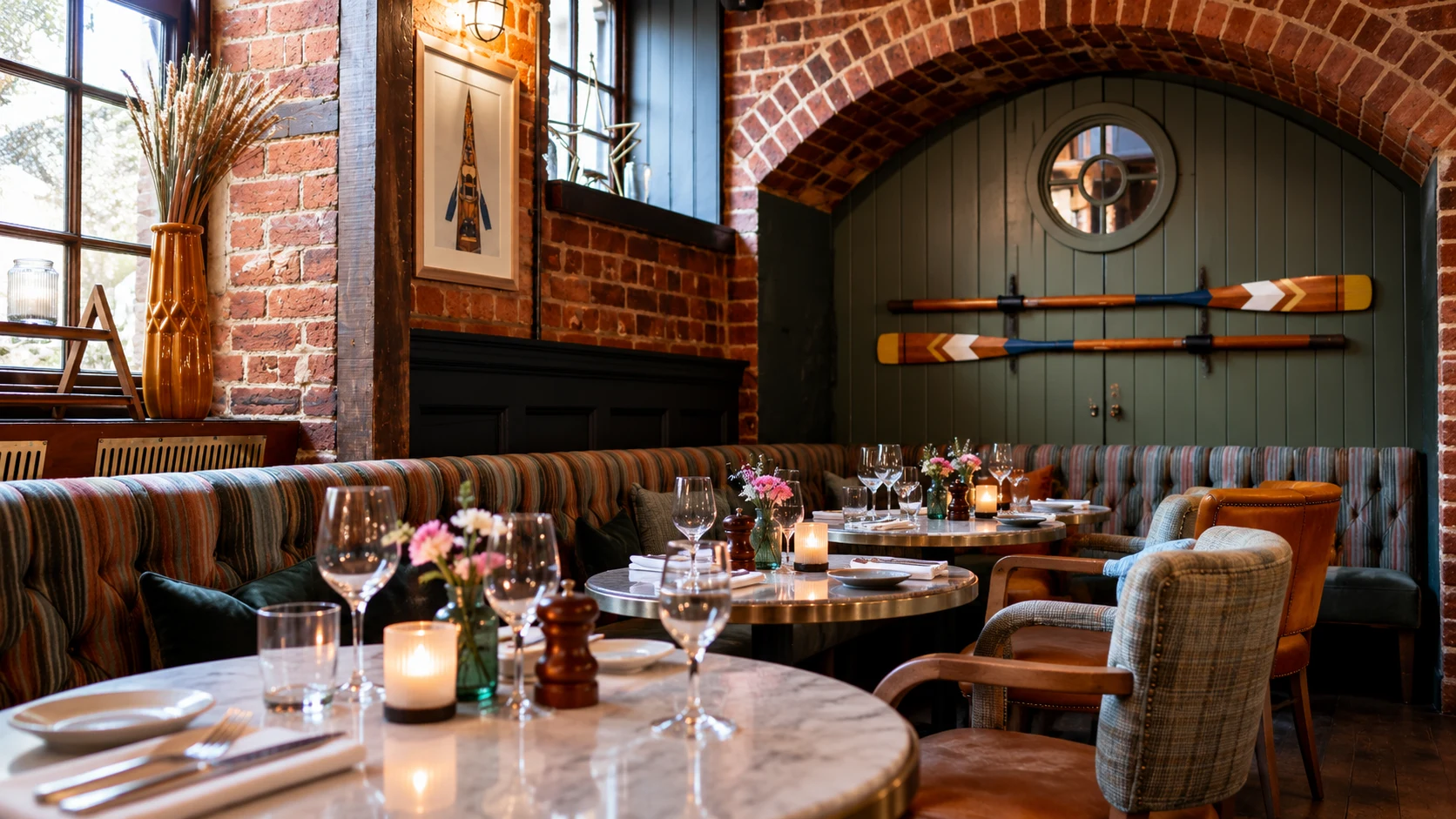
Breakfast, lunch and dinner follow a Fuller’s pub menu. London Pride and other Fuller’s beers are served alongside seasonal guests. Food service ends before the bar closes.
Weather and rainy days
Rain limits use of the riverside terrace, though indoor tables provide shelter. If combining the pub with a boat trip, check whether river conditions allow the sailing to run.
Conversely the first warm weekend of the year fills it completely.
Getting here
Walking — eight minutes south from Carfax down St Aldate's; five minutes from Christ Church; about fifteen minutes from the railway station.
Bus — St Aldate's is one of Oxford's main bus corridors, with stops within a minute of the door.
Car — there is no visitor parking. Central Oxford is heavily restricted and there is no visitor car park. Use Park & Ride. Redbridge Park & Ride is the nearest and is on the same road south.
Cycling — the Thames towpath runs past the door, and the pub is on the national cycle route south towards Abingdon.
By river — visiting moorings exist at Folly Bridge but are limited and in heavy demand in season; do not count on one.
Visit your way
Access and family planning.
Pub facilities
The pub has step-free access, accessible toilets and baby-changing facilities.
The converted warehouse has wide openings and a flat wharf, though the exact route to a particular terrace table should be discussed with staff.
Getting to the door
St Aldate's is a main road with a wide, level pavement, and the approach from Carfax is a gentle continuous slope south — no steps, but a real gradient over about eight minutes. From the Christ Church end it is shorter and flatter.
Bus stops are within a minute of the door on one of Oxford's busiest corridors, which makes this considerably easier to reach without a car than the Perch or the Trout.
There is no visitor car park. Blue badge provision on St Aldate's itself is limited and the surrounding streets are heavily restricted; Redbridge Park & Ride is the nearest practical option.
Inside and outside
The terrace and courtyard are flat, which is the single most useful accessibility fact about the place — the main attraction is the part that is easiest to reach. Table spacing and the entrance route may still affect wheelchair or pushchair access at busy times.
The interior is large and open by pub standards, but it is busy, and at peak times the circulation space between tables narrows considerably. A weekday morning is a very different building from a Saturday afternoon.
Not confirmed
Ask the pub about the following before booking:
- Accessible bedrooms. Nineteen rooms are offered across four types (Indulgence, Comfy, Cosy, Family). Whether any is a step-free or adapted room, and whether any is on the ground floor, is not stated. Telephone 01865 721600 before booking if this matters.
- Lift provision to the upper floors of a three-storey listed building.
- Hearing loop coverage.
- Accessible toilet dimensions and whether transfer space is left- or right-handed.
- Step-free route from the street to the terrace as a continuous path — step- free access is stated for the premises, but the specific route to the riverside seating is not described.
Given the building is a listed early nineteenth-century warehouse, upper-floor access is the item most likely to be constrained, and the one most worth telephoning about.
Going on the water
Boat access is arranged with Salter’s separately from the pub.
Punts are not accessible. Boarding a punt means stepping down into an unstable flat-bottomed boat from a bank, and hire here is self-drive only — propelling it requires standing on a rear deck. There is no realistic adaptation.
Passenger boats are a much better prospect and the reason to come. Boarding is from a pier rather than a bank. However, step-free boarding is unconfirmed, and it will depend on the vessel and the river level on the day. Contact Salter's on 01865 243421 before travelling if step-free boarding is required.
Sensory notes
- Loud at peak times, both inside and on the terrace. Weekend afternoons in summer are the loudest.
- Bright and exposed on the terrace — little shade, and strong reflected glare off the water in the middle of the day.
- Dogs are welcome and usually present in numbers, which matters for anyone with an allergy or a phobia.
- Quiet windows: weekday mornings, and winter generally. The riverside terrace is generally less busy outside summer.
Visual impairment
The terrace edge meets open water without a substantial barrier. This is the most significant hazard on the site for anyone with limited vision, and it is worth requesting a table away from the river edge rather than discovering the arrangement on arrival.
Interior lighting is normal pub lighting — adequate, not dim in the way the older Oxford pubs are.
The practical summary
If your visit is a drink on a flat riverside terrace reached from a main bus route, this is one of the better options in central Oxford and the terrace is the accessible part.
If your visit involves staying overnight, using the upper floors, or getting onto a boat, telephone first. The room and boarding arrangements remain unconfirmed.
Short version
One of the easier central Oxford pubs to bring children to, almost entirely because of the terrace. Space, open air, boats to watch and no low beams to worry about. The building itself will not hold a child's attention for long, but the river will.
Ages
Under 3 — manageable. Baby-changing facilities are provided, the terrace takes a pushchair without difficulty, and there is room to move. The riverside edge needs watching; see below.
3 to 8 — the best age for this. Punts going out, boats coming in, ducks, the winch. A Family Room is one of the four accommodation types if you are staying over.
8 to 12 — good, especially paired with an actual boat trip. The Iffley Lock service is about the right length; watching a lock work is genuinely interesting at this age and it is the cheapest river trip Salter's runs.
Teenagers — a river trip or self-drive punt can extend a meal or drink stop.
The one real caution
The terrace is on open water. There is no barrier of the kind you would find at a purpose-built family attraction, and the river at Folly Bridge is deep and moving. Small children need to be within reach, not within sight — particularly on a busy summer afternoon when the terrace is crowded and sightlines are poor.
This is not a reason to avoid the place. It is a reason to choose your table. Seats away from the water edge exist and are worth asking for with a toddler.
Punting with children
Salter's takes a maximum of five people per punt and hire here is self-drive only. Both matter for families:
- Five includes children, so a family of six needs two punts.
- Someone in your party must be able to handle the punt.
If nobody wants to learn on the day, take the Salter's passenger boat instead — the same river without having to propel the boat.
Educational value
Modest but real, and better than it looks. This is a working river site with a legible history: a wharf from 1638, a warehouse from 1827, a boat firm from 1858, a pub from 1977. The winch makes the cargo-handling story concrete in a way a label never does.
The winch and wharf show how cargo moved between the river and the warehouse.
Practicalities
Food — a standard Fuller's menu with children's options; food service ends at 21:00 on weekdays and Saturdays, 20:00 on Sundays.
Pushchairs — step-free access is provided and the terrace is flat. Inside is busier and tighter at peak times.
Toilets — including accessible provision and baby-changing.
Dogs — welcome, and there are usually several. Worth knowing if a child is nervous of them.
Noise — loud at peak times. The terrace absorbs children well; the interior on a wet Saturday does not.
Length of a family visit
There is no play area or children’s trail. A short meal or drink stop can fit before or after a river trip, with Christ Church Meadow nearby for a walk.
Christ Church Meadow is four minutes away and is the obvious pairing: open space, a walk, cattle, and the same river from the other bank.
Self-guided walk
Explore beyond the venue.
A practical, step-by-step route connecting this experience with more of Oxford.The ashlar front, St Aldate's
Start on the far pavement of St Aldate's, opposite the pub, before you go in.
This is the only place the 1827 front reads properly: three storeys, five bays, sash windows with glazing bars, a four-panelled door under a semi-circular fanlight, hipped slate roof. Dressed stone facing the city.
Remember it, because in a minute you will see the back and it is brick. A warehouse dressed its street face and left its working face plain.
5 minutes.

Folly Bridge
Walk south twenty metres onto the bridge.
Look back and down. From here the whole arrangement is legible at once: the warehouse, the wharf below it, the terrace, the water. The bridge was rebuilt in 1827, the same year as the warehouse — the new crossing is why the yard was rebuilt.
Downstream to the east is the Eights Week course. The finishing line is just beyond the pub, which is where its name comes from.
Narrow pavement and constant traffic — stand well in.
5 minutes.
The winch, in the courtyard
Back across and into the courtyard, before you find a table.
The winch lifted material on and off the barges and was left where it stood when the warehouse became a pub in 1977. Its winding gear gives a visible link with the warehouse’s cargo-handling past.
While you are here: the ground under your feet is the wharf, working since at least 1638. It is older than the building by two centuries.
10 minutes.
The punt station
Out to the bank beside the pub, OX1 4LA.
Watch a handover if one is happening. Punts here are self-drive, five people maximum, £25–£30 an hour, Easter to October — and they go downstream onto the Isis, not onto the Cherwell. Cherwell punting is at Magdalen Bridge, on the other side of the city, and the two are constantly confused.
Take one out here if you want to; the walk works either way.
10 minutes, or an hour with a punt.
Salter's pier
Cross the bridge approach to the pier, OX1 4LA.
Salter's took over this boatyard and never really left — it moved the passenger side across the approach and kept going. The pub is the warehouse it vacated. Two businesses, one nineteenth-century origin, thirty metres apart, and hardly anyone makes the connection.
Boats leave for Iffley Lock roughly hourly, 11:00 to 17:00, April to September.
5 minutes, or take the boat and skip to Stop 7.
The towpath to Iffley
From the pub, follow the towpath east and downstream. Christ Church Meadow opens on your left almost immediately, and the path runs beside it.
This is the Eights Week course. The college boathouses come up on the far bank — the terrace of buildings where the crews launch — and the whole stretch makes sense once you know that the racing runs towards the pub, not away from it.
Iffley Lock is about 25 minutes. Flat, unshaded, and popular with cyclists; keep left.
25 minutes.
Iffley Lock
The lock itself.
Watch a boat through if one is coming. A Thames lock is a piece of working eighteenth-century-descended engineering operating in public for free, and it takes about ten minutes to cycle through.
This is where the short Salter's trips turn round, so you may well see the boat you could have taken.
20 minutes.
Return to Folly Bridge
Retrace the towpath to Folly Bridge. For a longer outing, add a separate walk through Christ Church Meadow using its public entrance. The meadow is free, with grazing land between the Isis and Cherwell.
25 minutes.
The terrace
Finish where you started, on the wharf.
You have now walked the course the pub is named after, seen the yard it was built to serve and the firm that bought it, and stood on ground that has been loading boats since 1638.
Finish with a drink or meal at the pub if you wish.
As long as you like.
Make a record
Photograph it thoughtfully.
The problem to solve
This is a big brick building beside bright water, which means the two things you want in frame — the building and the river — are usually several stops apart in brightness. Most photographs of the Head of the River are either a correctly exposed building against a blown-out river, or a nice river with a black building.
Morning and late evening solve it. The middle of a summer day does not.
Best angles
From the far bank, downstream. The strongest composition available: the pub, the terrace and Folly Bridge in one frame with the river leading in. Cross the bridge and walk a short way along the towpath on the south side.
From the bridge itself. Higher viewpoint, good for showing the wharf's relationship to the water and for catching punts setting off directly below. Narrow pavement — stand clear of the traffic and do not block it.
From the far pavement of St Aldate's. The only place the ashlar front reads properly: five bays, sash windows, the fanlight over the door, hipped slate roof. This view shows the dressed-stone street frontage.
From the terrace, looking east. Downstream towards the Eights finishing line and Christ Church Meadow. This is the view people actually remember.
Light
Golden hour, evening — the terrace faces the water and takes low western light well. The lower light picks out the brickwork and wharf edge.
Early morning — the quietest, and the only time you will get the terrace without people. Softer and cooler than evening; better for the building, less good for atmosphere.
Midday summer — avoid for anything careful. Harsh top light, blown highlights off the water, and the terrace full.
Winter afternoons — underrated. Bare trees open up sightlines along the river that are closed in summer, and the low sun runs straight down the water.
Details worth close work
- The winch in the courtyard. Flat light, not sun. It is the one object that explains the building and it photographs poorly in contrast.
- The wharf edge where the ground meets the water — the 1638 working level.
- The fanlight and four-panelled door on the St Aldate's front.
- Punt handovers at the bank, with the agreement of the people involved.
- Boat names and lettering on the Salter's vessels.
People and consent
The terrace is full of identifiable people much of the time. For anything beyond personal use, photograph the building, the boats and the river rather than the drinkers, or ask.
Do not photograph staff at work without asking. Punt handovers involve staff directly, and the fact that a moment is funny does not make it fair game.
Crews and rowers on the water during Eights Week are in a public sporting event and are ordinarily fine to photograph; individuals sitting at a pub table are not in the same category.
Rules and permissions
Personal photography is unrestricted in the ordinary way on public land — the bridge, the pavement, the towpath.
The terrace and courtyard are private property. Casual personal photography is not an issue; tripods, lighting and anything that reads as a commercial or professional shoot need permission from the pub in advance. Telephone 01865 721600.
Salter's premises — the pier and punt station — are likewise private, and a separate permission from the pub's. Contact Salter's on 01865 243421.
Drones: arrange any aerial work with the venue in advance. Ordinary visitor photography permission does not cover a drone flight.
Equipment
Nothing specialised. A wide lens for the building from the bridge, something longer for punts and boats on the water, and a polariser if you want to see into the river rather than off it. The polariser is the one piece of kit that materially improves photographs here.
See it
In pictures.
4 views, full screen. Tap any one to open the viewer.Around here
Make more of the area.
Good to know
Questions, answered.
Where is the Head of the River in Oxford?
The Head of the River pub is beside Folly Bridge on St Aldate’s, Oxford OX1 4LB, overlooking the Thames, which is also called the Isis in Oxford. About the pub
Does the Head of the River have a riverside terrace?
Yes. The pub has a riverside dining area and garden beside the Thames. Fuller’s refurbishment
Can I stay at the Head of the River?
Yes. The pub has 19 bedrooms, including family rooms. The hotel says a cooked breakfast is included in its room rate. Bedrooms Fuller’s refurbishment
Are dogs allowed in rooms at the Head of the River in Oxford?
The Head of the River hotel in Oxford accepts dogs subject to its house rules; dogs must not be left alone in a bedroom when their owners leave the hotel. Hotel house rules
What historic building houses the Head of the River in Oxford?
The Head of the River pub in Oxford occupies a former warehouse at Folly Bridge. The north-west wing, known as Wharf House, is Grade II listed. Historic England
Can I hire a punt near the Head of the River?
Salter’s Steamers hires self-drive punts from Folly Bridge. A punt for up to five people costs £25 per hour Monday–Friday or £30 per hour Saturday–Sunday. At least one member of the party must be 18 or over, and photo ID is required for the security deposit. Salter’s self-hire
Can I take a river cruise from Folly Bridge?
Yes. Salter’s operates a short cruise from Folly Bridge towards Iffley Lock, as well as an afternoon tea cruise. Dates and availability vary by service. Salter’s short trips
Are Head of the River bedrooms wheelchair accessible?
Bedroom access and lift provision are not confirmed in the available information. Contact the hotel on 01865 721600 before booking to discuss your requirements. Bedrooms
Editorial notes
Sources and further reading.
Sources for this guide
Every factual claim in this bundle traces to a source below. Sources are prioritised: statutory heritage → local history archive → the operator's own site → the adjacent operator's own site. No AI-generated source is cited.
Research and verification carried out 3 August 2026.
Sources
S01 — Historic England, National Heritage List for England: entry 1348481
https://historicengland.org.uk/listing/the-list/list-entry/1348481 Wharf House (North West Wing Only), St Aldate's Street — Listed Building, Grade II, first listed 1 December 1971. Used for: the designation, the grade, the entry number, the date, the statutory address, the National Grid Reference (SP 51455 05608), and the full listing description quoted in 02-history.md and 13-operational-data.json — "Early C19. Brick, ashlar fronted. 3 storeys, 5 bays, 4 windows and door, on the ground floor. 4-panelled door with semi-circular fanlight. Tripartite sash either side of the door, the rest are sashes with glazing bars. Hipped slate roof."
Critically, also used for the north-west wing only qualification.
Accessed 3 August 2026. Retrieved via Firecrawl; the site returns HTTP 403 to direct automated requests.
S02 — South Oxford Local History: Pubs
https://southoxfordhistory.org.uk/interesting-aspects-of-grandpont-and-south-oxford-s-history/pubs Local history society record. Used for: the wharf in use "since at least 1638"; Isaac King's boatyard and the St Aldate's Yard inventory (wharf house and warehouse, another warehouse, a dwelling house, two stables, several covered sheds, the wharf); "The wharf house and main warehouse … were built in 1827, when Folly Bridge was rebuilt"; "In 1858 the site was taken over by Salter's Steamers"; "In 1977 the warehouse was converted into a pub and the wharf became the pub's courtyard garden"; and the surviving winch.
This is the load-bearing source for the bundle's central argument and the only one giving 1977 precisely. See the conflict ledger and 16-editor-notes.md — a second source for 1977 is the top open item.
S03 — The Head of the River, official site
https://www.headoftheriveroxford.co.uk/ Used for: address and postcode (Folly Bridge, St Aldate's, OX1 4LB); telephone and email; pub and kitchen opening hours as quoted; Fuller's ownership; 19 bedrooms across four room types (Indulgence, Comfy, Cosy, Family) with breakfast included; dog-friendly policy; free wifi; step-free access; accessible toilets and baby-changing. Accessed 3 August 2026.
Note: this page lists "Historic pub" among its amenities. That claim is not carried forward — see the conflict ledger.
S04 — The Head of the River, history page
https://www.headoftheriveroxford.co.uk/history Used for: the naming competition in the Oxford Mail; 2,700 entries; the winner Lewis Fisher and his gallon of whisky; the explanation that the finishing line of the four-day regatta lies just east of the pub and that "Head of the River" refers to the boat finishing first; and the River Isis as the name for this stretch of the Thames. Accessed 3 August 2026.
S05 — Salter's Steamers, official site
https://www.salterssteamers.co.uk/ · https://salterssteamers.co.uk/punting-oxford Used for: the founding year 1858; Folly Bridge as a departure location and the pier postcode OX1 4LA; punt hire prices (£25 per hour Monday–Friday, £30 Saturday–Sunday); maximum five people per punt; the Easter to October season, weather dependent; self-drive only, with no chauffeured option; FareHarbor booking and walk-up one-hour hires; photo ID required for the security deposit; and the punting route on the Thames/Isis towards Christ Church Meadow and Iffley.
Salter's own punting page describes its location as "situated beside the historic Head of the River pub", which is the direct confirmation that the two sit together. Accessed 3 August 2026.
S06 — Salter's Steamers, trips and schedules
https://salterssteamers.co.uk/short-trips/ · https://salterssteamers.co.uk/directions-to-oxford/ Used for: the Iffley Lock service, roughly hourly 11:00–17:00, April to September; the Abingdon trip, about two hours each way, May to September; the 90-minute afternoon tea cruise and its 2026 public dates (20 July – 27 August); and the description of the departure point below the head office on Folly Bridge, nearest postcode OX1 4LA. Accessed 3 August 2026. Dates are annual and explicitly flagged as volatile.
S07 — OpenStreetMap / Nominatim
https://nominatim.openstreetmap.org/ Used for: the coordinates 51.74667, −1.25602, returned for "The Head of the River, 1 Folly Bridge, OX1 4LB".
Used as corroboration rather than as the primary authority: the Historic England listing's own National Grid Reference (SP 51455 05608) converts to the same point, so two independent sources agree. Recorded as production_status: verified in the operational data on that basis. Accessed 3 August 2026.
Conflict ledger
C1 — "Historic pub"
- S03 lists "Historic pub" among the pub's amenities.
- S02 dates the conversion of the warehouse to a pub to 1977.
Not carried forward. The building is early nineteenth century and Grade II listed; the business has been a pub since 1977. Both facts are true and the bundle states both, separately and explicitly. Collapsing them into "historic pub" is the single most common error in published material about this place, and correcting it is the page's editorial reason for existing.
C2 — When did it become a pub?
- S04 (the pub's own history): the warehouse was "over a century later … converted into a pub" — no year.
- S02: "In 1977 the warehouse was converted into a pub."
Used: 1977, from S02. The two are consistent — 1827 plus 150 years is "over a century later" — but only S02 is specific. Flagged in 16-editor-notes.md as resting on a single source, with the city planning record for the change of use proposed as corroboration at the next revision.
C3 — Which postcode?
- S03: the pub is OX1 4LB.
- S05/S06: Salter's pier and the punt station are OX1 4LA.
Not a contradiction but a genuine trap. Both are correct and they are metres apart across the bridge approach. Navigation apps route to whichever is given. The bundle states both and says which is which, in 03-visitor-guide.md, 05-hidden-details.md and the operational data's adjacent_postcode_note.
C4 — Electoral ward
- An aggregator listing site records the Grade II entry under "Holywell Ward".
- S01, the statutory source, gives the address as St Aldate's Street and the parish as Non Civil Parish, with National Grid Reference SP 51455 05608 — which is at Folly Bridge, nowhere near Holywell.
Used: S01. The ward attribution is an aggregator data artefact and is not repeated anywhere in this bundle. Recorded here so a future editor who encounters it knows it was seen and rejected.
Claims deliberately not made
Recorded so a future editor knows these were considered and rejected, not overlooked.
- That the pub is old. It is not. See C1.
- That Salter's and the pub are one business. They share an origin and a bridge. Salter's runs the boats; Fuller's runs the pub.
- That the whole building is listed. The listing covers the north-west wing only (S01).
- A precise date for the wharf. S02 gives "at least 1638", and the bundle repeats the qualifier rather than presenting 1638 as a foundation date.
- Any claim that this is a hidden gem. It is one of the busiest pubs in Oxford on a summer afternoon.
- Accessible bedrooms, lift provision, hearing-loop coverage, step-free boat boarding — all recorded as unverified rather than assumed either way.
- Opening hours for the punt station. S05 gives the season and the prices but not daily opening times, so none are stated.
Acquisition-date discrepancy (4 November 2026)
The sources differ on when the Salter family took over St Aldate’s Yard. Brasenose College hosts a historical report stating 1858: https://www.bnc.ox.ac.uk/downloads/news/Lloyds_Bank_Oxford_history_report_by_Liz_Woolley_Oct_2019.pdf Oxford Preservation Trust’s referenced heritage walk says the Folly Bridge wharf was acquired in 1870: https://www.oxfordpreservation.org.uk/sites/default/files/2024-05/Book%206%20-%20footnoted%20text%20MG.pdf The specific yard-acquisition date is therefore omitted pending reconciliation; the firm’s founding in 1858 is a separate claim and is not changed by this note.
Opening hours, prices, programmes and access arrangements can change. Confirm critical details with the venue.
Continue exploring / Oxford
More to explore
in Oxford
Find another place for your itinerary, or explore all things to do in Oxford.
 Culture & historyChrist Church CathedralExplore experience →
 Culture & historyChrist ChurchExplore experience →
 Parks & meadowsChrist Church MeadowExplore experience →
 On the waterSalter's SteamersExplore experience →