Pont Neuf
Paris’s oldest surviving bridge, its carved faces and Henri IV statue at the island’s western tip.
01 / The experience
A new kind of bridge, four centuries ago.
Pont Neuf crosses the Seine in two parts, using the western tip of Île de la Cité between them. That shape makes it more than a route between banks: the middle of the crossing opens towards Henri IV’s statue, Place Dauphine and the low island point of Square du Vert-Galant.
An open bridge between the riverbanks
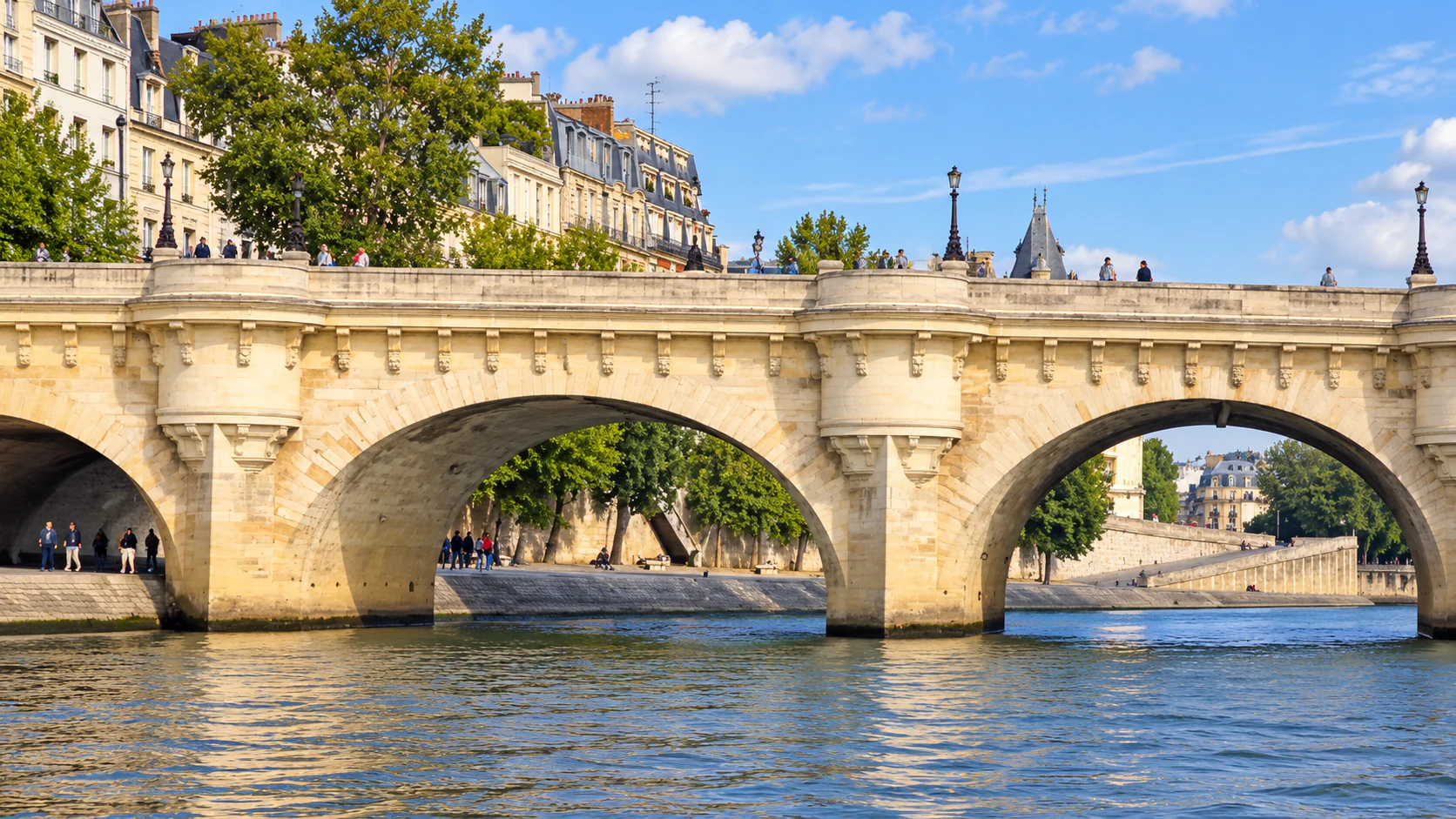
Despite its name, it is Paris’s oldest surviving bridge. Construction began in 1578 and was completed in 1607. Its stone arches were designed without the houses and shops that crowded many earlier crossings. Raised pavements gave pedestrians a more deliberate place within the bridge, helping explain why its broad, open form mattered to the city.
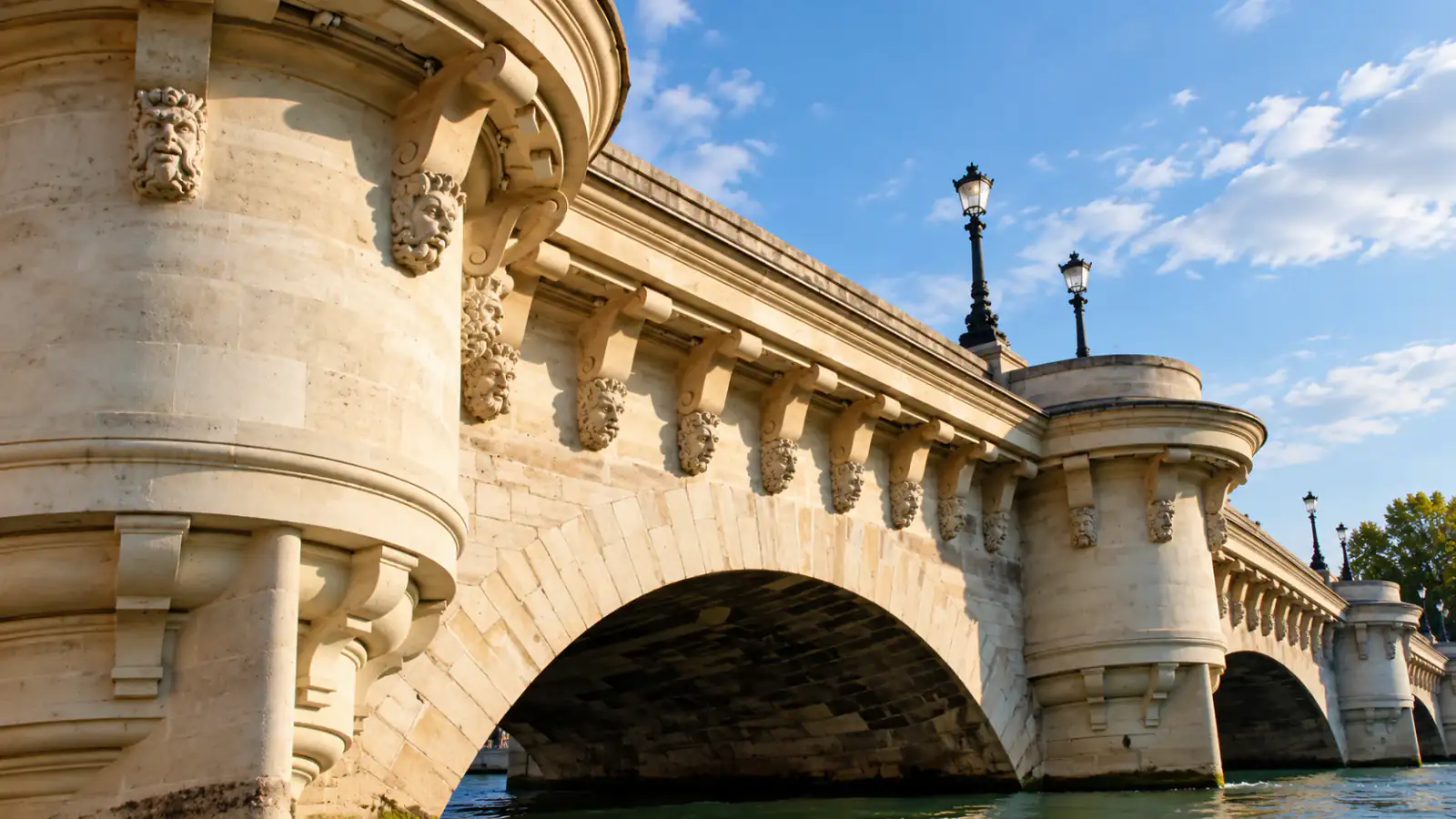
The rounded bays and carved stone faces add a closer architectural subject. Hundreds of mascarons decorate the bridge, visible especially from lower river viewpoints. From the pavement, the curve of the parapet and changing view across each river arm make the structure easier to understand than a single distant photograph does.
Henri IV and the island connection
Henri IV’s equestrian statue marks the island connection. The present sculpture dates from the nineteenth century, replacing the earlier royal monument destroyed during the Revolution. Behind it, rue Henri-Robert leads into Place Dauphine; below, steps reach the lower island garden and quays.
A crossing can connect the Louvre side of the river with Saint-Germain-des-Prés, or become part of a circuit through the Conciergerie and Notre-Dame. Boats passing below give the bridge another scale, where the arches and carved faces are the main subjects. The pedestrian bridge visit and a cruise are different experiences with different starting points.
In pictures
The full gallery.
02 / The essentials
Pont Neuf: visit essentials
- 01
Île de la Cité
- 02
Allow 20–45 minutes
- 03
Walking across the public bridge is free.
04 / Before you go
Plan your visit
Paris’s oldest surviving bridge, its carved faces and Henri IV statue at the island’s western tip.
Admission
Walking across the public bridge is free.
Opening & visit
Public crossing, subject to temporary works, events and traffic restrictions.
Arrival
Pont Neuf métro on line 7 serves the Right Bank approach. The bridge crosses both arms of the Seine through Île de la Cité.
Pont Neuf, between quai de la Mégisserie and quai des Grands Augustins, Paris
Plan your visit
No bridge admission is required. River cruises below use separate operators, tickets and boarding areas.
Accessibility
Use the pavement crossings; steps down to the lower island square are a separate route.
05 / Where it is
Find it
and what’s nearby.
Continue exploring
More of Paris, around your visit.
Continue your Paris day
06 / Good to know
Pont Neuf: frequently asked questions
01Why is Pont Neuf called new if it is Paris’s oldest bridge?
The name belongs to its construction, which began in 1578. Completed in 1607, it is now the oldest surviving bridge in Paris.
02Is Pont Neuf free to cross?
Yes. It is a public bridge, subject to temporary works or event restrictions.
03What are the carved faces on Pont Neuf?
The stone mascarons decorate the bridge’s exterior. Lower river viewpoints and boat passages show them differently from the pavement.
04Where is the Henri IV statue on Pont Neuf?
It stands at the central island connection, facing towards the Place Dauphine approach.
05Does Pont Neuf reach Île de la Cité?
Yes. Its two sections cross the two river arms through the island’s western end.
06Can I board Bateaux Parisiens at Pont Neuf?
The ordinary Bateaux Parisiens Eiffel Tower sightseeing product boards at Port de la Bourdonnais. Other cruise operators use Pont Neuf; use the boarding point and berth printed on your cruise ticket.