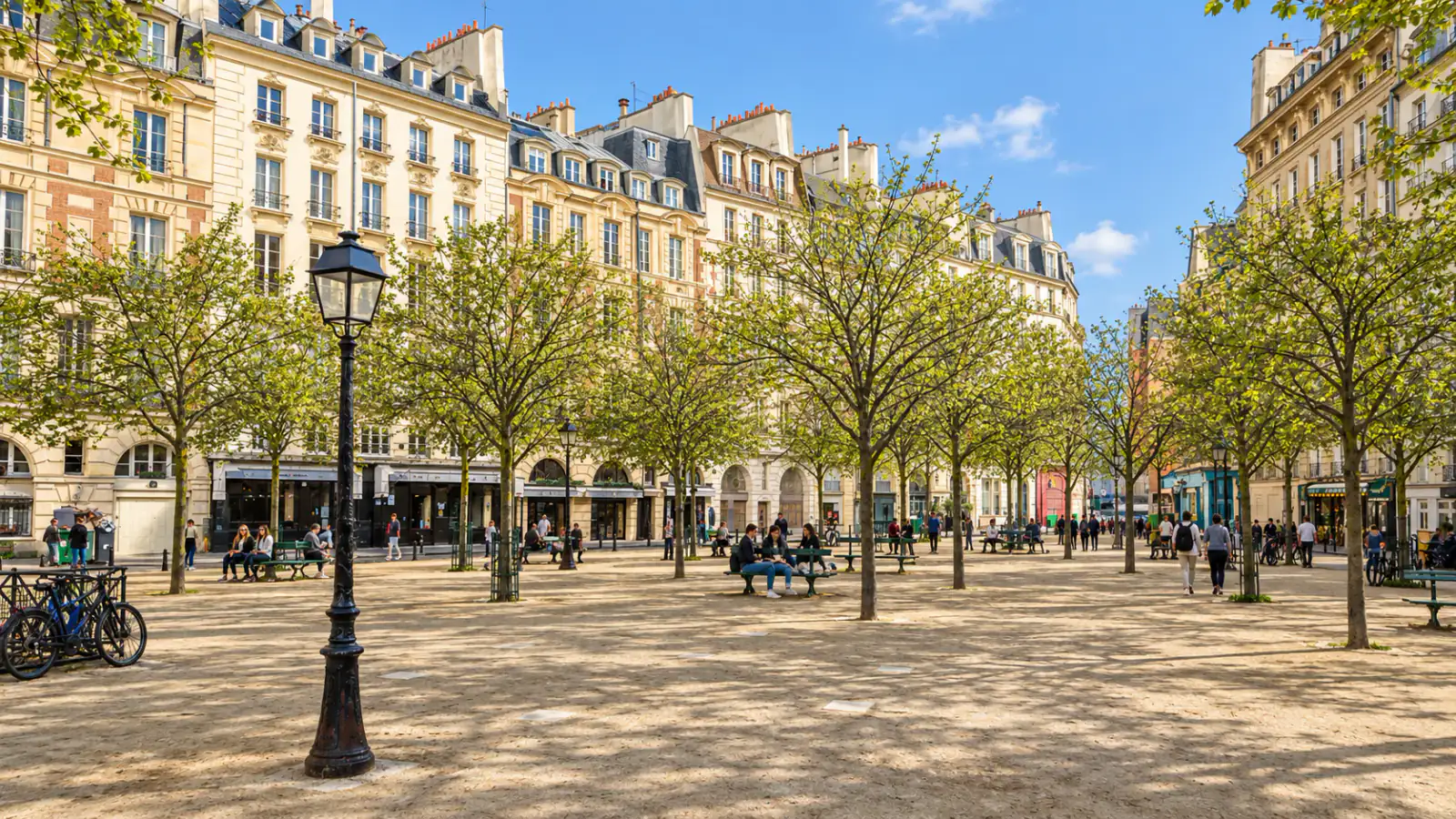
Place Dauphine
A triangular tree-shaded square between Pont Neuf and the Palais de Justice.
01 / The experience
An island square with a royal beginning.
Place Dauphine narrows towards Pont Neuf like the point of the island itself. Its central trees, benches and gravel form a small public space between rows of houses, while the open eastern end looks towards the Palais de Justice. The change from the bridge’s traffic and river views to this enclosed square is immediate.
A triangular square behind Pont Neuf
Henri IV initiated the development in the early seventeenth century. The name honours his son, the future Louis XIII, and the original scheme used red brick and pale stone within a unified arrangement. The surviving entrance buildings give a sense of that design, although later alterations mean the whole square should not be read as an intact matching set of seventeenth-century façades.
The relationship with Pont Neuf is essential. Henri IV’s equestrian statue stands on the bridge rather than in the middle of the square. The small street between the paired entrance buildings joins the two spaces, allowing the statue, the island and the square to be understood together.
Cafés, trees and the western island walk
The eastern side changed substantially in the nineteenth century when buildings were removed to open a view towards the law courts. That decision explains why the square feels triangular without being enclosed on all three sides. The planted central area followed, bringing the benches and trees that now define an ordinary pause here.
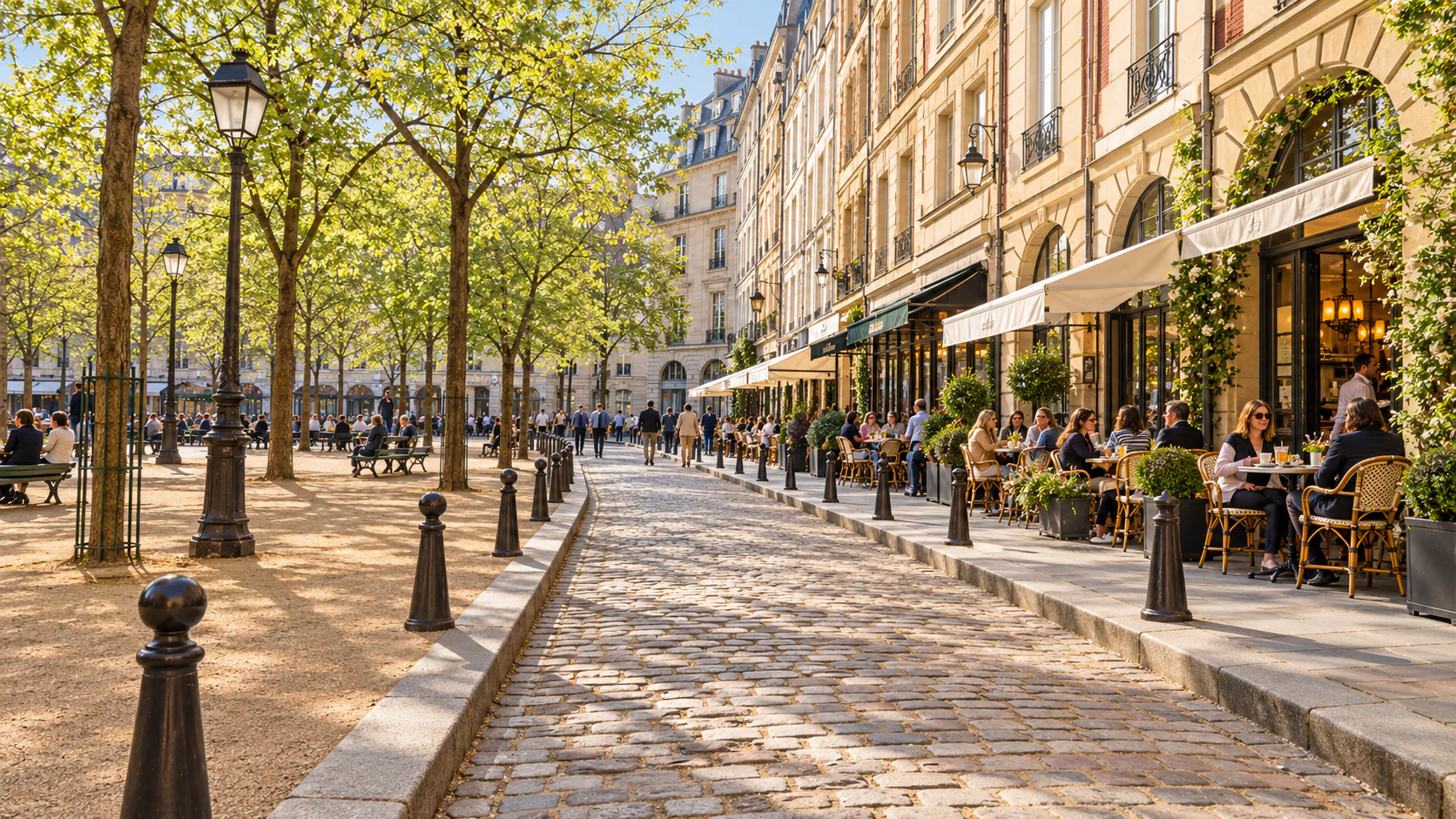
Cafés and restaurants occupy parts of the ground floor, but the public square needs no purchase. It fits naturally between the Conciergerie and Pont Neuf, offering a quieter civic space after the island’s monumental interiors. The interest is in that small sequence of architecture and everyday use, rather than an attraction behind a ticket gate.
In pictures
The full gallery.
02 / The essentials
Place Dauphine: visit essentials
- 01
Île de la Cité
- 02
Allow 20–40 minutes
- 03
The public square is free; cafés and restaurants charge separately.
04 / Before you go
Plan your visit
A triangular tree-shaded square between Pont Neuf and the Palais de Justice.
Admission
The public square is free; cafés and restaurants charge separately.
Opening & visit
The square’s public routes are generally open; severe weather can close the planted square.
Arrival
Walk in from Pont Neuf via rue Henri-Robert or from rue de Harlay beside the Palais de Justice.
Place Dauphine / 6 rue de Harlay, 75001 Paris
Plan your visit
No admission or general reservation is needed. Individual restaurants have their own arrangements.
Accessibility
Expect gravel, uneven paving and kerbs; the city lists the square as accessible to visitors with reduced mobility.
05 / Where it is
Find it
and what’s nearby.
Continue exploring
More of Paris, around your visit.
06 / Good to know
Place Dauphine: frequently asked questions
01Is Place Dauphine free to visit?
Yes. It is a public square; a café or restaurant purchase is optional.
02Where is Place Dauphine in Paris?
It is near the western tip of Île de la Cité, between Pont Neuf and rue de Harlay beside the Palais de Justice.
03Why is Place Dauphine triangular?
Its early seventeenth-century development followed the western island site. Later removal of the eastern row opened the square towards the law courts.
04Are all Place Dauphine buildings original?
No. The square has been altered substantially. Its paired entrance buildings help convey the original brick-and-stone scheme.
05Can I combine Place Dauphine with Notre-Dame?
Yes. An island walk can connect Notre-Dame, the palace precinct and Place Dauphine before reaching Pont Neuf.
06Is Place Dauphine step-free?
The city lists accessible entry, but gravel, kerbs and uneven paving affect the route. Severe weather can close the planted square.