Notre-Dame de Paris
Restored Gothic vaults, medieval carving and rose windows in Paris’s island cathedral.
01 / The experience
A bright new chapter within eight centuries of stone.
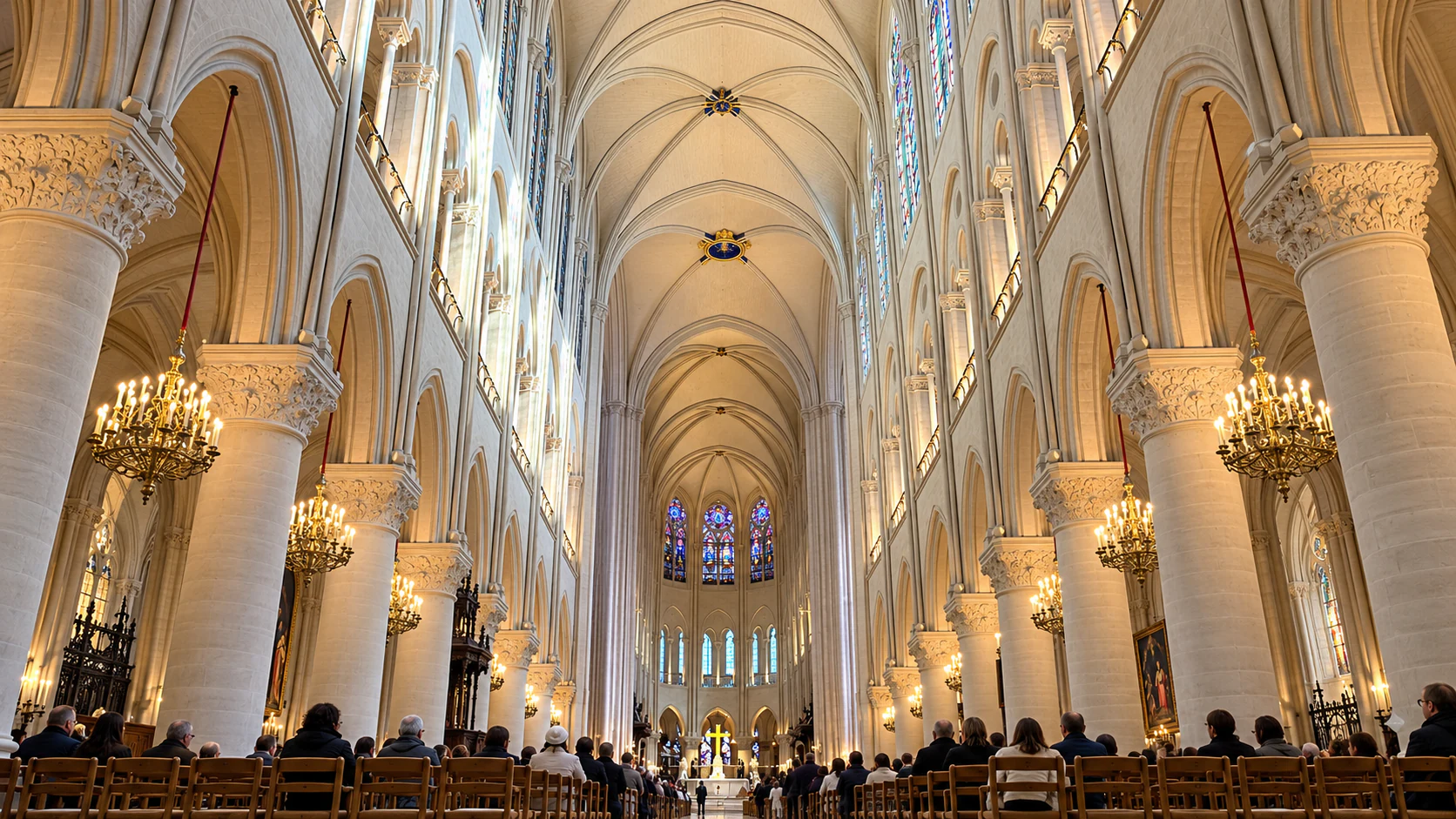
The first impression inside Notre-Dame is the colour of the stone. Cleaning during the restoration has brought the pale limestone back into view, letting the nave’s tall arcades, galleries and high windows read as a connected structure. The cathedral reopened in December 2024 after the fire of April 2019. It remains a working place of worship, with a daily rhythm of services alongside the visitor circuit.
The nave is a good place to understand how the building stands. Round piers carry the great arcades, while narrower shafts rise towards the ribs overhead. The sexpartite vaults divide each bay into six sections. Looking from the lower arcades towards the clerestory reveals the different levels of the elevation; crossing into a side aisle changes the proportions again, bringing carved capitals and smaller chapels closer.
Restored spaces and medieval glass
At the crossing, Guillaume Bardet’s bronze altar introduces a contemporary shape within that medieval framework. Its curved mass sits before the older choir, where carved wooden stalls and the great golden cross form a different ensemble. Near the western entrance, the bronze baptismal font has its own setting and purpose. These additions belong to the cathedral’s renewed liturgical life, rather than a reconstruction of a single historical moment.
The north and south rose windows deserve separate attention. Their circles of stone tracery contain different arrangements of medieval figures and coloured glass. The north rose retains much of its thirteenth-century glazing; the south rose has undergone substantial later restoration. A view of the whole transept explains how the windows illuminate the building, while a closer look reveals the many small scenes within their larger patterns.
Sculpture, music and the island setting
Around the choir, the painted stone screen brings religious narrative down to a more intimate scale. Its figures, niches and surviving colour reward a much closer view than the soaring nave. Other works give the circuit distinct pauses: the Virgin and Child statue, the carved pulpit, the Pietà ensemble and memorials to people associated with the cathedral. The official masterpiece circuit identifies works and their positions; the accessible route on the day may differ around services or conservation work.
Above the western end, the great organ occupies an architectural setting of its own. Carved wood and ranks of metal pipes fill the gallery beneath the vaults. Hearing it depends on the cathedral’s musical and liturgical programme. The tower bells tell another part of that musical history, including the great bourdon Emmanuel. Their belfry belongs to the separately managed tower visit, rather than the ordinary ground-level cathedral circuit.
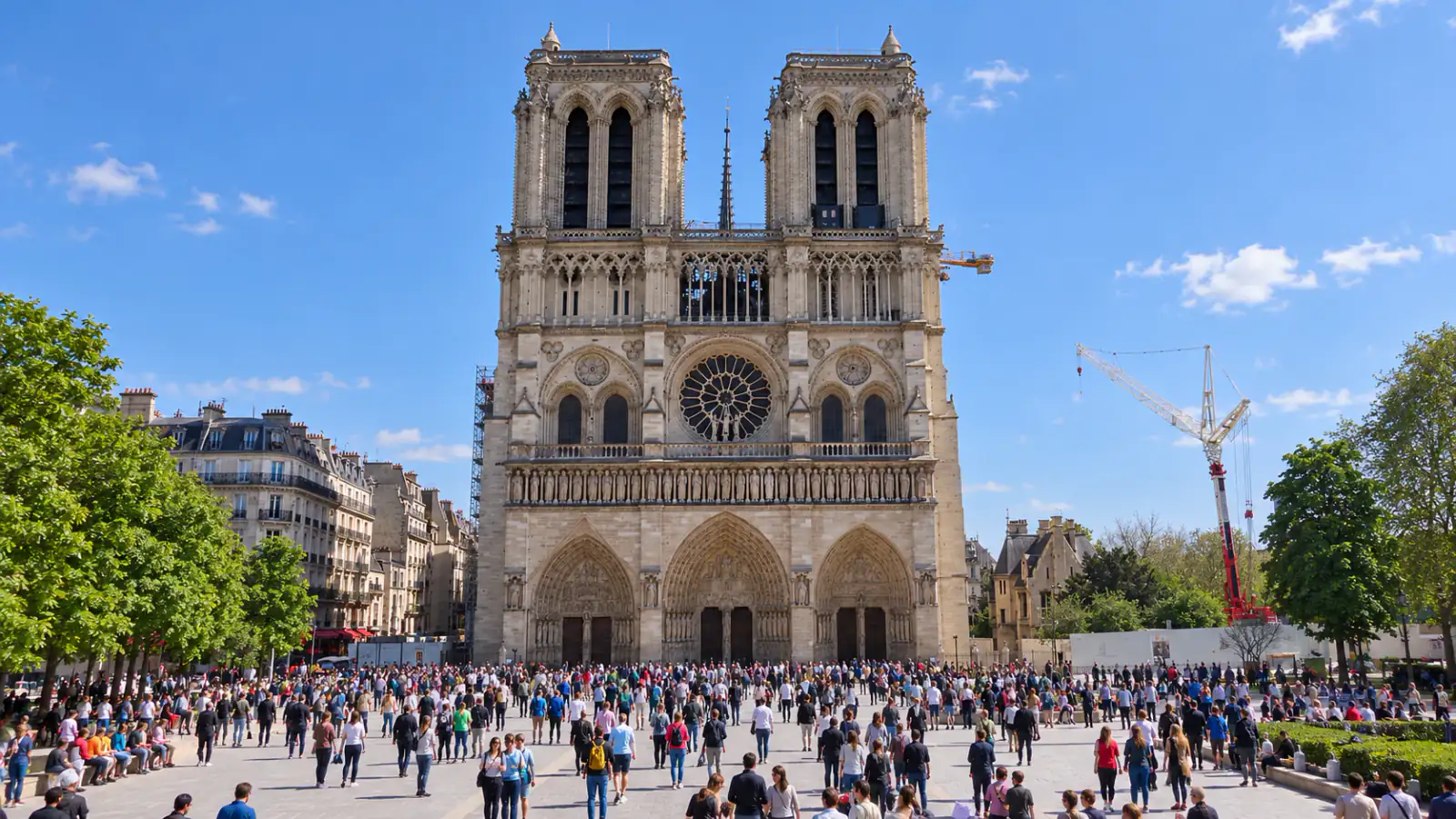
Outside, the west front presents a different order: three portals, the Gallery of Kings, the rose and the two towers. The portal sculpture is best understood as individual groups within the larger façade. From the Seine, the southern flank reveals the transept and flying buttresses; from a tower viewpoint, the rebuilt spire and lead roofs explain the outline that was lost in the fire. The roof timbers and technical spaces are not part of an ordinary free visit.
Notre-Dame also helps make sense of Île de la Cité. Sainte-Chapelle offers a very different medieval interior within the former palace, while the Conciergerie connects royal architecture with the island’s judicial history. Place Dauphine and Pont Neuf bring the walk back to public squares and river crossings. Exterior restoration and the remaking of the cathedral’s surroundings continue, so the forecourt and riverside approach may include barriers even while the cathedral welcomes visitors.
In pictures
The full gallery.
02 / The essentials
Notre-Dame de Paris: visit essentials
- 01
Île de la Cité
- 02
Allow 1–2 hours for the cathedral, plus queuing
- 03
Cathedral entry is free. The treasury and tower tour charge separately.
04 / Before you go
Plan your visit
Restored Gothic vaults, medieval carving and rose windows in Paris’s island cathedral.
Admission
Cathedral entry is free. The treasury and tower tour charge separately.
Opening & visit
Open daily, with extended Thursday opening. Services and special celebrations can change the visitor route.
Arrival
Approach the signed visitor queue on the west forecourt. Cité and Saint-Michel–Notre-Dame are nearby stations; external works can change the approach.
6 parvis Notre-Dame – place Jean-Paul-II, 75004 Paris
Plan your visit
Free entry can be reserved through the cathedral’s official portal on the day of the visit, as slots are released; walk-in entry remains possible. The treasury and CMN tower tour have separate admission arrangements. Paid third-party cathedral-entry tickets are not required.
Accessibility
The cathedral interior and treasury have accessible routes. The separate tower climb involves many stairs and is unsuitable for visitors who cannot manage them.
05 / Where it is
Find it
and what’s nearby.
Continue exploring
More of Paris, around your visit.
Continue your Paris day
06 / Good to know
Notre-Dame de Paris: frequently asked questions
01Is Notre-Dame de Paris free to visit?
Ordinary cathedral entry is free. The treasury and the separately managed tower visit charge their own admission. You do not need to buy a third-party cathedral-entry ticket.
02Do I need a reservation to enter Notre-Dame?
No. A free reservation through the cathedral’s official portal can reduce waiting; walk-in queues are also available. Slots are released close to the visit, and the portal determines what is available.
03How long does a Notre-Dame cathedral visit take?
Allow one to two hours inside, plus the entry queue. A treasury visit or tower climb adds time and should be planned separately.
04Can I visit Notre-Dame’s towers with the free cathedral reservation?
No. The towers are managed by the Centre des monuments nationaux and require a separate booking through their official site. The route includes a substantial stair climb.
05Is Notre-Dame accessible for a wheelchair user?
The cathedral interior and treasury have accessible routes. Ask the cathedral’s reception team for the appropriate entrance during external works. The tower climb is a different route with stairs.
06Can I take photographs inside Notre-Dame?
Respect the cathedral’s current photography instructions and worshippers. Flash, equipment and access may be restricted during services; do not interrupt prayer or enter closed areas.
07Which Notre-Dame artworks and architectural features should I look for?
The rose windows, choir screen, great organ, carved stalls, Virgin and Child and Pietà ensemble offer distinct subjects. The restored vaults and contemporary bronze liturgical furniture are also central to the present interior.
08Can I visit Notre-Dame while exterior restoration continues?
The cathedral is open, but work around its exterior and forecourt can affect pedestrian routes. Follow the signed visitor entrance and allow extra time for the queue and security.