Montmartre
A hilltop Paris of white domes, artists’ squares, steep lanes and quieter streets beyond the busiest viewpoints.
01 / The experience
The hill above the city, and the streets beyond the viewpoint.
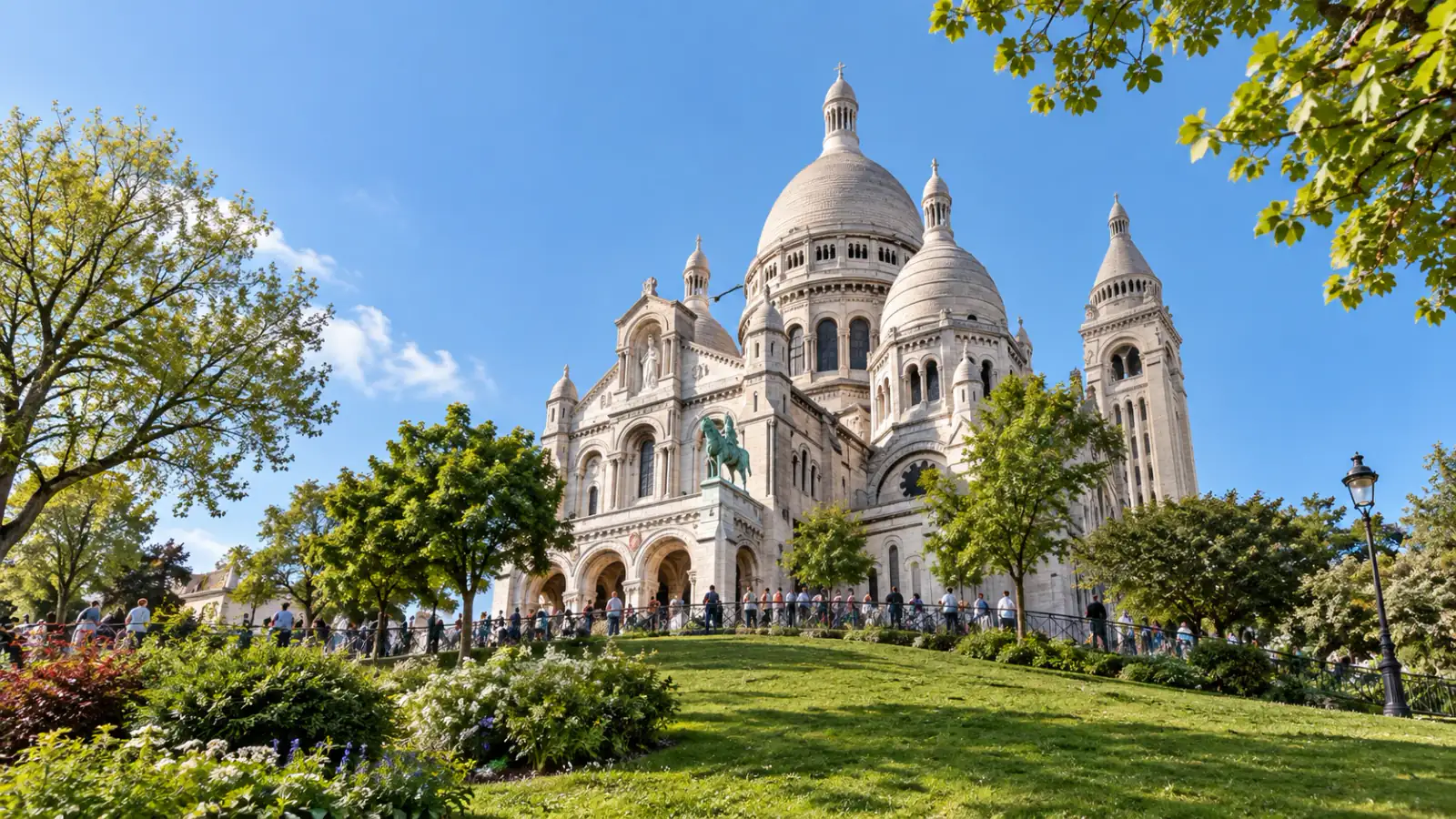
Montmartre changes with the climb. Lower streets lead into slopes and stairways, then open onto the gardens and terraces beneath Sacré-Cœur. The white domes are the most recognisable landmark, but the movement through changing levels gives the neighbourhood much of its character. Paris appears below in stages rather than all at once.
Sacré-Cœur and the streets below
The basilica and its outdoor setting form a strong first focus. From below, the gardens and steps frame the building; from above, the view reverses towards the city. Those are different architectural experiences within a short distance. The church remains a religious place as well as a visitor landmark, with worship and visitor access shaping an interior visit.
The streets around Abbesses and rue Lepic reveal a more everyday commercial side of the hill, with shop windows and food shopping among the routes used by visitors. They connect the celebrated upper squares with a neighbourhood that continues below them, broadening the walk beyond the view from Sacré-Cœur.
Place du Tertre and Rue de l’Abreuvoir
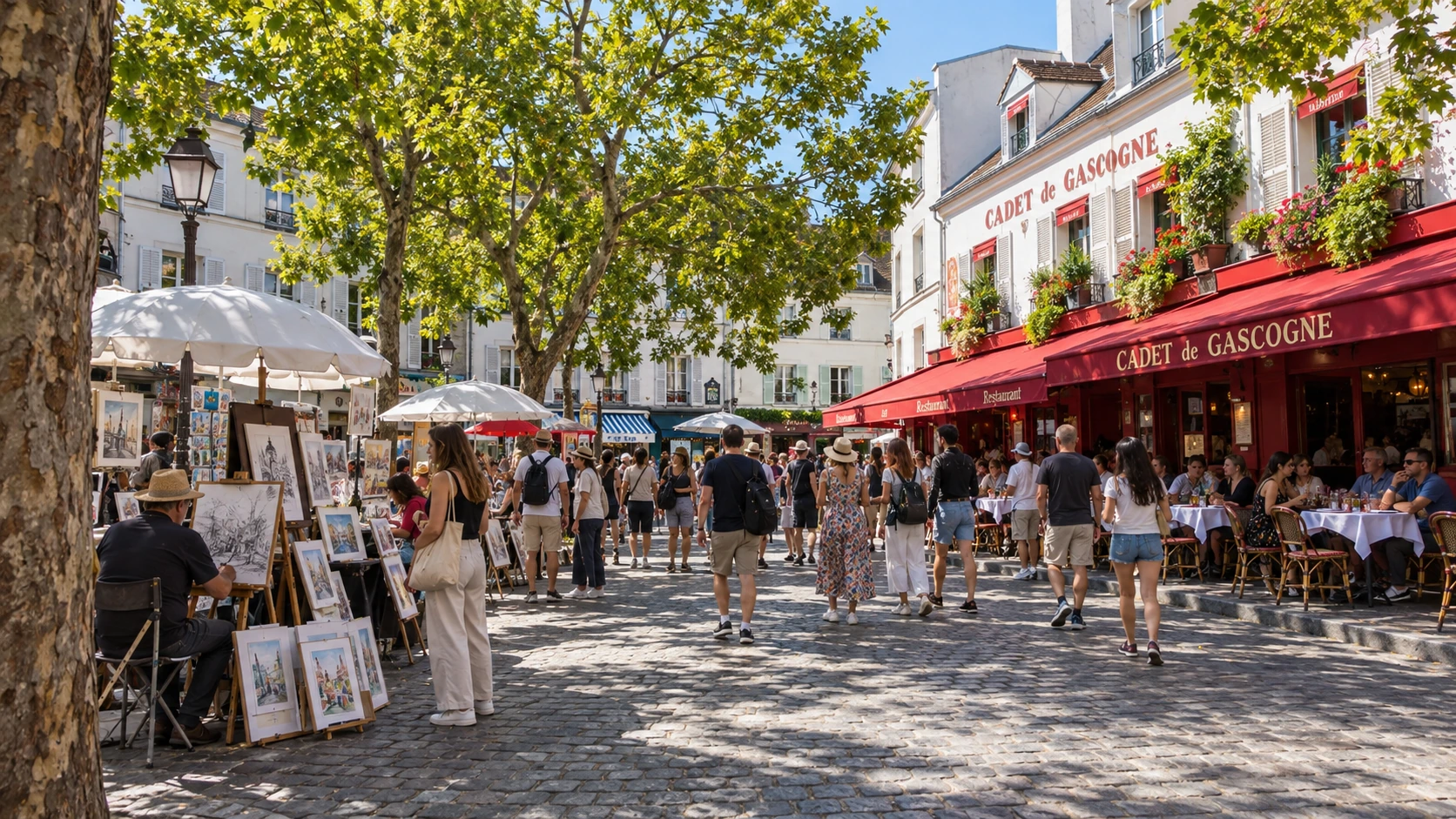
Place du Tertre introduces another kind of scene. Artists, close-set buildings and café tables make the square more intimate and animated than the broad viewpoint. Portrait work and other paid services belong to the people offering them, while the square itself is a public place to look at and move through. Its interest lies in that activity as much as the surviving street setting.
Quieter lanes reveal another scale. Rue de l'Abreuvoir bends through a smaller architectural scene, with the Maison Rose frontage and surrounding greenery giving it a particularly recognisable image. Elsewhere, steps, uneven paving and compact buildings make the hill's topography visible in ordinary streets. A photograph of one famous corner captures only a small part of that changing landscape.
Mills, vineyard and neighbourhood cafés
The surviving mill landmarks and vineyard setting add to Montmartre's association with an older, less densely urbanised hill. They are features within a working neighbourhood, with individual access arrangements rather than a continuous open-air museum. The streets and exterior views nevertheless give enough context to understand why the district feels different from the broad avenues below.
The food options in the wider 18th arrondissement also broaden the picture. Bønne on rue Labat brings Norwegian waffles, brunost and cinnamon or cardamom buns into an old butcher's shop. Lomi's rue Marcadet café offers another coffee-led stop, connected with a wider roasting and training operation. These are separate neighbourhood addresses, not tables beside the basilica, and reaching them reveals more of the streets beyond the busiest hilltop route.
Approaches to the hill
The approaches from Anvers and Abbesses create different walks, with the funicular providing another option when operating. Slopes, stairs and crowds are consequential parts of the visit, particularly for anyone needing a gentler route. A shorter hilltop circuit can still connect the basilica setting, a square and one of the smaller lanes without treating every landmark as compulsory.
Montmartre's lasting appeal is the change in perspective it provides within Paris. The city is seen from above, then disappears again behind a turn in a lane or a close line of buildings. The viewpoint is only one part of that experience; the streets behind it give the neighbourhood its depth.
In pictures
The full gallery.
02 / The essentials
Montmartre: visit essentials
- 01
Montmartre
- 02
Allow 3–5 hours for the hill, squares and smaller streets
- 03
Public streets, gardens, viewpoints, the basilica, transport and private venues keep different hours and access conditions. Check the places and return transport you intend to use.
04 / Before you go
Plan your visit
A hilltop Paris of white domes, artists’ squares, steep lanes and quieter streets beyond the busiest viewpoints.
Admission
The ordinary public-street walk is free. Food, transport, guided activities and any separate dome, museum, show or other admission are additional.
Check admissionChoose your visit
Public streets, gardens, viewpoints, the basilica, transport and private venues keep different hours and access conditions. Check the places and return transport you intend to use.
Confirm opening and service times for your visit.
Arrival & access
Anvers gives access towards the gardens below Sacré-Cœur; Abbesses is another neighbourhood approach. Choose the route that suits your mobility, verify the relevant station and funicular service, and follow any booked tour’s actual meeting instructions.
Butte Montmartre, 75018 Paris
Expect steep slopes, cobbles, steps and crowded viewpoints. Check lift and funicular availability, arrange any needed assistance and use a shorter or suitably accessed route; a hilltop reference point is not a step-free arrival guarantee.
The I love you wall in Square Jehan-Rictus is currently inaccessible for safety reasons; it is not included as a visit stop.
Plan admission
The outdoor neighbourhood walk needs no general admission ticket. Check official arrangements for the basilica, dome, museums, performances and any paid guided activity. Confirm a chosen restaurant independently; the area guide does not reserve a table or a tour.
05 / Where it is
Find it
and what’s nearby.
Continue exploring
More of Paris, around your visit.
Continue your Paris day
06 / Good to know
Montmartre: frequently asked questions
01How much time should I allow for a Montmartre visit?
Allow around three to five hours for the hilltop, a museum and a food stop. With less time, focus on Sacré-Cœur and Place du Tertre; adding the Renoir gardens, Dalí Paris and a sit-down lunch makes this a half-day outing.
02Which Métro station should I use for Montmartre?
Anvers on line 2 suits an approach towards the gardens and funicular below Sacré-Cœur. Abbesses on line 12 suits the streets around rue des Abbesses and rue Lepic. Choose the starting point to match your first stop; both approaches still involve hilly streets.
03Can I reach Sacré-Cœur in Montmartre without climbing the 222 garden steps?
The funicular provides an alternative to the 222 steps through Square Louise Michel. It gets you up the hill, but it does not make the rest of Montmartre’s steep streets or individual attractions step-free.
04Which parts of Montmartre can I visit for free?
The neighbourhood streets, Place du Tertre and ordinary entry to Sacré-Cœur are free. Museum admission and the basilica’s dome climb are separate paid visits. Allow separately for the funicular, food and any portrait you commission; there is no single admission ticket for the district.
05What is a useful walking route through Montmartre?
Start at Sacré-Cœur for the view, continue to Place du Tertre, then choose Musée de Montmartre on rue Cortot or Dalí Paris on rue Poulbot. Leave time for rue de l’Abreuvoir before descending towards rue Lepic. This is a suggested sequence with slopes, rather than a step-free route.
06What can I do in Montmartre when it rains?
Choose Musée de Montmartre for the neighbourhood’s art history and Valadon studio, or Dalí Paris for sculpture and graphic works. Both are separate ticketed visits. Pair one with a café or meal and shorten the outdoor hilltop walk; the garden views are better saved for a break in the weather.
07Can I visit the Renoir gardens in Montmartre without buying museum admission?
Musée de Montmartre offers a separate garden-only admission option for the Renoir gardens and café. It does not include the exhibition rooms or Valadon studio. Choose full museum admission if the studio and indoor collections are part of your visit.
08Where can I stop for coffee or a meal around Montmartre?
KB CaféShop on avenue Trudaine is a coffee stop below the hill. Le Coq & Fils on rue Lepic specialises in poultry to share; Bouillon Pigalle, on boulevard de Clichy, offers a brasserie meal at the foot of the district. Choose the stop to suit your route rather than climbing back up for lunch.
09Is Montmartre suitable for a wheelchair or a visitor who cannot manage many steps?
The steep streets make a district-wide walk demanding even when you use the funicular. Sacré-Cœur has a rear accessible entrance at 35 rue du Chevalier de la Barre; its dome has no lift. Musée de Montmartre has partial access, with steps remaining in parts of the permanent collection and garden.
10Do I need to climb the Sacré-Cœur dome for a Paris view from Montmartre?
No: you can enjoy the outlook from the hilltop outside the basilica without buying a dome ticket. The dome adds a higher panoramic view, reached by almost 300 steps with no lift. Its separate ticket is sold on site, and weather or maintenance can interrupt access.