Grands Boulevards
Covered passages, theatrical façades and brasserie tables on Paris’s historic entertainment boulevards.
01 / The experience
Large entertainment façades and small covered streets.
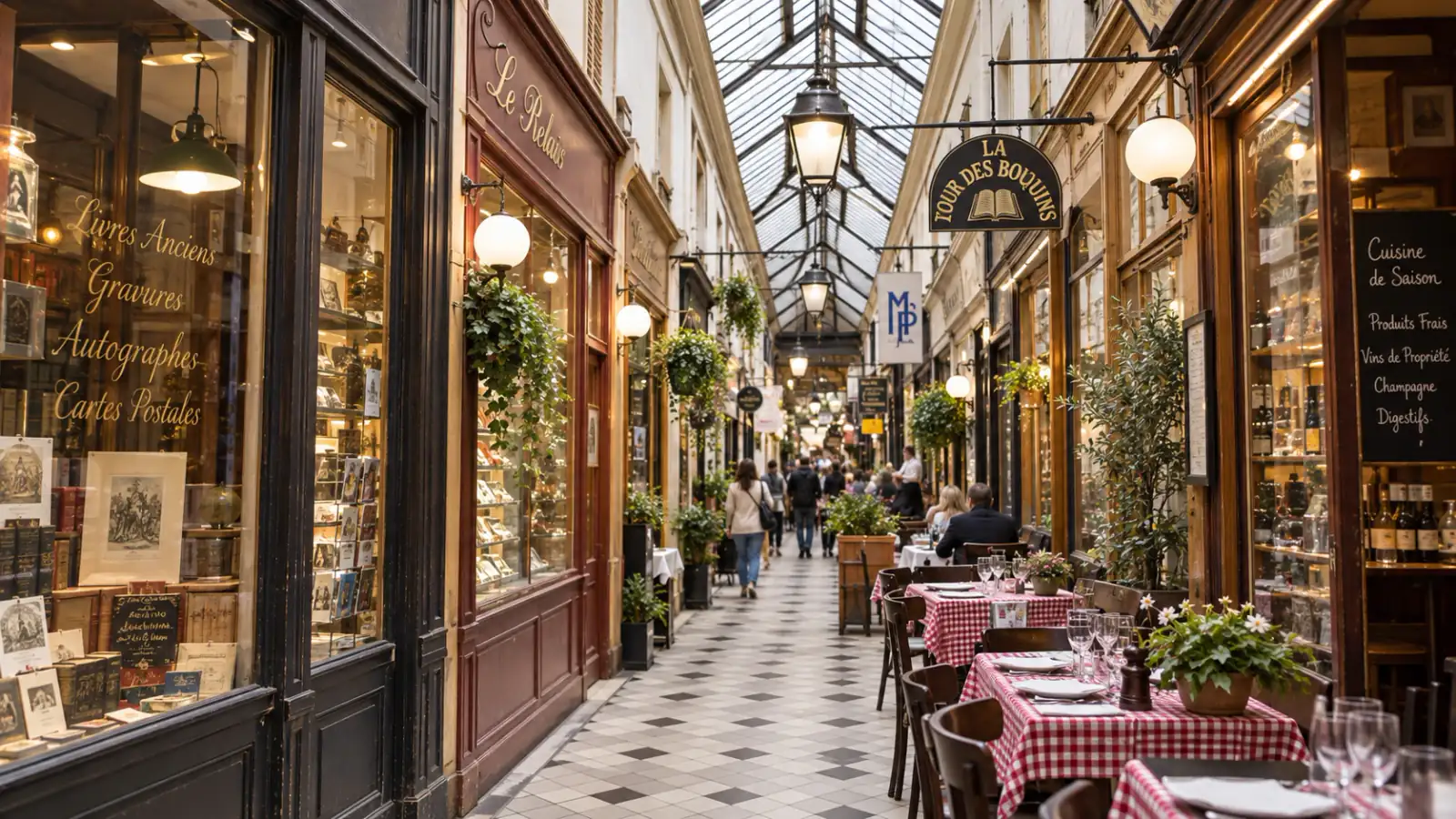
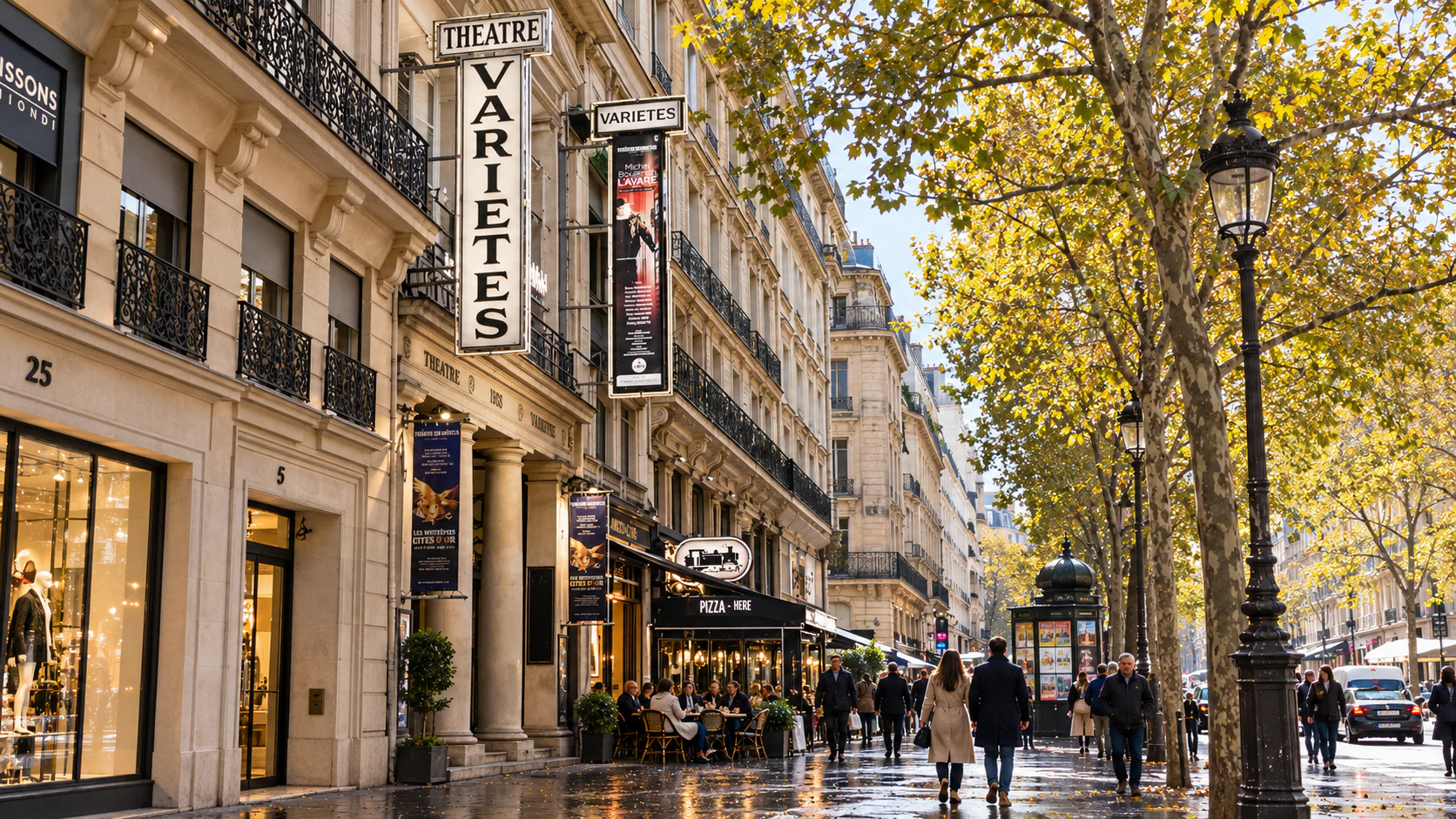
The Grands Boulevards shift between two architectural scales. Outside, broad streets carry traffic past theatres, cinemas and cafés; inside the covered passages, narrow pedestrian routes lead beneath glazed roofs and past small shopfronts. The contrast is the district's most distinctive experience, with a much larger city continuing just beyond the arcade entrances.
Boulevards and the covered passages
Around boulevard Montmartre and boulevard Poissonnière, a manageable walk can take in several versions of that contrast. The boulevard provides the public frontage, while side streets and passages reveal smaller spaces behind it. The district is a corridor rather than a single enclosed attraction, so the interest lies in the sequence of places and the differences between them.
The wider corridor runs between the Opéra and République areas, with stately Haussmannian buildings providing a repeated street framework. Individual entertainment façades interrupt that continuity, announcing a theatre or cinema within an otherwise recognisable block. The result is a district where the public face of a show has an architectural role of its own, before anyone enters the auditorium or looks at the programme.
Small arcades and the Grand Rex
Passage des Panoramas, Passage Jouffroy and Passage Verdeau bring different combinations of roof structures, paving and shopfronts. Looking up reveals how daylight reaches the narrow streets; looking along them shows the changing signs, windows and doors. They remain working commercial spaces, which gives the visit a more ordinary rhythm than a preserved architectural set.
The Grand Rex offers the opposite scale. Its corner tower and cinema façade announce entertainment to the boulevard, especially when illuminated. The building can be appreciated from the pavement as part of the district's architecture, while screenings and tours create separate ways to experience it inside. The dated programme determines those options, with the exterior remaining part of the public street.
Chartier and the continuation towards Opéra
Food has a similarly strong setting at Bouillon Chartier Grands Boulevards. The dining hall's mirrors, woodwork and rows of tables belong to a tradition of serving everyday French meals in a substantial room. Leeks vinaigrette, eggs mayonnaise and familiar main courses keep the food approachable, while the old napkin drawers and historical detail give the meal context. It is a particular restaurant off the boulevard, with its own activity and walk-in rhythm.
The western continuation towards Opéra introduces a more monumental architectural focus. Palais Garnier and Café de la Paix belong to the wider outing, but their large public spaces feel different from the small glazed passages. A route connecting the two areas reveals how Paris' entertainment district can move between a theatre square and a much more intimate shopping arcade.
Weather changes the use of these spaces without making the whole district indoors. The covered sections offer shelter, while the links between them return to crossings and open streets. That movement is part of the area's character: the visitor continually passes between the scale of the boulevard and the scale of a shop window. The most rewarding subject is not a single building but the way those large and small spaces fit together, with eating, shopping and entertainment still giving them practical purposes.
In pictures
The full gallery.
02 / The essentials
Grands Boulevards: visit essentials
- 01
Grands Boulevards
- 02
Allow 3–5 hours, longer with a show or museum
- 03
Public streets remain distinct from the opening of passages, shops, theatres and restaurants. Evening façades do not establish late kitchen service or building access.
04 / Before you go
Plan your visit
Covered passages, theatrical façades and brasserie tables on Paris’s historic entertainment boulevards.
Admission
Public street walking is free. Passage access, shops and individual businesses have their own conditions; meals, shows, museum visits and cinema admission are additional.
Check admissionChoose your visit
Public streets remain distinct from the opening of passages, shops, theatres and restaurants. Evening façades do not establish late kitchen service or building access.
Confirm opening and service times for your visit.
Arrival & access
Use Grands Boulevards métro for the central boulevard section, or arrive from Opéra and continue east. Follow the exact passage, theatre or restaurant address for any reserved visit.
Boulevard Montmartre / boulevard Poissonnière, Paris 2e & 9e
Busy crossings, narrow passages, thresholds and uneven paving can affect the walk. Confirm suitable entrances at the venues you book and keep an outdoor-to-indoor alternative that matches your group.
Plan admission
Public boulevard walking needs no district ticket. Check covered-passage access, reserve any performance, museum or cinema visit separately and allow for the Chartier walk-in queue.
05 / Where it is
Find it
and what’s nearby.
Continue exploring