Osaka Castle Museum
Explore Osaka Castle’s history museum, gold tea-room replica and tower views, with time for the moats and park.
01 / The experience
Hideyoshi’s golden tea room, the Summer Siege and Osaka from above
A golden tea room is an unexpected centrepiece for a castle visit. Osaka Castle Museum has a full-size replica of Toyotomi Hideyoshi's portable version, bringing a very particular kind of display into the tower. Around it, models and historical exhibits explain how the castle changed under the Toyotomi and Tokugawa families. The museum gives you people and events to connect with the huge walls outside.
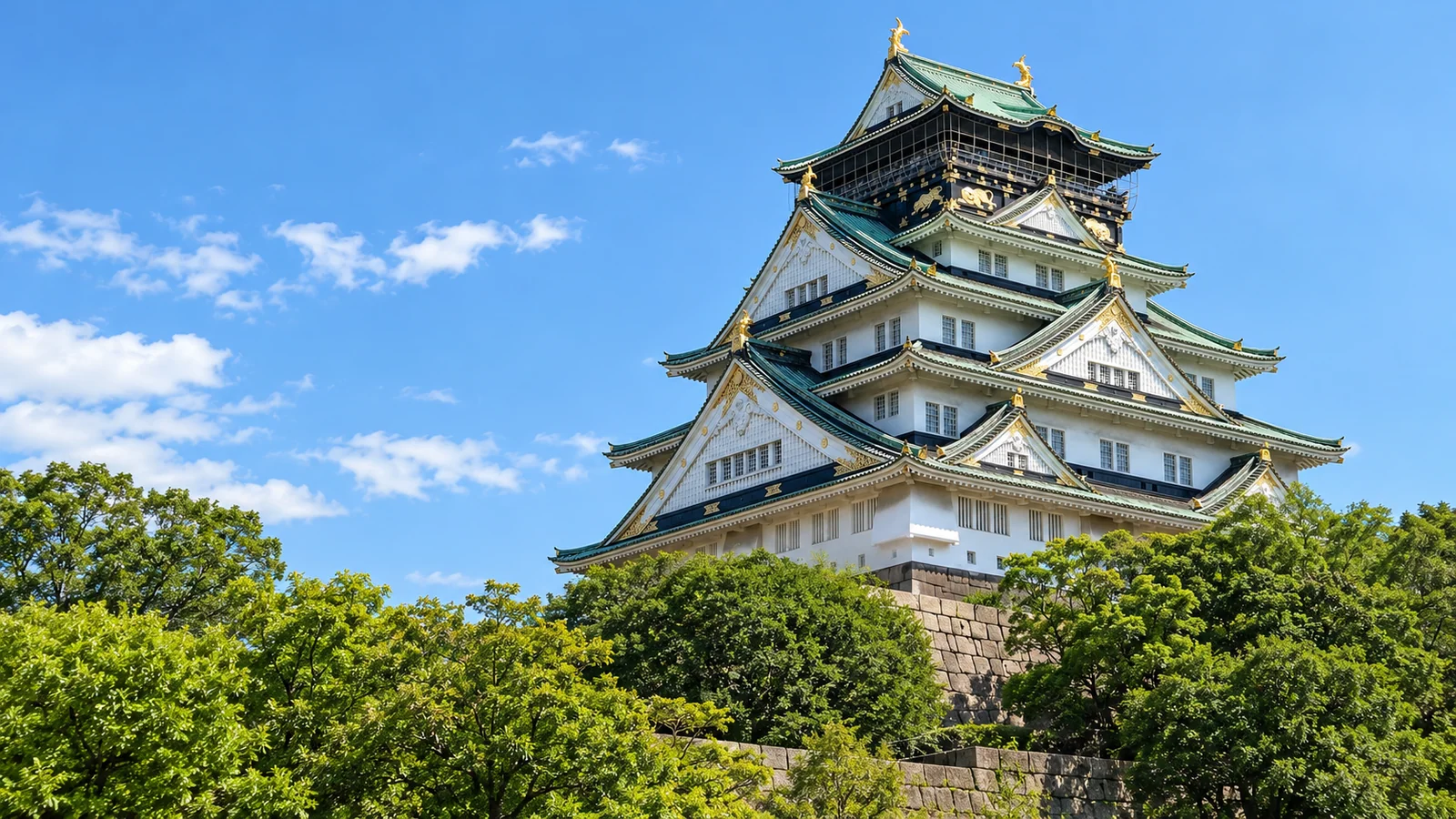
The tower itself belongs to another chapter. Completed in 1931 with public donations, it is a modern steel-and-concrete building, the third main tower to occupy the site. Its white walls, green-blue roofs and gold decoration recall the castle's earlier grandeur, while the interior functions as a museum. That makes it a different visit from walking through a surviving timber keep: the galleries and the city view are the reasons to come inside.
Hideyoshi's original tower stood for only about thirty years before the castle fell in 1615. Tokugawa forces destroyed it as the Toyotomi family lost its final struggle for power. The rebuilt Tokugawa tower was completed in 1626 and burned after a lightning strike in 1665. Knowing that sequence makes the models especially useful. They show different versions of a place whose familiar name can otherwise suggest one unchanged building.
The golden tea-room replica offers a smaller-scale way into Hideyoshi's world. The original was made to be assembled and moved, so its extravagance was something that could travel with its owner. Beside the castle models, it gives the galleries a contrast between a whole fortified headquarters and an intensely decorated space for an intimate gathering. It is an approachable exhibit even if the rival families and battles are new to you.
The fifth-floor displays follow the Summer Siege of Osaka in 1615. Miniature figures recreate fighting involving Sanada and Matsudaira forces, with visual material helping explain scenes from the famous battle screens. After the architecture models, these bring movement and people into the setting. You can connect the fall of the Toyotomi stronghold with particular parts of the conflict, rather than leaving it as a date on a timeline.
The seventh floor turns towards Hideyoshi's life, using miniature scenes to carry the story. Other galleries display historical objects in changing selections, so the exhibits offer more than the permanent models alone. You can spend the visit following the rise and fall of one powerful figure, or concentrate on the castle's construction and successive forms. Both approaches give the tower interior a clear purpose.
At the top, the observation area takes you back to modern Osaka. The moats, walls and park spread out below, with the city continuing around them. It is a useful final perspective after the models: the scale of the site becomes visible, and the castle's position within today's city is easier to grasp. A walk through the grounds before or after the tower gives those views a counterpart at ground level.
This is a good Osaka outing for travellers who would like history, museum displays and an open-air walk in the same visit. The tower supplies the narrative, while the surrounding fortifications provide the physical scale. Give both parts some time and the castle becomes more than the familiar skyline from a photograph, with enough distinct exhibits to make the interior worthwhile.
04 / Before you go
Plan your visit
Admission & cost
Adult tower admission ¥1,200
Current adult tower admission is ¥1,200. University/high-school admission is ¥600 with the required proof; younger visitors need the accepted age evidence for free admission. Confirm current rates and separate park attractions.
When to visit
Current ordinary hours 09:00–18:00, final admission 17:30. The ticket queue may close earlier when busy. Ordinary closure 28 December–1 January; check special changes.
Allow 2–3 hours for the park approach and tower museum, longer if adding another separately admitted attraction.
Allow for the park walk and tower queue before a Namba dinner reservation; the outdoor grounds and museum are separate choices.
Arrival & access
From Namba, choose the current Osaka Metro/JR connection to a suitable Osaka Castle Park approach. The nearest useful station depends on your gate and mobility; include the park walk before the tower ticket entrance.
1-1 Osakajo, Chuo-ku, Osaka 540-0002
Plan your visit
A tower ticket covers the museum; the main park grounds are free and other attractions have separate charges. Historical-object displays rotate. The assisted wheelchair route differs from ordinary lift-and-stair circulation; arrange the complete museum and observation-area route. Pushchairs are stored at the tower entrance.
Location & nearby places
Continue exploring / Japan
More to explore
in Japan
Find another place for your itinerary, or explore all things to do in Japan.
 Landmarks & gardensFushimi Inari TaishaExplore experience →
 Museums, markets & cultureKuromon MarketExplore experience →
 Museums, markets & cultureDotonboriExplore experience →
 Museums, markets & cultureHIRAKUZA Osaka sumo showExplore experience →
Good to know
Osaka Castle Museum: frequently asked questions
Is Osaka Castle’s main tower an original wooden building?
Osaka Castle’s main tower is a 1931 reconstruction. Inside are history displays and an eighth-floor observation area, so come for the castle’s story and the views across Osaka.
Which floors should I prioritise on a shorter Osaka Castle Museum visit?
At Osaka Castle Museum, try the golden tea-room replica and castle models on the third floor, Summer Siege miniatures on the fifth, then the eighth-floor view. It gives you a useful mix of the museum and observation area.
Is Osaka Castle Park free if I do not enter the tower museum?
The main Osaka Castle Park grounds are free. You pay to enter the tower museum, and some other park attractions have their own charges.
How does wheelchair access work inside Osaka Castle Museum?
Osaka Castle Museum has an assisted route to the museum and observation area. Arrange the full approach as well as the route inside, because it differs from the usual lift-and-stair circulation.
Can pushchairs go inside Osaka Castle’s tower museum?
Leave your pushchair at the Osaka Castle Museum tower entrance under the current storage arrangements.
What is Osaka Castle Museum’s last admission, and can queues close earlier?
Osaka Castle Museum’s final admission is normally 17:30, but the ticket queue can close earlier when busy. Arrive with time to explore the displays and observation area after entry.