Raeren Pottery Museum
Follow Raeren stoneware from medieval tableware to contemporary ceramics inside a moated castle.
01 / The experience
The stoneware village inside a moated castle
See how a border village became a centre for European stoneware, in the medieval castle that houses its archaeological finds.
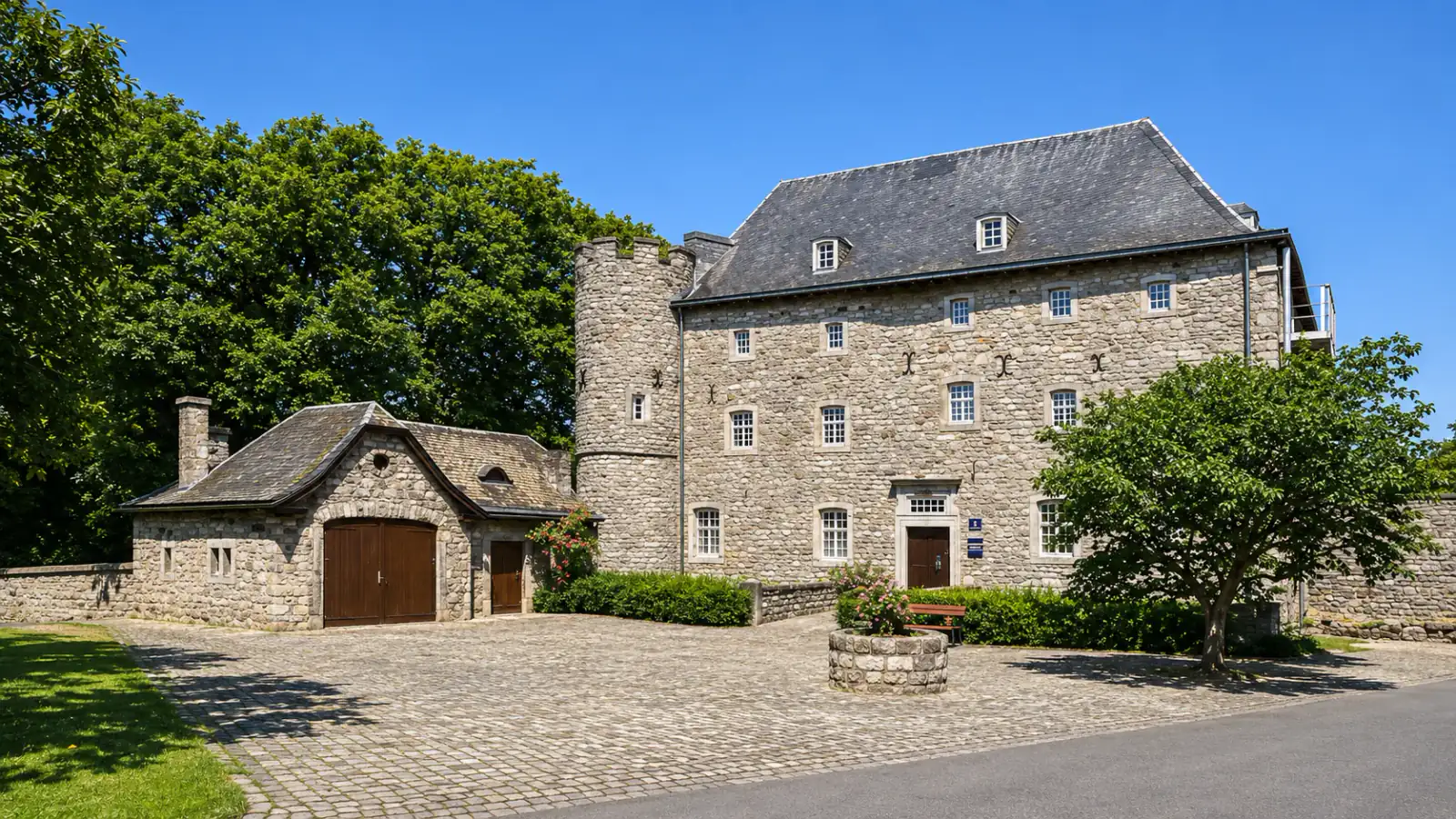
A stone bridge over the moat leads to Raeren Castle. The thick walls were built to protect a residence; the objects inside are the work of potters whose goods travelled well beyond this corner of eastern Belgium. The museum has occupied the fourteenth-century castle since 1963. Much of its collection grew out of finds made in Raeren itself, which makes the pottery a record of ordinary village work as well as a collection of finished pieces.
The oldest finds include simple tableware from the thirteenth and fourteenth centuries. They sit in a much longer story that leads to the decorated jugs and tankards of the Renaissance and Baroque periods. Raeren was known for stoneware, a hard ceramic fired at high temperatures. Its durability suited vessels made for everyday drinking, pouring and storage, while moulded ornament gave potters room to show their skill. The cases make it possible to see how a familiar shape could be repeated and altered: a handle, a band of decoration or an inscription gives a vessel its own character.
A tankard associated with Jan Emens Mennicken, one of the village’s best-known potters, puts a voice to that trade. His inscriptions could be irreverent. They turn what looks at first like solemn historic pottery into something that once carried a joke around a table. Later work by Hubert Schiffer and twentieth-century replicas show how the older forms were taken up again, after the original stoneware industry had declined.
The Rehker Collection widens the view beyond Raeren. Its Roman ceramics and stoneware from other production centres, including Siegburg and the Westerwald, give the local pieces something to stand beside. There is contemporary ceramic work too. A tour of the displays can go from a plain early vessel to a modern piece shaped for exhibition rather than daily use, with hundreds of years of changing purposes in between.
Raeren is a natural stop for visitors staying near the German border or travelling between Eupen and Aachen. The castle and its moat are worth taking in as part of the visit. The museum’s attention to one material and one village makes it a manageable outing even if you only have part of a day.
Highlights
- 01
Allow 1–1½ hours
- 02
€5 adult
- 03
Indoor collection; the bridge and approach are outdoors.
- 04
Closed Mondays.
04 / Before you go
Plan your visit
Admission & cost
€5 adult; €3 youth up to 18, seniors and groups of 10 or more; children up to 12 free. Family ticket €12 for two adults and two youths. Confirm 2027 prices.
When to visit
Tuesday–Sunday 10:00–17:00; closed Mondays. Check holiday opening before travelling.
Allow 1–1½ hours
Closed Mondays.
Arrival & access
Use Burgstraße 103 for the museum inside Raeren Castle. The stone bridge crosses the moat to the castle.
Burgstraße 103, 4730 Raeren, Belgium
Plan your visit
Use the museum’s admission information for a self-guided visit. Contact the museum directly to arrange a group tour.
Accessibility
Contact the museum in advance about step-free access to the castle rooms.
Location & nearby places
Continue exploring / the Ardennes during F1
More to explore
in the Ardennes during F1
Find another place for your itinerary, or explore all things to do in the Ardennes during F1.
 Race And CircuitExperience Factory Eupen · indoor kartingExplore experience →
 Heritage visitsIKOB Museum of Contemporary ArtExplore experience →
 CyclingVennbahn Stage 2: Raeren to MonschauExplore experience →
 Day Trips And ExtensionsAachen CathedralExplore experience →
Good to know
Raeren Pottery Museum: frequently asked questions
What is on display at Raeren Pottery Museum besides antique jugs?
Raeren Pottery Museum in eastern Belgium displays archaeological finds, Roman and regional ceramics from the Rehker Collection, later replicas and contemporary work.
Where is the entrance to Raeren Pottery Museum?
Raeren Pottery Museum is inside the moated castle at Burgstraße 103, Raeren, Belgium. The approach crosses the castle’s stone bridge.
Can I book a guided group visit to Raeren Pottery Museum?
Raeren Pottery Museum arranges group tours directly; ask about the language, date and full group charge. Ordinary museum admission is for a self-guided visit.