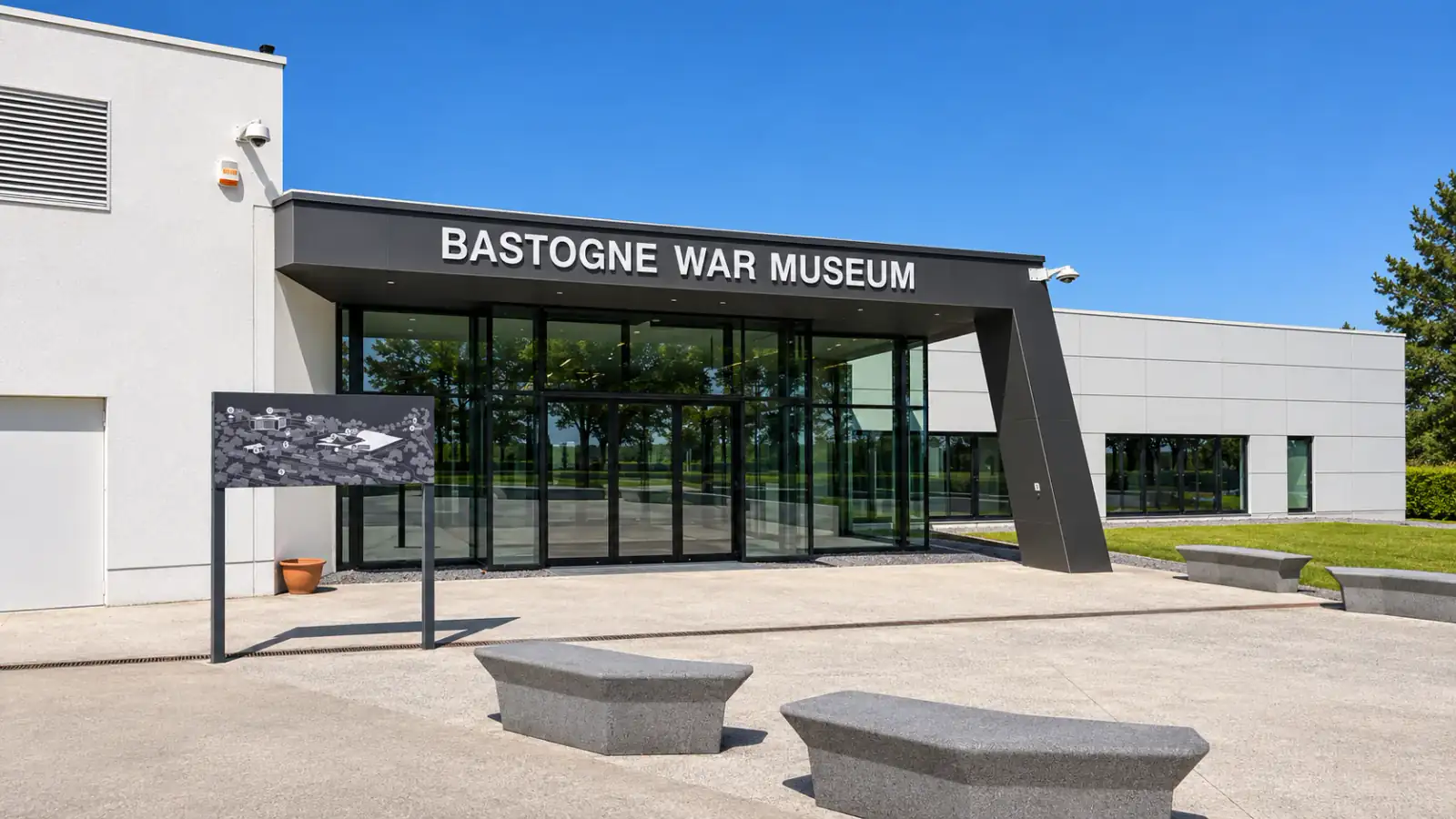
Bastogne War Museum
Follow four wartime perspectives through the Battle of the Bulge, then explore postwar Europe in Generations45.
01 / The experience
Bastogne through the eyes of civilians and soldiers
See how the fighting around Bastogne affected both the people who lived there and the forces sent to hold it.
A bicycle and a pile of belongings on a red platform tell one part of the story at Bastogne War Museum. A Sherman tank under a forest of hanging interpretation panels tells another. The museum stands beside the Mardasson Memorial and puts the Battle of the Bulge into the longer history of the Second World War. The fighting around Bastogne occupies much of the visit, but there is time for the lives disrupted by the fighting and for what followed it.
Four voices from the winter of 1944
The audio tour introduces four people who would have had little reason to meet before the winter of 1944. Émile Mostade is a teenager from Bastogne whose father repairs bicycles; Mathilde Devillers is a young teacher. Robert Keane is a corporal in the American 101st Airborne Division, while Hans Wegmüller is a German lieutenant. They are characters drawn from historical evidence and partly fictionalised. Each notices different things. A soldier’s account of a position in the woods can sit beside a civilian’s concern about shelter or leaving home. Those shifts in viewpoint give the objects in the cases a scale that a campaign map alone cannot convey.
The museum’s staged scenes give those accounts a setting. In the reconstructed café, the wooden counter, bentwood chairs and round tables make an ordinary public room part of the story. A forest scene uses darkened trees, light and sound to show a very different place to spend the winter. These are presentations within the museum rather than reconstructions you have to seek out across the battlefield. They can be loud and intense, something to factor into a visit with young children or anyone sensitive to sudden sound.
From the ruins of Bastogne to the Cold War
Generations45 changes the time frame. It follows two veterans, the American Sergio and the German Karl, after the war, from ruined Bastogne to a Europe divided by the Cold War. A reconstructed street makes the damage to a town visible at street level. An old neighbourhood cinema is part of the installation, and the account runs as far as the fall of the Berlin Wall. The extension takes about half an hour and fits with the main exhibition on the same day. The two together make a worthwhile visit even if the battlefield or the War Rooms need a separate outing.
Outside, the five-pointed Mardasson Memorial marks the Belgian tribute to American forces who fought in the Battle of the Bulge. Its tall stone colonnades and the ring at the centre make more sense once you have seen how closely the museum’s story is tied to the ground around it. The memorial is a separate site beside the museum. Allow time to see the monument from outside. Ask about access if you want to visit the crypt or upper walkway.
The War Rooms and Bois Jacques
The ticket also covers two stops away from the museum. At the Bastogne War Rooms, the McAuliffe cellar is the setting for the American reply to a German surrender demand on 22 December 1944. At Bois Jacques, about four kilometres from the museum, the surviving foxholes are small depressions in the forest floor. An optional phone app shows how the ground was used through short scenes set in specific locations. The difference between the two places is part of the appeal: one tells a story about a headquarters decision, the other about what it meant to hold a position in winter.
For a Grand Prix trip, Bastogne works best as a separate day from the circuit. The main museum and Generations45 take about two and a half hours before you allow for lunch, the memorial or a move between sites. The Bistrot de la Paix is at the museum, with a terrace facing the memorial. A visit that includes the War Rooms and Bois Jacques needs time for their own opening hours and for the journeys between them.
Highlights
- 01
Allow 2½ hours for the main museum and Generations45
- 02
€28 adult · full experience
- 03
Indoor museum; the memorial and Bois Jacques are outdoors.
- 04
The War Rooms and Bois Jacques are separate locations.
04 / Before you go
Plan your visit
Admission & cost
Full experience: €28 ages 19–64, €24.50 ages 65+, €15.50 ages 6–18; under 6 free at the museum. Family ticket €72 for two adults and two children aged 6–18. The audio guide, Generations45, Bois Jacques and the War Rooms are included.
When to visit
The museum opens at 09:30 on listed days, with seasonal closing times. Choose a dated arrival slot; the other sites have their own hours.
Allow 2½ hours for the main museum and Generations45
The War Rooms and Bois Jacques are separate locations.
Arrival & access
Start at the main museum on Colline du Mardasson, beside the memorial. Museum parking is €7.50 per vehicle. From Libramont, bus 6 to Pépinière leaves about a 20-minute walk.
Colline du Mardasson 5, 6600 Bastogne, Belgium
Plan your visit
Reserve a timed arrival for the main museum. Tickets are non-refundable, and entry without a reservation depends on capacity.
Visit Generations45 on the same day as the museum. Plan to use Bois Jacques and the War Rooms within seven days; contact the museum before relying on a longer window.
Accessibility
The museum and War Rooms are accessible to visitors with reduced mobility. At Bois Jacques, use the call button at the accessible gate; paths to the foxholes can be difficult for wheelchairs and pushchairs.
Location & nearby places
Continue exploring
More history in the Ardennes
Plan your Grand Prix trip
Good to know
Bastogne War Museum: frequently asked questions
What does the Bastogne War Museum full-experience ticket include?
The Bastogne War Museum full-experience ticket includes the main museum and audio guide, Generations45, the Bastogne War Rooms and the Bois Jacques battlefield in Belgium. The War Rooms and Bois Jacques are at separate addresses.
Can I visit Bastogne War Museum, the War Rooms and Bois Jacques in one day?
A one-day visit to Bastogne War Museum, the Bastogne War Rooms and Bois Jacques is possible when their opening hours align. Allow about 2½ hours for the main museum and Generations45, one hour for the War Rooms and 30 minutes for Bois Jacques, plus transfers and a break.
Do I need a smartphone to visit the Bois Jacques battlefield near Bastogne?
The foxholes at Bois Jacques near Bastogne can be seen without a smartphone app. The optional app provides six location-based scenes in English, French, Dutch and German and can be downloaded before the visit.
Does a Bastogne War Museum visit include the Mardasson Memorial?
The Mardasson Memorial stands next to Bastogne War Museum but is a separate memorial. Access to its crypt and upper walkway needs to be checked separately.