Spa’s thermal heritage walk · La Ligne Bleue
Follow the blue arrows from the Pouhon through Spa’s springs, former baths, promenades and royal villa.
01 / The experience
How taking the waters shaped a whole town
See how mineral water shaped Spa’s buildings, parks and social life on an official three-kilometre route.
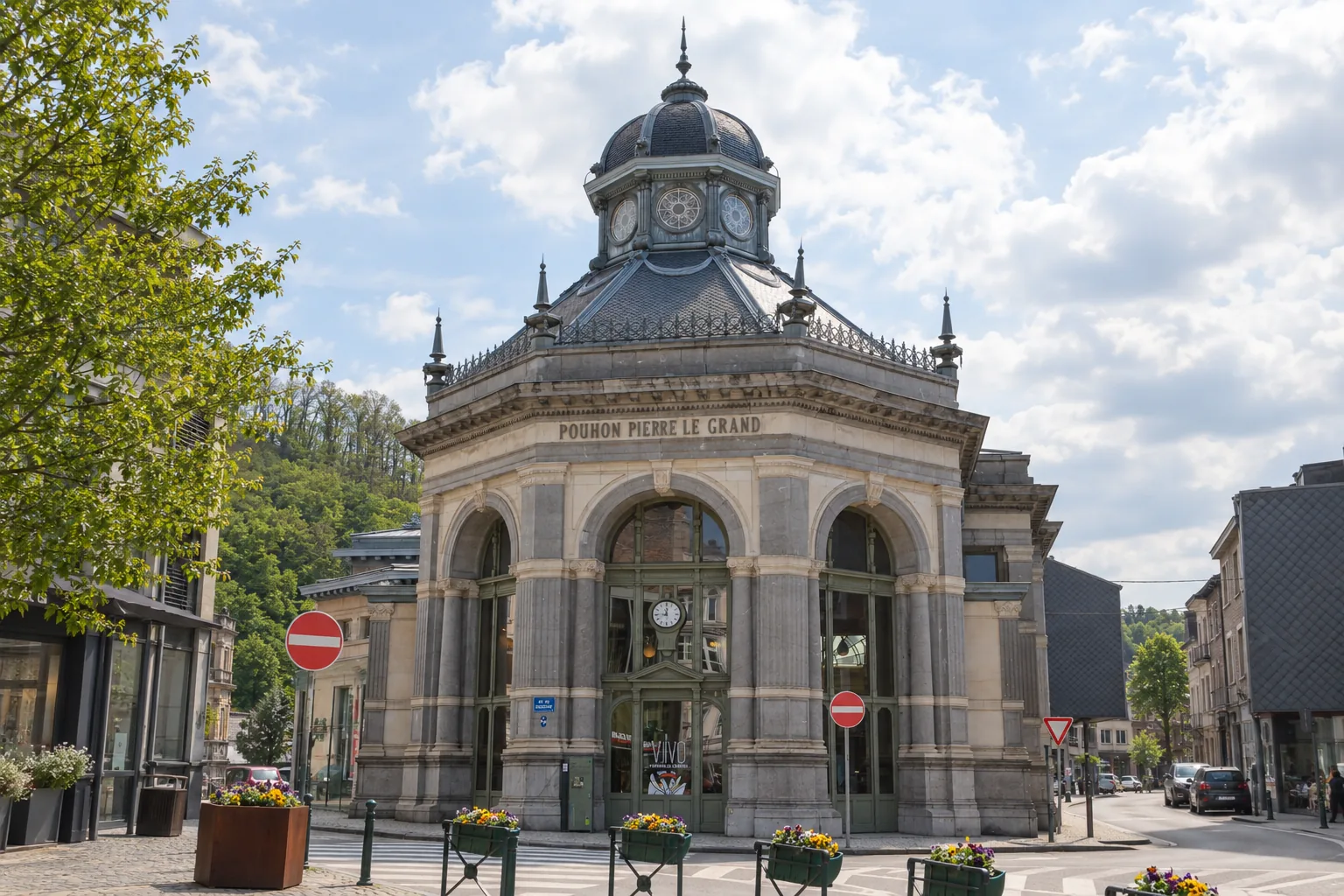
Look down outside the Pouhon Pierre le Grand. The small paving stones with blue arrows are the start of La Ligne Bleue, a three-kilometre walk through Spa. The route ties the spring house to the parks, public rooms and villas that grew up around the business of taking the waters. It is easy to see the buildings individually on a trip to town; following the arrows makes it easier to see why they belong together.
From the Pouhon to the town hall
The Pouhon is the clearest place to begin. A pouhon is a mineral spring, and the one inside this octagonal pavilion is rich in iron and naturally sparkling. The present building was designed by Victor Besme and dates from 1880. The winter garden above the spring makes room for a different sort of gathering, with ironwork and masonry doing different jobs in the same building. The name recalls Peter the Great’s visit in 1717, long before the pavilion went up. Spa joined ten other towns on the UNESCO World Heritage List in 2021, under the name The Great Spa Towns of Europe. What they share is the way mineral water shaped whole towns, from the treatment buildings to places to walk and meet.
The first stretch runs towards the town hall. The Perron’s column stands on three frogs. Its form recalls the civic monuments of the old Principality of Liège; the frogs give Spa’s version a character of its own. Near it, the Pouhon Prince de Condé has a nineteenth-century iron and glass structure and a much newer glass pyramid. Together with the older spring house, it shows how an everyday act such as collecting water could become a public occasion.
Baths, promenades and the royal villa
At Place Royale, the former baths are visible from the street. Their decorated stonework and rounded wing give a sense of the scale of the old thermal establishment. The public thermal baths operating today are up the hill, reached by the funicular near the square. The foot route stays in town and takes you into Parc de Sept Heures. The name recalls the hour when visitors came out to promenade. Beneath the Galerie Léopold II, rows of iron columns support a covered walk built in 1878. It offered shelter and gave visitors a place to meet between treatments, even when the weather was poor.
The blue line goes on to the Villa Royale, where Queen Marie-Henriette lived towards the end of her life. The old royal residence now houses Spa ! museum. Its Spa Story exhibition picks up the history seen in the streets, with objects connected to bathing and to the visitors who took the town’s reputation home with them. The decorated wooden boxes and other small objects called *bois de Spa*, or *jolités*, were part of that trade. The former stables belong to the same complex. The museum is an optional indoor stop with its own admission.
Through old Spa to the Casino
The return takes in a different Spa: the streets near Chapelle Leloup, the quieter lanes of the old town and a glimpse of the Waux-Hall. This surviving eighteenth-century assembly house gives some idea of the town’s social life before the present Casino de Spa was built. The Casino and Kursaal near the end of the walk inherited that role on a larger scale. Their rooms and gardens were places for entertainment as much as the baths were places for treatment. By the time the arrows lead back towards the spring, the distance between those purposes turns out to be only a few streets.
La Ligne Bleue is a free walk at your own pace. There is also a privately guided heritage walk for visitors who want a guide and a visit to the spring. For a shorter outing, the Pouhon, Place Royale and Parc de Sept Heures make a useful town-centre visit on their own; leave the Villa Royale and the hillside stretch for a longer day.
Highlights
- 01
3 km · allow 75–90 minutes on foot
- 02
Free self-guided walk
- 03
Outdoor town walk, with shelter under the Galerie Léopold II.
- 04
There are stair alternatives, but some streets slope.
04 / Before you go
Plan your visit
Admission & cost
The self-guided outdoor route is free. Spa ! museum: €5 adult for a separate visit. Indoor attractions, the funicular and the private guided walk have separate admission or charges.
When to visit
Walk the public streets in daylight at your own pace. The Pouhon, museum and other indoor stops have their own hours.
3 km · allow 75–90 minutes on foot
There are stair alternatives, but some streets slope.
Arrival & access
Start outside the tourist office at the Pouhon Pierre le Grand, Rue du Marché 1A. Follow the square paving markers with blue arrows. Spa and Spa-Géronstère are the town’s railway stops.
Pouhon Pierre le Grand, Rue du Marché 1A, 4900 Spa, Belgium
Plan the walk
No booking is needed for the public walk. Open the route map before setting out; indoor visits are optional.
Accessibility
The full route uses the Thier steps and a spiral stair near the railway. For the route without these stairs, use Rue de la Chapelle and Rue Collin Leloup, then Rue Cockerill and Rue des Capucins. Expect slopes; use the route map for the diversions.
Location & nearby places
Continue exploring
More of Spa and the Ardennes
Other ways to visit Spa
Plan your Grand Prix trip
Good to know
Spa’s thermal heritage walk · La Ligne Bleue: frequently asked questions
Is Spa’s La Ligne Bleue heritage walk a guided tour?
La Ligne Bleue in Spa, Belgium is a free, self-guided heritage route marked with blue arrows. The tourist office arranges private guided walks separately.
Can I avoid the stairs on Spa’s La Ligne Bleue heritage walk?
La Ligne Bleue in Spa has two signed-route alternatives in the walks brochure: Rue de la Chapelle and Rue Collin Leloup avoid the Thier stairs; Rue Cockerill and Rue des Capucins lead to Rue du Waux-Hall. Both alternatives still include slopes.
Where can I see displays about Spa’s historic baths?
The Spa Story displays are in the Villa Royale at Spa ! museum in Spa, Belgium, a separate paid stop from the La Ligne Bleue walk. Only the ground-floor areas and park are currently accessible to wheelchairs and pushchairs.
Are Spa’s old baths on Place Royale still the public bathing complex?
The former baths on Place Royale are a landmark on Spa’s La Ligne Bleue heritage walk. Today’s public Thermes de Spa are up the hill, reached by the funicular near Place Royale.