Via Sepulcral Romana
Look down onto a Roman burial road and its barrel-shaped tombs from the public square, then visit the interpretation centre when open.
01 / The experience
Via Sepulcral Romana
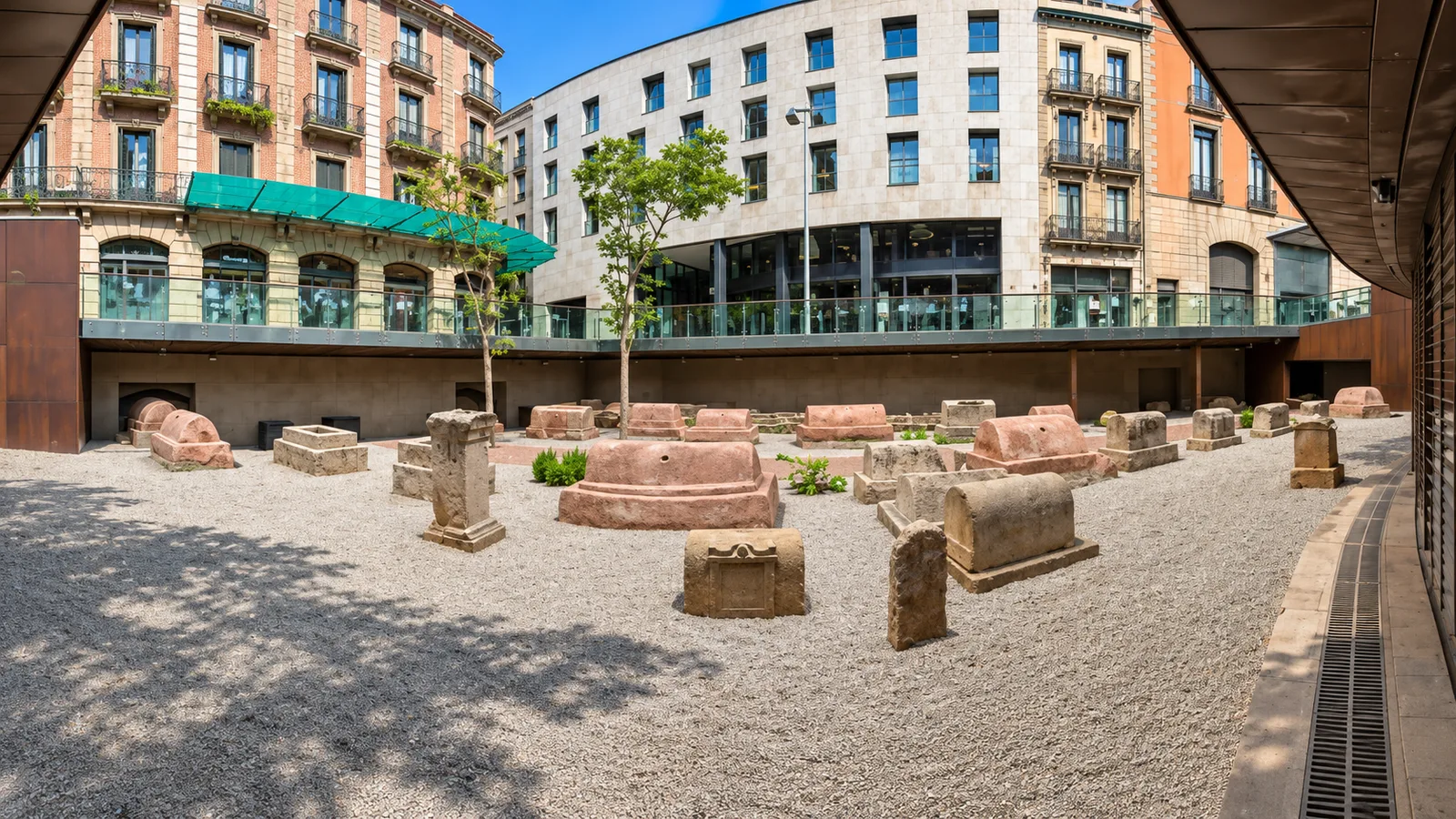
The Roman burial road lies below the modern paving of Plaça de la Vila de Madrid. From the square, look for the line of tombs on either side of the old road. This was a secondary route out of Barcino towards the area now called Sarrià. The graves stood outside the Roman city, where people passing along the road could see them. The burial ground was used between the first and third centuries AD.
Cupae, altars and standing stones
Some monuments are upright slabs or altars. Others are cupae, the low rounded tombs that resemble barrels laid on their sides. Looking down from the edge of the square makes their placement on both sides of the road clear. At the lower level their different shapes are easier to distinguish. The alignment of the burials is one of the best reasons to see the archaeology in place.
How the road survived beneath the square
The road had long since disappeared beneath deposits left by water flowing through the area. In 1588 a convent was built on the site. It was damaged during the Spanish Civil War and moved as the city redeveloped the square. The work brought the Roman remains to light. Barcelona kept them in place, leaving the change in level visible between the Roman road and the modern pedestrian routes around it.
What the interpretation centre adds
The small interpretation centre explains how the burial ground fitted into the territory around Barcino. It uses finds from the excavation to explain burial rites as well as the roads and surveyed fields around the colony. Allow time for the centre when it reopens. The public square is the place to start for the overall layout, with MUHBA Plaça del Rei offering a complementary look at life inside the Roman city.
04 / Before you go
Plan your visit
Cost
- View from the public square
- Free where the public overlook is accessible.
- Interpretation centre admission
- €2.10 per person for museum entry
- MUHBA combined ticket
- €7.30 per person, valid for six months.
When to go
Renovation closure through 4 December inclusive. Usual hours after reopening: Tue–Thu and Sun 10:00–14:00. Fri–Sat 10:00–15:00 and 16:00–19:00. Last entry 30 minutes before each closing. Closed Mon, 1 January, 1 May, 24 June and 25 December.
Getting there
Plaça de la Vila de Madrid, 1, 08002 Barcelona
Take Metro L3 to Liceu. Walk up La Rambla towards Plaça de Catalunya, then turn east into Carrer de la Canuda for Plaça de la Vila de Madrid. The archaeological site lies below the paving. For the museum entrance, follow the MUHBA signs in the square.
Entry and booking
MUHBA’s renovation notice lists a closure through 4 December inclusive. Confirm reopening before buying a ticket for the centre. The public square normally overlooks the excavation for free. Work barriers can limit views.
When the centre is open, general admission is €2.10 per person or included in the €7.30 MUHBA combined ticket. The combined ticket is valid for six months.
Location & nearby places
Continue exploring
More in the old city
Good to know
Via Sepulcral Romana: frequently asked questions
Can I see Via Sepulcral Romana from the square for free?
The public edge of Plaça de la Vila de Madrid normally offers a free view of Via Sepulcral Romana. Temporary work barriers can limit the view.
Is the Via Sepulcral Romana interpretation centre open?
MUHBA lists the Via Sepulcral Romana interpretation centre as closed for renovation through 4 December inclusive. Confirm the reopening date with MUHBA before buying tickets.
Does the MUHBA combined ticket cover Via Sepulcral Romana?
The €7.30 MUHBA combined ticket includes the Via Sepulcral Romana museum visit when the centre is open. Single-site general admission is €2.10. The combined ticket is valid for six months.
How do I get to Via Sepulcral Romana from Liceu metro station?
For Via Sepulcral Romana, take Metro L3 to Liceu. Walk north along La Rambla and turn east along Carrer de la Canuda to Plaça de la Vila de Madrid.