The Main Grandstand looks over the grid and pit garages. Grandstand I overlooks the final corner and pit entry. Both have roof cover. Grandstand L has a roof and looks across to the end of the main straight and towards Turn 5. Sun can reach roofed seats depending on the row and time of day. Pelouse, the general admission area, has open grass banks with several views around the lap.
4.657km lap
14turns
16viewing areas
01
Choose the racing action
Compare corners, straights and the view from each area.
02
Check the ticket
Reserved seat or general admission? Check membership and access restrictions.
03
Match the entrance
Find the recommended gate, then follow your ticket’s entry instructions.
The Catalan Grand Prix brings MotoGP, Moto2 and Moto3 to Circuit de Barcelona-Catalunya from Friday 11 to Sunday 13 June. Three-day tickets cover the weekend. For one day, the ticket office lists Saturday and Sunday Pelouse tickets for the grass viewing areas.
Grandstand tickets are grouped into Recta Principal, El Mirador and L’Estadi. The event’s zone guide shows where each area sits around the lap. Thursday 10 June is The Run-up. The launch offer that included it has ended.
For the MotoGP disability discount for you and one companion, email the circuit ticket office with your certificate and ID before buying. Bring proof of eligibility for discounted tickets to the circuit.
The first INDYCAR Grand Prix of Barcelona takes place on Sunday 18 July at Circuit de Barcelona-Catalunya. The official weekend runs from Friday 16 to Sunday 18 July. The race start time is still to be announced.
Sign up with the circuit to receive ticket sale information and event updates. Public tickets are marked as coming soon.
From Barcelona Sants or Passeig de Gràcia, take a Rodalies R2 or R2 Nord train that stops at Montmeló. Allow roughly 30 to 40 minutes on foot from the station to the circuit, depending on your entrance. On the regular Sagalés 428 route, the nearest stops are Verneda del Congost – Rec del Molinar from Montmeló and Can Cabanyes – Can Gordi from Granollers. The circuit gives about ten minutes’ walk from either stop.
By car, take the Montmeló exit from the C-17 or use AP-7 exits 13, 14 or 15. For both 2027 events, gate assignments and opening times, public parking arrangements, and any extra trains or shuttles are still to be announced. Use the access instructions for your ticket when the circuit releases them.
Drones, model aircraft, and remotely piloted aerial systems
Glass bottles, glass food jars, and hard metal thermoses/flasks
Laser pointers, high-powered optical strobes, and megaphones/air horns
Bicycles, electric scooters, hoverboards, skateboards, and rollerblades
Commercial broadcasting video cameras and audio recording equipment
Ambush marketing materials, political banners, and unauthorized commercial flyers
Get to know your circuit surroundings.
Places to consider
4 places and planning leads.
Check the roof and shade for the block and row on your ticket. The 2028 Grand Prix seating plan is still to be announced.
01
Race And Circuit
Circuit de Barcelona-Catalunya guided tour
From the main grandstand at Montmeló you see the start, the pit straight and the garages opposite. On the guided tour, you begin on the other side of that view, at the Control Tower. The visit takes about 90 minutes and links the places that make a race work, from the briefing room to the paddock behind the pit building.
The circuit opened in 1991 and has hosted both Formula 1 and MotoGP. Race Direction is where officials oversee the action. The briefing room gives you another part of that story, while the press room shows where the championship is reported. Each room has a different job, even though they all serve the same strip of asphalt.
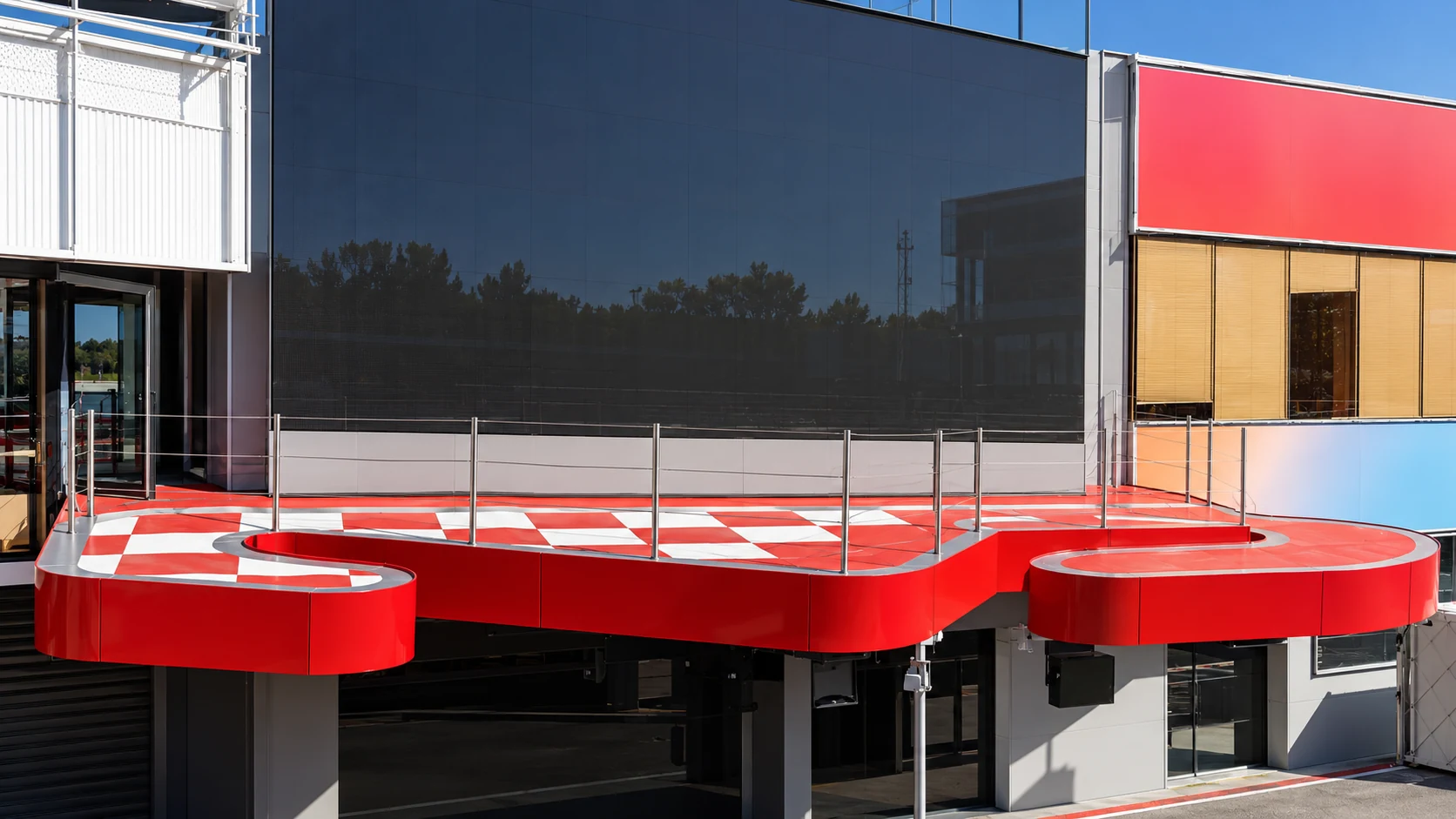
The route goes through the pre-podium area and onto the podium. The balcony’s red outline echoes the shape of the circuit. From here it’s easy to picture the short path drivers take from the finish to the ceremony. The tour also takes in the paddock and includes the main grandstand area, where you can see the scale of the pit straight from across the track.
The guided visit makes sense on a trip built around the circuit itself. You can stand where teams and officials spend their working day and see how those spaces connect. Allow time to get from the West Main Gate to the tower before the scheduled start.
Montmeló · Vallès Oriental
Pick a dated guided tour session. The operator lists starts at 10:00 and 12:00 on selected days.
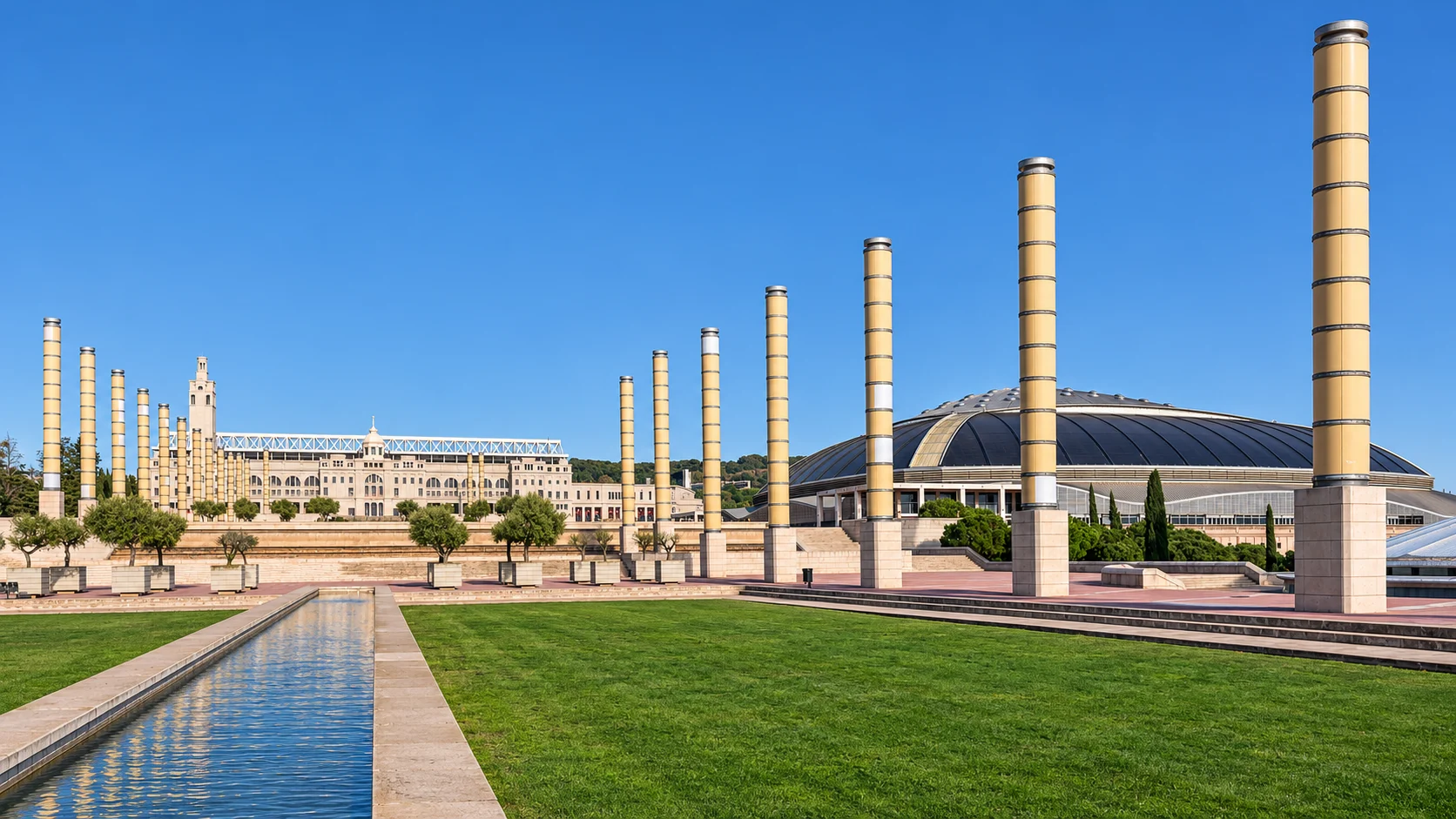
The climb back to the Olympic Stadium tells you as much about Montjuïc as any old race photograph. At the top, the road runs past a stadium built for the 1929 exhibition and later used for the 1992 Olympics. Below, it winds through narrow bends between gardens, a theatre and exhibition buildings. Those streets formed the 3.79 km circuit that hosted four Spanish Grands Prix between 1969 and 1975.
Start outside the Museu Olímpic i de l’Esport, next to the Estadi Olímpic Lluís Companys. Walk east along Avinguda de l’Estadi towards Avinguda de Miramar. This is the stadium straight from the Formula 1 years. The Olympic Museum’s circuit memorial is by the entrance. The stadium itself doubled as the paddock for the 1975 Grand Prix.
At the junction with Avinguda de Miramar, turn downhill onto Passeig de Santa Madrona. The racing drivers knew the turn into the descent as the Miramar hairpin. The road winds down past the Laribal gardens and the Font del Gat. Continue past Teatre Grec and stay on Passeig de Santa Madrona where Passeig de l’Exposició branches away. The old Vies bend takes its name from the tram tracks the drivers once crossed.
At the lower end, follow the street round by Carrer de la Guàrdia Urbana to Avinguda de Rius i Taulet. Head west along the avenue, past the foot of the fountain terraces. This was the Recta de les Fonts, the straight that held the start and finish in the early years. At the far end, the old La Pèrgola bends lead up towards Poble Espanyol. Follow Avinguda del Marquès de Comillas past the entrance between the Ávila-style towers.
Continue uphill with Avinguda de l’Estadi towards Plaça de Sant Jordi, where the Font de Ceres stands. Use the pavements and pedestrian crossings around today’s junction. Continue on Avinguda de l’Estadi past the Picornell pools and back to the stadium and Olympic Museum. If you prefer to skip the sustained climb back, finish near Poble Espanyol and head down to Plaça d’Espanya.
Jackie Stewart won the first two Formula 1 races here, in 1969 and 1971. Emerson Fittipaldi won in 1973. In 1975 a crash killed four people and the race was stopped. Lella Lombardi finished sixth and earned half a point, becoming the first woman to score in the Formula 1 World Championship. Motorcycle and other competition continued on Montjuïc after Formula 1 stopped racing here.
Trams and traffic run along Avinguda Diagonal today. In 1951 and 1954 the avenue was the long straight of Barcelona’s first Formula 1 circuit. The extended Pedralbes lap ran for about 6.3 km, with about 2.5 km on the Diagonal alone. The walk follows the racing direction where it can, using public pavements, street crossings and a path through Parc de Cervantes to get around the modern interchange.
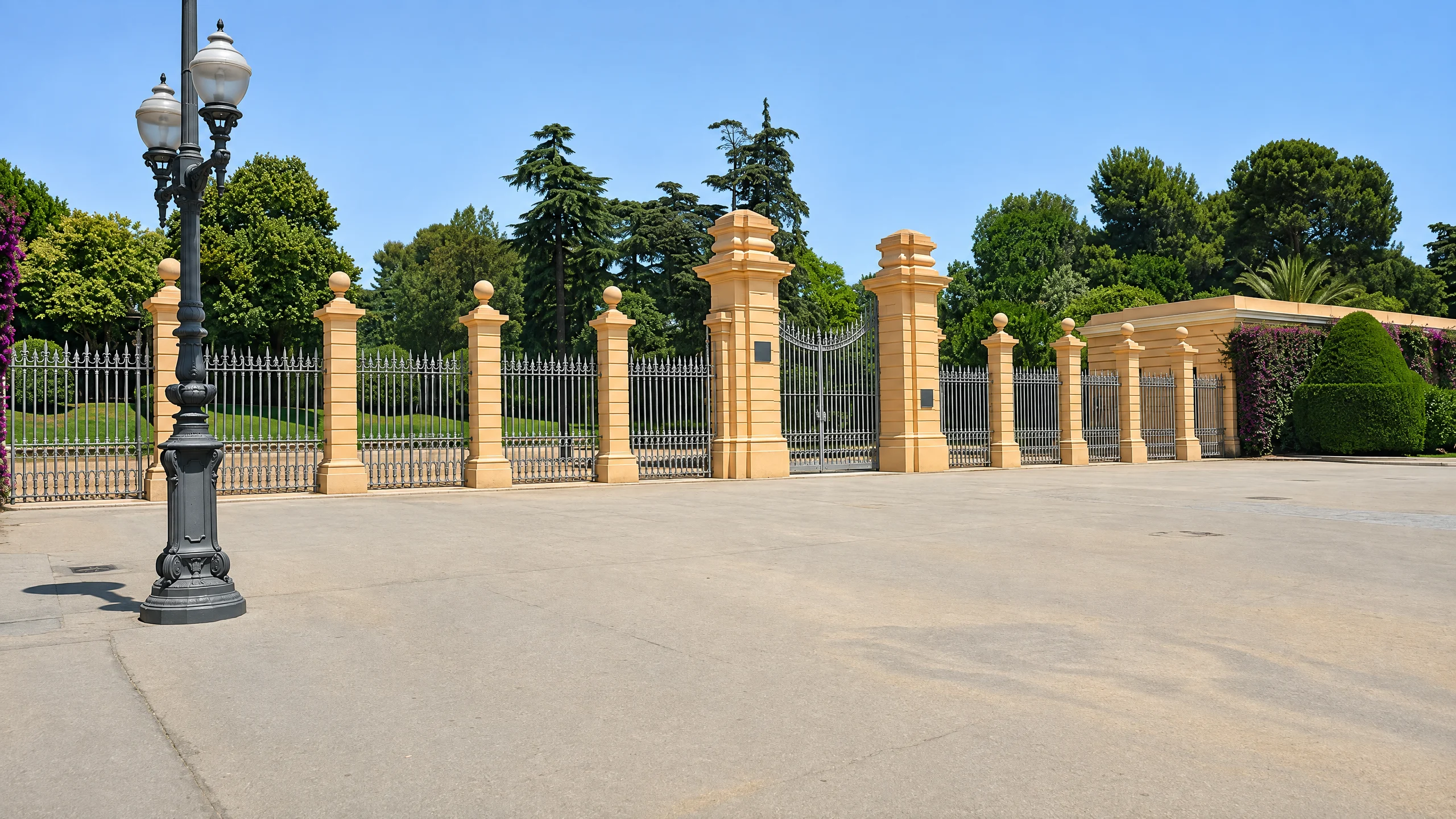
Begin at the iron gates of the Pedralbes Palace gardens. The RACC headquarters at number 687 stands on the south side of the old main straight. Walk west on the gardens side of the Diagonal, past the university buildings and towards Parc de Cervantes. The straight once carried cars out towards the edge of Barcelona, where they turned right for the road to Esplugues.
Enter Parc de Cervantes from Avinguda Diagonal at number 712. Follow the park paths uphill and use the upper exit onto Avinguda d’Esplugues at number 20. This cuts across to the next section of the old lap on foot, away from the current Ronda de Dalt ramps. Once out of the park, head east along Avinguda d’Esplugues to the Creu de Pedralbes junction. Turn downhill onto Avinguda de Pedralbes towards Passeig de Manuel Girona.
Turn left into Passeig de Manuel Girona. This turn took the Grand Prix cars onto the longer layout. Around numbers 55–61, Gaudí’s irregular stone gate at Finca Miralles survives beside the pavement. Continue to Plaça de Prat de la Riba and use the marked crossings around the square to reach Carrer de Numància. Follow Numància south to the Diagonal, then turn west past Maria Cristina to return to the palace gates.
Juan Manuel Fangio won the 1951 finale for Alfa Romeo and secured his first world title here. Three years later, Mike Hawthorn won for Ferrari, with Fangio third in a Mercedes. Both races finished on the street you walk back along. The breadth of the Diagonal and the sharper turn onto Manuel Girona help explain how different Pedralbes felt from the wooded bends of Montjuïc.
For a shorter visit, walk the Diagonal straight from the palace gates as far as Parc de Cervantes. Zona Universitària station is back along the avenue near the park and serves L3. You can also return to Palau Reial the way you came.
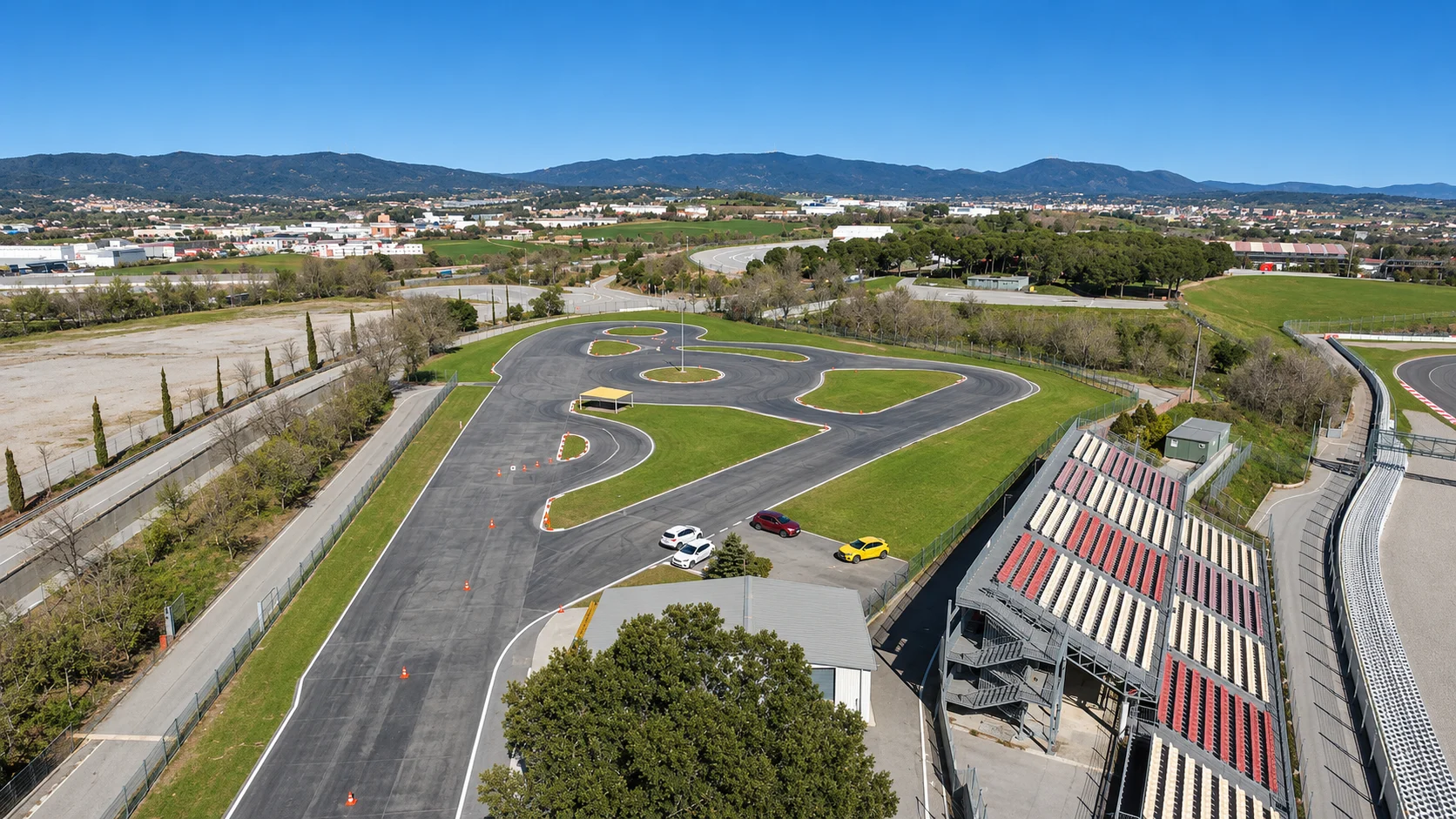
From above, the RACC driving school looks like a small circuit alongside the Grand Prix track. It has short loops, a braking straight and a large low-grip surface where instructors can recreate conditions drivers rarely get to practise in everyday traffic. The facility covers about 13,000 m², with roughly half set aside for reduced grip.
The four-hour intermediate course is aimed at people who already drive regularly. It combines briefing and practice, with emergency braking on the straight and in bends, avoidance exercises, and recovery when the car loses grip. Instructors also cover how driver-assistance systems intervene and where the driver still has to make the decision. Each participant has a school car for the session. RACC uses both manual and automatic vehicles, so ask ahead if you need a particular transmission.
The course calendar has separate Barcelona and Madrid tabs. For Montmeló, choose a Barcelona date for the intermediate course. RACC’s current beginner course and Perfeccionamiento de la Conducción booking pages direct visitors to Madrid. Ask RACC whether it can arrange either level at Montmeló before making travel plans for it.
MotorExperience runs separate sport-driving sessions at the circuit. Its BMW drift experience uses a low-grip track, while its Ferrari F430 experience offers laps of the Grand Prix layout. The BMW starts at €99 for five laps and the Ferrari at €249 for two. Both require drivers to be at least 18 and hold a valid category B car licence. MotorExperience issues its own meeting instructions and sets its own change terms. Ask the organiser for dates and access before buying a voucher.
Montmeló’s guided tour is another way to see the circuit. It covers race control, the paddock and the podium. The driving course takes place on the school’s training grounds and is booked independently of the guided tour.
Montmeló · Vallès Oriental
Select Barcelona on the intermediate course calendar. A valid category B car driving licence is required.