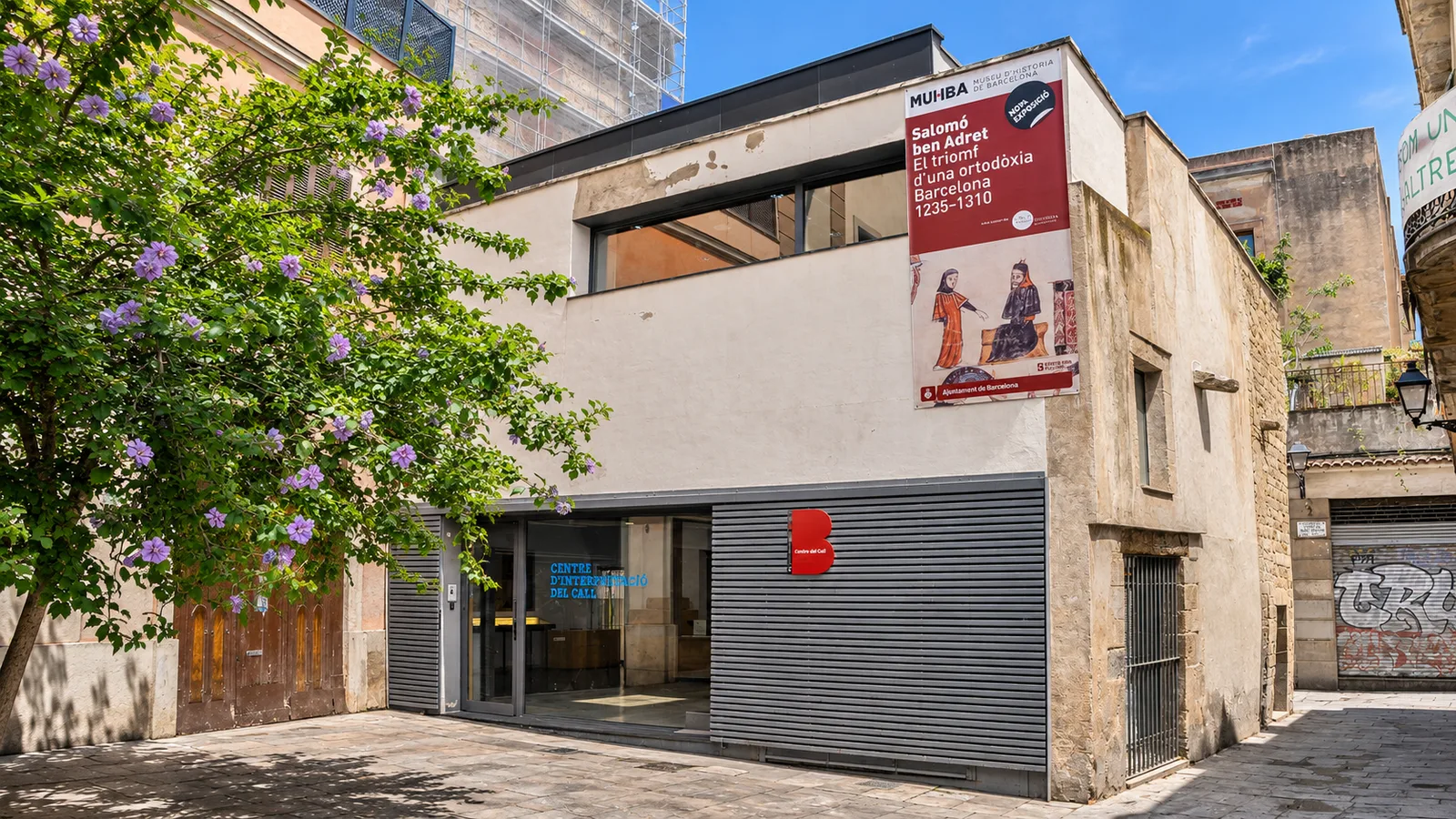
MUHBA El Call
Explore medieval Jewish Barcelona through excavated remains, objects from the neighbourhood and the scholars who lived in El Call.
01 / The experience
MUHBA El Call
MUHBA El Call is tucked into Placeta de Manuel Ribé, just off the lanes of Barcelona’s medieval Jewish quarter. The museum stands on the site of the house of Jucef Bonhiac, a veil weaver. Some of the surviving masonry dates from the 13th and 14th centuries. The glass floor in the main gallery lets you see into the older fabric below the exhibition, which makes the building itself a good place to begin.
The medieval neighbourhood in objects and maps
The galleries show how El Call fitted into the rest of Barcelona. The name originally meant a narrow street. It came to refer to the neighbourhood where many of the city’s Jewish residents lived. Maps and objects connect the lanes to households, workshops and the wider medieval city, whose trade and public life counted Jewish merchants, craftspeople and officials among its participants. Look for the bowls and jugs excavated in the neighbourhood, columns from the Banys Nous and gravestones from the Jewish cemetery on Montjuïc. The different glazed colours and painted patterns on the tableware are a record of what people used at home.
The Jewish scholars and books of El Call
The upper exhibition follows the ideas that travelled beyond the neighbourhood. It brings together the work of Abraham bar Hiyya, a mathematician and translator, Salomó ben Adret, a rabbinic jurist, and Hasday Cresques, a philosopher. The library interactive introduces some of the works written in El Call between the 11th and 14th centuries. The city’s Jewish quarter was attacked in the pogrom of 1391, a turning point for the community whose history the museum traces.
From the galleries to the surrounding lanes
After the exhibits, step back out into the short lanes around the museum. Carrer de Marlet and Carrer de Sant Ramon del Call give the maps in the galleries some scale. At number 1 on Carrer de Marlet, a copy of a Hebrew inscription marks a charitable foundation established by Rabbi Samuel ha-Sardí. MUHBA keeps the original. Plaça de Sant Felip Neri is nearby. To follow the city’s earlier history, continue to the Roman archaeology at MUHBA Plaça del Rei or to the Via Sepulcral Romana near La Rambla.
04 / Before you go
Plan your visit
Cost
- General admission
- €2.10 per person
- MUHBA combined ticket
- €7.30 per person, valid for six months.
When to go
Tue–Thu and Sun 10:00–14:00. Fri–Sat 10:00–15:00 and 16:00–19:00. Last entry 30 minutes before each closing. Closed Mon, 1 January, 1 May, 24 June and 25 December.
Getting there
Placeta de Manuel Ribé, 08002 Barcelona
Take Metro L4 to Jaume I and follow Carrer de Jaume I to Plaça de Sant Jaume. Continue into Carrer del Call, then turn into Carrer de la Fruita for Placeta de Manuel Ribé. Look for the MUHBA entrance on the small square.
Entry and booking
General admission is €2.10 per person. Buy single-site admission or use the €7.30 MUHBA combined ticket, valid for six months. If you are only visiting MUHBA El Call and Via Sepulcral Romana, separate general tickets cost €4.20 in total.
Under-16s enter free, and the first Sunday of each month is free during opening hours. Last entry is 30 minutes before the museum closes.
Location & nearby places
Continue exploring
More in the old city
Good to know
MUHBA El Call: frequently asked questions
How much is admission to MUHBA El Call in Barcelona?
General admission to MUHBA El Call costs €2.10 per person. The €7.30 MUHBA combined ticket also covers MUHBA El Call and is valid for six months.
What can I see at MUHBA El Call?
MUHBA El Call has remains of a medieval house, objects excavated in the old Jewish quarter, cemetery inscriptions and a gallery about the community’s scholars and books.
When is MUHBA El Call free to visit?
MUHBA El Call is free to everyone during opening hours on the first Sunday of the month. Children under 16 enter free on regular opening days.
How do I get to MUHBA El Call by metro?
Take Metro L4 to Jaume I for MUHBA El Call. Walk to Plaça de Sant Jaume and take Carrer del Call and Carrer de la Fruita to the museum entrance at Placeta de Manuel Ribé.