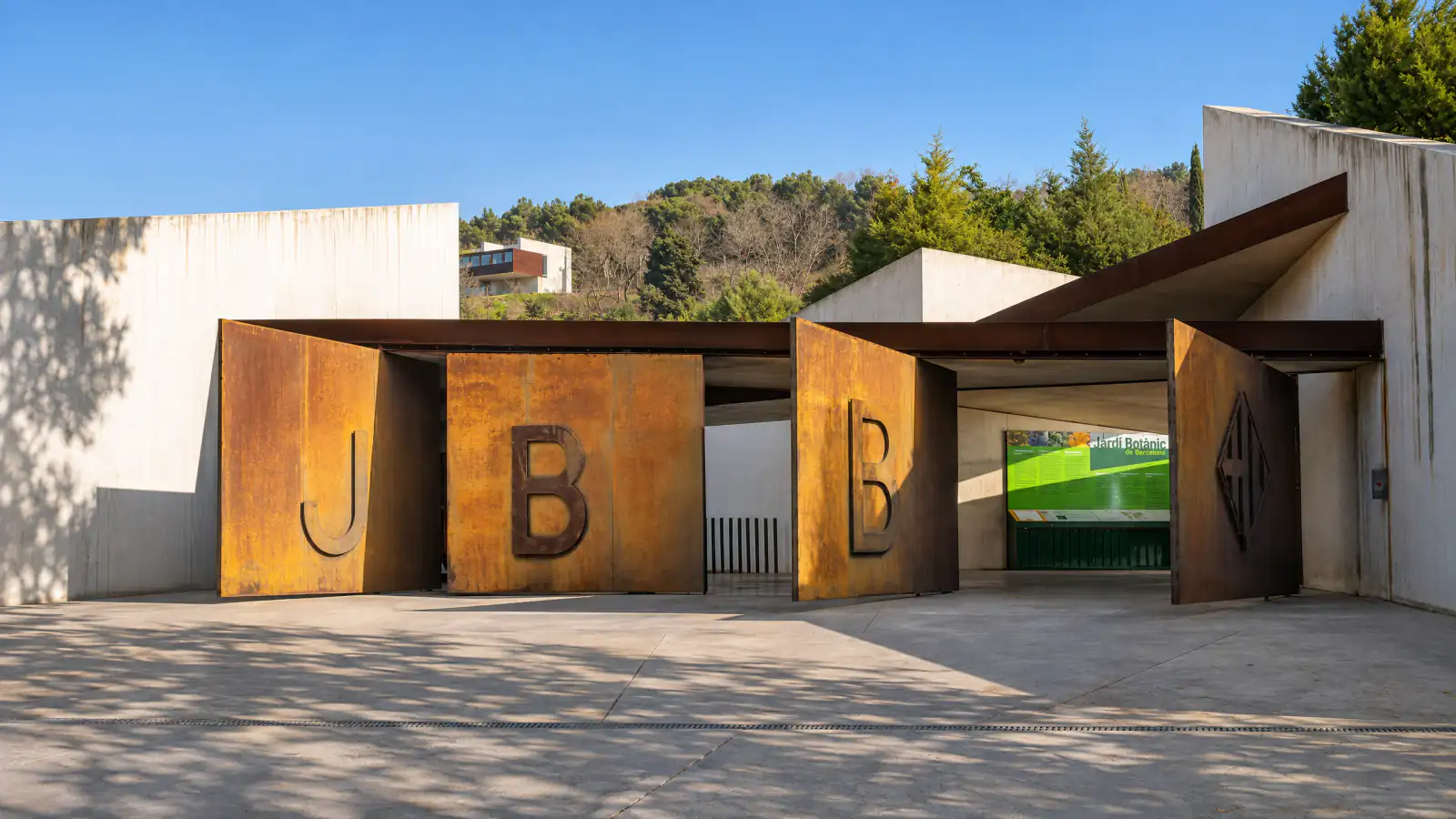
Jardí Botànic de Barcelona
Follow the triangular hillside paths through five Mediterranean-climate regions, with a pond, a nursery bonsai display and seasonal planting.
01 / The experience
Jardí Botànic de Barcelona
The pond at the entrance sets out the elements that shape Barcelona’s Botanical Garden. Plants sit beside water and between walls of weathering steel. Beyond the pond, pale paths divide the hillside into sloping triangles. The geometry comes from the design by architects Carles Ferrater and Josep Lluís Canosa and their landscape team. The beds are laid out as small plant communities, so a bend in the path can take you from one landscape to another. Look across the slope before taking a side path and you can see how much of the garden fits into the spaces between those lines.
Five regions with a shared climate
The garden brings together plants from five areas with a Mediterranean climate. They come from the Mediterranean basin, California, central Chile, South Africa’s Cape and southern Australia. The Mediterranean basin is represented in four sections, covering eastern and western landscapes, North Africa and the Canary Islands. The plants are grouped by the places and habitats where they grow together. It makes a difference to the walk. A low, dry coastal bed and a sheltered woodland can both belong to the same region.
From banksias to Cape aloes
Australia’s section includes eucalyptus, wattles and banksias, alongside grass trees with narrow leaves. In the Californian beds, look for where the form of the chaparral recalls scrub around the Mediterranean, even as the species change. Central Chile brings tougher-looking, thorny shrubs and some very different forms, with cacti and sculptural bromeliads such as Puya. The South African section includes Cape fynbos and plants such as the tree aloe. In the Mediterranean areas, the difference between Canary Island succulent planting, North African palms and the familiar trees of the western basin is one of the easiest comparisons to make without seeing every path.
How the garden changes by season
The garden looks different as the seasons change. Spring brings widespread flowering across the Mediterranean plants and more activity around the pollinator shelter. In summer the dry-looking beds reveal how many plants reduce leaf growth or retain only small, tough leaves. After the first autumn rains, new leaves and shoots can make the same paths look greener. By winter, the shape of the trees, the branching succulents and the weathered walls have more room to stand out.
Bonsai, the Salvador Cabinet and the Institute
The nursery sets aside space for a rotating display of Mediterranean bonsai. Small forms preserve details you can see in the outdoor beds at a different scale, such as twisted trunks and low spreading branches. The display is open on weekends and public holidays. The Salvador Cabinet introduces another side of the garden, the work of collecting and naming plants and other specimens. The family cabinet grew from the collections of generations of Barcelona apothecaries. On weekends you can see it through the protective glass on the ground floor of the Botanical Institute. The Botanical Institute occupies the upper part of the garden, where its long façade sits above the paths and its collections support research into Mediterranean plants.
The 45-minute loop and a longer visit
The garden map marks a 45-minute express loop. It leaves time to see the pond and cross several different plant landscapes without following every spur. Allow 90 minutes or more if you want to spend time in the regional collections or include the bonsai when it is open. The new garden’s visitor entrance is on Carrer del Doctor Font i Quer by the Olympic Stadium. The separate Historic Botanical Garden is tucked behind the Museu Nacional d’Art de Catalunya, with its own paths and entrance. If you are combining the new garden with Montjuïc Castle, leaving the castle for the higher part of the visit brings you from the garden’s enclosed beds to the harbour view.
04 / Before you go
Plan your visit
Admission
- Garden admission
- €5 per adult.
- Reduced garden admission
- €2.50 per eligible visitor.
- Garden and Natural Sciences Museum combined ticket
- €8 per adult or €4 per eligible visitor.
- Sunday afternoons
- Free from 15:00 and all day on the first Sunday of each month.
- Visitors under 16
- Free.
Opening hours
Opens at 10:00. Closes 17:00 November–January, 18:00 February–March, 19:00 April–May and September–October, and 20:00 June–August. Last entry 30 minutes before closing. Closed 1 January, 1 May, 24 June and 25 December.
See opening hoursGetting there
Carrer del Doctor Font i Quer, 2, 08038 Barcelona
Use the ticket entrance at Carrer del Doctor Font i Quer 2 near the Olympic Stadium. Take bus 150 from Plaça d’Espanya to Avinguda de l’Estadi Olímpic, followed by a 5–10-minute walk. Bus 13 stops by the garden. The walk from the upper funicular station takes 10–15 minutes.
The entrance ramp has a 10% gradient. The paths and ramps give access to the regional beds, with accessible toilets in the main building. The bonsai display is outside the step-free route.
Tickets and entry
Choose Jardí Botànic de Barcelona for the Montjuïc garden. The €8 combined ticket also includes the Museu de Ciències Naturals de Barcelona at Parc del Fòrum.
Garden admission is free on Sundays from 15:00 and all day on the first Sunday of each month. The nursery’s bonsai display is included on weekends and public holidays.
Location & nearby places
Continue exploring / Barcelona
More to explore
in Barcelona
Find another place for your itinerary, or explore all things to do in Barcelona.
 Race And CircuitHistoric Montjuïc street circuit walkExplore experience →
 Museums Art And ArchitectureFundació Joan MiróExplore experience →
 Beaches And MontjuicMontjuïc CastleExplore experience →
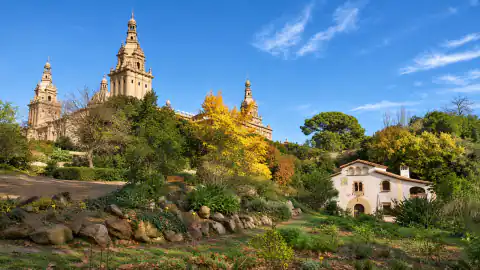 Beaches And MontjuicJardí Botànic HistòricExplore experience →
Good to know
Jardí Botànic de Barcelona: frequently asked questions
How long should I spend at Jardí Botànic de Barcelona on Montjuïc?
Jardí Botànic de Barcelona has a 45-minute express loop. Allow at least 90 minutes for the regional plant beds and the bonsai display when it is open.
When does the bonsai display open at Jardí Botànic de Barcelona?
The bonsai display at Jardí Botànic de Barcelona opens on weekends and public holidays and is included in garden admission. The nursery display is outside the step-free route.
Where is the entrance to Jardí Botànic de Barcelona on Montjuïc?
Enter Jardí Botànic de Barcelona at Carrer del Doctor Font i Quer 2 near the Olympic Stadium. The separate Historic Botanical Garden is behind the Museu Nacional d’Art de Catalunya.
When can I visit Jardí Botànic de Barcelona for free?
Jardí Botànic de Barcelona offers free entry from 15:00 every Sunday and throughout opening hours on the first Sunday of each month.