Prospect Heights
Brownstone streets, Vanderbilt Avenue and Brooklyn’s museum-and-garden edge.
01 / The experience
Streets, books and Brooklyn culture.
Brownstone streets, Vanderbilt Avenue and Brooklyn’s museum-and-garden edge.
Vanderbilt and the side streets.
Vanderbilt Avenue gives Prospect Heights its busy north–south thread: neighbourhood shops and places to eat, apartment buildings with rounded bays, and side streets lined with raised brownstone entrances. Carlton and Underhill Avenues introduce a different scale, with iron fences, narrow front gardens and rows of stoops under street trees. Together they make a neighbourhood walk with its own character, even when there is no museum visit on the agenda. Grand Army Plaza sits at the southern end; Barclays Center marks a much busier northern approach.
The architecture rewards a route that crosses the avenues as well as following them. Prospect Place, Park Place and Sterling Place connect residential blocks with the commercial streets. Italianate cornices, neo-Grec carving and the heavier forms of Romanesque Revival sit within a district developed largely from the middle of the nineteenth century into the early twentieth. Its landmark designation in 2009 protects a varied streetscape rather than a single architectural style. Carlton’s repeated stoops and Underhill’s contrasting brick and pale-stone façades show that variety particularly well.
The library and Grand Army Plaza.
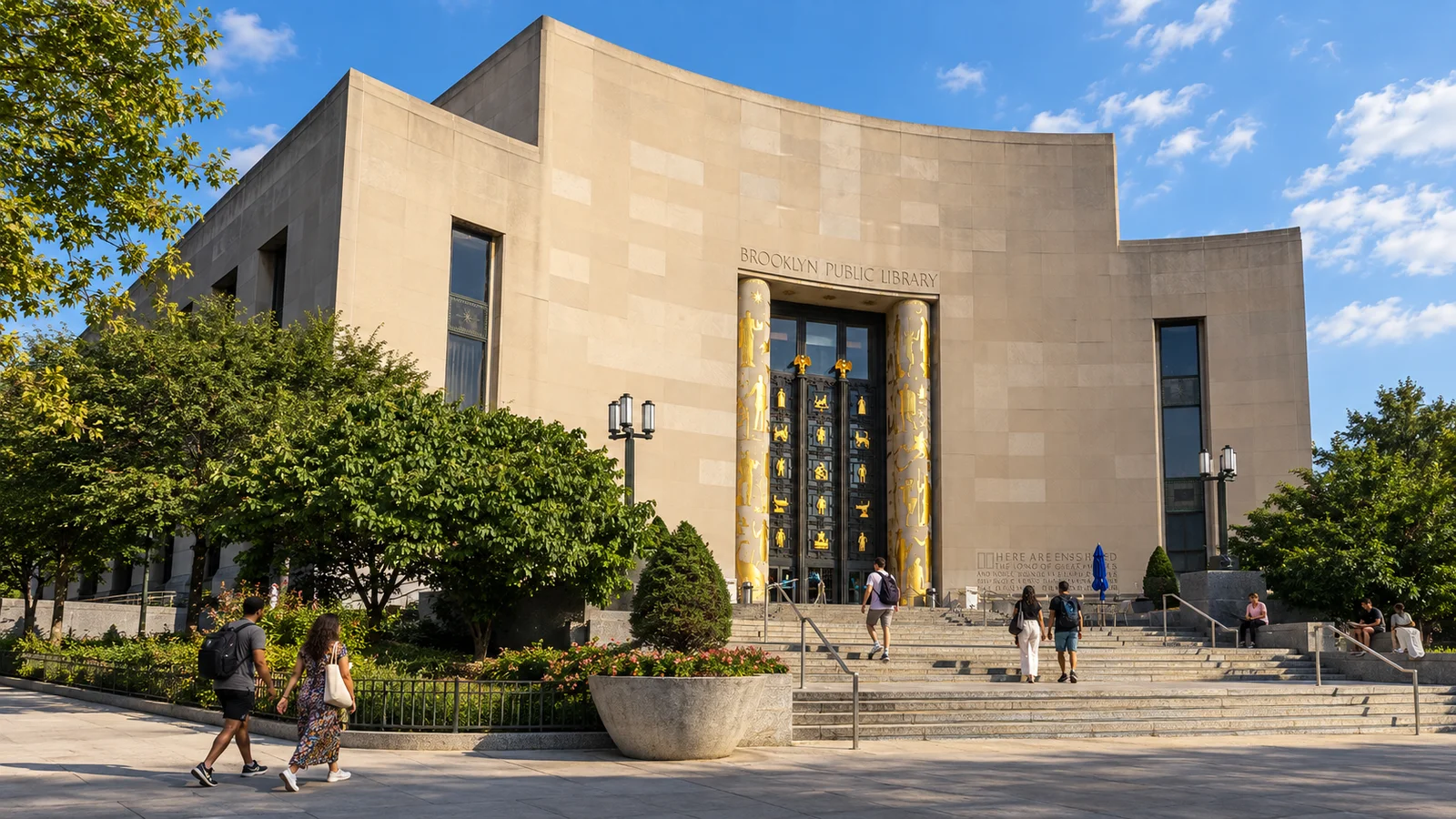
Central Library makes a memorable starting point at Grand Army Plaza. Opened in 1941, its open-book form brings two limestone wings towards an imposing central entrance. Bronze literary figures and gilded reliefs give the doorway much of its detail. Inside are public collections, reading spaces and cultural programmes, with the Information Commons serving as a shared working space. The building remains an active library through a phased renovation, so exhibitions and events depend on the areas and programmes operating during your visit.
Outside, Grand Army Plaza changes the scale again. The Soldiers’ and Sailors’ Arch stands amid the traffic circle, while the park begins beyond the crossings. Endale Arch carries the approach through to Long Meadow, making the transition from street to park unusually clear. On the Flatbush Avenue side, the ornate freestanding clock near Sterling Place is a much smaller street landmark. The clock and the library belong to the neighbourhood’s edges, where the residential grid meets Brooklyn’s larger civic spaces.
Museums, gardens and an evening out.
Eastern Parkway leads towards Brooklyn Museum and Brooklyn Botanic Garden along the cultural edge shared with Crown Heights. The museum offers substantial collections and changing exhibitions; the garden ranges from formal terraces to Japanese garden landscapes and seasonal planting. Either can become the main visit, with Prospect Heights supplying the surrounding streets. The garden’s formal Osborne Garden, Japanese Hill-and-Pond Garden and seasonal planting offer quite different landscapes within the same grounds. The museum and garden have their own admission, opening and access arrangements.
For food near the cultural edge, Lincoln Station on Lincoln Place serves coffee, breakfast sandwiches and rotisserie-chicken lunches. Cheryl’s Global Soul on Underhill Avenue offers a seated alternative, from pancakes and fried chicken to a vegetable tagine and sake-glazed salmon. At the other end of the walk, Barclays Center brings basketball, concerts and event crowds to Atlantic and Flatbush Avenues. It is an event destination rather than an everyday indoor shortcut. For a destination dinner farther east, Bong on Sterling Place in Crown Heights offers Chakriya Un’s Cambodian cooking: whole fried fish with herbs and wrap-making accompaniments, sour clams and dishes made for sharing. Its small, art-filled room belongs to a different neighbourhood, but is a useful continuation from the museum side of this one.
In pictures
Streets and civic landmarks.
In pictures
Around the neighbourhood.
In pictures
An evening nearby.
04 / Before you go
Plan your visit
Admission
Free street walk
Public streets and ordinary library access are free. Museum, garden and arena admission is charged separately.
When to visit
Public streets daily. Central Library: Monday–Thursday 9am–8pm; Friday–Saturday 9am–6pm; Sunday 1–5pm.
Library holidays, special events and the phased renovation can affect indoor access. Museum, garden and arena visits follow their own schedules.
Arrival
Central Library, 10 Grand Army Plaza, Brooklyn, NY 11238
The map marks Central Library’s building at Grand Army Plaza, a starting point on the neighbourhood’s southern edge. Grand Army Plaza on the 2/3 and the separate Seventh Avenue B/Q station on Flatbush Avenue serve this end; Atlantic Avenue–Barclays Center serves the northern end.
Visits & programmes
No reservation is needed for a self-guided street walk. Library programmes can require registration; museum, garden and arena admission follows the individual venue’s arrangements.
Accessibility
Central Library is fully accessible. For a step-free subway approach at the museum end, Eastern Parkway–Brooklyn Museum has an elevator on the south side of Eastern Parkway beside the museum parking entrance. Atlantic Avenue–Barclays Center also has elevators. Grand Army Plaza is not on the MTA’s accessible-station list. Use signal-controlled crossings around the plaza; household stoops and front gardens are private.
Location & nearby places
Continue exploring
Continue through Brooklyn.
06 / Good to know
Prospect Heights: frequently asked questions
01Is Brooklyn Museum in the same part of Brooklyn?
It is on Eastern Parkway at the cultural edge beside Prospect Heights and Crown Heights. The museum and Botanic Garden are useful connections from the southern streets; Barclays Center is at the opposite end.
02Can I visit the library without joining?
Ordinary public library access is free. Borrowing and some programmes have their own eligibility or registration requirements.