Park Slope
Brownstone blocks, independent avenues and the western entrances to Prospect Park.
01 / The experience
Avenues, brownstones and the park.
Brownstone blocks, independent avenues and the western entrances to Prospect Park.
Across the brownstone blocks.
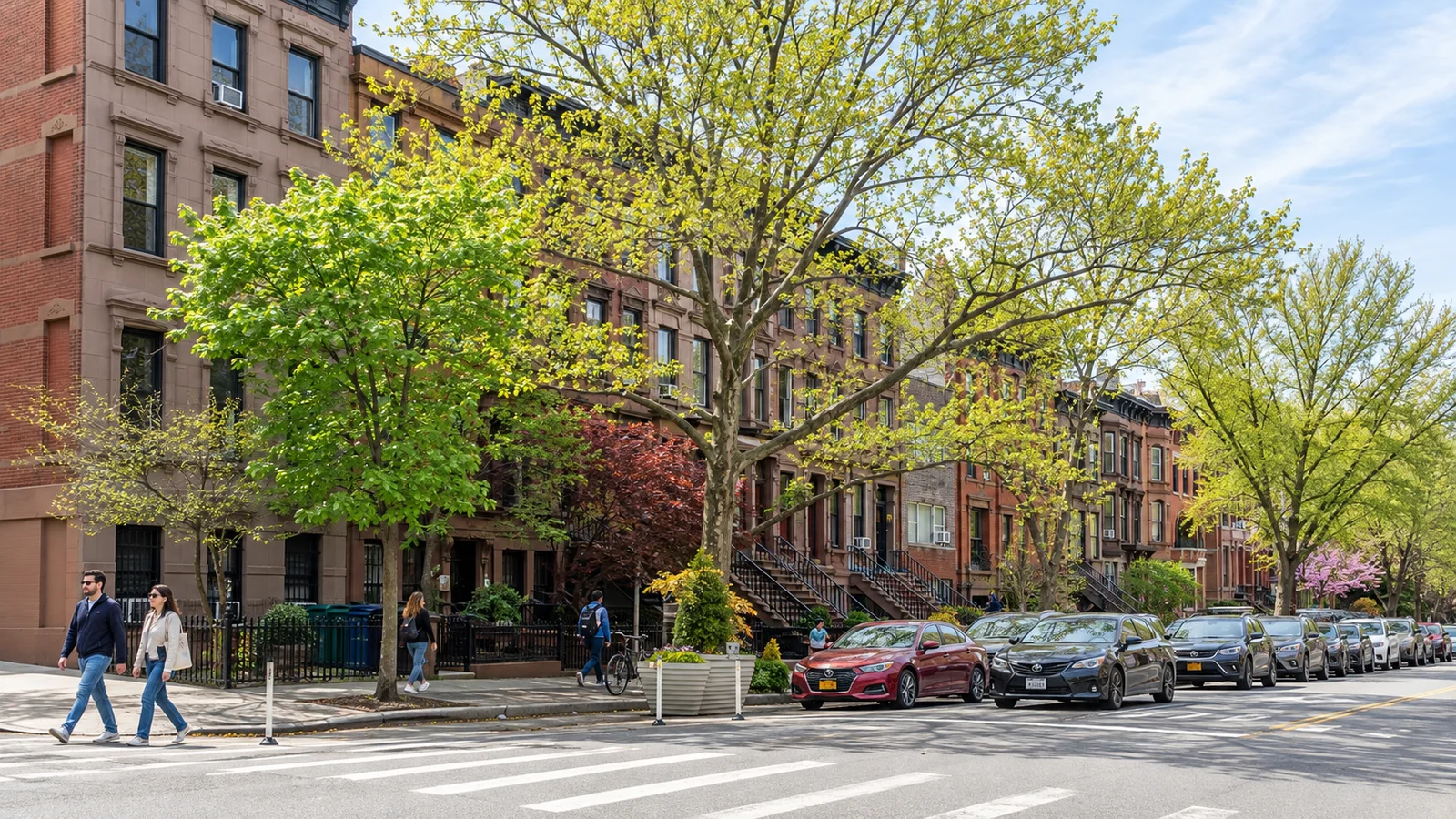
Park Slope is built around the relationship between its avenues, residential blocks and the long western side of Prospect Park. Seventh Avenue carries shops and everyday neighbourhood errands; Fifth Avenue brings another run of independent businesses, restaurants and evening stops farther down the slope. Between them and the park, brownstone streets climb past deep stoops, bay windows and mature trees. It is easy to spend an afternoon here without treating the neighbourhood as a corridor to a single attraction.
The blocks near Eighth Avenue and Prospect Park West contain some of its most coherent historic streetscapes. Garfield Place, Carroll Street and Montgomery Place are useful streets for an architectural walk, with rows that change from relatively restrained façades to carved stone, rounded bays and elaborate cornices. The original historic district was designated in 1973, with later extensions protecting more of the neighbourhood. Homes remain private; their entrances and gardens are part of the street view, with the public pavement providing the route.
Seventh and Fifth Avenues.
Seventh Avenue is a useful contrast to those residential blocks. Ground-floor shops occupy buildings with projecting upper bays, and church towers interrupt the roofline. Near Lincoln Place, Brooklyn Conservatory of Music occupies the ornate brownstone at 58 Seventh Avenue. The school has been based there since 1944 and runs lessons, ensembles and public programmes. It also operates a newer Prospect Park West campus; an event’s actual location matters when arranging an evening around music rather than simply looking at the original building from outside.
WINNER Bakery on Seventh Avenue adds sourdough, pastries, sandwiches and takeaway chicken dinners to the neighbourhood walk, with limited outdoor seating. Farther north, Bar Goto Niban on Bergen Street pairs Japanese cocktails with miso wings, kombu celery and croquettes near Barclays Center. Downhill, Fifth Avenue has a broader mix of shops, food and nightlife along a commercial stretch running south from the Barclays end of the neighbourhood. Washington Park gives that avenue a particularly useful stopping point. The Old Stone House sits among gardens and public recreation space, with JJ Byrne Playground beside it. Children’s play, basketball and community events make this a working neighbourhood park as well as a historic site. The playground’s spray fountains are a summer feature; the house’s garden and fieldstone exterior remain the more dependable year-round subjects.
History and the park.
The house itself is a reconstruction of the 1699 Vechte-Cortelyou farmhouse, made on the site associated with the Battle of Brooklyn. Its exhibition connects the events of 1776 with life in Brooklyn during the war, while contemporary exhibitions and community programmes give the building a present-day role. The red roof, shutters and stone walls are quite different from the surrounding row houses. The permanent exhibition and public restrooms are accessible; the upstairs Great Room is reached by stairs. Ordinary visiting is on Friday, Saturday and Sunday afternoons.
Prospect Park opens out above these streets. Third Street and Ninth Street are useful western approaches, while Grand Army Plaza connects the northern end with Endale Arch and Long Meadow. Litchfield Villa sits near Prospect Park West, and the Lena Horne Bandshell anchors another part of the park’s cultural life. A street-and-park visit can stay on this western side; Brooklyn Museum and Brooklyn Botanic Garden are farther around the park on Eastern Parkway. Prospect Heights continues beyond Grand Army Plaza, bringing a different set of avenues and a natural next neighbourhood to explore.
In pictures
Streets, shops and music.
In pictures
Washington Park and Prospect Park.
In pictures
Along the park’s western side.
04 / Before you go
Plan your visit
Admission
Free street walk
The street walk and ordinary park entry are free. Food, classes, performances and special programmes have their own charges.
When to visit
Public streets daily. Old Stone House: Friday–Sunday noon–4pm, or by appointment.
Prospect Park is open daily 5am–1am. Indoor programmes, exhibitions and seasonal playground water play have separate operating times.
Arrival
Old Stone House, 336 Third Street, Brooklyn, NY 11215
The map marks the Old Stone House address in Washington Park, between Fourth and Fifth Avenues and Third and Fourth Streets. Union Street on the R serves this part of Fifth Avenue; Fourth Avenue–Ninth Street serves the southern approach. Seventh Avenue on the F/G is a different station from Seventh Avenue on the B/Q at Flatbush Avenue.
Visits & programmes
Explore the public streets freely. Old Stone House visits outside Friday–Sunday noon–4pm are by appointment; performances, classes and special programmes use their organisers’ own admission arrangements.
Accessibility
The neighbourhood slopes uphill from Fifth Avenue towards Prospect Park West. Seventh Avenue F/G has an elevator at the northwest corner of Seventh Avenue and Ninth Street; the Seventh Avenue B/Q station is a separate station. At the Old Stone House, the permanent exhibition and public restrooms are accessible, while the upstairs Great Room has stairs. Private stoops are not public seating or walking routes.
Location & nearby places
Continue exploring
Continue through Brooklyn.
Nearby sights and neighbourhoods
Plan your New York visit
06 / Good to know
Park Slope: frequently asked questions
01Which Seventh Avenue subway station should I use?
Seventh Avenue F/G is at Ninth Street and has an elevator at the northwest corner. Seventh Avenue B/Q is on Flatbush Avenue near the northern end of the neighbourhood. They are different stations.
02Can I visit the Old Stone House during the week?
Ordinary visiting is Friday–Sunday noon–4pm. Other visits are by appointment with the house. The park and exterior can be part of a street walk independently of the exhibition.