Malmundarium
Carnival costumes, paper-making and local history inside Malmedy’s old monastery.
01 / The experience
The town’s story, under the monastery roof
Carnival costumes, historic craft and cathedral treasures in Malmedy’s former Benedictine monastery.
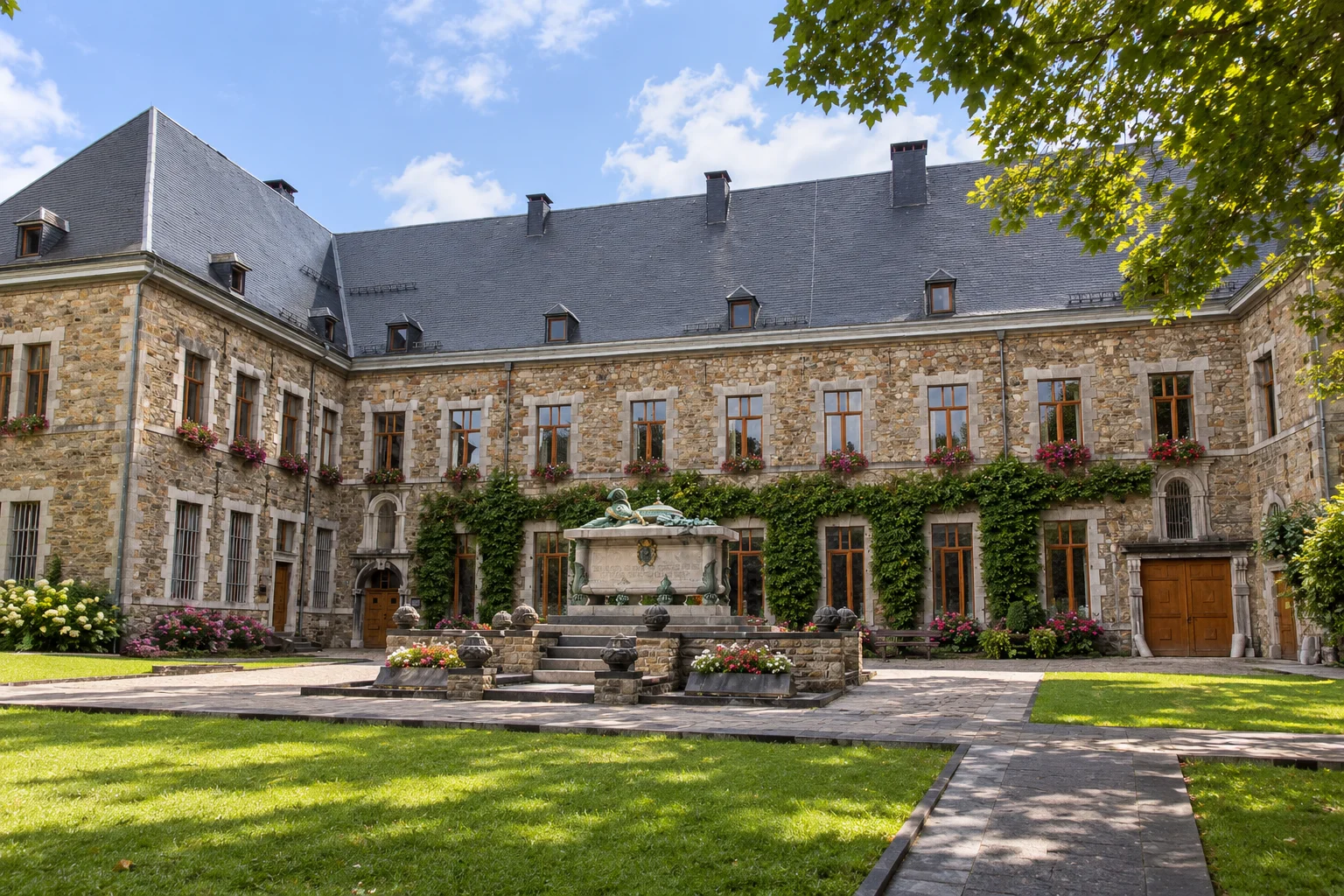
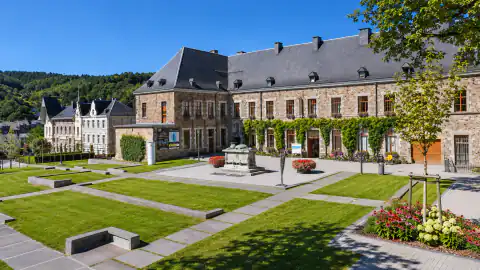
The old Benedictine monastery beside Malmedy’s cathedral holds the things that made the town: leather, paper, carnival costumes and the treasures of its abbey church. The buildings date mainly from the early eighteenth century, but the community began much earlier. In 648, Remacle and his companions settled here. Malmedy and nearby Stavelot went on to form an abbey principality that endured until the French Revolution. The Historium, up in the roof space, takes that long story from the first settlement to the damage of the Second World War. Its records sit under the substantial timbers of the old monastery.
The paper gallery brings the story back down to the rivers. A mill was established on the Warchenne around 1726. In the nineteenth century the Steinbach family helped turn papermaking into a much larger industry, and by 1848 Malmedy was making photographic paper. The gallery follows the change from sheet making to machines through models, tools and archive material. The leather gallery tells an older industrial story. Oak bark supplied tannin, while the Warche and Warchenne supplied water. Samples, tools and films show how a raw hide became a material that could be cut, stitched and worn.
In the Cwarmê gallery, music and traditional costumes bring Malmedy’s four-day pre-Lenten carnival indoors. Written traces of the festival go back to 1459. Its masks are characters with roles to play; the parade, brass bands and satirical performances in Walloon are all part of the tradition. It’s a lively introduction for families, especially if July is the only time you’ll be in town.
The cathedral treasury is a quieter room. Look for the medieval figure of Saint Catherine, a monastic psalter and the embroidered silk that once dressed an altar. Carved panelling salvaged from the church at Wandre frames the collection. The neighbouring abbey church kept its cathedral title after serving as the seat of the short-lived diocese of Eupen-Malmedy in the 1920s.
The museum sits on Place du Châtelet, an easy pairing with time in central Malmedy. The costumes and craft rooms make a satisfying shorter visit; the Historium and treasury are worth leaving time for if you are also going to Stavelot, where the other half of the old principality has its own museum.
Highlights
- 01
1–2 hours
- 02
€6 adult
- 03
Indoor museum and a sheltered cloister.
- 04
Confirm summer opening for your date.
04 / Before you go
Plan your visit
Admission & cost
€6 adult; €5 for students and ages 65+; €3 ages 6–12. Ages 0–5 are free except for school groups. Confirm 2027 prices.
When to visit
Tuesday–Sunday 10:00–17:00. Confirm summer hours before travelling.
1–2 hours
Confirm summer opening for your date.
Arrival & access
Use Place du Châtelet 10. P10 is behind the museum, reached via Rue Devant l’Étang 1.
Place du Châtelet 10, 4960 Malmedy, Belgium
Plan your visit
Use the museum’s visitor information for admission. Arrange guided tours or hands-on workshops separately.
Accessibility
A lift serves the Historium. P10 has two accessible bays; assistance dogs are welcome.
Location & nearby places
Continue exploring / the Ardennes during F1
More to explore
in the Ardennes during F1
Find another place for your itinerary, or explore all things to do in the Ardennes during F1.
 Food & drinkHalmes MalmedyExplore experience →
 Food & drinkL’EndroitExplore experience →
 Food & drinkScotch InnExplore experience →
 Mountain biking & enduroWarche quarries mountain-bike loopExplore experience →
Good to know
Malmundarium: frequently asked questions
Can I see carnival costumes at the Malmundarium in Malmedy in July?
The Cwarmê carnival-costume gallery is part of the permanent route at the Malmundarium in Malmedy, Belgium. The street carnival takes place before Lent.
Can visitors try paper-making at the Malmundarium in Malmedy?
Admission to the Malmundarium in Malmedy covers the displays. Hands-on workshops and guided visits require separate arrangements with the museum.
Is there a lift to the Malmundarium’s Historium in Malmedy?
The Malmundarium in Malmedy has a lift to the upper-floor Historium. Car park P10 behind the building has two accessible parking bays.