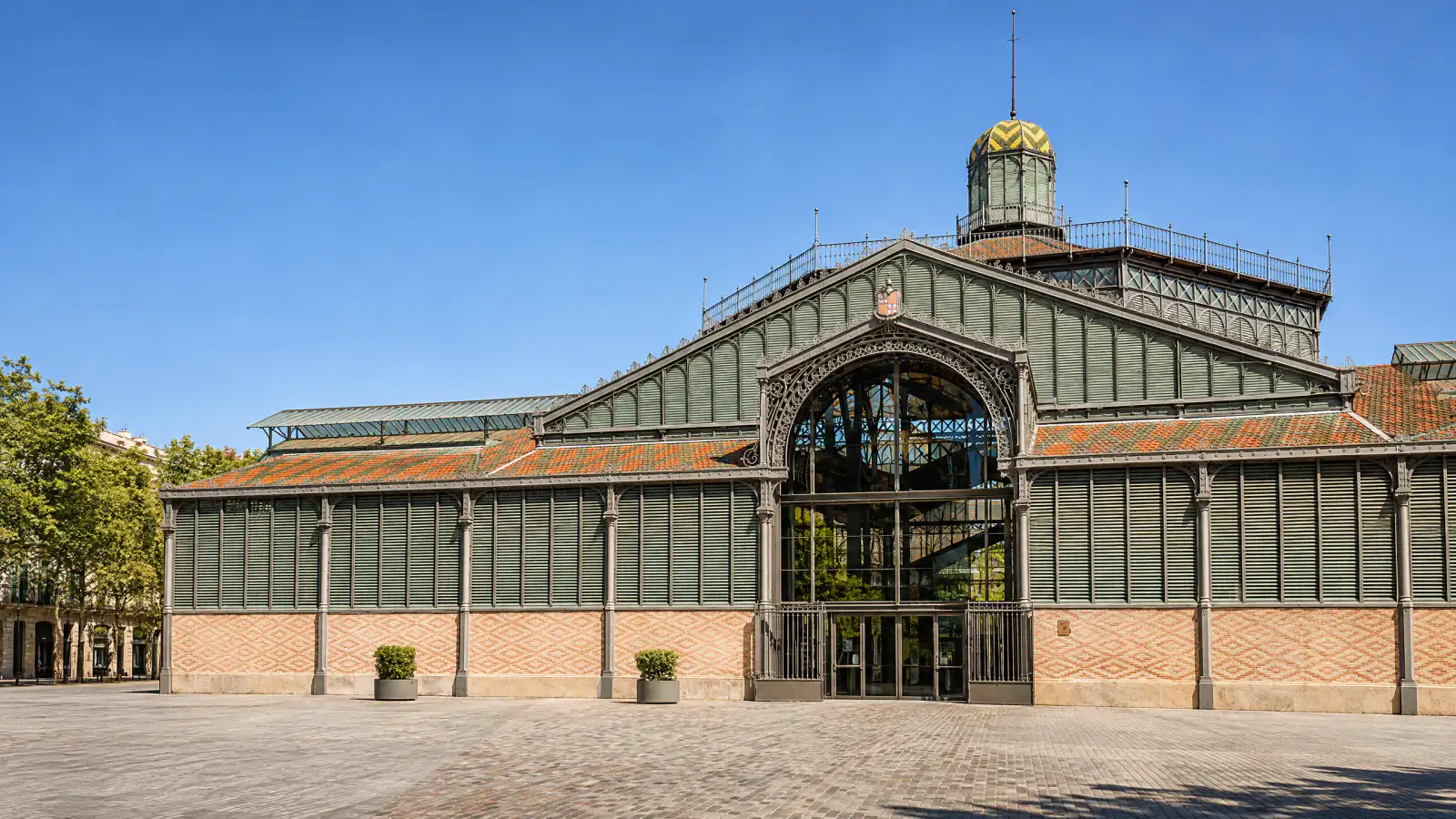
El Born Market Hall & Archaeological Site
See the cobbled streets and house foundations of La Ribera beneath the old El Born market, from the free upper walkway or on an archaeological tour.
01 / The experience
El Born Market Hall & Archaeological Site
On Plaça Comercial, the old market’s iron and glass stand above a low brick base. Inside, daylight reaches across the tall spans of the 1876 hall and down into a second street plan. From the upper walkway you can see shallow rooms, lines of cobbles and the gaps where people once passed between buildings. The view from the balcony makes it easier to grasp how much of La Ribera fits beneath one market roof. Join the archaeology tour to follow the surviving routes on the lower level.
Nine streets beneath the market
The excavations identified sections of nine streets, with the remains of around sixty houses spread across eleven blocks. The route that ran from the Born to Pla d’en Llull was a main thoroughfare. Around the former Carrer del Joc de la Pilota, taverns and inns stood near houses. Farther west, the Rec Comtal channel supplied water to trades that depended on it, including leather workers. The different widths of streets and rooms show how homes, commerce and workshops fitted into the same district.
What the household finds tell us
Clay fragments tell another part of the story. Blue-decorated Catalan bowls and dishes were among the objects recovered from the channel, wells and drains. Archaeologists can compare where these objects were found with surviving household inventories and other documents. That is how a set of low walls can be tied to the people who used a particular house or workshop. The guided route puts those pieces of evidence in the streets where they belong.
From the siege to the wholesale market
La Ribera was part of the city that withstood the siege of 1713–1714. After Barcelona fell, residents were ordered to demolish houses to make way for the Ciutadella fortress and the ground around it. The old market arrived much later, after the city recovered that land for public use. It first served neighbourhood shoppers, then became Barcelona’s central wholesale fruit and vegetable market in 1921. Its iron columns and glazed upper walls are part of that later working building. The market traded until 1971.
The Ciutadella foyer and the walk to the basilica
On the Ciutadella side, the free foyer display El Born, més que un mercat follows the hall and the park through that change. The permanent exhibition is being renewed. The excavation and the market roof give the visit its shape even if you only have time for the free upper walkway. From Plaça Comercial, Passeig del Born leads straight back to the apse and visitor entrance of Santa Maria del Mar.
04 / Before you go
Plan your visit
Admission
- Market hall and upper perimeter
- Free
- Barcelona 1700 guided visit, 2026
- €4.20 per person
- Museum Friends tour rate
- €2.90 per person
Opening hours
March–October, Tuesday–Sunday and public holidays 10:00–20:00. November–February, Tuesday–Saturday 10:00–19:00 and Sundays and public holidays 10:00–20:00. Last entry 30 minutes before closing. Closed non-holiday Mondays, 1 January, 1 May, 24 June and 25 December. On 26 December closes 14:30.
See opening hoursGetting there
Plaça Comercial, 12, 08003 Barcelona
From Jaume I on metro L4, walk through El Born to Passeig del Born and follow it away from Santa Maria del Mar to Plaça Comercial. The market entrance is under the large glazed arch at No. 12. Barceloneta on L4 and Estació de França are also nearby.
Tickets and entry
Walk into the market hall and see the excavations from the upper perimeter for free. The guided Barcelona 1700 visit takes you down to the archaeological level. The museum lists €4.20 for the one-hour 2026 tour. Contact MUHBA reservations on +34 93 256 21 22 for spaces and dates.
Choose the tour language in advance. The 2026 English programme lists 15:00 Tuesday–Friday and 10:30 Saturday–Sunday. The official programme lists dates through 31 December 2026.
Arrive before your booked start time and wear flat, closed shoes on the excavation tour. A lift reaches a wooden viewing platform with a partial view. The lower archaeological circuit is closed to wheelchair users. Check which exhibition rooms are open when planning a visit.
Location & nearby places
Continue exploring
More old-city landmarks
Good to know
El Born Market Hall & Archaeological Site: frequently asked questions
Can I see the ruins at Barcelona’s El Born Market Hall for free?
El Born Market Hall in Barcelona is free to enter and the upper walkway overlooks the ruins. A guided visit takes you down to archaeological level to follow the excavated streets.
Can wheelchair users see the excavation at Barcelona’s El Born Market Hall?
At El Born Market Hall in Barcelona, a lift reaches a wooden platform with a partial view of the excavation. The archaeological circuit is closed to wheelchairs under the site’s conservation rules.