Barcelona Pavilion
Explore Mies van der Rohe and Lilly Reich’s 1929 pavilion through its reflecting pools, marble walls and original furniture design.
01 / The experience
Barcelona Pavilion
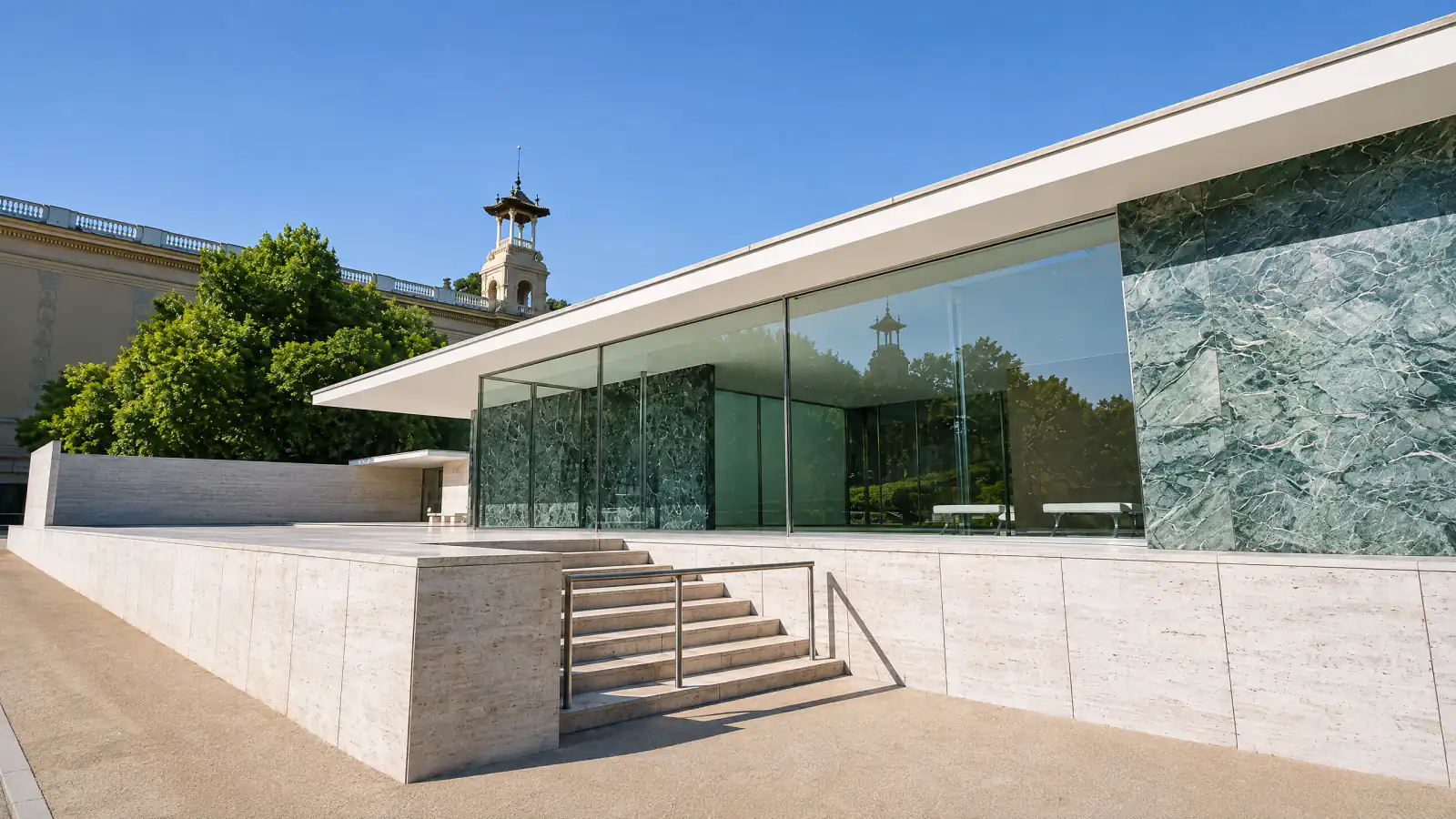
From the avenue, the Barcelona Pavilion looks like a flat roof laid across a handful of stone walls. A few shallow steps bring you onto the travertine platform and alongside the main reflecting pool. From its far corner you can see the building and its reflection together. Closer to the roof, transparent and dark glass make it harder to read where the edges of the rooms actually are. This is how Ludwig Mies van der Rohe and Lilly Reich greeted visitors to the German pavilion at Barcelona’s 1929 International Exposition. It was a setting for an official reception, and its design makes crossing the building the main event.
Golden onyx and the Barcelona chairs
Under the roof, the stone changes from pale Roman travertine to green marble and a single freestanding panel of golden onyx. The pattern across the onyx opens out around the joins, where slabs cut from the same stone face each other. Look from the edge of the carpet and you can see the amber wall alongside the leather and curved metal frames of the Barcelona chairs. Mies and Reich designed the chairs for this space. Reich’s background in textiles and exhibition design is a good way into the arrangement of surfaces, screens and furniture here. The polished steel columns pick up fragments of whatever stands around them, even as they carry the roof.
Dawn and the smaller pool
The smaller pool is tucked beyond the glass. Georg Kolbe’s bronze figure Dawn stands against veined green stone with both arms raised. The sculpture can be seen from the covered room through the glazing and again from the open side of the pool. From those two positions, its reflection lands in different surfaces. This end of the Pavilion makes the relationship between the sculpture and its setting particularly easy to see.
The 1986 reconstruction
The original pavilion was dismantled in 1930. The building open today was reconstructed on the same site in 1986 by Ignasi de Solà-Morales, Cristian Cirici and Fernando Ramos. The reconstruction used stones of the same type and provenance as the original. The included audio guide covers the design and reconstruction, and the specialist bookshop carries architecture and design titles.
Across the avenue to Casaramona
Across the avenue, CaixaForum occupies a brick textile mill that was already standing when the 1929 fair opened. The two stops sit side by side on the lower slope of Montjuïc. The Pavilion is the shorter visit, and the Casaramona factory adds a longer look at a building that has changed uses several times. Further uphill, Poble Espanyol shows a third approach to architecture commissioned for the same exposition.
04 / Before you go
Plan your visit
Admission
- Standard adult admission
- €9 per person
- Eligible students and reduced categories
- €5 per person
Opening hours
March–October 10:00–20:00. November–February 10:00–18:00. Last entry 15 minutes before closing. Closed 25 December. Special event hours may apply.
See opening hoursGetting there
Avinguda de Francesc Ferrer i Guàrdia, 7, 08038 Barcelona
Take metro L1 or L3 or FGC to Espanya. Walk toward the fountains along Avinguda de la Reina Maria Cristina, then turn right onto Avinguda de Francesc Ferrer i Guàrdia. The Pavilion is at No. 7, opposite CaixaForum. Buses 13 and 150 stop at Ferrer i Guàrdia–Mèxic.
Tickets and entry
Ordinary admission is available online or at the entrance and includes an audio guide in English and five other languages. Tiqets lists changes or cancellation up to 12 hours before the visit on its standard ticket.
From 12 to 22 November 2026, entry is by advance timed ticket for Pavelló-Laberint. Confirm your slot before setting out, as wind damage interrupted visits after opening. The Pavilion is scheduled to close 23–27 November for dismantling.
The Pavilion is wheelchair accessible. Admission can change on dates when the foundation runs special events.
Location & nearby places
Continue exploring
More architecture on Montjuïc
Nearby visits
Good to know
Barcelona Pavilion: frequently asked questions
When was the Barcelona Pavilion on Montjuïc rebuilt?
The Barcelona Pavilion on Montjuïc is a 1986 reconstruction on the original site. The pavilion built for the 1929 International Exposition was dismantled in 1930.
How much time do I need to visit the Barcelona Pavilion on Montjuïc?
Allow 30–45 minutes for the Barcelona Pavilion’s pools, covered rooms and included audio guide. Allow extra time for its architecture bookshop when it is open.