Harlem
Black art, music, historic streets and neighbourhood food across Upper Manhattan.
01 / The experience
Art, music and the streets between.
Black art, music, historic streets and neighbourhood food across Upper Manhattan.
Art and performance.
Harlem’s cultural life extends well beyond one famous marquee. The Studio Museum brings artists of African descent into a building made for looking, learning and working; the Schomburg Center preserves the books, images and recordings behind generations of Black thought. Apollo’s performances and history add another kind of encounter. These institutions belong to a neighbourhood of homes, shops and restaurants, with the ordinary life of the streets running between them.
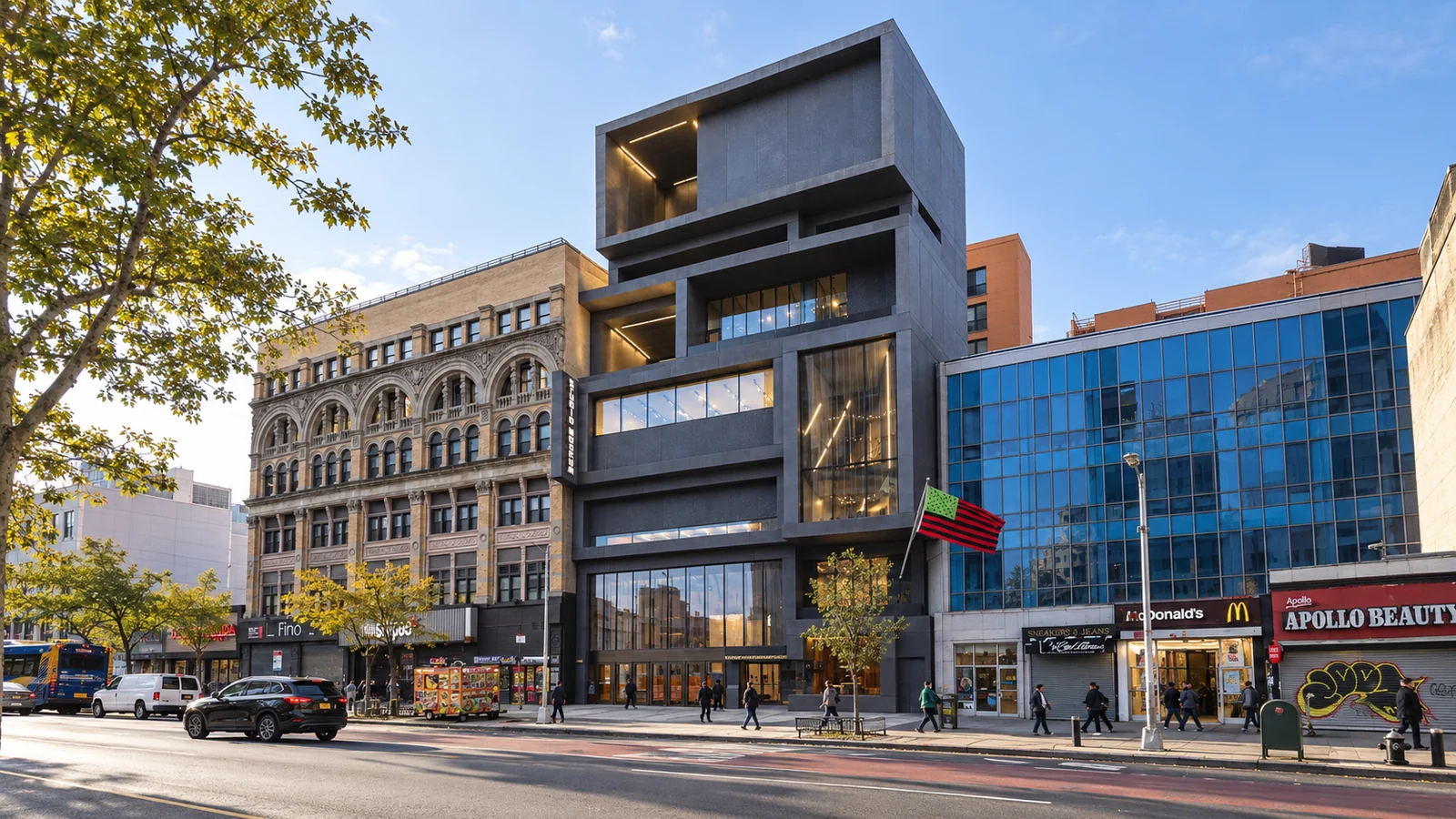
West 125th Street is a useful place to begin. The new Studio Museum’s dark, stacked volumes stand out among the commercial frontages, while its stepped public interior draws the street into the building. Farther west, the Apollo sign and the restored Victoria frontage connect Harlem’s entertainment history to its current stages. The historic Apollo auditorium is undergoing renovation, so the available tour, exhibition and Victoria performances determine what an indoor visit involves.
The Schomburg Center lies farther north, at Malcolm X Boulevard and West 135th Street. Its free exhibitions offer an introduction to the collection without requiring a research appointment. In the Langston Hughes Lobby, the Rivers cosmogram places poetry and memory under visitors’ feet. The research divisions have their own arrangements; the centre’s reading rooms are working scholarly spaces rather than an unrestricted sightseeing route.
Streets and a country house.
Harlem’s residential architecture deserves its own attention. Astor Row’s houses on West 130th Street have wooden porches and front gardens, an unusual relationship to a Manhattan pavement. Strivers’ Row, on West 138th and 139th streets, presents another ensemble of late nineteenth-century houses. These remain private homes. The public streets provide the view; gates, stoops and shared rear passages are not an invitation to enter.
Hamilton Grange takes the story north into Hamilton Heights. Alexander Hamilton’s country house now stands in St Nicholas Park, with a small historic floor reached on a guided tour. Its verandas and furnished rooms show a different period from the Harlem Renaissance institutions around 125th Street. The distances are substantial enough that this northern visit can be reached by subway or bus instead of being folded into an obligatory continuous walk.
Food and places to stay.
Food supplies several distinct reasons to stop. Sylvia’s remains the established soul-food restaurant in the guide. Red Rooster adds an art-filled dining room and a live-music programme, with performance charges and reservations to consider alongside dinner. FIELDTRIP puts different rice varieties at the heart of its bowls. VeganHood serves plant-based versions of soul-food and Caribbean dishes, while Levain’s Harlem bakery offers bread, pastries and its large cookies. The range supports a quick lunch, a sweet purchase or an evening table without making every restaurant part of the same meal.
Aloft Harlem and Renaissance New York Harlem provide two different hotel settings near the 125th Street cultural corridor. Aloft has a recessed courtyard arrival, contemporary bedrooms and a social lobby; Renaissance combines the Victoria complex’s historic street presence with a taller hotel and restaurant above. HI New York City adds shared dormitories and private rooms for a different budget, but it is on Amsterdam Avenue at West 103rd Street, outside Harlem on the Upper West Side.
The subway approach depends on which part of the neighbourhood comes first. The A, B, C and D station at 125th Street serves the western cultural corridor; the 2 and 3 station serves Malcolm X Boulevard. Those are different stations. The city’s existing transport map and MTA journey planner provide the onward connections, including a shorter ride between the southern food stops and Hamilton Heights.
In pictures
Harlem’s cultural corridor.
In pictures
Around the neighbourhood.
In pictures
Food and places to stay.
04 / Before you go
Plan your visit
Admission
Free to explore
Walking streets is free. Museums, food, accommodation and performances have their own charges.
Opening
Public streets are accessible daily; museums, houses and performances have separate opening schedules.
Arrival
144 West 125th Street, New York, NY 10027
The map starts at the Studio Museum on West 125th Street. Use the western 125th Street A/B/C/D station or the separate Lenox Avenue 2/3 station according to your first stop.
Tickets & visits
Explore the public streets freely; arrange museum tickets, house tours and performances with the named venue.
Accessibility
The route covers several subway stops. The 125th Street A/B/C/D station has lifts; the 2/3 station is a different station without lift access. Private stoops and rear alleys are not public routes.
Location & nearby places
Continue exploring
More of New York.
Explore Harlem
06 / Good to know
Harlem: frequently asked questions
01How do I arrange this visit?
Explore the public streets freely; arrange museum tickets, house tours and performances with the named venue.
02What access arrangements matter?
The route covers several subway stops. The 125th Street A/B/C/D station has lifts; the 2/3 station is a different station without lift access. Private stoops and rear alleys are not public routes.