Schomburg Center
Free Black-history exhibitions, the Rivers cosmogram and a major working research library.
01 / The experience
Books, memory and the Rivers floor.
Free Black-history exhibitions, the Rivers cosmogram and a major working research library.
The Schomburg Center’s Langston Hughes Lobby contains one of Harlem’s most meaningful public artworks. Rivers, a terrazzo cosmogram created by Houston Conwill with Estella Conwill Majozo and Joseph De Pace, spreads across the floor in blue lines and a circular field. It connects the waterways in Hughes’s poetry with Black history and remembrance. The poet’s ashes lie beneath the installation.
The institution around it grew from a library collection into a major centre for research in Black culture. Arturo Schomburg, an Afro-Puerto Rican historian and collector, assembled books, manuscripts and other evidence of the achievements of people of African descent. His collection entered the New York Public Library in 1926, forming a foundation for holdings that now reach across literature, art, photographs, moving images and recorded sound.
An ordinary visitor can begin with the free exhibitions. The material might be a letter, a printed book, a photograph or a work of art; the strength of the displays is the connection between an individual object and the larger life around it. Exhibitions change, so a particular document or centenary display should not be treated as a permanent room. The Schomburg’s collections include Aaron Douglas’s Aspects of Negro Life murals, another important connection to the Harlem Renaissance, with display arrangements determined by the programme.
The centre is also a place of live conversation. Author events, talks, screenings and other public programmes give the collections a contemporary audience. Some events require registration even when admission is free. The shop offers books and cultural items, providing a smaller way into the range of writing represented here.
Research access is a different visit from browsing an exhibition. Readers who need archival material use the relevant division’s appointment and request procedures; a public exhibition visit does not open every reading room or storage area. That distinction protects time for both a casual visitor and someone making a specific scholarly journey.
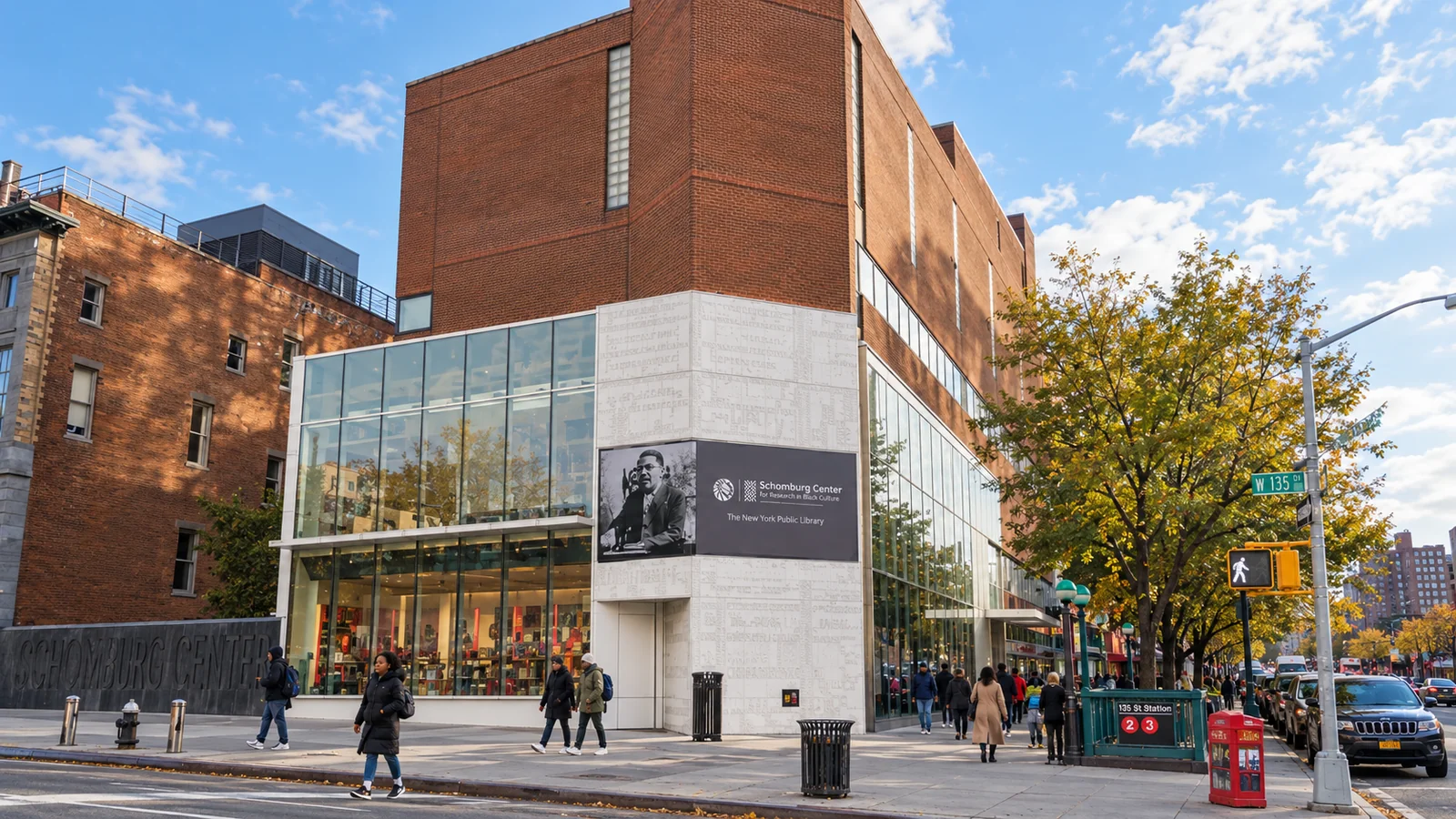
The building stands at Malcolm X Boulevard and West 135th Street, north of the busiest section of the 125th Street cultural corridor. Its combination of free displays, the Rivers floor and a working research mission makes it a substantial destination in its own right. Public hours and access to individual spaces follow the library’s calendar; telephone enquiries are the practical route for a visit dependent on a specific room or exhibition.
In pictures
Arrival and collections
In pictures
Music and performance
In pictures
Reading and exhibitions
04 / Before you go
Plan your visit
Admission
Free exhibitions
Exhibition entry is free; register separately for any named public programme.
Display selections rotate; the gallery images include a collection display, not a guarantee that every pictured work is currently on view.
Opening
Public exhibitions follow the library calendar; research divisions and events have separate schedules. Call for the day’s exhibition hours.
Arrival
515 Malcolm X Boulevard, New York, NY 10037
Use the main Schomburg entrance at Malcolm X Boulevard and West 135th Street; the nearby 135th Street 2/3 station is separate from the western B/C station.
Tickets & visits
Public exhibitions are free. Individual events may require registration. Archival research follows division-specific appointment and material-request procedures.
Accessibility
Ask the centre about the step-free entrance and access to the specific exhibition, lobby or research room. A general exhibition visit does not include access to every division.
Location & nearby places
06 / Good to know
Schomburg Center: frequently asked questions
01How do I arrange this visit?
Public exhibitions are free. Individual events may require registration. Archival research follows division-specific appointment and material-request procedures.
02What access arrangements matter?
Ask the centre about the step-free entrance and access to the specific exhibition, lobby or research room. A general exhibition visit does not include access to every division.