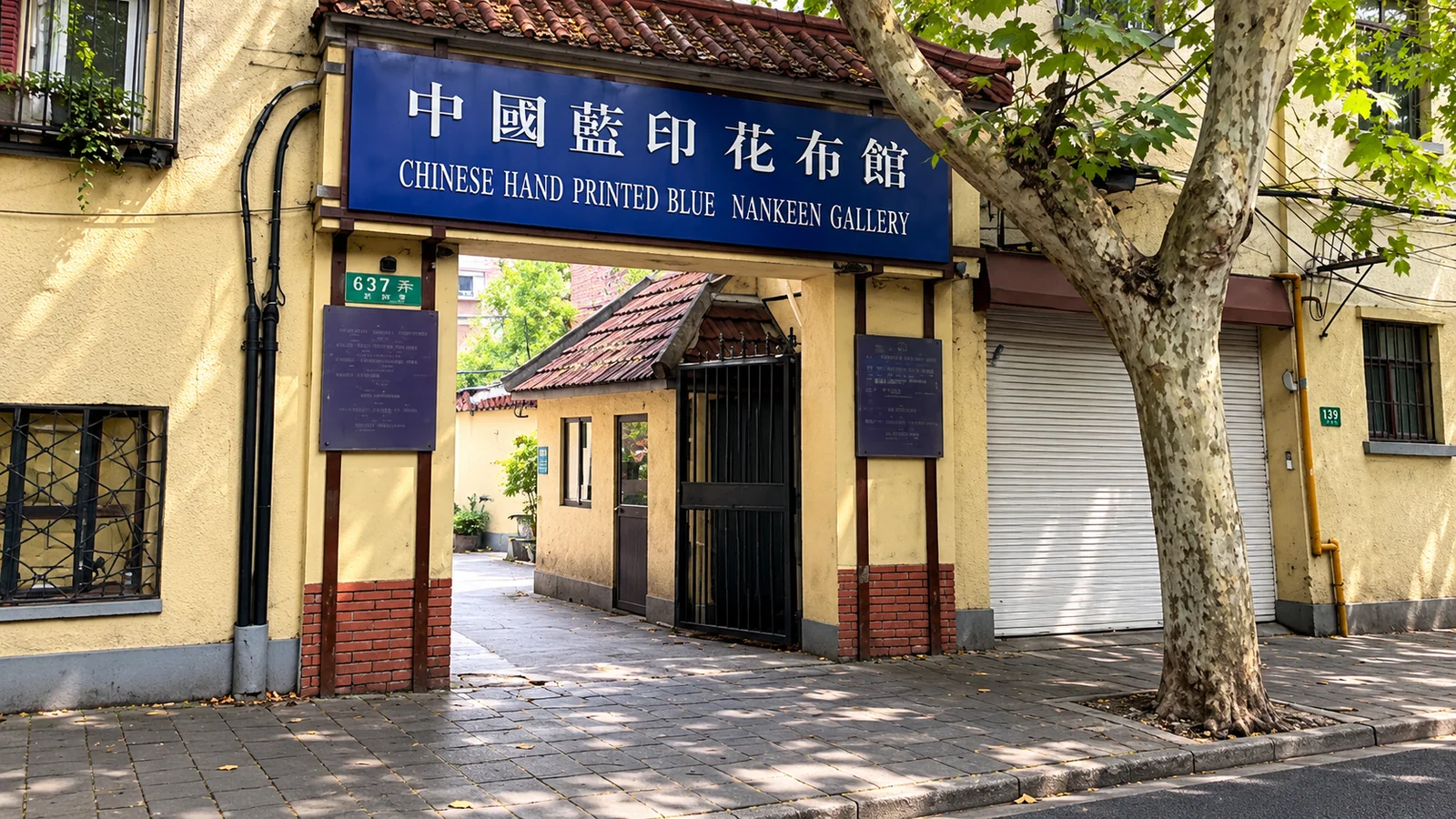
Chinese Hand Printed Blue Nankeen Gallery
Follow Changle Road’s blue sign to handmade indigo textiles, printing tools and a small upstairs gallery.
01 / The experience
Chinese Hand Printed Blue Nankeen Gallery
A blue sign above a passage on Changle Road points towards a craft that once belonged to everyday homes across Jiangnan. Blue nankeen is cotton patterned through a resist-printing and indigo-dyeing process: the pale flowers, birds and geometric forms are part of the making, rather than decoration added to a finished blue cloth. The gallery makes a useful connection between a textile you can buy and the work required to produce it.
The ground floor sells handmade pieces ranging from clothing and accessories to household textiles. Upstairs, looms, spinning wheels and printing and dyeing tools give the finished patterns a different meaning. A tablecloth or length of fabric can be a more revealing souvenir when you have seen the tools behind it. The collection grew from the work of Japanese collector Kubo Masa and Shanghai collaborators, adding a cross-cultural story to an apparently modest lane address.
The cloth begins with a stencil. A resist paste protects the parts intended to stay pale, the fabric takes the indigo dye, and the paste is removed to reveal the pattern. Carving the stencil and applying that paste are skilled stages in their own right. Birds, flowers and auspicious motifs connect the finished textile to the households that used it for bedding, curtains and clothing. This is everyday decorative art, with a history that reaches far beyond a souvenir shop.
Kubo Masa collected old blue cloth and patterns across several Chinese provinces before helping establish the Changle Road museum with Shanghai partners. That collecting story explains why tools and older textiles belong beside contemporary pieces for sale. The lane approach is part of the character: the blue sign leads through the passage to a small, purpose-specific place, not a broad shopping arcade. A length of cloth, a bag and a household textile make different purchases; the making and pattern are the useful points of comparison.
This is a focused textile-gallery visit rather than a large museum day. It fits with an outing around Changle Road, particularly if traditional materials interest you more than another major monument. A dyeing class is a separate proposition: the exhibition and shop do not establish a drop-in workshop.
Highlights
- 01
Ask about gallery admission
- 02
Usually listed as 09:30–17:30; gallery access and shop arrangements may differ.
04 / Before you go
Plan your visit
Admission & cost
Ask about gallery admission
Ask the gallery for current admission terms. Textiles and other purchases are separate; a practical dyeing class is not included.
When to visit
Usually listed as 09:30–17:30; gallery access and shop arrangements may differ.
Allow an estimated 45–75 minutes.
Use a free city afternoon rather than combining this with a timed circuit departure.
Arrival & access
Enter Lane 637 from Changle Road and follow the blue gallery sign to No. 24. This is inside a lane, not a large freestanding street-front museum.
No. 24, Lane 637 Changle Road · 长乐路637弄24号
Plan your visit
Ask staff about upstairs access. Arrange any practical dyeing activity and its teaching language directly with the gallery before visiting.
Location & nearby places
Continue exploring / Shanghai
More to explore
in Shanghai
Find another place for your itinerary, or explore all things to do in Shanghai.
 Spas & wellnessDragonfly — Xinle RetreatExplore experience →
 Temples & spiritual heritageJing’an TempleExplore experience →
 Museums & Chinese cultureShanghai Museum of Arts and CraftsExplore experience →
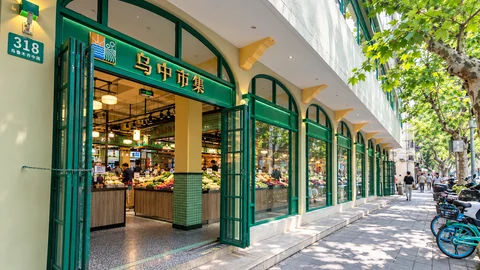 Local food & marketsWuzhong Market — Wulumuqi Middle RoadExplore experience →
Good to know
Chinese Hand Printed Blue Nankeen Gallery: frequently asked questions
Is the Chinese Hand Printed Blue Nankeen Gallery a dyeing workshop?
The regular offer at the Chinese Hand Printed Blue Nankeen Gallery is a gallery and shop. A hands-on activity requires its own arrangement.
What can I see at the Chinese Hand Printed Blue Nankeen Gallery besides the shop?
The Chinese Hand Printed Blue Nankeen Gallery’s upstairs collection includes looms, spinning wheels and traditional printing and dyeing tools.
Where is the entrance to the Chinese Hand Printed Blue Nankeen Gallery?
For the Chinese Hand Printed Blue Nankeen Gallery, start at the sign on Changle Road and continue into Lane 637 to No. 24.