Poblenou Cemetery
Walk the niche courts and carved pantheons of Barcelona’s first cemetery outside the walls, with the Kiss of Death and El Santet along the way.
01 / The experience
Poblenou Cemetery
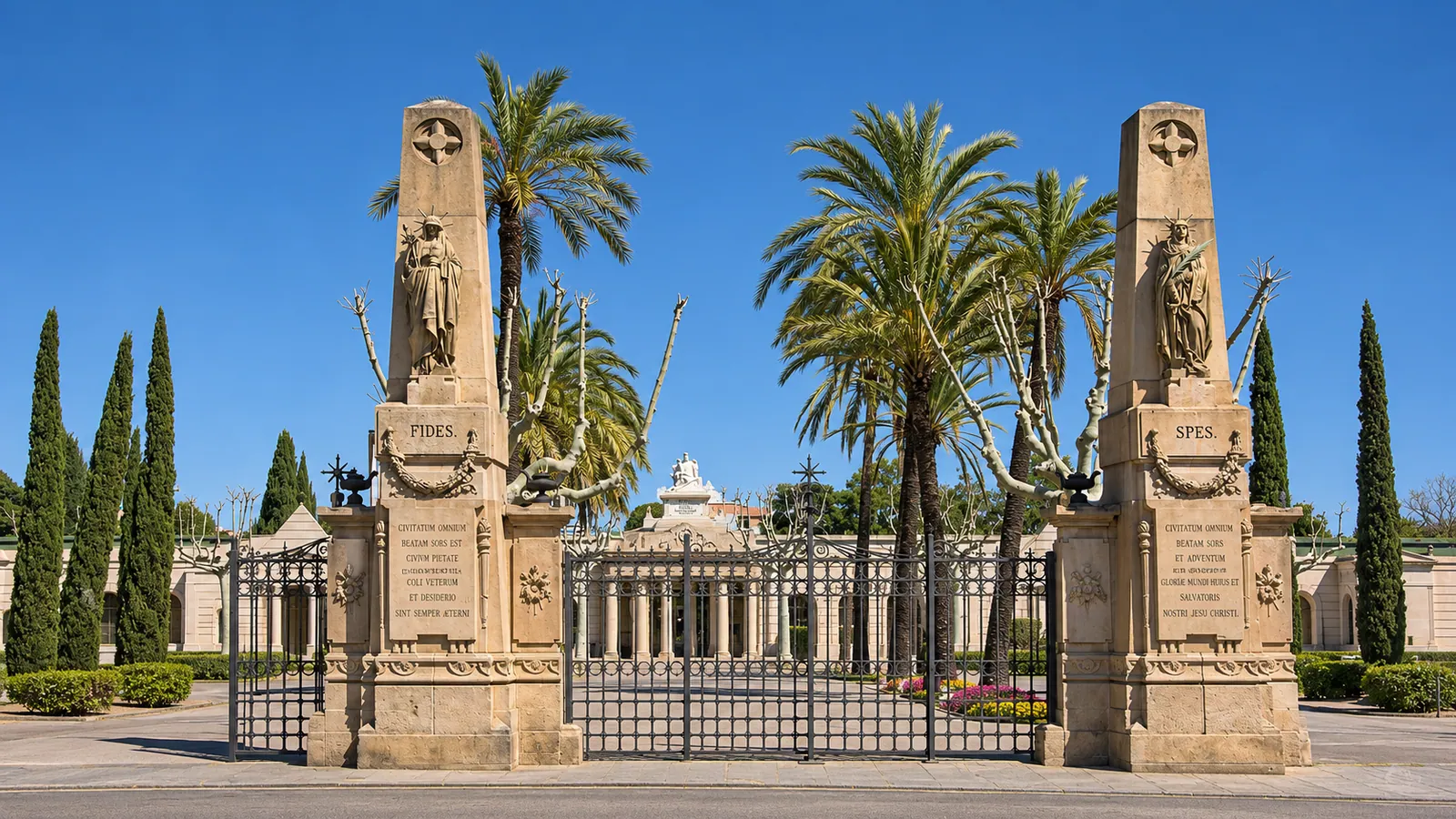
Beyond the iron gates on Avinguda d’Icària, the layout of Poblenou Cemetery tells two different stories about Barcelona. There was a cemetery on this site outside the city walls in 1775. The cemetery seen today opened in 1819, with a design by the Italian architect Antoni Ginesi. In its early courts, the burial niches rise in regular rows around shared lanes. Farther in, the larger family pantheons stand apart as small buildings, with carved portals, steps and iron railings.
From niche courts to family pantheons
The later monuments show what Barcelona’s industrial families and civic institutions wanted to preserve about themselves in stone. A walk from the repeated arches of the niche courts to the showier family monuments makes the change visible. Some tombs use Gothic forms, while others set a single figure above the roofline. At pantheon 65 in Section 2, a bust of Josep Anselm Clavé stands inside a railing designed by Lluís Domènech i Montaner, the architect of Palau de la Música Catalana. Clavé’s choral societies brought singing into working-class public life.
The Kiss of Death and El Santet
The best-known sculpture is El Petó de la Mort, the Kiss of Death, at tomb 63 in Section 3. A winged skeleton leans towards a young man in a marble group above the tomb. It stands against the surrounding niche walls, which give the sculpture its scale. The everyday side of the cemetery is visible at the flower-filled niche of Francesc Canals, known as El Santet, at niche 138 in Section 1, interior block 4. Visitors leave notes and flowers there. The two stops show how differently people use and remember the same place.
Walking the marked heritage route
The cemetery remains in use. Give people visiting graves and attending services space, and keep voices low on the narrower paths. The operator’s marked daytime route covers 30 graves, taking in figures and monuments from the period between the original cemetery and Barcelona’s 1888 Universal Exposition. The two-hour guided version is offered on selected Sundays in Catalan or Spanish.
04 / Before you go
Plan your visit
Admission
- Independent visit
- Free
- Daytime guided route
- €10 per person plus booking fee
- Guided route for children under six
- Free. Notify the organiser.
Opening hours
Daily 08:00–18:00, including public holidays. Guided visits take place on selected Sundays at 10:30.
See official visitor informationArrival and entrance
Main gate, Avinguda d’Icària, 204, 08005 Barcelona
Take metro L4 to Llacuna and use the Ciutat de Granada exit. Walk towards the coast on Carrer de la Ciutat de Granada, then follow Avinguda d’Icària to the main gate at No. 204. For a guided visit, use the same address and arrive five minutes early with your printed booking confirmation.
Free entry and guided tours
The cemetery grounds are free for independent visits. The separately ticketed daytime tour takes two hours and is in Catalan or Spanish, with the language shown for each date.
Guided tickets are €10 plus the booking fee. Children under six go free. Notify the organiser if bringing an under-six. The booking seller’s terms exclude changes and refunds.
Access and facilities
The main paths run between the burial courts. Individual monuments can have steps and narrow approaches. Ask Cementiris de Barcelona for access information if you need a step-free route.
Location & nearby places
Continue exploring / Barcelona
More to explore
in Barcelona
Find another place for your itinerary, or explore all things to do in Barcelona.
 Museums Art And ArchitectureCan FramisExplore experience →
 Landmarks And GardensTorre de les Aigües del BesòsExplore experience →
 Neighbourhoods & districtsPoblenouExplore experience →
 Barcelona beachesBogatell BeachExplore experience →
Good to know
Poblenou Cemetery: frequently asked questions
Is Poblenou Cemetery free to enter?
Independent entry to Poblenou Cemetery is free. The optional two-hour daytime guided route costs €10 per person plus a booking fee.
What are Poblenou Cemetery’s opening hours?
Poblenou Cemetery opens daily from 08:00 to 18:00, including public holidays. The ticketed daytime tours start at 10:30 on selected Sundays.
Which languages are offered on the Poblenou Cemetery guided tour?
The Poblenou Cemetery daytime guided tour is in Catalan or Spanish. The municipal calendar and booking page identify the language for each session.
Where is the main entrance to Poblenou Cemetery?
The main gate to Poblenou Cemetery is at Avinguda d’Icària, 204. Take metro L4 to Llacuna and use the Ciutat de Granada exit for the approach on foot.
What is the Kiss of Death sculpture at Poblenou Cemetery?
The Kiss of Death, or El Petó de la Mort, at Poblenou Cemetery is a marble tomb sculpture in which a winged skeleton bends to kiss a young man.